


 Скачать презентацию Chapter 8 The Management Information Systems Organization Managing
3c6e344fe108f40ca11687e9d3a5057d.ppt
- Количество слайдов: 24
 Chapter 8. The Management Information Systems Organization Managing and Using Information Systems: A Strategic Approach by Keri Pearlson Power. Point Slides prepared by Gene Mesher Copyright © 2001 John Wiley & Sons, Inc. 1
 Copyright ã 2001 John Wiley & Sons, Inc. All rights reserved. Reproduction or translation of this work beyond that named in Section 117 of the United States Copyright Act without the express written consent of the copyright owner is unlawful. Requests for further information should be addressed to the Permissions Department, John Wiley & Sons, Inc. Adopters of the textbook are granted permission to make back-up copies for their own use only, to make copies for distribution to students of the course the textbook is used in, and to modify this material to best suit their instructional needs. Under no circumstances can copies be made for resale. The Publisher assumes no responsibility for errors, omissions, or damages, caused by the use of these programs or from the use of the information contained herein. 2
 UNDERSTANDING THE MIS ORGANIZATION 3
 Chief Information Officer (CIO) z. Gartner group definition: “To provide technology vision and leadership for developing and implementing IT initiatives that create and maintain leadership for the enterprise in a constantly changing and intensely competitive marketplace. ” 4
 11 CIO responsibilities: z Championing the organization z Architecture management z Business strategy consultant z Business technology planning z Applications development z IT infrastructure management z Sourcing z Partnership developer z Technology transfer agent z Customer satisfaction management z Training 5
 9 essential CIO skills: z Strong business orientation z Ability to realize benefits & manage costs and risks associated with IT z Ability to bridge gaps between available technologies and business needs z Familiarity with client’s needs z Strong organizational skills z Ability to conceive and build multiple IT projects z Ability to articulate and advocate for a mgmt IT vision z Ability to mesh with existing mgmt structure z Strategic enterprise vision extending beyond IT 6
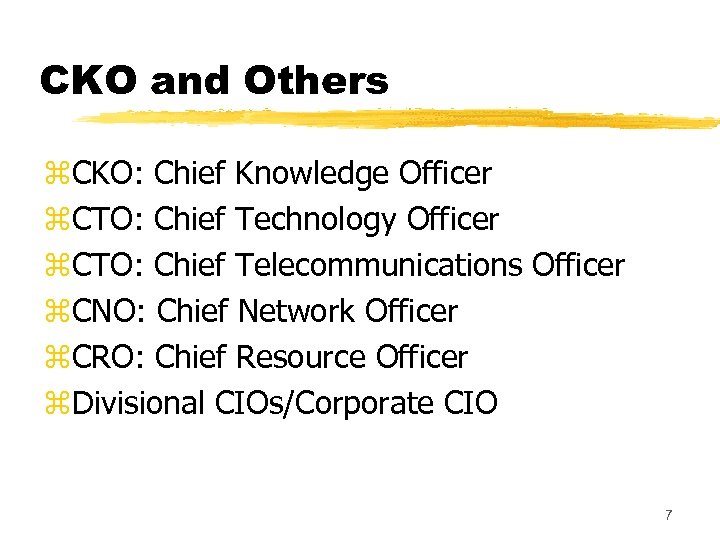 CKO and Others z. CKO: Chief Knowledge Officer z. CTO: Chief Technology Officer z. CTO: Chief Telecommunications Officer z. CNO: Chief Network Officer z. CRO: Chief Resource Officer z. Divisional CIOs/Corporate CIO 7
 Other Information Systems Organizational Roles z IS Managers z Systems Developers z Business Analysts z Database Administrators z Operations Personnel z Support Personnel z Developers z Webmaster, Web Designer, Web Developer, etc. 8
 Figure 8. 2 Sample IS Organizational Chart CIO CTO CKO GM CNO IS Managers System Devs. Bus. Analysts DB Admins. Support Other Personnel 9
 INFORMATION SYSTEMS ORGANIZATION PROCESSES 10
 IS Organization Processes z Systems Development z Systems Maintenance z Data Center Operations z Internet and Networking Services z New Technology Introduction z Special Projects z Resource Management z General Support 11
 WHAT TO EXPECT FROM INFORMATION SYSTEMS 12
 What to Expect from IS z. Anticipating New technologies z. Strategic Direction z. Process Innovation z. Internal Partnerships z. Supplier Management z. Architecture and Standards z. Human Resource Management 13
 WHAT THE INFORMATION SYSTEMS ORGANIZATION DOES NOT DO 14
 What IS doesn’t do… z. Still a need for mgmt to partner with IS to make sure business goals and needs are met. z. General managers generally set the business strategy, not IS professionals. 15
 OUTSOURCING AND DECENTRALIZATION 16
 Outsourcing z Means of cost control: e. g. , maintenance z Classic model: only outsource functions that don’t give a competitive advantage z Later (90 s): sometime outsourcing even CA functions is a good idea if done by outside experts (but this is risky). z Now, “selective outsourcing”: choose which IT capabilities to retain in-house and which to outsource. 17
 Factors driving outsourcing z Cost savings z Highly qualified IT staff are difficult to find and retain z By bringing in outside expertise, management needs to focus less on IS operations and more on the information itself. z Outsourcers are specialists, should understand how to manage IS staff more effectively. z Outsourcers may have larger IS resources that provide greater capacity on demand. 18
 Disadvantages of outsourcing z. Abdication of control z. High switching costs z. Lack of technological innovation z. Loss of ownership 19
 Figure 8. 6 Steps to avoid pitfalls z Don’t focus solely on price z Use life-cycle svc. contracts that occur in stages z Establish short-term supplier contracts z Use multiple, best of breed suppliers z Develop skills in contract management z Thoroughly evaluate outsourcers capabilities z Choose an outsourcer whose capabilities complement yours. z Base choice on a cultural fit as well as expertise z Determine if outsourcing relationship produces a net benefit for your company 20
 Centralized vs. Decentralized Organizational Structures z Centralized: resources under one control and, often, in one location. z Decentralized: resources not in the same location or control. z “Federalism” combines centralization with decentralization. z E. g. , Bethlehem Steel allow major business units (plants) to decentralize and operate independently. z E. g. , Levi-Strauss centralized to minimize the duplication of resources and save on costs. 21
 FOOD FOR THOUGHT: CALCULATING RETURN ON INVESTMENT 22
 ROI Valuation Methods z. ROI Analysis (easy to use, but doesn’t assess intangible costs and benefits) z. NPV (accounts for time value of money) z. EVA (considers opportunity costs): net operating profit after taxes 23
 End of Chapter 8 24