


 Скачать презентацию Chapter 8 The Courtroom Work Group and the
8375628413477105c577e58f22a3b473.ppt
- Количество слайдов: 45
 Chapter 8 The Courtroom Work Group and the Criminal Trial CRIMINAL JUSTICE A Brief Introduction, 6/E by Frank Schmalleger © 2006 Pearson Education, Inc. Pearson Prentice Hall Upper Saddle River, NJ 07458
 Learning Objectives • Discuss the courtroom work group and its professional members • Discuss indigent defense • Identify and explain the roles of nonprofessional courtroom participants • Explain how professional participants work together CRIMINAL JUSTICE A Brief Introduction, 6/E by Frank Schmalleger © 2006 Pearson Education, Inc. Pearson Prentice Hall Upper Saddle River, NJ 07458
 Learning Objectives • Explain the roles of expert and lay witnesses in a criminal trial • Describe the stages in a criminal trial • Explain the hearsay rule • Explain the possible benefits of a professional jury system CRIMINAL JUSTICE A Brief Introduction, 6/E by Frank Schmalleger © 2006 Pearson Education, Inc. Pearson Prentice Hall Upper Saddle River, NJ 07458
 The Courtroom Work Group • Courtroom work group refers to: The professional courtroom actors, including judges, prosecuting attorneys, defense attorneys, public defenders, and others who earn a living serving the court. • It involves a recognition of informal rules of civility, cooperation, and shared goals. – Web Extra 8 -2 • Scott Peterson case – Web Extra 8 -1 – Library Extra 8 -1 • Hear author discuss the chapter. CRIMINAL JUSTICE A Brief Introduction, 6/E by Frank Schmalleger © 2006 Pearson Education, Inc. Pearson Prentice Hall Upper Saddle River, NJ 07458
 The Judge • The judge is: An elected or appointed public official who presides over a court of law and who is authorized to hear and sometimes to decide cases and to conduct trials. • The role of the judge is: – To rule on matters of law. – To decide guilt or innocence in bench trials. – To manage the court. CRIMINAL JUSTICE A Brief Introduction, 6/E by Frank Schmalleger © 2006 Pearson Education, Inc. Pearson Prentice Hall Upper Saddle River, NJ 07458
 Judicial Selection • Judges at the federal level are nominated by the president and confirmed by the Senate. • Judges at the state level are selected by: – Election. – Appointment. – Missouri plan. CRIMINAL JUSTICE A Brief Introduction, 6/E by Frank Schmalleger © 2006 Pearson Education, Inc. Pearson Prentice Hall Upper Saddle River, NJ 07458
 Judicial Qualifications • General jurisdiction and appellate court judges: – Hold a law degree. – Are licensed attorneys. – Are members of their state bar association. • Limited jurisdiction judges: – May be elected. – May not have any legal training. • Web Extra 8 -3 CRIMINAL JUSTICE A Brief Introduction, 6/E by Frank Schmalleger © 2006 Pearson Education, Inc. Pearson Prentice Hall Upper Saddle River, NJ 07458
 The Prosecuting Attorney • The prosecutor is: An attorney whose official duty is to conduct criminal proceedings on behalf of the state or the people against those accused of having committed criminal offenses. • The role of the prosecutor is: – To represent the people. – To act as quasi-legal advisor of local police. – To demonstrate guilt beyond a reasonable doubt. CRIMINAL JUSTICE A Brief Introduction, 6/E by Frank Schmalleger © 2006 Pearson Education, Inc. Pearson Prentice Hall Upper Saddle River, NJ 07458
 Prosecutorial Discretion • Prosecutorial discretion refers to: The decision-making power of prosecutors, based on the wide range of choices available to them, in the handling of criminal defendants, the scheduling of cases for trial, the acceptance of negotiated pleas, and so on. • The most important form of prosecutorial discretion lies in the power to charge a person with an offense. CRIMINAL JUSTICE A Brief Introduction, 6/E by Frank Schmalleger © 2006 Pearson Education, Inc. Pearson Prentice Hall Upper Saddle River, NJ 07458
 The Abuse of Discretion • The high level of discretion allows for the potential for abuse. – Personal considerations – Overzealous prosecution – Administrative decisions – To harass defendants into pleading guilty – Discriminate against minorities CRIMINAL JUSTICE A Brief Introduction, 6/E by Frank Schmalleger © 2006 Pearson Education, Inc. Pearson Prentice Hall Upper Saddle River, NJ 07458
 The Prosecutor’s Professional Responsibility • American Bar Association (ABA) Code of Professional Responsibility – “The duty of the prosecutor is to seek justice, not merely to convict. ” • Web Extra 8 -4 CRIMINAL JUSTICE A Brief Introduction, 6/E by Frank Schmalleger © 2006 Pearson Education, Inc. Pearson Prentice Hall Upper Saddle River, NJ 07458
 The Defense Counsel • The defense counsel is: A licensed trial lawyer, hired or appointed to conduct the legal defense of a person accused of a crime and to represent him or her before a court of law. • The role of the defense counsel is: – To represent the accused. – To ensure that the defendant’s rights are not violated. – To file appeals. CRIMINAL JUSTICE A Brief Introduction, 6/E by Frank Schmalleger © 2006 Pearson Education, Inc. Pearson Prentice Hall Upper Saddle River, NJ 07458
 The Criminal Lawyer • Three major categories of defense attorneys assist criminal defendants. – Private attorneys, usually referred to as criminal lawyers or retained counsel – Court-appointed counsel – Public defenders • Web Extras 8 -5 and 8 -6 CRIMINAL JUSTICE A Brief Introduction, 6/E by Frank Schmalleger © 2006 Pearson Education, Inc. Pearson Prentice Hall Upper Saddle River, NJ 07458
 Criminal Defense of the Poor • The Sixth Amendment guarantees the right to an attorney. – Powell v. Alabama (1932) • State right to an attorney in capital cases – Gideon v. Wainwright (1963) • State right to an attorney in all felony cases – Argersinger v. Hamlin (1972) • Right to an attorney when faced with potential imprisonment – In re Gault (1967) • Right to an attorney given to juveniles CRIMINAL JUSTICE A Brief Introduction, 6/E by Frank Schmalleger © 2006 Pearson Education, Inc. Pearson Prentice Hall Upper Saddle River, NJ 07458
 Criminal Defense of the Poor • Three systems for indigent defense: – Court-appointed counsel – Public defenders – Contract counsel • Web Extra 8 -7 • Library Extras 8 -2, 8 -3, and 8 -4 CRIMINAL JUSTICE A Brief Introduction, 6/E by Frank Schmalleger © 2006 Pearson Education, Inc. Pearson Prentice Hall Upper Saddle River, NJ 07458
 The Ethics of Defense • Temptation at unethical behavior: – The nature of the adversarial process – The emotions of the participants – The privileged and extensive knowledge about their cases CRIMINAL JUSTICE A Brief Introduction, 6/E by Frank Schmalleger © 2006 Pearson Education, Inc. Pearson Prentice Hall Upper Saddle River, NJ 07458
 The Ethics of Defense • Four main groups of standards – Canons of Professional Ethics – Model Code of Professional Responsibility – Model Rules of Professional Conduct – Standards for Criminal Justice • Web Extra 8 -8 CRIMINAL JUSTICE A Brief Introduction, 6/E by Frank Schmalleger © 2006 Pearson Education, Inc. Pearson Prentice Hall Upper Saddle River, NJ 07458
 American Bar Association Code of Professional Responsibility • In representing a client, a lawyer shall not: – Knowingly harass or injury another in the client’s defense. – Knowingly make a defense that is unwarranted under the law. – Conceal or fail to disclose that which is required by law to be revealed. – Knowingly use perjured testimony or false evidence. – Knowingly make a false statement of law or fact. – Counsel or assist with illegal or fraudulent conduct. CRIMINAL JUSTICE A Brief Introduction, 6/E by Frank Schmalleger © 2006 Pearson Education, Inc. Pearson Prentice Hall Upper Saddle River, NJ 07458
 The Bailiff • The bailiff is: The court officer whose duties are to keep order in the courtroom and to maintain physical custody of the jury. • The role of the bailiff is: – – – To act as court officer. To ensure order. To call witnesses. To prevent the escape of the accused. To supervise a sequestered jury. CRIMINAL JUSTICE A Brief Introduction, 6/E by Frank Schmalleger © 2006 Pearson Education, Inc. Pearson Prentice Hall Upper Saddle River, NJ 07458
 Local Court Administrators • Court administrators provide uniform court management, assuming many of the duties previously performed by chief judges. – Record keeping – Scheduling and case-flow analysis – Personnel administration – Space utilization and facilities planning – Budget management CRIMINAL JUSTICE A Brief Introduction, 6/E by Frank Schmalleger © 2006 Pearson Education, Inc. Pearson Prentice Hall Upper Saddle River, NJ 07458
 The Court Reporter • The role of the court reporter (court stenographer or court recorder) is to create a record of all that occurs during a trial • Web Extra 8 -9 CRIMINAL JUSTICE A Brief Introduction, 6/E by Frank Schmalleger © 2006 Pearson Education, Inc. Pearson Prentice Hall Upper Saddle River, NJ 07458
 The Clerk of the Court • The clerk maintains all records of criminal cases. – All pleas and motions made – Prepares a jury pool – Issues jury summonses – Subpoenas and swear in witnesses – Marks physical evidence for identification CRIMINAL JUSTICE A Brief Introduction, 6/E by Frank Schmalleger © 2006 Pearson Education, Inc. Pearson Prentice Hall Upper Saddle River, NJ 07458
 The Expert Witness • The expert witness is: A person who has special knowledge and skills recognized by the court as relevant to the determination of guilt or innocence. • Unlike lay witnesses, expert witnesses may express opinions or draw conclusions in their testimony. CRIMINAL JUSTICE A Brief Introduction, 6/E by Frank Schmalleger © 2006 Pearson Education, Inc. Pearson Prentice Hall Upper Saddle River, NJ 07458
 Outsiders: Nonprofessional Courtroom Participants • The lay witness is: An eyewitness, character witness, or other person called on to testify who is not considered an expert. • Lay witnesses must testify to the facts only and must not draw conclusions or express opinions. • A subpoena is: A written order issued by a judicial officer or grand jury requiring an individual to appear in court and give testimony. CRIMINAL JUSTICE A Brief Introduction, 6/E by Frank Schmalleger © 2006 Pearson Education, Inc. Pearson Prentice Hall Upper Saddle River, NJ 07458
 Jurors • A juror is: A member of a trial or grand jury who has been selected for jury duty and is required to serve as an arbiter of the facts in a court. • Jurors are expected to render verdicts of “guilty” or “not guilty” as to the charges. • “Hung jury” is the inability to give a verdict. • Web Extra 8 -10 CRIMINAL JUSTICE A Brief Introduction, 6/E by Frank Schmalleger © 2006 Pearson Education, Inc. Pearson Prentice Hall Upper Saddle River, NJ 07458
 The Victim • Victims are like witnesses. • They experience many hardships. – Uncertainties as to their role – Lack of knowledge regarding the legal system – Trial delays that result in frequent travel, missed work, and wasted time – Fear of retaliation – Trauma of testifying and of cross-examination CRIMINAL JUSTICE A Brief Introduction, 6/E by Frank Schmalleger © 2006 Pearson Education, Inc. Pearson Prentice Hall Upper Saddle River, NJ 07458
 The Defendant • Defendants must be present at their trials. • They must be present at every stage. – If initially present, the defendant may be voluntarily absent. • The majority of criminal defendants are poor, uneducated, and alienated. CRIMINAL JUSTICE A Brief Introduction, 6/E by Frank Schmalleger © 2006 Pearson Education, Inc. Pearson Prentice Hall Upper Saddle River, NJ 07458
 The Defendant • Defendants exercise choice in: – Counsel. – Defense strategy. – Information to divulge. – Whether to testify. – Whether to file an appeal. CRIMINAL JUSTICE A Brief Introduction, 6/E by Frank Schmalleger © 2006 Pearson Education, Inc. Pearson Prentice Hall Upper Saddle River, NJ 07458
 The Press • The Sixth Amendment requires a public trial. • Press reports often create problems, making it hard to find jurors without opinions. • Change of venue refers to: The movement of a trial or lawsuit from one jurisdiction to another to ensure a fair trial. CRIMINAL JUSTICE A Brief Introduction, 6/E by Frank Schmalleger © 2006 Pearson Education, Inc. Pearson Prentice Hall Upper Saddle River, NJ 07458
 The Criminal Trial • Procedures in a modern courtroom are highly formalized. • Rules of evidence refer to: Court rules that govern the admissibility of evidence at criminal hearings and trials. • Based partially on tradition. • Circumscribed by informal rules and professional expectations. CRIMINAL JUSTICE A Brief Introduction, 6/E by Frank Schmalleger © 2006 Pearson Education, Inc. Pearson Prentice Hall Upper Saddle River, NJ 07458
 Nature and Purpose of the Criminal Trial • Adversarial system refers to: The two-sided structure under which American criminal trial courts operate that pits the prosecution against the defense. • In theory, justice is done when the most effective adversary is able to convince the judge or jury that his or her perspective on the case is the correct one. • Library Extra 8 -5 CRIMINAL JUSTICE A Brief Introduction, 6/E by Frank Schmalleger © 2006 Pearson Education, Inc. Pearson Prentice Hall Upper Saddle River, NJ 07458
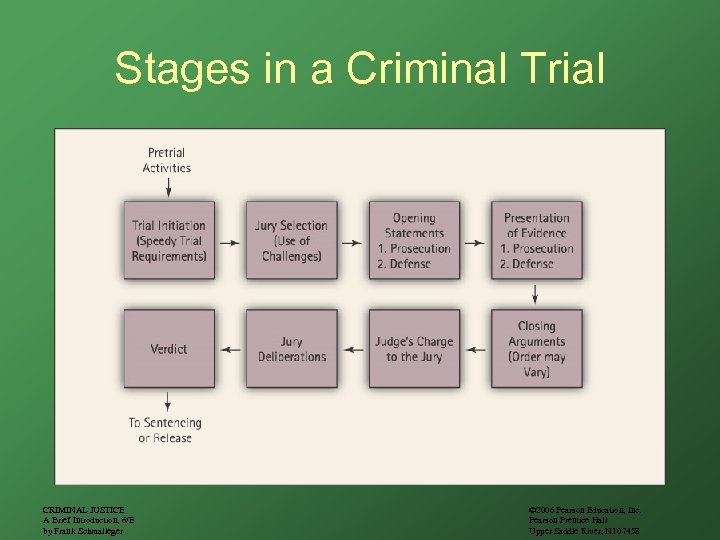 Stages in a Criminal Trial CRIMINAL JUSTICE A Brief Introduction, 6/E by Frank Schmalleger © 2006 Pearson Education, Inc. Pearson Prentice Hall Upper Saddle River, NJ 07458
 Trial Initiation: The Speedy Trial Act • Klopfer v. North Carolina (1967) – The court asserted that the state right to a speedy trial was a U. S. Constitutional guarantee. • Speedy Trial Act refers to: A 1974 federal law requiring that proceedings against a defendant in a criminal case begin within a specified period of time, such as 70 working days after indictment. CRIMINAL JUSTICE A Brief Introduction, 6/E by Frank Schmalleger © 2006 Pearson Education, Inc. Pearson Prentice Hall Upper Saddle River, NJ 07458
 Jury Selection • The Sixth Amendment guarantees the right to an impartial jury. • Jury selection refers to: The process whereby, according to law and precedent, members of a particular trial jury are chosen. • Three types of challenges: – Challenges to the array – Challenges for cause – Peremptory challenges CRIMINAL JUSTICE A Brief Introduction, 6/E by Frank Schmalleger © 2006 Pearson Education, Inc. Pearson Prentice Hall Upper Saddle River, NJ 07458
 Jury Selection • Voir dire examination is the questioning of potential jurors in order to select unbiased individuals. • Peremptory challenge refers to: The right to challenge a potential juror without disclosing the reason for the challenge. • Scientific jury selection • Library Extra 8 -6 CRIMINAL JUSTICE A Brief Introduction, 6/E by Frank Schmalleger © 2006 Pearson Education, Inc. Pearson Prentice Hall Upper Saddle River, NJ 07458
 Jury Selection and Race • Peremptory challenges continue to tend toward racial imbalance. • Batson v. Kentucky (1986) – The use of peremptory challenges for discriminatory purposes constitutes a violation of the defendant’s right to an impartial trial. CRIMINAL JUSTICE A Brief Introduction, 6/E by Frank Schmalleger © 2006 Pearson Education, Inc. Pearson Prentice Hall Upper Saddle River, NJ 07458
 Opening Statements • Opening statement refers to: The initial statement of the prosecution or the defense, made in a court of law to a judge or to a judge and jury, describing the facts that he or she intends to present during trial to prove the case. • Evidence is not offered. • Defense may choose to focus on the prosecutor’s burden of proof requirement. CRIMINAL JUSTICE A Brief Introduction, 6/E by Frank Schmalleger © 2006 Pearson Education, Inc. Pearson Prentice Hall Upper Saddle River, NJ 07458
 The Presentation of Evidence • Evidence refers to: Anything useful to a judge or jury in deciding the facts of a case. • Types of evidence: – Direct evidence – Circumstantial evidence – Real evidence CRIMINAL JUSTICE A Brief Introduction, 6/E by Frank Schmalleger © 2006 Pearson Education, Inc. Pearson Prentice Hall Upper Saddle River, NJ 07458
 The Testimony of Witnesses • Testimony refers to: Oral evidence offered by a sworn witness on the witness stand during a criminal trial. • Perjury refers to: The intentional making of a false statement as part of the testimony by a sworn witness in a judicial proceeding on a matter relevant to the case at hand. CRIMINAL JUSTICE A Brief Introduction, 6/E by Frank Schmalleger © 2006 Pearson Education, Inc. Pearson Prentice Hall Upper Saddle River, NJ 07458
 The Hearsay Rule • Hearsay refers to: Something that is not based on the personal knowledge of a witness. • The hearsay rule is a long-standing precedent in which hearsay cannot be used in American courtrooms. • Exception to the hearsay rule may occur when the person with direct knowledge is dead or is otherwise unable to testify. CRIMINAL JUSTICE A Brief Introduction, 6/E by Frank Schmalleger © 2006 Pearson Education, Inc. Pearson Prentice Hall Upper Saddle River, NJ 07458
 Closing Arguments • Closing argument refers to: An oral summation of a case presented to a judge, or to a judge and jury, by the prosecution or by the defense in a criminal trial. • The summation provides a review and analysis of the evidence. • It works to persuade the jury to draw a conclusion favorable to the presenter. CRIMINAL JUSTICE A Brief Introduction, 6/E by Frank Schmalleger © 2006 Pearson Education, Inc. Pearson Prentice Hall Upper Saddle River, NJ 07458
 The Judge’s Charge to the Jury • The judge charges the jury to retire and reach a verdict. • The judge will: – Stress jury objectivity. – Remind jurors of the statutory elements of the charge. – Explain the burden of proof. – Explain “guilty beyond a reasonable doubt. ” CRIMINAL JUSTICE A Brief Introduction, 6/E by Frank Schmalleger © 2006 Pearson Education, Inc. Pearson Prentice Hall Upper Saddle River, NJ 07458
 Jury Deliberation and the Verdict • The verdict is: The decision of the jury in a jury trial or of a judicial officer in a nonjury trial. • The Allen Charge urges the jury to vigorous deliberations and suggests to obstinate jurors that their objections may be ill founded if they make no impression on the other jurors. CRIMINAL JUSTICE A Brief Introduction, 6/E by Frank Schmalleger © 2006 Pearson Education, Inc. Pearson Prentice Hall Upper Saddle River, NJ 07458
 Problems with the Jury System • Jurors cannot be expected to understand modern legal complexities. • Jurors often cannot understand jury instructions. • Jurors often cannot separate emotions from fact. • Some juries are dominated by one or two members with forceful personalities. • Web Extra 8 -11 CRIMINAL JUSTICE A Brief Introduction, 6/E by Frank Schmalleger © 2006 Pearson Education, Inc. Pearson Prentice Hall Upper Saddle River, NJ 07458
 Problems with the Jury System • Suggestions for improving jury system: – Replace jury with a panel of judges – Replace jury with professional jurors • Dependability • Knowledge • Equity • Library Extra 8 -7 CRIMINAL JUSTICE A Brief Introduction, 6/E by Frank Schmalleger © 2006 Pearson Education, Inc. Pearson Prentice Hall Upper Saddle River, NJ 07458