


 Скачать презентацию Chapter 8 Political Participation n n n
d2fcf2ba97af6c496fe9ba056f78d8f9.ppt
- Количество слайдов: 48
 Chapter 8 Political Participation
 n n n Quiz 1 a 1 b 1 c Copyright © 2011 Cengage
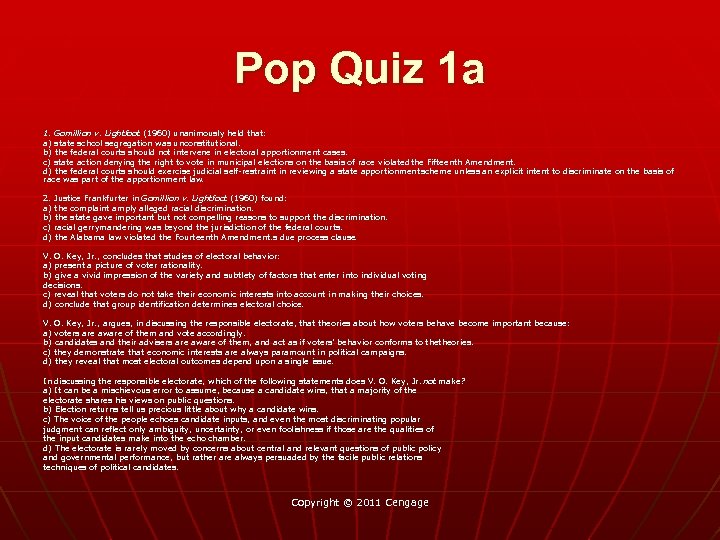 Pop Quiz 1 a 1. Gomillion v. Lightfoot (1960) unanimously held that: a) state school segregation was unconstitutional. b) the federal courts should not intervene in electoral apportionment cases. c) state action denying the right to vote in municipal elections on the basis of race violated the Fifteenth Amendment. d) the federal courts should exercise judicial self-restraint in reviewing a state apportionment scheme unless an explicit intent to discriminate on the basis of race was part of the apportionment law. 2. Justice Frankfurter in Gomillion v. Lightfoot (1960) found: a) the complaint amply alleged racial discrimination. b) the state gave important but not compelling reasons to support the discrimination. c) racial gerrymandering was beyond the jurisdiction of the federal courts. d) the Alabama law violated the Fourteenth Amendment. s due process clause. . clause V. O. Key, Jr. , concludes that studies of electoral behavior: a) present a picture of voter rationality. b) give a vivid impression of the variety and subtlety of factors that enter into individual voting decisions. c) reveal that voters do not take their economic interests into account in making their choices. d) conclude that group identification determines electoral choice. V. O. Key, Jr. , argues, in discussing the responsible electorate, that theories about how voters behave become important because: a) voters are aware of them and vote accordingly. b) candidates and their advisers are aware of them, and act as if voters’ behavior conforms to thetheories. c) they demonstrate that economic interests are always paramount in political campaigns. d) they reveal that most electoral outcomes depend upon a single issue. . issue In discussing the responsible electorate, which of the following statements does V. O. Key, Jr. not make? a) It can be a mischievous error to assume, because a candidate wins, that a majority of the electorate shares his views on public questions. b) Election returns tell us precious little about why a candidate wins. c) The voice of the people echoes candidate inputs, and even the most discriminating popular judgment can reflect only ambiguity, uncertainty, or even foolishness if those are the qualities of the input candidates make into the echo chamber. d) The electorate is rarely moved by concerns about central and relevant questions of public policy and governmental performance, but rather are always persuaded by the facile public relations techniques of political candidates. Copyright © 2011 Cengage
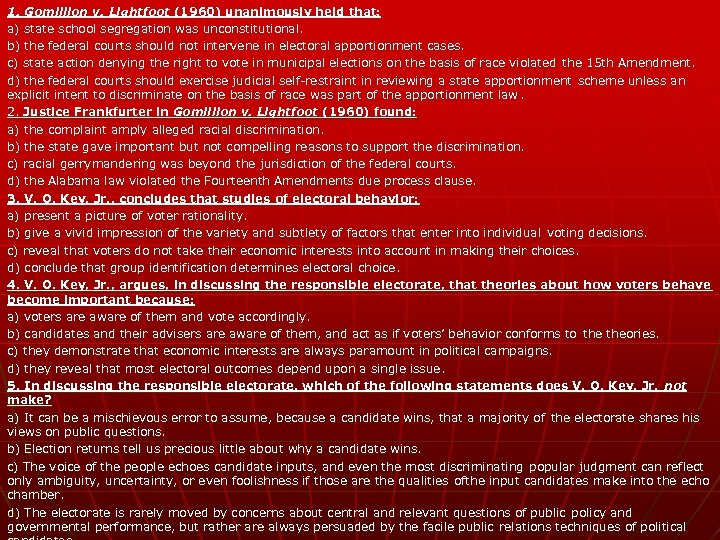 1. Gomillion v. Lightfoot (1960) unanimously held that: a) state school segregation was unconstitutional. b) the federal courts should not intervene in electoral apportionment cases. c) state action denying the right to vote in municipal elections on the basis of race violated the 15 th Amendment. d) the federal courts should exercise judicial self-restraint in reviewing a state apportionment scheme unless an explicit intent to discriminate on the basis of race was part of the apportionment law. 2. Justice Frankfurter in Gomillion v. Lightfoot (1960) found: a) the complaint amply alleged racial discrimination. b) the state gave important but not compelling reasons to support the discrimination. c) racial gerrymandering was beyond the jurisdiction of the federal courts. d) the Alabama law violated the Fourteenth Amendments due process clause. 3. V. O. Key, Jr. , concludes that studies of electoral behavior: a) present a picture of voter rationality. b) give a vivid impression of the variety and subtlety of factors that enter into individual voting decisions. c) reveal that voters do not take their economic interests into account in making their choices. d) conclude that group identification determines electoral choice. 4. V. O. Key, Jr. , argues, in discussing the responsible electorate, that theories about how voters behave become important because: a) voters are aware of them and vote accordingly. b) candidates and their advisers are aware of them, and act as if voters’ behavior conforms to theories. c) they demonstrate that economic interests are always paramount in political campaigns. d) they reveal that most electoral outcomes depend upon a single issue. 5. In discussing the responsible electorate, which of the following statements does V. O. Key, Jr. not make? a) It can be a mischievous error to assume, because a candidate wins, that a majority of the electorate shares his views on public questions. b) Election returns tell us precious little about why a candidate wins. c) The voice of the people echoes candidate inputs, and even the most discriminating popular judgment can reflect only ambiguity, uncertainty, or even foolishness if those are the qualities ofthe input candidates make into the echo chamber. d) The electorate is rarely moved by concerns about central and relevant questions of public policy and governmental performance, but rather are always persuaded by the facile public relations techniques of political
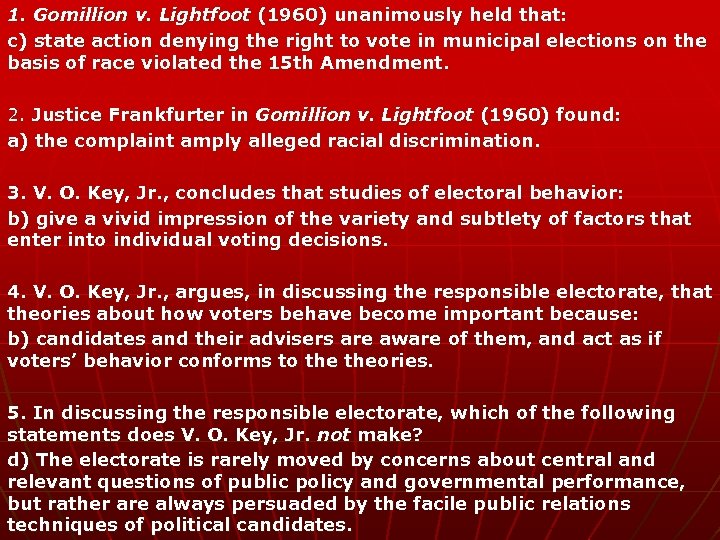 1. Gomillion v. Lightfoot (1960) unanimously held that: c) state action denying the right to vote in municipal elections on the basis of race violated the 15 th Amendment. 2. Justice Frankfurter in Gomillion v. Lightfoot (1960) found: a) the complaint amply alleged racial discrimination. 3. V. O. Key, Jr. , concludes that studies of electoral behavior: b) give a vivid impression of the variety and subtlety of factors that enter into individual voting decisions. 4. V. O. Key, Jr. , argues, in discussing the responsible electorate, that theories about how voters behave become important because: b) candidates and their advisers are aware of them, and act as if voters’ behavior conforms to theories. 5. In discussing the responsible electorate, which of the following statements does V. O. Key, Jr. not make? d) The electorate is rarely moved by concerns about central and relevant questions of public policy and governmental performance, but rather are always persuaded by the facile public relations techniques of political candidates.
 Copyright © 2011 Cengage
 Quiz 1 b Draw and label the following graphs n Guns/Butter Increasing Opportunity cost PPC showing what happens when there is an increase of quantity of inputs but performance of output has grown more relative to the increase of inputs. It is now an overheating economy. Draw the point of output along with the correct shift. • Then draw a business cycle and stop the curve where it matches up with the given performance of the economy above. n n Supply and Demand for Legos showing a simple case where Legos Corporation has had an increase in its resource costs. Show what will happen to the graph. FOREX Curve of US currency in relation to EU currency showing what happens in the US when there is an increase in taste of American goods. Consumption schedule with Saving Schedule showing what happens when households have an increase household debt. Investment Demand curve showing what happens when there is an decrease in operating costs.
 Copyright © 2011 Cengage
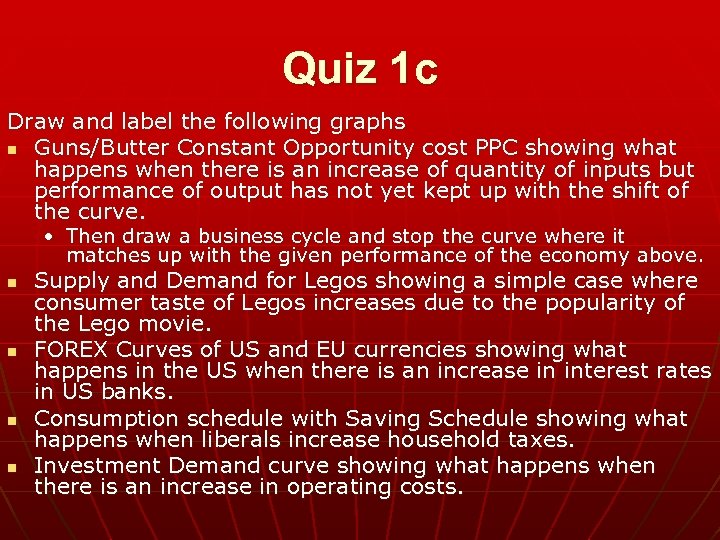 Quiz 1 c Draw and label the following graphs n Guns/Butter Constant Opportunity cost PPC showing what happens when there is an increase of quantity of inputs but performance of output has not yet kept up with the shift of the curve. • Then draw a business cycle and stop the curve where it matches up with the given performance of the economy above. n n Supply and Demand for Legos showing a simple case where consumer taste of Legos increases due to the popularity of the Lego movie. FOREX Curves of US and EU currencies showing what happens in the US when there is an increase in interest rates in US banks. Consumption schedule with Saving Schedule showing what happens when liberals increase household taxes. Investment Demand curve showing what happens when there is an increase in operating costs.
 Copyright © 2011 Cengage
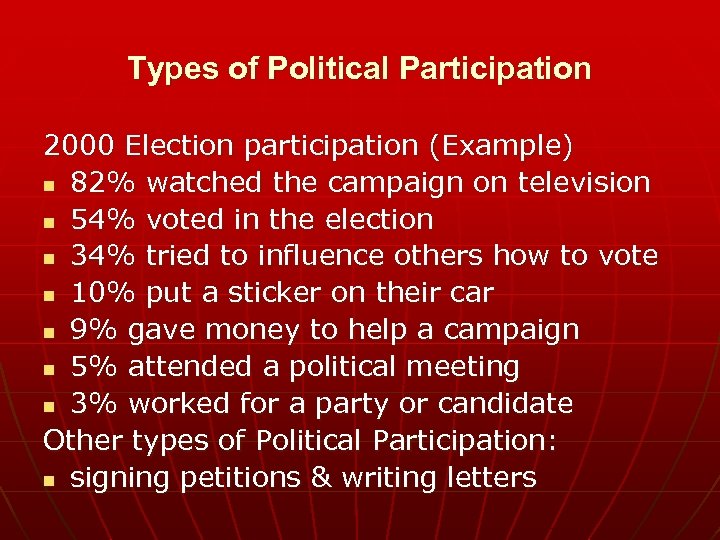 Types of Political Participation 2000 Election participation (Example) n 82% watched the campaign on television n 54% voted in the election n 34% tried to influence others how to vote n 10% put a sticker on their car n 9% gave money to help a campaign n 5% attended a political meeting n 3% worked for a party or candidate Other types of Political Participation: n signing petitions & writing letters
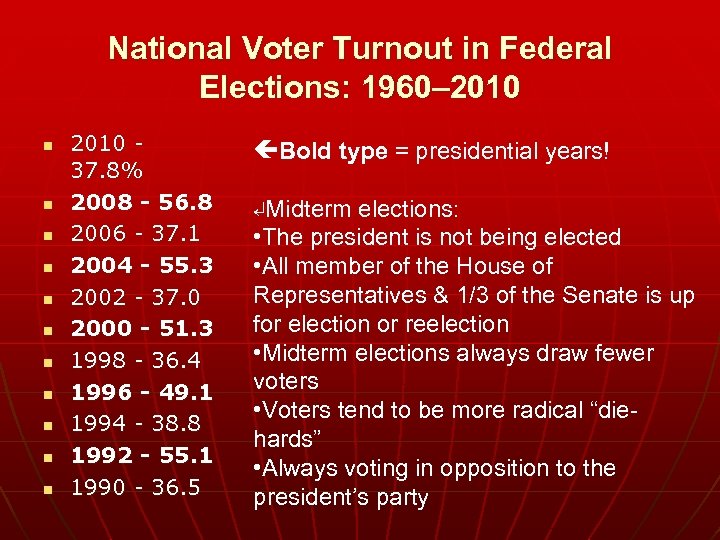 National Voter Turnout in Federal Elections: 1960– 2010 n n n 2010 37. 8% 2008 - 56. 8 2006 - 37. 1 2004 - 55. 3 2002 - 37. 0 2000 - 51. 3 1998 - 36. 4 1996 - 49. 1 1994 - 38. 8 1992 - 55. 1 1990 - 36. 5 Bold type = presidential years! ↵Midterm elections: • The president is not being elected • All member of the House of Representatives & 1/3 of the Senate is up for election or reelection • Midterm elections always draw fewer voters • Voters tend to be more radical “diehards” • Always voting in opposition to the president’s party
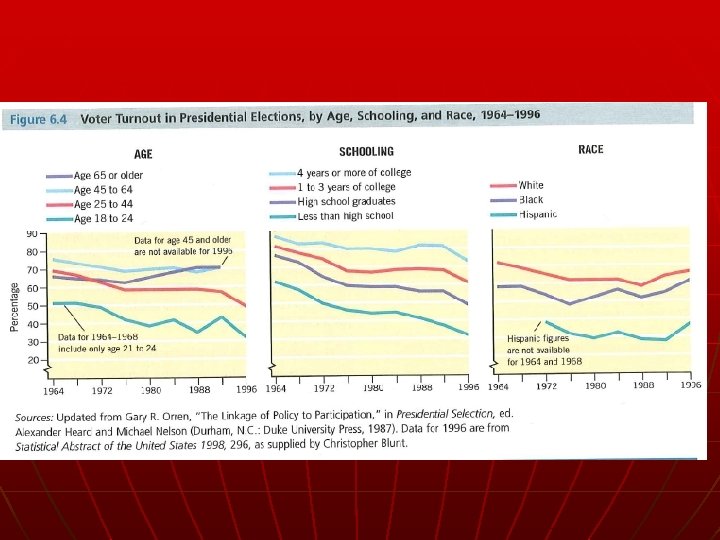
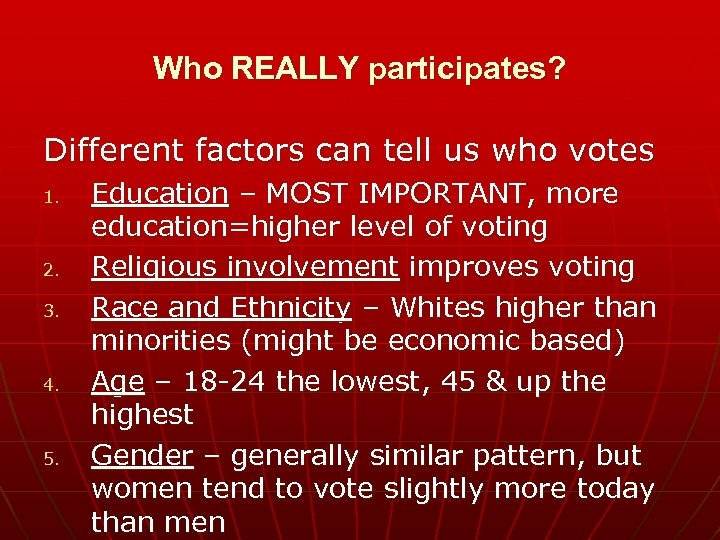 Who REALLY participates? Different factors can tell us who votes 1. 2. 3. 4. 5. Education – MOST IMPORTANT, more education=higher level of voting Religious involvement improves voting Race and Ethnicity – Whites higher than minorities (might be economic based) Age – 18 -24 the lowest, 45 & up the highest Gender – generally similar pattern, but women tend to vote slightly more today than men
 Copyright © 2011 Cengage
 n WHO GOVERNS? 1. Who votes, who doesn’t? 2. Why do some people participate in politics at higher rates than others? n TO WHAT ENDS? 1. How did the Framers of the Constitution think average citizens should participate in America’s representative democracy? 2. Should today’s college-age citizens participate more in politics? Copyright © 2011 Cengage
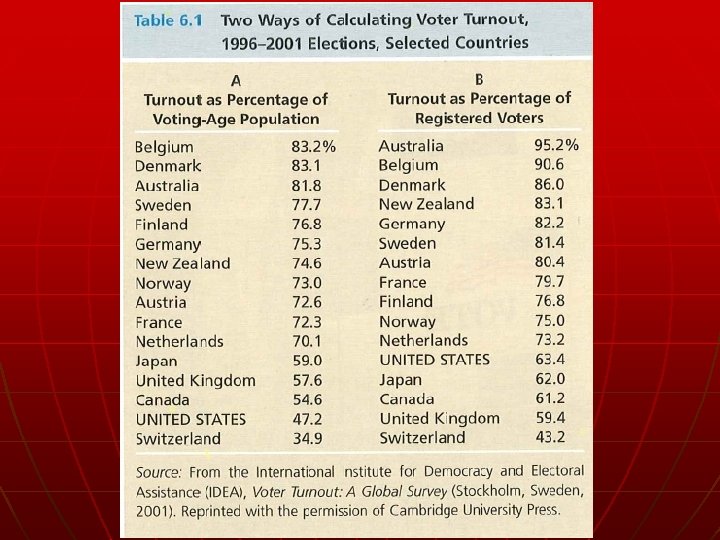
 A Closer Look at Nonvoting I: A-C n n n Voting-age population – citizens who are eligible to vote after reaching the minimum age requirement. Registered voters – people who are registered to vote. Source of low voter turnout – a relatively low percentage of the voting-age population is registered to vote. Copyright © 2011 Cengage
 Registration has costs in the U. S. ; there are no costs in European countries where registration is automatic Eligible Voter turnout n Voter Registration – blamed as one of the causes of low turnout (Institutional issues) n “Motor-Voter” (1993) – National Voter Registration Act – allowed people to register to vote while they get license
 Copyright © 2011 Cengage
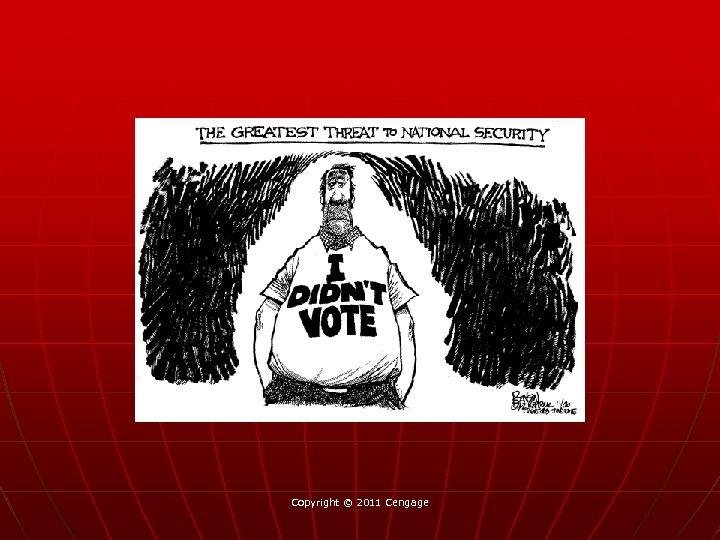
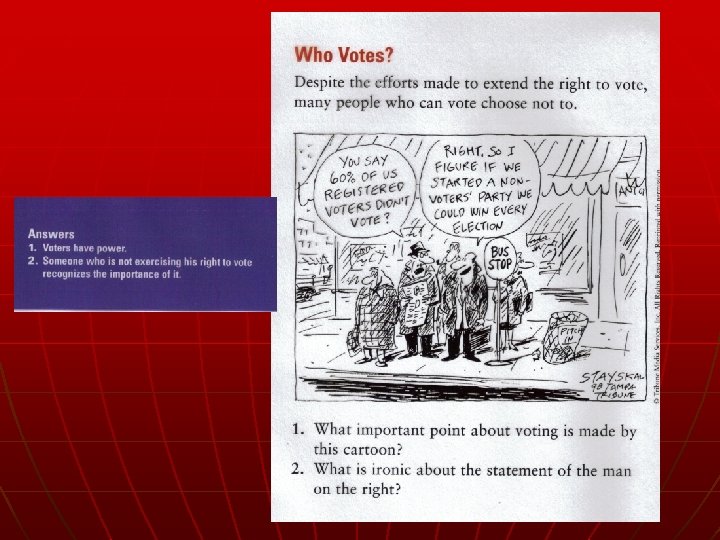 Copyright © 2011 Cengage
 Copyright © 2011 Cengage
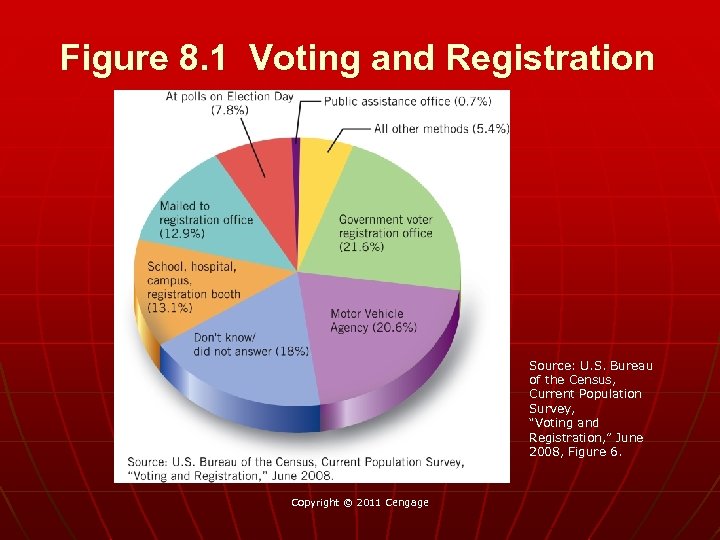 Figure 8. 1 Voting and Registration Source: U. S. Bureau of the Census, Current Population Survey, “Voting and Registration, ” June 2008, Figure 6. Copyright © 2011 Cengage
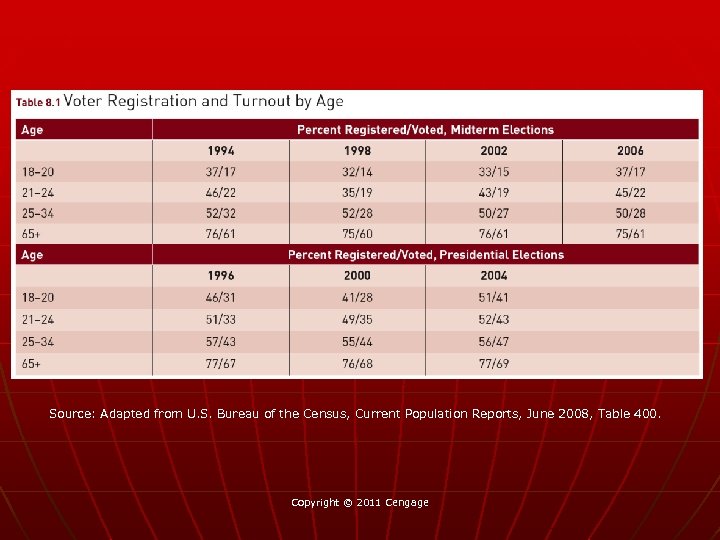 Source: Adapted from U. S. Bureau of the Census, Current Population Reports, June 2008, Table 400. Copyright © 2011 Cengage
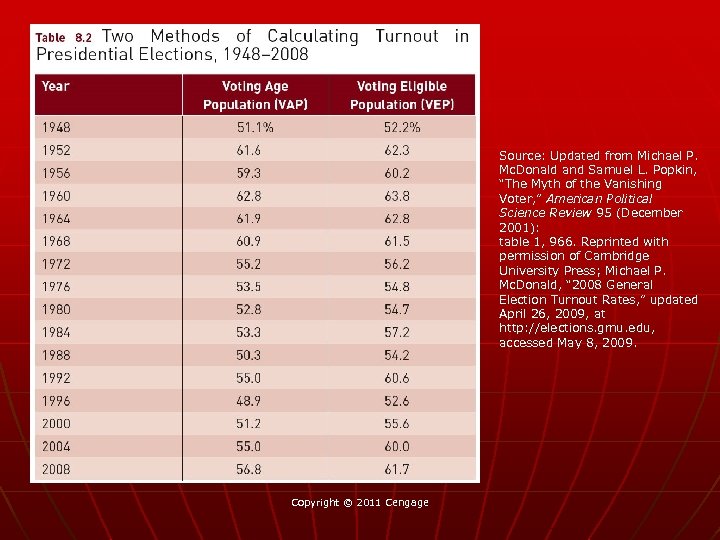 Source: Updated from Michael P. Mc. Donald and Samuel L. Popkin, “The Myth of the Vanishing Voter, ” American Political Science Review 95 (December 2001): table 1, 966. Reprinted with permission of Cambridge University Press; Michael P. Mc. Donald, “ 2008 General Election Turnout Rates, ” updated April 26, 2009, at http: //elections. gmu. edu, accessed May 8, 2009. Copyright © 2011 Cengage
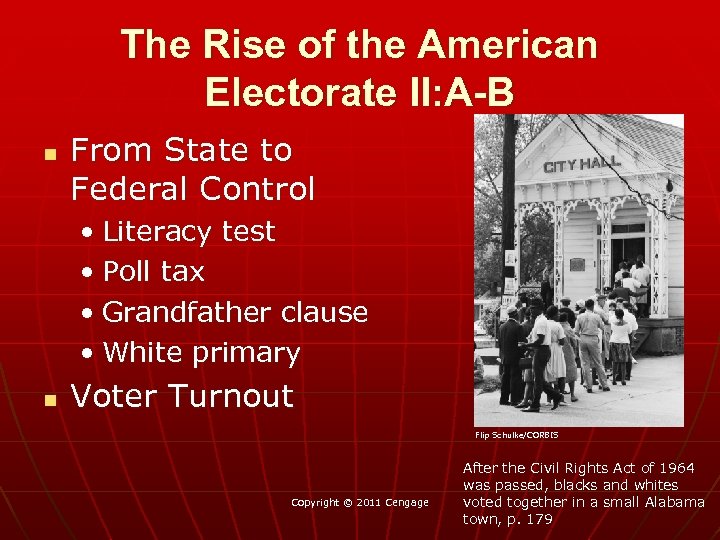 The Rise of the American Electorate II: A-B n From State to Federal Control • Literacy test • Poll tax • Grandfather clause • White primary n Voter Turnout Flip Schulke/CORBIS Copyright © 2011 Cengage After the Civil Rights Act of 1964 was passed, blacks and whites voted together in a small Alabama town, p. 179
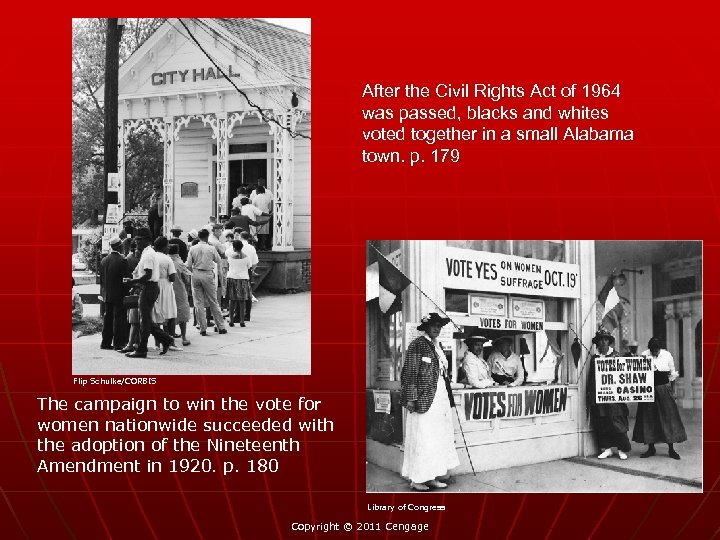 After the Civil Rights Act of 1964 was passed, blacks and whites voted together in a small Alabama town. p. 179 Flip Schulke/CORBIS The campaign to win the vote for women nationwide succeeded with the adoption of the Nineteenth Amendment in 1920. p. 180 Library of Congress Copyright © 2011 Cengage
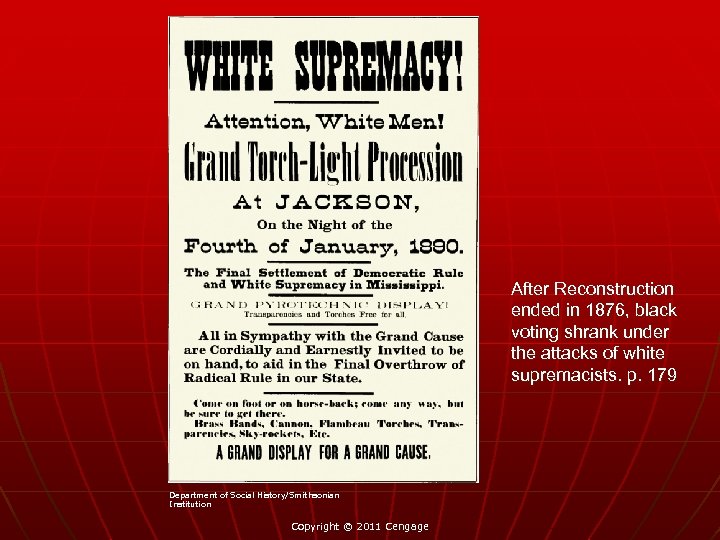 After Reconstruction ended in 1876, black voting shrank under the attacks of white supremacists. p. 179 Department of Social History/Smithsonian Institution Copyright © 2011 Cengage
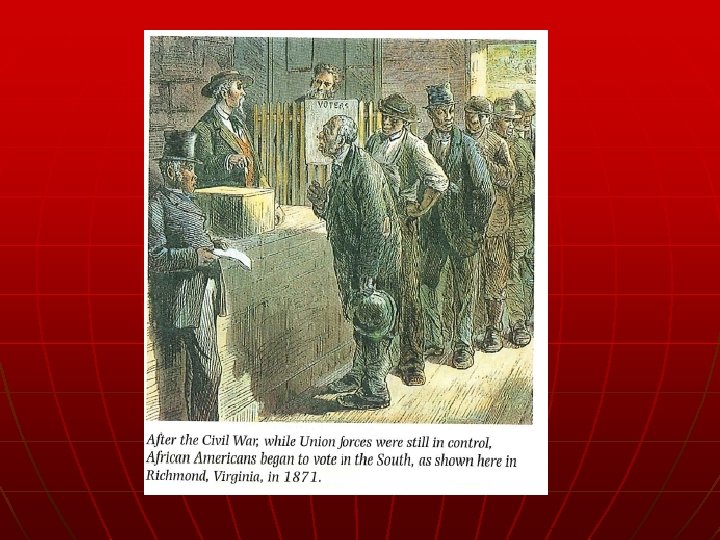
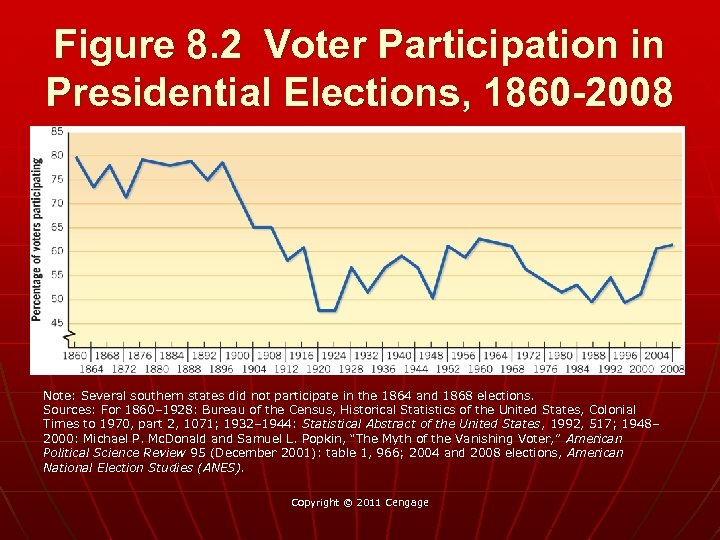 Figure 8. 2 Voter Participation in Presidential Elections, 1860 -2008 Note: Several southern states did not participate in the 1864 and 1868 elections. Sources: For 1860– 1928: Bureau of the Census, Historical Statistics of the United States, Colonial Times to 1970, part 2, 1071; 1932– 1944: Statistical Abstract of the United States, 1992, 517; 1948– 2000: Michael P. Mc. Donald and Samuel L. Popkin, “The Myth of the Vanishing Voter, ” American Political Science Review 95 (December 2001): table 1, 966; 2004 and 2008 elections, American National Election Studies (ANES). Copyright © 2011 Cengage
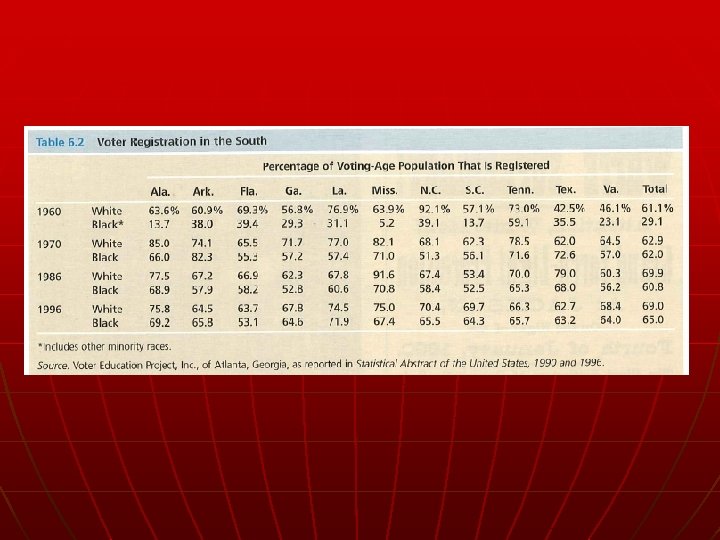
 Expanding Suffrage 1. 2. Lifting of property restrictions (1830) – “universal manhood suffrage” gave voting rights to all white males Suffrage for African-Americans (18631964) 1. 1865 - 15 th Amendment – Voting Rights to all 2. 1954 - Brown v. Board – separate but equal is illegal, killed Jim Crow laws 3. 1964 24 th Amendment – banned poll tax 4. 1965 – Voting Rights Act of 1965 – federal law prohibited (no literacy tests, fair elections etc. )
 Expanding Suffrage 3. 4. Women’s Suffrage (1920) – 19 th Amendment gave women the right to vote 18 -21 year-olds (1971) – 26 th Amendment, sparked by Vietnam
 Who Participates in Politics? III: A -C n Forms of Participation • Inactive • Voting specialists • Campaigners • Communalists • Parochial participants • Activists n Participation: Causes and Meaning Copyright © 2011 Cengage
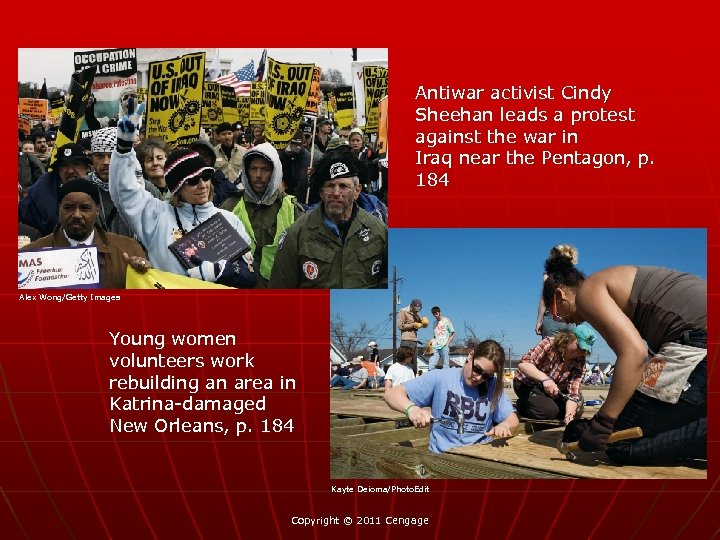 Antiwar activist Cindy Sheehan leads a protest against the war in Iraq near the Pentagon, p. 184 Alex Wong/Getty Images Young women volunteers work rebuilding an area in Katrina-damaged New Orleans, p. 184 Kayte Deioma/Photo. Edit Copyright © 2011 Cengage
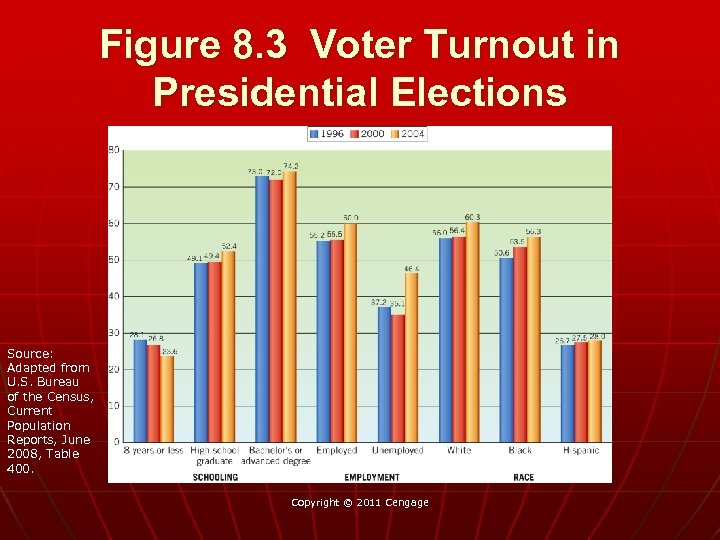 Figure 8. 3 Voter Turnout in Presidential Elections Source: Adapted from U. S. Bureau of the Census, Current Population Reports, June 2008, Table 400. Copyright © 2011 Cengage
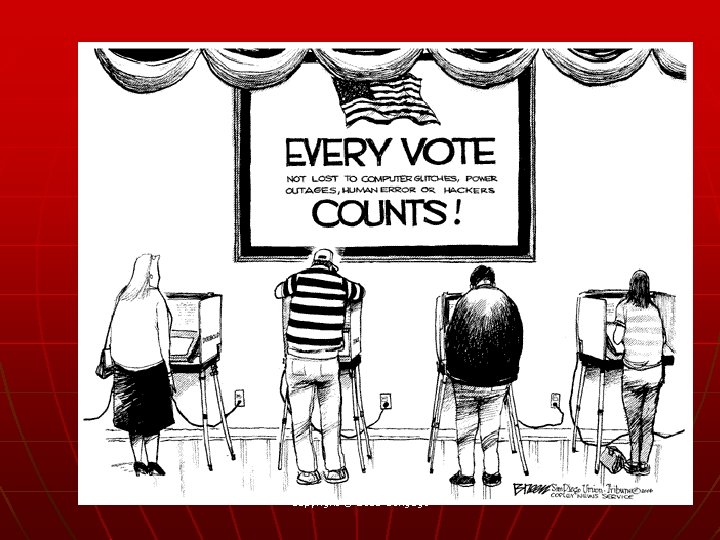
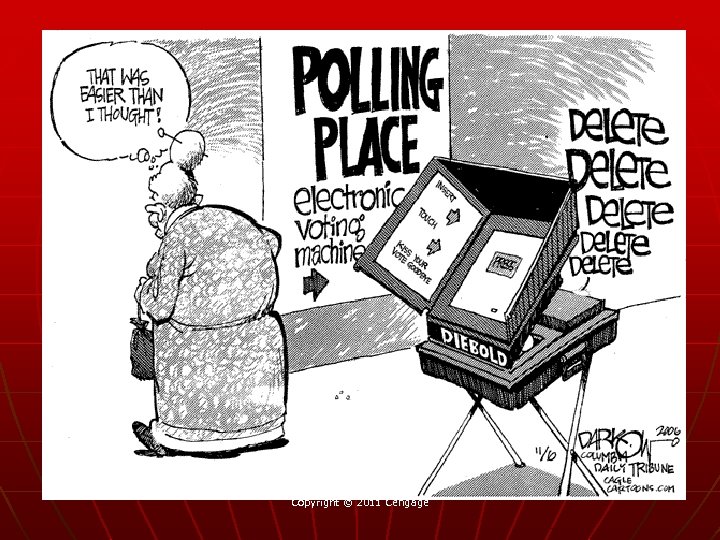
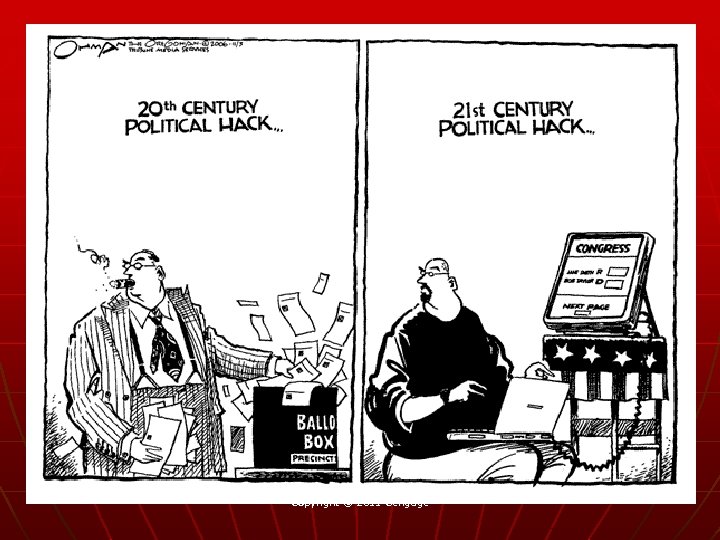
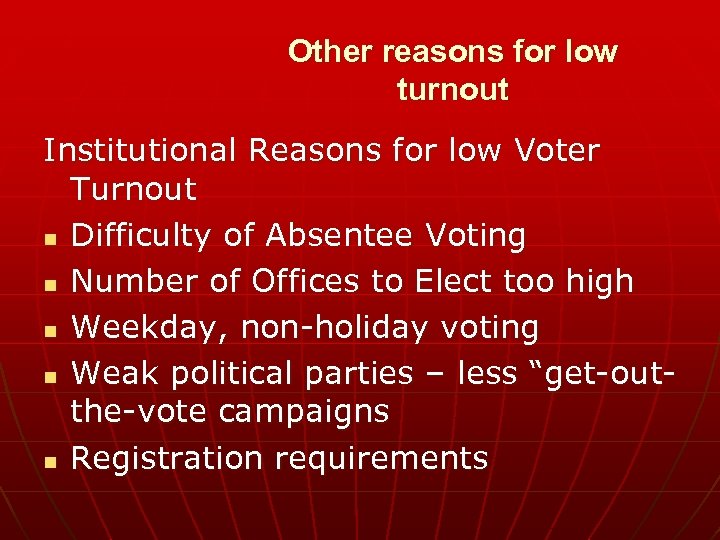 Other reasons for low turnout Institutional Reasons for low Voter Turnout n Difficulty of Absentee Voting n Number of Offices to Elect too high n Weekday, non-holiday voting n Weak political parties – less “get-outthe-vote campaigns n Registration requirements
 Copyright © 2011 Cengage
 Copyright © 2011 Cengage
 Copyright © 2011 Cengage
 Machine Video Copyright © 2011 Cengage
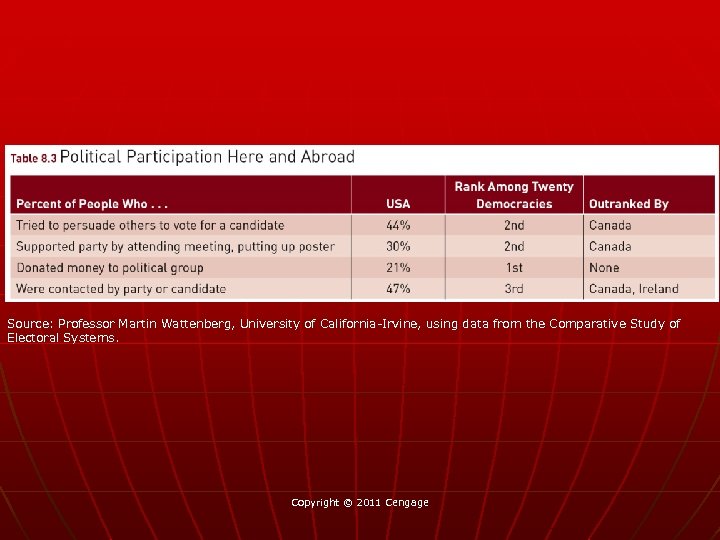 Source: Professor Martin Wattenberg, University of California-Irvine, using data from the Comparative Study of Electoral Systems. Copyright © 2011 Cengage
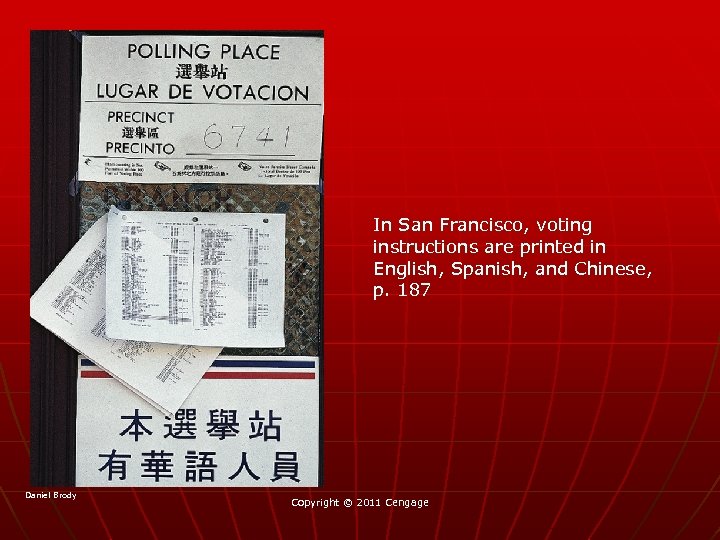 In San Francisco, voting instructions are printed in English, Spanish, and Chinese, p. 187 Daniel Brody Copyright © 2011 Cengage
 HW Turn in n DEBATE Copyright © 2011 Cengage
 WHAT WOULD YOU DO? MEMORANDUM To: Senator Henry Gilbert From: Peter Clark, legislative analyst Subject: Voting reform legislation In the 1990 s, barely half of the electorate voted for president, and only a third or so cast ballots for congressional elections. In a few recent presidential primaries and statewide special elections, turnout has run 10 percent or below. Studies show that often citizens miss the opportunity to vote because of complications with work or child care. To address this problem, legislators from both parties support celebrating Veterans Day on Election Day, which would create a national holiday for voting. Eligible voters who do not go to the polls would be fined. Copyright © 2011 Cengage
 WHAT WOULD YOU DO? Arguments for: 1. This proposal honors veterans by recognizing their service with the fundamental requirement of representative democracy, rule by the people through voting. 2. A voting holiday ensures that people who cannot take off time from work or other responsibilities to vote have the opportunity to exercise their democratic right. 3. Imposing a fine for nonvoting sends a moral message that voting is a civic duty in a democracy. More citizens will feel morally obliged to vote if all citizens are legally obliged to do so. Copyright © 2011 Cengage
 WHAT WOULD YOU DO? Arguments against: 1. Just as veterans volunteer their service, so, too, should citizens volunteer to exercise their democratic responsibilities. 2. Voting is a right, but citizens have a civic duty to exercise that right, and the government should not, in effect, exercise that duty on their behalf. Moreover, people can vote by absentee ballot at their convenience. 3. Compulsory voting does not guarantee informed voting. It is both unwise and undemocratic to legally oblige people to vote. Copyright © 2011 Cengage
 WHAT WOULD YOU DO? Your decision: Vote for bill? Vote against bill? Copyright © 2011 Cengage