


 Скачать презентацию Chapter 8 Network Security Introduction Graciela Perera Computer
563098cd3e59bdf2e947c2b79ead1d3c.ppt
- Количество слайдов: 34
 Chapter 8 Network Security Introduction Graciela Perera Computer Science Department All material copyright 1996 -2007 J. F Kurose and K. W. Ross, All Rights Reserved
 Chapter 8: Network Security Chapter goals: r understand principles of network security: m cryptography and its many uses beyond “confidentiality” m authentication m message integrity 8: Network Security 8 -2
 What is network security? Confidentiality: only sender, intended receiver should “understand” message contents m sender encrypts message m receiver decrypts message Authentication: sender, receiver want to confirm identity of each other Message integrity: sender, receiver want to ensure message not altered (in transit, or afterwards) without detection Access and availability: services must be accessible and available to users 8: Network Security 8 -3
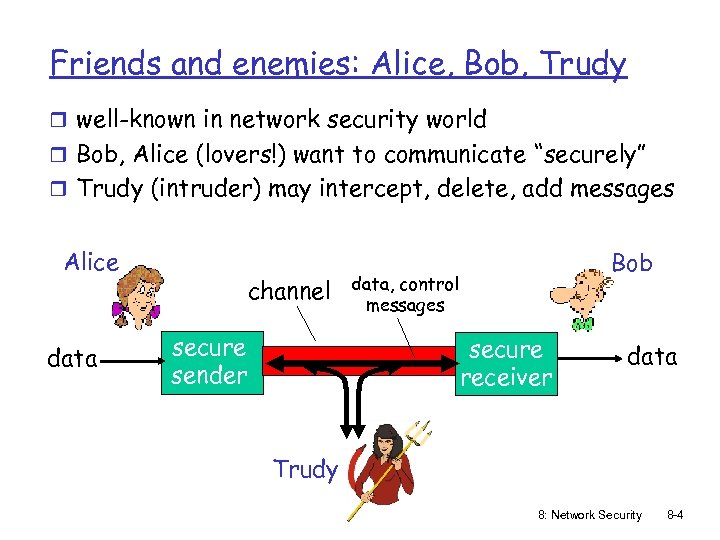 Friends and enemies: Alice, Bob, Trudy r well-known in network security world r Bob, Alice (lovers!) want to communicate “securely” r Trudy (intruder) may intercept, delete, add messages Alice data channel secure sender Bob data, control messages secure receiver data Trudy 8: Network Security 8 -4
 Who might Bob, Alice be? r … well, real-life Bobs and Alices! r Web browser/server for electronic r r transactions (e. g. , on-line purchases) on-line banking client/server DNS servers routers exchanging routing table updates other examples? 8: Network Security 8 -5
 There are bad guys (and girls) out there! Q: What can a “bad guy” do? A: a lot! eavesdrop: intercept messages m actively insert messages into connection m impersonation: can fake (spoof) source address in packet (or any field in packet) m hijacking: “take over” ongoing connection by removing sender or receiver, inserting himself in place m denial of service: prevent service from being used by others (e. g. , by overloading resources) m more on this later …… 8: Network Security 8 -6
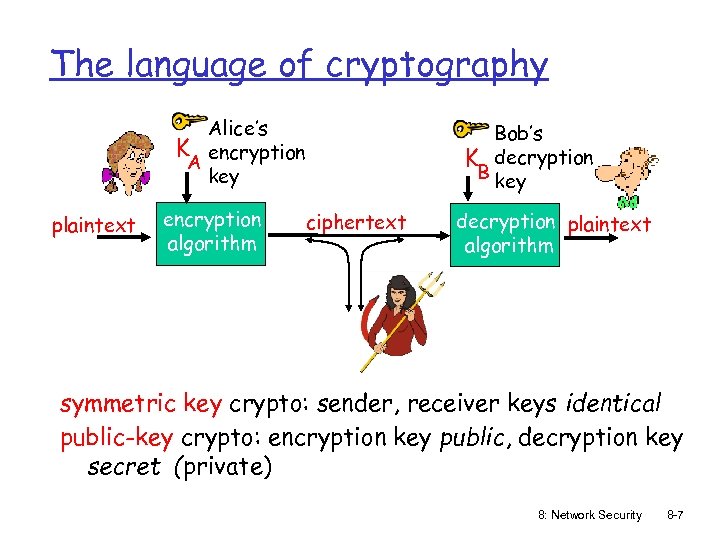 The language of cryptography Alice’s K encryption A key plaintext encryption algorithm Bob’s K decryption B key ciphertext decryption plaintext algorithm symmetric key crypto: sender, receiver keys identical public-key crypto: encryption key public, decryption key secret (private) 8: Network Security 8 -7
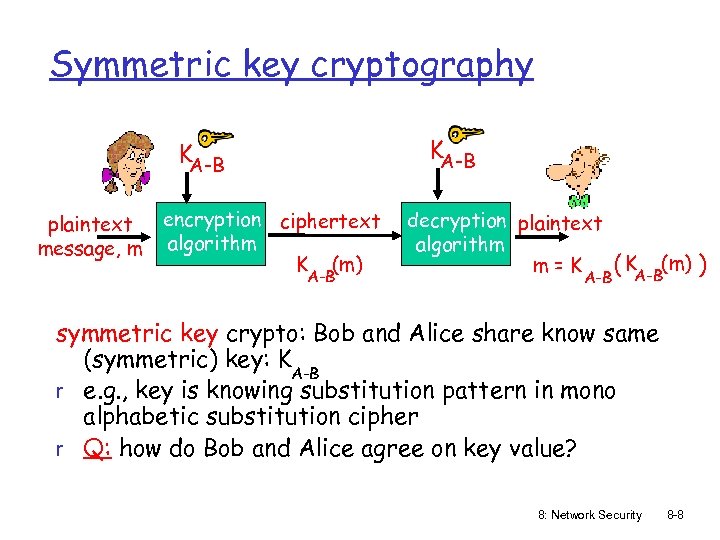 Symmetric key cryptography KA-B plaintext message, m encryption ciphertext algorithm K (m) A-B decryption plaintext algorithm m=K A-B ( KA-B(m) ) symmetric key crypto: Bob and Alice share know same (symmetric) key: K A-B r e. g. , key is knowing substitution pattern in mono alphabetic substitution cipher r Q: how do Bob and Alice agree on key value? 8: Network Security 8 -8
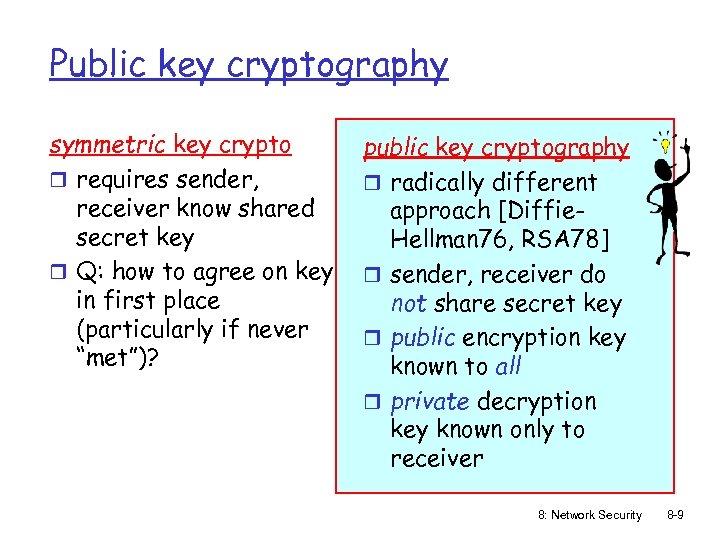 Public key cryptography symmetric key crypto r requires sender, receiver know shared secret key r Q: how to agree on key in first place (particularly if never “met”)? public key cryptography r radically different approach [Diffie. Hellman 76, RSA 78] r sender, receiver do not share secret key r public encryption key known to all r private decryption key known only to receiver 8: Network Security 8 -9
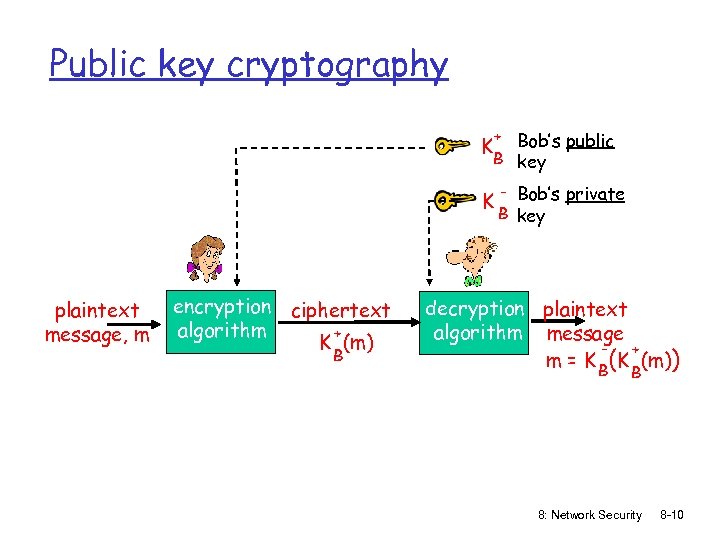 Public key cryptography + Bob’s public B key K K plaintext message, m encryption ciphertext algorithm + K (m) B - Bob’s private B key decryption plaintext algorithm message + m = K B(K (m)) B 8: Network Security 8 -10
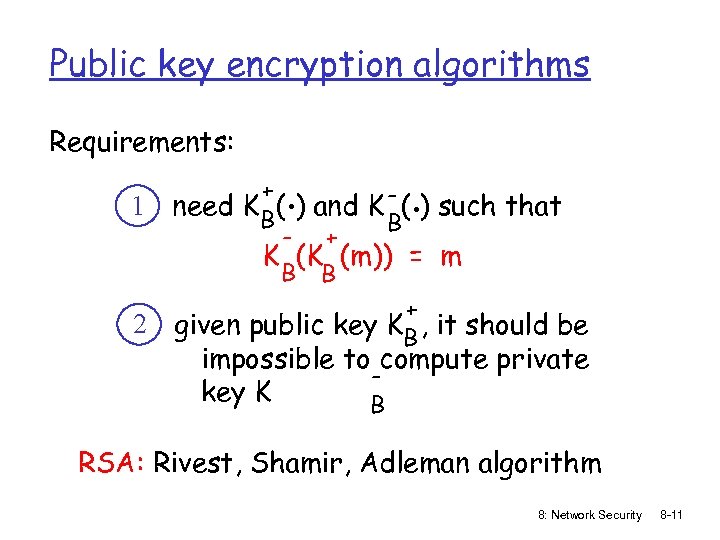 Public key encryption algorithms Requirements: 1 2 . . + need K B( ) and K - ( ) such that B - + K (K (m)) = m B B + given public key KB , it should be impossible to compute private key K B RSA: Rivest, Shamir, Adleman algorithm 8: Network Security 8 -11
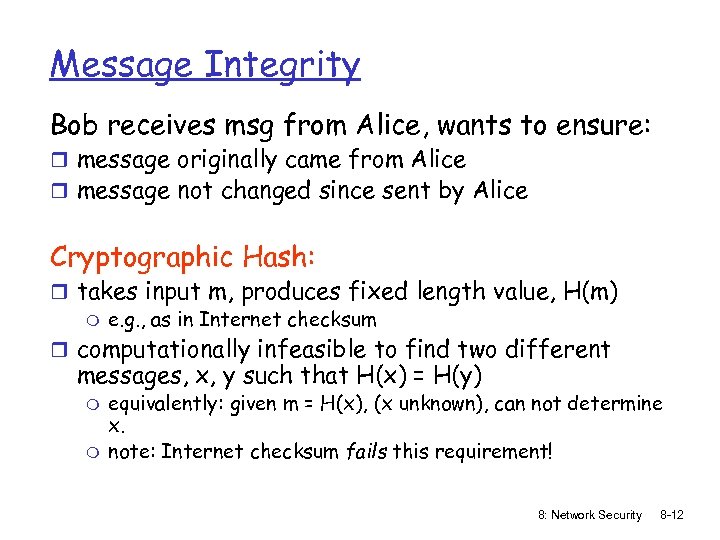 Message Integrity Bob receives msg from Alice, wants to ensure: r message originally came from Alice r message not changed since sent by Alice Cryptographic Hash: r takes input m, produces fixed length value, H(m) m e. g. , as in Internet checksum r computationally infeasible to find two different messages, x, y such that H(x) = H(y) m m equivalently: given m = H(x), (x unknown), can not determine x. note: Internet checksum fails this requirement! 8: Network Security 8 -12
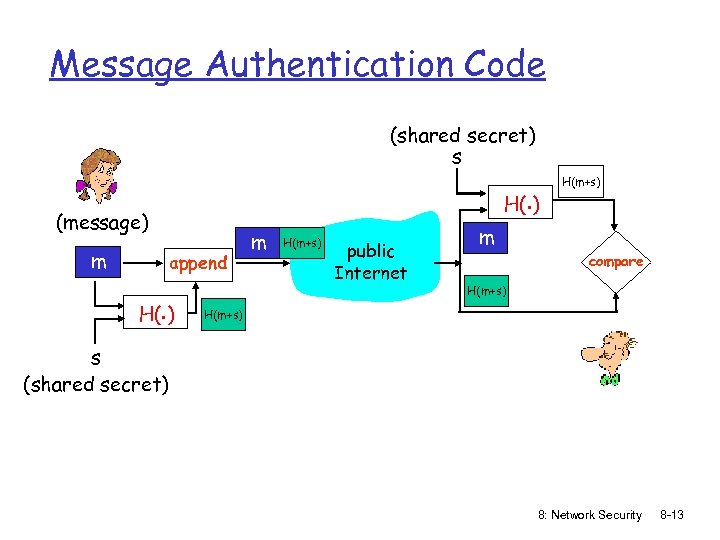 Message Authentication Code (shared secret) s H(. ) (message) m append H(. ) m H(m+s) public Internet H(m+s) m compare H(m+s) s (shared secret) 8: Network Security 8 -13
 MACs in practice r MD 5 hash function widely used (RFC 1321) m computes 128 -bit MAC in 4 -step process. m arbitrary 128 -bit string x, appears difficult to construct msg m whose MD 5 hash is equal to x • recent (2005) attacks on MD 5 r SHA-1 is also used m US standard [NIST, FIPS PUB 180 -1] m 160 -bit MAC 8: Network Security 8 -14
 Digital Signatures cryptographic technique analogous to handwritten signatures. r sender (Bob) digitally signs document, establishing he is document owner/creator. r verifiable, nonforgeable: recipient (Alice) can prove to someone that Bob, and no one else (including Alice), must have signed document 8: Network Security 8 -15
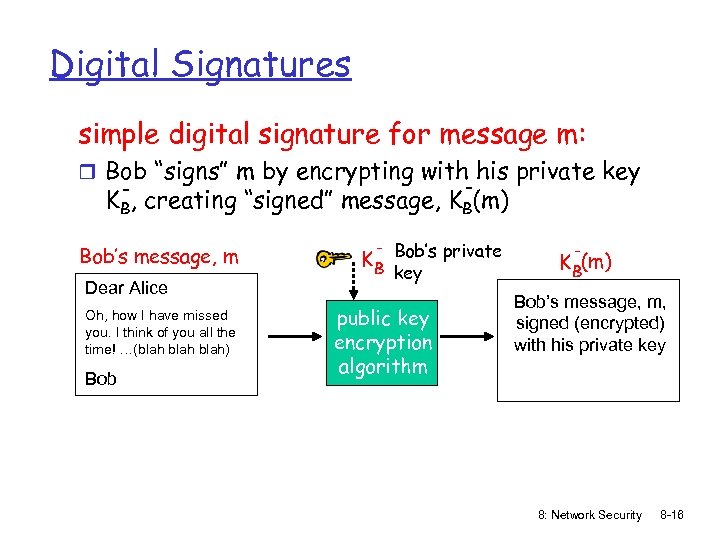 Digital Signatures simple digital signature for message m: r Bob “signs” m by encrypting with his private key - KB, creating “signed” message, KB(m) Bob’s message, m Dear Alice Oh, how I have missed you. I think of you all the time! …(blah) Bob K B Bob’s private key public key encryption algorithm K B(m) Bob’s message, m, signed (encrypted) with his private key 8: Network Security 8 -16
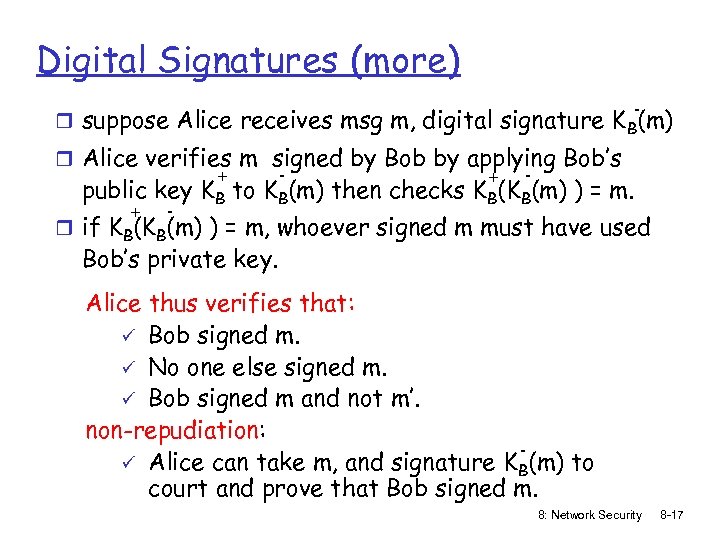 Digital Signatures (more) - r suppose Alice receives msg m, digital signature K B(m) r Alice verifies m signed by Bob by applying Bob’s + - public key KB to KB(m) then checks KB(KB(m) ) = m. + - r if KB(KB(m) ) = m, whoever signed m must have used Bob’s private key. Alice thus verifies that: ü Bob signed m. ü No one else signed m. ü Bob signed m and not m’. non-repudiation: ü Alice can take m, and signature KB(m) to court and prove that Bob signed m. 8: Network Security 8 -17
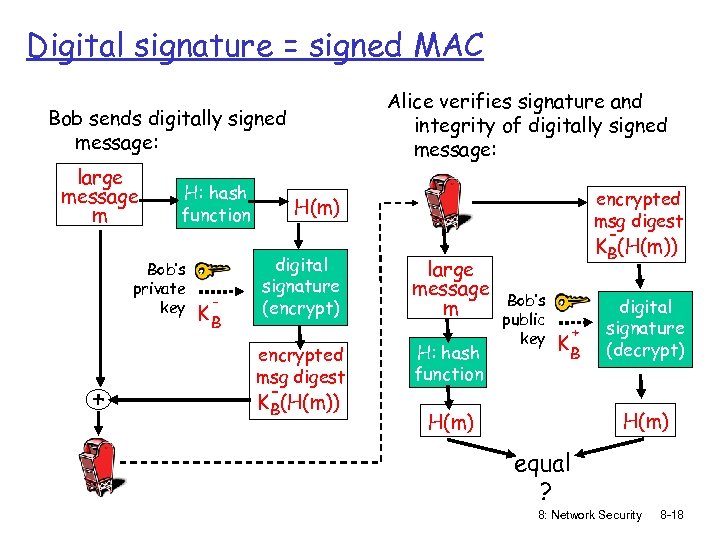 Digital signature = signed MAC Alice verifies signature and integrity of digitally signed message: Bob sends digitally signed message: large message m H: hash function Bob’s private key + - KB encrypted msg digest H(m) digital signature (encrypt) encrypted msg digest KB(H(m)) large message m H: hash function KB(H(m)) Bob’s public key + KB digital signature (decrypt) H(m) equal ? 8: Network Security 8 -18
 Public Key Certification public key problem: r When Alice obtains Bob’s public key (from web site, e-mail, diskette), how does she know it is Bob’s public key, not Trudy’s? solution: r trusted certification authority (CA) 8: Network Security 8 -19
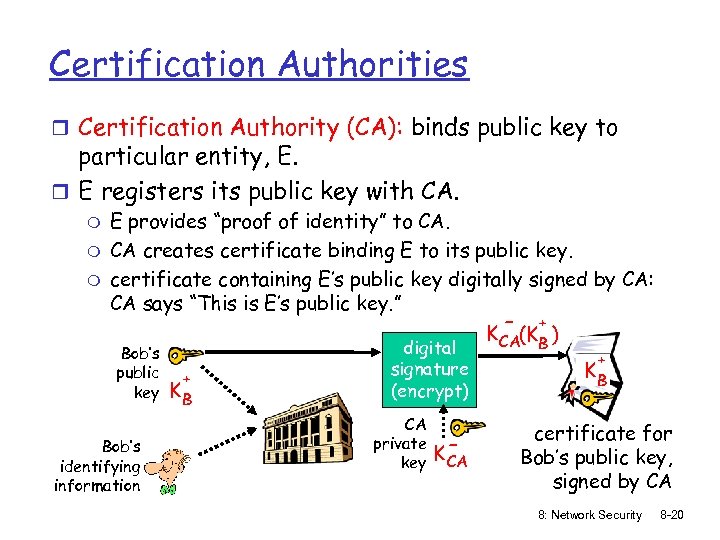 Certification Authorities r Certification Authority (CA): binds public key to particular entity, E. r E registers its public key with CA. m m m E provides “proof of identity” to CA. CA creates certificate binding E to its public key. certificate containing E’s public key digitally signed by CA: CA says “This is E’s public key. ” - + K CA(KB ) Bob’s public key Bob’s identifying information + KB digital signature (encrypt) CA private key K- CA + KB certificate for Bob’s public key, signed by CA 8: Network Security 8 -20
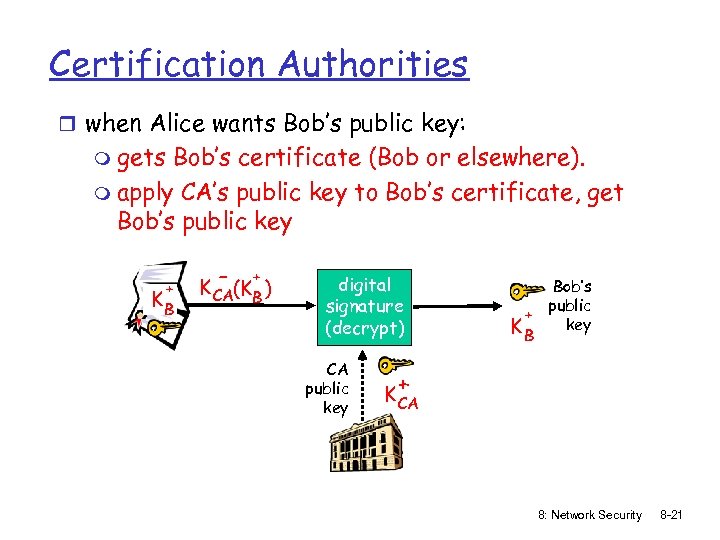 Certification Authorities r when Alice wants Bob’s public key: m gets Bob’s certificate (Bob or elsewhere). m apply CA’s public key to Bob’s certificate, get Bob’s public key + KB - + K CA(KB ) digital signature (decrypt) CA public key Bob’s public + key KB + K CA 8: Network Security 8 -21
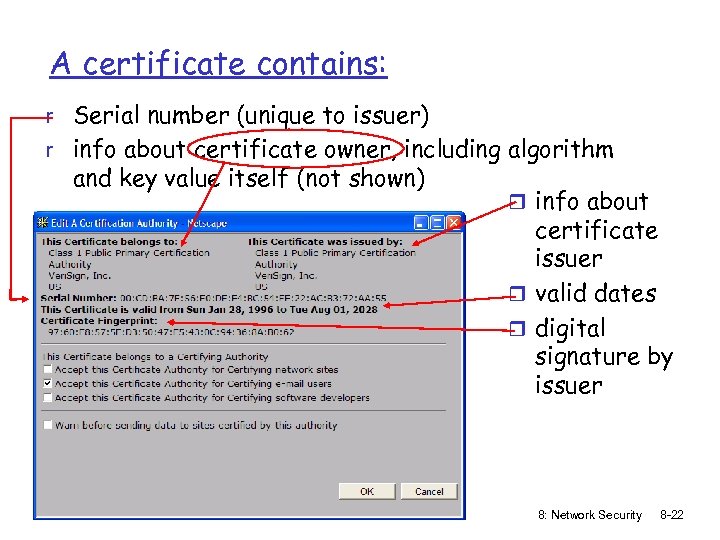 A certificate contains: r Serial number (unique to issuer) r info about certificate owner, including algorithm and key value itself (not shown) r info about certificate issuer r valid dates r digital signature by issuer 8: Network Security 8 -22
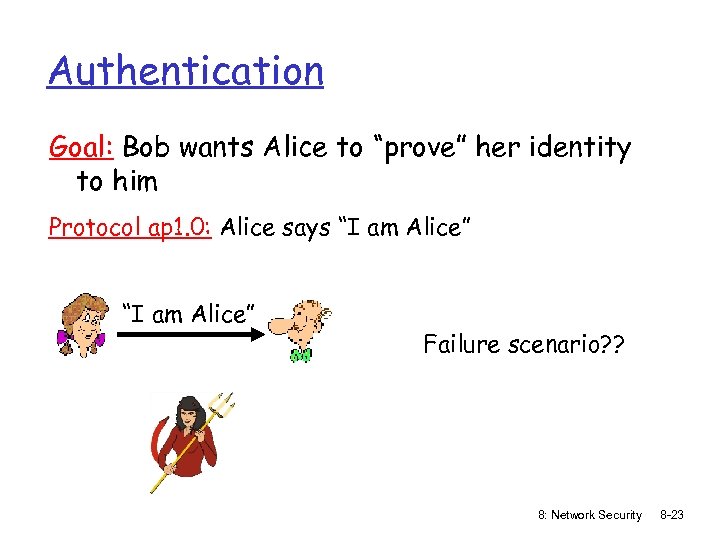 Authentication Goal: Bob wants Alice to “prove” her identity to him Protocol ap 1. 0: Alice says “I am Alice” Failure scenario? ? 8: Network Security 8 -23
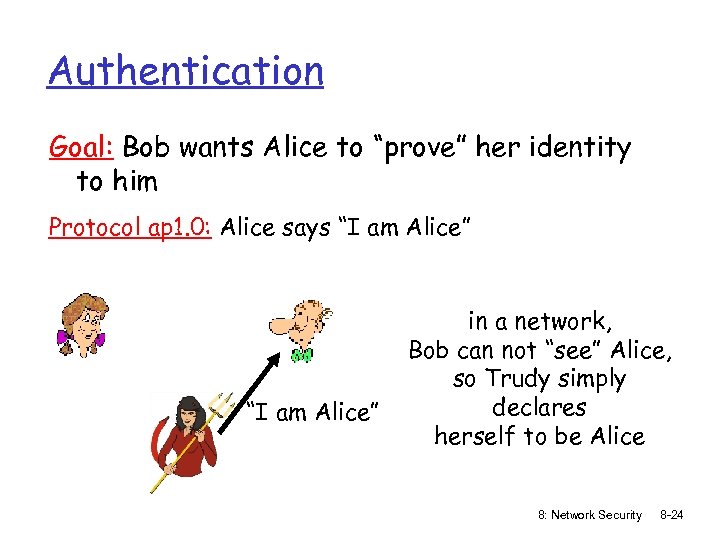 Authentication Goal: Bob wants Alice to “prove” her identity to him Protocol ap 1. 0: Alice says “I am Alice” in a network, Bob can not “see” Alice, so Trudy simply declares herself to be Alice 8: Network Security 8 -24
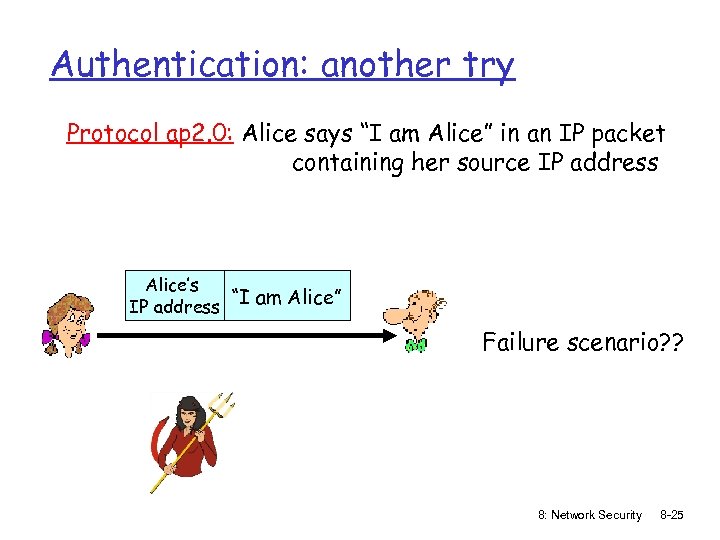 Authentication: another try Protocol ap 2. 0: Alice says “I am Alice” in an IP packet containing her source IP address Alice’s “I am Alice” IP address Failure scenario? ? 8: Network Security 8 -25
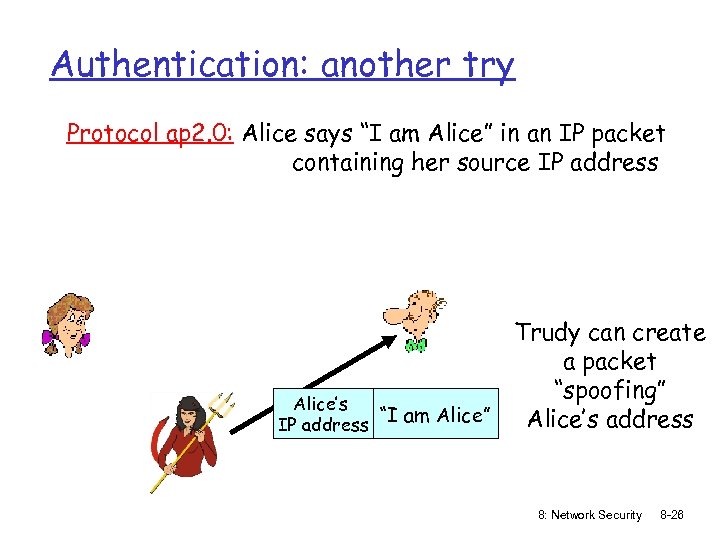 Authentication: another try Protocol ap 2. 0: Alice says “I am Alice” in an IP packet containing her source IP address Alice’s IP address Trudy can create a packet “spoofing” “I am Alice” Alice’s address 8: Network Security 8 -26
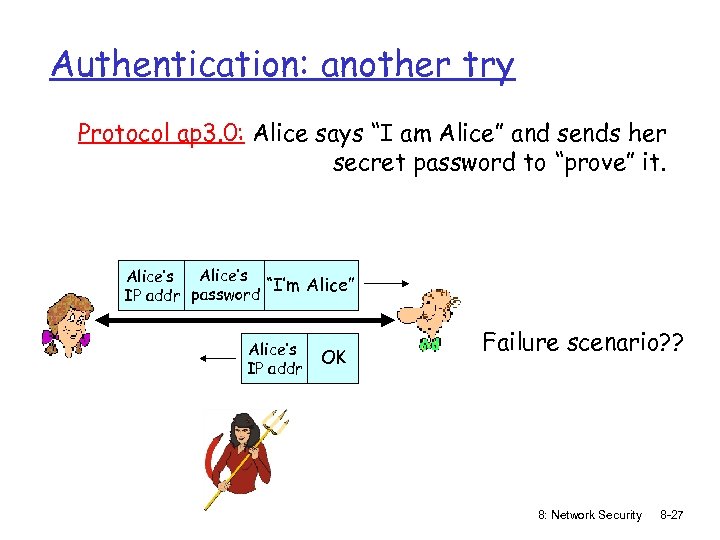 Authentication: another try Protocol ap 3. 0: Alice says “I am Alice” and sends her secret password to “prove” it. Alice’s “I’m Alice” IP addr password Alice’s IP addr OK Failure scenario? ? 8: Network Security 8 -27
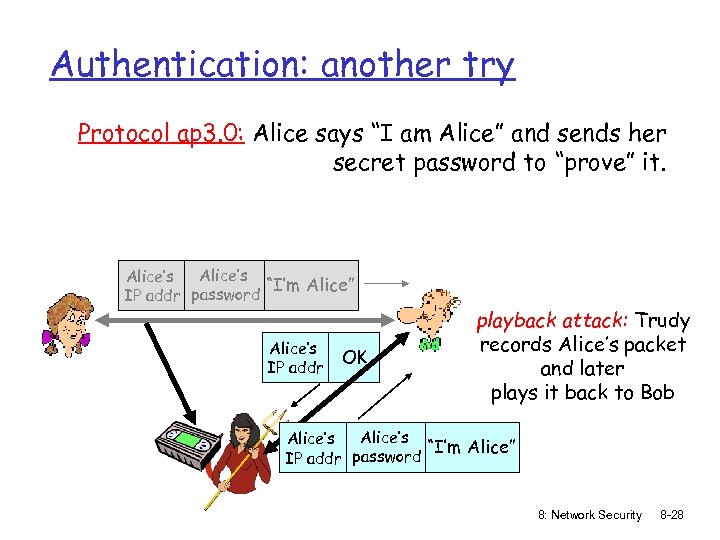 Authentication: another try Protocol ap 3. 0: Alice says “I am Alice” and sends her secret password to “prove” it. Alice’s “I’m Alice” IP addr password Alice’s IP addr OK playback attack: Trudy records Alice’s packet and later plays it back to Bob Alice’s “I’m Alice” IP addr password 8: Network Security 8 -28
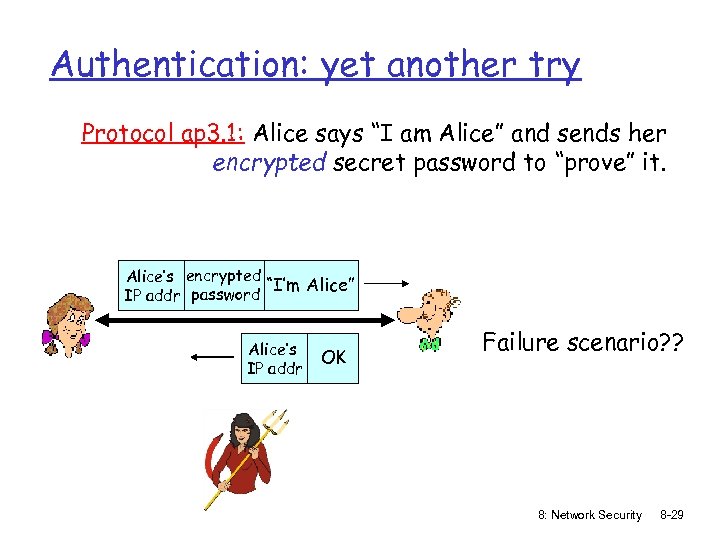 Authentication: yet another try Protocol ap 3. 1: Alice says “I am Alice” and sends her encrypted secret password to “prove” it. Alice’s encrypted “I’m Alice” IP addr password Alice’s IP addr OK Failure scenario? ? 8: Network Security 8 -29
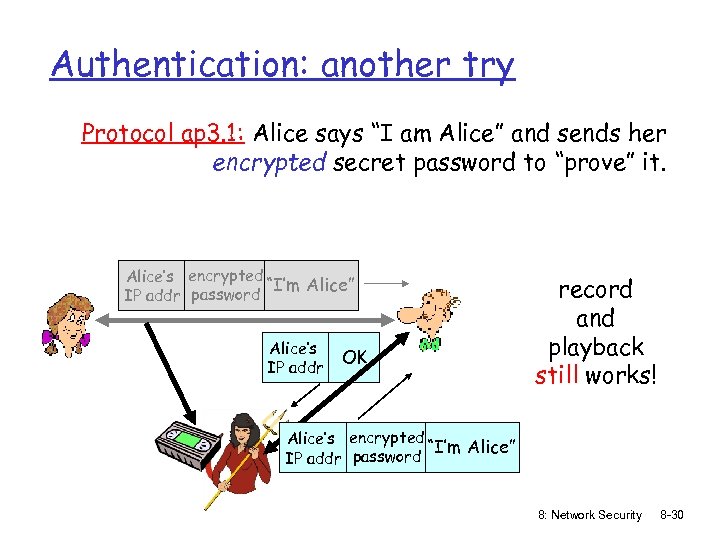 Authentication: another try Protocol ap 3. 1: Alice says “I am Alice” and sends her encrypted secret password to “prove” it. Alice’s encrypted “I’m Alice” IP addr password Alice’s IP addr OK record and playback still works! Alice’s encrypted “I’m Alice” IP addr password 8: Network Security 8 -30
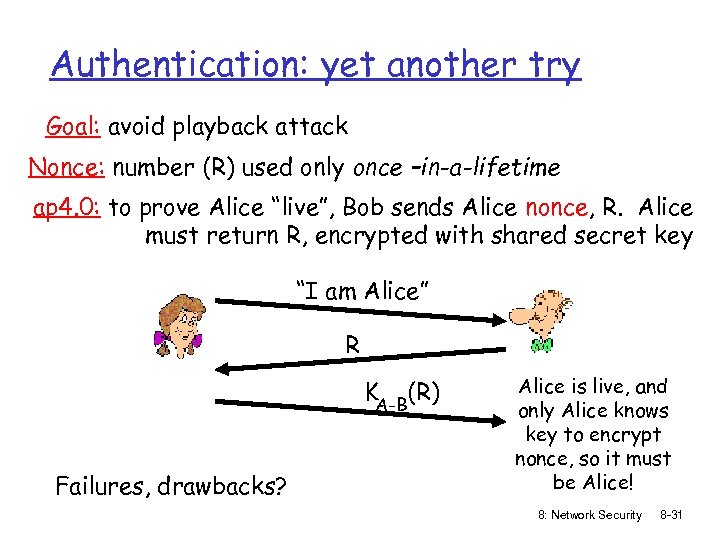 Authentication: yet another try Goal: avoid playback attack Nonce: number (R) used only once –in-a-lifetime ap 4. 0: to prove Alice “live”, Bob sends Alice nonce, R. Alice must return R, encrypted with shared secret key “I am Alice” R KA-B(R) Failures, drawbacks? Alice is live, and only Alice knows key to encrypt nonce, so it must be Alice! 8: Network Security 8 -31
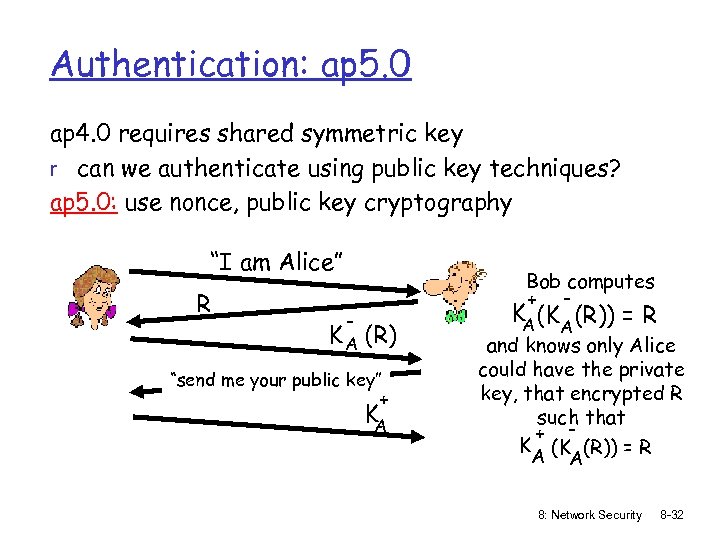 Authentication: ap 5. 0 ap 4. 0 requires shared symmetric key r can we authenticate using public key techniques? ap 5. 0: use nonce, public key cryptography “I am Alice” R Bob computes + - - K A (R) “send me your public key” + KA KA(KA (R)) = R and knows only Alice could have the private key, that encrypted R such that + K (K (R)) = R A A 8: Network Security 8 -32
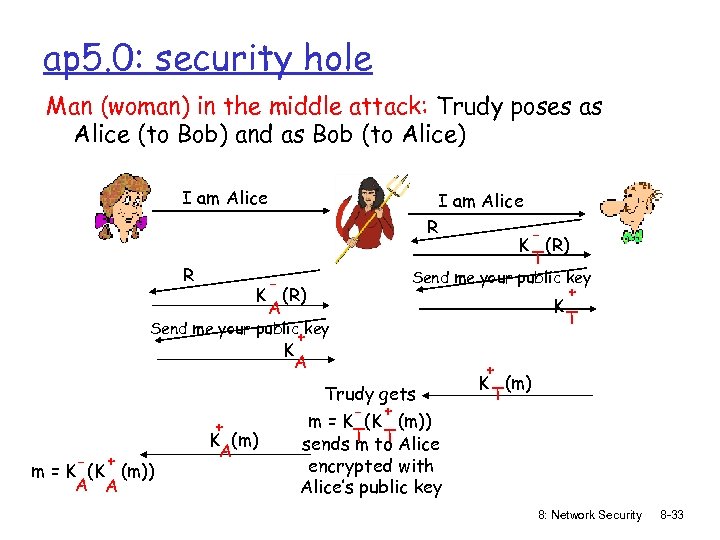 ap 5. 0: security hole Man (woman) in the middle attack: Trudy poses as Alice (to Bob) and as Bob (to Alice) I am Alice R K (R) T K (R) A Send me your public key + K T Send me your public key + K A - + m = K (K (m)) A A + K (m) A Trudy gets - + m = K (K (m)) sends T to Alice m T + K (m) T encrypted with Alice’s public key 8: Network Security 8 -33
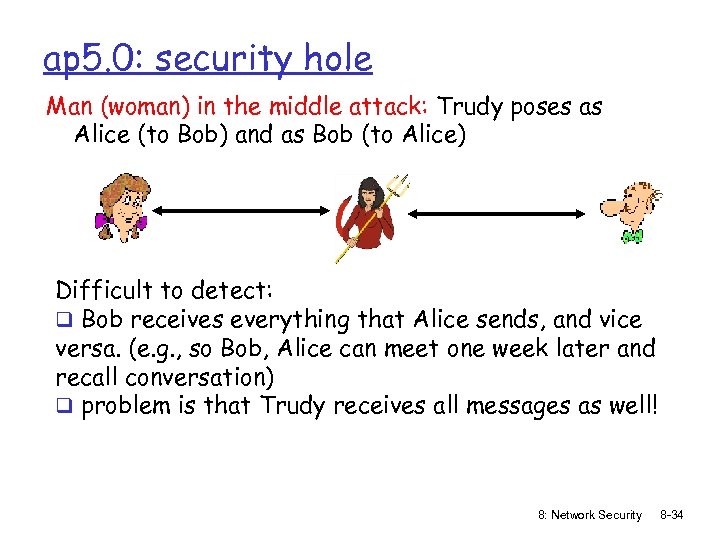 ap 5. 0: security hole Man (woman) in the middle attack: Trudy poses as Alice (to Bob) and as Bob (to Alice) Difficult to detect: q Bob receives everything that Alice sends, and vice versa. (e. g. , so Bob, Alice can meet one week later and recall conversation) q problem is that Trudy receives all messages as well! 8: Network Security 8 -34