


 Скачать презентацию Chapter 8 Marketing The Planning Process
cb6e81252f747b2dda545708afd3f261.ppt
- Количество слайдов: 72
 & Chapter 8 Marketing The Planning Process
 Introduction: n Key Concepts l The Single Biggest Thing l The Campaign Concept l The Language of Marketing l Planning & Strategy n How Advertising Works n The Planning Process n Questions & Discussion
 Key Concepts n The Single Biggest Thing n Campaigns n Objectives & Strategies n Advertising & Marketing
 The Single Biggest Thing: Key Concepts n Advertising dollars have great “elasticity” l l n Advertising can be The Single Biggest Thing l n Planning and implementing the Right Advertising is usually critical for success in the marketplace The Wrong Advertising is usually worthless It can probably impact sales more than any other element of the marketing mix. And … it is the most fun!
 The Single Biggest Thing Key Concepts Advertising is just a part of “The Five Ps” n All of “IMC” is important n However. . . n Advertising dollars are. . . n Often, the biggest item in the marketing budget l The most visible part of marketing spending l The most controllable marketing activity l n Advertising is often… “the tail that wags the marketing dog”
 Campaigns: Key Concepts Origin of term n Military Campaigns n Political Campaigns n Advertising Campaigns n
 Campaigns: Key Concepts n Origin of term Fr. campagne, It. campagna - open country suited to military maneuvers l Campaign - a series of military operations with a particular objective in a war l Campaign - a series of organized planned actions with a particular purpose, as for electing a candidate. l
 Campaigns: Key Concepts n Military Campaigns “Victory is my objective. War is my strategy. ” Winston Churchill
 Campaigns: Key Concepts n Military Campaigns “a series of military operations with a particular objective in a war” l Advertising and marketing use both the language and the military mindset l Example: a very popular marketing book… l
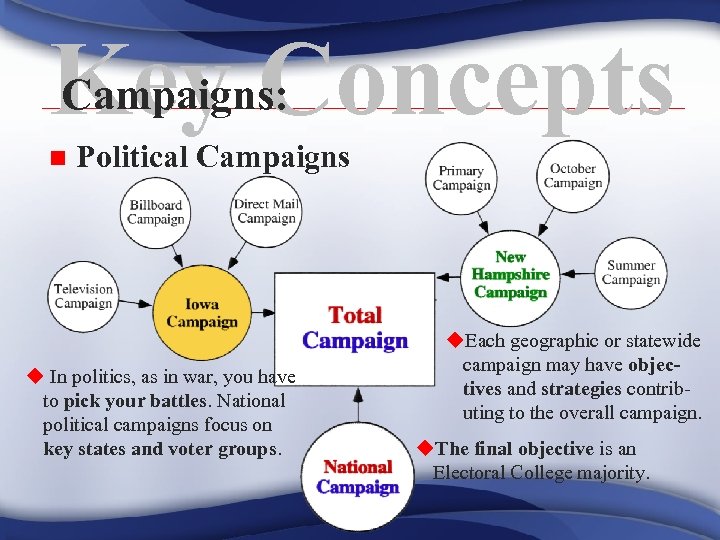 Campaigns: Key Concepts n Political Campaigns u In politics, as in war, you have to pick your battles. National political campaigns focus on key states and voter groups. u. Each geographic or statewide campaign may have objectives and strategies contributing to the overall campaign. u. The final objective is an Electoral College majority.
 Campaigns: Key Concepts n Advertising Campaigns “Advertising is a team sport!”
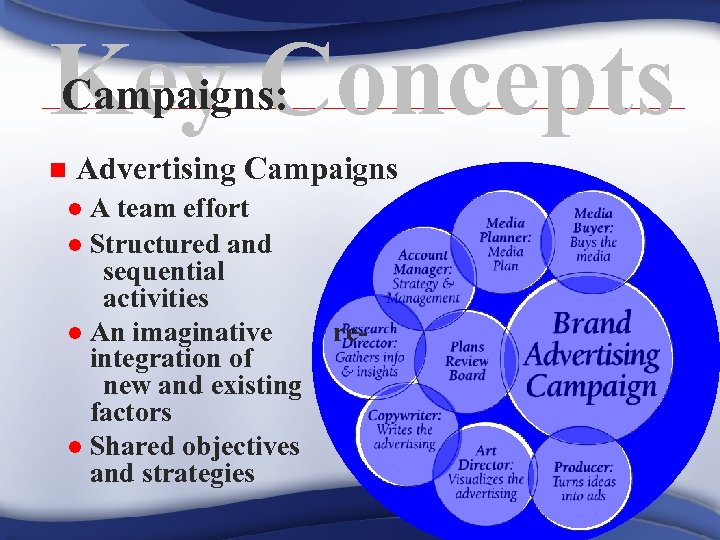 Campaigns: Key Concepts n Advertising Campaigns A team effort l Structured and sequential activities l An imaginative integration of new and existing factors l Shared objectives and strategies l re-
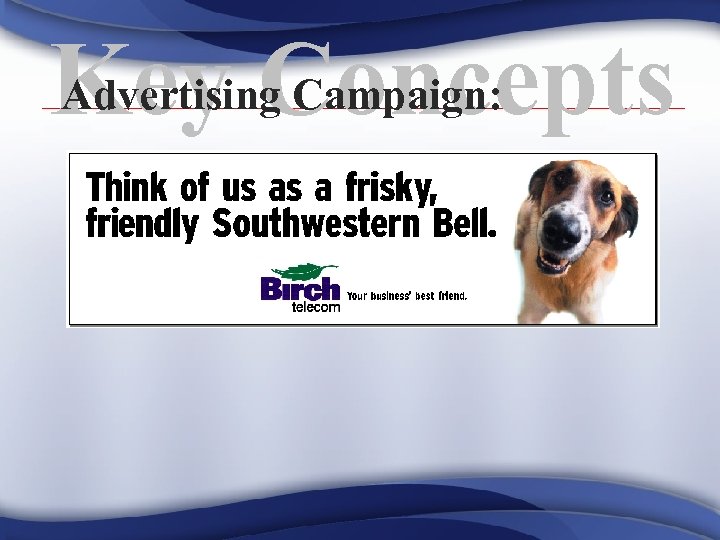
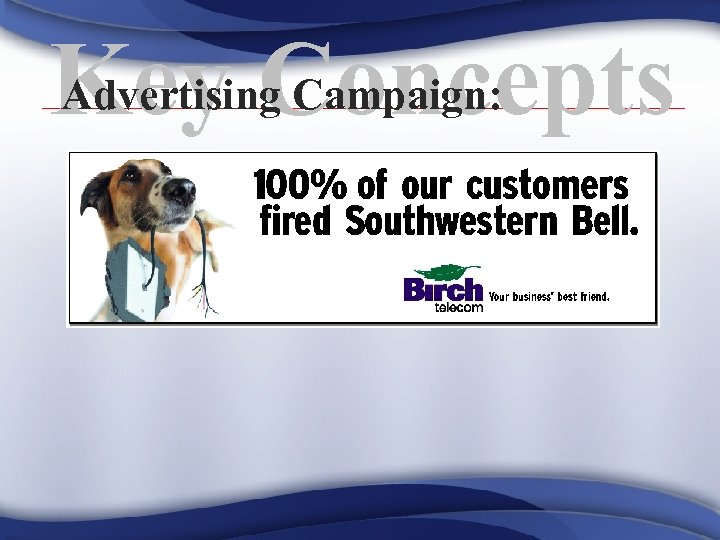
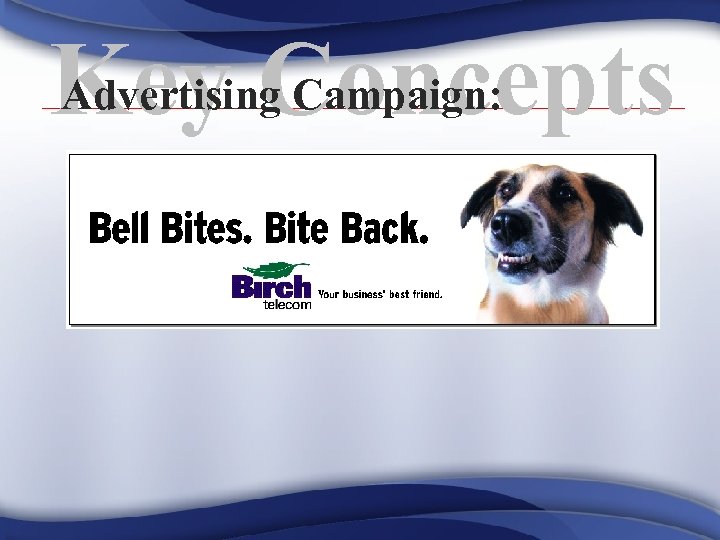
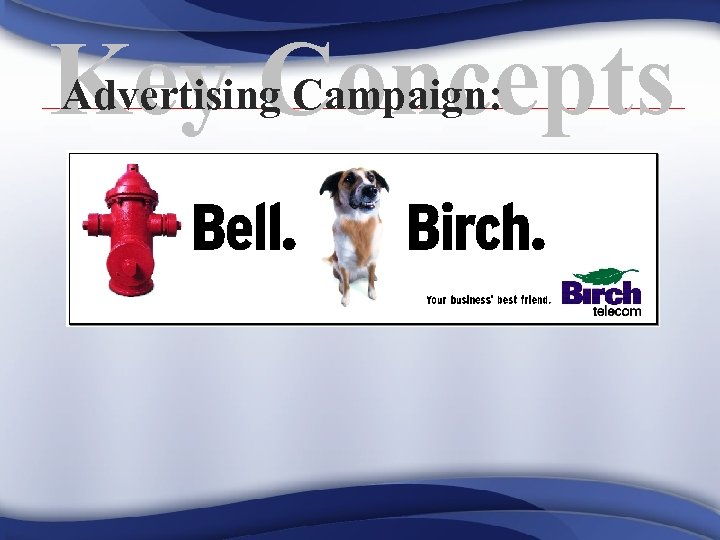
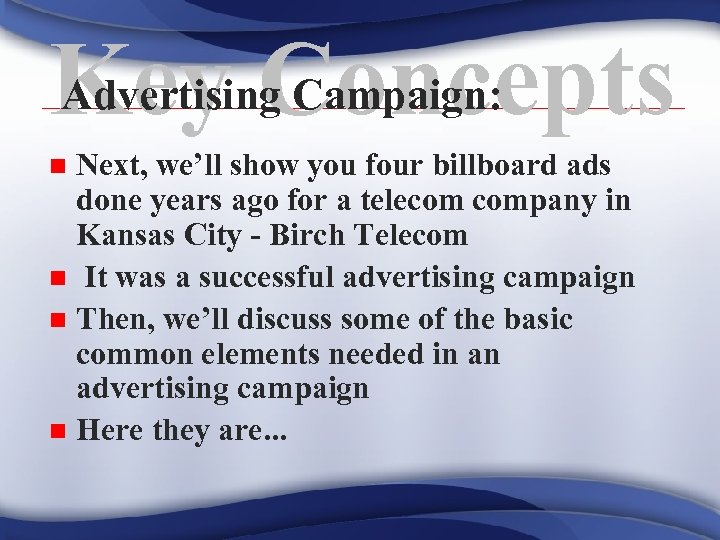 Advertising Campaign: Key Concepts Next, we’ll show you four billboard ads done years ago for a telecom company in Kansas City - Birch Telecom n It was a successful advertising campaign n Then, we’ll discuss some of the basic common elements needed in an advertising campaign n Here they are. . . n
 Advertising Campaign: Key Concepts
 Advertising Campaign: Key Concepts
 Advertising Campaign: Key Concepts
 Advertising Campaign: Key Concepts
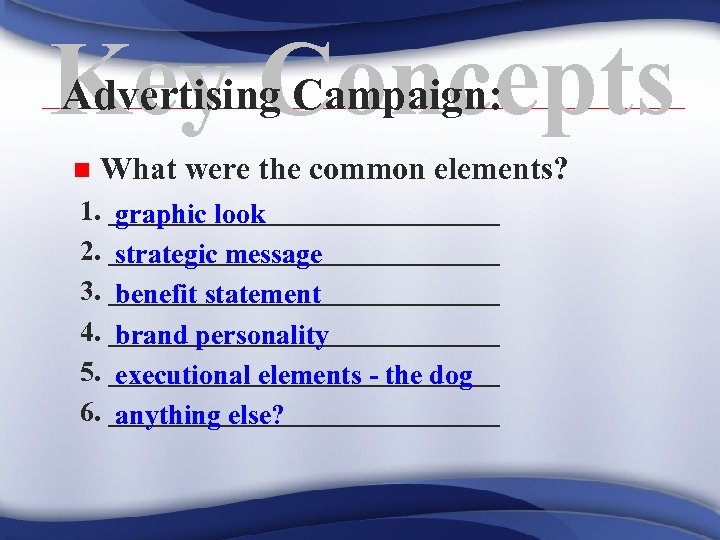 Advertising Campaign: Key Concepts n What were the common elements? 1. ______________ graphic look 2. ______________ strategic message 3. ______________ benefit statement 4. ______________ brand personality 5. ______________ executional elements - the dog 6. ______________ anything else?
 Advertising Campaign: Key Concepts n Campaigns are built with… Plans & Strategies
 Plans & Concepts Key. Strategies: Organized Actions and… n “Imaginative Reintegration” n Plans & Strategies are a combination of: n Tightly organized planned actions l Unique strategic configurations l Plans may contain strategies n Strategies need plans to be implemented n
 Plans & Concepts Key. Strategies: n Kenichi Ohmae (head of Mc. Kinsey Japan) “In business as on the battlefield, the object of strategy is to bring about the conditions most favorable to one’s own side. In strategic thinking , one first seeks a clear understanding of the particular character of each element of a situation, and then makes the fullest possible use of human brainpower to restructure the elements in the most advantageous way. ”
 Plans & Concepts Key. Strategies: n Kenichi Ohmae (head of Mc. Kinsey Japan) “Phenomena and events in the real world do not always fit a linear model. Hence, the most reliable means of dissecting a situation into its constituent parts and then reassembling them in the desired pattern is not a step-by-step methodology such as systems analysis. Rather, it is that ultimate non-linear thinking tool, the human brain. ”
 Plans & Concepts Key. Strategies: n Kenichi Ohmae (head of Mc. Kinsey Japan) “No matter how difficult or unprecedented the problem, a breakthrough to the best possible solution can come only from a combination of rational analysis based on the real nature of things, and imaginative reintegration of all the different items into a new pattern using nonlinear brain power. ”
 Plans & Concepts Key. Strategies: n n Now let’s talk about Plans Marketing Plans are written: l l n By the Advertisers By their Advertising Agencies Creative Plans may be called: l l l Creative strategies Creative blueprints Creative platforms Creative briefs And sometimes the word “communication” replaces the word “creative”
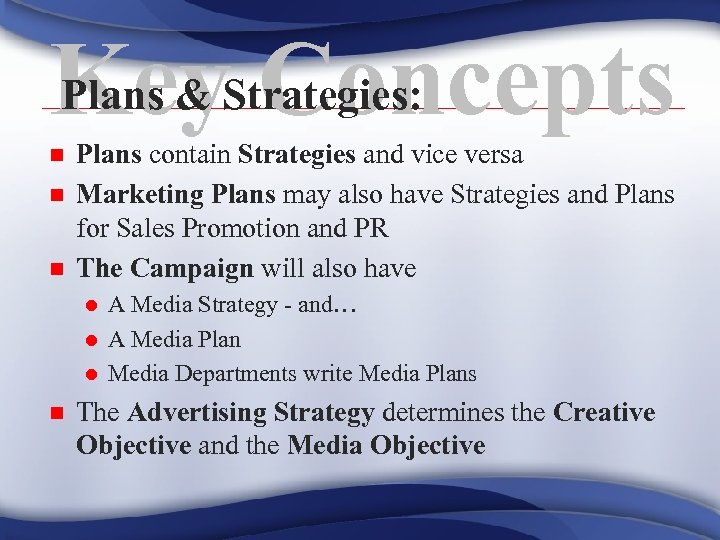 Plans & Concepts Key. Strategies: n n n Plans contain Strategies and vice versa Marketing Plans may also have Strategies and Plans for Sales Promotion and PR The Campaign will also have l l l n A Media Strategy - and… A Media Plan Media Departments write Media Plans The Advertising Strategy determines the Creative Objective and the Media Objective
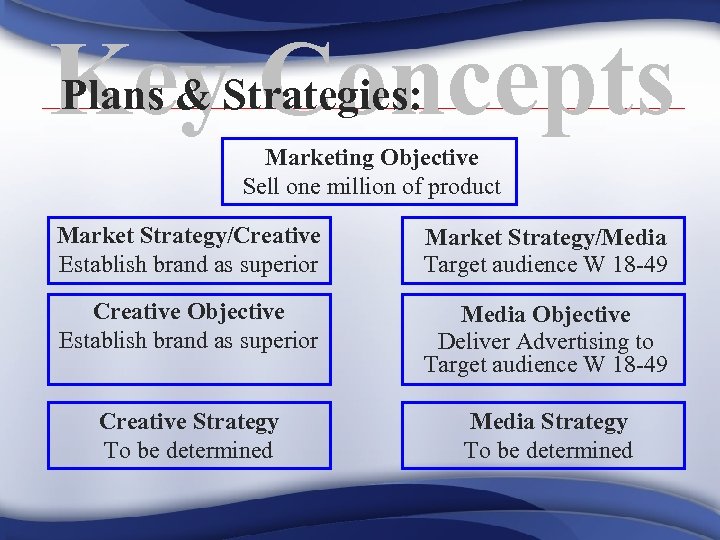 Plans & Concepts Key. Strategies: Marketing Objective Sell one million of product Market Strategy/Creative Establish brand as superior Market Strategy/Media Target audience W 18 -49 Creative Objective Establish brand as superior Media Objective Deliver Advertising to Target audience W 18 -49 Creative Strategy To be determined Media Strategy To be determined
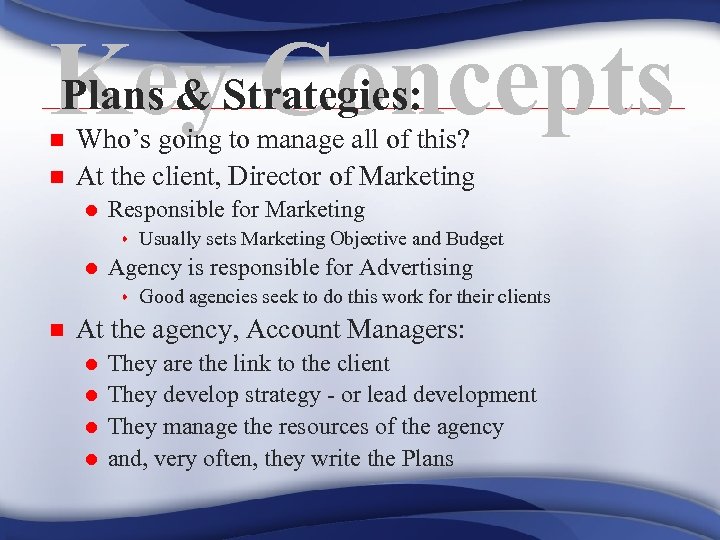 Plans & Concepts Key. Strategies: n n Who’s going to manage all of this? At the client, Director of Marketing l Responsible for Marketing s l Agency is responsible for Advertising s n Usually sets Marketing Objective and Budget Good agencies seek to do this work for their clients At the agency, Account Managers: l l They are the link to the client They develop strategy - or lead development They manage the resources of the agency and, very often, they write the Plans
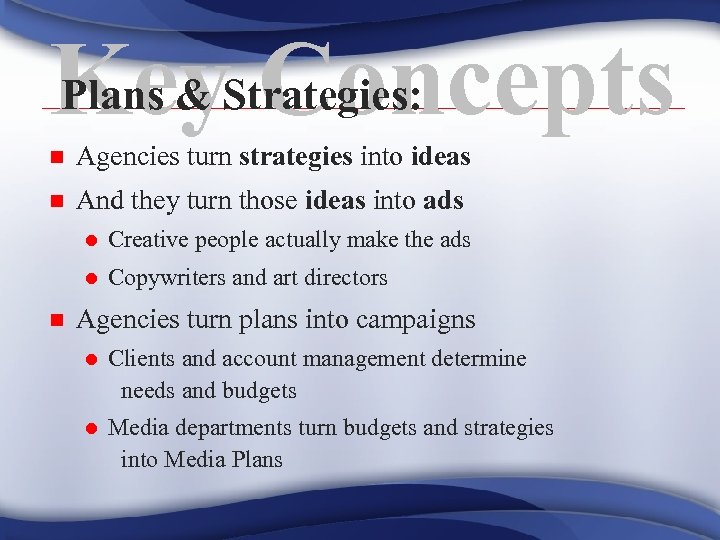 Plans & Concepts Key. Strategies: n Agencies turn strategies into ideas n And they turn those ideas into ads l l n Creative people actually make the ads Copywriters and art directors Agencies turn plans into campaigns l Clients and account management determine needs and budgets l Media departments turn budgets and strategies into Media Plans
 Plans & Concepts Key. Strategies: To make plans and strategies work, a lot of people have to work together. n And that means they have to speak… n The same language!
 Vocabulary: Key Concepts n The Language of Marketing & Advertising Original concepts came from military n Now the business of marketing has its own intellectual infrastructure - a way of thinking and a way of talking n Understanding the specific meanings of key words and concepts is critical n n Yes, it will be on the test!
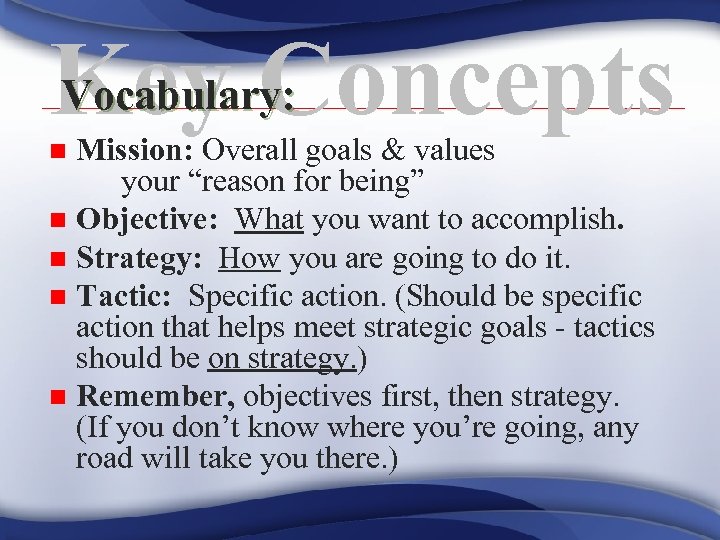 Vocabulary: Key Concepts Mission: Overall goals & values your “reason for being” n Objective: What you want to accomplish. n Strategy: How you are going to do it. n Tactic: Specific action. (Should be specific action that helps meet strategic goals - tactics should be on strategy. ) n Remember, objectives first, then strategy. (If you don’t know where you’re going, any road will take you there. ) n
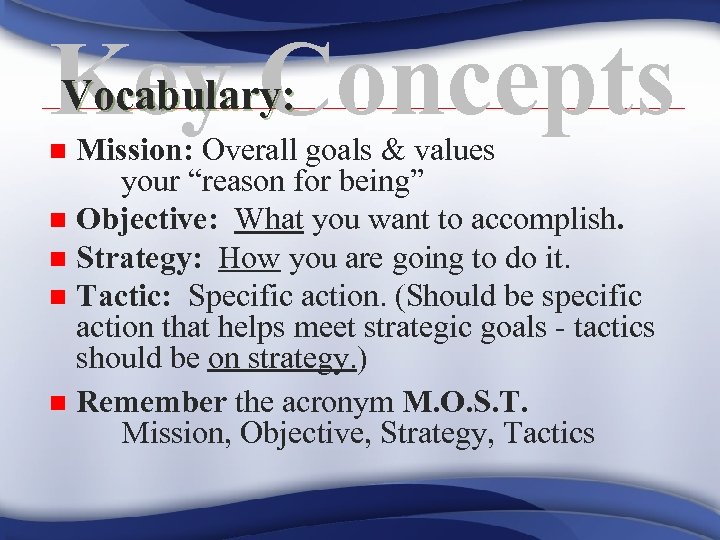 Vocabulary: Key Concepts Mission: Overall goals & values your “reason for being” n Objective: What you want to accomplish. n Strategy: How you are going to do it. n Tactic: Specific action. (Should be specific action that helps meet strategic goals - tactics should be on strategy. ) n Remember the acronym M. O. S. T. Mission, Objective, Strategy, Tactics n
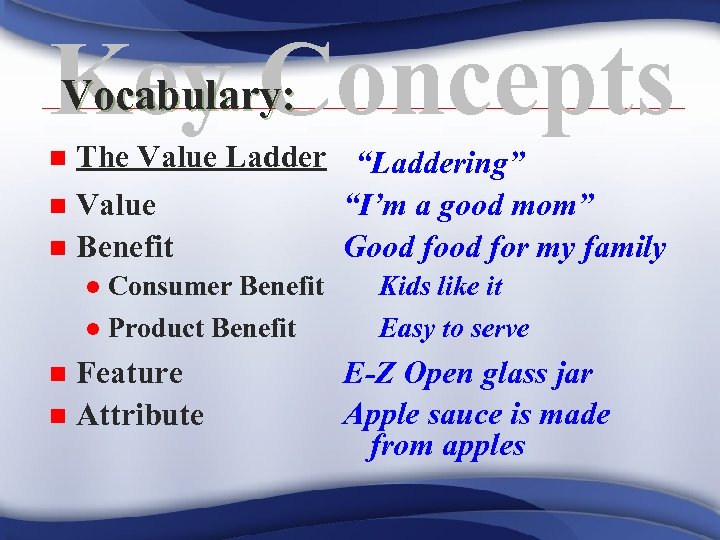 Vocabulary: Key Concepts The Value Ladder “Laddering” n Value “I’m a good mom” n Benefit Good for my family n Consumer Benefit l Product Benefit l Feature n Attribute n Kids like it Easy to serve E-Z Open glass jar Apple sauce is made from apples
 Vocabulary: Key Concepts Some More Important Words… n Target audience - person or group to whom advertising is directed n Primary target - the target audience l Secondary target - usually, the trade l Demographics - statistical description of target audience n Psychographics - psychological traits of target audience n
 Vocabulary: Key Concepts Some More Important Words… n Sales Promotion - use of incentives (a small bribe) to develop or stimulate sales n Public Relations (PR) - publicity through non -paid media n l Publics - a PR version of target audience Situation Analysis - beginning section of plan where current situation is evaluated n “SWOT” Analysis - Strengths, Weaknesses, Opportunities, and Threats n
 Vocabulary: Key Concepts Some Important Media Words… n Reach - percentage of the audience exposed to an advertising message n Frequency - average number of times audience has had the opportunity to see the message n GRPs (Gross Rating Points) - the sum of the ratings points (a point is one percent of the audience) n TRPs (Target Rating Points) - this is a subset, measuring rating points for the target group n
 Vocabulary: Key Concepts Some More Important Media Words… n CPM (Cost per thousand) - how much it costs to reach a thousand people (the “M” is the Roman numeral for a thousand) n CPP (Cost per point) - how much it costs to buy a “point” of the broadcast audience n Share - percentage of an audience tuned to a specific station or specific show n OK, now that we know how to talk about advertising, let’s talk about how it works… n
 Advertising How Advertising Works n Next, we’ll cover. . . Some things we know about people n Some things we know about advertising messages n The Lavidge-Steiner Learning Model n “AIDA” n
 Advertising How Advertising Works n Some things we know about people. n “People read what interests them, sometimes it’s an ad. ” (Gossage) n People are strategic - they look out for their own best interests. n People are bombarded with messages l A key concern is getting through clutter n People (and advertising) work from both logic and emotion
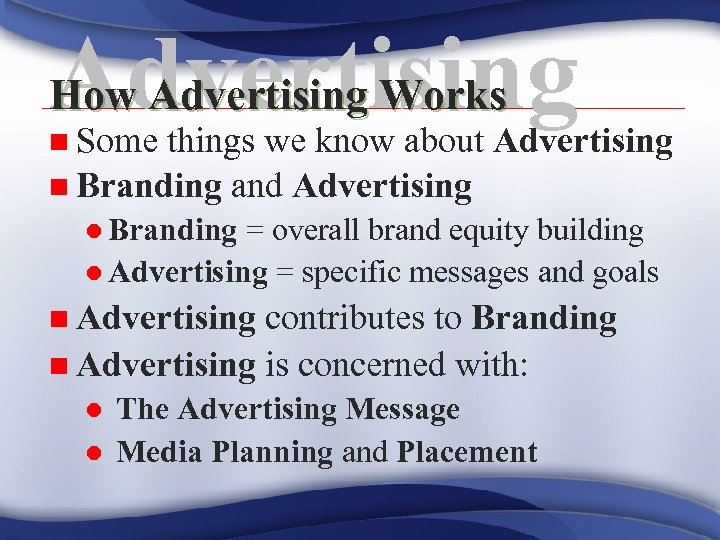 Advertising How Advertising Works n Some things we know about Advertising n Branding and Advertising l Branding = overall brand equity building l Advertising = specific messages and goals n Advertising contributes to Branding n Advertising is concerned with: l l The Advertising Message Media Planning and Placement
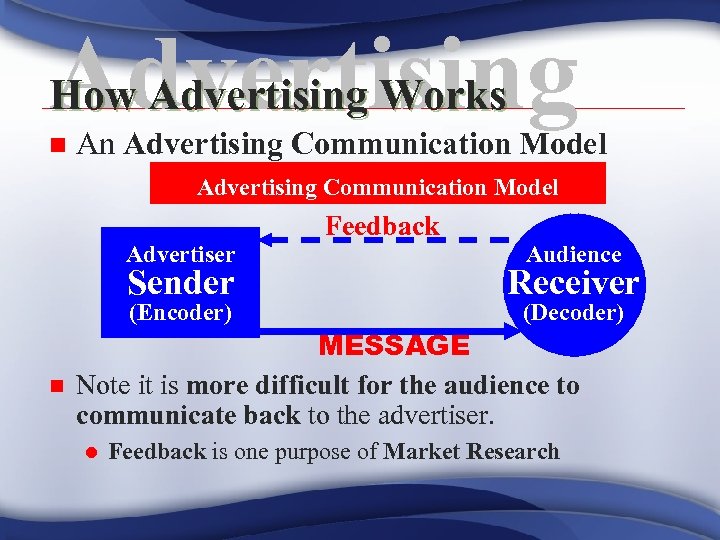 Advertising How Advertising Works n An Advertising Communication Model Feedback Advertiser Sender (Encoder) n Audience Receiver (Decoder) MESSAGE Note it is more difficult for the audience to communicate back to the advertiser. l Feedback is one purpose of Market Research
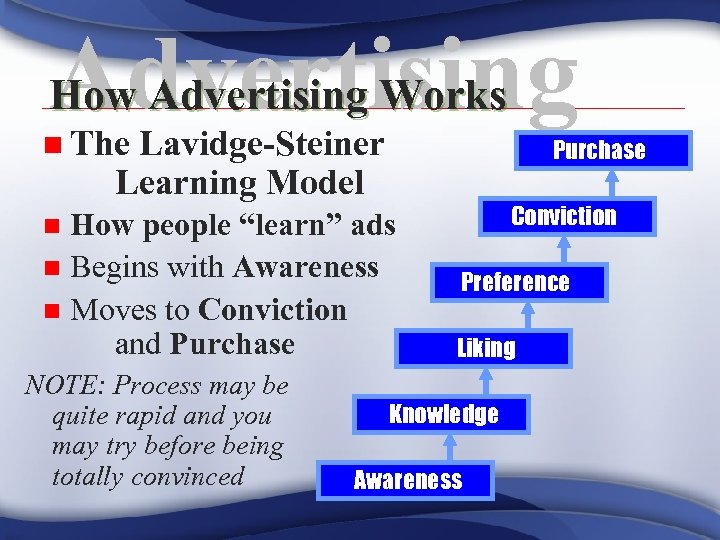 Advertising How Advertising Works n The Lavidge-Steiner Learning Model Purchase How people “learn” ads n Begins with Awareness n Moves to Conviction and Purchase Conviction n NOTE: Process may be quite rapid and you may try before being totally convinced Preference Liking Knowledge Awareness
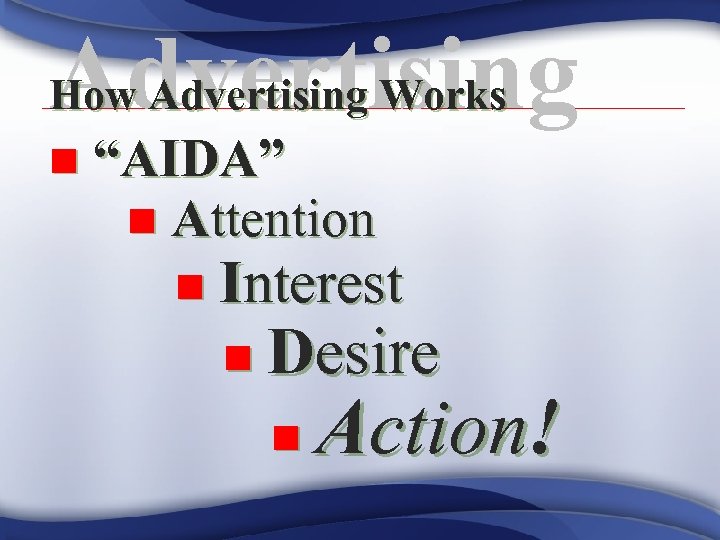 Advertising How Advertising Works n “AIDA” n Attention n Interest n Desire n Action!
 Advertising How Advertising Works n What we need to know: l Target Audience l Factors That Motivate Purchase Behavior l Unique Brand Characteristics
 Advertising How Advertising Works n More ways to think about Advertising n Factors That Influence Purchase Behavior l l n Basis of competition A critical decision The Problem The Advertising Must Solve l From the Y&R Creative Work Plan - one of the key tasks is determining what you want the advertising to do.
 Advertising How Advertising Works n More ways to think about Advertising n “Brand Contact Points” n Aperture and Personal Media Network n Unique Selling Proposition n “inherent drama” n Whatever and however you think about it, eventually you have to do it… n “You need a Plan!
 Planning Introduction n The n Planning Process Generally, plans cover at least four areas: Marketing Objective and Strategy (The 5 Ps) l Advertising Objective and Strategy l Creative Strategy (The Advertising Message) l Media Objective and Media Strategy l Other Plans and Strategies l s Sales Promotion, PR, etc.
 Planning Introduction n The Planning Process Generally, this approach is right for a consumer-oriented marketer. n For example, a small industrial firm might emphasize other things - such as: n Trade Shows and Trade Advertising l Their own Sales Force or Sales Reps l Current Customer Relationships l n However, the underlying principles apply.
 Planning Introduction n The Planning Process
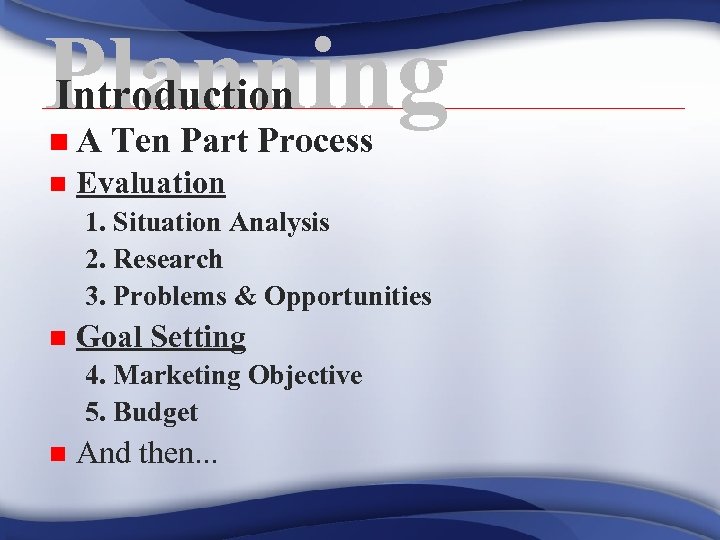 Planning Introduction n. A n Ten Part Process Evaluation 1. Situation Analysis 2. Research 3. Problems & Opportunities n Goal Setting 4. Marketing Objective 5. Budget n And then. . .
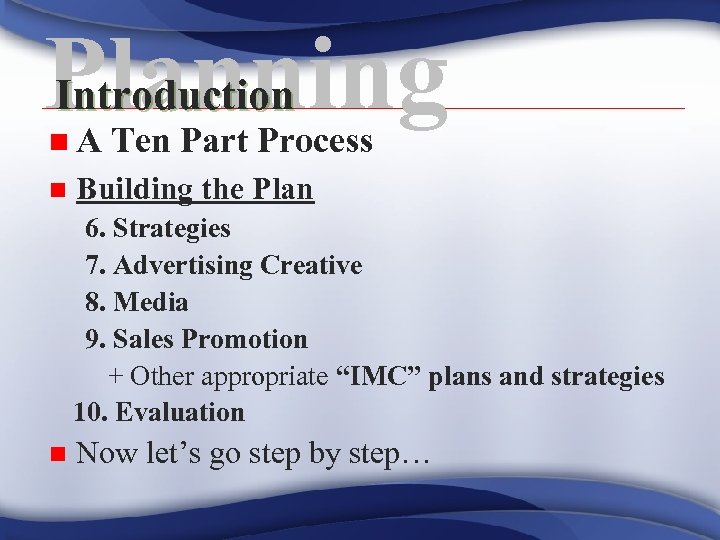 Planning Introduction n. A n Ten Part Process Building the Plan 6. Strategies 7. Advertising Creative 8. Media 9. Sales Promotion + Other appropriate “IMC” plans and strategies 10. Evaluation n Now let’s go step by step…
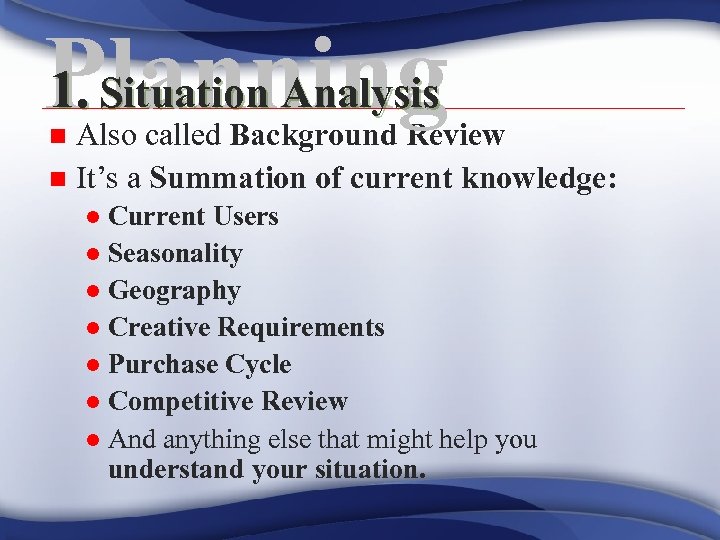 1. Situation Analysis Planning Also called Background Review n It’s a Summation of current knowledge: n Current Users l Seasonality l Geography l Creative Requirements l Purchase Cycle l Competitive Review l And anything else that might help you understand your situation. l
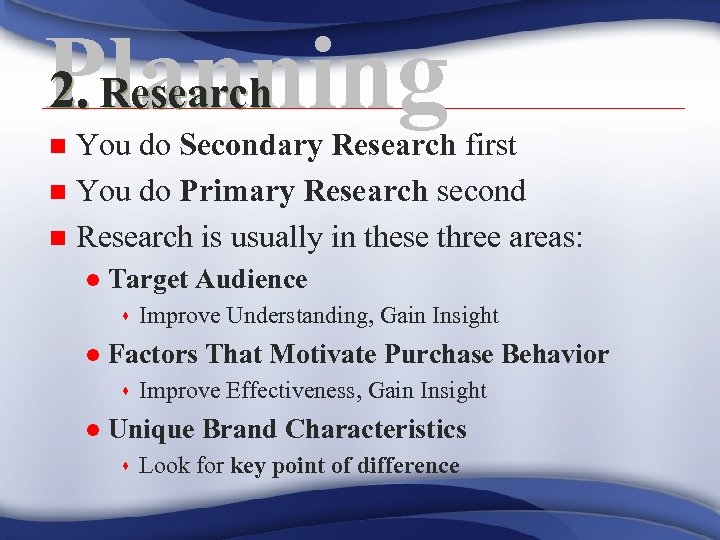 2. Research Planning You do Secondary Research first n You do Primary Research second n Research is usually in these three areas: n l Target Audience s l Factors That Motivate Purchase Behavior s l Improve Understanding, Gain Insight Improve Effectiveness, Gain Insight Unique Brand Characteristics s Look for key point of difference
 2. Research Planning n Research Techniques: l Qualitative Research Focus groups s One-on-one interviews s l Quantitative Research Surveys s Observation s Experiments s n When preparing The Research Plan s Be sure to know what you’re looking for!
 3. Problems & Opportunities Planning n Also known as a “SWOT” Analysis l Strengths, Weaknesses, Opportunities, Threats “For every problem there is an opportunity” n Understanding problems is a critical skill n Identify the right problem and you’re on the road to the solution n And, whatever you do… n Don’t solve the wrong problem! n
 4. The Objective Planning n The n It Marketing Objective is a number is the goal of your marketing activities l Usually, it is a sales or volume goal l It may be difficult to get to, but the final answer is simple and measurable.
 5. The Budget Planning Determining a budget usually involves asking two very important questions: l How much will it take? l How much do we have? n Here are ways marketers work to develop good answers to those questions. n
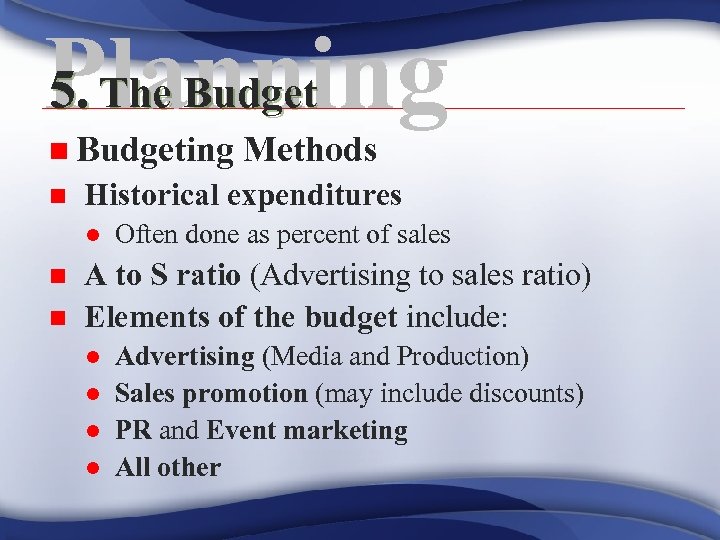 5. The Budget Planning n Budgeting n Historical expenditures l n n Methods Often done as percent of sales A to S ratio (Advertising to sales ratio) Elements of the budget include: l l Advertising (Media and Production) Sales promotion (may include discounts) PR and Event marketing All other
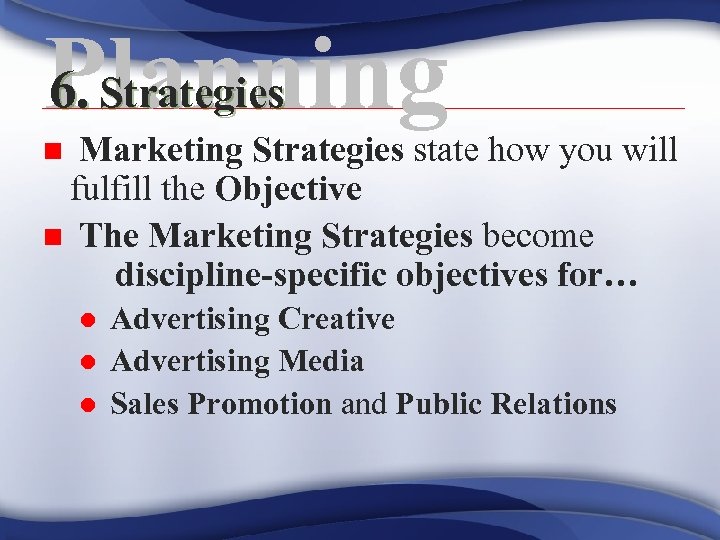 6. Strategies Planning Marketing Strategies state how you will fulfill the Objective n The Marketing Strategies become discipline-specific objectives for… n l l l Advertising Creative Advertising Media Sales Promotion and Public Relations
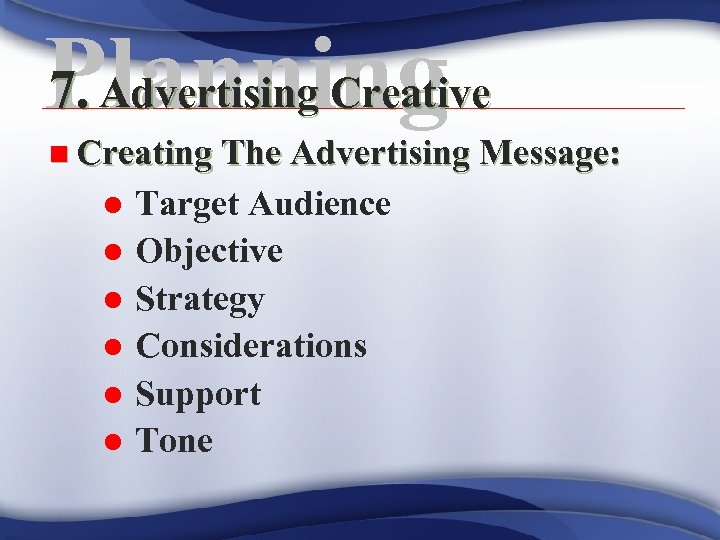 7. Advertising Creative Planning n Creating The Advertising Message: l l l Target Audience Objective Strategy Considerations Support Tone
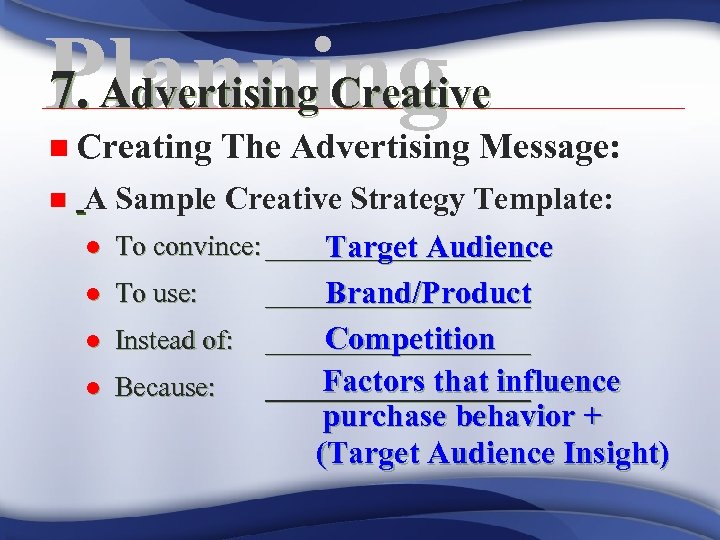 7. Advertising Creative Planning n Creating n The Advertising Message: A Sample Creative Strategy Template: l To convince: __________ Target Audience l To use: __________ Brand/Product Competition l Instead of: __________ Factors that influence l Because: __________ purchase behavior + (Target Audience Insight)
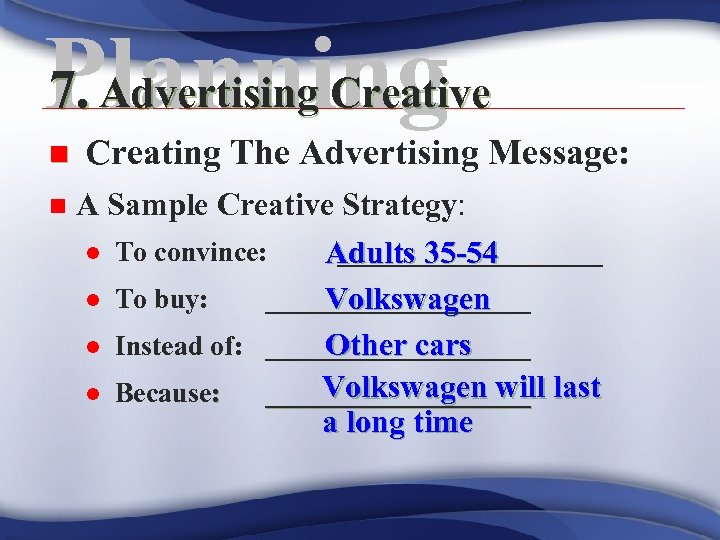 7. Advertising Creative Planning n n Creating The Advertising Message: A Sample Creative Strategy: l To convince: __________ Adults 35 -54 l To buy: __________ Volkswagen Other cars l Instead of: __________ Volkswagen will l Because: __________ last a long time
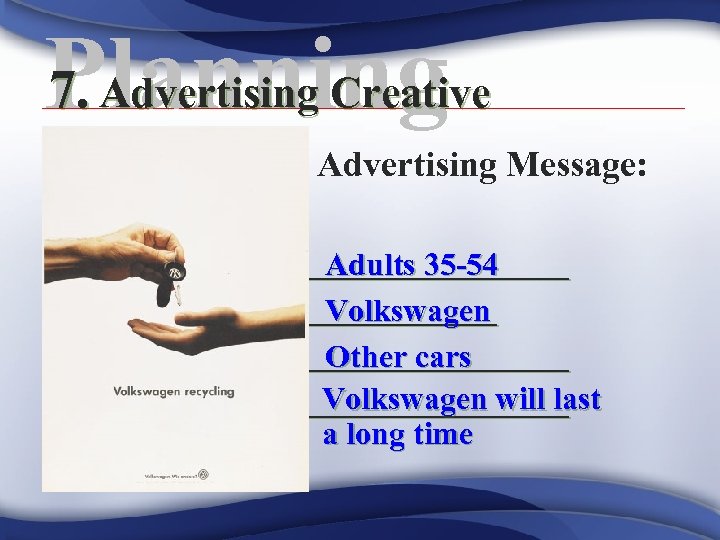 7. Advertising Creative Planning n Creating The Advertising Message: n To convince: __________ Adults 35 -54 n To buy: __________ Volkswagen n Instead of: __________ Other cars Volkswagen will last n Because: __________ a long time n
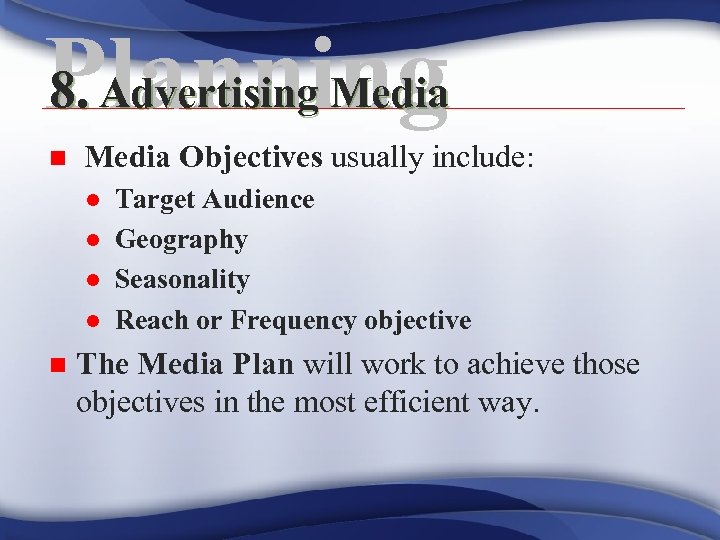 8. Advertising Media Planning n Media Objectives usually include: l l n Target Audience Geography Seasonality Reach or Frequency objective The Media Plan will work to achieve those objectives in the most efficient way.
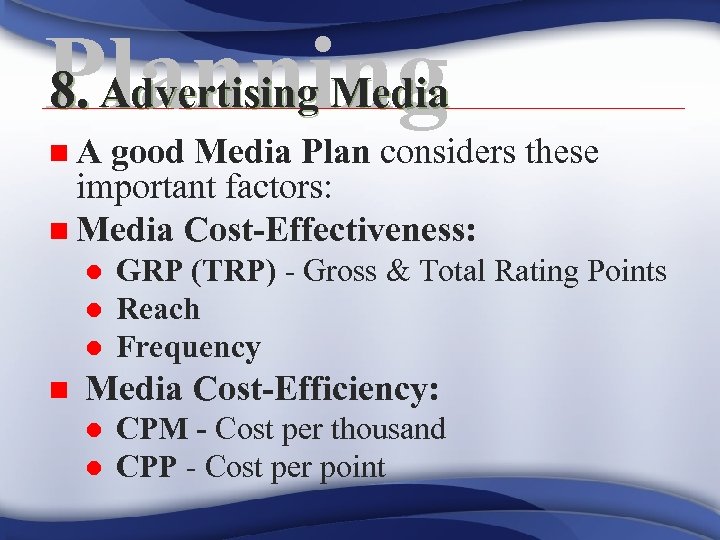 8. Advertising Media Planning n. A good Media Plan considers these important factors: n Media Cost-Effectiveness: l l l n GRP (TRP) - Gross & Total Rating Points Reach Frequency Media Cost-Efficiency: l l CPM - Cost per thousand CPP - Cost per point
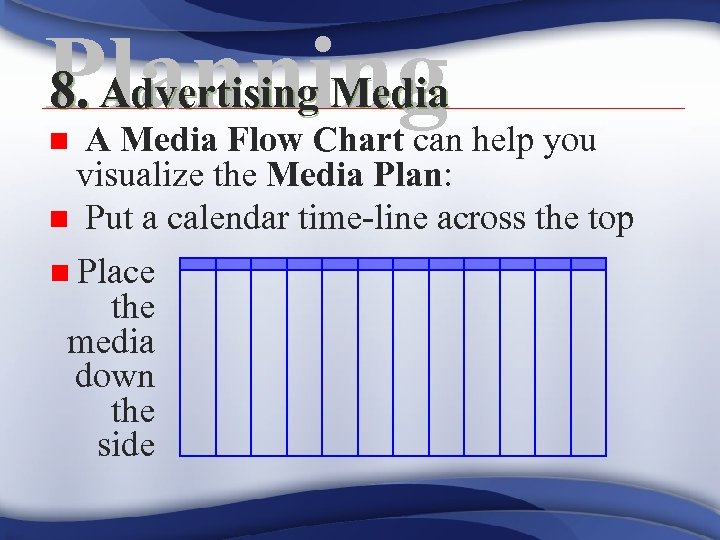 8. Advertising Media Planning A Media Flow Chart can help you visualize the Media Plan: n Put a calendar time-line across the top n Place the media down the side n
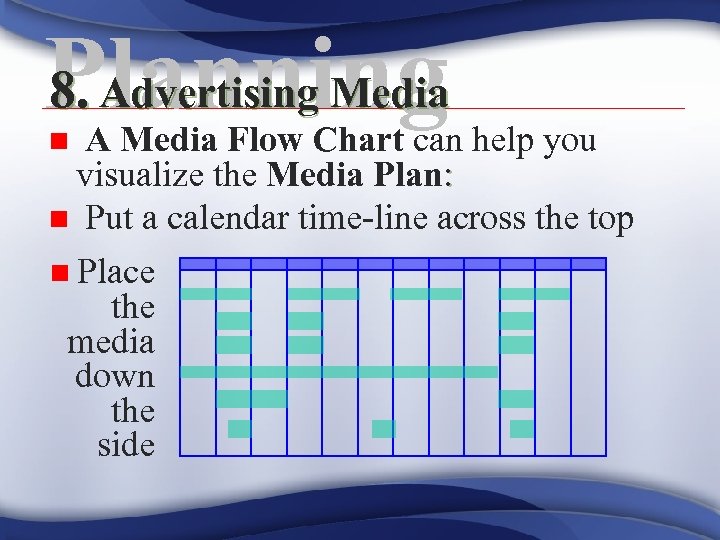 8. Advertising Media Planning A Media Flow Chart can help you visualize the Media Plan: n Put a calendar time-line across the top n Place the media down the side n
 9. Sales Promotion & Planning PR n Sales Promotion = l l l n Tangible motivation to buy An incentive or small bribe To both consumers and the trade Public Relations = l l Non-paid media coverage 3 rd party endorsement (reviews, etc. ) Marketing PR (MPR) Not Corporate PR (CPR)
 9. Sales Promotion & Planning PR n n Sales Promotion Consumer Promotion = Win/Free/Save l l l n Sweepstakes & Contests Added Value Extras/Bonus Packs Coupons/Savings/Rebates Trade Promotion = l l l Allowances Other Payments/Incentives Events/Sales Contests
 9. Sales Promotion & Planning PR n Public Relations = Product Publicity Opportunities l 3 rd Party Endorsements & “Influencers” (columnists, talk show hosts, etc. ) l Press Relations l Other Strategic Publicity l n n May also include… Event Marketing
 10. Evaluation Planning n n It starts and ends with Research Methods for evaluating the plan. Input/learning for next year’s plan Methods include: l l n Tracking studies Attitude, usage, and awareness studies Creative l l Recall Persuasion
 In Conclusion Planning Putting plans and strategies together is a lot of work. n It’s worth it, because this is the way to build sales and make the most of a business’s potential. n If you go to work in The Business of Brands, chances are, you’ll have to play a part creating a winning plan. n