


 Скачать презентацию CHAPTER 8 Inventory Management Pearson Education Inc
0b807027d1484227312c6cceb0d45d3a.ppt
- Количество слайдов: 33
 CHAPTER 8 Inventory Management © Pearson Education, Inc. publishing as Prentice Hall
 Learning Objectives • To learn about the ways that inventory can be classified • To discuss inventory costs and the trade-offs that exist among them • To identify when to order an how much to order, with a particular emphasis on the economic order quantity © Pearson Education, Inc. publishing as Prentice Hall 8 -2
 Learning Objectives • To differentiate the various inventory flow patterns • To discuss special concerns with inventory management • To identify several contemporary approaches to managing inventory © Pearson Education, Inc. publishing as Prentice Hall 8 -3
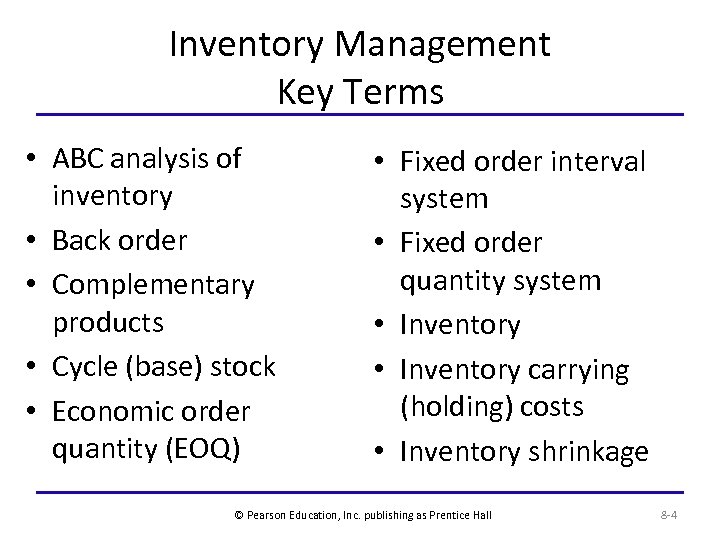 Inventory Management Key Terms • ABC analysis of inventory • Back order • Complementary products • Cycle (base) stock • Economic order quantity (EOQ) • Fixed order interval system • Fixed order quantity system • Inventory carrying (holding) costs • Inventory shrinkage © Pearson Education, Inc. publishing as Prentice Hall 8 -4
 Inventory Management Key Terms • Inventory turnover • Just-in-time (JIT) approach • Lean manufacturing (lean) • Ordering costs • Pipeline (in-transit) stock • Psychic stock • Reorder (trigger) point (ROP) • Safety (buffer) stock • Service parts logistics • Speculative stock • Stockout costs • Substitute products • Vendor-managed inventory (VMI) © Pearson Education, Inc. publishing as Prentice Hall 8 -5
 Inventory Management • Inventory refers to stocks of goods and materials that are maintained for many purposes, the most common being to satisfy normal demand patterns. © Pearson Education, Inc. publishing as Prentice Hall 8 -6
 Inventory Management • Inventory management – Decisions drive other logistics activities – Objectives can differ for different functional areas of an organization – Must consider inventory costs • Carrying costs • Ordering costs • Stockout costs © Pearson Education, Inc. publishing as Prentice Hall 8 -7
 Inventory Classifications • Cycle or base stock refers to inventory that is needed to satisfy normal demand during the course of an order cycle. • Safety or buffer stock refers to inventory that is held in addition to cycle stock to guard against uncertainty in demand or lead time. © Pearson Education, Inc. publishing as Prentice Hall 8 -8
 Inventory Classifications • Pipeline or in-transit stock is inventory that is en route between various fixed facilities in a logistics system such as a plant, warehouse, or store. • Speculative stock refers to inventory that is held for several reasons, including seasonal demand, projected price increases, and potential shortages of a product. • Psychic stock is inventory carried to stimulate demand (retail). © Pearson Education, Inc. publishing as Prentice Hall 8 -9
 Inventory Costs • Inventory costs in the twenty-first century represent approximately one-third of total logistics costs. • Inventory cost should factor into an organization’s inventory management policy. • Inventory costs include: – Carrying cost – Ordering cost – Stockout cost © Pearson Education, Inc. publishing as Prentice Hall 8 -10
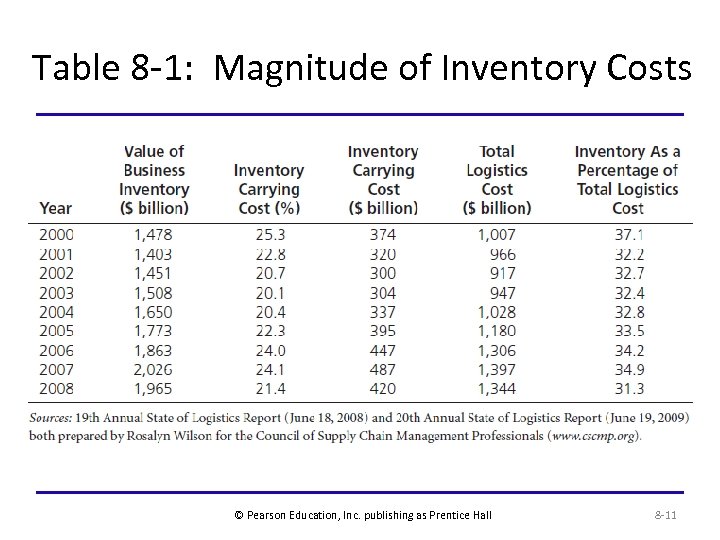 Table 8 -1: Magnitude of Inventory Costs © Pearson Education, Inc. publishing as Prentice Hall 8 -11
 Inventory Costs • Inventory carrying (holding) costs are the costs associated with holding inventory. © Pearson Education, Inc. publishing as Prentice Hall 8 -12
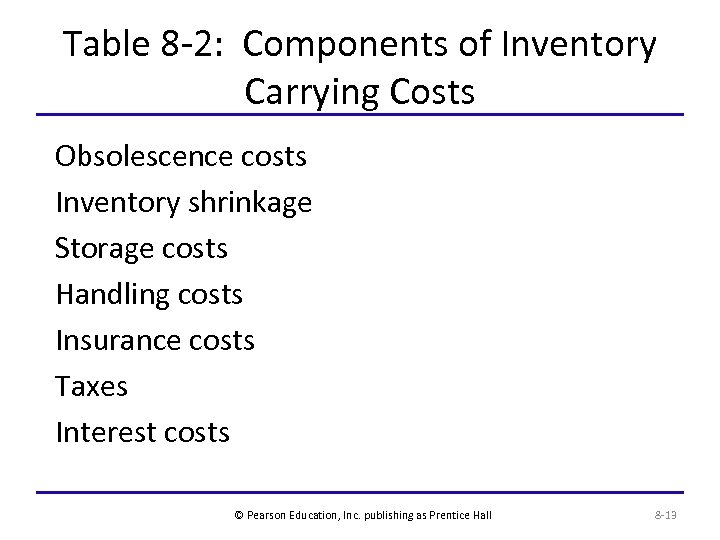 Table 8 -2: Components of Inventory Carrying Costs Obsolescence costs Inventory shrinkage Storage costs Handling costs Insurance costs Taxes Interest costs © Pearson Education, Inc. publishing as Prentice Hall 8 -13
 Inventory Costs • Ordering costs refer to those costs associated with ordering inventory, such as order costs and setup costs. © Pearson Education, Inc. publishing as Prentice Hall 8 -14
 Inventory Costs • Examples of order costs include: – Costs of receiving an order (wages) – Conducting a credit check – Verifying inventory availability – Entering orders into the system – Preparing invoices – Receiving payment © Pearson Education, Inc. publishing as Prentice Hall 8 -15
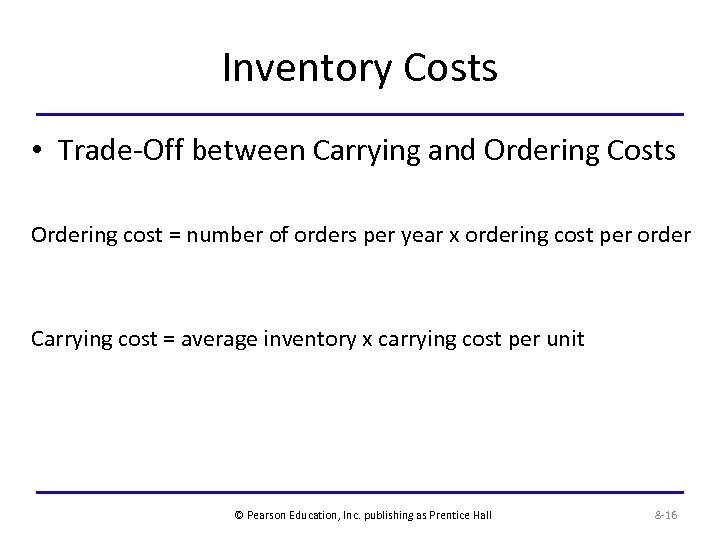 Inventory Costs • Trade-Off between Carrying and Ordering Costs Ordering cost = number of orders per year x ordering cost per order Carrying cost = average inventory x carrying cost per unit © Pearson Education, Inc. publishing as Prentice Hall 8 -16
 Inventory Costs • Stockout cost is an estimated cost or penalty that is realized when a company is out of stock when a customer wants to buy an item. • Stockout costs involve an understanding of a customer’s reaction to a company being out of stock. © Pearson Education, Inc. publishing as Prentice Hall 8 -17
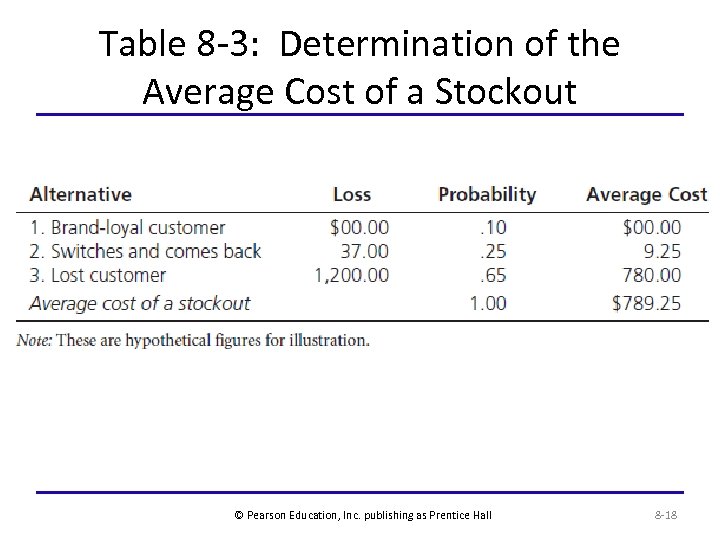 Table 8 -3: Determination of the Average Cost of a Stockout © Pearson Education, Inc. publishing as Prentice Hall 8 -18
 Inventory Costs • General Rules Regarding Stockout Costs – The higher the average cost of a stockout, the better it is for the company to hold some amount of inventory (SS) to protect against stockouts. – The higher the probability of a delayed sale, the lower the average stockout costs and the lower the inventory that needs to be held by a company. © Pearson Education, Inc. publishing as Prentice Hall 8 -19
 Inventory Costs • Trade-Off between Carrying and Stockout Costs – Higher inventory levels (higher carrying costs) result in lower chances of a stockout (lower stockout costs) © Pearson Education, Inc. publishing as Prentice Hall 8 -20
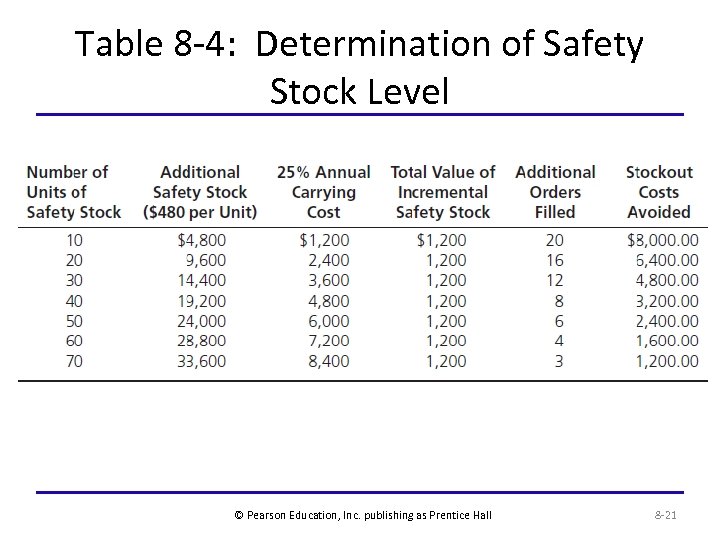 Table 8 -4: Determination of Safety Stock Level © Pearson Education, Inc. publishing as Prentice Hall 8 -21
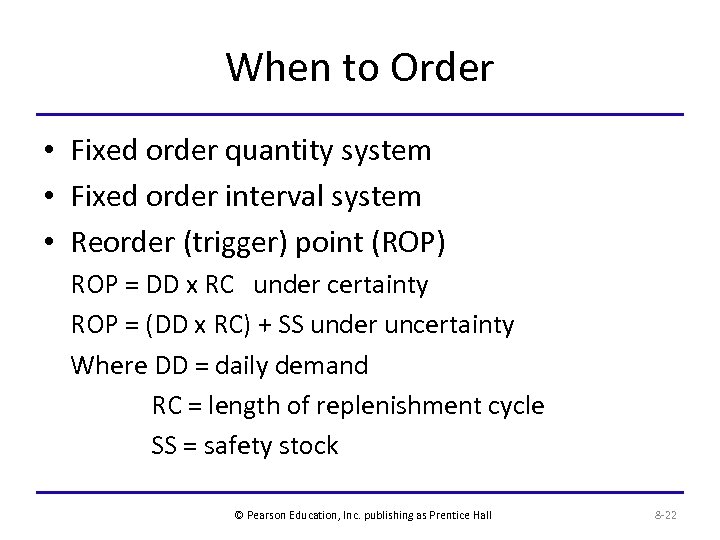 When to Order • Fixed order quantity system • Fixed order interval system • Reorder (trigger) point (ROP) ROP = DD x RC under certainty ROP = (DD x RC) + SS under uncertainty Where DD = daily demand RC = length of replenishment cycle SS = safety stock © Pearson Education, Inc. publishing as Prentice Hall 8 -22
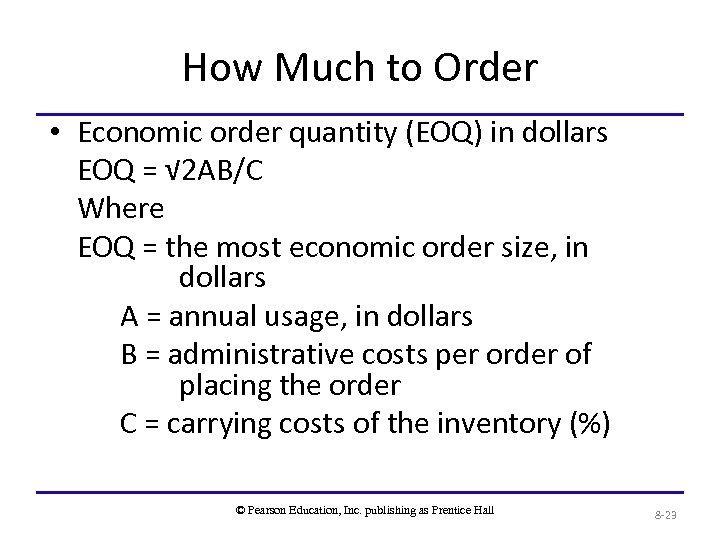 How Much to Order • Economic order quantity (EOQ) in dollars EOQ = √ 2 AB/C Where EOQ = the most economic order size, in dollars A = annual usage, in dollars B = administrative costs per order of placing the order C = carrying costs of the inventory (%) © Pearson Education, Inc. publishing as Prentice Hall 8 -23
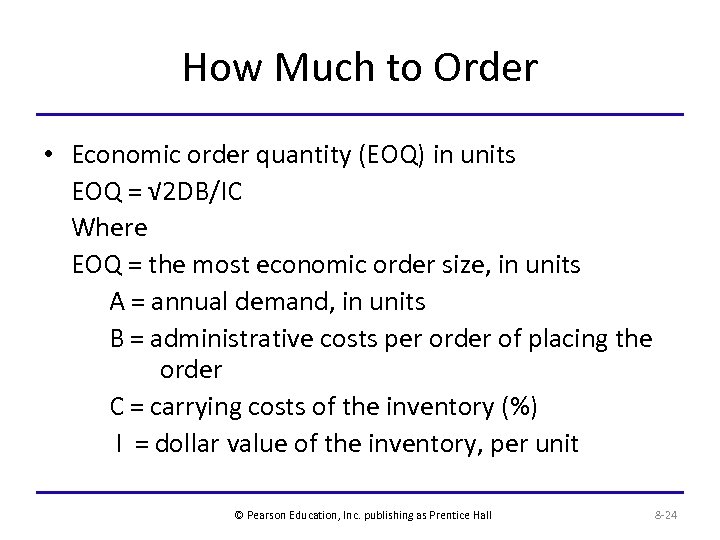 How Much to Order • Economic order quantity (EOQ) in units EOQ = √ 2 DB/IC Where EOQ = the most economic order size, in units A = annual demand, in units B = administrative costs per order of placing the order C = carrying costs of the inventory (%) I = dollar value of the inventory, per unit © Pearson Education, Inc. publishing as Prentice Hall 8 -24
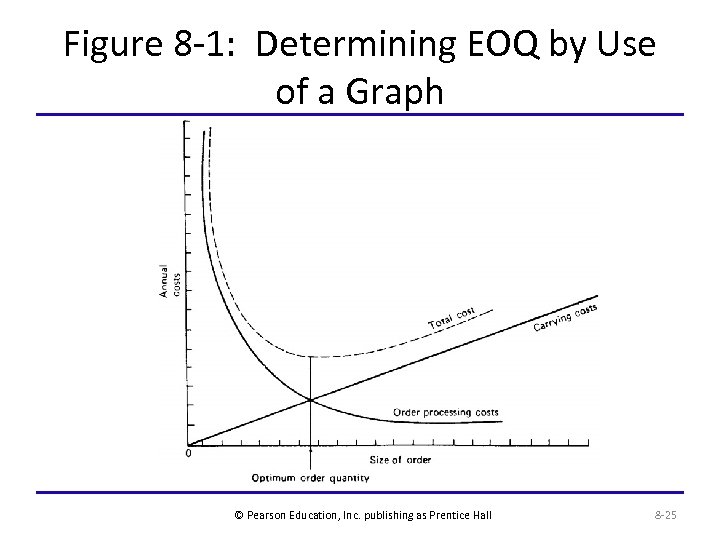 Figure 8 -1: Determining EOQ by Use of a Graph © Pearson Education, Inc. publishing as Prentice Hall 8 -25
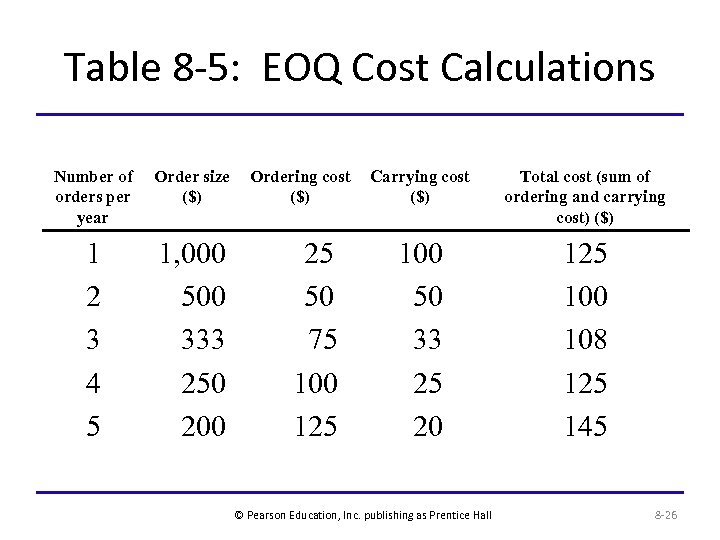 Table 8 -5: EOQ Cost Calculations Number of orders per year Order size ($) 1 2 3 4 5 1, 000 500 333 250 200 Ordering cost ($) 25 50 75 100 125 Carrying cost ($) Total cost (sum of ordering and carrying cost) ($) 100 50 33 25 20 125 100 108 125 145 © Pearson Education, Inc. publishing as Prentice Hall 8 -26
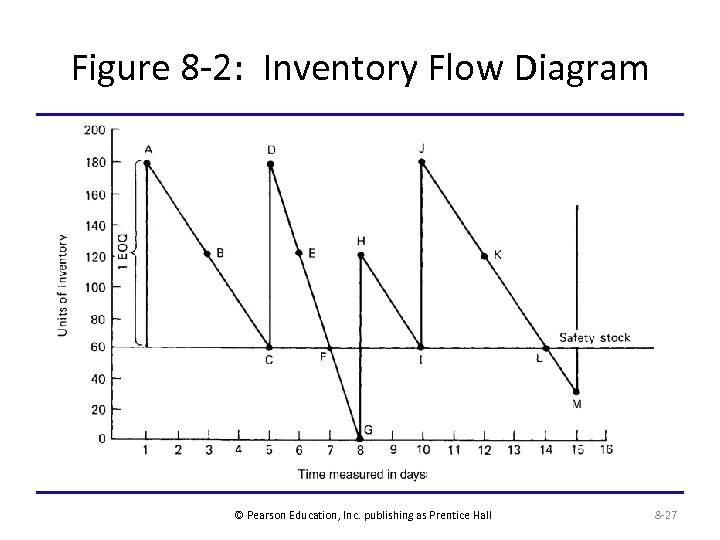 Figure 8 -2: Inventory Flow Diagram © Pearson Education, Inc. publishing as Prentice Hall 8 -27
 Inventory Flows • Safety stock can prevent against two problem areas – Increased rate of demand – Longer-than-normal replenishment • When fixed order quantity system like EOQ is used, time between orders may vary • When reorder point is reached, fixed order quantity is ordered © Pearson Education, Inc. publishing as Prentice Hall 8 -28
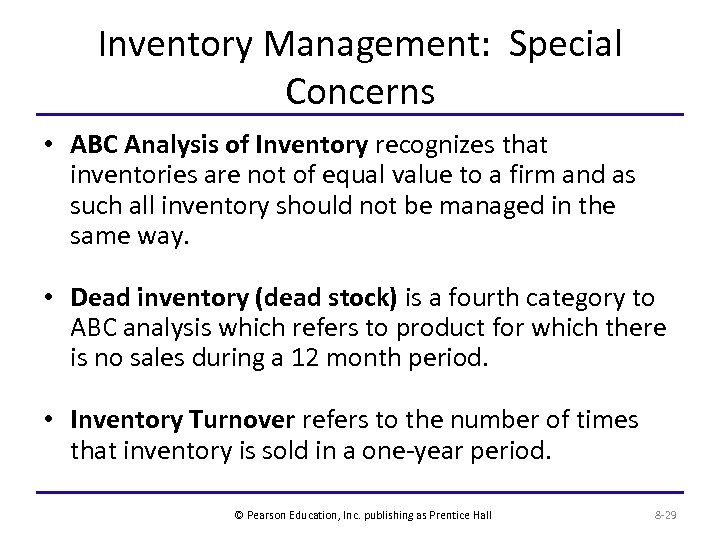 Inventory Management: Special Concerns • ABC Analysis of Inventory recognizes that inventories are not of equal value to a firm and as such all inventory should not be managed in the same way. • Dead inventory (dead stock) is a fourth category to ABC analysis which refers to product for which there is no sales during a 12 month period. • Inventory Turnover refers to the number of times that inventory is sold in a one-year period. © Pearson Education, Inc. publishing as Prentice Hall 8 -29
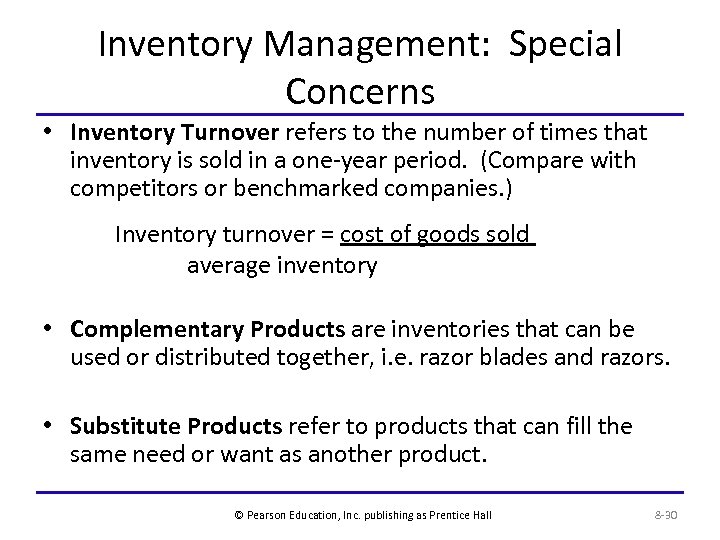 Inventory Management: Special Concerns • Inventory Turnover refers to the number of times that inventory is sold in a one-year period. (Compare with competitors or benchmarked companies. ) Inventory turnover = cost of goods sold average inventory • Complementary Products are inventories that can be used or distributed together, i. e. razor blades and razors. • Substitute Products refer to products that can fill the same need or want as another product. © Pearson Education, Inc. publishing as Prentice Hall 8 -30
 Contemporary Approaches to Managing Inventory • Lean Manufacturing • Service Parts Logistics • Vendor-Managed Inventory (VMI) © Pearson Education, Inc. publishing as Prentice Hall 8 -31
 Copyright Notice © Pearson Education, Inc. publishing as Prentice Hall 8 -32
 All rights reserved. No part of this publication may be reproduced, stored in a retrieval system, or transmitted, in any form or by any means, electronic, mechanical, photocopying, recording, or otherwise, without the prior written permission of the publisher. Printed in the United States of America.