


 Скачать презентацию Chapter 8 Implementing Strategies Marketing Finance Accounting R D and
14e1c0994d1c748c01d6e0c61e114f5f.ppt
- Количество слайдов: 40
 Chapter 8 Implementing Strategies: Marketing, Finance/Accounting, R&D, and MIS Issues Strategic Management: Concepts & Cases 13 th Edition Fred David Copyright © 2011 Pearson Education, Inc. Publishing as Prentice Hall 1
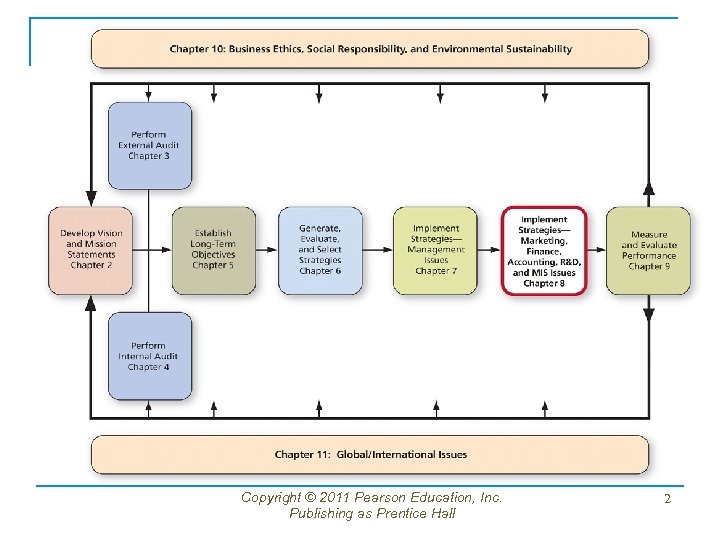 Copyright © 2011 Pearson Education, Inc. Publishing as Prentice Hall 2
 Implementing Strategies “The greatest strategy is doomed if it’s implemented badly. ” – Bernard Reimann Copyright © 2011 Pearson Education, Inc. Publishing as Prentice Hall 3
 The Nature of Strategy Implementation Less than 10% of strategies formulated are successfully implemented! Copyright © 2011 Pearson Education, Inc. Publishing as Prentice Hall 4
 Marketing Issues Marketing decisions requiring policies n n n n Exclusive dealerships or multiple channels of distribution Heavy, light, or no TV advertising To limit or not the share of business with a single customer Price leader or price follower Offer complete or limited warranty Reward salespeople with commission or salary Advertise online or not Copyright © 2011 Pearson Education, Inc. Publishing as Prentice Hall 5
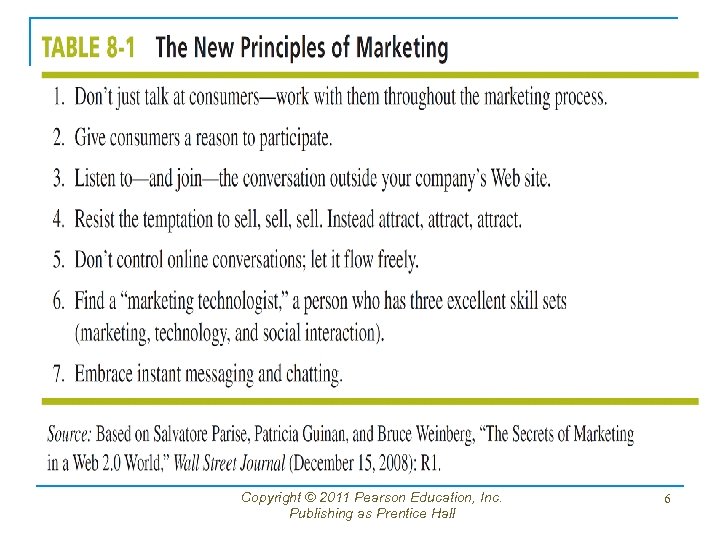 Copyright © 2011 Pearson Education, Inc. Publishing as Prentice Hall 6
 Current Marketing Issues n Advertising media n Purpose-based marketing Copyright © 2011 Pearson Education, Inc. Publishing as Prentice Hall 7
 Marketing Issues n Market segmentation n Product positioning Copyright © 2011 Pearson Education, Inc. Publishing as Prentice Hall 8
 Marketing Issues Market Segmentation n Subdividing of a market into distinct subsets of customers according to needs and buying habits Copyright © 2011 Pearson Education, Inc. Publishing as Prentice Hall 9
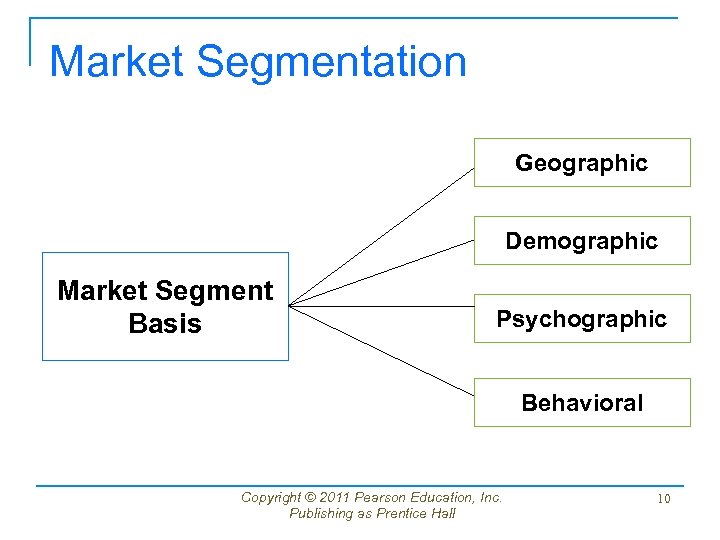 Market Segmentation Geographic Demographic Market Segment Basis Psychographic Behavioral Copyright © 2011 Pearson Education, Inc. Publishing as Prentice Hall 10
 Market Segmentation n Market-development, productdevelopment, market-penetration, and diversification strategies require market segmentation Market segmentation allows operating with limited resources; enables small firms to compete successfully Market segmentation decisions affect marketing mix variables Copyright © 2011 Pearson Education, Inc. Publishing as Prentice Hall 11
 Marketing Mix Variables Product n Place n Promotion n Price n Copyright © 2011 Pearson Education, Inc. Publishing as Prentice Hall 12
 Marketing Issues Product Positioning Schematic representations that reflect how products/services compare to competitors’ on dimensions most important to success in the industry Copyright © 2011 Pearson Education, Inc. Publishing as Prentice Hall 13
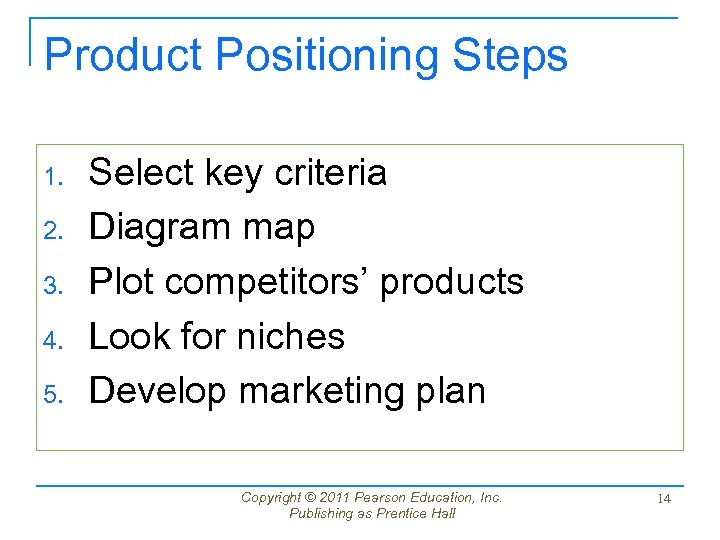 Product Positioning Steps 1. 2. 3. 4. 5. Select key criteria Diagram map Plot competitors’ products Look for niches Develop marketing plan Copyright © 2011 Pearson Education, Inc. Publishing as Prentice Hall 14
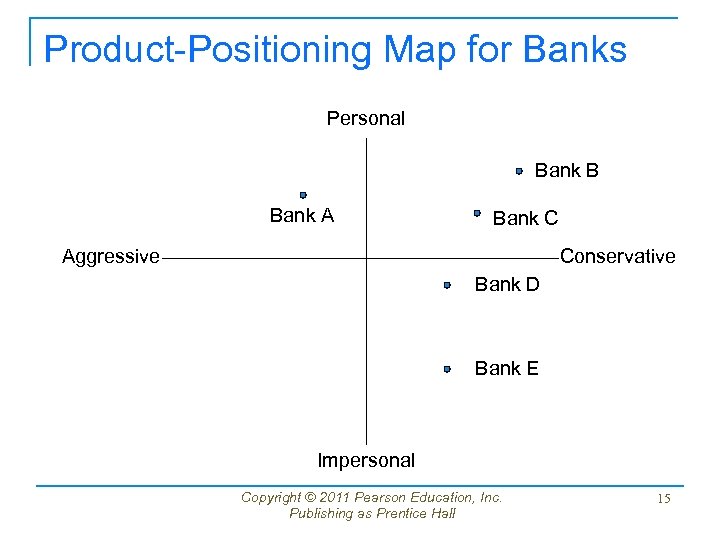 Product-Positioning Map for Banks Personal Bank B Bank A Bank C Aggressive Conservative Bank D Bank E Impersonal Copyright © 2011 Pearson Education, Inc. Publishing as Prentice Hall 15
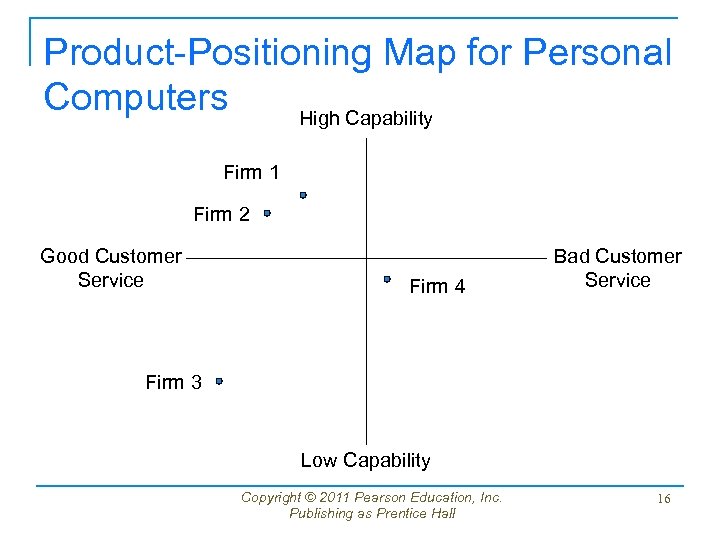 Product-Positioning Map for Personal Computers High Capability Firm 1 Firm 2 Good Customer Service Firm 4 Bad Customer Service Firm 3 Low Capability Copyright © 2011 Pearson Education, Inc. Publishing as Prentice Hall 16
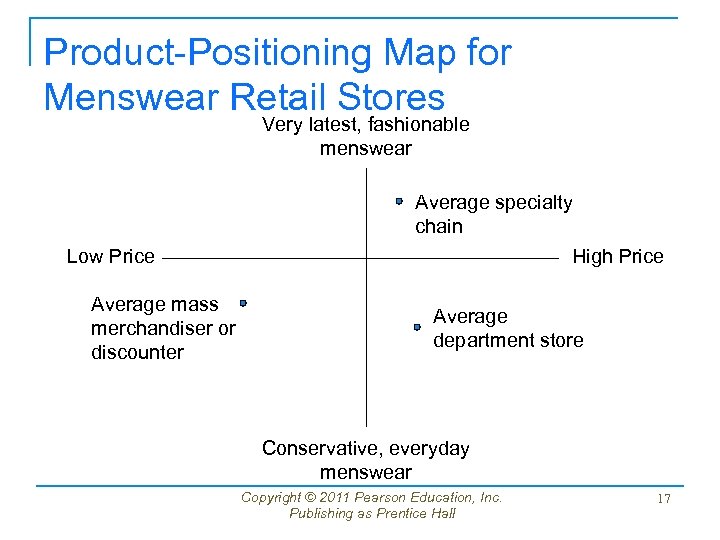 Product-Positioning Map for Menswear Retail Stores Very latest, fashionable menswear Low Price Average mass merchandiser or discounter Average specialty chain High Price Average department store Conservative, everyday menswear Copyright © 2011 Pearson Education, Inc. Publishing as Prentice Hall 17
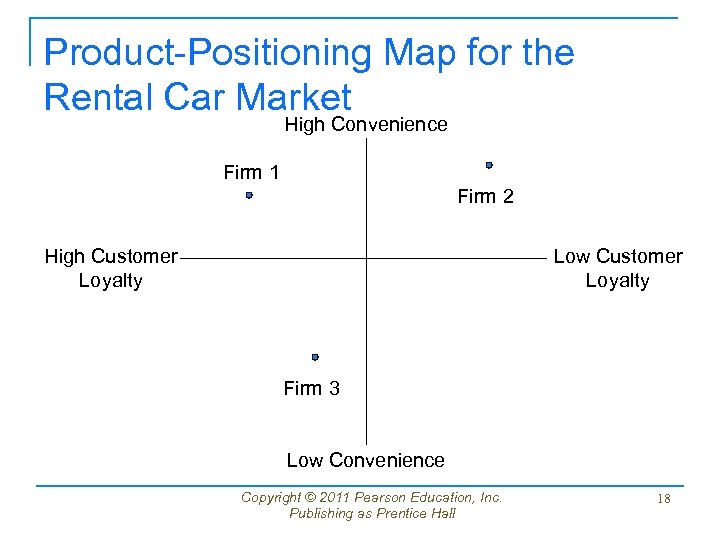 Product-Positioning Map for the Rental Car Market High Convenience Firm 1 Firm 2 High Customer Loyalty Low Customer Loyalty Firm 3 Low Convenience Copyright © 2011 Pearson Education, Inc. Publishing as Prentice Hall 18
 Product Positioning n Look for a vacant niche n Don’t serve two segments with the same strategy n Don’t position yourself in the middle of the map Copyright © 2011 Pearson Education, Inc. Publishing as Prentice Hall 19
 Finance/Accounting Issues Acquiring needed capital n Developing projected financial statements n Preparing financial budgets n Evaluating the worth of a business n Copyright © 2011 Pearson Education, Inc. Publishing as Prentice Hall 20
 Finance/Accounting Issues n n n n Raise capital – short-term debt, long-term debt, preferred, or common stock Lease or buy fixed assets Determine appropriate dividend payout ratio LIFO, FIFO, or market-value accounting Timeframe of accounts receivable Discounts on accounts Amount of cash to be kept on hand Copyright © 2011 Pearson Education, Inc. Publishing as Prentice Hall 21
 Finance/Accounting Issues Debt vs. Equity Decisions n EPS/EBIT analysis q Earnings per share/earnings before interest and taxes Copyright © 2011 Pearson Education, Inc. Publishing as Prentice Hall 22
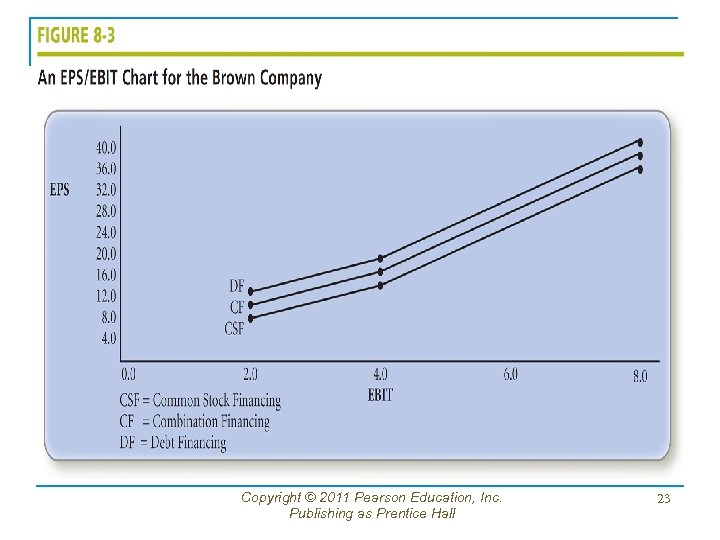 Copyright © 2011 Pearson Education, Inc. Publishing as Prentice Hall 23
 Finance/Accounting Issues Projected Financial Statement Analysis n Allows an organization to examine the expected results of various actions and approaches Copyright © 2011 Pearson Education, Inc. Publishing as Prentice Hall 24
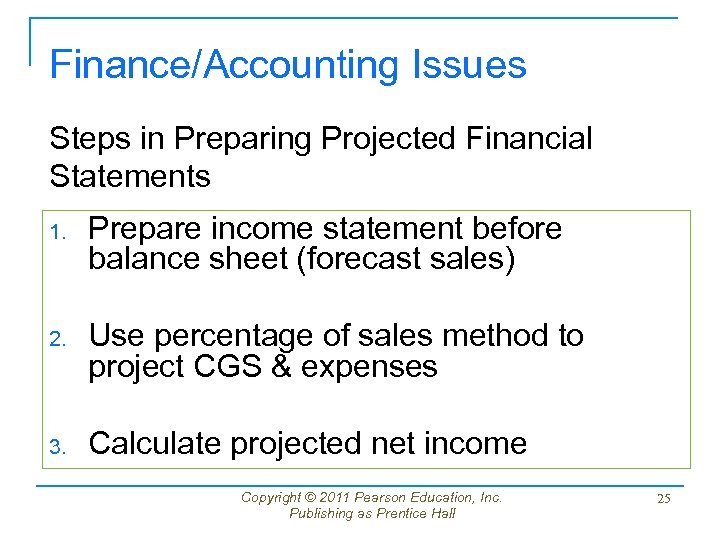 Finance/Accounting Issues Steps in Preparing Projected Financial Statements 1. Prepare income statement before balance sheet (forecast sales) 2. Use percentage of sales method to project CGS & expenses 3. Calculate projected net income Copyright © 2011 Pearson Education, Inc. Publishing as Prentice Hall 25
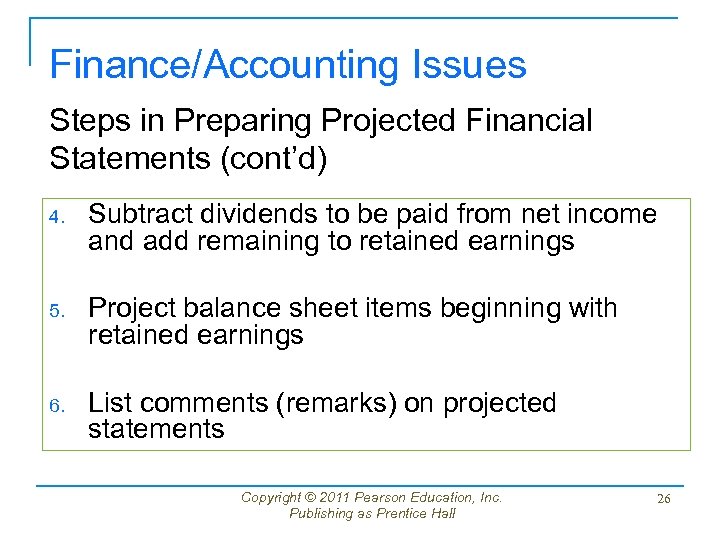 Finance/Accounting Issues Steps in Preparing Projected Financial Statements (cont’d) 4. Subtract dividends to be paid from net income and add remaining to retained earnings 5. Project balance sheet items beginning with retained earnings 6. List comments (remarks) on projected statements Copyright © 2011 Pearson Education, Inc. Publishing as Prentice Hall 26
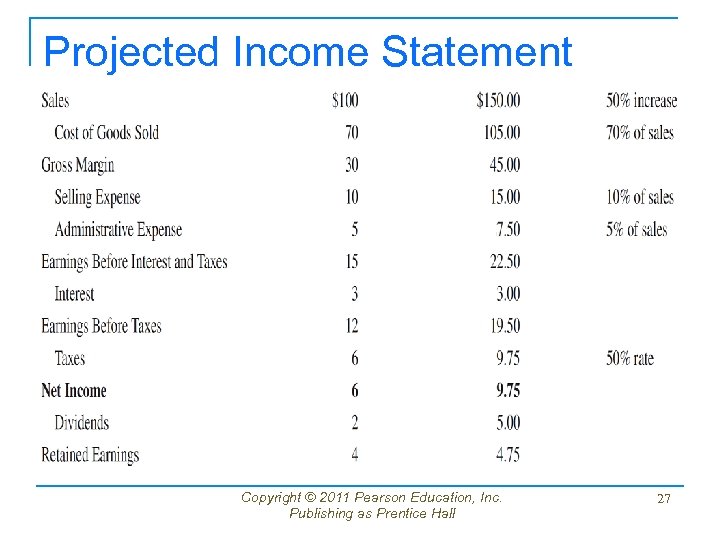 Projected Income Statement Copyright © 2011 Pearson Education, Inc. Publishing as Prentice Hall 27
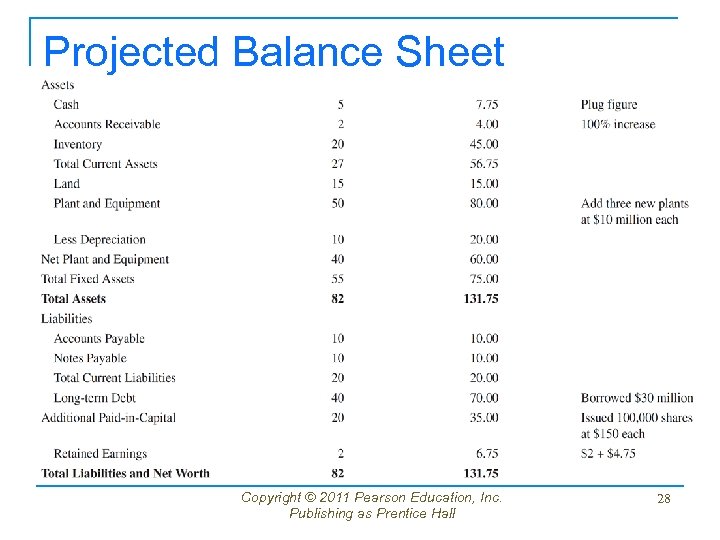 Projected Balance Sheet Copyright © 2011 Pearson Education, Inc. Publishing as Prentice Hall 28
 Finance/Accounting Issues Financial Budget Details how funds will be obtained and spent for a specified period of time Copyright © 2011 Pearson Education, Inc. Publishing as Prentice Hall 29
 Types of Budgets n n n Cash budgets Operating budgets Sales budgets Profit budgets Factory budgets Capital budgets n n n Expense budgets Divisional budgets Variable budgets Flexible budgets Fixed budgets Copyright © 2011 Pearson Education, Inc. Publishing as Prentice Hall 30
 Finance/Accounting Issues Evaluating Worth of a Business n Central to strategy implementation – integrative, intensive, and diversification strategies often implemented through acquisitions of other firms Copyright © 2011 Pearson Education, Inc. Publishing as Prentice Hall 31
 Evaluating Worth of a Business Three Basic Approaches 1. What a firm owns 2. What a firm earns 3. What a firm will bring in the market Copyright © 2011 Pearson Education, Inc. Publishing as Prentice Hall 32
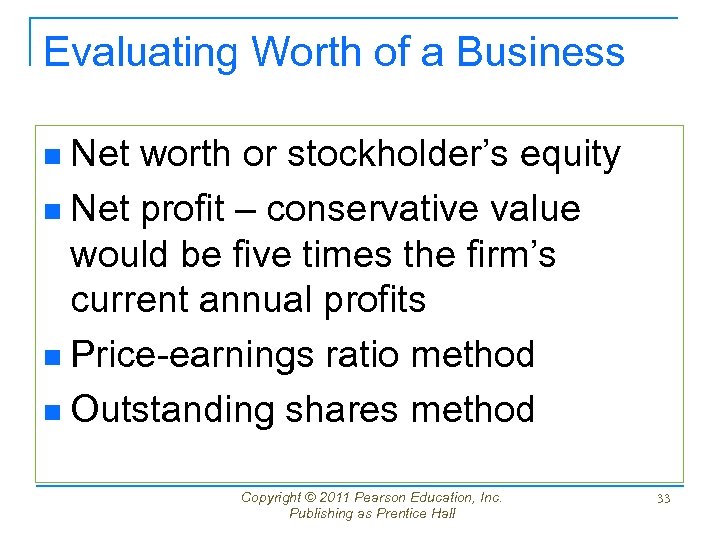 Evaluating Worth of a Business Net worth or stockholder’s equity n Net profit – conservative value would be five times the firm’s current annual profits n Price-earnings ratio method n Outstanding shares method n Copyright © 2011 Pearson Education, Inc. Publishing as Prentice Hall 33
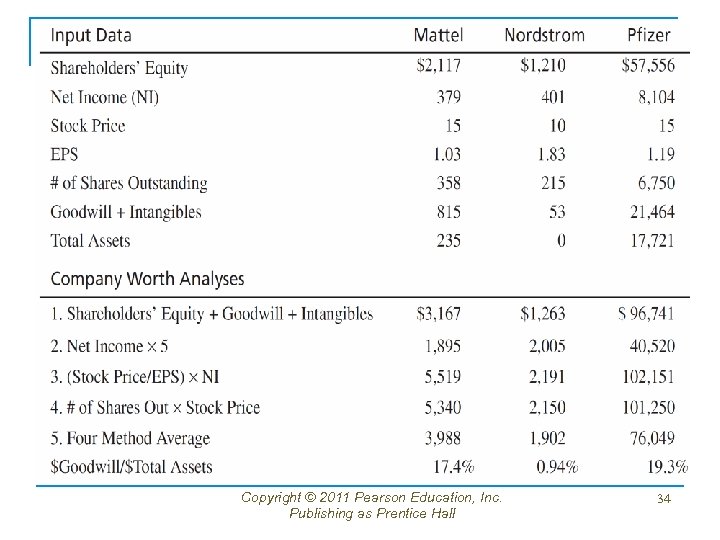 Copyright © 2011 Pearson Education, Inc. Publishing as Prentice Hall 34
 Research & Development Issues New products and improvement of existing products that allow for effective strategy implementation Copyright © 2011 Pearson Education, Inc. Publishing as Prentice Hall 35
 Research & Development Issues Constraints n Level of support constrained by resource availability n Technological improvements shorten product life cycles Copyright © 2011 Pearson Education, Inc. Publishing as Prentice Hall 36
 Research & Development Issues Three Major R&D Approaches to Implementing Strategies 1. First firm to market new technological products 2. Innovative imitator of successful products 3. Low-cost producer of similar but less Copyright © 2011 expensive products Pearson Education, Inc. Publishing as Prentice Hall 37
 Management Information Systems (MIS) Issues Having an effective management information system (MIS) may be the most important factor in differentiating successful from unsuccessful firms. Copyright © 2011 Pearson Education, Inc. Publishing as Prentice Hall 38
 MIS Issues Functions of MIS n n Information collection, retrieval, and storage Keeping managers informed Coordination of activities among divisions Allows firm to reduce costs Copyright © 2011 Pearson Education, Inc. Publishing as Prentice Hall 39
 All rights reserved. No part of this publication may be reproduced, stored in a retrieval system, or transmitted, in any form or by any means, electronic, mechanical, photocopying, recording, or otherwise, without the prior written permission of the publisher. Printed in the United States of America. Copyright © 2011 Pearson Education, Inc. Publishing as Prentice Hall 40