


 Скачать презентацию Chapter 8 Electronic Payment Systems and Security
7677fe4273bf8d7691e53611e9b7193b.ppt
- Количество слайдов: 36
 Chapter 8 Electronic Payment Systems and Security © Prentice Hall, 2000 1
 Learning Objectives z Describe typical electronic payment systems for EC z Identify the security requirements for safe electronic payments z Describe the typical security schemes used to meet the security requirements z Identify the players and procedures of the electronic credit card system on the Internet z Discuss the relationship between SSL and SET protocols © Prentice Hall, 2000 2
 Learning Objectives (cont. ) z Discuss the relationship between electronic fund transfer and debit card z Describe the characteristics of a stored value card z Classify and describe the types of IC cards used for payments z Discuss the characteristics of electronic check systems © Prentice Hall, 2000 3
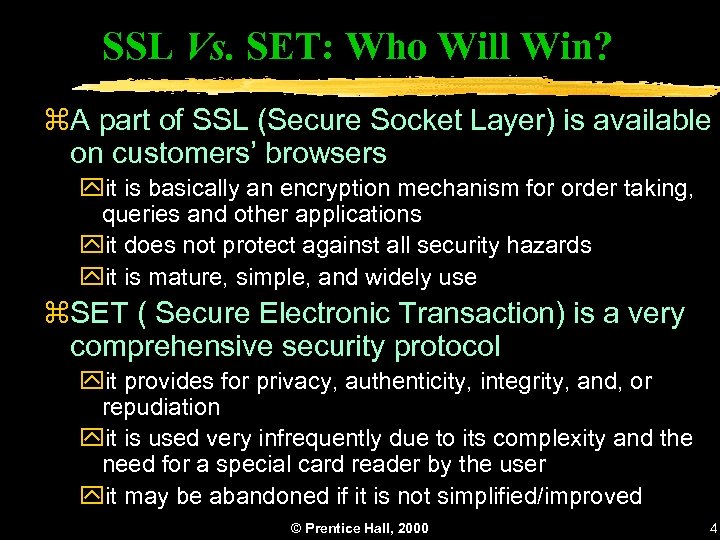 SSL Vs. SET: Who Will Win? z. A part of SSL (Secure Socket Layer) is available on customers’ browsers yit is basically an encryption mechanism for order taking, queries and other applications yit does not protect against all security hazards yit is mature, simple, and widely use z. SET ( Secure Electronic Transaction) is a very comprehensive security protocol yit provides for privacy, authenticity, integrity, and, or repudiation yit is used very infrequently due to its complexity and the need for a special card reader by the user yit may be abandoned if it is not simplified/improved © Prentice Hall, 2000 4
 Payments, Protocols and Related Issues z. SET Protocol is for Credit Card Payments z. Electronic Cash and Micropayments z. Electronic Fund Transfer on the Internet z. Stored Value Cards and Electronic Cash z. Electronic Check Systems © Prentice Hall, 2000 5
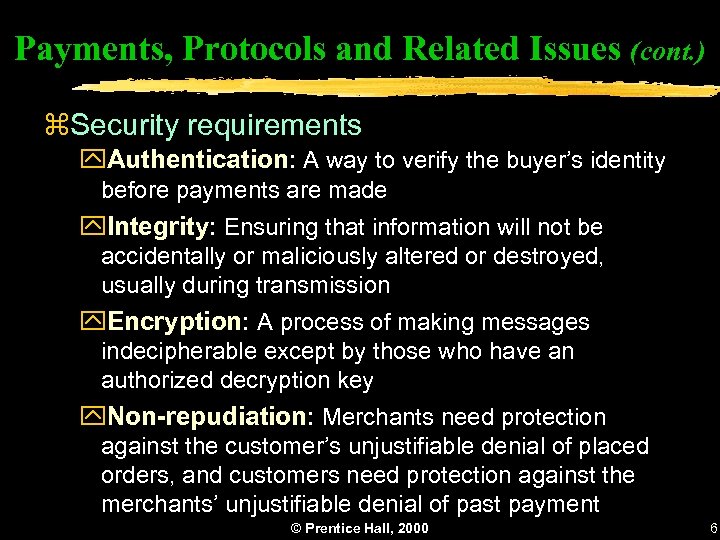 Payments, Protocols and Related Issues (cont. ) z. Security requirements y. Authentication: A way to verify the buyer’s identity before payments are made y. Integrity: Ensuring that information will not be accidentally or maliciously altered or destroyed, usually during transmission y. Encryption: A process of making messages indecipherable except by those who have an authorized decryption key y. Non-repudiation: Merchants need protection against the customer’s unjustifiable denial of placed orders, and customers need protection against the merchants’ unjustifiable denial of past payment © Prentice Hall, 2000 6
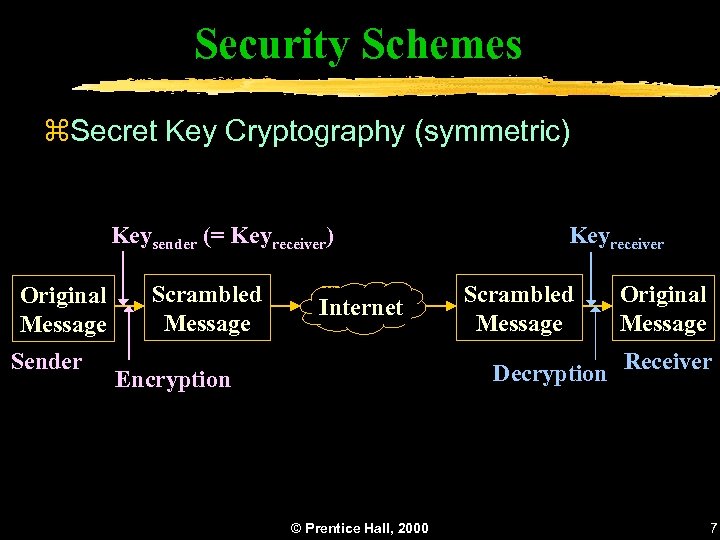 Security Schemes z. Secret Key Cryptography (symmetric) Keysender (= Keyreceiver) Original Message Sender Scrambled Message Internet Keyreceiver Scrambled Message Original Message Decryption Receiver Encryption © Prentice Hall, 2000 7
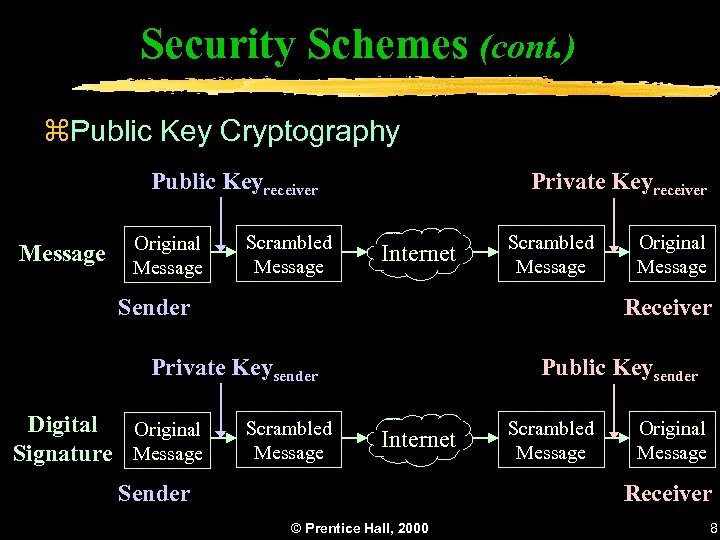 Security Schemes (cont. ) z. Public Key Cryptography Public Keyreceiver Message Original Message Scrambled Message Private Keyreceiver Internet Scrambled Message Sender Receiver Private Keysender Digital Original Signature Message Original Message Scrambled Message Public Keysender Internet Sender Scrambled Message Original Message Receiver © Prentice Hall, 2000 8
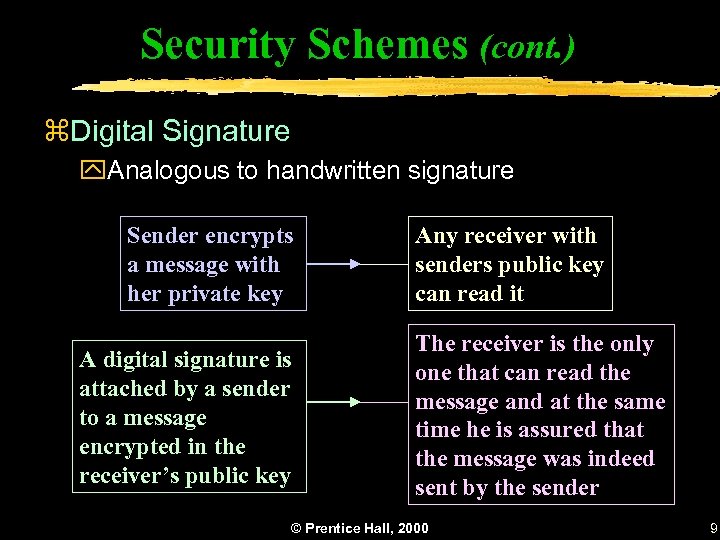 Security Schemes (cont. ) z. Digital Signature y. Analogous to handwritten signature Sender encrypts a message with her private key A digital signature is attached by a sender to a message encrypted in the receiver’s public key Any receiver with senders public key can read it The receiver is the only one that can read the message and at the same time he is assured that the message was indeed sent by the sender © Prentice Hall, 2000 9
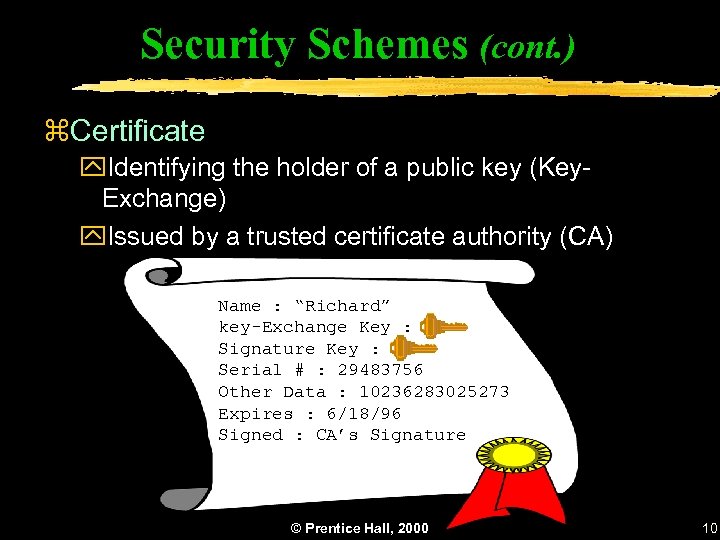 Security Schemes (cont. ) z. Certificate y. Identifying the holder of a public key (Key. Exchange) y. Issued by a trusted certificate authority (CA) Name : “Richard” key-Exchange Key : Signature Key : Serial # : 29483756 Other Data : 10236283025273 Expires : 6/18/96 Signed : CA’s Signature © Prentice Hall, 2000 10
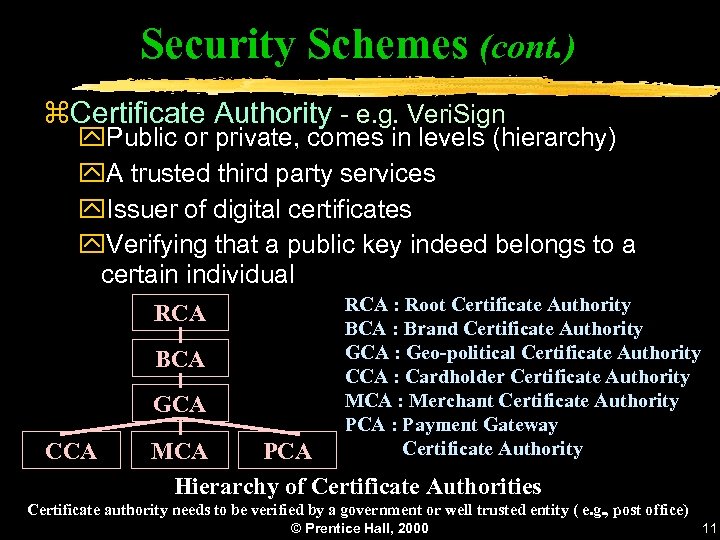 Security Schemes (cont. ) z. Certificate Authority - e. g. Veri. Sign y. Public or private, comes in levels (hierarchy) y. A trusted third party services y. Issuer of digital certificates y. Verifying that a public key indeed belongs to a certain individual RCA BCA GCA CCA RCA : Root Certificate Authority BCA : Brand Certificate Authority GCA : Geo-political Certificate Authority CCA : Cardholder Certificate Authority MCA : Merchant Certificate Authority PCA : Payment Gateway Certificate Authority MCA PCA Hierarchy of Certificate Authorities Certificate authority needs to be verified by a government or well trusted entity ( e. g. , post office) © Prentice Hall, 2000 11
 Electronic Credit Card System on the Internet z. The Players y. Cardholder y. Merchant (seller) y. Issuer (your bank) y. Acquirer (merchant’s financial institution, acquires the sales slips) y. Brand (VISA, Master Card) © Prentice Hall, 2000 12
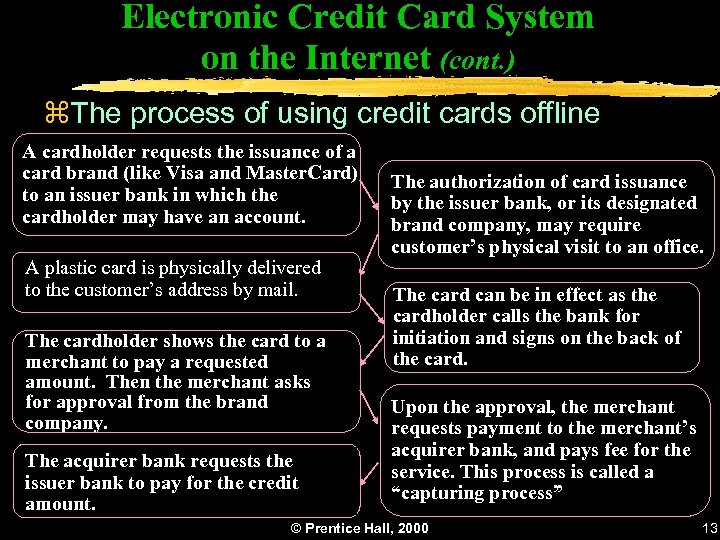 Electronic Credit Card System on the Internet (cont. ) z. The process of using credit cards offline A cardholder requests the issuance of a card brand (like Visa and Master. Card) to an issuer bank in which the cardholder may have an account. A plastic card is physically delivered to the customer’s address by mail. The cardholder shows the card to a merchant to pay a requested amount. Then the merchant asks for approval from the brand company. The acquirer bank requests the issuer bank to pay for the credit amount. The authorization of card issuance by the issuer bank, or its designated brand company, may require customer’s physical visit to an office. The card can be in effect as the cardholder calls the bank for initiation and signs on the back of the card. Upon the approval, the merchant requests payment to the merchant’s acquirer bank, and pays fee for the service. This process is called a “capturing process” © Prentice Hall, 2000 13
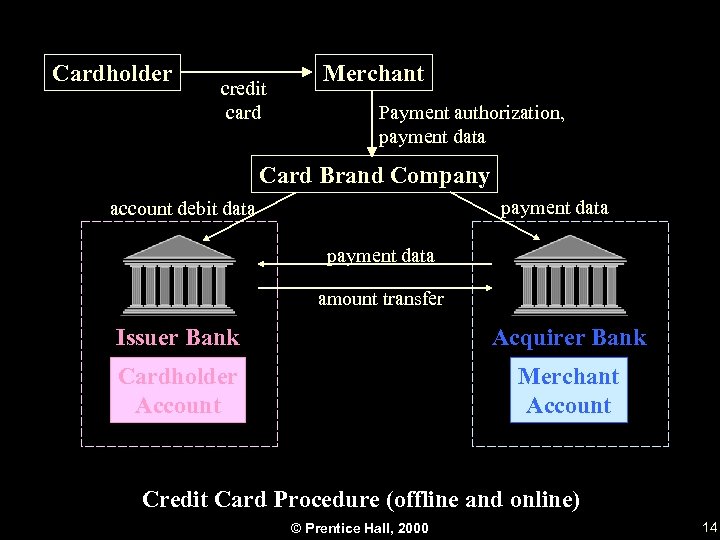 Cardholder credit card Merchant Payment authorization, payment data Card Brand Company payment data account debit data payment data amount transfer Issuer Bank Acquirer Bank Cardholder Account Merchant Account Credit Card Procedure (offline and online) © Prentice Hall, 2000 14
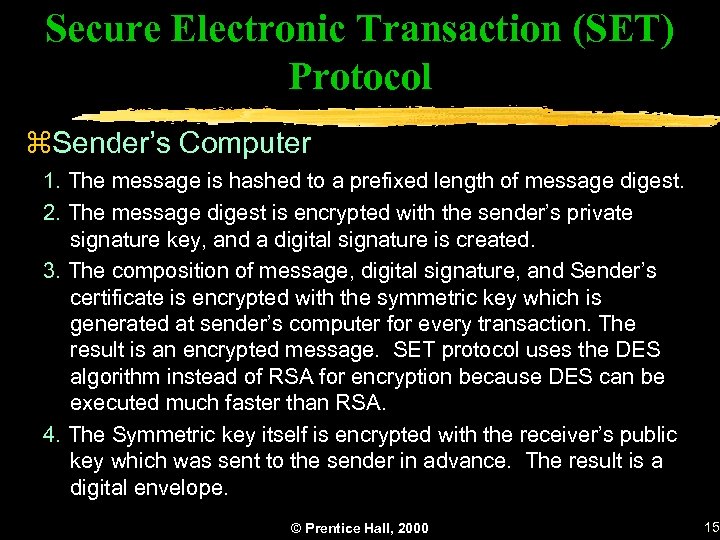 Secure Electronic Transaction (SET) Protocol z. Sender’s Computer 1. The message is hashed to a prefixed length of message digest. 2. The message digest is encrypted with the sender’s private signature key, and a digital signature is created. 3. The composition of message, digital signature, and Sender’s certificate is encrypted with the symmetric key which is generated at sender’s computer for every transaction. The result is an encrypted message. SET protocol uses the DES algorithm instead of RSA for encryption because DES can be executed much faster than RSA. 4. The Symmetric key itself is encrypted with the receiver’s public key which was sent to the sender in advance. The result is a digital envelope. © Prentice Hall, 2000 15
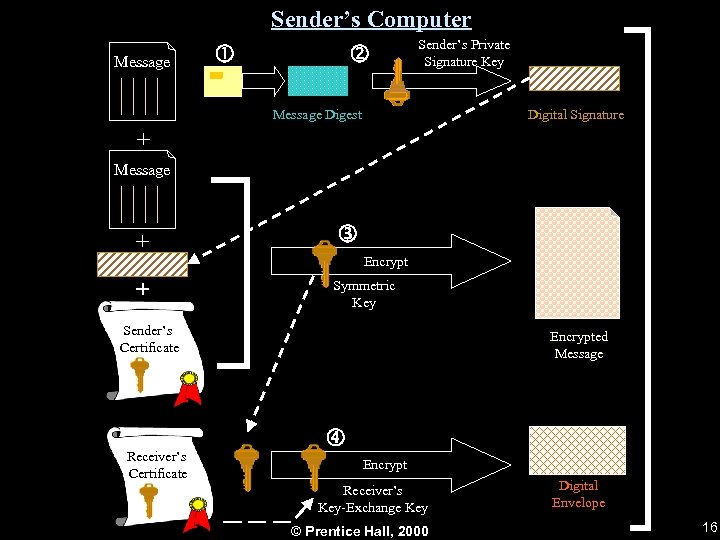 Sender’s Computer Message Sender’s Private Signature Key Message Digest Digital Signature + Message + + Symmetric Key Encrypt Sender’s Certificate Receiver’s Certificate Encrypted Message Encrypt Receiver’s Key-Exchange Key © Prentice Hall, 2000 Digital Envelope 16
 Secure Electronic Transaction (SET) Protocol (cont. ) z. Receiver’s Computer 5. The encrypted message and digital envelope are transmitted to receiver’s computer via the Internet. 6. The digital envelope is decrypted with receiver’s private exchange key. 7. Using the restored symmetric key, the encrypted message can be restored to the message, digital signature, and sender’s certificate. 8. To confirm the integrity, the digital signature is decrypted by sender’s public key, obtaining the message digest. 9. The delivered message is hashed to generate message digest. 10. The message digests obtained by steps 8 and 9 respectively, are compared by the receiver to confirm whethere was any change during the transmission. This step confirms the integrity. © Prentice Hall, 2000 17
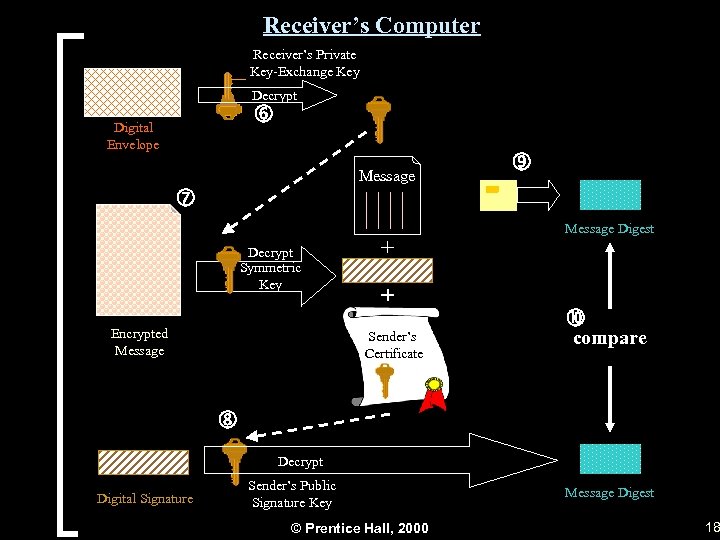 Receiver’s Computer Receiver’s Private Key-Exchange Key Decrypt Digital Envelope Message Decrypt Symmetric Key Encrypted Message + + Sender’s Certificate Message Digest compare Decrypt Digital Signature Sender’s Public Signature Key © Prentice Hall, 2000 Message Digest 18
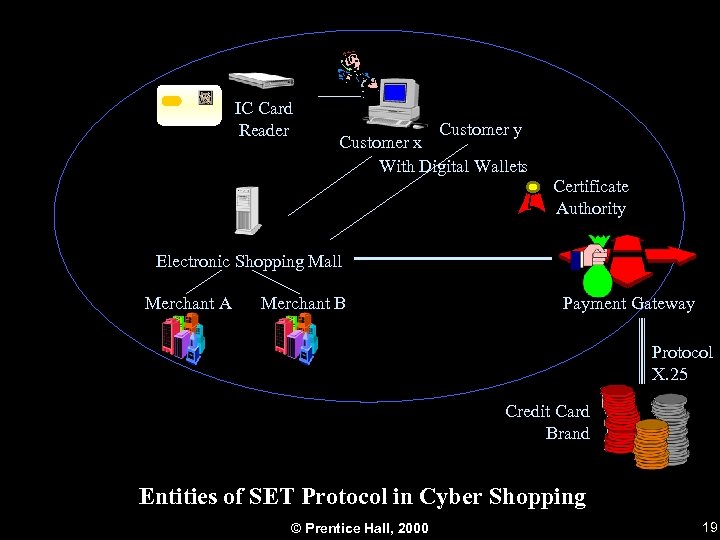 IC Card Reader Customer y Customer x With Digital Wallets Certificate Authority Electronic Shopping Mall Merchant A Merchant B Payment Gateway Protocol X. 25 Credit Card Brand Entities of SET Protocol in Cyber Shopping © Prentice Hall, 2000 19
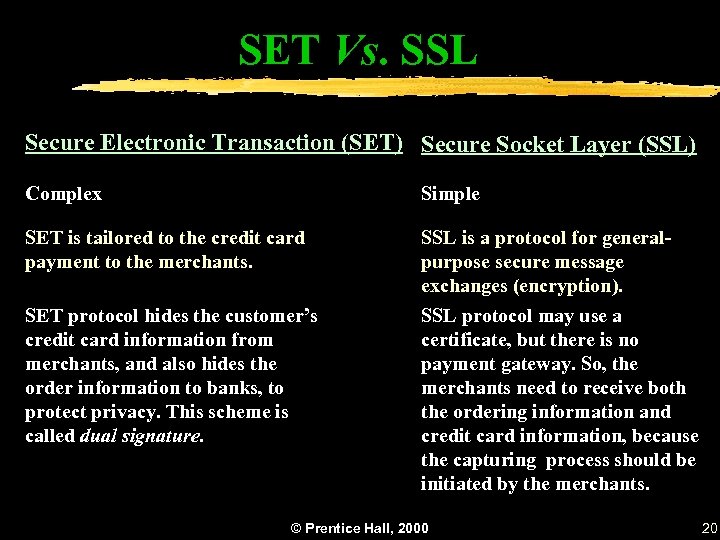 SET Vs. SSL Secure Electronic Transaction (SET) Secure Socket Layer (SSL) Complex Simple SET is tailored to the credit card payment to the merchants. SSL is a protocol for generalpurpose secure message exchanges (encryption). SSL protocol may use a certificate, but there is no payment gateway. So, the merchants need to receive both the ordering information and credit card information, because the capturing process should be initiated by the merchants. SET protocol hides the customer’s credit card information from merchants, and also hides the order information to banks, to protect privacy. This scheme is called dual signature. © Prentice Hall, 2000 20
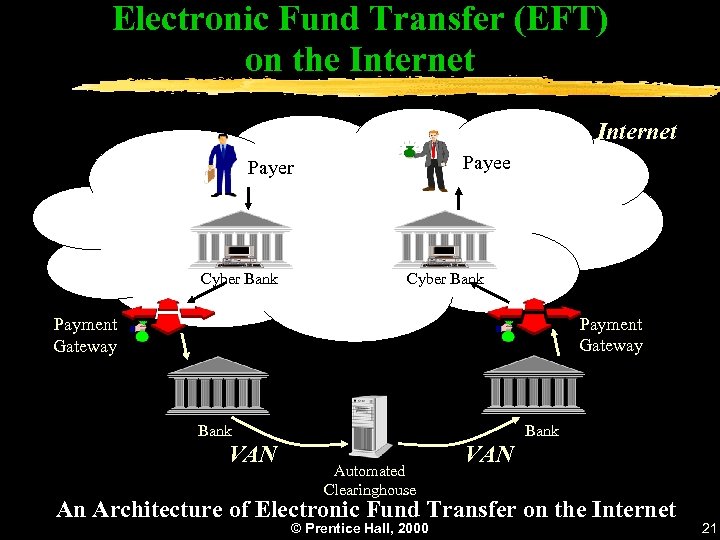 Electronic Fund Transfer (EFT) on the Internet Payee Payer Cyber Bank Payment Gateway Bank VAN Bank Automated Clearinghouse VAN An Architecture of Electronic Fund Transfer on the Internet © Prentice Hall, 2000 21
 Debit Cards z. A delivery vehicle of cash in an electronic form z. Mondex, Visa. Cash applied this approach z. Either anonymous or onymous z. Cyber. Cash has commercialized a debit card named Cyber. Coin as a medium of micropayments on the Internet © Prentice Hall, 2000 22
 Financial EDI z. It is an EDI used for financial transactions y. EDI is a standardized way of exchanging messages between businesses y. EFT can be implemented using a Financial EDI system z. Safe Financial EDI needs to adopt a security scheme used for the SSL protocol z. Extranet encrypts the packets exchanged between senders and receivers using the public key cryptography © Prentice Hall, 2000 23
 Electronic Cash and Micropayments z. Smart Cards y. The concept of e-cash is used in the non-Internet environment y. Plastic cards with magnetic stripes (old technology) y. Includes IC chips with programmable functions on them which makes cards “smart” y. One e-cash card for one application y. Recharge the card only at designated locations, such as bank office or a kiosk. Future: recharge at your PC ye. g. Mondex & Visa. Cash © Prentice Hall, 2000 24
 Mondex Makes Shopping Easy z. Shopping with Mondex z. Adding money to the card z. Payments in a new era of electronic shopping z. Paying on the Internet © Prentice Hall, 2000 25
 Electronic Money z. Digi. Cash y. The analogy of paper money or coins y. Expensive, as each payment transaction must be reported to the bank and recorded y. Conflict with the role of central bank’s bill issuance y. Legally, Digi. Cash is not supposed to issue more than an electronic gift certificate even though it may be accepted by a wide number of member stores © Prentice Hall, 2000 26
 Electronic Money (cont. ) z. Stored Value Cards y. No issuance of money y. Debit card — a delivering vehicle of cash in an electronic form y. Either anonymous or onymous y. Advantage of an anonymous card xthe card may be given from one person to another y. Also implemented on the Internet without employment of an IC card © Prentice Hall, 2000 27
 Electronic Money (cont. ) z. Smart card-based e-cash y. Can be recharged at home through the Internet y. Can be used on the Internet as well as in a non. Internet environment z. Ceiling of Stored Values y. To prevent the abuse of stored values in money laundry y. S$500 in Singapore; HK$3, 000 in Hong Kong z. Multiple Currencies y. Can be used for cross border payments © Prentice Hall, 2000 28
 Contactless IC Cards z. Proximity Card y. Used to access buildings and for paying in buses and other transportation systems y. Bus, subway and toll card in many cities z. Amplified Remote Sensing Card y. Good for a range of up to 100 feet, and can be used for tolling moving vehicles at gates y. Pay toll without stopping (e. g. Highway 91 in California) © Prentice Hall, 2000 29
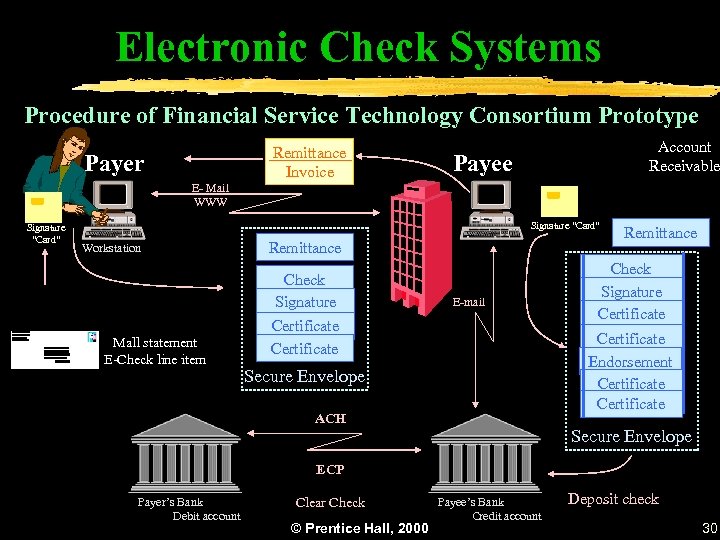 Electronic Check Systems Procedure of Financial Service Technology Consortium Prototype Remittance Invoice Payer Account Receivable Payee E- Mail WWW Signature “Card” Workstation Remittance Check Signature Mall statement E-Check line item E-mail Certificate Remittance Check Signature Certificate Endorsement Certificate Secure Envelope ACH Secure Envelope ECP Payer’s Bank Debit account Clear Check © Prentice Hall, 2000 Payee’s Bank Credit account Deposit check 30
 Electronic Check Systems (cont. ) z. Electronic Checkbook y. Counterpart of electronic wallet y. To be integrated with the accounting information system of business buyers and with the payment server of sellers y. To save the electronic invoice and receipt of payment in the buyers and sellers computers for future retrieval y. Example : Safe. Check y. Used mainly in B 2 B © Prentice Hall, 2000 31
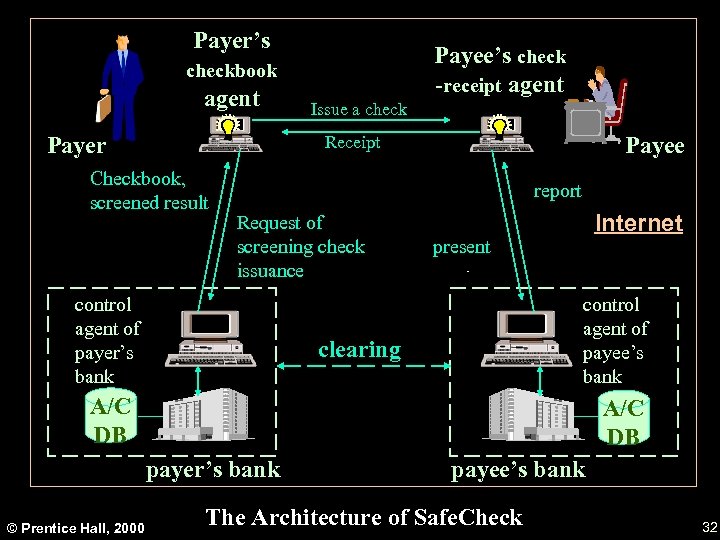 Payer’s Payee’s check -receipt agent checkbook agent Payer Issue a check Payee Receipt Checkbook, screened result report Request of screening check issuance control agent of payer’s bank Internet present control agent of payee’s bank clearing A/C DB payer’s bank © Prentice Hall, 2000 payee’s bank The Architecture of Safe. Check 32
 Integrating Payment Methods z. Two potential consolidations: y. The on-line electronic check is merging with EFT y. The electronic check with a designated settlement date is merging with electronic credit cards z. Security First Network Bank (SFNB) y. First cyberbank y. Lower service charges to challenge the service fees of traditional banks z. Visa y. Visa. Cash is a debit card ye. Pay is an EFT service © Prentice Hall, 2000 33
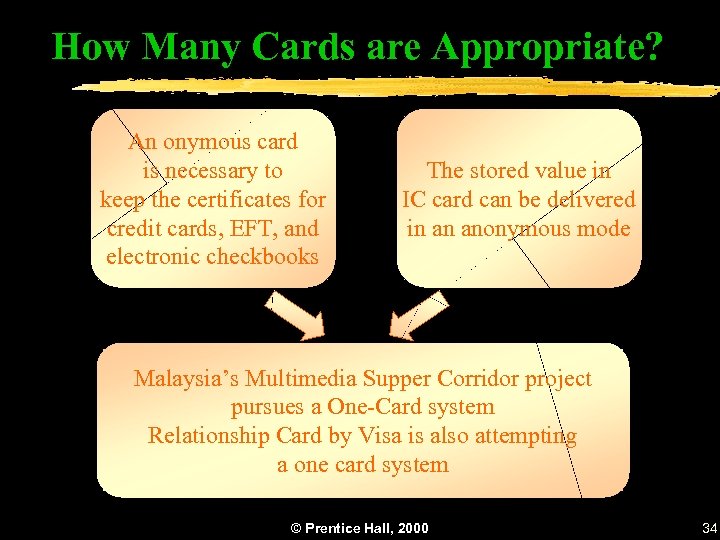 How Many Cards are Appropriate? An onymous card is necessary to keep the certificates for credit cards, EFT, and electronic checkbooks The stored value in IC card can be delivered in an anonymous mode Malaysia’s Multimedia Supper Corridor project pursues a One-Card system Relationship Card by Visa is also attempting a one card system © Prentice Hall, 2000 34
 Five Security Tips z Don’t reveal your online Passcode to anyone. If you think your online Passcode has been compromised, change it immediately. z Don’t walk away from your computer if you are in the middle of a session. z Once you have finished conducting your banking on the Internet, always sign off before visiting other Internet sites. z If anyone else is likely to use your computer, clear your cache or turn off and re-initiate your browser in order to eliminate copies of Web pages that have been stored in your hard drive. z Bank of America strongly recommends that you use a browser with 128 -bit encryption to conduct secure financial transactions over the Internet. © Prentice Hall, 2000 35
 Managerial Issues z Security solution providers can cultivate the opportunity of providing solutions for the secure electronic payment systems z Electronic payment system solution providers can offer various types of electronic payment systems to electronic stores and banks z Electronic stores should select an appropriate set of electronic payment systems z Banks need to develop cyberbank services to be compatible with the various electronic payment system z Credit card brand companies need to develop an EC standard like SET, and watch the acceptance by customers z Smart card brand should develop a business model in cooperation with application sectors and banks z Certificate authority needs to identify the types of certificate to provide © Prentice Hall, 2000 36