


 Скачать презентацию Chapter 8 COST FUNCTIONS 1 Definitions of
65e9c7ca9497be07ed227242f36e7c91.ppt
- Количество слайдов: 82
 Chapter 8 COST FUNCTIONS 1
 Definitions of Costs • It is important to differentiate between accounting cost and economic cost – the accountant’s view of cost stresses outof-pocket expenses, historical costs, depreciation, and other bookkeeping entries – economists focus more on opportunity cost 2
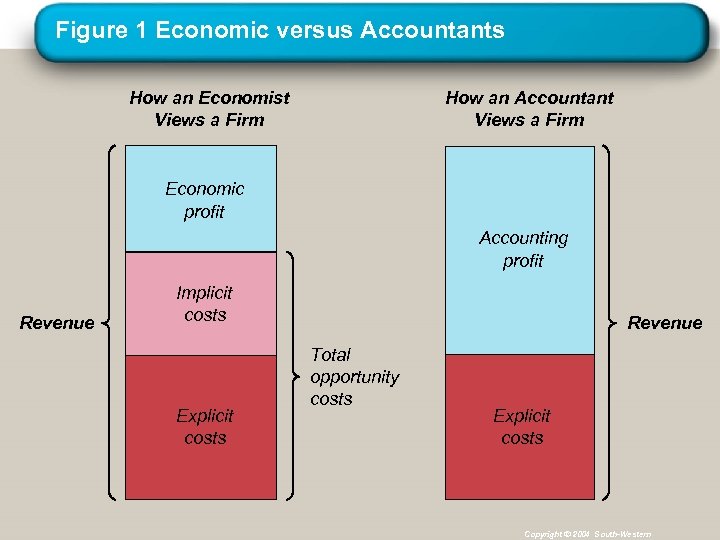 Figure 1 Economic versus Accountants How an Economist Views a Firm How an Accountant Views a Firm Economic profit Accounting profit Revenue Implicit costs Explicit costs Revenue Total opportunity costs Explicit costs Copyright © 2004 South-Western
 Definitions of Costs • Labor Costs – to accountants, expenditures on labor are current expenses and hence costs of production – to economists, labor is an explicit cost • labor services are contracted at some hourly wage (w) and it is assumed that this is also what the labor could earn in alternative employment 4
 Definitions of Costs • Capital Costs – accountants use the historical price of the capital and apply some depreciation rule to determine current costs – economists refer to the capital’s original price as a “sunk cost” and instead regard the implicit cost of the capital to be what someone else would be willing to pay for its use • we will use v to denote the rental rate for capital 5
 Definitions of Costs • Costs of Entrepreneurial Services – accountants believe that the owner of a firm is entitled to all profits • revenues or losses left over after paying all input costs – economists consider the opportunity costs of time and funds that owners devote to the operation of their firms • part of accounting profits would be considered as entrepreneurial costs by economists 6
 Economic Cost • The economic cost of any input is the payment required to keep that input in its present employment – the remuneration the input would receive in its best alternative employment 7
 Two Simplifying Assumptions • There are only two inputs – homogeneous labor (l), measured in laborhours – homogeneous capital (k), measured in machine-hours • entrepreneurial costs are included in capital costs • Inputs are hired in perfectly competitive markets – firms are price takers in input markets 8
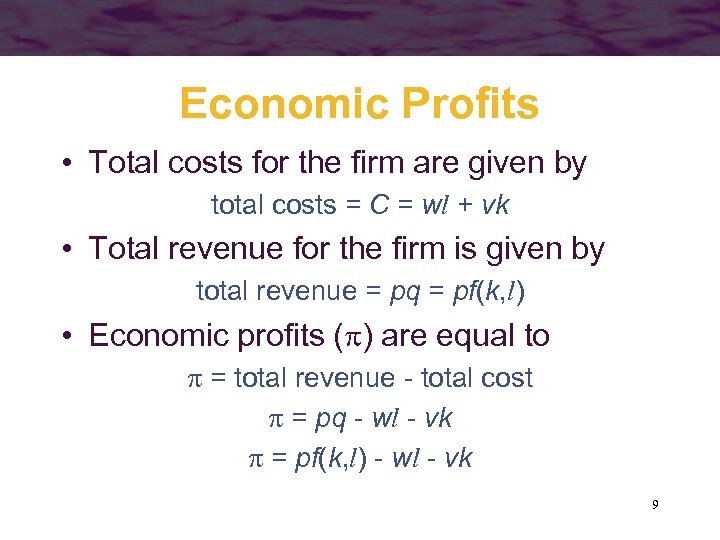 Economic Profits • Total costs for the firm are given by total costs = C = wl + vk • Total revenue for the firm is given by total revenue = pq = pf(k, l) • Economic profits ( ) are equal to = total revenue - total cost = pq - wl - vk = pf(k, l) - wl - vk 9
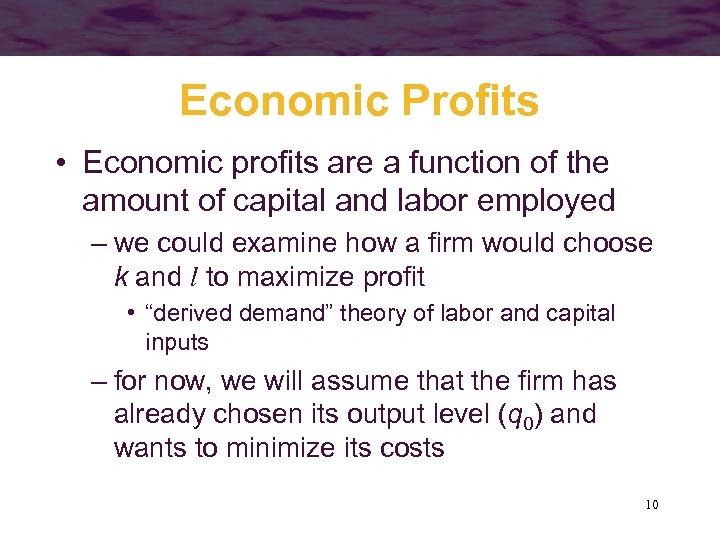 Economic Profits • Economic profits are a function of the amount of capital and labor employed – we could examine how a firm would choose k and l to maximize profit • “derived demand” theory of labor and capital inputs – for now, we will assume that the firm has already chosen its output level (q 0) and wants to minimize its costs 10
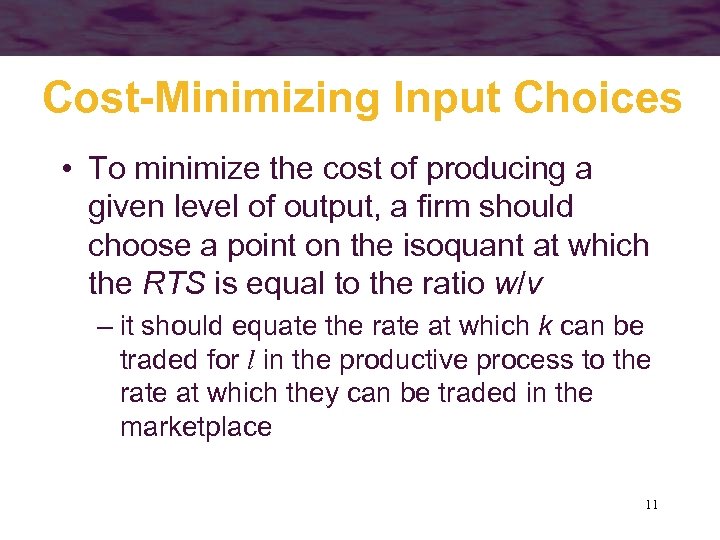 Cost-Minimizing Input Choices • To minimize the cost of producing a given level of output, a firm should choose a point on the isoquant at which the RTS is equal to the ratio w/v – it should equate the rate at which k can be traded for l in the productive process to the rate at which they can be traded in the marketplace 11
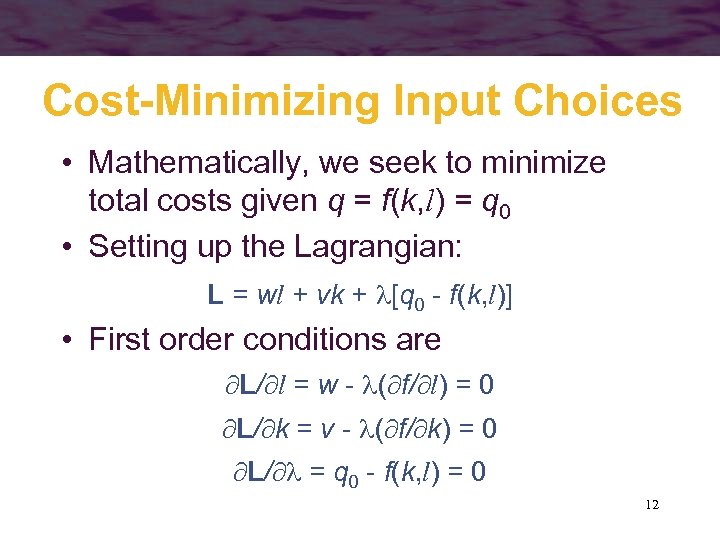 Cost-Minimizing Input Choices • Mathematically, we seek to minimize total costs given q = f(k, l) = q 0 • Setting up the Lagrangian: L = wl + vk + [q 0 - f(k, l)] • First order conditions are L/ l = w - ( f/ l) = 0 L/ k = v - ( f/ k) = 0 L/ = q 0 - f(k, l) = 0 12
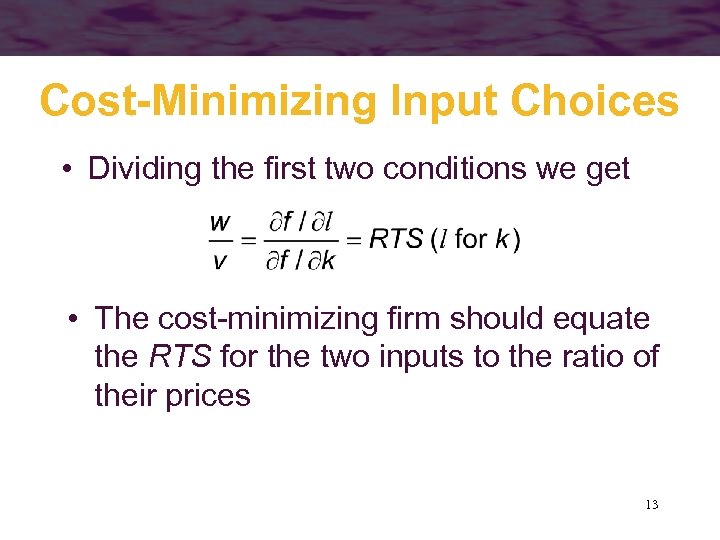 Cost-Minimizing Input Choices • Dividing the first two conditions we get • The cost-minimizing firm should equate the RTS for the two inputs to the ratio of their prices 13
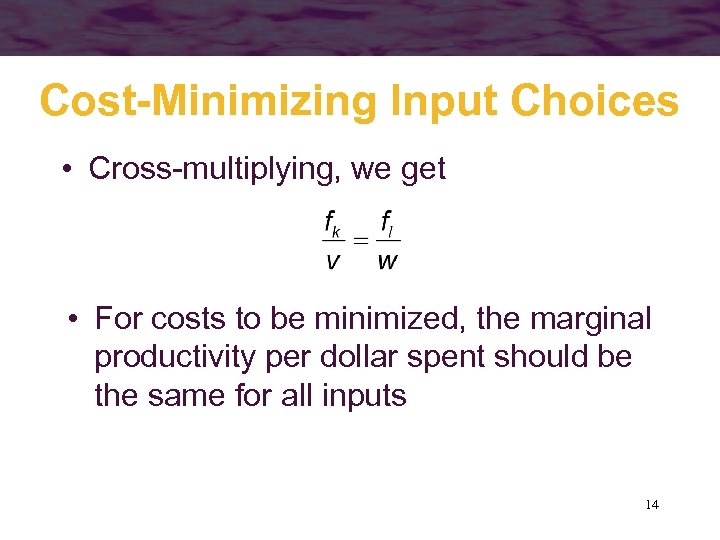 Cost-Minimizing Input Choices • Cross-multiplying, we get • For costs to be minimized, the marginal productivity per dollar spent should be the same for all inputs 14
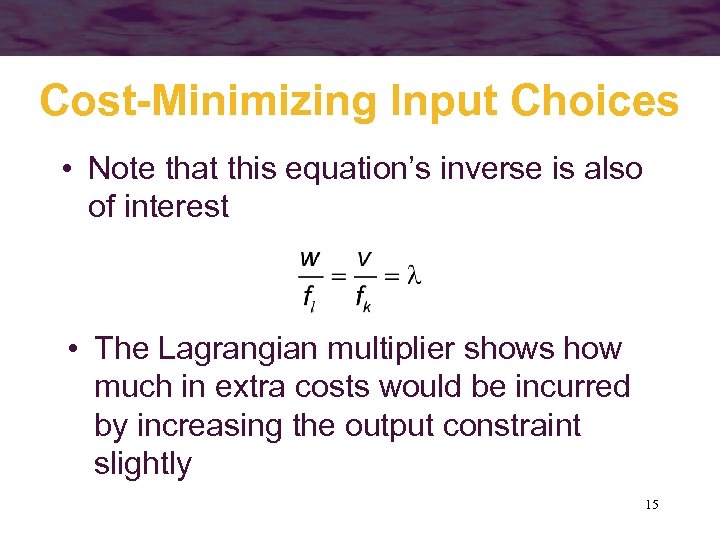 Cost-Minimizing Input Choices • Note that this equation’s inverse is also of interest • The Lagrangian multiplier shows how much in extra costs would be incurred by increasing the output constraint slightly 15
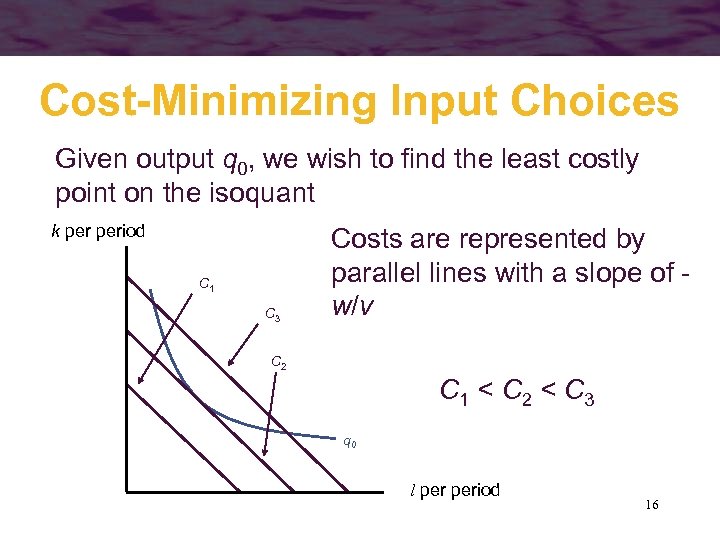 Cost-Minimizing Input Choices Given output q 0, we wish to find the least costly point on the isoquant k period C 1 C 3 Costs are represented by parallel lines with a slope of w/v C 2 C 1 < C 2 < C 3 q 0 l period 16
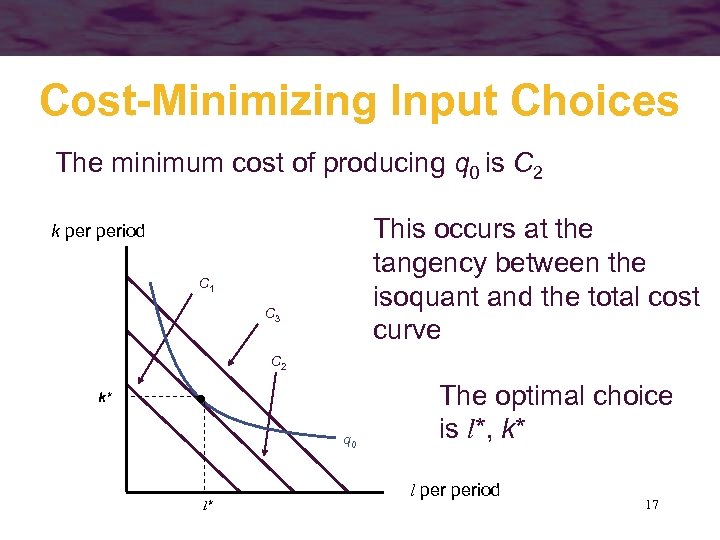 Cost-Minimizing Input Choices The minimum cost of producing q 0 is C 2 This occurs at the tangency between the isoquant and the total cost curve k period C 1 C 3 C 2 k* q 0 l* The optimal choice is l*, k* l period 17
 Contingent Demand for Inputs • In Chapter 4, we considered an individual’s expenditure-minimization problem – we used this technique to develop the compensated demand for a good • Can we develop a firm’s demand for an input in the same way? 18
 Contingent Demand for Inputs • In the present case, cost minimization leads to a demand for capital and labor that is contingent on the level of output being produced • The demand for an input is a derived demand – it is based on the level of the firm’s output 19
 The Firm’s Expansion Path • The firm can determine the costminimizing combinations of k and l for every level of output • If input costs remain constant for all amounts of k and l the firm may demand, we can trace the locus of costminimizing choices – called the firm’s expansion path 20
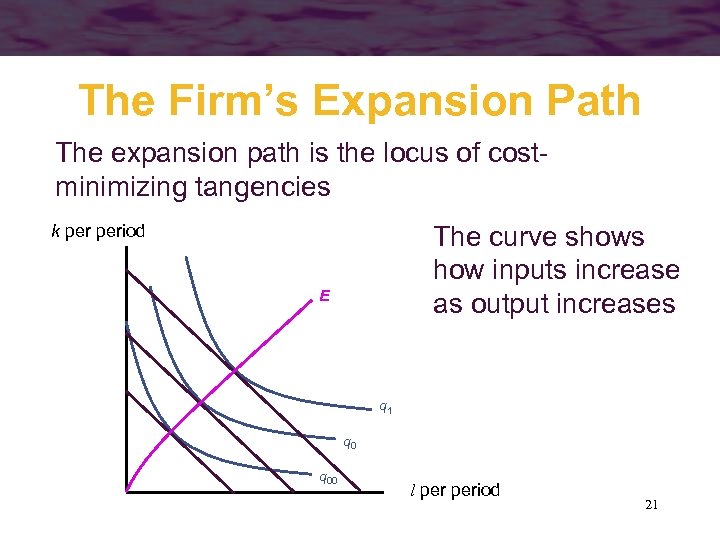 The Firm’s Expansion Path The expansion path is the locus of costminimizing tangencies The curve shows how inputs increase as output increases k period E q 1 q 00 l period 21
 The Firm’s Expansion Path • The expansion path does not have to be a straight line – the use of some inputs may increase faster than others as output expands • depends on the shape of the isoquants • The expansion path does not have to be upward sloping – if the use of an input falls as output expands, that input is an inferior input 22
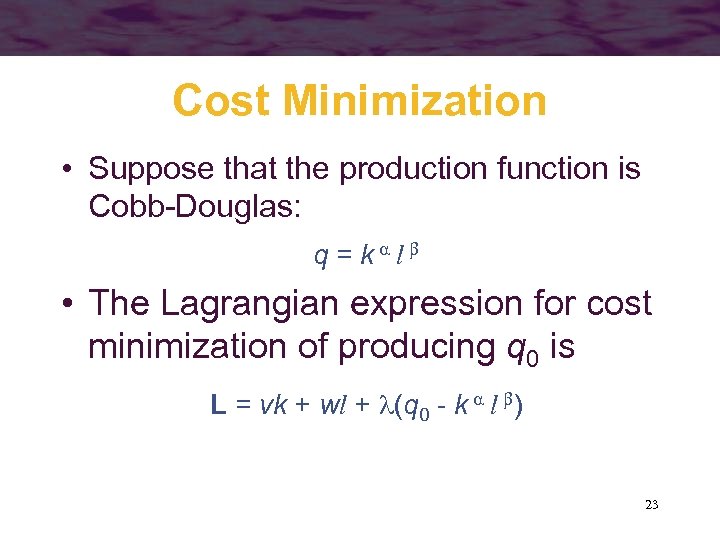 Cost Minimization • Suppose that the production function is Cobb-Douglas: q = k l • The Lagrangian expression for cost minimization of producing q 0 is L = vk + wl + (q 0 - k l ) 23
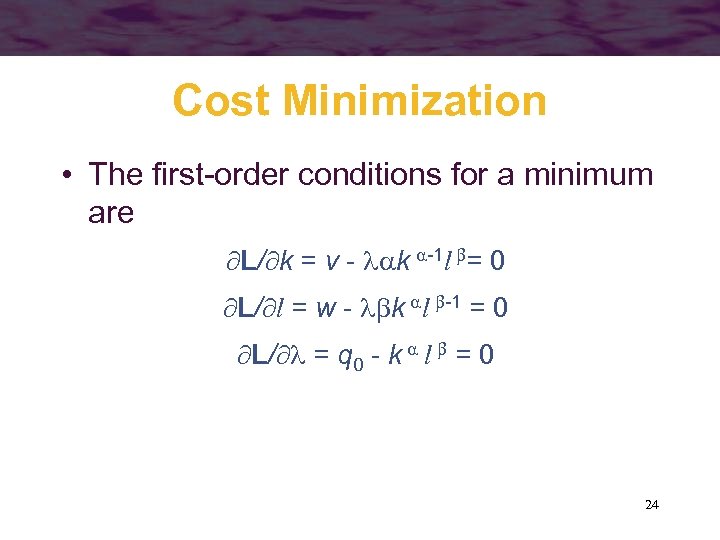 Cost Minimization • The first-order conditions for a minimum are L/ k = v - k -1 l = 0 L/ l = w - k l -1 = 0 L/ = q 0 - k l = 0 24
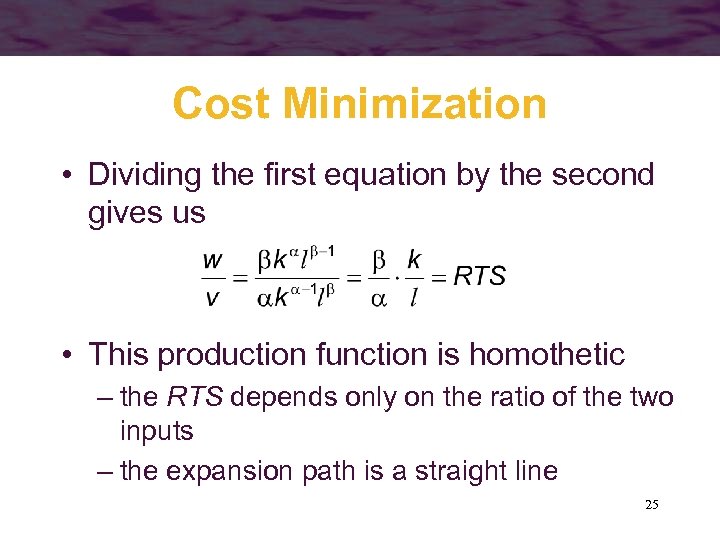 Cost Minimization • Dividing the first equation by the second gives us • This production function is homothetic – the RTS depends only on the ratio of the two inputs – the expansion path is a straight line 25
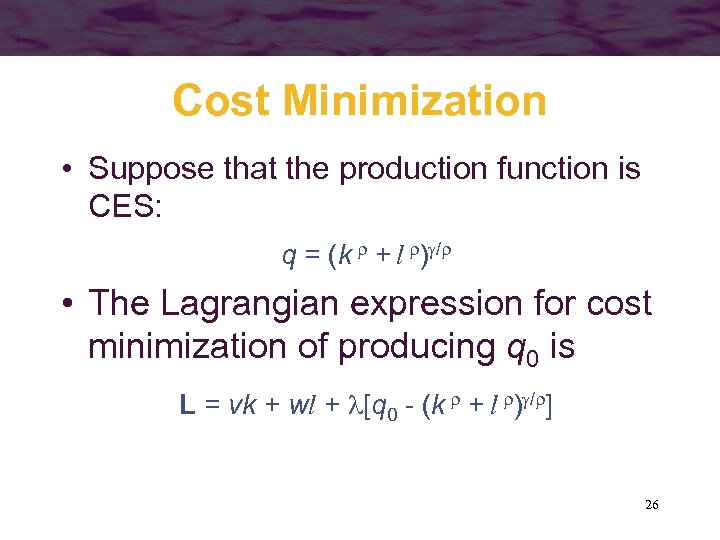 Cost Minimization • Suppose that the production function is CES: q = (k + l ) / • The Lagrangian expression for cost minimization of producing q 0 is L = vk + wl + [q 0 - (k + l ) / ] 26
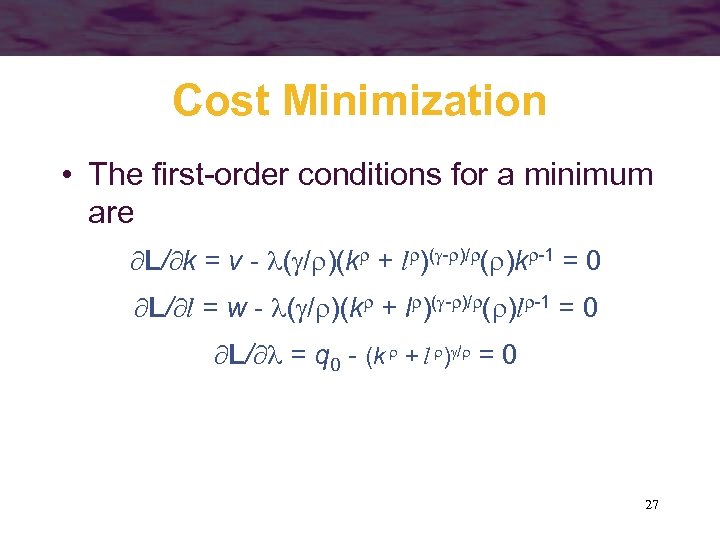 Cost Minimization • The first-order conditions for a minimum are L/ k = v - ( / )(k + l )( - )/ ( )k -1 = 0 L/ l = w - ( / )(k + l )( - )/ ( )l -1 = 0 L/ = q 0 - (k + l ) / = 0 27
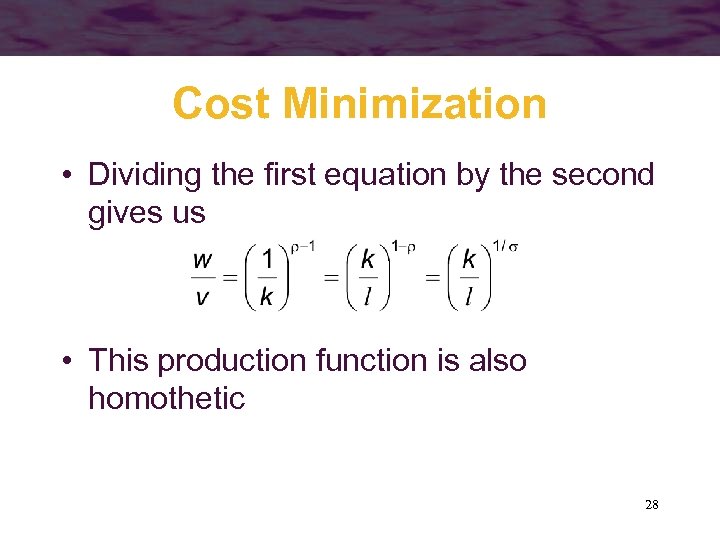 Cost Minimization • Dividing the first equation by the second gives us • This production function is also homothetic 28
 Total Cost Function • The total cost function shows that for any set of input costs and for any output level, the minimum cost incurred by the firm is C = C(v, w, q) • As output (q) increases, total costs increase 29
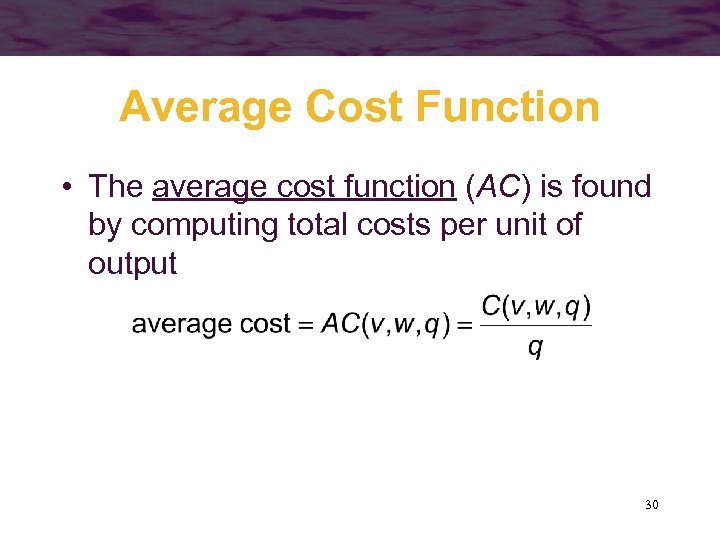 Average Cost Function • The average cost function (AC) is found by computing total costs per unit of output 30
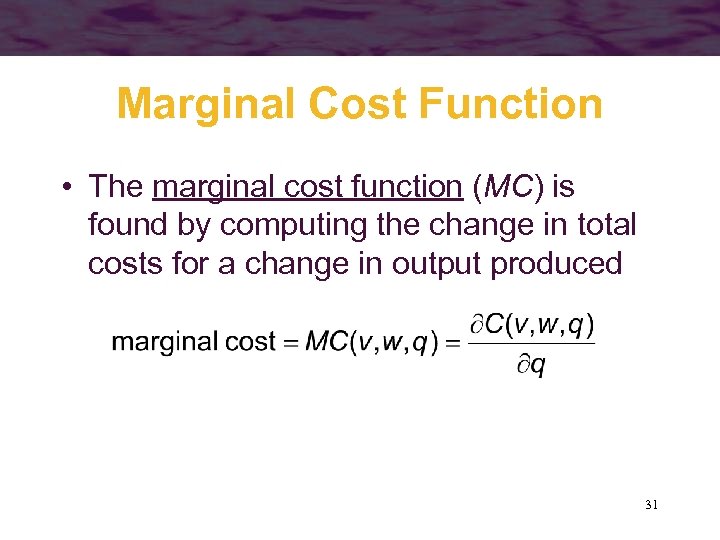 Marginal Cost Function • The marginal cost function (MC) is found by computing the change in total costs for a change in output produced 31
 Graphical Analysis of Total Costs • Suppose that k 1 units of capital and l 1 units of labor input are required to produce one unit of output C(q=1) = vk 1 + wl 1 • To produce m units of output (assuming constant returns to scale) C(q=m) = vmk 1 + wml 1 = m(vk 1 + wl 1) C(q=m) = m C(q=1) 32
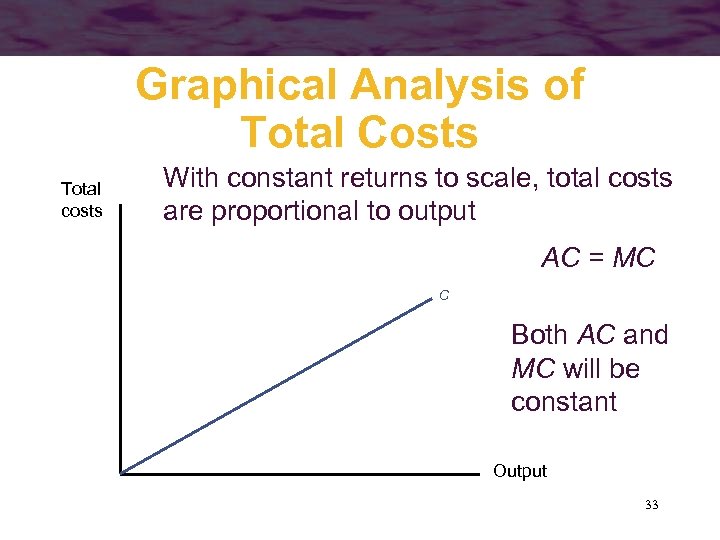 Graphical Analysis of Total Costs Total costs With constant returns to scale, total costs are proportional to output AC = MC C Both AC and MC will be constant Output 33
 Graphical Analysis of Total Costs • Suppose instead that total costs start out as concave and then becomes convex as output increases – one possible explanation for this is that there is a third factor of production that is fixed as capital and labor usage expands – total costs begin rising rapidly after diminishing returns set in 34
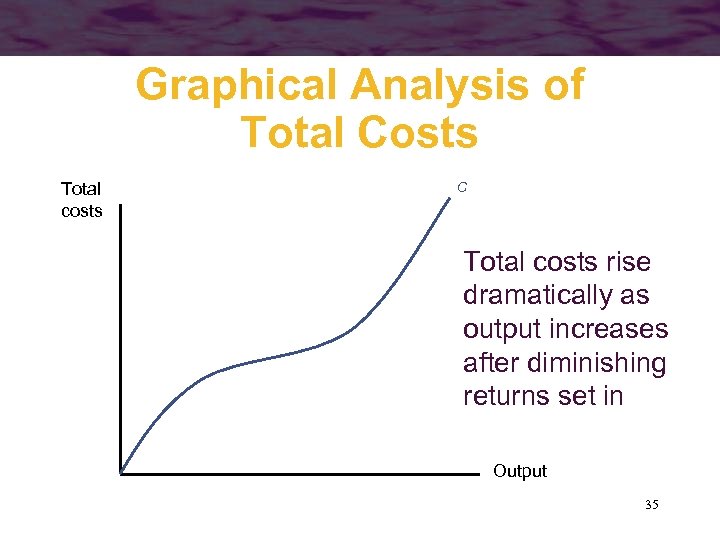 Graphical Analysis of Total Costs Total costs C Total costs rise dramatically as output increases after diminishing returns set in Output 35
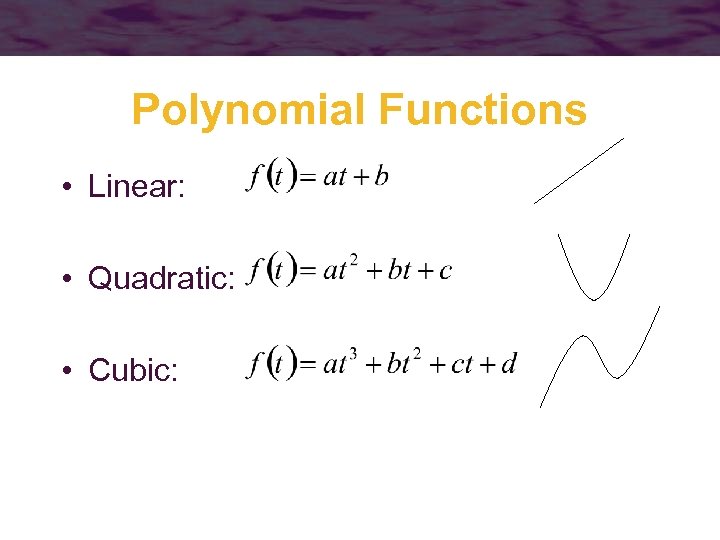 Polynomial Functions • Linear: • Quadratic: • Cubic:
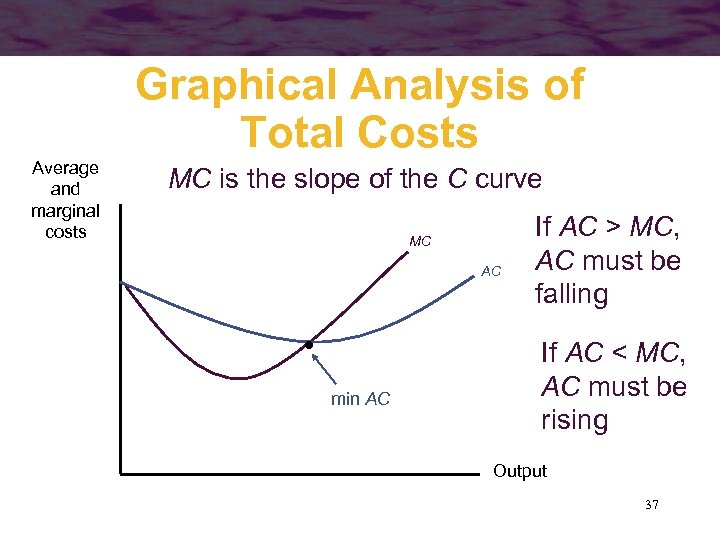 Graphical Analysis of Total Costs Average and marginal costs MC is the slope of the C curve MC AC min AC If AC > MC, AC must be falling If AC < MC, AC must be rising Output 37
 Shifts in Cost Curves • The cost curves are drawn under the assumption that input prices and the level of technology are held constant – any change in these factors will cause the cost curves to shift 38
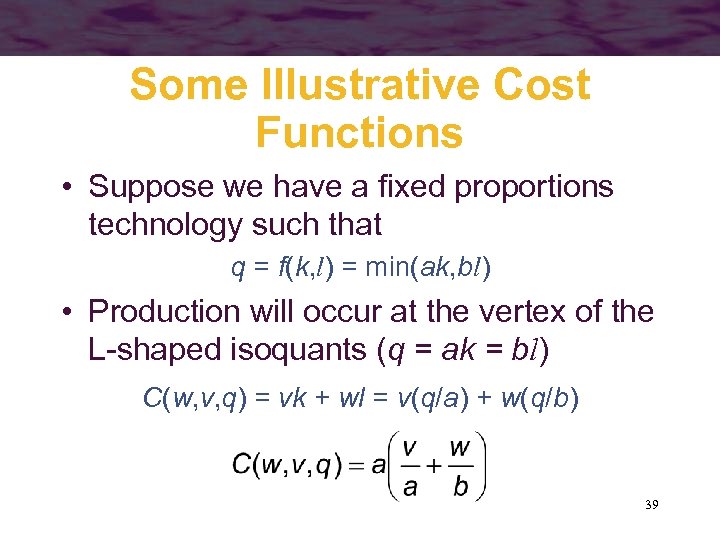 Some Illustrative Cost Functions • Suppose we have a fixed proportions technology such that q = f(k, l) = min(ak, bl) • Production will occur at the vertex of the L-shaped isoquants (q = ak = bl) C(w, v, q) = vk + wl = v(q/a) + w(q/b) 39
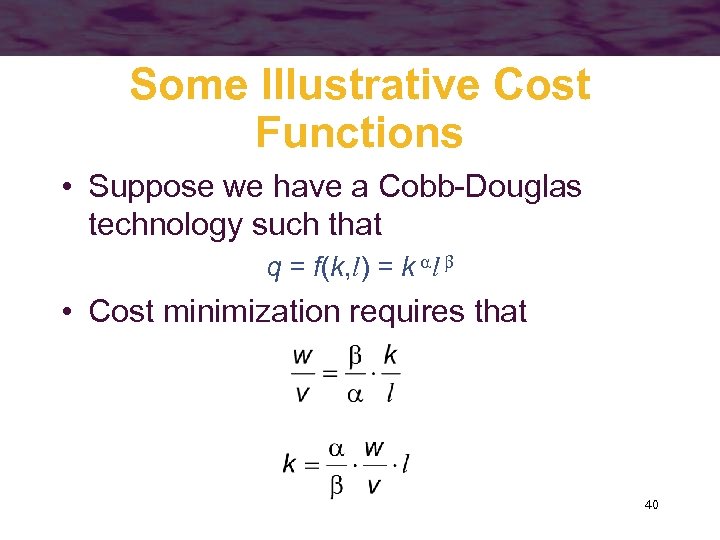 Some Illustrative Cost Functions • Suppose we have a Cobb-Douglas technology such that q = f(k, l) = k l • Cost minimization requires that 40
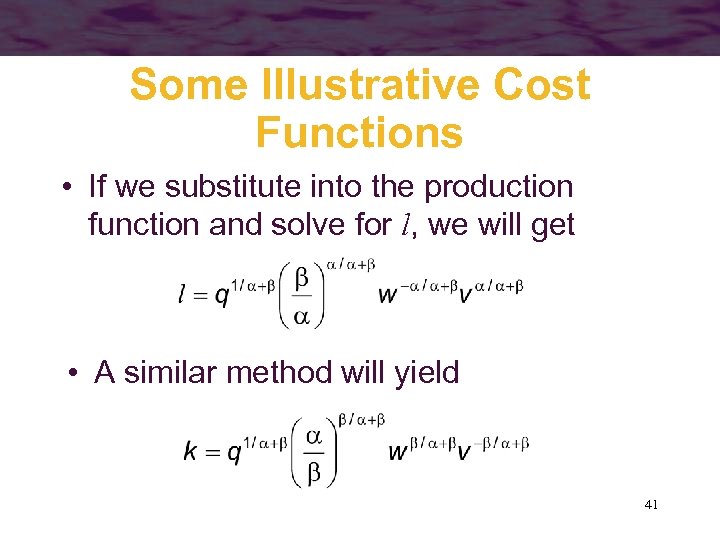 Some Illustrative Cost Functions • If we substitute into the production function and solve for l, we will get • A similar method will yield 41
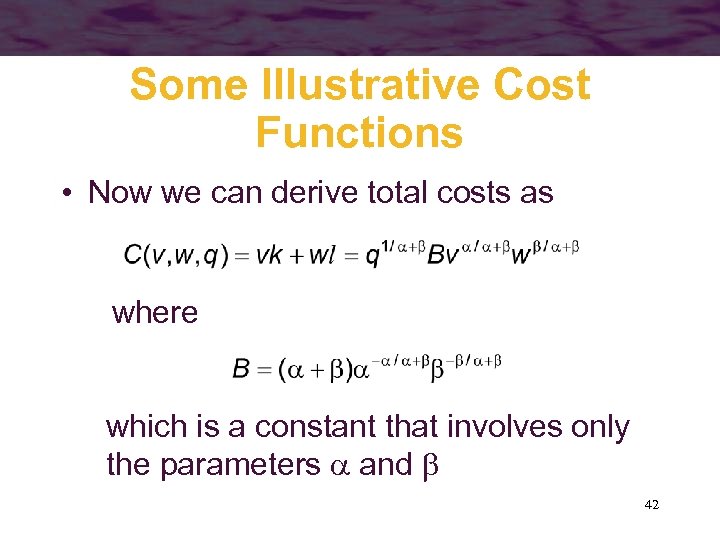 Some Illustrative Cost Functions • Now we can derive total costs as where which is a constant that involves only the parameters and 42
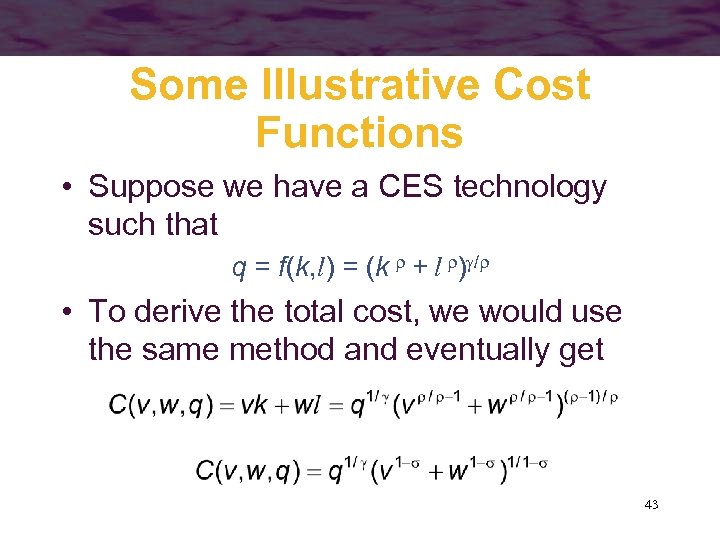 Some Illustrative Cost Functions • Suppose we have a CES technology such that q = f(k, l) = (k + l ) / • To derive the total cost, we would use the same method and eventually get 43
 Properties of Cost Functions • Homogeneity – cost functions are all homogeneous of degree one in the input prices • cost minimization requires that the ratio of input prices be set equal to RTS, a doubling of all input prices will not change the levels of inputs purchased • pure, uniform inflation will not change a firm’s input decisions but will shift the cost curves up 44
 Properties of Cost Functions • Nondecreasing in q, v, and w – cost functions are derived from a costminimization process • any decline in costs from an increase in one of the function’s arguments would lead to a contradiction 45
 Properties of Cost Functions • Concave in input prices – costs will be lower when a firm faces input prices that fluctuate around a given level than when they remain constant at that level • the firm can adapt its input mix to take advantage of such fluctuations 46
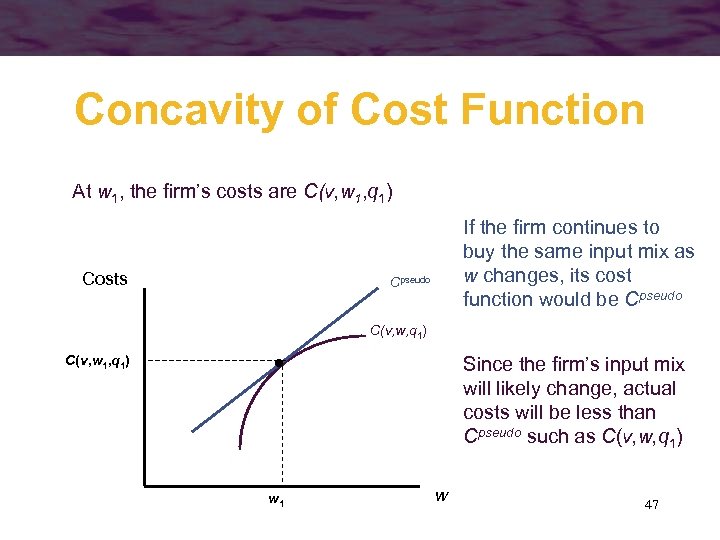 Concavity of Cost Function At w 1, the firm’s costs are C(v, w 1, q 1) Costs If the firm continues to buy the same input mix as w changes, its cost function would be Cpseudo C(v, w, q 1) C(v, w 1, q 1) Since the firm’s input mix will likely change, actual costs will be less than Cpseudo such as C(v, w, q 1) w 1 w 47
 Properties of Cost Functions • Some of these properties carry over to average and marginal costs – homogeneity – effects of v, w, and q are ambiguous 48
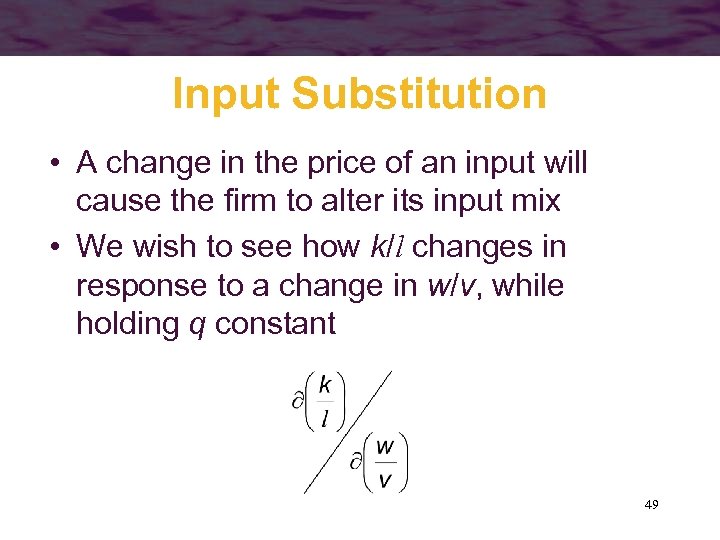 Input Substitution • A change in the price of an input will cause the firm to alter its input mix • We wish to see how k/l changes in response to a change in w/v, while holding q constant 49
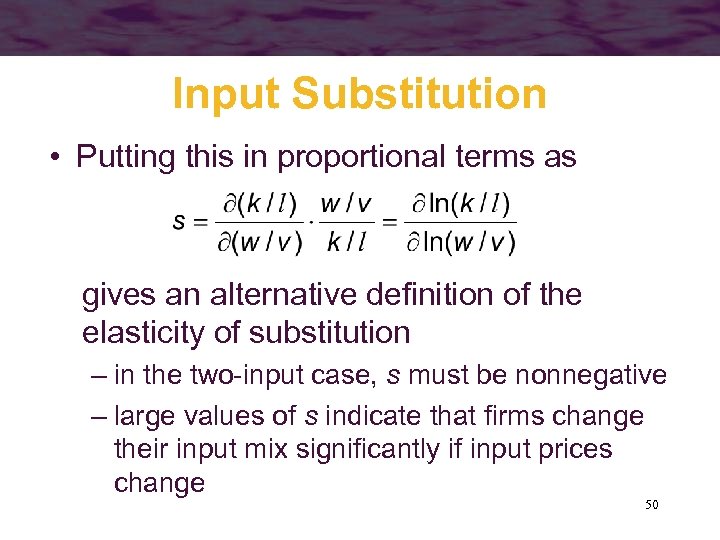 Input Substitution • Putting this in proportional terms as gives an alternative definition of the elasticity of substitution – in the two-input case, s must be nonnegative – large values of s indicate that firms change their input mix significantly if input prices change 50
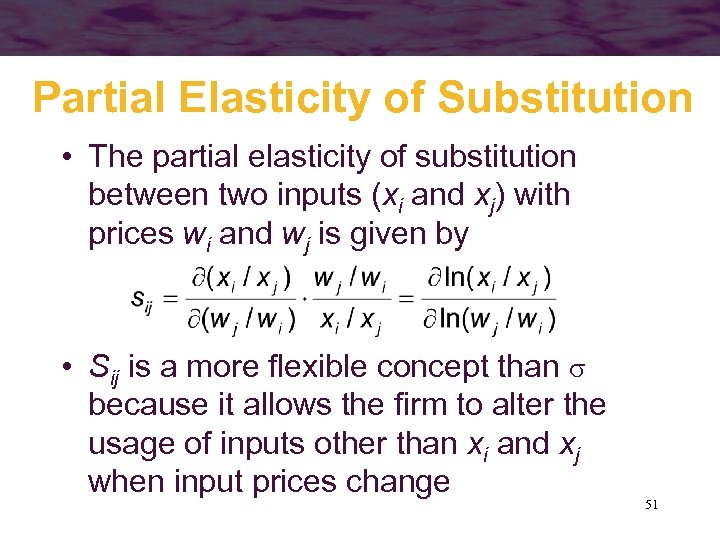 Partial Elasticity of Substitution • The partial elasticity of substitution between two inputs (xi and xj) with prices wi and wj is given by • Sij is a more flexible concept than because it allows the firm to alter the usage of inputs other than xi and xj when input prices change 51
 Size of Shifts in Costs Curves • The increase in costs will be largely influenced by the relative significance of the input in the production process • If firms can easily substitute another input for the one that has risen in price, there may be little increase in costs 52
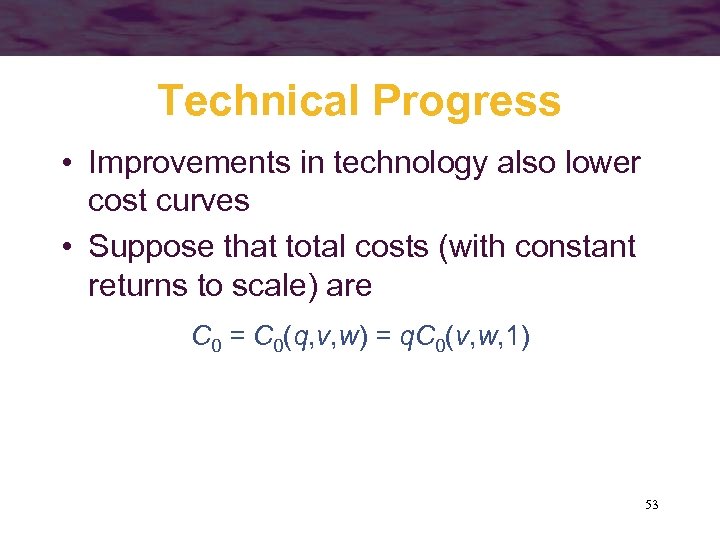 Technical Progress • Improvements in technology also lower cost curves • Suppose that total costs (with constant returns to scale) are C 0 = C 0(q, v, w) = q. C 0(v, w, 1) 53
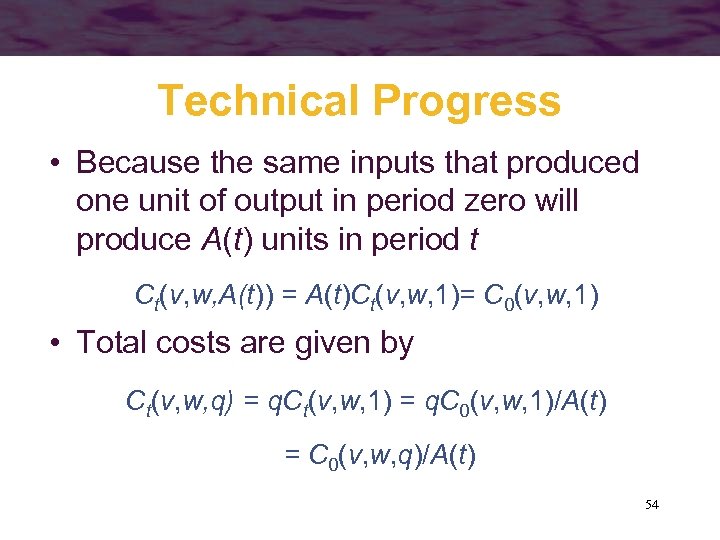 Technical Progress • Because the same inputs that produced one unit of output in period zero will produce A(t) units in period t Ct(v, w, A(t)) = A(t)Ct(v, w, 1)= C 0(v, w, 1) • Total costs are given by Ct(v, w, q) = q. Ct(v, w, 1) = q. C 0(v, w, 1)/A(t) = C 0(v, w, q)/A(t) 54
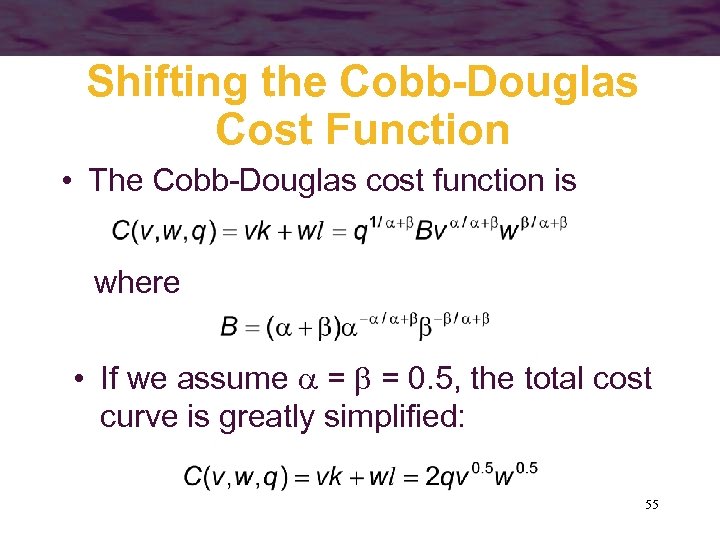 Shifting the Cobb-Douglas Cost Function • The Cobb-Douglas cost function is where • If we assume = = 0. 5, the total cost curve is greatly simplified: 55
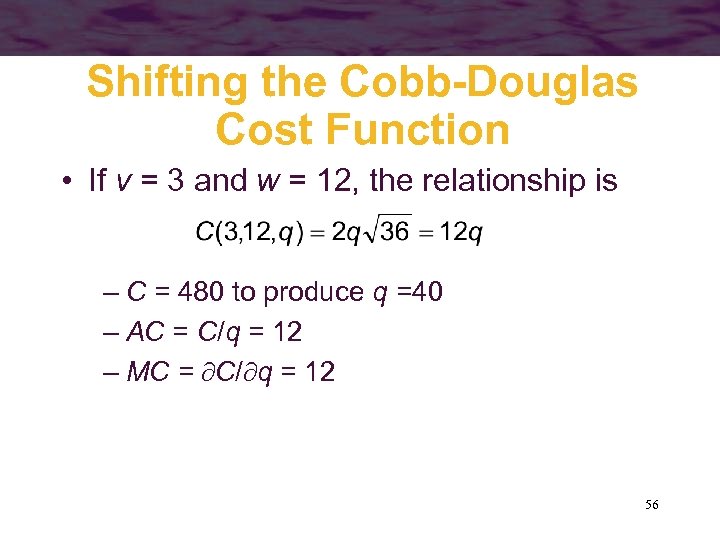 Shifting the Cobb-Douglas Cost Function • If v = 3 and w = 12, the relationship is – C = 480 to produce q =40 – AC = C/q = 12 – MC = C/ q = 12 56
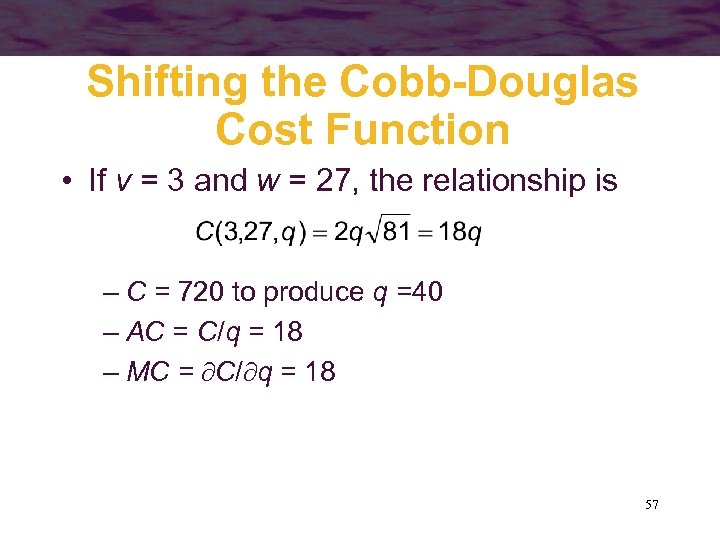 Shifting the Cobb-Douglas Cost Function • If v = 3 and w = 27, the relationship is – C = 720 to produce q =40 – AC = C/q = 18 – MC = C/ q = 18 57
 Contingent Demand for Inputs • Contingent demand functions for all of the firms inputs can be derived from the cost function – Shephard’s lemma • the contingent demand function for any input is given by the partial derivative of the total-cost function with respect to that input’s price 58
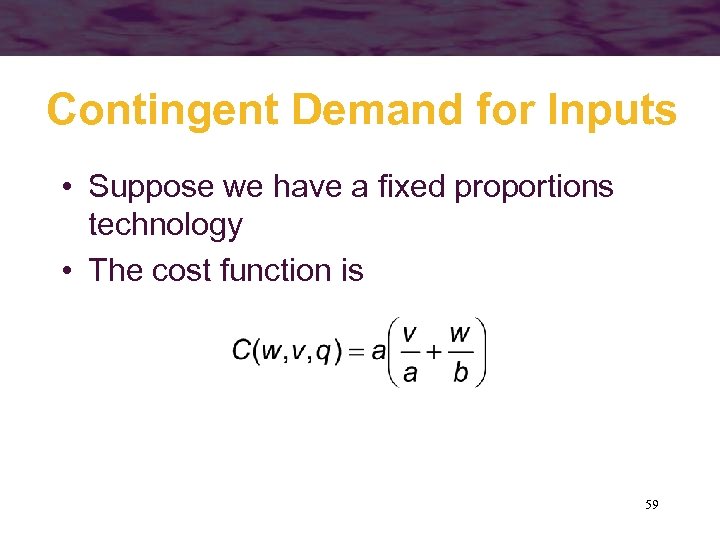 Contingent Demand for Inputs • Suppose we have a fixed proportions technology • The cost function is 59
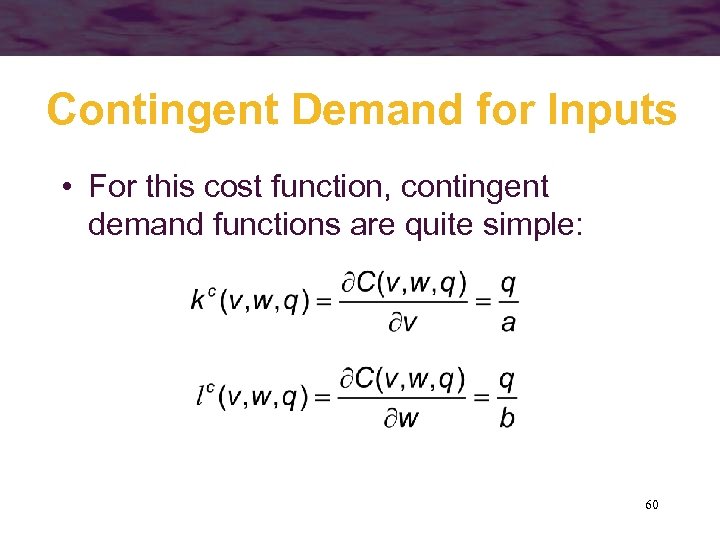 Contingent Demand for Inputs • For this cost function, contingent demand functions are quite simple: 60
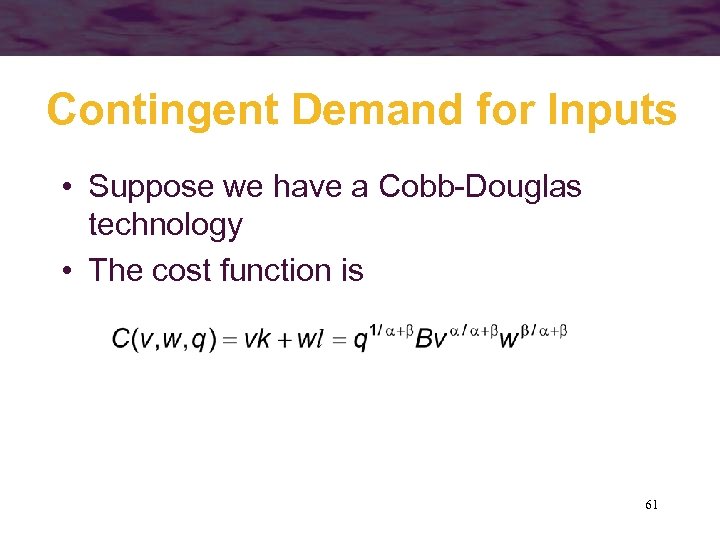 Contingent Demand for Inputs • Suppose we have a Cobb-Douglas technology • The cost function is 61
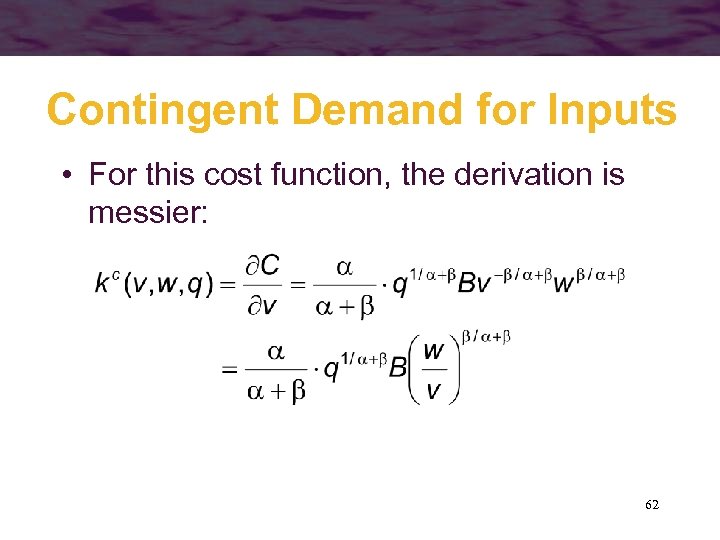 Contingent Demand for Inputs • For this cost function, the derivation is messier: 62
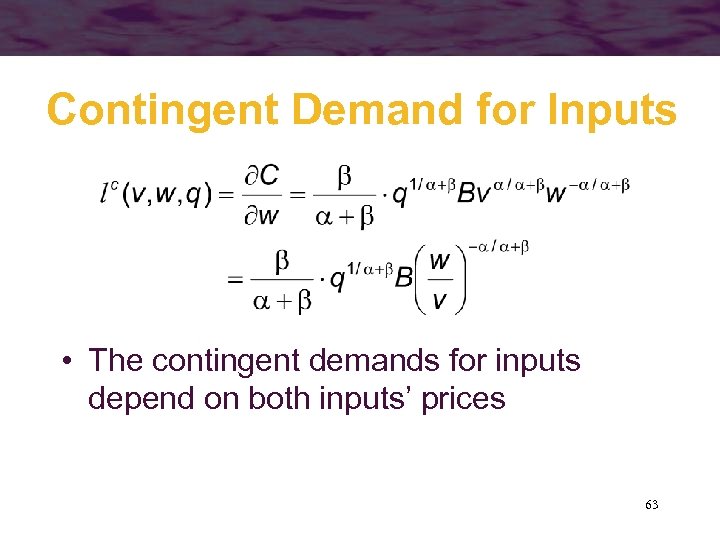 Contingent Demand for Inputs • The contingent demands for inputs depend on both inputs’ prices 63
 Short-Run, Long-Run Distinction • In the short run, economic actors have only limited flexibility in their actions • Assume that the capital input is held constant at k 1 and the firm is free to vary only its labor input • The production function becomes q = f(k 1, l) 64
 Short-Run Total Costs • Short-run total cost for the firm is SC = vk 1 + wl • There are two types of short-run costs: – short-run fixed costs are costs associated with fixed inputs (vk 1) – short-run variable costs are costs associated with variable inputs (wl) 65
 Short-Run Total Costs • Short-run costs are not minimal costs for producing the various output levels – the firm does not have the flexibility of input choice – to vary its output in the short run, the firm must use nonoptimal input combinations – the RTS will not be equal to the ratio of input prices 66
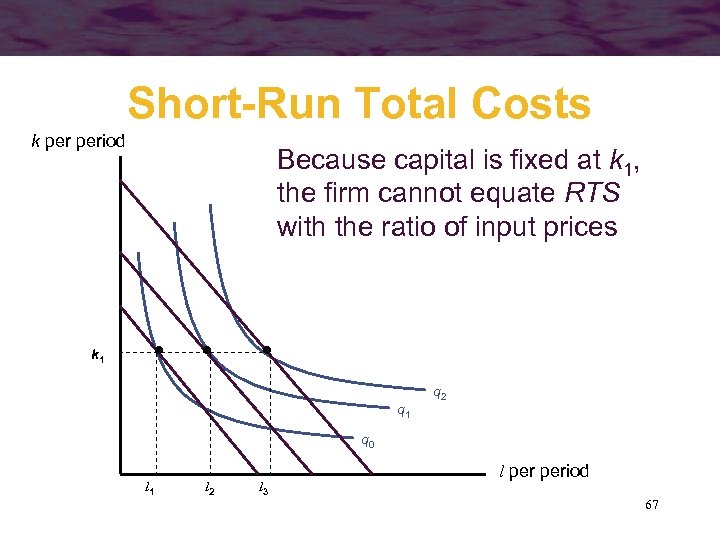 Short-Run Total Costs k period Because capital is fixed at k 1, the firm cannot equate RTS with the ratio of input prices k 1 q 2 q 0 l 1 l 2 l 3 l period 67
 Short-Run Marginal and Average Costs • The short-run average total cost (SAC) function is SAC = total costs/total output = SC/q • The short-run marginal cost (SMC) function is SMC = change in SC/change in output = SC/ q 68
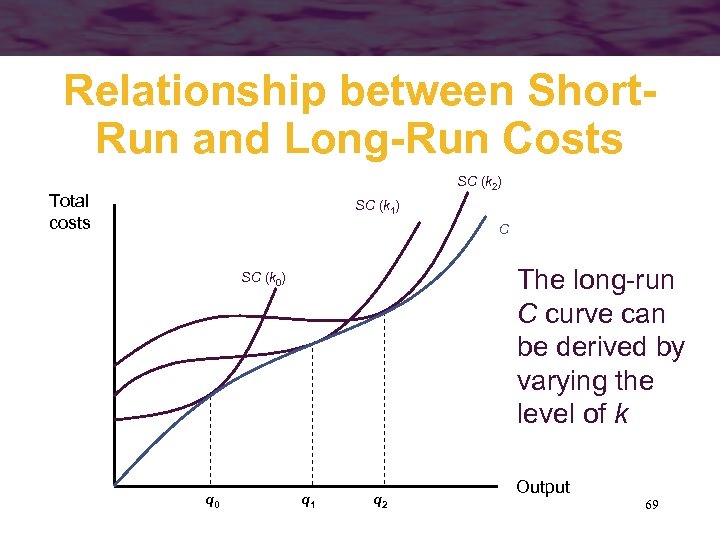 Relationship between Short. Run and Long-Run Costs SC (k 2) Total costs SC (k 1) C The long-run C curve can be derived by varying the level of k SC (k 0) q 0 q 1 q 2 Output 69
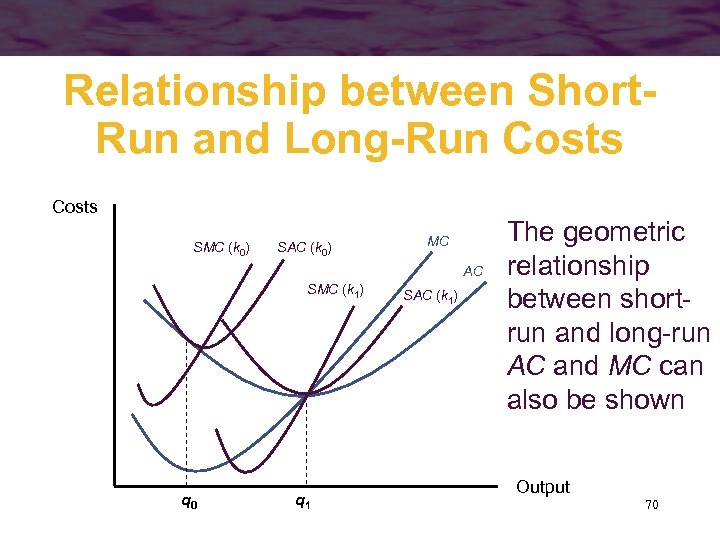 Relationship between Short. Run and Long-Run Costs SMC (k 0) SAC (k 0) MC AC SMC (k 1) q 0 q 1 SAC (k 1) The geometric relationship between shortrun and long-run AC and MC can also be shown Output 70
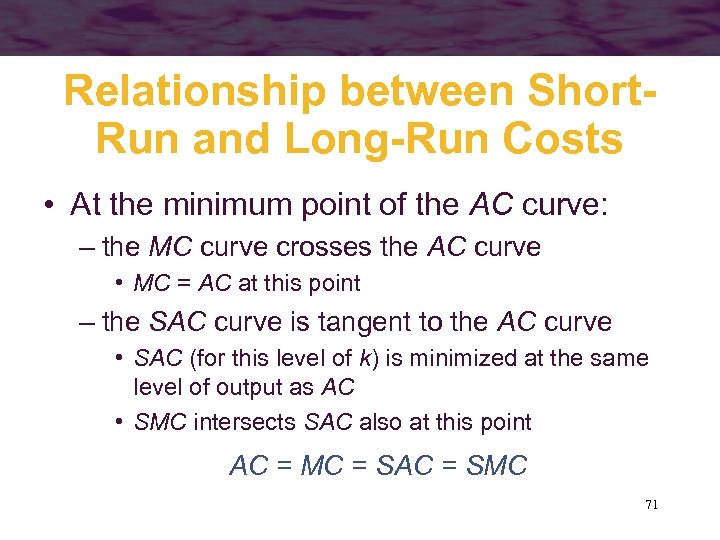 Relationship between Short. Run and Long-Run Costs • At the minimum point of the AC curve: – the MC curve crosses the AC curve • MC = AC at this point – the SAC curve is tangent to the AC curve • SAC (for this level of k) is minimized at the same level of output as AC • SMC intersects SAC also at this point AC = MC = SAC = SMC 71
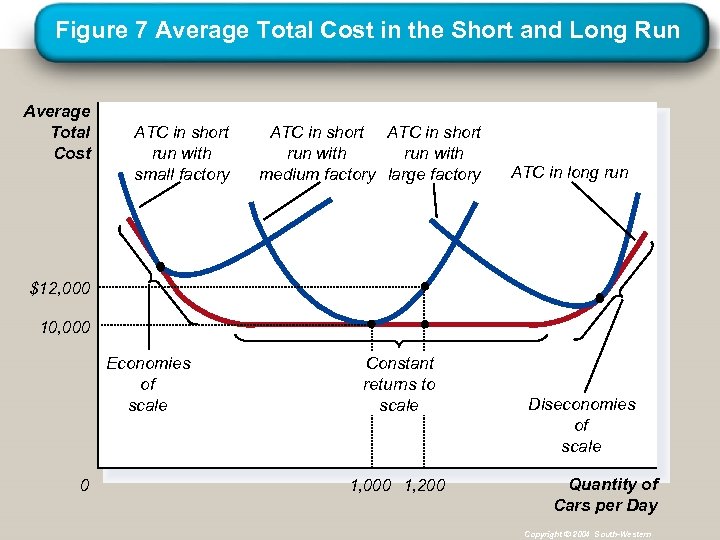 Figure 7 Average Total Cost in the Short and Long Run Average Total Cost ATC in short run with small factory ATC in short run with medium factory large factory ATC in long run $12, 000 10, 000 Economies of scale 0 Constant returns to scale 1, 000 1, 200 Diseconomies of scale Quantity of Cars per Day Copyright © 2004 South-Western
 Typical Cost Curves It is now time to examine the relationships that exist between the different measures of cost.
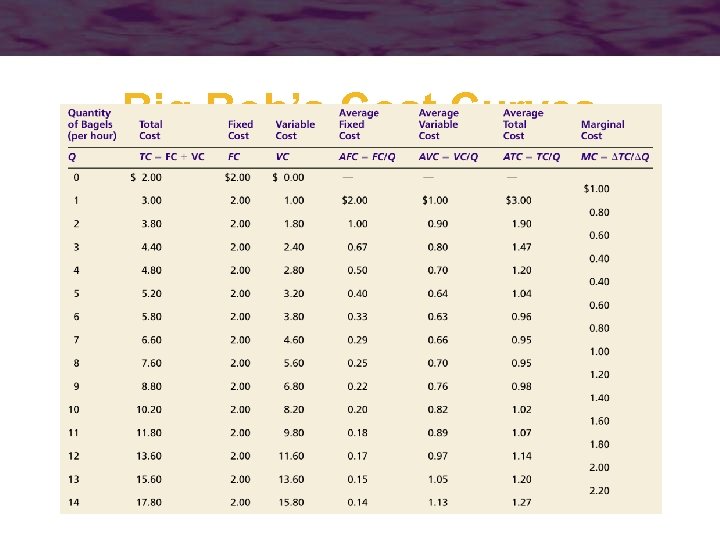 Big Bob’s Cost Curves
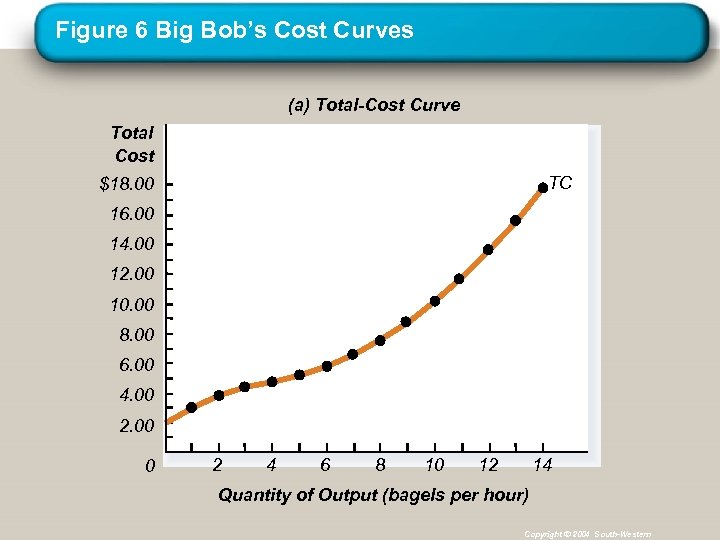 Figure 6 Big Bob’s Cost Curves (a) Total-Cost Curve Total Cost TC $18. 00 16. 00 14. 00 12. 00 10. 00 8. 00 6. 00 4. 00 2. 00 0 2 4 6 8 10 12 14 Quantity of Output (bagels per hour) Copyright © 2004 South-Western
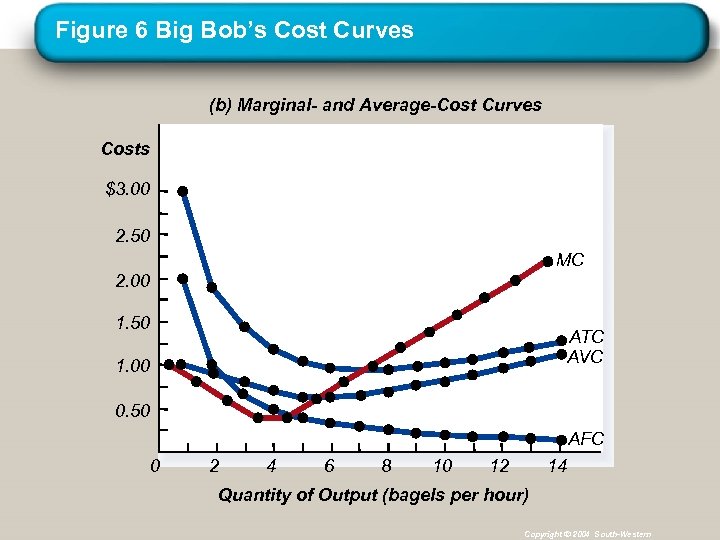 Figure 6 Big Bob’s Cost Curves (b) Marginal- and Average-Cost Curves Costs $3. 00 2. 50 MC 2. 00 1. 50 ATC AVC 1. 00 0. 50 AFC 0 2 4 6 8 10 12 14 Quantity of Output (bagels per hour) Copyright © 2004 South-Western
 Important Points to Note: • A firm that wishes to minimize the economic costs of producing a particular level of output should choose that input combination for which the rate of technical substitution (RTS) is equal to the ratio of the inputs’ rental prices 77
 Important Points to Note: • Repeated application of this minimization procedure yields the firm’s expansion path – the expansion path shows how input usage expands with the level of output • it also shows the relationship between output level and total cost • this relationship is summarized by the total cost function, C(v, w, q) 78
 Important Points to Note: • The firm’s average cost (AC = C/q) and marginal cost (MC = C/ q) can be derived directly from the total-cost function – if the total cost curve has a general cubic shape, the AC and MC curves will be ushaped 79
 Important Points to Note: • All cost curves are drawn on the assumption that the input prices are held constant – when an input price changes, cost curves shift to new positions • the size of the shifts will be determined by the overall importance of the input and the substitution abilities of the firm – technical progress will also shift cost curves 80
 Important Points to Note: • Input demand functions can be derived from the firm’s total-cost function through partial differentiation – these input demands will depend on the quantity of output the firm chooses to produce • are called “contingent” demand functions 81
 Important Points to Note: • In the short run, the firm may not be able to vary some inputs – it can then alter its level of production only by changing the employment of its variable inputs – it may have to use nonoptimal, highercost input combinations than it would choose if it were possible to vary all inputs 82