 Скачать презентацию Chapter 8 Common Agricultural Policy Baldwin Wyplosz The
4992f6c87f4f253b8efc9b844e1d2e39.ppt
- Количество слайдов: 19



Chapter 8: Common Agricultural Policy © Baldwin&Wyplosz The Economics of European Integration 1
CAP • Massively complex, massively expensive policy. • Hard to understand without seeing how it developed. • CAP started as simple price support policy in 1962. • EU was net importer of most food, so could support price via tariff. – Technically known as a ‘variable levy. ’ © Baldwin&Wyplosz The Economics of European Integration 2
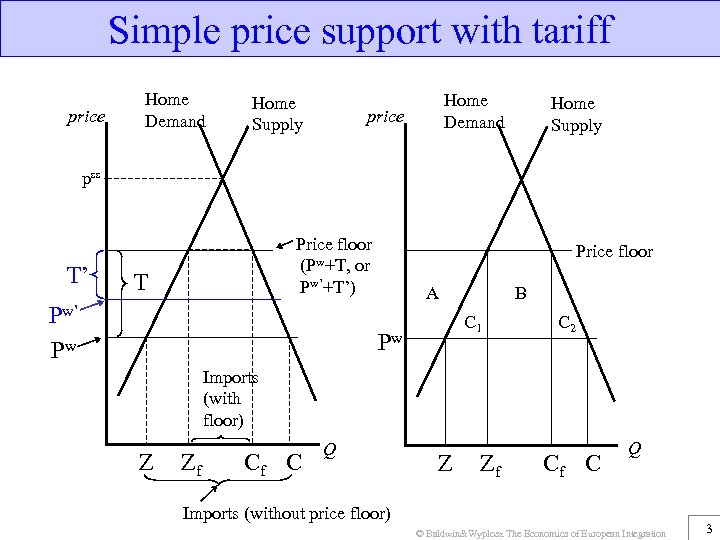
Simple price support with tariff price Home Demand Home Supply Home Demand price Home Supply pss T’ Price floor (Pw+T, or Pw’+T’) T Pw’ Pw Price floor A B C 1 Pw C 2 Imports (with floor) Z Zf Cf C Q Imports (without price floor) © Baldwin&Wyplosz The Economics of European Integration 3
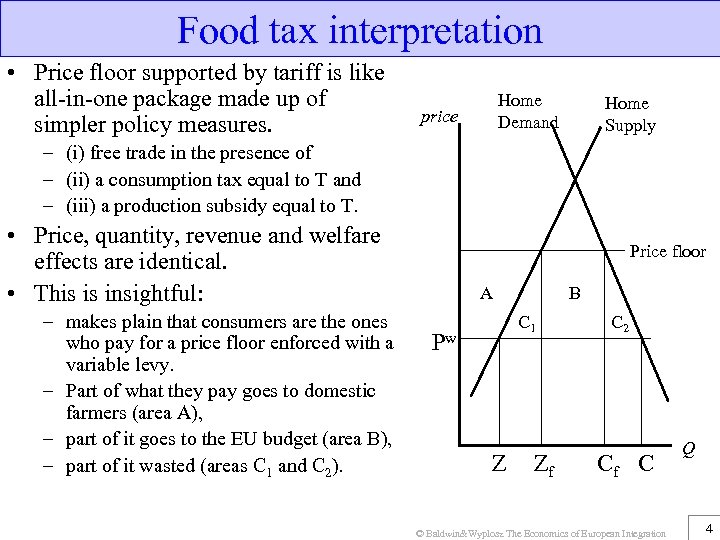
Food tax interpretation • Price floor supported by tariff is like all-in-one package made up of simpler policy measures. Home Demand price Home Supply – (i) free trade in the presence of – (ii) a consumption tax equal to T and – (iii) a production subsidy equal to T. • Price, quantity, revenue and welfare effects are identical. • This is insightful: – makes plain that consumers are the ones who pay for a price floor enforced with a variable levy. – Part of what they pay goes to domestic farmers (area A), – part of it goes to the EU budget (area B), – part of it wasted (areas C 1 and C 2). Price floor A B C 1 Pw Z Zf C 2 Cf C © Baldwin&Wyplosz The Economics of European Integration Q 4
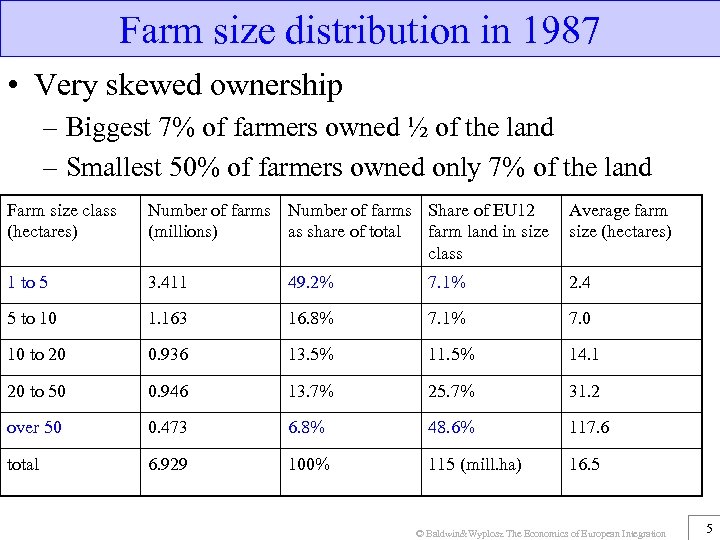
Farm size distribution in 1987 • Very skewed ownership – Biggest 7% of farmers owned ½ of the land – Smallest 50% of farmers owned only 7% of the land Farm size class (hectares) Number of farms Share of EU 12 (millions) as share of total farm land in size class Average farm size (hectares) 1 to 5 3. 411 49. 2% 7. 1% 2. 4 5 to 10 1. 163 16. 8% 7. 1% 7. 0 10 to 20 0. 936 13. 5% 11. 5% 14. 1 20 to 50 0. 946 13. 7% 25. 7% 31. 2 over 50 0. 473 6. 8% 48. 6% 117. 6 total 6. 929 100% 115 (mill. ha) 16. 5 © Baldwin&Wyplosz The Economics of European Integration 5
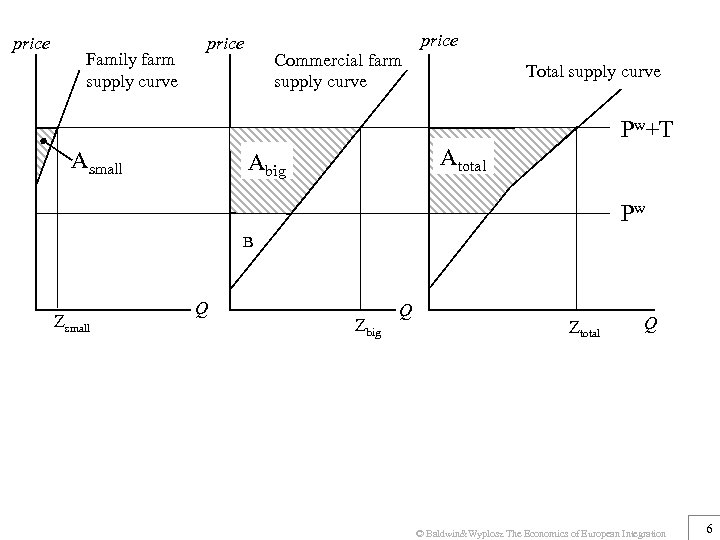
price Family farm supply curve price Commercial farm supply curve Total supply curve Pw+T Asmall Atotal Abig Pw B Zsmall Q Zbig Q Ztotal Q © Baldwin&Wyplosz The Economics of European Integration 6
CAP problems • #1 Problem: The supply problem • ‘Green’ revolution technology boom, supply ↑ – High guaranteed prices encourage investment & adoption – Output rises much faster than consumption © Baldwin&Wyplosz The Economics of European Integration 7
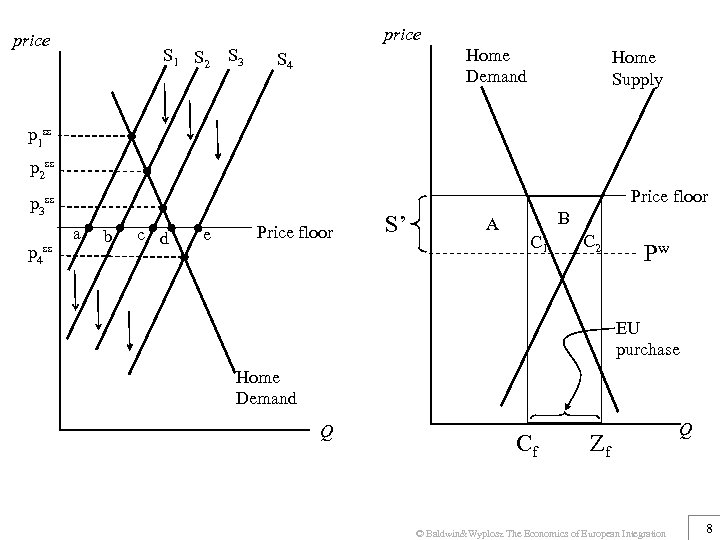
price S 1 S 2 S 3 Home Demand S 4 Home Supply p 1 ss p 2 ss Price floor p 3 ss p 4 ss a b c d e Price floor S’ A B C 1 C 2 Pw EU purchase Home Demand Q Cf Zf © Baldwin&Wyplosz The Economics of European Integration Q 8
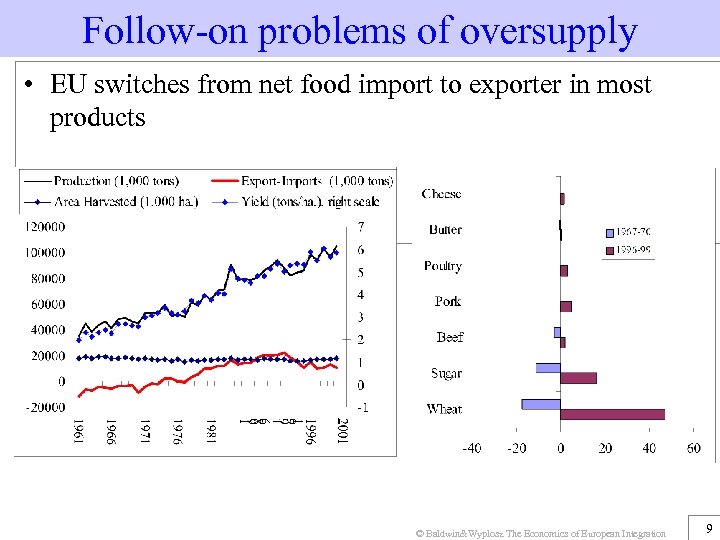
Follow-on problems of oversupply • EU switches from net food import to exporter in most products © Baldwin&Wyplosz The Economics of European Integration 9
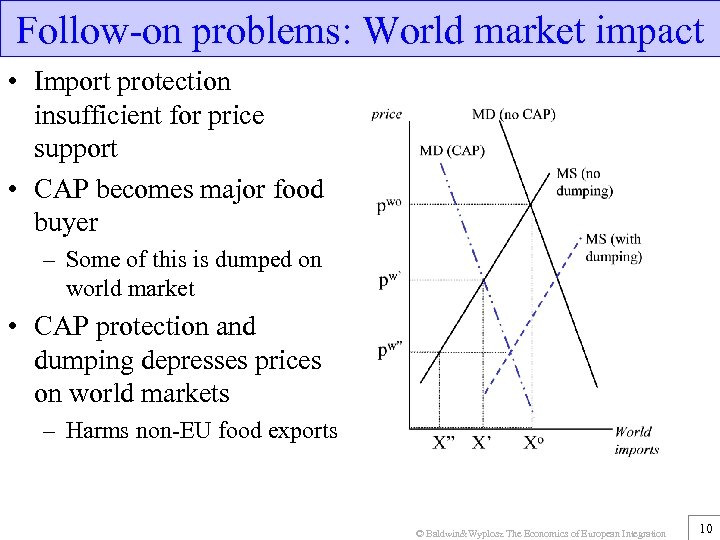
Follow-on problems: World market impact • Import protection insufficient for price support • CAP becomes major food buyer – Some of this is dumped on world market • CAP protection and dumping depresses prices on world markets – Harms non-EU food exports © Baldwin&Wyplosz The Economics of European Integration 10
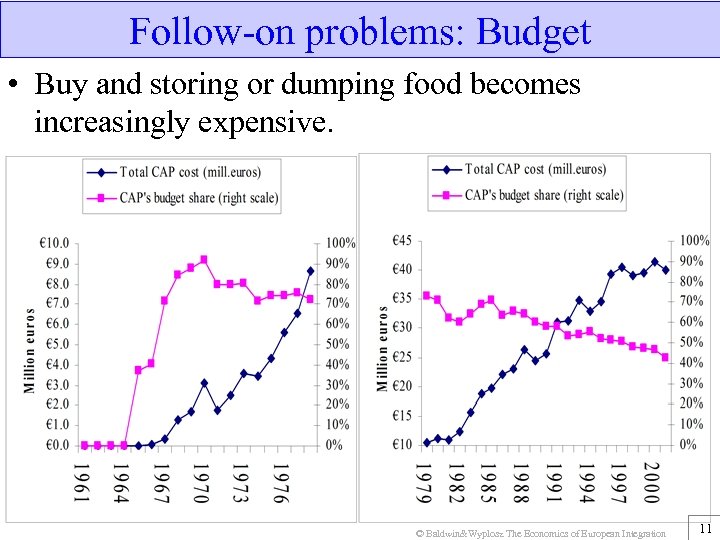
Follow-on problems: Budget • Buy and storing or dumping food becomes increasingly expensive. © Baldwin&Wyplosz The Economics of European Integration 11
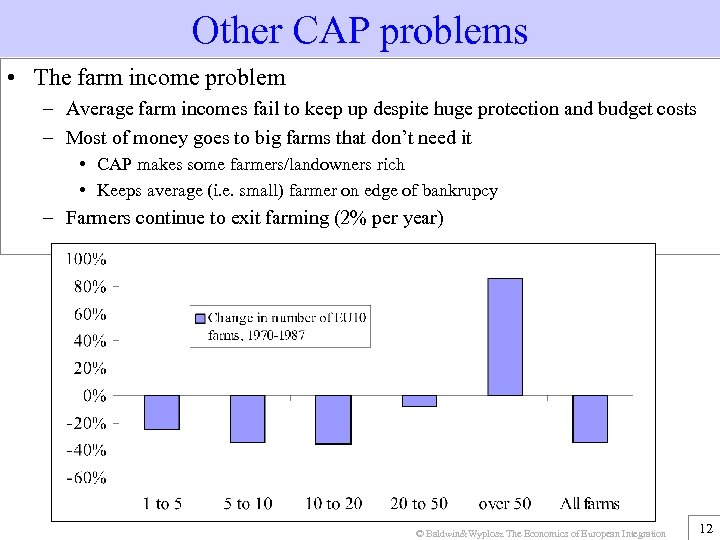
Other CAP problems • The farm income problem – Average farm incomes fail to keep up despite huge protection and budget costs – Most of money goes to big farms that don’t need it • CAP makes some farmers/landowners rich • Keeps average (i. e. small) farmer on edge of bankrupcy – Farmers continue to exit farming (2% per year) © Baldwin&Wyplosz The Economics of European Integration 12
Other CAP problems • Factory Farming – pollution – animal welfare – Nostalgia • Bad for ‘image’ and thus public support for CAP © Baldwin&Wyplosz The Economics of European Integration 13
CAP Reforms • Supply control attempts – 1980 s, experimentation with ad hoc & complex set supply ‘controls’ to discourage production – Generally failed; technological progress & high guaranteed prices overwhelmed supply controls • 1992: Mac. Sharry Reforms – Basic idea: CUT PRICES supports to near world-price level & COMPENSATE farmers with direct payments – Was essential to complete the Uruguay Round – Worked well • June 2003 Reforms; essential to Doha Round – Implementation 2004 -2007 – Similar to Mac. Sharry reforms in spirit © Baldwin&Wyplosz The Economics of European Integration 14
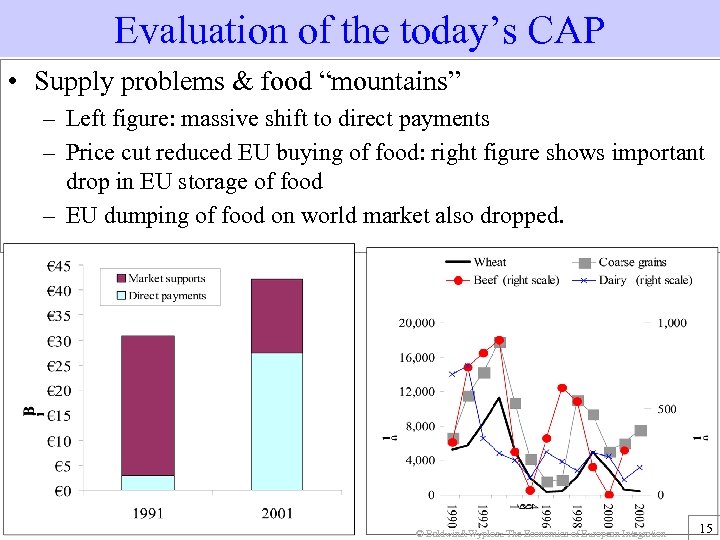
Evaluation of the today’s CAP • Supply problems & food “mountains” – Left figure: massive shift to direct payments – Price cut reduced EU buying of food: right figure shows important drop in EU storage of food – EU dumping of food on world market also dropped. © Baldwin&Wyplosz The Economics of European Integration 15
Farm incomes & CAP support inequity • Reformed CAP (post Mac. Sharry) support still goes mostly to big, rich farmers – payments intended to compensate, so inequity continued • Half the payments to 5% of farms (the largest) • Half the farms (smallest) get only 4% of payments • Recent studies show that only about half of these payments go to farmers – Rest to non-farming landowners and suppliers of agricultural inputs (seed, fertilisers, agri-chemicals, etc. ) • “Who Finances the Queen’s CAP payments? ” http: //shop. ceps. be/Book. Detail. php? item_id=1285 © Baldwin&Wyplosz The Economics of European Integration 16
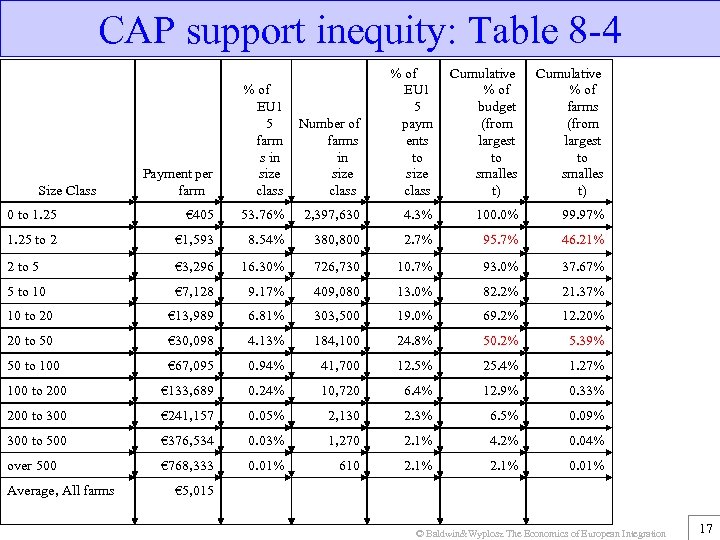
CAP support inequity: Table 8 -4 Payment per farm % of EU 1 5 farm s in size class Number of farms in size class % of EU 1 5 paym ents to size class 0 to 1. 25 € 405 53. 76% 2, 397, 630 4. 3% 100. 0% 99. 97% 1. 25 to 2 € 1, 593 8. 54% 380, 800 2. 7% 95. 7% 46. 21% 2 to 5 € 3, 296 16. 30% 726, 730 10. 7% 93. 0% 37. 67% 5 to 10 € 7, 128 9. 17% 409, 080 13. 0% 82. 2% 21. 37% 10 to 20 € 13, 989 6. 81% 303, 500 19. 0% 69. 2% 12. 20% 20 to 50 € 30, 098 4. 13% 184, 100 24. 8% 50. 2% 5. 39% 50 to 100 € 67, 095 0. 94% 41, 700 12. 5% 25. 4% 1. 27% 100 to 200 € 133, 689 0. 24% 10, 720 6. 4% 12. 9% 0. 33% 200 to 300 € 241, 157 0. 05% 2, 130 2. 3% 6. 5% 0. 09% 300 to 500 € 376, 534 0. 03% 1, 270 2. 1% 4. 2% 0. 04% over 500 € 768, 333 0. 01% 610 2. 1% 0. 01% Size Class Average, All farms Cumulative % of budget (from largest to smalles t) Cumulative % of farms (from largest to smalles t) € 5, 015 © Baldwin&Wyplosz The Economics of European Integration 17
Future challenges • Doha Round – Failure in Cancun may require deeper reform of CAP • Eastern Enlargement – Number of farms will rise. – Farmland rise from 130 mill hect to 170 mill © Baldwin&Wyplosz The Economics of European Integration 18
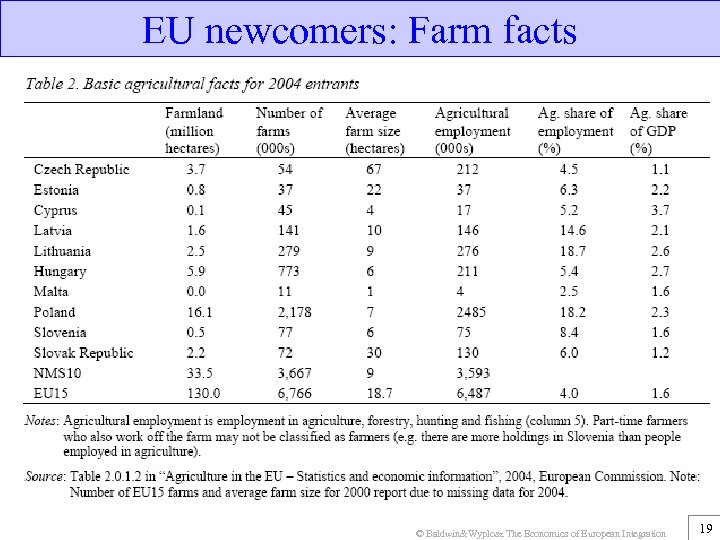
EU newcomers: Farm facts © Baldwin&Wyplosz The Economics of European Integration 19
Скачать презентацию Chapter 8 Common Agricultural Policy Baldwin Wyplosz The
4992f6c87f4f253b8efc9b844e1d2e39.ppt