


 Скачать презентацию chapter 8 An Economic Analysis of Financial Structure
bc1575b1fc3c838f62d4bf76ea266135.ppt
- Количество слайдов: 13
 chapter 8 An Economic Analysis of Financial Structure
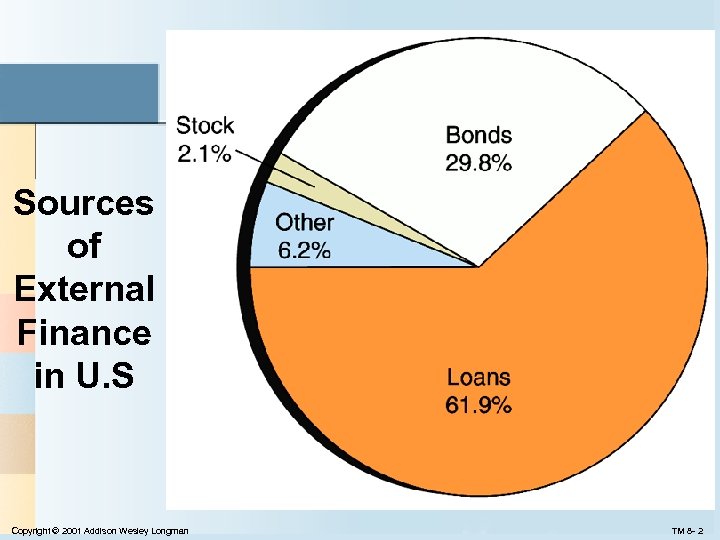 Sources of External Finance in U. S Copyright © 2001 Addison Wesley Longman TM 8 - 2
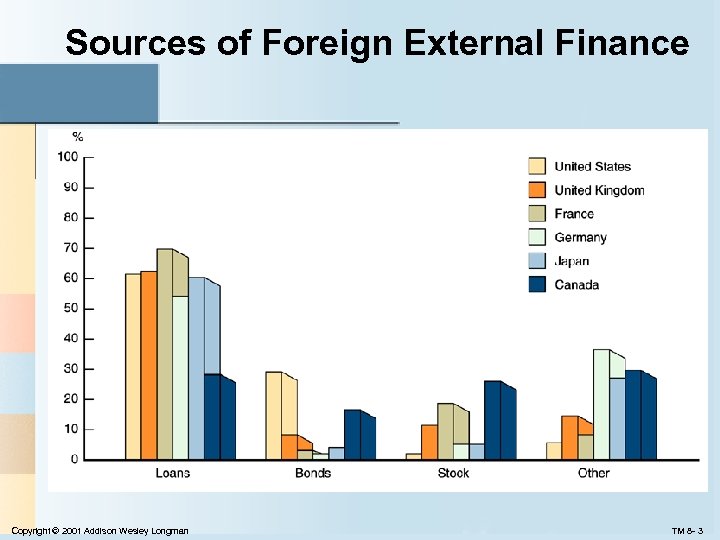 Sources of Foreign External Finance Copyright © 2001 Addison Wesley Longman TM 8 - 3
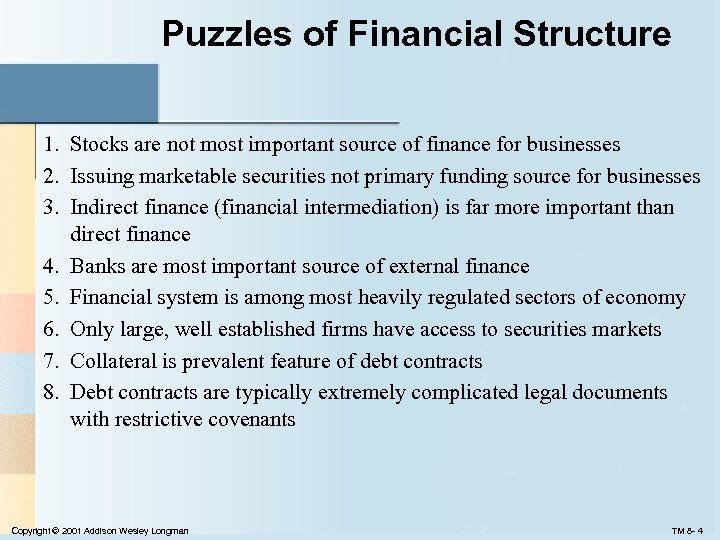 Puzzles of Financial Structure 1. Stocks are not most important source of finance for businesses 2. Issuing marketable securities not primary funding source for businesses 3. Indirect finance (financial intermediation) is far more important than direct finance 4. Banks are most important source of external finance 5. Financial system is among most heavily regulated sectors of economy 6. Only large, well established firms have access to securities markets 7. Collateral is prevalent feature of debt contracts 8. Debt contracts are typically extremely complicated legal documents with restrictive covenants Copyright © 2001 Addison Wesley Longman TM 8 - 4
 Transactions Costs and Financial Structure Transactions costs hinder flow of funds to people with productive investment opportunities Financial intermediaries make profits by reducing transactions costs 1. Take advantage of economies of scale Example: Mutual Funds 2. Develop expertise to lower transactions costs Explains Puzzle 3 Copyright © 2001 Addison Wesley Longman TM 8 - 5
 Adverse Selection and Moral Hazard: Definitions Adverse Selection: 1. Before transaction occurs 2. Potential borrowers most likely to produce adverse outcomes are ones most likely to seek loans and be selected Moral Hazard: 1. After transaction occurs 2. Hazard that borrower has incentives to engage in undesirable (immoral) activities making it more likely that won’t pay loan back Copyright © 2001 Addison Wesley Longman TM 8 - 6
 Adverse Selection and Financial Structure Lemons Problem in Securities Markets 1. If can’t distinguish between good and bad securities, willing pay only average of good and bad securities’ value. 2. Result: Good securities undervalued and firms won’t issue them; bad securities overvalued so too many issued. 3. Investors won’t want to buy bad securities, so market won’t function well. Explains Puzzle 2 and Puzzle 1. Also explains Puzzle 6: Less asymmetric information for well known firms, so smaller lemons problem Copyright © 2001 Addison Wesley Longman TM 8 - 7
 Tools to Help Solve Adverse Selection (Lemons) Problem 1. Private Production and Sale of Information Free-rider problem interferes with this solution 2. Government Regulation to Increase Information Explains Puzzle 5 3. Financial Intermediation A. Analogy to solution to lemons problem provided by used car dealers B. Avoid free-rider problem by making private loans Explains Puzzles 3 and 4 4. Collateral and Net Worth Explains Puzzle 7 Copyright © 2001 Addison Wesley Longman TM 8 - 8
 Moral Hazard: Debt Vs. Equity Moral Hazard in Equity: Principal-Agent Problem 1. Result of separation of ownership by stockholders (principals) from control by managers (agents) 2. Managers act in own rather than stockholders’ interest Tools to Help Solve the Principal-Agent Problem 1. Monitoring: production of information 2. Government regulation to increase information 3. Financial intermediation 4. Debt contracts Explains Puzzle 1: Why debt used more than equity Copyright © 2001 Addison Wesley Longman TM 8 - 9
 Moral Hazard and Debt Markets Moral hazard: borrower wants to take on too much risk Tools to Help Solve Moral Hazard 1. Net Worth 2. Monitoring and Enforcement of Restrictive Covenants 3. Financial Intermediation Banks and other intermediaries have special advantages in monitoring Explains Puzzles 1– 4. Copyright © 2001 Addison Wesley Longman TM 8 - 10
 Financial Development and Economic Growth Financial Repression Leads to Low Growth: Why? 1. Poor legal system 2. Weak accounting standards 3. Government directs credit 4. Financial institutions nationalized 5. Inadequate government regulation Financial Crises Factors Causing Financial Crises 1. Increase in interest rates 2. Increases in uncertainty 3. Asset market effects on balance sheets Stock market effects on net worth Unanticipated deflation Cash flow effects 4. Bank panics Copyright © 2001 Addison Wesley Longman TM 8 - 11
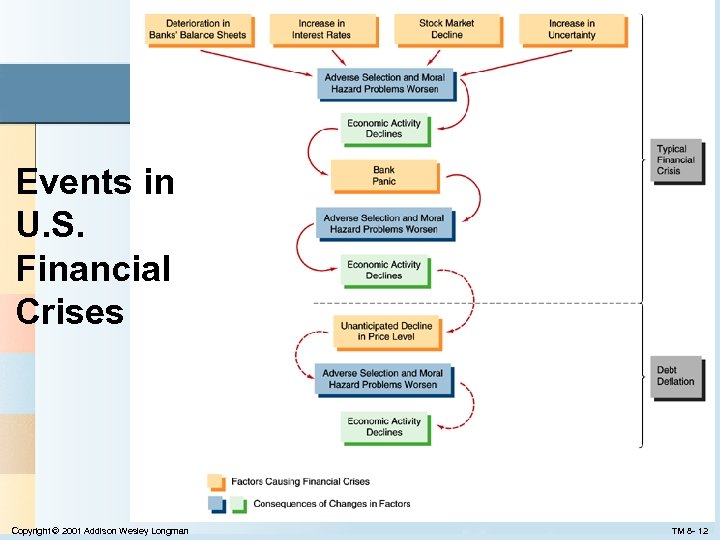 Events in U. S. Financial Crises Copyright © 2001 Addison Wesley Longman TM 8 - 12
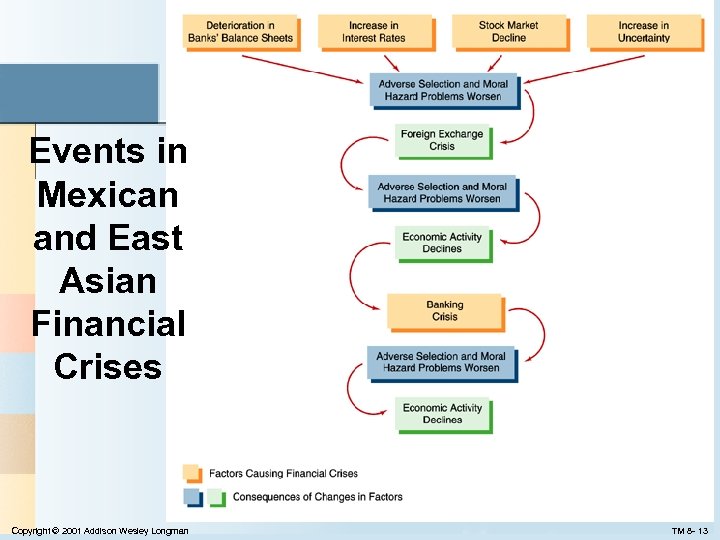 Events in Mexican and East Asian Financial Crises Copyright © 2001 Addison Wesley Longman TM 8 - 13