


 Скачать презентацию Chapter 8 9 Managerial Decision Making and Organizing
Ch8_9 Managerial Decision Making and Organizing.ppt
- Количество слайдов: 29
 Chapter 8, 9 Managerial Decision Making and Organizing
 Managerial Decision Making l Decision making is not easy l It must be done amid – – – ever-changing factors unclear information conflicting points of view Manager’s Challenge: Tupperware Copyright © 2005 by South-Western, a division of Thomson Learning. All rights reserved. 2
 Decisions and Decision Making l Decision = choice made from available alternatives l Decision Making = process of identifying problems and opportunities and resolving them Copyright © 2005 by South-Western, a division of Thomson Learning. All rights reserved. 3
 Categories of Decisions 1. Programmed Decisions - decisions that have been made before and have certain outcome – Made in response to recurring organizational problems F. i. , the decision to order a paper or other office supplies – Ethical Dilemma: The No-Show Consultant Copyright © 2005 by South-Western, a division of Thomson Learning. All rights reserved. 4
 Categories of Decisions 2. Nonprogrammed Decisions – new, novel, and complex decisions that have never been made before and they have uncertain outcome - Uncertainty is great Most difficult decisions that demand creative approaches F. i. , strategic planning, decision to build a new factory, develop a new product or enter a new geographical market Copyright © 2005 by South-Western, a division of Thomson Learning. All rights reserved. 5
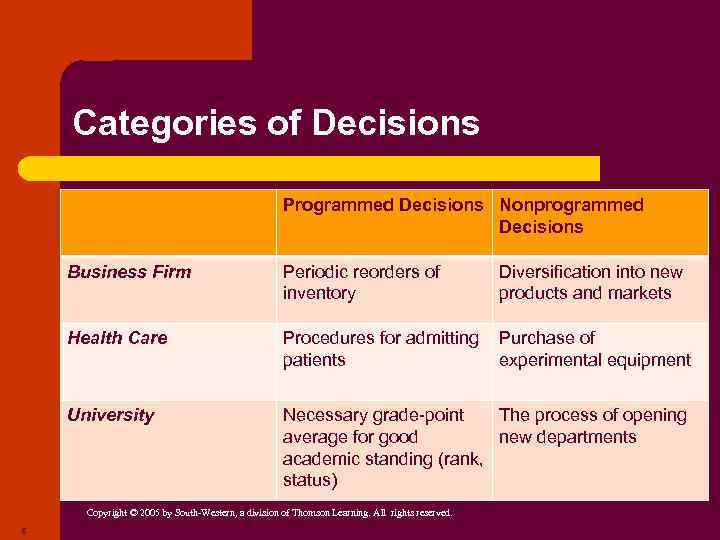 Categories of Decisions Programmed Decisions Nonprogrammed Decisions Business Firm Periodic reorders of inventory Diversification into new products and markets Health Care Procedures for admitting patients Purchase of experimental equipment University Necessary grade-point The process of opening average for good new departments academic standing (rank, status) Copyright © 2005 by South-Western, a division of Thomson Learning. All rights reserved. 6
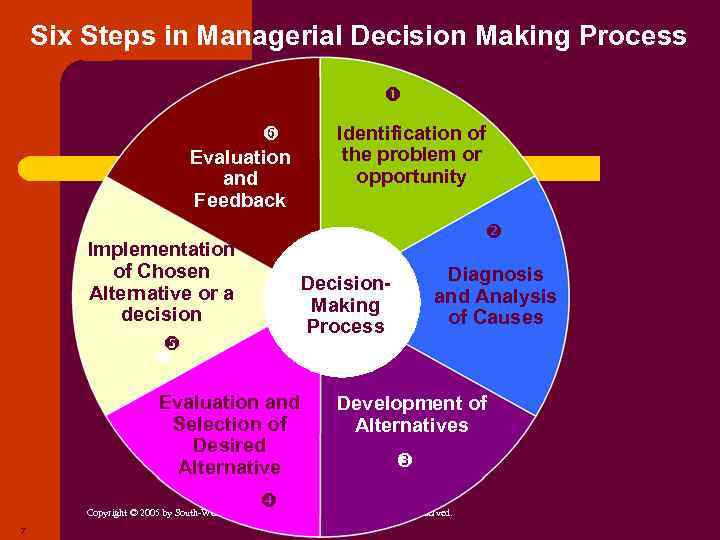 Six Steps in Managerial Decision Making Process Evaluation and Feedback Identification of the problem or opportunity Implementation of Chosen Alternative or a decision Diagnosis and Analysis of Causes Decision. Making Process Evaluation and Selection of Desired Alternative Development of Alternatives Copyright © 2005 by South-Western, a division of Thomson Learning. All rights reserved. 7
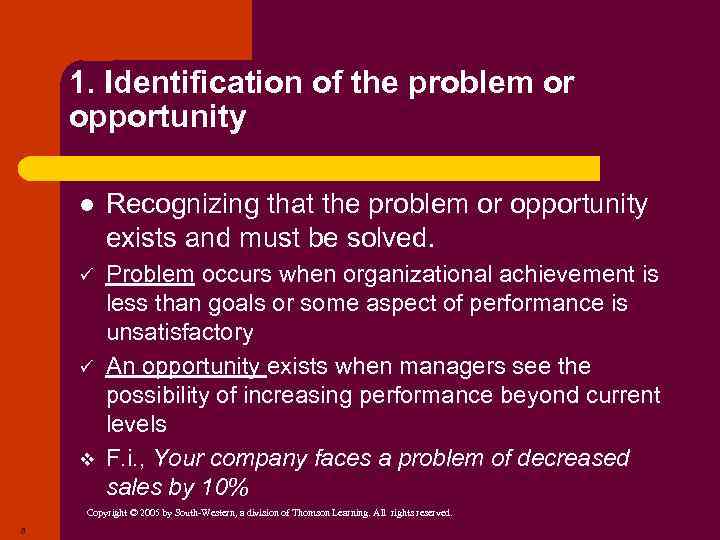 1. Identification of the problem or opportunity l Recognizing that the problem or opportunity exists and must be solved. ü Problem occurs when organizational achievement is less than goals or some aspect of performance is unsatisfactory An opportunity exists when managers see the possibility of increasing performance beyond current levels F. i. , Your company faces a problem of decreased sales by 10% ü v Copyright © 2005 by South-Western, a division of Thomson Learning. All rights reserved. 8
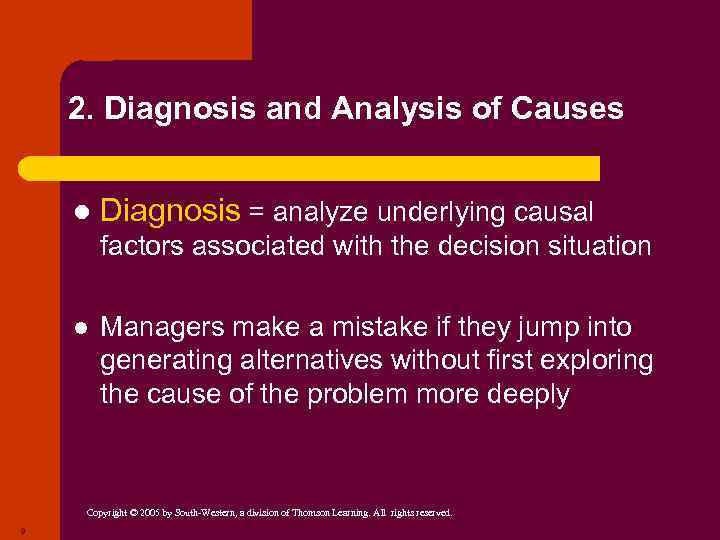 2. Diagnosis and Analysis of Causes l Diagnosis = analyze underlying causal factors associated with the decision situation l Managers make a mistake if they jump into generating alternatives without first exploring the cause of the problem more deeply Copyright © 2005 by South-Western, a division of Thomson Learning. All rights reserved. 9
 2. Diagnosis and Analysis of Causes F. i. , Your company faces a problem of decreased sales by 10% v Reasons: l Poor customer service l Low quality of goods l Untimely delivery l Or anything else? v Copyright © 2005 by South-Western, a division of Thomson Learning. All rights reserved. 10
 Underlying Causes - Kepner /Tregoe l When did it occur? l Where did it occur? l How did it occur? l To whom did it occur? l What is the urgency of the problem? l What is the interconnectedness of events? l What result came from which activity? Copyright © 2005 by South-Western, a division of Thomson Learning. All rights reserved. 11
 3. Development of Alternatives l l l Developing numerous solutions for programmed and nonprogrammed decisions One of the techniques used for generating ideas is called brainstorming Brainstorming is a process in which a small group of people interact with each other with the goal of producing a large quantity of novel and innovative ideas Copyright © 2005 by South-Western, a division of Thomson Learning. All rights reserved. 12
 Brainstorming For a brainstorming process to be successful, a leader should follow these guidelines: ü Keep the group small – 5 to 8 members ü Have a well defined problem ü Limit the session to 40 -60 minutes ü Appoint someone to be the recorder ü Encourage all ideas from the team, even wild and extreme ones; ü Establish a goal of quantity of ideas over the quality of ideas ü Forbid evaluation or criticism of any idea Copyright © 2005 by South-Western, a division of Thomson Learning. All rights reserved. 13
 4. Evaluation and selection of the best alternative l Ø Ø What will be the best alternative? That alternative, which best fits organizational goals Achieves the desired result using minimum organizational resources Copyright © 2005 by South-Western, a division of Thomson Learning. All rights reserved. 14
 5. Implementation of the decision l l l The Implementation Stage involves the use of managerial and administrative abilities The success of the chosen alternative depends whether it can be translated into action Communication, motivation and leadership skills must be used to see that the decision is carried out. Copyright © 2005 by South-Western, a division of Thomson Learning. All rights reserved. 15
 6. Evaluation and Feedback l l l Decision makers gather information that tells them how the decision was implemented and whether it was effective in achieving its goals. Feedback is important, because decision making is a continuous process Feedback is a part of monitoring that assesses whether a new decision needs to be made Copyright © 2005 by South-Western, a division of Thomson Learning. All rights reserved. 16
 Organization Structure l l Organizing is defined as the distribution of tasks and allocation of resources to departments and individuals in order to achieve stated organizational goal. Organizational Structure shows how the tasks assigned to individuals and departments, formal reporting relationships, number of hierarchical levels, and span of manager’s control. Copyright © 2005 by South-Western, a division of Thomson Learning. All rights reserved. 17
 Organization Structure l l l Organization chart is the visual representation of an organization’s structure. Chain of command is the line of authority that links all persons in an organization and shows who reports to whom Span of Management/Span of Control is the number of employees who report to a supervisor Copyright © 2005 by South-Western, a division of Thomson Learning. All rights reserved. 18
 Tall and Flat Structure Span of Control used in an organization determines whether the structure is tall or flat 1. Tall structure has a narrow span and more hierarchical levels 2. Flat structure has a wide span and few hierarchical levels l The trend has been toward wider spans of control Copyright © 2005 by South-Western, a division of Thomson Learning. All rights reserved. 19
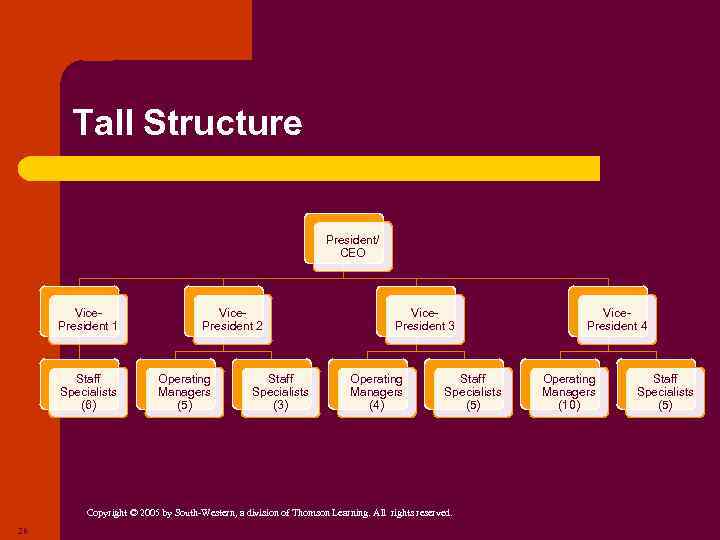 Tall Structure President/ CEO Vice. President 1 Staff Specialists (6) Vice. President 2 Operating Managers (5) Staff Specialists (3) Vice. President 3 Operating Managers (4) Staff Specialists (5) Copyright © 2005 by South-Western, a division of Thomson Learning. All rights reserved. 20 Vice. President 4 Operating Managers (10) Staff Specialists (5)
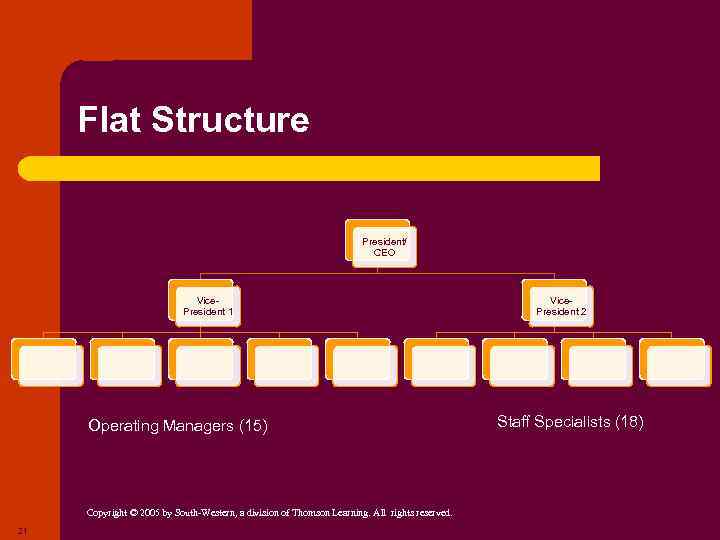 Flat Structure President/ CEO Vice. President 1 Operating Managers (15) Copyright © 2005 by South-Western, a division of Thomson Learning. All rights reserved. 21 Vice. President 2 Staff Specialists (18)
 Departmentalization is the basis on which individuals are grouped into departments and departments are grouped into total organization. Five types of departmentalization: ü Functional departmentalization ü Divisional departmentalization ü Matrix departmentalization ü Team departmentalization ü Network departmentalization Copyright © 2005 by South-Western, a division of Thomson Learning. All rights reserved. 22
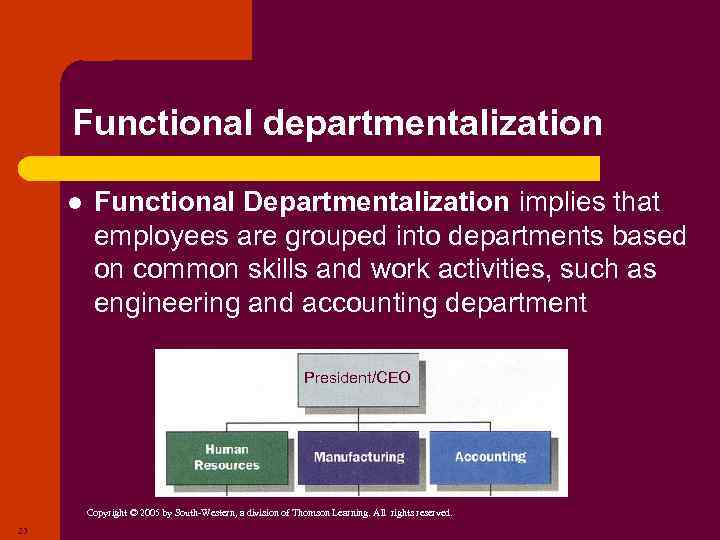 Functional departmentalization l Functional Departmentalization implies that employees are grouped into departments based on common skills and work activities, such as engineering and accounting department President/CEO Copyright © 2005 by South-Western, a division of Thomson Learning. All rights reserved. 23
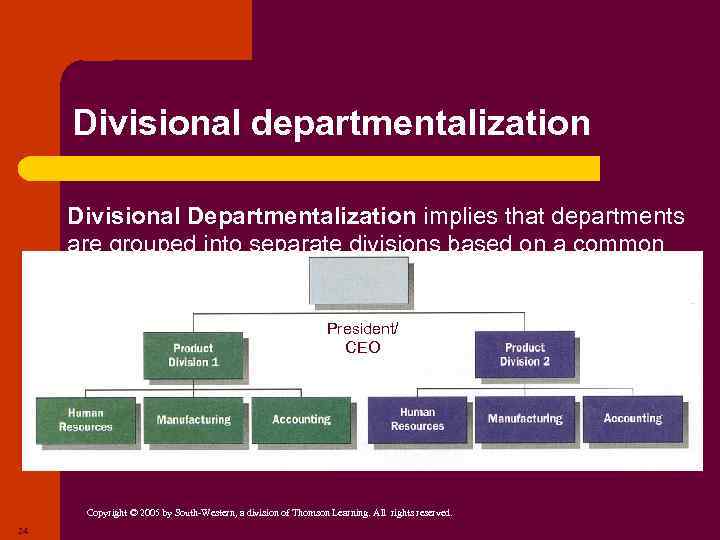 Divisional departmentalization Divisional Departmentalization implies that departments are grouped into separate divisions based on a common product, project or geographical locations President/ CEO Copyright © 2005 by South-Western, a division of Thomson Learning. All rights reserved. 24
 Matrix departmentalization l Matrix Departmentalization implies that functional departmentalization and divisional departmentalization exist simultaneously, some employees report to two bosses l These bosses are functional boss, who is the head of department, and divisional boss, who is the head of President/CEO division. They are called matrix bosses Employees, who report to two bosses, are called twoboss employee l Copyright © 2005 by South-Western, a division of Thomson Learning. All rights reserved. 25
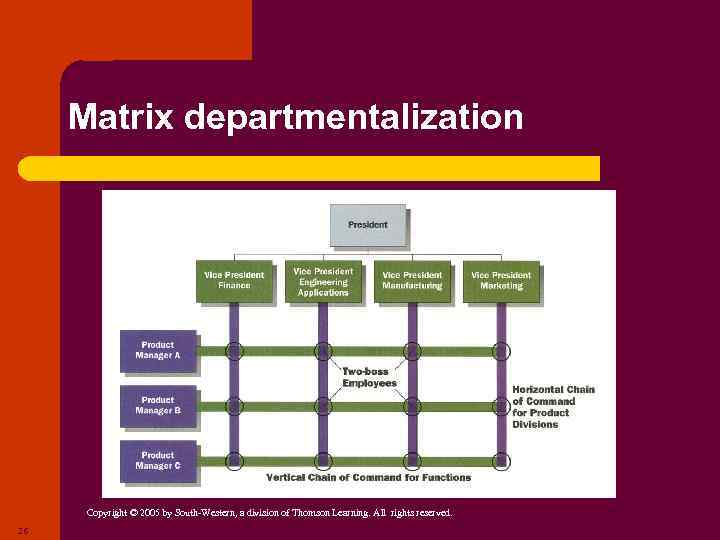 Matrix departmentalization Copyright © 2005 by South-Western, a division of Thomson Learning. All rights reserved. 26
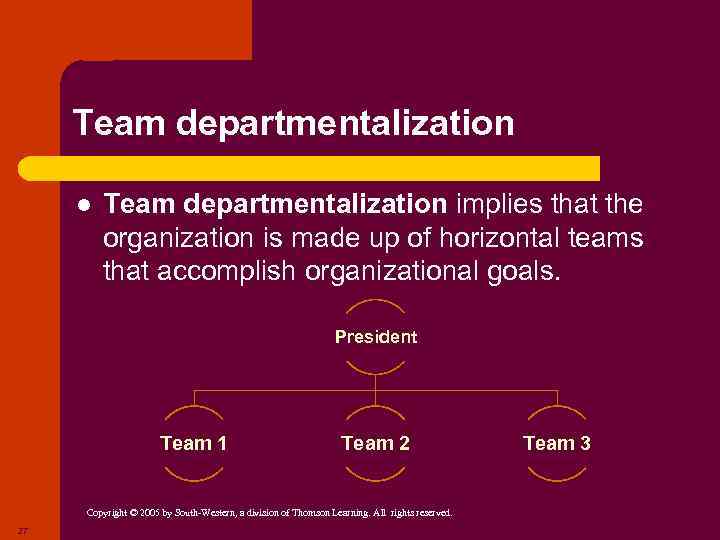 Team departmentalization l Team departmentalization implies that the organization is made up of horizontal teams that accomplish organizational goals. President Team 1 Team 2 Copyright © 2005 by South-Western, a division of Thomson Learning. All rights reserved. 27 Team 3
 Network departmentalization l v Network departmentalization is used for small organizations, where central office is electronically connected to other organizations that perform important functions, which may be located anywhere in the world. Rather than manufacturing, engineering, sales and accounting being under one roof, these services are provided by separate organizations working under contract and connected electronically to the central office. Copyright © 2005 by South-Western, a division of Thomson Learning. All rights reserved. 28
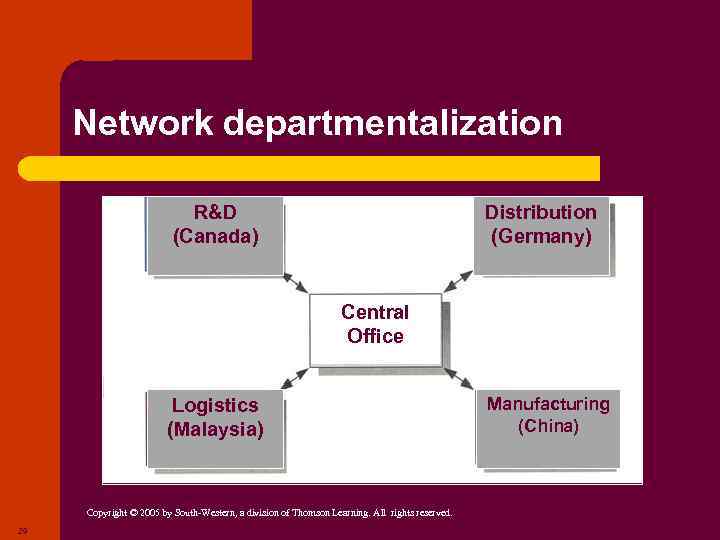 Network departmentalization R&D (Canada) Distribution (Germany) Central Office Logistics (Malaysia) Copyright © 2005 by South-Western, a division of Thomson Learning. All rights reserved. 29 Manufacturing (China)