


 Скачать презентацию Chapter 7 Writing the Programs Shari L Pfleeger
59fb56b5bf99888f6690f16c2c6edca6.ppt
- Количество слайдов: 27
 Chapter 7 Writing the Programs Shari L. Pfleeger Joann M. Atlee 4 th Edition
 Contents 7. 1 7. 2 7. 3 7. 4 7. 5 7. 6 7. 7 Programming Standards and Procedures Programming Guidelines Documentation The Programming Process Information System Example Real Time Example What this Chapter Means for You Pfleeger and Atlee, Software Engineering: Theory and Practice Chapter 7. 2
 Chapter 7 Objectives • Standards for programming • Guidelines for reuse • Using design to frame the code • Internal and external documentation Pfleeger and Atlee, Software Engineering: Theory and Practice Chapter 7. 3
 7. 1 Programming Standards and Procedures • Standards for you – methods of code documentation • Standards for others – Integrators, maintainers, testers – Prologue documentation – Automated tools to identify dependencies • Matching design with implementation – Low coupling, high cohesion, well-defined interfaces Pfleeger and Atlee, Software Engineering: Theory and Practice Chapter 7. 4
 7. 2 Programming Guidelines Control Structures • Make the code easy to read • Build the program from modular blocks • Make the code not too specific, and not too general • Use parameter names and comments to exhibit coupling among components • Make the dependency among components visible Pfleeger and Atlee, Software Engineering: Theory and Practice Chapter 7. 5
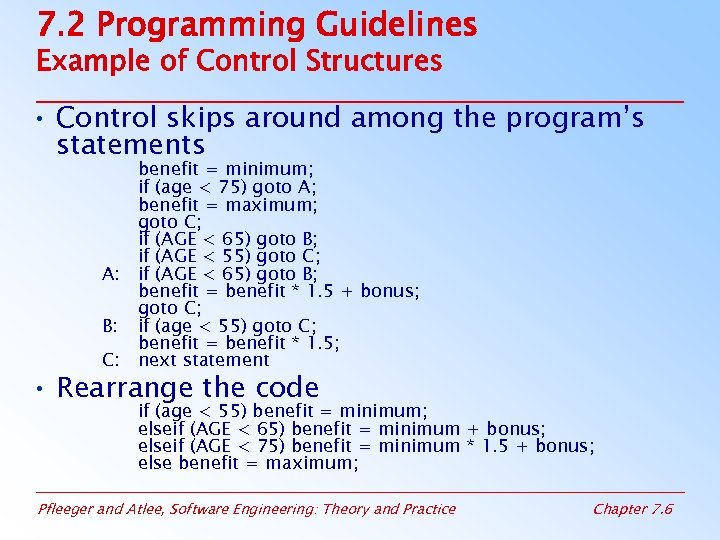 7. 2 Programming Guidelines Example of Control Structures • Control skips around among the program’s statements benefit = minimum; if (age < 75) goto A; benefit = maximum; goto C; if (AGE < 65) goto B; if (AGE < 55) goto C; A: if (AGE < 65) goto B; benefit = benefit * 1. 5 + bonus; goto C; B: if (age < 55) goto C; benefit = benefit * 1. 5; C: next statement • Rearrange the code if (age < 55) benefit = minimum; elseif (AGE < 65) benefit = minimum + bonus; elseif (AGE < 75) benefit = minimum * 1. 5 + bonus; else benefit = maximum; Pfleeger and Atlee, Software Engineering: Theory and Practice Chapter 7. 6
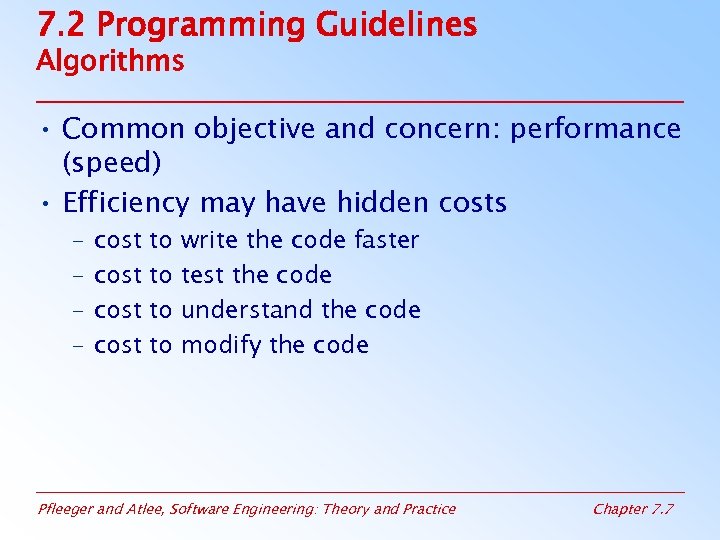 7. 2 Programming Guidelines Algorithms • Common objective and concern: performance (speed) • Efficiency may have hidden costs – – cost to to write the code faster test the code understand the code modify the code Pfleeger and Atlee, Software Engineering: Theory and Practice Chapter 7. 7
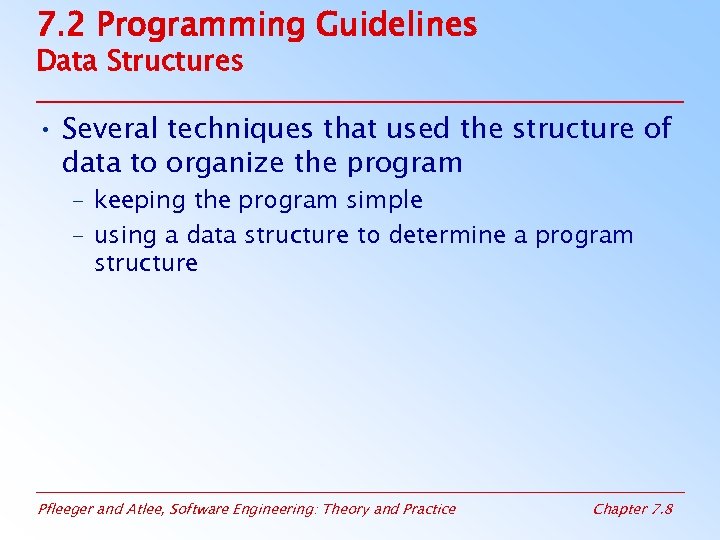 7. 2 Programming Guidelines Data Structures • Several techniques that used the structure of data to organize the program – keeping the program simple – using a data structure to determine a program structure Pfleeger and Atlee, Software Engineering: Theory and Practice Chapter 7. 8
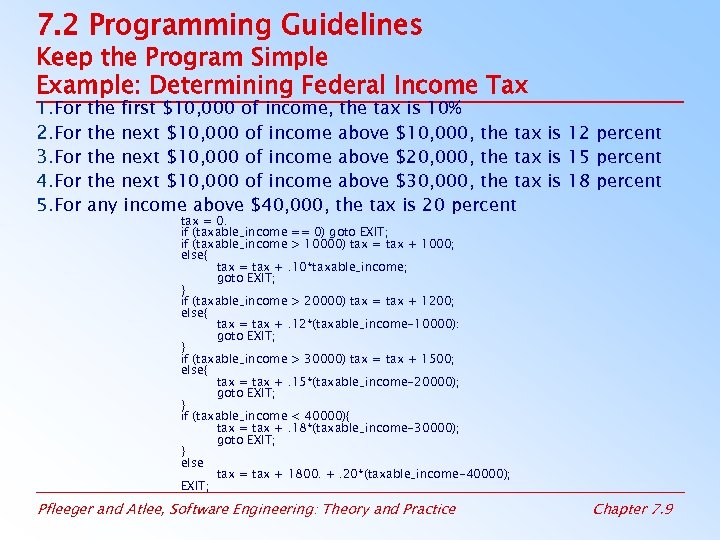 7. 2 Programming Guidelines Keep the Program Simple Example: Determining Federal Income Tax 1. For 2. For 3. For 4. For 5. For the first $10, 000 of income, the tax is 10% the next $10, 000 of income above $10, 000, the tax is 12 percent the next $10, 000 of income above $20, 000, the tax is 15 percent the next $10, 000 of income above $30, 000, the tax is 18 percent any income above $40, 000, the tax is 20 percent tax = 0. if (taxable_income == 0) goto EXIT; if (taxable_income > 10000) tax = tax + 1000; else{ tax = tax +. 10*taxable_income; goto EXIT; } if (taxable_income > 20000) tax = tax + 1200; else{ tax = tax +. 12*(taxable_income-10000): goto EXIT; } if (taxable_income > 30000) tax = tax + 1500; else{ tax = tax +. 15*(taxable_income-20000); goto EXIT; } if (taxable_income < 40000){ tax = tax +. 18*(taxable_income-30000); goto EXIT; } else tax = tax + 1800. +. 20*(taxable_income-40000); EXIT; Pfleeger and Atlee, Software Engineering: Theory and Practice Chapter 7. 9
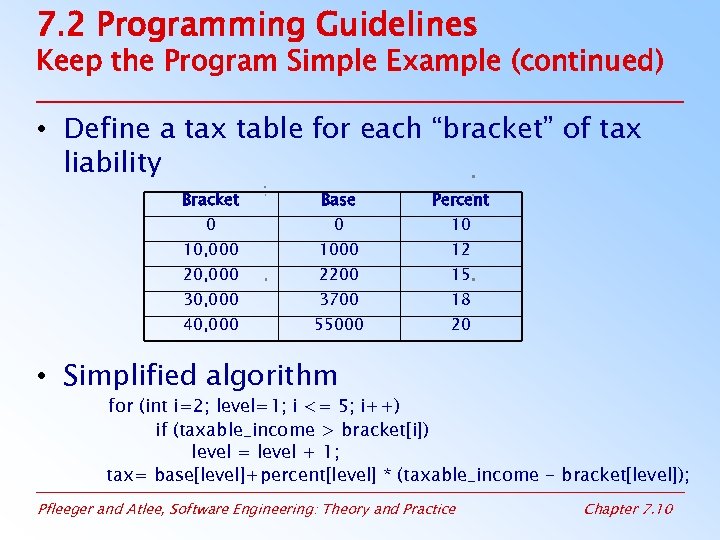 7. 2 Programming Guidelines Keep the Program Simple Example (continued) • Define a tax table for each “bracket” of tax liability Bracket 0 Base 0 Percent 10 10, 000 12 20, 000 2200 15 30, 000 3700 18 40, 000 55000 20 • Simplified algorithm for (int i=2; level=1; i <= 5; i++) if (taxable_income > bracket[i]) level = level + 1; tax= base[level]+percent[level] * (taxable_income - bracket[level]); Pfleeger and Atlee, Software Engineering: Theory and Practice Chapter 7. 10
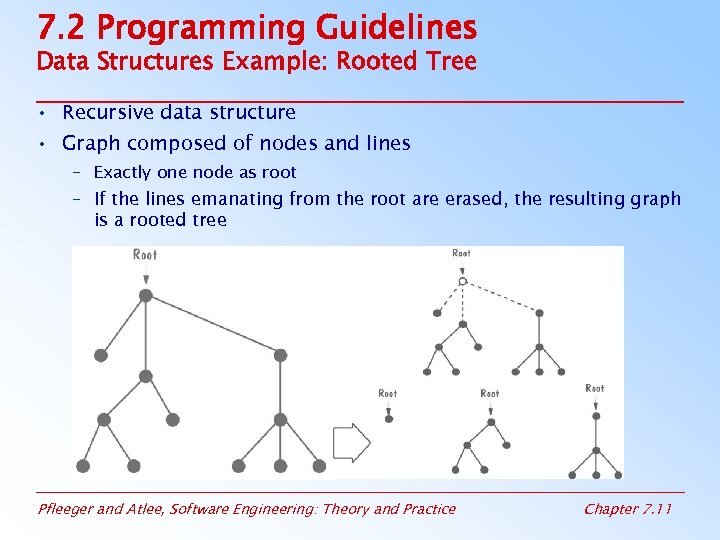 7. 2 Programming Guidelines Data Structures Example: Rooted Tree • Recursive data structure • Graph composed of nodes and lines – Exactly one node as root – If the lines emanating from the root are erased, the resulting graph is a rooted tree Pfleeger and Atlee, Software Engineering: Theory and Practice Chapter 7. 11
 7. 2 Programming Guidelines General Guidelines to Preserve Quality • Localize input and output • Employ pseudocode • Revise and rewrite, rather than patch • Reuse – Producer reuse: create components designed to be reused in future applications – Consumer reuse: reuse components initially developed for other projects Pfleeger and Atlee, Software Engineering: Theory and Practice Chapter 7. 12
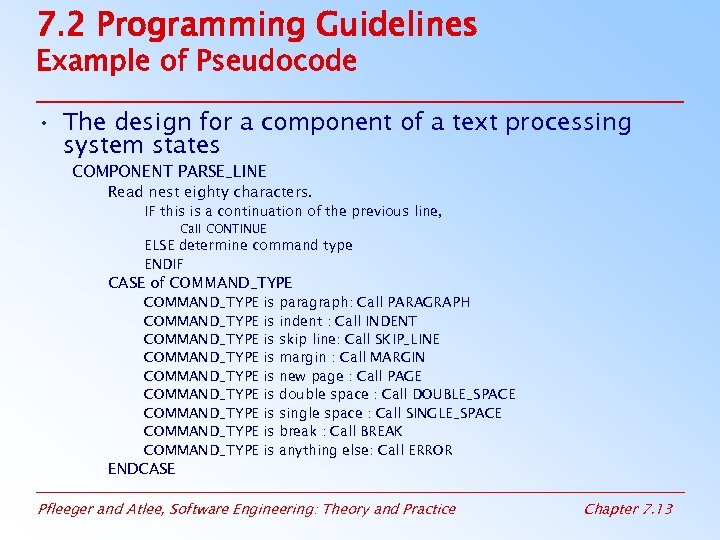 7. 2 Programming Guidelines Example of Pseudocode • The design for a component of a text processing system states COMPONENT PARSE_LINE Read nest eighty characters. IF this is a continuation of the previous line, Call CONTINUE ELSE determine command type ENDIF CASE of COMMAND_TYPE COMMAND_TYPE COMMAND_TYPE ENDCASE is is is paragraph: Call PARAGRAPH indent : Call INDENT skip line: Call SKIP_LINE margin : Call MARGIN new page : Call PAGE double space : Call DOUBLE_SPACE single space : Call SINGLE_SPACE break : Call BREAK anything else: Call ERROR Pfleeger and Atlee, Software Engineering: Theory and Practice Chapter 7. 13
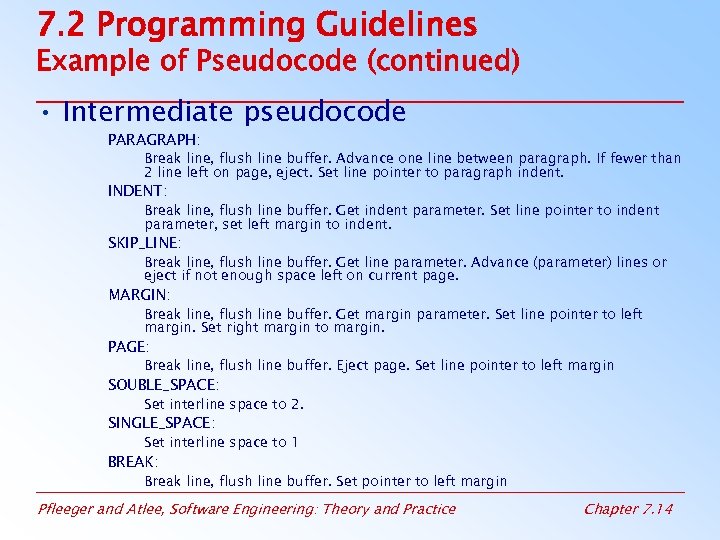 7. 2 Programming Guidelines Example of Pseudocode (continued) • Intermediate pseudocode PARAGRAPH: Break line, flush line buffer. Advance one line between paragraph. If fewer than 2 line left on page, eject. Set line pointer to paragraph indent. INDENT: Break line, flush line buffer. Get indent parameter. Set line pointer to indent parameter, set left margin to indent. SKIP_LINE: Break line, flush line buffer. Get line parameter. Advance (parameter) lines or eject if not enough space left on current page. MARGIN: Break line, flush line buffer. Get margin parameter. Set line pointer to left margin. Set right margin to margin. PAGE: Break line, flush line buffer. Eject page. Set line pointer to left margin SOUBLE_SPACE: Set interline space to 2. SINGLE_SPACE: Set interline space to 1 BREAK: Break line, flush line buffer. Set pointer to left margin Pfleeger and Atlee, Software Engineering: Theory and Practice Chapter 7. 14
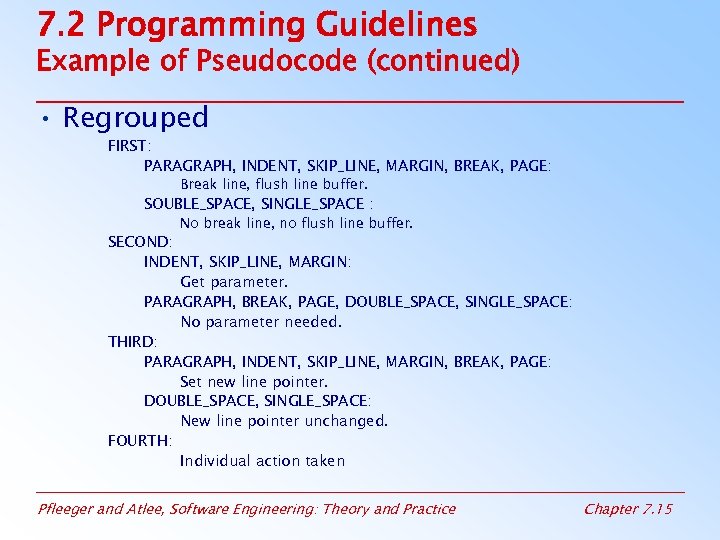 7. 2 Programming Guidelines Example of Pseudocode (continued) • Regrouped FIRST: PARAGRAPH, INDENT, SKIP_LINE, MARGIN, BREAK, PAGE: Break line, flush line buffer. SOUBLE_SPACE, SINGLE_SPACE : No break line, no flush line buffer. SECOND: INDENT, SKIP_LINE, MARGIN: Get parameter. PARAGRAPH, BREAK, PAGE, DOUBLE_SPACE, SINGLE_SPACE: No parameter needed. THIRD: PARAGRAPH, INDENT, SKIP_LINE, MARGIN, BREAK, PAGE: Set new line pointer. DOUBLE_SPACE, SINGLE_SPACE: New line pointer unchanged. FOURTH: Individual action taken Pfleeger and Atlee, Software Engineering: Theory and Practice Chapter 7. 15
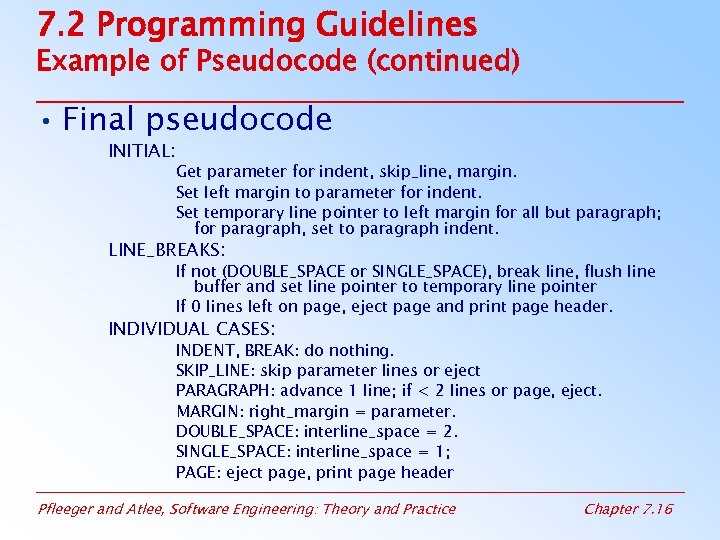 7. 2 Programming Guidelines Example of Pseudocode (continued) • Final pseudocode INITIAL: Get parameter for indent, skip_line, margin. Set left margin to parameter for indent. Set temporary line pointer to left margin for all but paragraph; for paragraph, set to paragraph indent. LINE_BREAKS: If not (DOUBLE_SPACE or SINGLE_SPACE), break line, flush line buffer and set line pointer to temporary line pointer If 0 lines left on page, eject page and print page header. INDIVIDUAL CASES: INDENT, BREAK: do nothing. SKIP_LINE: skip parameter lines or eject PARAGRAPH: advance 1 line; if < 2 lines or page, eject. MARGIN: right_margin = parameter. DOUBLE_SPACE: interline_space = 2. SINGLE_SPACE: interline_space = 1; PAGE: eject page, print page header Pfleeger and Atlee, Software Engineering: Theory and Practice Chapter 7. 16
 7. 2 Programming Guidelines Consumer Reuse • Four key characteristics to check about components to reuse – does the component perform the function or provide the data needed? – is it less modification than building the component from scratch? – is the component well-documented? – is there a complete record of the component’s test and revision history? Pfleeger and Atlee, Software Engineering: Theory and Practice Chapter 7. 17
 7. 2 Programming Guidelines Producer Reuse • Several issues to keep in mind – make the components general – separate dependencies (to isolate sections likely to change) – keep the component interface general and welldefined – include information about any faults found and fixed – use clear naming conventions – document data structures and algorithms – keep the communication and error-handling sections separate and easy to modify Pfleeger and Atlee, Software Engineering: Theory and Practice Chapter 7. 18
 7. 3 Documentation • Internal documentation – – – header comment block meaningful variable names and statement labels other program comments format to enhance understanding document data (data dictionary) • External documentation – describe the problem – describe the algorithm – describe the data Pfleeger and Atlee, Software Engineering: Theory and Practice Chapter 7. 19
 7. 3 Documentation Information Included in Header Comment Block • What is the component called • Who wrote the component • Where the component fits in the general system design • When the component was written and revised • Why the component exists • How the component uses its data structures, algorithms, and control Pfleeger and Atlee, Software Engineering: Theory and Practice Chapter 7. 20
 7. 4 The Programming Process Extreme Programming • Two types of participants – customers: who define the features using stories, describe detailed tests and assign priorities – programmers: who implement the stories Pfleeger and Atlee, Software Engineering: Theory and Practice Chapter 7. 21
 7. 4 The Programming Process Pair Programming • The and driver or pilot: controlling the computer writing the code navigator: reviewing the driver’s code providing feedback Pfleeger and Atlee, Software Engineering: Theory and Practice Chapter 7. 22
 7. 4 The Programming Process Whither Programming? • Documentation is still essential in agilemethods – Assist the developers in planning, as a roadmap – Helps describe key abstractions and defines system boundaries – Assists in communicating among team members Pfleeger and Atlee, Software Engineering: Theory and Practice Chapter 7. 23
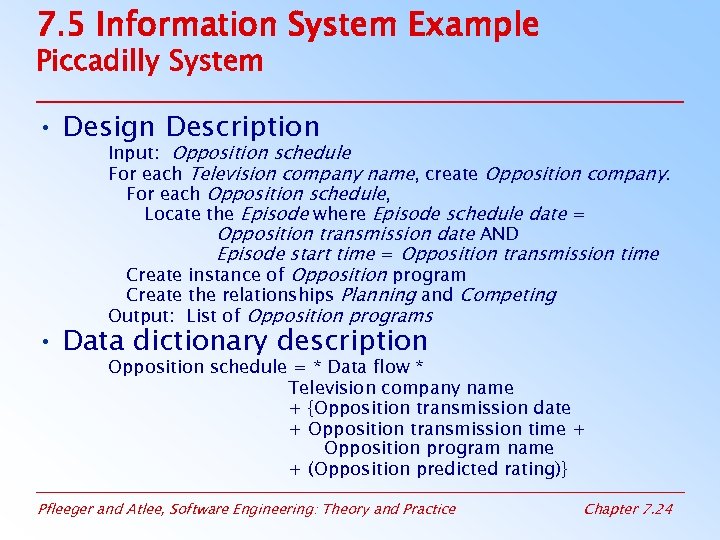 7. 5 Information System Example Piccadilly System • Design Description Input: Opposition schedule For each Television company name, create Opposition company. For each Opposition schedule, Locate the Episode where Episode schedule date = Opposition transmission date AND Episode start time = Opposition transmission time Create instance of Opposition program Create the relationships Planning and Competing Output: List of Opposition programs • Data dictionary description Opposition schedule = * Data flow * Television company name + {Opposition transmission date + Opposition transmission time + Opposition program name + (Opposition predicted rating)} Pfleeger and Atlee, Software Engineering: Theory and Practice Chapter 7. 24
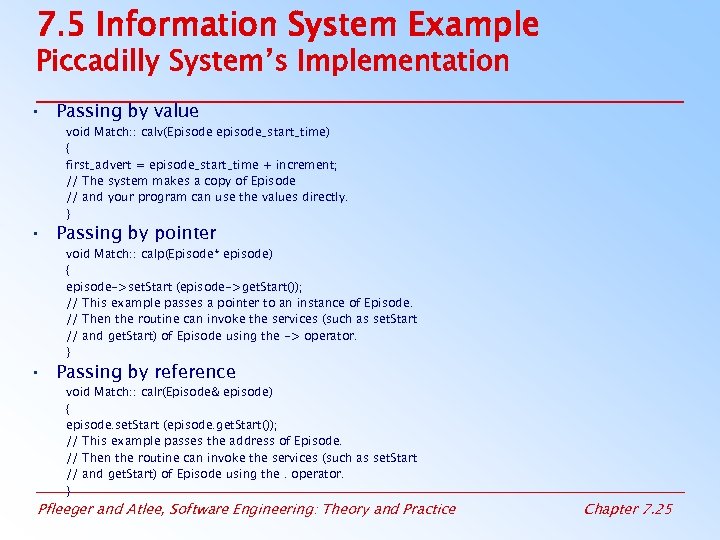 7. 5 Information System Example Piccadilly System’s Implementation • Passing by value void Match: : calv(Episode episode_start_time) { first_advert = episode_start_time + increment; // The system makes a copy of Episode // and your program can use the values directly. } • Passing by pointer void Match: : calp(Episode* episode) { episode->set. Start (episode->get. Start()); // This example passes a pointer to an instance of Episode. // Then the routine can invoke the services (such as set. Start // and get. Start) of Episode using the -> operator. } • Passing by reference void Match: : calr(Episode& episode) { episode. set. Start (episode. get. Start()); // This example passes the address of Episode. // Then the routine can invoke the services (such as set. Start // and get. Start) of Episode using the. operator. } Pfleeger and Atlee, Software Engineering: Theory and Practice Chapter 7. 25
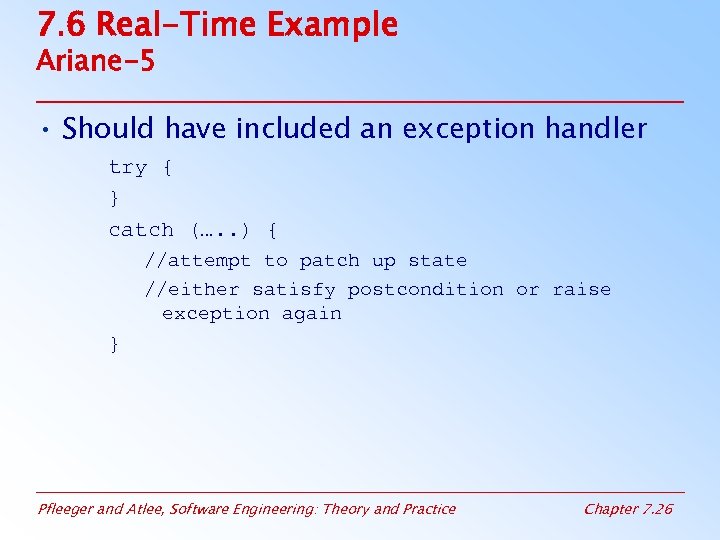 7. 6 Real-Time Example Ariane-5 • Should have included an exception handler try { } catch (…. . ) { //attempt to patch up state //either satisfy postcondition or raise exception again } Pfleeger and Atlee, Software Engineering: Theory and Practice Chapter 7. 26
 7. 7 What This Chapter Means for You • Things to consider when writing a code – organizational standards and guidelines – reusing code from other projects – writing code to make it reusable on future projects – using the low-level design as an initial framework, and moving in several iterations from design to code Pfleeger and Atlee, Software Engineering: Theory and Practice Chapter 7. 27