


 Скачать презентацию Chapter 7 Transmission Media Copyright The Mc
7f8f9d698e553a73640a10c47ced05c9.ppt
- Количество слайдов: 38
 Chapter 7 Transmission Media Copyright © The Mc. Graw-Hill Companies, Inc. Permission required for reproduction or display.
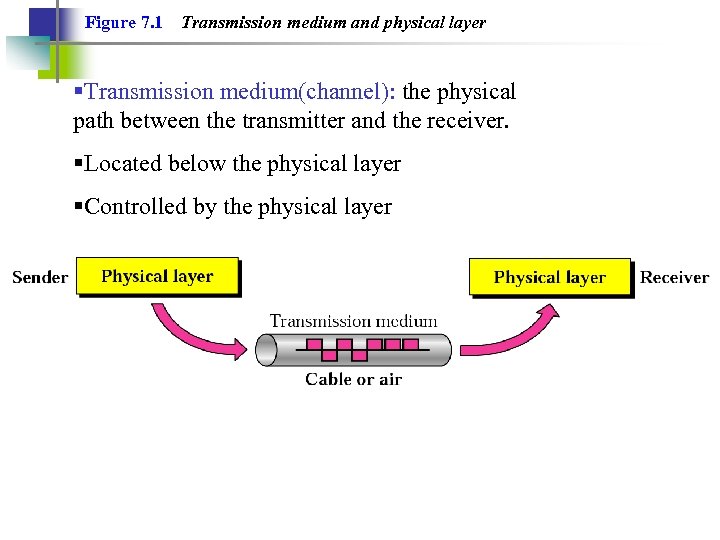 Figure 7. 1 Transmission medium and physical layer §Transmission medium(channel): the physical path between the transmitter and the receiver. §Located below the physical layer §Controlled by the physical layer
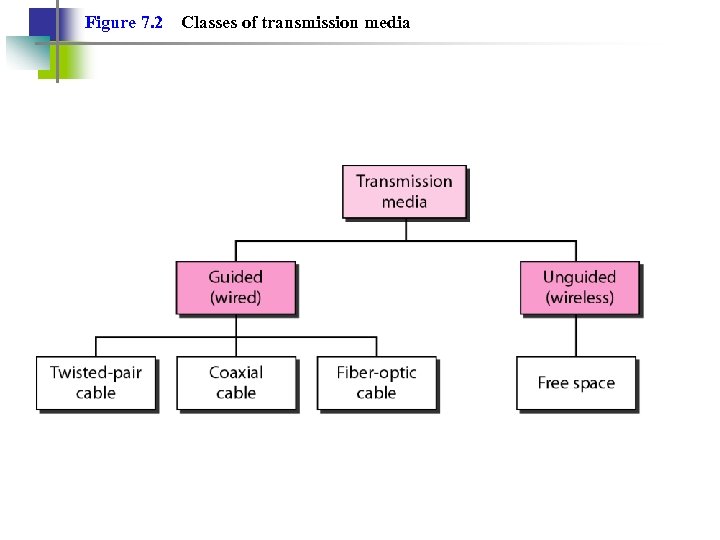 Figure 7. 2 Classes of transmission media
 7. 1 Guided Media Twisted-Pair Cable Coaxial Cable Fiber-Optic Cable
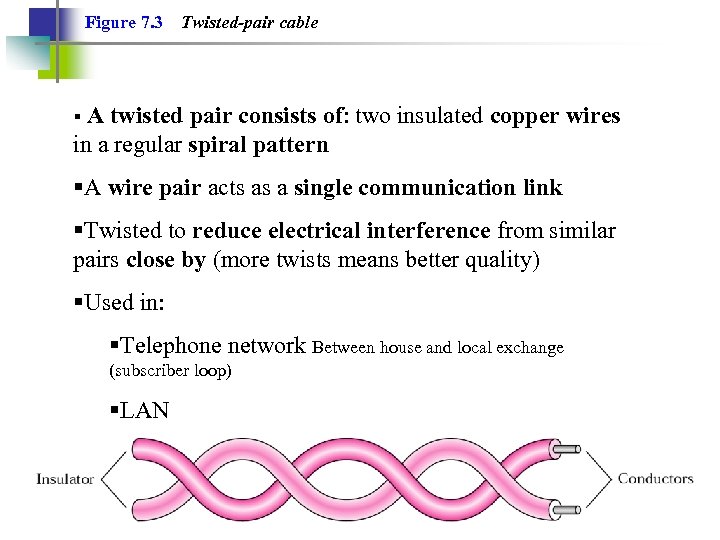 Figure 7. 3 Twisted-pair cable §A twisted pair consists of: two insulated copper wires in a regular spiral pattern §A wire pair acts as a single communication link §Twisted to reduce electrical interference from similar pairs close by (more twists means better quality) §Used in: §Telephone network Between house and local exchange (subscriber loop) §LAN
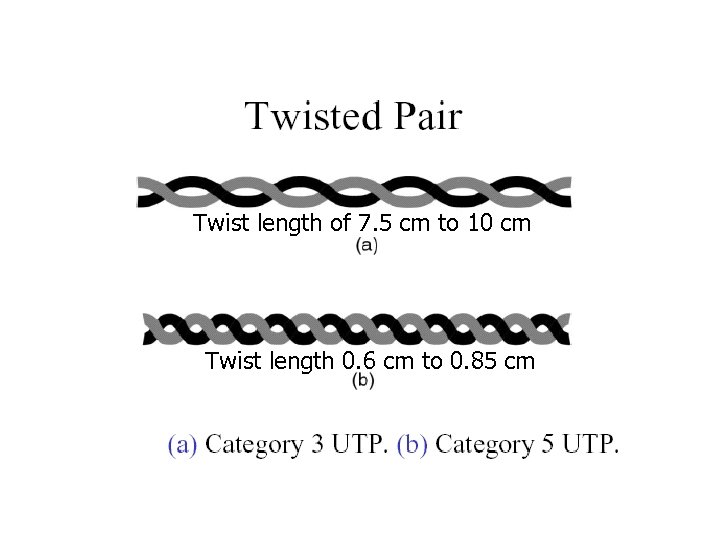 Twist length of 7. 5 cm to 10 cm Twist length 0. 6 cm to 0. 85 cm
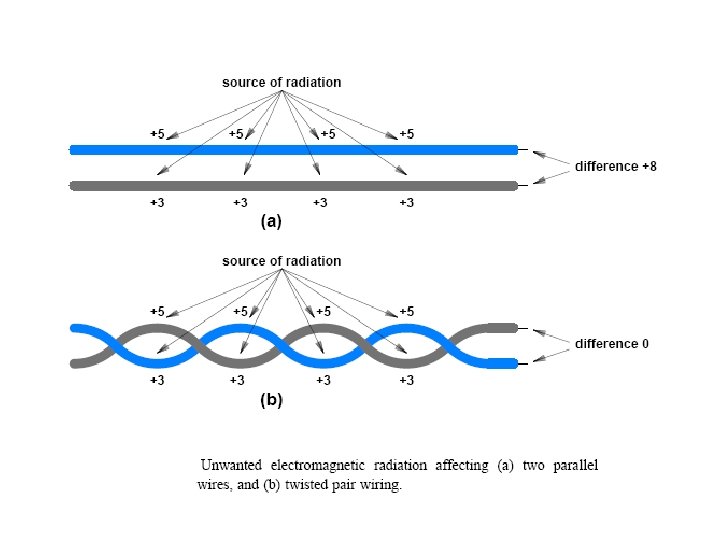
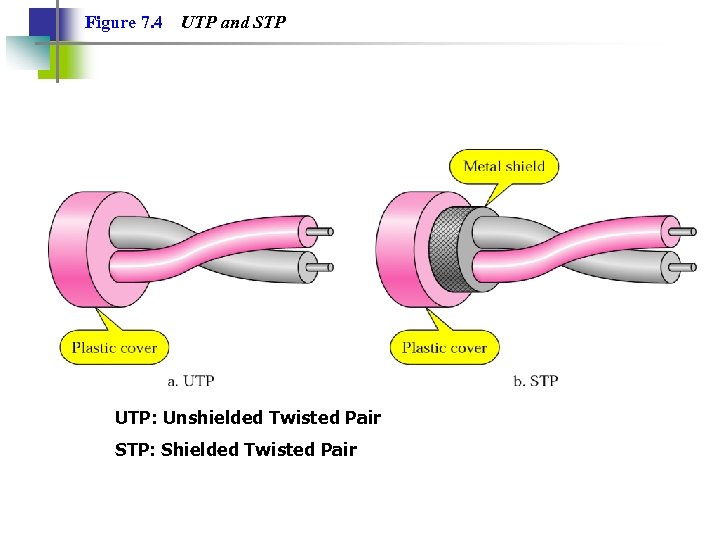 Figure 7. 4 UTP and STP UTP: Unshielded Twisted Pair STP: Shielded Twisted Pair
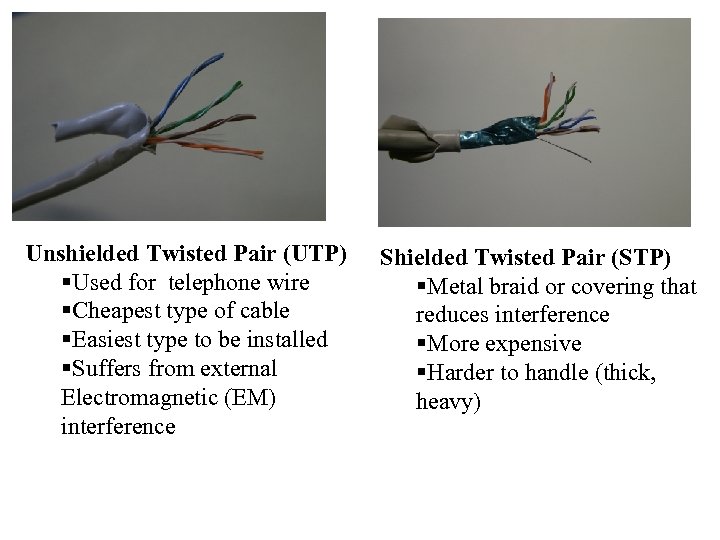 Unshielded Twisted Pair (UTP) §Used for telephone wire §Cheapest type of cable §Easiest type to be installed §Suffers from external Electromagnetic (EM) interference Shielded Twisted Pair (STP) §Metal braid or covering that reduces interference §More expensive §Harder to handle (thick, heavy)
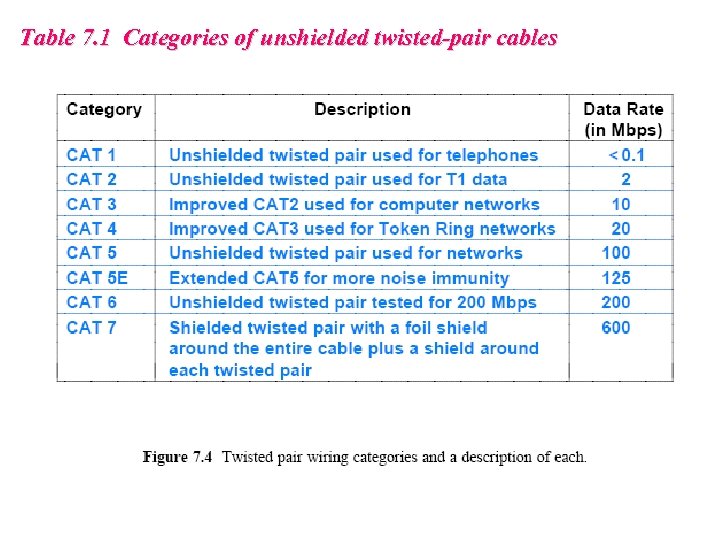 Table 7. 1 Categories of unshielded twisted-pair cables
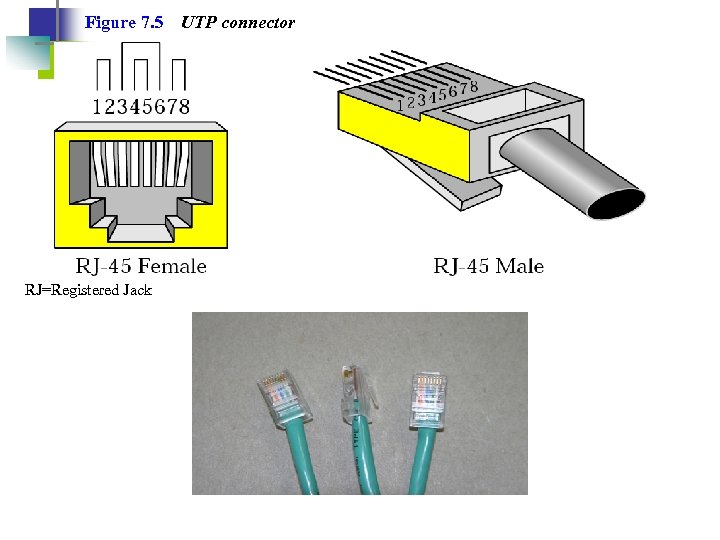 Figure 7. 5 RJ=Registered Jack UTP connector
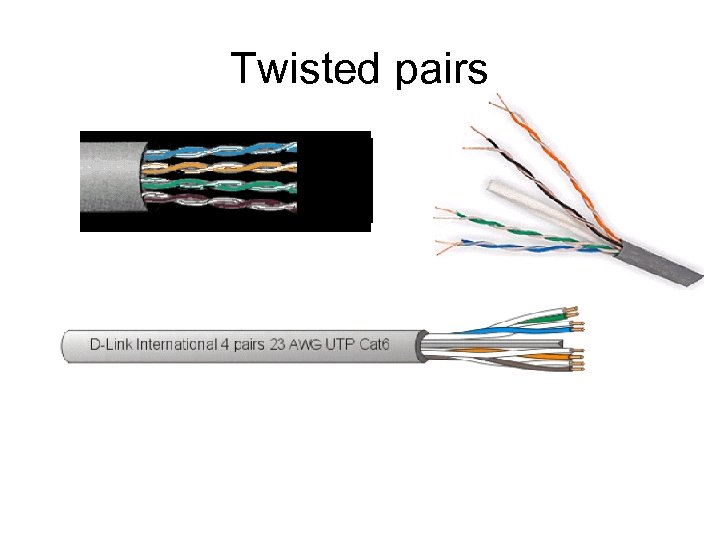 Twisted pairs
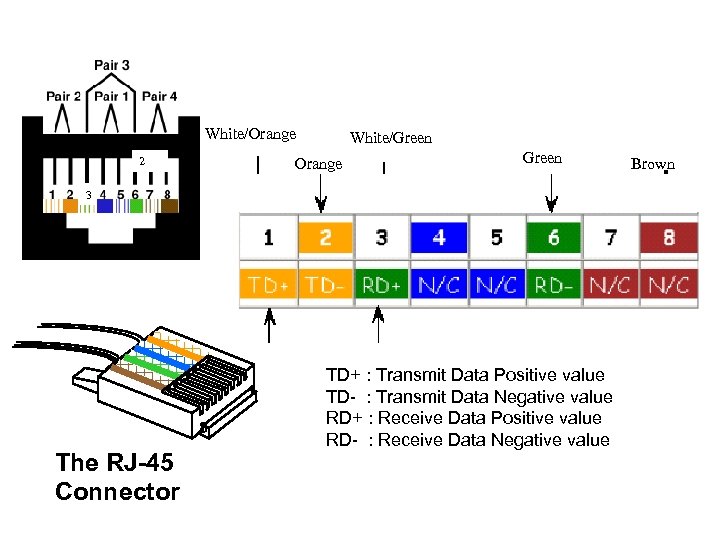 White/Orange 2 White/Green Orange Green 3 1 8 The RJ-45 Connector TD+ : Transmit Data Positive value TD- : Transmit Data Negative value RD+ : Receive Data Positive value RD- : Receive Data Negative value Brown
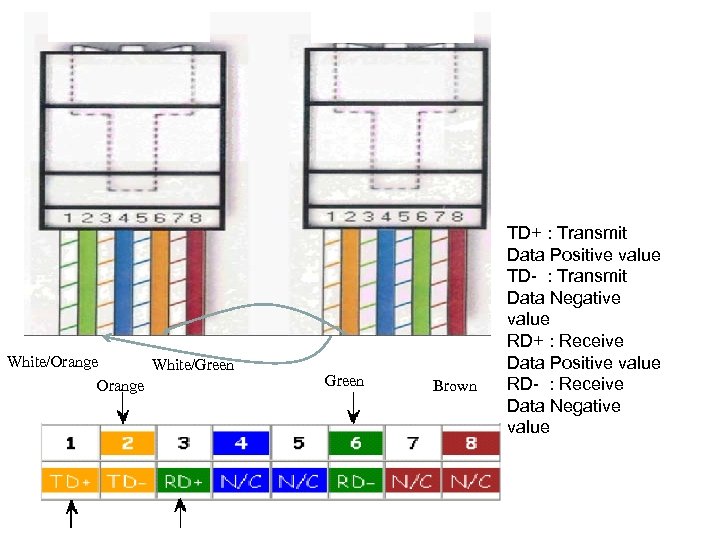 White/Orange White/Green Brown TD+ : Transmit Data Positive value TD- : Transmit Data Negative value RD+ : Receive Data Positive value RD- : Receive Data Negative value
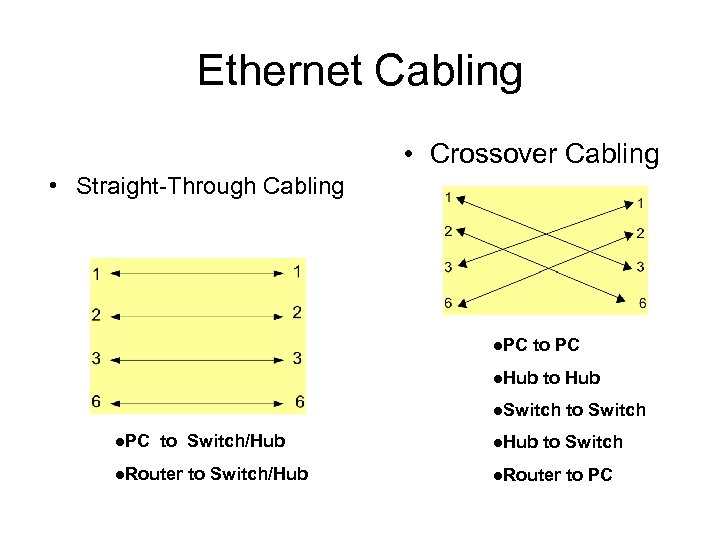 Ethernet Cabling • Crossover Cabling • Straight-Through Cabling l. PC to PC l. Hub to Hub l. Switch l. PC to Switch/Hub l. Router to Switch/Hub l. Hub to Switch l. Router to PC
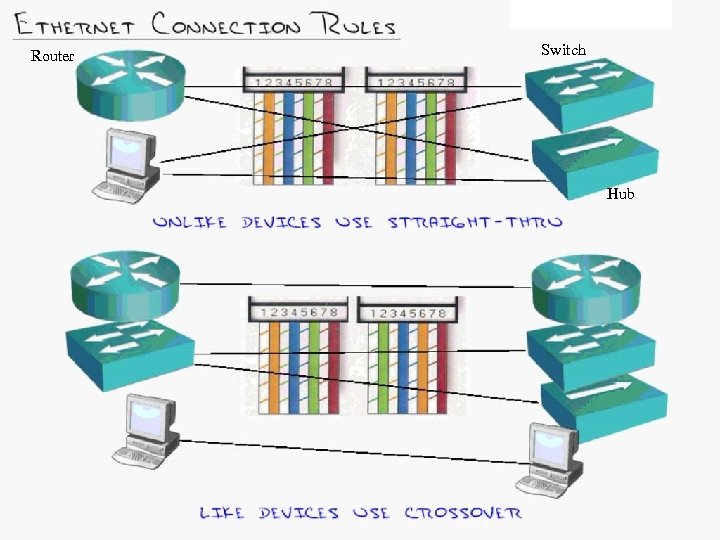 Router Switch Hub
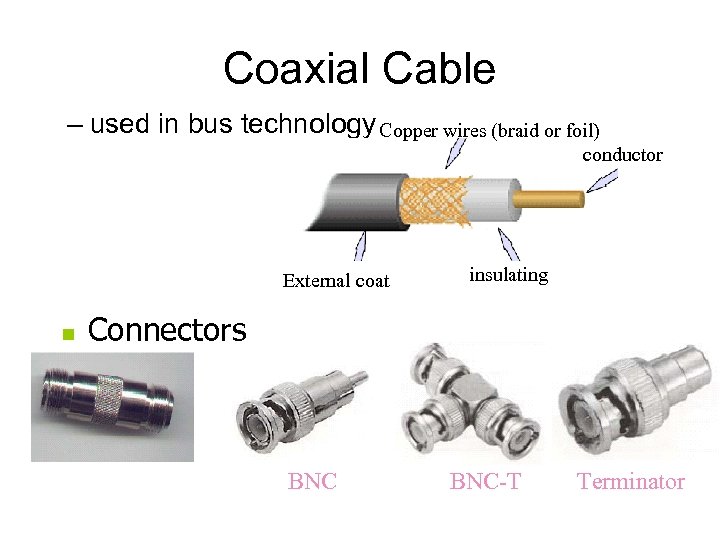 Coaxial Cable – used in bus technology Copper wires (braid or foil) conductor External coat n insulating Connectors BNC-T Terminator
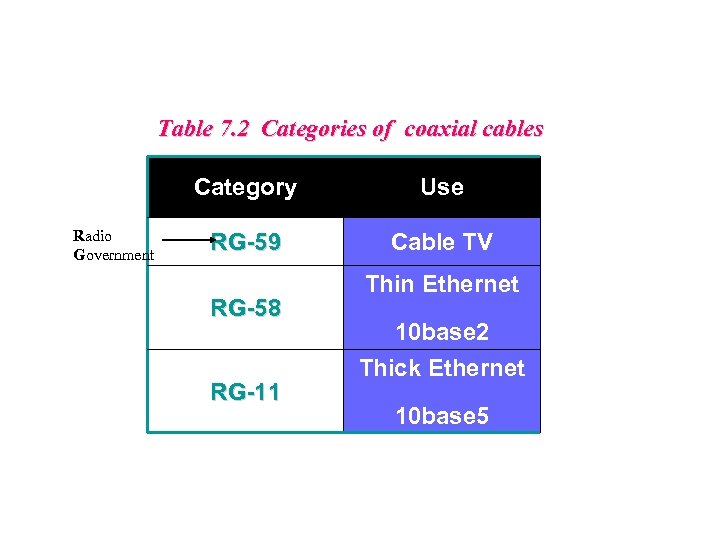 Table 7. 2 Categories of coaxial cables Category Radio Government Use RG-59 Cable TV RG-58 RG-11 Thin Ethernet 10 base 2 Thick Ethernet 10 base 5
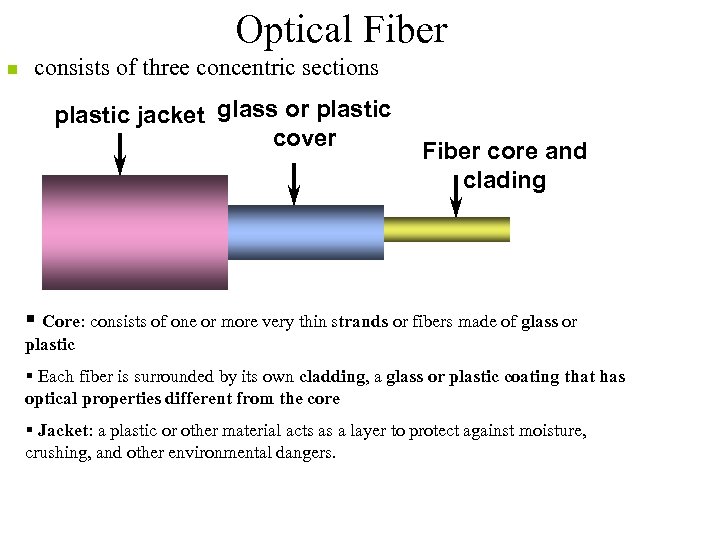 Optical Fiber n consists of three concentric sections plastic jacket glass or plastic cover Fiber core and clading § Core: consists of one or more very thin strands or fibers made of glass or plastic § Each fiber is surrounded by its own cladding, a glass or plastic coating that has optical properties different from the core § Jacket: a plastic or other material acts as a layer to protect against moisture, crushing, and other environmental dangers.
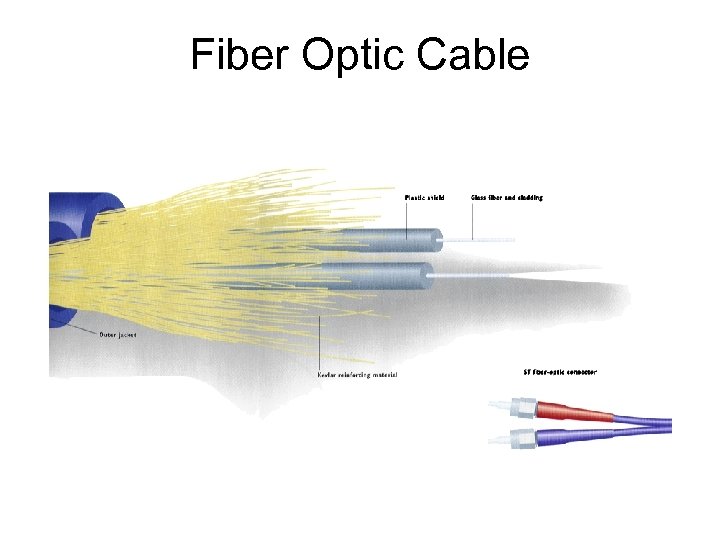 Fiber Optic Cable
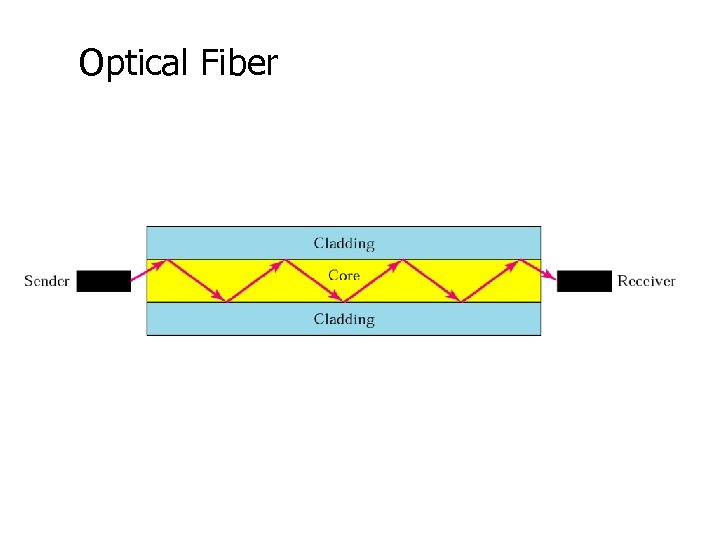 Optical Fiber
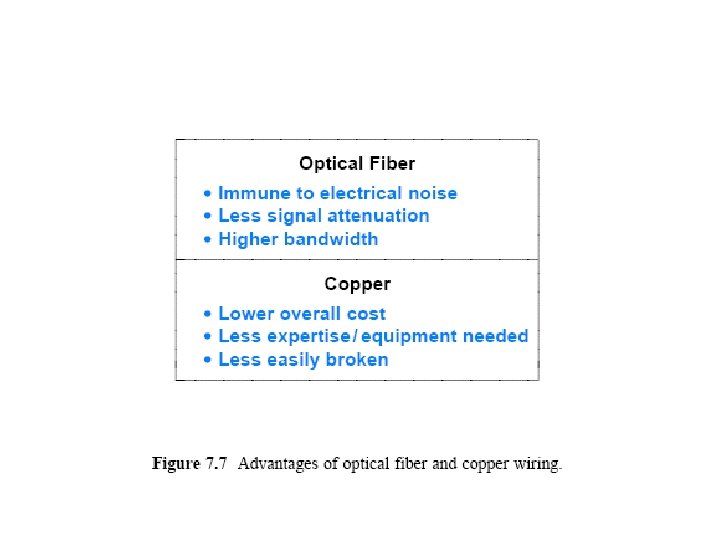
 Optical Fiber - Advantages • Greater capacity – Data rates of hundreds of Gbps • Smaller size & weight • Lower attenuation (signal loss) – Greater repeater spacing – 10 s of km at least • No crosstalk (no light leaking) • Electromagnetic isolation • highly secure (no light leaking)
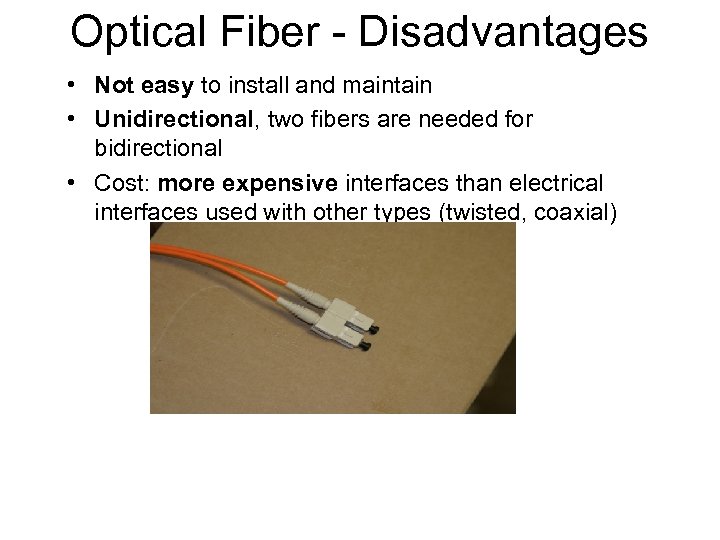 Optical Fiber - Disadvantages • Not easy to install and maintain • Unidirectional, two fibers are needed for bidirectional • Cost: more expensive interfaces than electrical interfaces used with other types (twisted, coaxial)
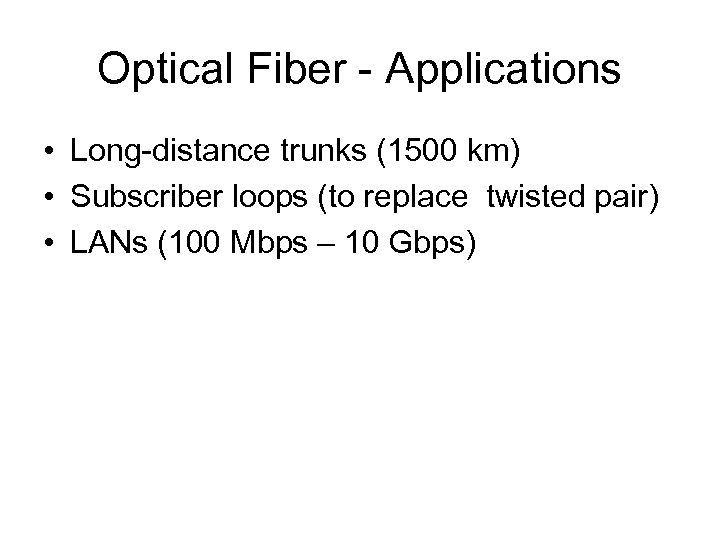 Optical Fiber - Applications • Long-distance trunks (1500 km) • Subscriber loops (to replace twisted pair) • LANs (100 Mbps – 10 Gbps)
 7. 2 Unguided Media: Wireless Radio Waves Microwaves Infrared
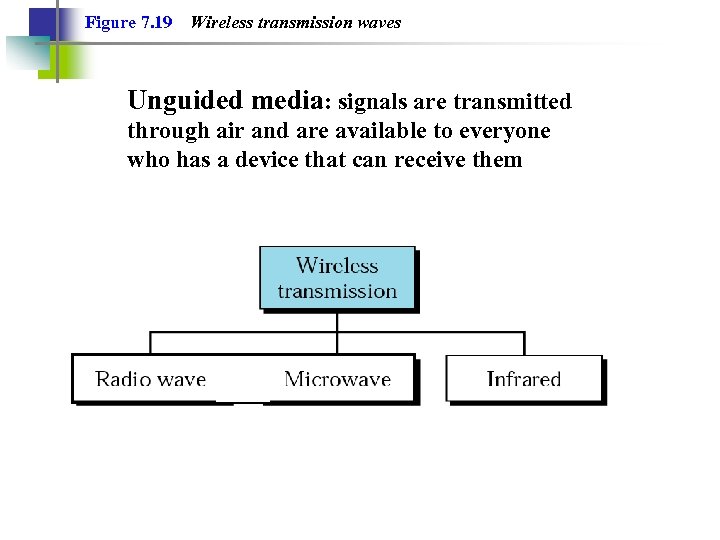 Figure 7. 19 Wireless transmission waves Unguided media: signals are transmitted through air and are available to everyone who has a device that can receive them
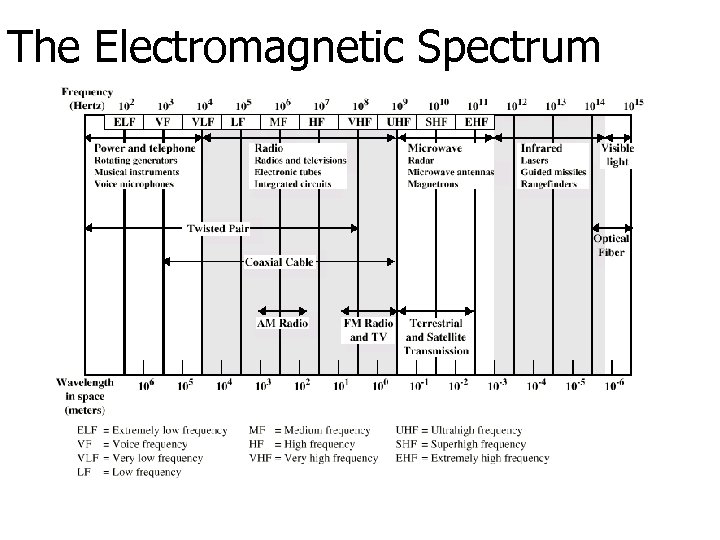 The Electromagnetic Spectrum
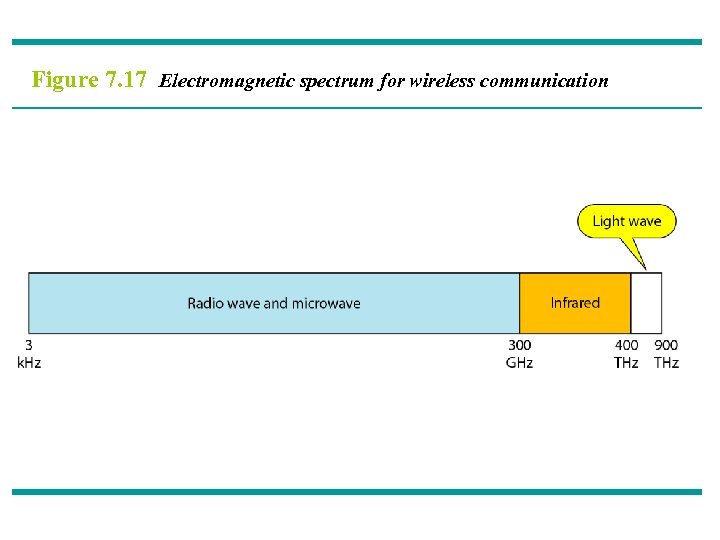 Figure 7. 17 Electromagnetic spectrum for wireless communication
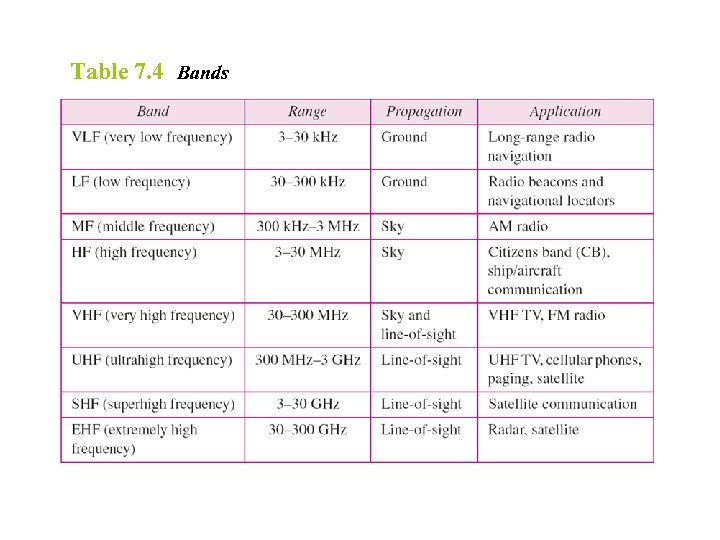 Table 7. 4 Bands
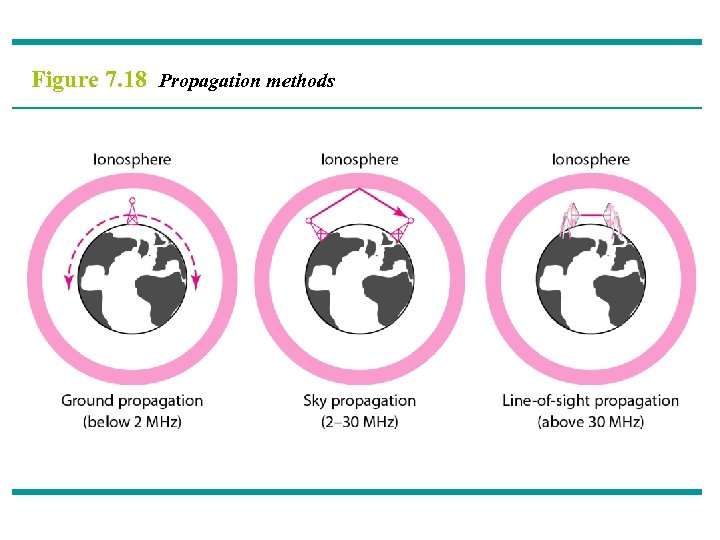 Figure 7. 18 Propagation methods
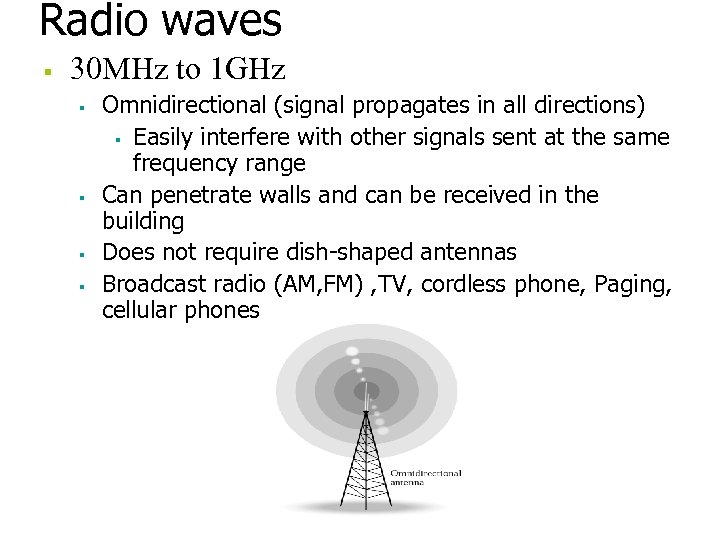 Radio waves § 30 MHz to 1 GHz § § Omnidirectional (signal propagates in all directions) § Easily interfere with other signals sent at the same frequency range Can penetrate walls and can be received in the building Does not require dish-shaped antennas Broadcast radio (AM, FM) , TV, cordless phone, Paging, cellular phones
 Note Radio waves are used for multicast communications, such as radio and television, and paging systems.
 Microwaves § 2 GHz to 300 GHz § Highly directional (line-of-sight propagation = straight lines) § Requires dish-shaped antennas § Point to point (sending and receiving antennas need to be aligned) § Very high frequency microwaves, usually, cannot penetrate walls (disadv. if receivers are inside buildings) § Used in long distance telephone communications § Used for short point-to-point transmission between buildings to connect their LANs § Used in Wireless networks, satellite communication
 Note Microwaves are used for unicast communication such as cellular telephones, satellite networks, and wireless LANs.
 Infrared § 300 GHz to 400 THz § § Have a very large bandwidth that is not yet completely utilized Local- short distance communication Line-of-sight propagation (directional) Used in local point-to-point Transmission or Multipoint within a very limited area (single room) § Used in Remote control, Ir. DA (Infrared Data Association) port (wireless keyboard, mouse) § Cannot be used under the sun because of the interference with the sun infrared rays § Ir. DA operates at 75 kbps up to 8 meters, and 1. 15 Mbps – 4 Mbps over a distance of 1 meter
 Note Infrared signals can be used for shortrange communication in a closed area using line-of-sight propagation.