


 Скачать презентацию Chapter 7 The Valuation and Characteristics of Stock
c1e88b7786b291430b940442e5c72486.ppt
- Количество слайдов: 56
 Chapter 7 The Valuation and Characteristics of Stock Slides developed by: Pamela L. Hall, Western Washington University
 Common Stock n Background n Stockholders own the corporation, but in many instances the corporation is widely held • Stock ownership is spread among a large number of people n Because of this, most stockholders are only interested in how much money they will receive as a stockholder • Most equity investors aren’t interested in a role as owners 2
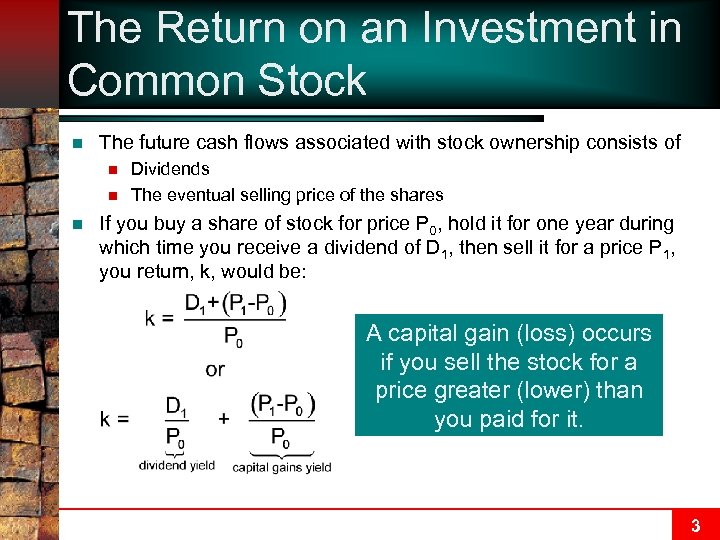 The Return on an Investment in Common Stock n The future cash flows associated with stock ownership consists of n n n Dividends The eventual selling price of the shares If you buy a share of stock for price P 0, hold it for one year during which time you receive a dividend of D 1, then sell it for a price P 1, you return, k, would be: A capital gain (loss) occurs if you sell the stock for a price greater (lower) than you paid for it. 3
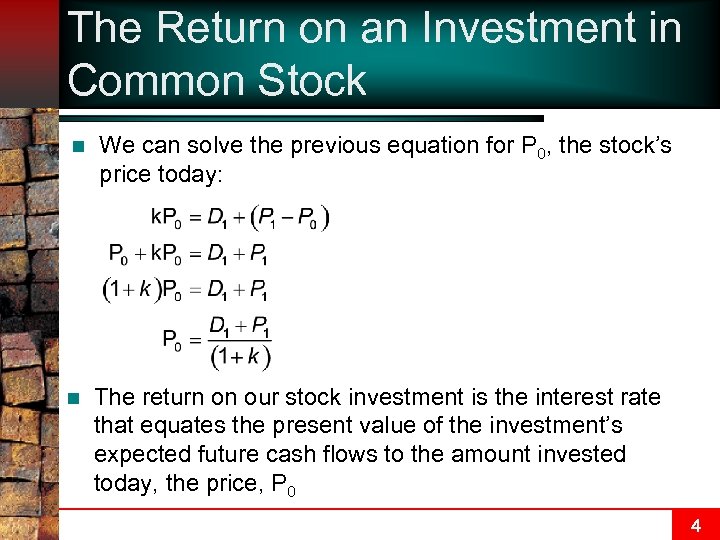 The Return on an Investment in Common Stock n n We can solve the previous equation for P 0, the stock’s price today: The return on our stock investment is the interest rate that equates the present value of the investment’s expected future cash flows to the amount invested today, the price, P 0 4
 The Nature of Cash Flows from Stock Ownership n Comparison of Cash Flows from Stocks and Bonds n The expected receipt of dividends and the future selling price of stock is similar to what a bondholder expects in terms of interest and principal repayment • However, with bondholders: • • A guarantee is associated with their interest payments Interest payments are constant The maturity value of a bond is fixed When the bond matures, the investor receives contracted par or face value from the issuing company • When stock is sold, the investor receives money from another investor 5
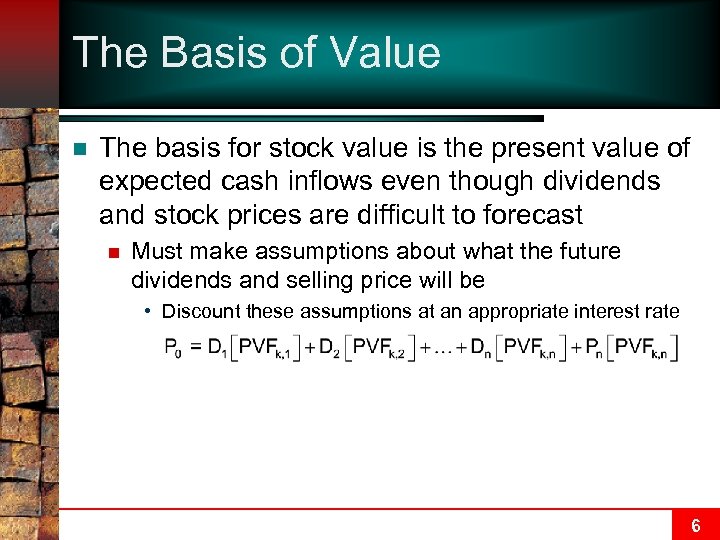 The Basis of Value n The basis for stock value is the present value of expected cash inflows even though dividends and stock prices are difficult to forecast n Must make assumptions about what the future dividends and selling price will be • Discount these assumptions at an appropriate interest rate 6
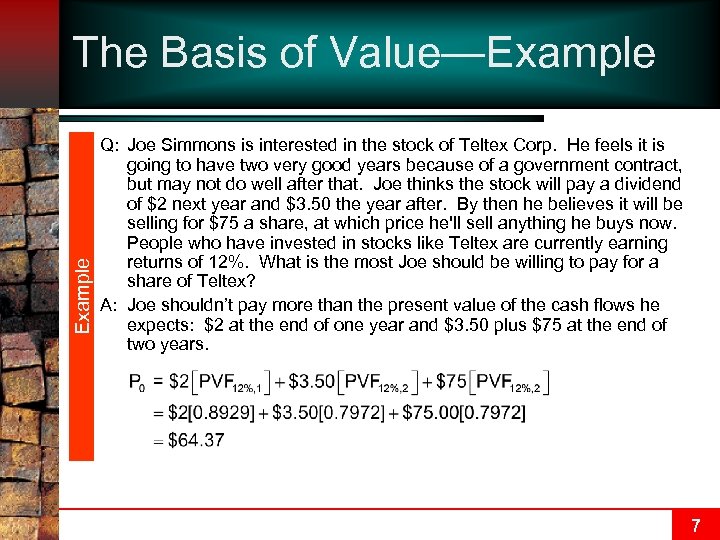 Example The Basis of Value—Example Q: Joe Simmons is interested in the stock of Teltex Corp. He feels it is going to have two very good years because of a government contract, but may not do well after that. Joe thinks the stock will pay a dividend of $2 next year and $3. 50 the year after. By then he believes it will be selling for $75 a share, at which price he'll sell anything he buys now. People who have invested in stocks like Teltex are currently earning returns of 12%. What is the most Joe should be willing to pay for a share of Teltex? A: Joe shouldn’t pay more than the present value of the cash flows he expects: $2 at the end of one year and $3. 50 plus $75 at the end of two years. 7
 The Intrinsic (Calculated) Value and Market Price n A stock’s intrinsic value is based on assumptions made by a potential investor n Must estimate future expected cash flows • Need to perform a fundamental analysis of the firm and the industry n Different investors with different cash flow estimates will have different intrinsic values 8
 Growth Models of Common Stock Valuation n Realistically most people tend to forecast growth rates rather than cash flows n Because forecasting exact future prices and dividends is very difficult 9
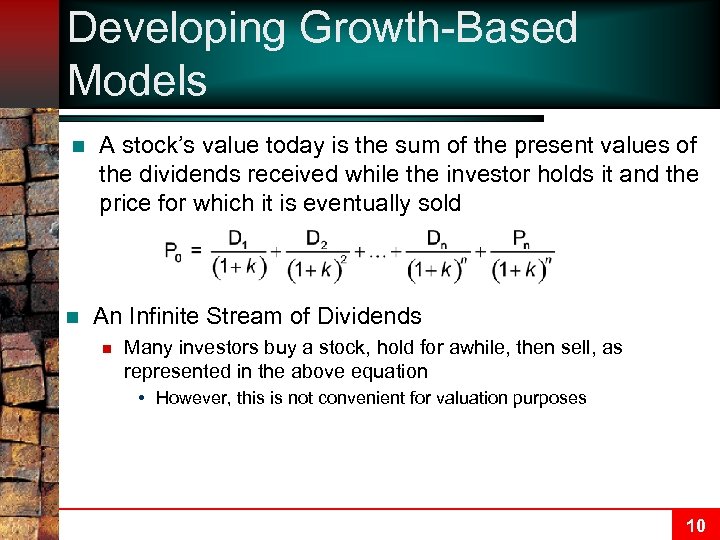 Developing Growth-Based Models n n A stock’s value today is the sum of the present values of the dividends received while the investor holds it and the price for which it is eventually sold An Infinite Stream of Dividends n Many investors buy a stock, hold for awhile, then sell, as represented in the above equation • However, this is not convenient for valuation purposes 10
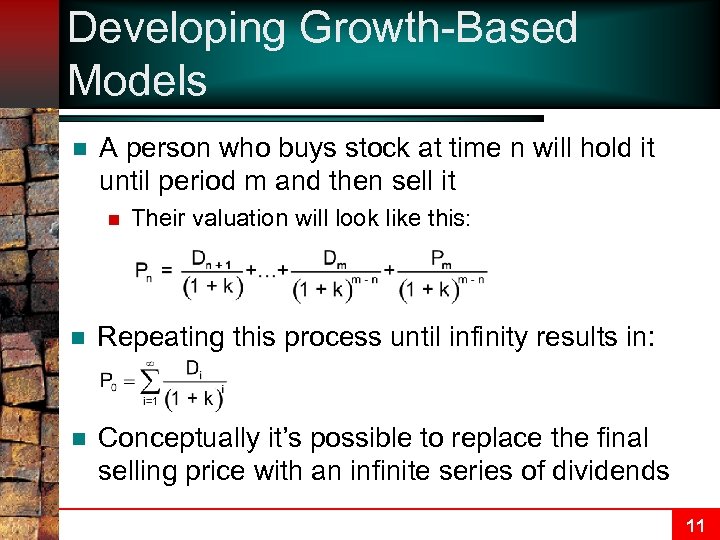 Developing Growth-Based Models n A person who buys stock at time n will hold it until period m and then sell it n Their valuation will look like this: n Repeating this process until infinity results in: n Conceptually it’s possible to replace the final selling price with an infinite series of dividends 11
 Working with Growth Rates n Growth rates work like interest rates n If growth is expected to be 6% next year then $100 experiencing a 6% growth will increase by $6, or $100 x 6% • The ending value after 6% growth will be $106, or $100 + $6, or $100 x (1. 06) 12
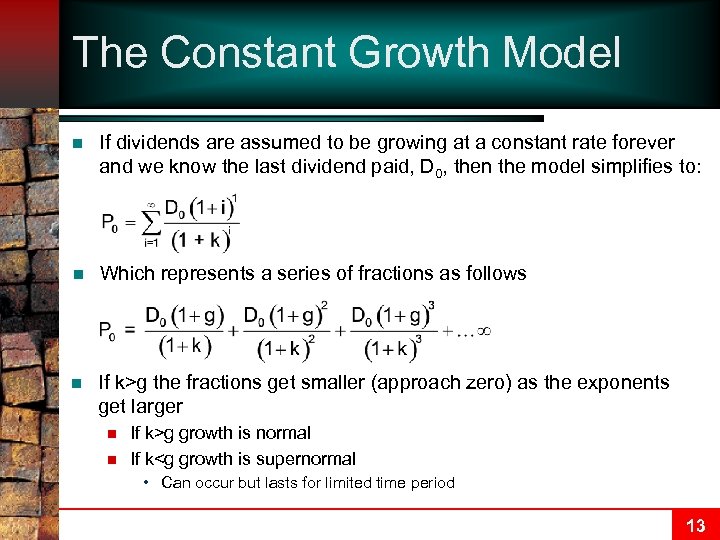 The Constant Growth Model n If dividends are assumed to be growing at a constant rate forever and we know the last dividend paid, D 0, then the model simplifies to: n Which represents a series of fractions as follows n If k>g the fractions get smaller (approach zero) as the exponents get larger n n If k>g growth is normal If k
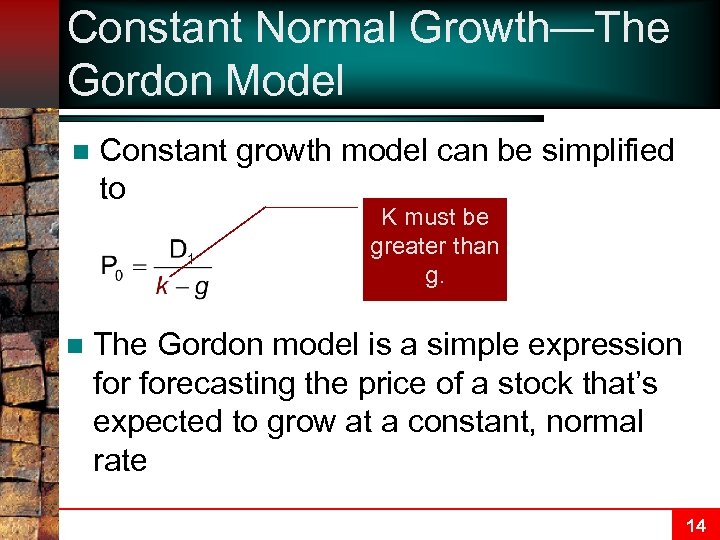 Constant Normal Growth—The Gordon Model n Constant growth model can be simplified to K must be greater than g. n The Gordon model is a simple expression forecasting the price of a stock that’s expected to grow at a constant, normal rate 14
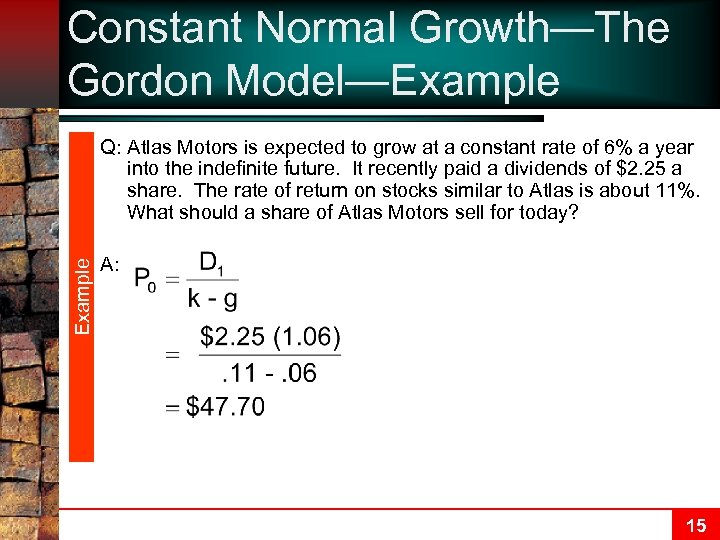 Constant Normal Growth—The Gordon Model—Example Q: Atlas Motors is expected to grow at a constant rate of 6% a year into the indefinite future. It recently paid a dividends of $2. 25 a share. The rate of return on stocks similar to Atlas is about 11%. What should a share of Atlas Motors sell for today? A: 15
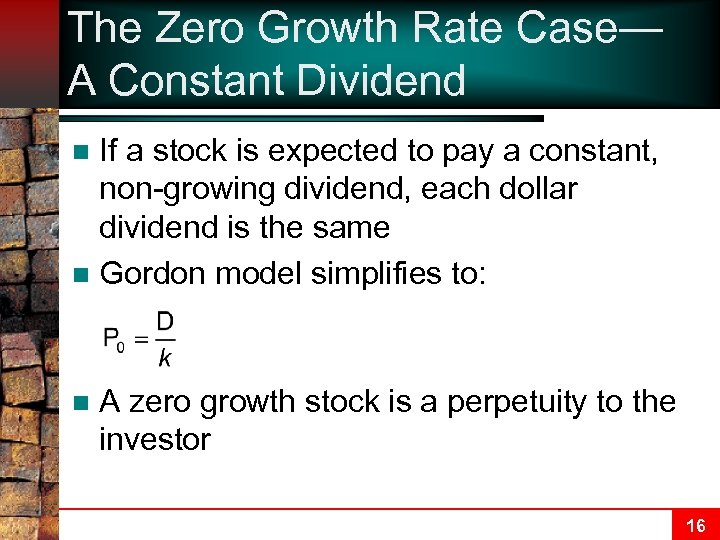 The Zero Growth Rate Case— A Constant Dividend If a stock is expected to pay a constant, non-growing dividend, each dollar dividend is the same n Gordon model simplifies to: n n A zero growth stock is a perpetuity to the investor 16
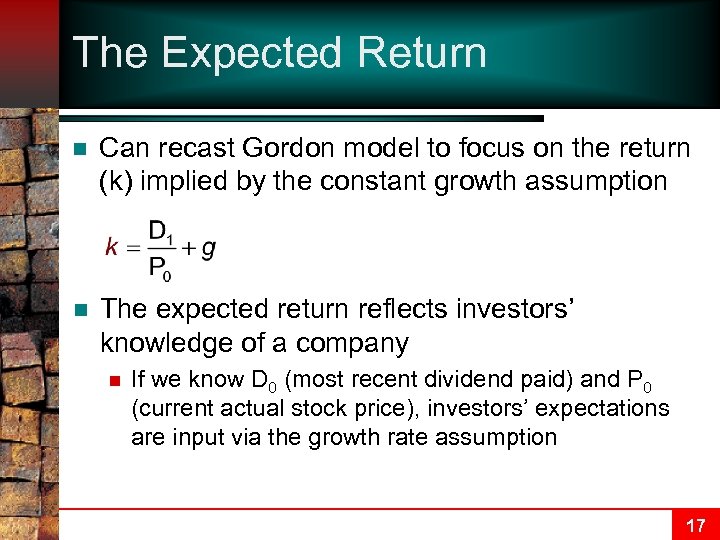 The Expected Return n Can recast Gordon model to focus on the return (k) implied by the constant growth assumption n The expected return reflects investors’ knowledge of a company n If we know D 0 (most recent dividend paid) and P 0 (current actual stock price), investors’ expectations are input via the growth rate assumption 17
 Two Stage Growth n At times a firm’s future growth may not be expected to be constant n n For example, a new product may lead to temporary high growth The two-stage growth model allows us to value a stock that is expected to grow at an unusual rate for a limited time n n Use the Gordon model to value the constant portion Find the present value of the non-constant growth periods 18
 Example Two Stage Growth—Example Q: Zylon Corporation’s stock is selling for $48 a share according to The Wall Street Journal. We’ve heard a rumor that the firm will make an exciting new product announcement next week. By studying the industry, we’ve concluded that this new product will support an overall company growth rate of 20% for about two years. After that, we feel growth will slow rapidly and level off at about 6%. The firm currently pays an annual dividend of $2. 00, which can be expected to grow with the company. The rate of return on stocks like Zylon is approximately 10%. Is Zylon a good buy at $48? A: We’ll estimate what we think Zylon should be worth given our expectations about growth. 19
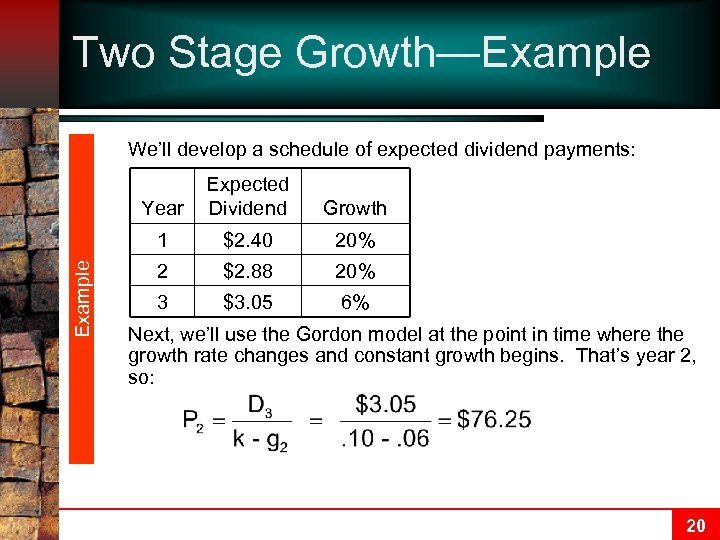 Two Stage Growth—Example We’ll develop a schedule of expected dividend payments: Growth 1 Example Year Expected Dividend $2. 40 20% 2 $2. 88 20% 3 $3. 05 6% Next, we’ll use the Gordon model at the point in time where the growth rate changes and constant growth begins. That’s year 2, so: 20
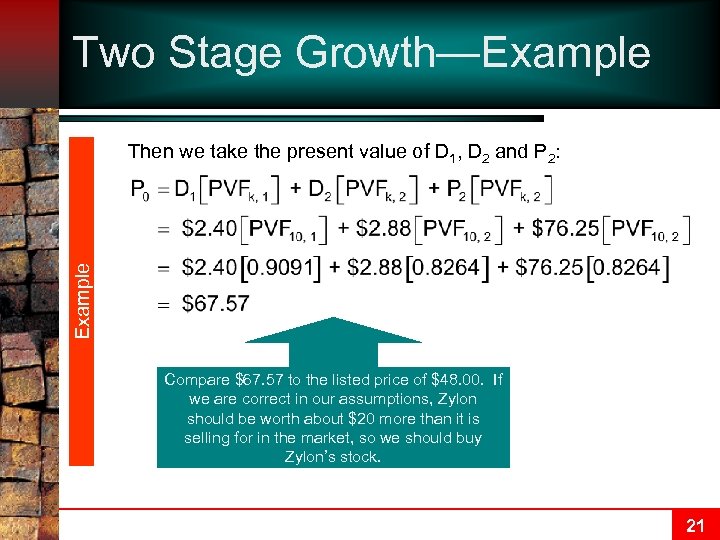 Two Stage Growth—Example Then we take the present value of D 1, D 2 and P 2: Compare $67. 57 to the listed price of $48. 00. If we are correct in our assumptions, Zylon should be worth about $20 more than it is selling for in the market, so we should buy Zylon’s stock. 21
 Practical Limitations of Pricing Models n Stock valuation models give approximate results because the inputs are approximations of reality n Bond valuation is precise because inputs are exact • With bonds future cash flows are contractually guaranteed in amount and time n Actual growth rate can be VERY different from predicted growth rates n n Even if growth rates differ only slightly, it can make a big difference in our decision So, it’s best to allow a margin for error in your estimations 22
 Practical Limitations of Pricing Models n Stocks That Don’t Pay Dividends n n Some firms don’t pay dividends even if they are profitable Many companies claim they never intend to pay dividends • These firms can still have a substantial stock price n Firms of this type typically are growing and are using their profits to finance their growth • However rapid growth won’t last forever • When growth slows, the firm will begin paying dividends • It’s these distant dividends that impart value 23
 Some Institutional Characteristics of Common Stock n Corporate Organization and Control n n n Controlled by Board of Directors (elected by stockholders) Board appoints top management who then appoint middle/lower management Board consists of: top management and outside members (major stockholders, top executives at other firms, former presidents, etc. ) In widely held corporations, top management is effectively in control of the firm because no stockholder group has enough power to remove them Preemptive Rights n n If firm issues new shares, existing shareholders have right to purchase pro rata share of new issue Common, but not required by law 24
 Voting Rights and Issues n Each share of common stock has one vote in the election of directors, which is usually cast by proxy n A proxy fight occurs if parties with conflicting interests solicit proxies at the same time 25
 Majority and Cumulative Voting n n n Majority voting gives the larger group control of the company Cumulative voting gives minority interest a chance at some representation on the board Shares With Different Voting Rights n Different classes of stock can be issued with different rights • Some stock may be issued with limited or no voting rights 26
 Stockholders’ Claim on Income And Assets n n Stockholders have claim on the firm’s net income What is not paid out as dividends is retained (Retained Earnings) for investment in new projects n n Leads to future growth Common stockholders are last in line to receive income or assets, and bear more risk than other investors n However, residual interest is large when firm does well 27
 Preferred Stock n Preferred stock is often referred to as a hybrid between common stock and bonds because: No maturity date (like common stock) n Fixed dividend payment (similar to bond interest payment) n 28
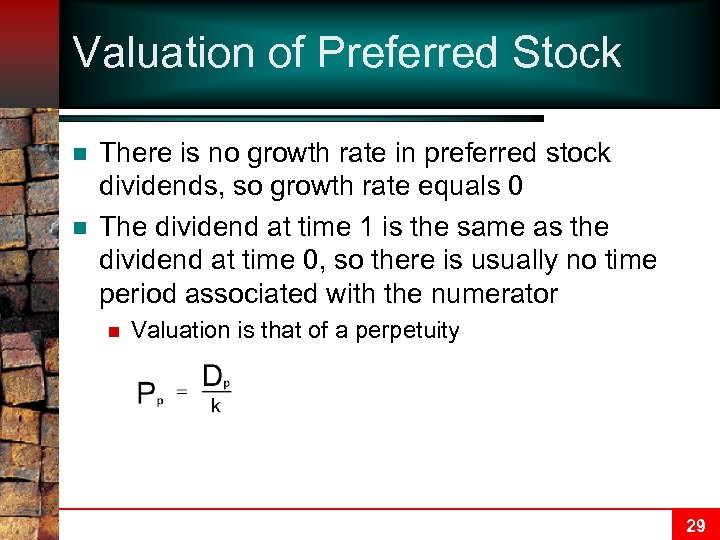 Valuation of Preferred Stock n n There is no growth rate in preferred stock dividends, so growth rate equals 0 The dividend at time 1 is the same as the dividend at time 0, so there is usually no time period associated with the numerator n Valuation is that of a perpetuity 29
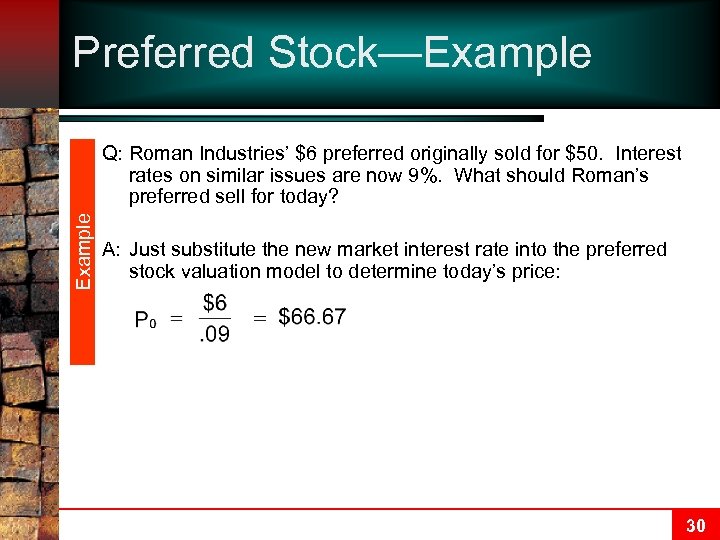 Preferred Stock—Example Q: Roman Industries’ $6 preferred originally sold for $50. Interest rates on similar issues are now 9%. What should Roman’s preferred sell for today? A: Just substitute the new market interest rate into the preferred stock valuation model to determine today’s price: 30
 Characteristics of Preferred Stock n Cumulative Feature n n n Common dividends can’t be paid unless the dividends on cumulative preferred are current Preferred stock never returns principal (like a bond does upon maturity) Preferred stockholders cannot force a firm into bankruptcy (like bondholders) Preferred stockholders received preferential treatment over common stockholders in the event of bankruptcy, but have a lower priority than bondholders Preferred stockholders do not have voting rights (like common stockholders do) Dividend payments to preferred stockholders are not tax deductible to the firm 31
 Securities Analysis n n Securities analysis is the art and science of selecting investments Fundamental analysis looks at a company and its business to forecast value Technical analysis bases value on the pattern of past prices and volumes The Efficient Market Hypothesis says information moves so rapidly in financial markets that price changes occur immediately, so it is impossible to consistently beat the market to bargains 32
 Options and Warrants n n Option gives the option holder the temporary right to buy (or sell) an asset from another party at a fixed price For instance, a company may be interested in building a new factory on a tract of land, but it is still unsure if it wants to build the factory n n However, it plans to make a final decision in six months The company could buy an option contract giving it the right to buy the land at a fixed price by the end of the six months • If the company pursues the factory project, it would exercise the option • If the company decided not to go ahead with the factory project it would not have to exercise the option • But what if the value of the land had risen substantially above the price fixed by the option—it could exercise the option and sell the land for a profit thus benefiting even though it didn’t own the land during the period of the option 33
 Stock Options Stock options are purchased to speculate on stock price movements n Can be traded in financial markets n Call option (call)—an option to buy a stock n Put option (put)—an option to sell stock n Known as a derivative—derives its value from the price of an underlying security n 34
 Call Option n Basic call option n Gives owner the right to buy stock at a fixed price (called the exercise or strike price) for a specified time period • Usually 3, 6 or 9 months Option expires at the end of the time period n Price of the option is less than the price of the underlying stock n 35
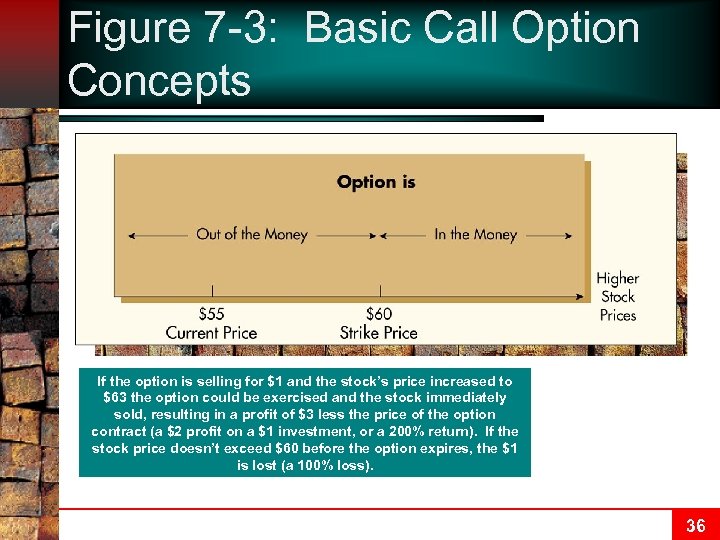 Figure 7 -3: Basic Call Option Concepts If the option is selling for $1 and the stock’s price increased to $63 the option could be exercised and the stock immediately sold, resulting in a profit of $3 less the price of the option contract (a $2 profit on a $1 investment, or a 200% return). If the stock price doesn’t exceed $60 before the option expires, the $1 is lost (a 100% loss). 36
 Call Options n The more volatile the stock’s price the more attractive the option n n The stock’s price is more likely to exceed the strike price before the option expires The longer the time until expiration the more attractive the option n The stock’s price is more likely to exceed the strike price before the option expires 37
 The Call Option Writer n The option writer is the person who creates the contract n Agrees to sell the stock at the strike price if the option is exercised The original writer must stand ready to deliver on the contract regardless of how many times the option is sold n Call writer hopes stock price will remain the same n 38
 Intrinsic Value A call option’s intrinsic value is the difference between the underlying stock’s current price and the option’s strike price n If the option is out-of-the-money then the intrinsic value is zero n Option will always sell for intrinsic value or above n n Difference between option’s intrinsic value and price is known as time value 39
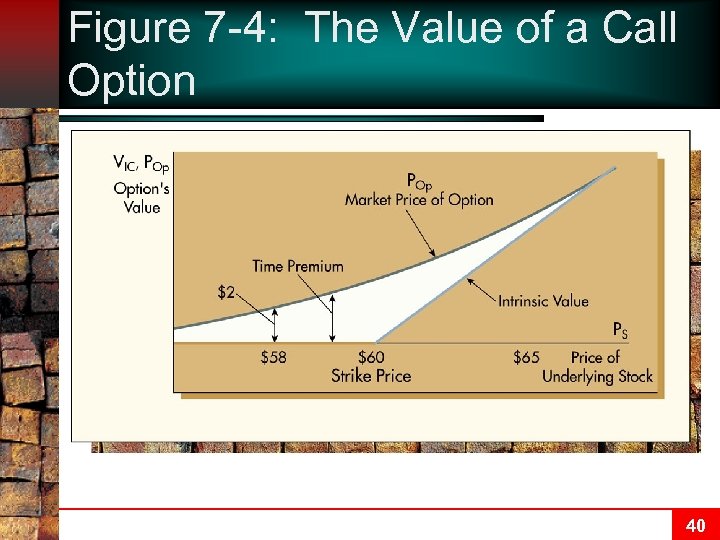 Figure 7 -4: The Value of a Call Option 40
 Options and Leverage n Financial leverage n Technique that amplifies return on investment • Improves positive returns and worsens negative returns n Options offer leveraging potential due to the lower price at which you can buy an option compared to the price of the underlying stock n The higher the price of the option the less the leverage potential 41
 Options that Expire Option investing is risky because options expire after a limited time n If the option was purchased out-of-themoney and the stock price never exceeds the strike price prior to the expiration date the option will expire worthless n n n Resulting in a 100% loss As the expiration date approaches an option’s time value approaches zero 42
 Trading in Options can be bought and sold at any time prior to expiration n n Price volatility in the options market n n Chicago Board Options Exchange (CBOE) is the largest, oldest and best known options exchange As the price of the underlying stock changes the price of the option changes but by a greater relative movement due to the lower price of the option compared to the stock Options are rarely exercised before expiration n If the call option owner believes a stock is unlikely to increase further he is likely to sell the option rather than exercise it as he would lose any time premium if he were to exercise the option 43
 Writing Options n n People write options for the premium income, hoping that the option will never be exercised Option writers lose whatever option buyers win n Take the opposite side of a bet Covered option—the writer owns the underlying stock Naked option—the writer does not own the underlying stock and must purchase it at the current price should the option be exercised 44
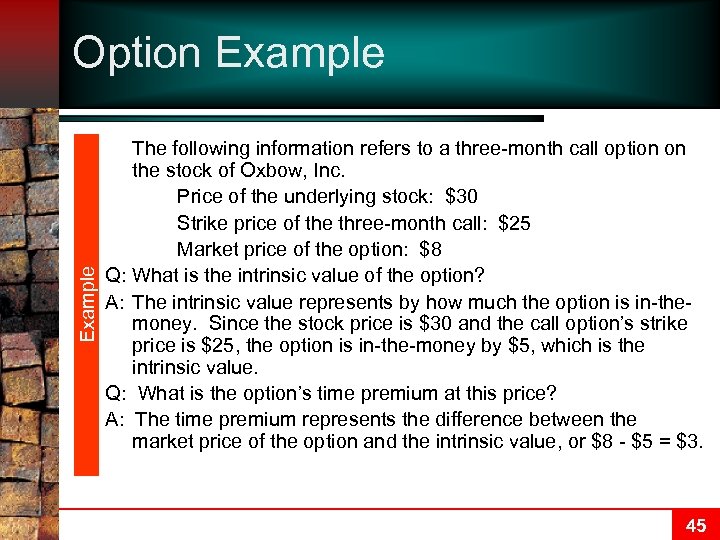 Example Option Example The following information refers to a three-month call option on the stock of Oxbow, Inc. Price of the underlying stock: $30 Strike price of the three-month call: $25 Market price of the option: $8 Q: What is the intrinsic value of the option? A: The intrinsic value represents by how much the option is in-themoney. Since the stock price is $30 and the call option’s strike price is $25, the option is in-the-money by $5, which is the intrinsic value. Q: What is the option’s time premium at this price? A: The time premium represents the difference between the market price of the option and the intrinsic value, or $8 - $5 = $3. 45
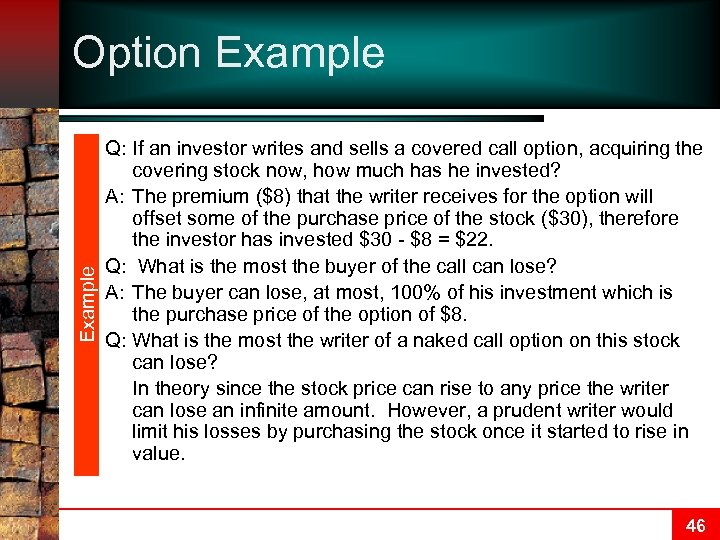 Example Option Example Q: If an investor writes and sells a covered call option, acquiring the covering stock now, how much has he invested? A: The premium ($8) that the writer receives for the option will offset some of the purchase price of the stock ($30), therefore the investor has invested $30 - $8 = $22. Q: What is the most the buyer of the call can lose? A: The buyer can lose, at most, 100% of his investment which is the purchase price of the option of $8. Q: What is the most the writer of a naked call option on this stock can lose? In theory since the stock price can rise to any price the writer can lose an infinite amount. However, a prudent writer would limit his losses by purchasing the stock once it started to rise in value. 46
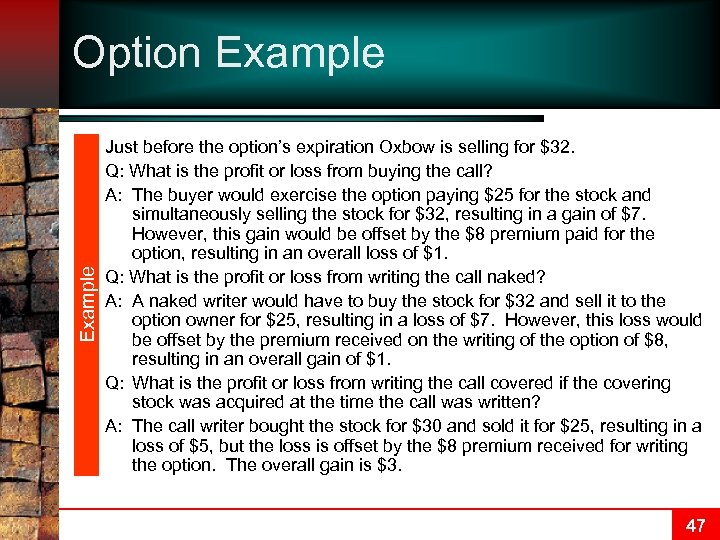 Example Option Example Just before the option’s expiration Oxbow is selling for $32. Q: What is the profit or loss from buying the call? A: The buyer would exercise the option paying $25 for the stock and simultaneously selling the stock for $32, resulting in a gain of $7. However, this gain would be offset by the $8 premium paid for the option, resulting in an overall loss of $1. Q: What is the profit or loss from writing the call naked? A: A naked writer would have to buy the stock for $32 and sell it to the option owner for $25, resulting in a loss of $7. However, this loss would be offset by the premium received on the writing of the option of $8, resulting in an overall gain of $1. Q: What is the profit or loss from writing the call covered if the covering stock was acquired at the time the call was written? A: The call writer bought the stock for $30 and sold it for $25, resulting in a loss of $5, but the loss is offset by the $8 premium received for writing the option. The overall gain is $3. 47
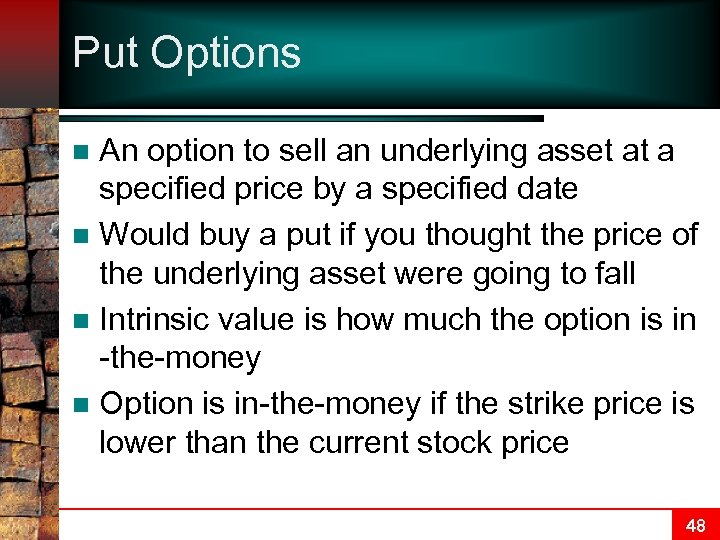 Put Options An option to sell an underlying asset at a specified price by a specified date n Would buy a put if you thought the price of the underlying asset were going to fall n Intrinsic value is how much the option is in -the-money n Option is in-the-money if the strike price is lower than the current stock price n 48
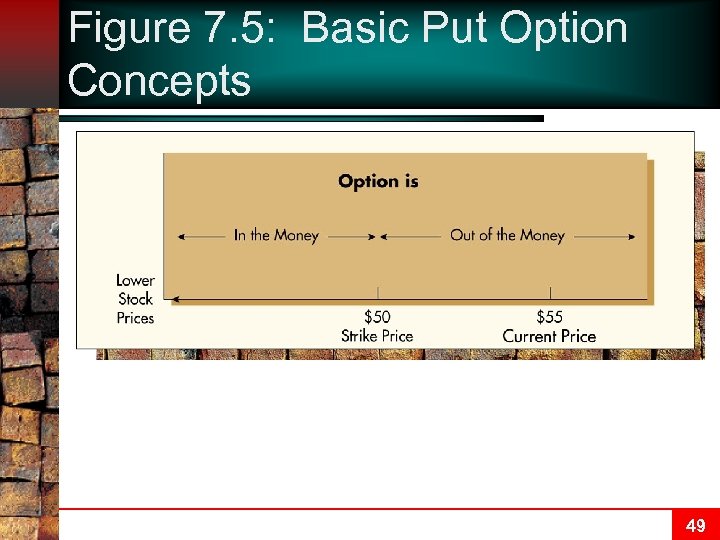 Figure 7. 5: Basic Put Option Concepts 49
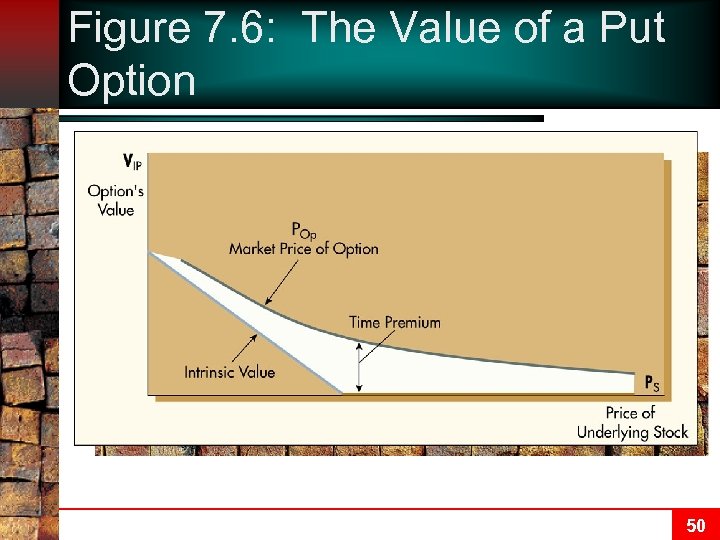 Figure 7. 6: The Value of a Put Option 50
 Option Pricing Models n n Option pricing model is more difficult than pricing models for stocks and bonds Fischer Black and Myron Scholes developed the Black-Scholes Option Pricing Model n Determines option’s price based on • • • Price of underlying stock Strike price of option Time remaining until expiration of option Volatility of underlying stock’s market price Risk-free interest rate 51
 Warrants Options trade between investors, not between the companies that issue the underlying stocks n Warrants are issued by the underlying companies n n When the warrant is exercised the company issues new stock and receives the exercise price • Thus, warrants are primary market instruments while options are secondary market instruments 52
 Warrants Similar to call options but have a longer expiration period (several years vs. months) n Usually issued as a “sweetener” (for bonds, for instance) n Warrants can generally be detached from another issue and sold separately n 53
 Employee Stock Options n More like warrants than traded options n n n Don’t expire for several years Strike prices are set far out of the money Employees who receive options generally receive a lower salary than they would otherwise If a company is expected to have a good future employees may want to receive options Companies like paying with options because they can pay the employees a lower salary n Argue that options allow up-and-coming companies to attract talented employees that they couldn’t otherwise afford 54
 The Executive Stock Option Problem Senior executives are usually the people who receive the most stock options n Tactic has been criticized recently n n May cause executive to try to increase stock price in unethical ways • Manipulating financial results driving the stock price higher • Market should eventually realize the problem and drive the stock down but executives have already exercised their stock options and sold the stock at the inflated price 55
 The Executive Stock Option Problem n n This can negatively impact a firm’s pension plan if it is heavily invested in its firm’s own stock In the early 2000 s investors realized that auditors couldn’t (or wouldn’t) always report financial manipulations n n n Enron, World. Com, Tyco Resulted in a loss of investor confidence in corporate management One result of the overhaul of financial reporting is the requirement that companies recognize employee stock options as expenses at the time they are issued n Problem is that no one knows how high the stock will rise in value at the time the options are issued 56