


 Скачать презентацию CHAPTER 7 THE PRESIDENCY CHAPTER 7 LEARNING
f890659bf1d7439e6acd237385ab908e.ppt
- Количество слайдов: 61
 CHAPTER 7 THE PRESIDENCY
 CHAPTER 7: LEARNING OBJECTIVES v Where Do Presidents Come From? Presidential Comings and Goings v Analyze the past traits of presidents; assess the requirements for holding the position v Understand the process by which presidents may be impeached and removed from office; know the order of presidential succession Copyright © 2012 Cengage Learning
 CHAPTER 7: LEARNING OBJECTIVES v The Evolution of the American Presidency v Trace the evolution of the American presidency from “chief clerk” in the late 18 th and early 19 th centuries to its eventual dominance of the political system v Understand how the modern presidency has persevered in the recent era of divisiveness Copyright © 2012 Cengage Learning
 CHAPTER 7: LEARNING OBJECTIVES v Express Powers and Responsibilities of the President v Recognize the formal powers vested in the president under Article II of the Constitution v Explain how presidents use the veto, the power of appointment and removal, and the pardon to exercise political power v Define the powers and limits of the president as commander in chief Copyright © 2012 Cengage Learning
 CHAPTER 7: LEARNING OBJECTIVES v Implied Powers and Responsibilities of the President v Recognize the implied powers of the presidency not spelled out in the Constitution including those exercised as the nation’s crisis manager and political party leader v Explain how presidents exercise power through executive orders and agreements Copyright © 2012 Cengage Learning
 CHAPTER 7: LEARNING OBJECTIVES v Presidential Resources v Describe the other individuals and offices in the executive branch that contribute to the modern presidency v Important Presidential Relationships v Recognize how the power of the presidency Copyright © 2012 Cengage Learning
 LAMARQUE/REUTERS /LANDOV TIME LIFE PICTURES/GETTY IMAGES BETTMANNCORBI Copyright © 2012 Cengage Learning
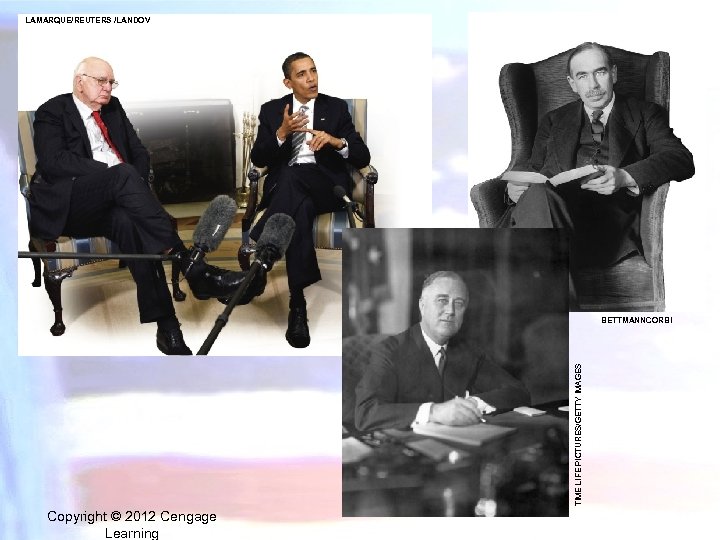
 A LEADER’S DETERMINATION TO STICK TO HIS PRINCIPLES DURING A SEVERE ECONOMIC CRISIS: NOW & THEN v The president was no economist, so he kept economists close by to help him make sense of detailed economic data v He understood that economic forces could make or break his administration v He also knew that the U. S. was facing a financial crisis of epic proportions Copyright © 2012 Cengage Learning
 NOW… PRESIDENT OBAMA’S ECONOMIC CRISIS v Obama’s “quintessentially Keynesian solution” to the 2009 economic crisis v $787 billion American Recovery and Reinvestment Act (ARRA) of 2009— fiscal stimulus plan v Saved or created an estimated 1. 6 to 1. 8 million jobs, but—increased the deficit by $200 billion in 2009 alone Copyright © 2012 Cengage Learning
 THEN… FDR AND THE GREAT DEPRESSION v 1934: Economist John Maynard Keynes urged FDR to engage in massive government spending to create jobs, build infrastructure, and assist struggling industries v The deficit mushroomed, and it took the onset of World War II to curb out-ofcontrol budget shortfalls Copyright © 2012 Cengage Learning
 NOW & THEN… v The Constitution says nothing about special rules that govern during a crisis, whether military, economic, or otherwise v The president must use the formidable powers as chief legislator and crisis manager and act decisively v Despite the stakes—a refusal to lead might be the greatest failing of all Copyright © 2012 Cengage Learning
 WHERE DO PRESIDENTS COME FROM? PRESIDENTIAL COMINGS AND GOINGS v Prerequisites: “natural born” citizen; at least 35 years-old; and a resident in the U. S. for at least 14 years v All U. S. presidents have been: v White (except Obama) and male v 42 to 77 years-old; Christians v 24 were firstborn males v All but 9 attended college v 26 have been related to other presidents Copyright © 2012 Cengage Learning
 WHERE DO PRESIDENTS COME FROM? PRESIDENTIAL COMINGS AND GOINGS v Washington established an unwritten two-term precedent v Unchallenged until FDR’s election to 4 consecutive terms v Twenty-second Amendment (1951)— restricts the presidency to no longer than two and a half terms Copyright © 2012 Cengage Learning
 WHERE DO PRESIDENTS COME FROM? PRESIDENTIAL COMINGS AND GOINGS v 4 presidents were assassinated while in office v 4 others died of natural causes while still serving as president v FDR died in 1945, only a few months into his fourth term Copyright © 2012 Cengage Learning
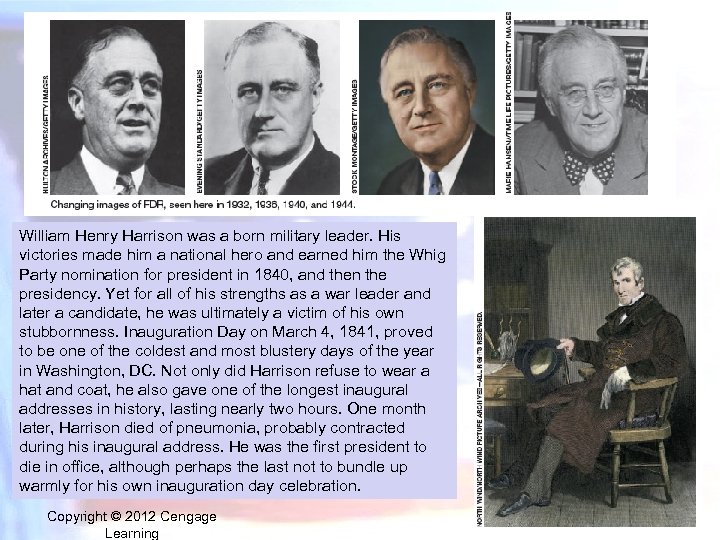 William Henry Harrison was a born military leader. His victories made him a national hero and earned him the Whig Party nomination for president in 1840, and then the presidency. Yet for all of his strengths as a war leader and later a candidate, he was ultimately a victim of his own stubbornness. Inauguration Day on March 4, 1841, proved to be one of the coldest and most blustery days of the year in Washington, DC. Not only did Harrison refuse to wear a hat and coat, he also gave one of the longest inaugural addresses in history, lasting nearly two hours. One month later, Harrison died of pneumonia, probably contracted during his inaugural address. He was the first president to die in office, although perhaps the last not to bundle up warmly for his own inauguration day celebration. Copyright © 2012 Cengage Learning
 AMERICAN GOVERNMENT … IN HISTORICAL PERSPECTIVE v PRESIDENTIAL SEX SCANDALS: v 1802: Thomas Jefferson and slave Sally Hemings v 1922: Warren Harding and mistress Nan Britton v 1995 -97: Bill Clinton and White House intern Monica Lewinsky Copyright © 2012 Cengage Learning
 IMPEACHMENT v Requires a majority vote of the House and conviction by two-thirds of the Senate v “Treason, Bribery, or other high Crimes and Misdemeanors” v Andrew Johnson and Bill Clinton – v Impeached but not convicted or removed v Richard Nixon—resigned Copyright © 2012 Cengage Learning
 THE EVOLUTION OF THE AMERICAN PRESIDENCY v The Founders designed a chief executive powerful enough to respond quickly, but limited by lack of lawmaking power, and the need for congressional approval v It has evolved through practice, tradition, and the personal energy of some presidents Copyright © 2012 Cengage Learning
 PRESIDENT AS “CHIEF CLERK OF THE UNITED STATES”: 1789– 1836 v Most presidents in the 4 decades after Washington v Primarily served Congress’s bidding and performed administrative duties v Andrew Jackson (1829– 1837), remade the office into one of tremendous political power Copyright © 2012 Cengage Learning
 WEAKENED PRESIDENCY IN THE WILDERNESS YEARS: 1837– 1900 v Pre-Civil War presidents following Jackson were much weaker v The president as chief clerk seemed again alive and well v The only effective president during this period was James K. Polk (1845– 1849) v Presided over a period of significant westward expansion Copyright © 2012 Cengage Learning
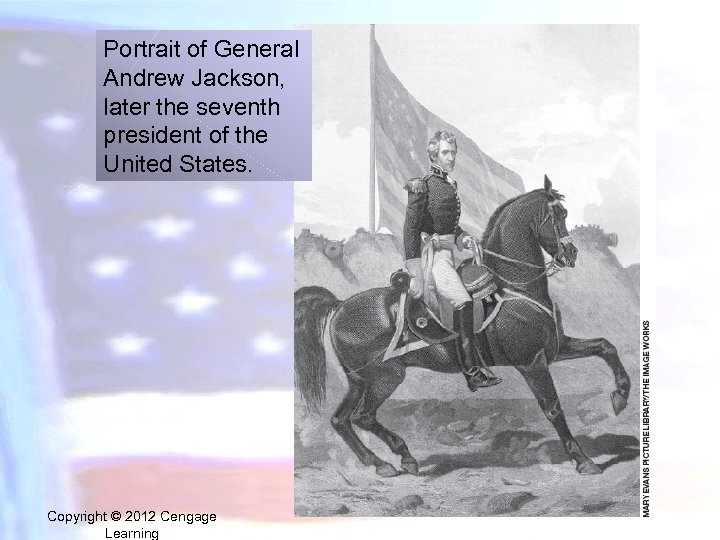 Portrait of General Andrew Jackson, later the seventh president of the United States. Copyright © 2012 Cengage Learning
 ABRAHAM LINCOLN (1861– 1865) v When confronted with state secessions and the Civil War v Took some bold, unprecedented acts: v Blockaded southern ports; called for 75, 000 northern soldiers; and suspended the writ of habeas corpus v Reinterpreted Article II into a source of executive authority during emergencies Copyright © 2012 Cengage Learning
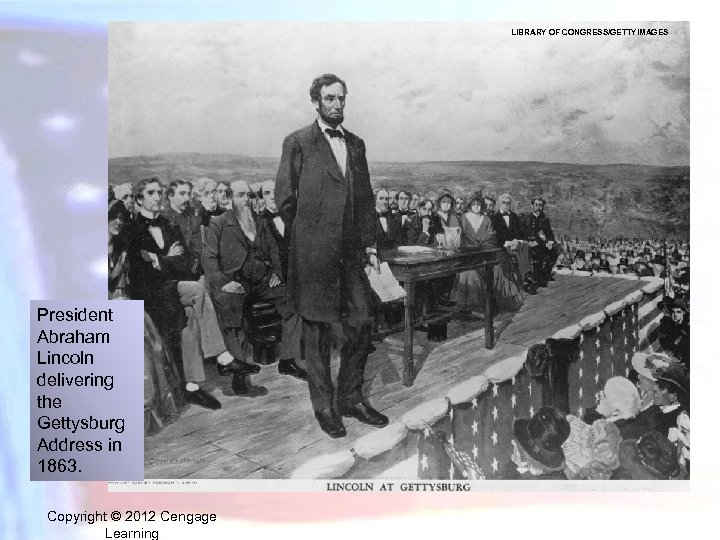 LIBRARY OF CONGRESS/GETTYIMAGES President Abraham Lincoln delivering the Gettysburg Address in 1863. Copyright © 2012 Cengage Learning
 WEAKENED PRESIDENCY IN THE WILDERNESS YEARS: 1837– 1900 v After Lincoln’s assassination, Congress, quickly reasserted its control v Keeping it for the remainder of the century v After Ulysses Grant left office in 1877, no sitting president won a second term until William Mc. Kinley in 1900 Copyright © 2012 Cengage Learning
 BIRTH OF THE MODERN PRESIDENCY AND ITS RISE TO DOMINANCE: 1901– 1945 v Theodore Roosevelt’s presidency (1901 – 1909) ushered in a new era of presidential authority v Willing to gamble political capital on bold assertions of presidential power v Won a Nobel Peace Prize and was the first president to travel to foreign lands Copyright © 2012 Cengage Learning
 BIRTH OF THE MODERN PRESIDENCY AND ITS RISE TO DOMINANCE: 1901– 1945 v FDR (1933 -1945) transformed the presidency into an institution marked by permanent bureaucracies and wellestablished repositories of power v The imperial presidency that took root at the beginning of the 20 th century came to fruition by the close of World War II Copyright © 2012 Cengage Learning
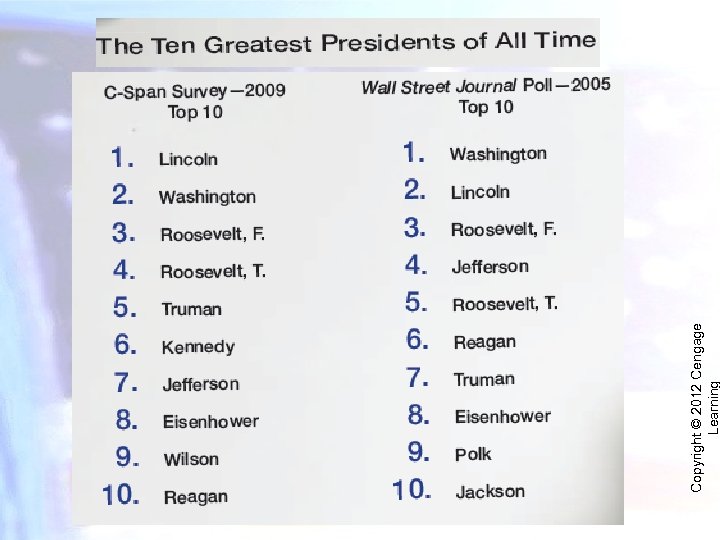
 CHECK THE LIST v THE TEN GREATEST PRESIDENTS OF ALL TIME v C-SPAN Survey of Presidential Leadership consists of rankings from a group of presidential historians and "professional observers of the presidency”— 2009 Copyright © 2012 Cengage Learning
 Copyright © 2012 Cengage Learning
 AMERICAN GOVERNMENT … IN GLOBAL PERSPECTIVE: v A NOMINEE WITH AFRICAN ROOTS, AS VIEWED BY A WRITER IN KENYA v Source: John Harbeson, “Harbeson’s Dreams and the African Agenda, ” Daily Nation, August 16, 2008 (http: //www. nation. co. ke/News/world//1068/457288/-/rx 0 emi/-/index. html; accessed on August 19, 2008) Copyright © 2012 Cengage Learning
 THE IMPERIAL PRESIDENCY COMES UNDER ATTACK, 1945– 1980 v With presidential authority greatest in the area of national security – v Waging the Cold War consumed considerable presidential energy v The Truman, Eisenhower and Kennedy administrations focused on containing the Soviet communist threat Copyright © 2012 Cengage Learning
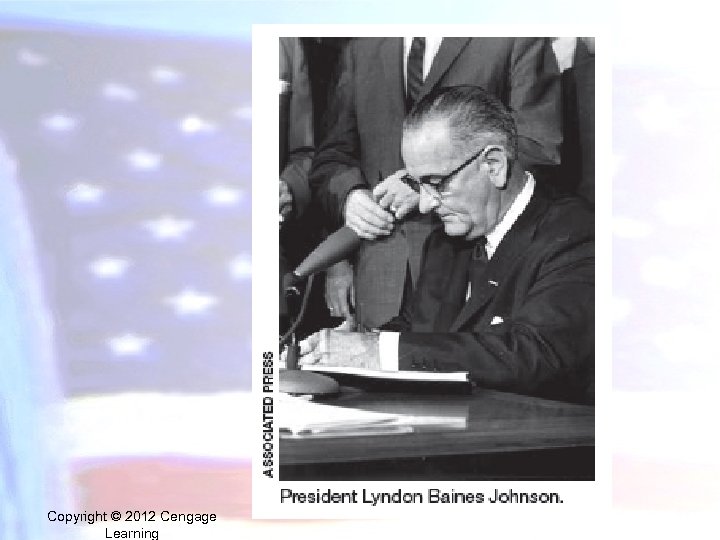
 THE IMPERIAL PRESIDENCY COMES UNDER ATTACK, 1945– 1980 v Lyndon Johnson’s Great Society – first sweeping domestic legislation since FDR’s New Deal v Included increases in federal aid to education, Medicare and Medicaid, and a voting rights act for African Americans v LBJ’s domestic success was offset by the unpopular war in Viet Nam Copyright © 2012 Cengage Learning
 Copyright © 2012 Cengage Learning
 THE IMPERIAL PRESIDENCY COMES UNDER ATTACK, 1945– 1980 v Presidents after Johnson came under increasing attack in the 1970 s v Richard Nixon (1969 -1974) v Watergate v Jimmy Carter (1977 -1981) v First elected president since 1932 to lose a re-election bid Copyright © 2012 Cengage Learning
 REDEFINING THE PRESIDENCY IN AN ERA OF DIVISIVENESS, 1981– 2008 v Ronald Reagan’s 1980 election marked the return of the chief executive as an unmatched force over American politics v The “great communicator” v Legislative success despite a Democratic House v Victorious end of the Cold War Copyright © 2012 Cengage Learning
 REDEFINING THE PRESIDENCY IN AN ERA OF DIVISIVENESS, 1981– 2008 v Reagan’s successors also faced the various divided government challenges v George H. W. Bush: tax legislation v Bill Clinton: Co-opted Republican programs v George W. Bush: tax cuts, “No Child Left Behind, ” and the War on Terror Copyright © 2012 Cengage Learning
 AMERICAN GOVERNMENT … IN POPULAR PERSPECTIVE: v Another “Tweet” from the Commander-in-Chief: The Interactive Presidency of Barack Obama v What types of information would you expect to find on www. whitehouse. gov that is not available on other media websites or other Internet sites that follow the presidency? Copyright © 2012 Cengage Learning
 AMERICAN GOVERNMENT … IN POPULAR PERSPECTIVE: v What advantages does a modern president have in the ability to communicate with a younger generation of citizens? v Do the political views of the web surfer affect his or willingness to visit the White House website? Why or why not? Copyright © 2012 Cengage Learning
 PRESIDENT BARACK OBAMA v Began – as most do – buoyed by feelings of good will from both sides of the political aisle v “Honeymoon period” ended quickly—as the details of his proposals for reform were laid bare for debate v Learned – the rhetoric of bipartisanship doesn’t easily translate into bipartisan votes Copyright © 2012 Cengage Learning
 EXPRESS POWERS AND RESPONSIBILITIES OF THE PRESIDENT v The Constitution lists only four specific presidential powers (expressed): 1. Commander-in-chief 2. Reprieves and pardons 3. Treaties (subject to Senate approval) 4. Certain appointments (subject to Senate approval) Copyright © 2012 Cengage Learning
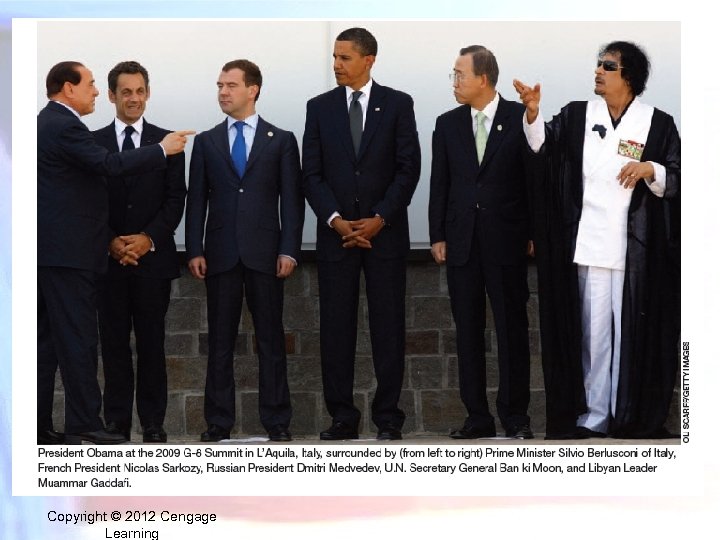
 EXPRESS POWERS AND RESPONSIBILITIES OF THE PRESIDENT v Important presidential functions – v Head of State—Formal duties and obligations on behalf of the U. S. v “State dinners” v Foreign affairs, including recognition (or non-recognition) of ambassadors and foreign governments Copyright © 2012 Cengage Learning
 Copyright © 2012 Cengage Learning
 EXPRESS POWERS AND RESPONSIBILITIES OF THE PRESIDENT v Chief Executive and Head of Government—Sole responsibility to execute U. S. laws v Powers of appointment and removal v Reprieve: reduces punishment without removing guilt v Pardon: both punishment and guilt Copyright © 2012 Cengage Learning
 EXPRESS POWERS AND RESPONSIBILITIES OF THE PRESIDENT v Chief Diplomat – Power to negotiate and execute treaties v Examples: Kennedy’s negotiations ending the 1962 Cuban Missile Crisis v Jimmy Carter: Panama Canal Treaty of 1977– 1978 v Bill Clinton: NAFTA Copyright © 2012 Cengage Learning
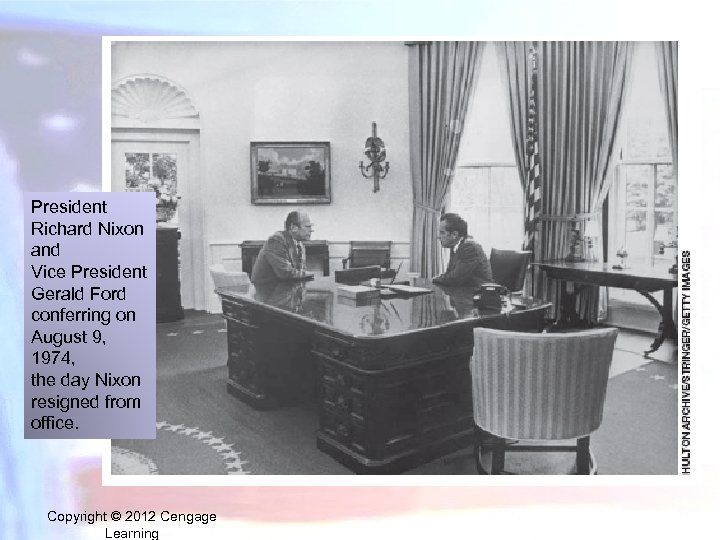 President Richard Nixon and Vice President Gerald Ford conferring on August 9, 1974, the day Nixon resigned from office. Copyright © 2012 Cengage Learning
 EXPRESS POWERS AND RESPONSIBILITIES OF THE PRESIDENT v Chief Legislator—involved in nearly every stage of federal lawmaking v State of the Union Address v White House Office of Legislative Affairs—liaison between the president and Congress v Vetoes Copyright © 2012 Cengage Learning
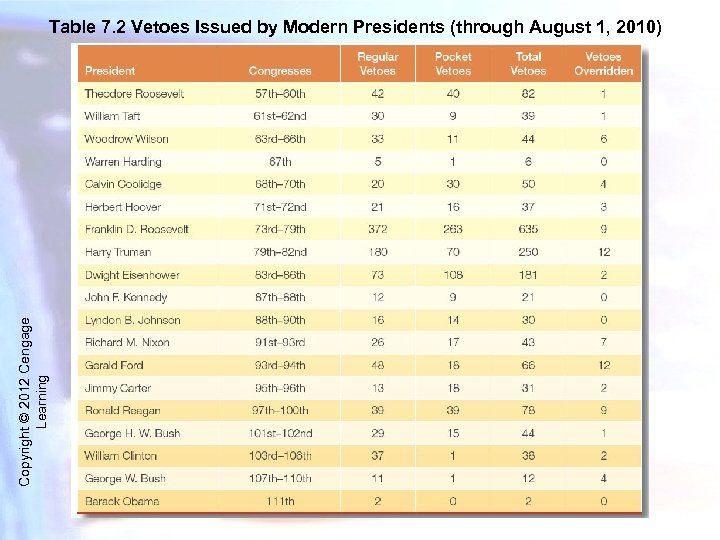 Copyright © 2012 Cengage Learning Table 7. 2 Vetoes Issued by Modern Presidents (through August 1, 2010)
 EXPRESS POWERS AND RESPONSIBILITIES OF THE PRESIDENT v Commander-in-Chief v Congress must “declare war” and the War Powers Resolution limits the power of the president to unilaterally commit troops to battle, but… v Ignored by Reagan, G. H. W. Bush, Clinton, and Obama Copyright © 2012 Cengage Learning
 IMPLIED POWERS AND RESPONSIBILITIES OF THE PRESIDENT v Crisis Manager—responds quickly and effectively to unexpected crises v Party Leader—decisions reflect on the party as a whole v Executive Order v Rule or regulation that has the force of law v Executive Agreement v Pact, written or oral, with a foreign government Copyright © 2012 Cengage Learning
 PRESIDENTIAL RESOURCES v The Vice President v Next in line for succession, however often relegated to the fringes of presidential power v Transformation in recent decades – v Have assumed roles as key advisers and executive branch officials working on behalf of the president Copyright © 2012 Cengage Learning
 PRESIDENTIAL RESOURCES v The Cabinet v Run their executive departments within the federal bureaucracy, and serve as key presidential advisers v Today’s Cabinet v Fifteen heads of departments v Six other important officials of “Cabinet rank” Copyright © 2012 Cengage Learning
 PRESIDENTIAL RESOURCES v The Executive Office of the President and the White House Staff v Created in 1939 to bring executive branch activities under tighter control v 2000 federal employees in numerous agencies assisting with the management and administration of executive branch departments Copyright © 2012 Cengage Learning
 PRESIDENTIAL RESOURCES v The First Lady – Previously relied on to assist in social obligations, until… v Woodrow Wilson’s two wives v Eleanor Roosevelt v Nancy Reagan v Barbara Bush v Hillary Clinton v Laura Bush v Michelle Obama Copyright © 2012 Cengage Learning
 YOUR PERSPECTIVE … ON AMERICAN GOVERNMENT v The White House Interns Program v Places interns in one of 12 different White House offices v Apply on line through the White House Web page: www. whitehouse. gov/about/internships/apply Copyright © 2012 Cengage Learning
 IMPORTANT PRESIDENTIAL RELATIONSHIPS v The President and the Public v Most modern presidents engage the public to support administration policies v Public support increases a president’s chances to get legislation passed – v Precipitous drops in public support may stop a president’s program in its tracks Copyright © 2012 Cengage Learning
 IMPORTANT PRESIDENTIAL RELATIONSHIPS v The President and Congress v Today presidents play significant roles in the legislative process v Presidential Congressional tools: v Campaigning for Congressional candidates v Personal contacts with members v Office of Congressional Relations v Rewards Copyright © 2012 Cengage Learning
 IMPORTANT PRESIDENTIAL RELATIONSHIPS v The President and the Media v Most effective channel for the president to communicate with the public v Effective media management is a hallmark of the most successful modern presidents v White House Press Secretary v White House Director of Communications Copyright © 2012 Cengage Learning
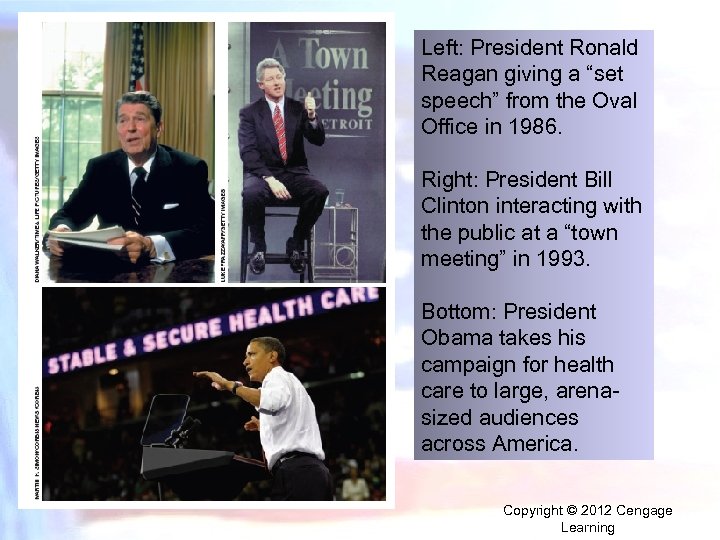 Left: President Ronald Reagan giving a “set speech” from the Oval Office in 1986. Right: President Bill Clinton interacting with the public at a “town meeting” in 1993. Bottom: President Obama takes his campaign for health care to large, arenasized audiences across America. Copyright © 2012 Cengage Learning
 NOW & THEN: MAKING THE CONNECTION v When unexpected crises confront the nation—military, economic, or otherwise —leadership must come from the president v John Maynard Keynes’ economic theories pointed FDR and Barack Obama’s administrations in a particular direction Copyright © 2012 Cengage Learning
 NOW & THEN: MAKING THE CONNECTION v Presidents can propose and implement legislation v Must act boldly and decisively to reassure the nation v Elected by the entire nation – therefore, can claim a mandate to act on behalf of the American people as a whole Copyright © 2012 Cengage Learning
 POLITICS INTERACTIVE! v A HONEYMOON FOR THE PRESIDENT? v www. cengage. com/dautrich/americangov ernment/2 e v Find the link on presidential agenda-setting and the “honeymoon period” during their first term in office v Consult the links regarding how presidents began their administrations with ambitious policymaking agendas Copyright © 2012 Cengage Learning
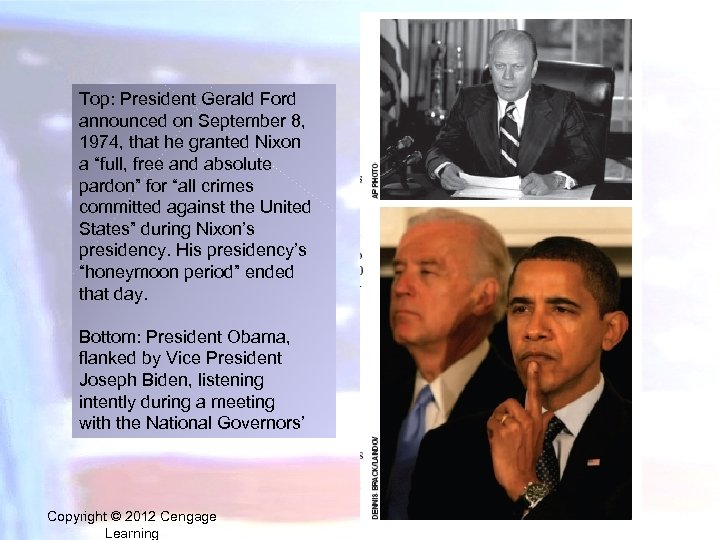 Top: President Gerald Ford announced on September 8, 1974, that he granted Nixon a “full, free and absolute pardon” for “all crimes committed against the United States” during Nixon’s presidency. His presidency’s “honeymoon period” ended that day. Bottom: President Obama, flanked by Vice President Joseph Biden, listening intently during a meeting with the National Governors’ Copyright © 2012 Cengage Learning