 Скачать презентацию CHAPTER 7 THE LABOUR MARKET Blanchard Amighini and
Blanchard - Macroeconomics - Chapter 7.ppt
- Количество слайдов: 35




CHAPTER 7: THE LABOUR MARKET Blanchard, Amighini and Giavazzi, Macroeconomics: A European Perspective , 1 st Edition, © Pearson Education Limited 2010
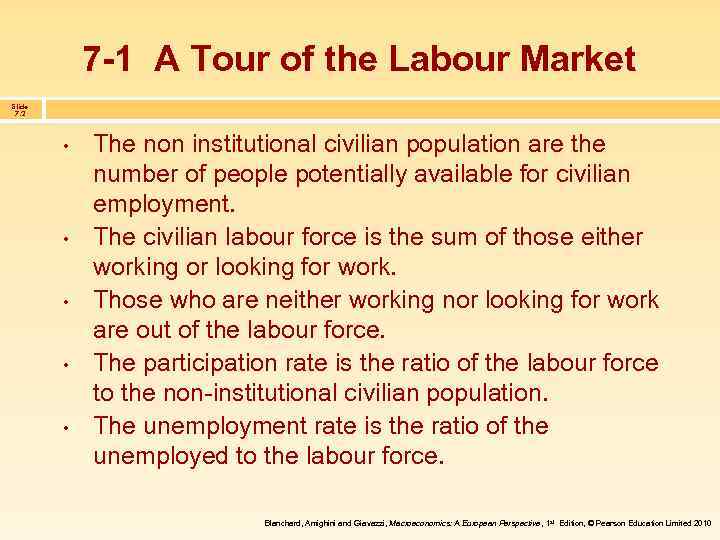
7 -1 A Tour of the Labour Market Slide 7. 2 • • • The non institutional civilian population are the number of people potentially available for civilian employment. The civilian labour force is the sum of those either working or looking for work. Those who are neither working nor looking for work are out of the labour force. The participation rate is the ratio of the labour force to the non-institutional civilian population. The unemployment rate is the ratio of the unemployed to the labour force. Blanchard, Amighini and Giavazzi, Macroeconomics: A European Perspective , 1 st Edition, © Pearson Education Limited 2010
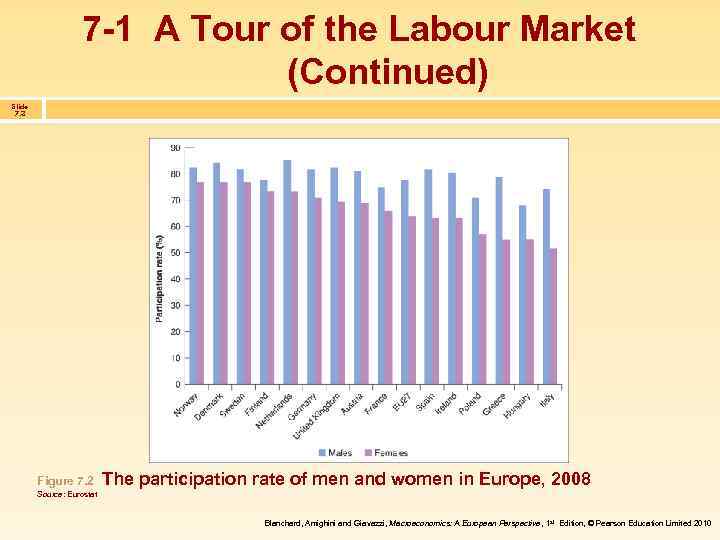
7 -1 A Tour of the Labour Market (Continued) Slide 7. 3 Figure 7. 2 The participation rate of men and women in Europe, 2008 Source: Eurostat Blanchard, Amighini and Giavazzi, Macroeconomics: A European Perspective , 1 st Edition, © Pearson Education Limited 2010
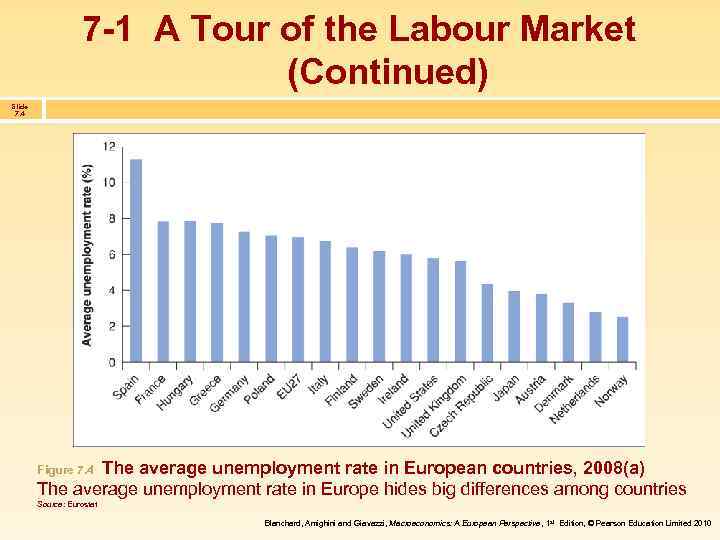
7 -1 A Tour of the Labour Market (Continued) Slide 7. 4 The average unemployment rate in European countries, 2008(a) The average unemployment rate in Europe hides big differences among countries Figure 7. 4 Source: Eurostat Blanchard, Amighini and Giavazzi, Macroeconomics: A European Perspective , 1 st Edition, © Pearson Education Limited 2010
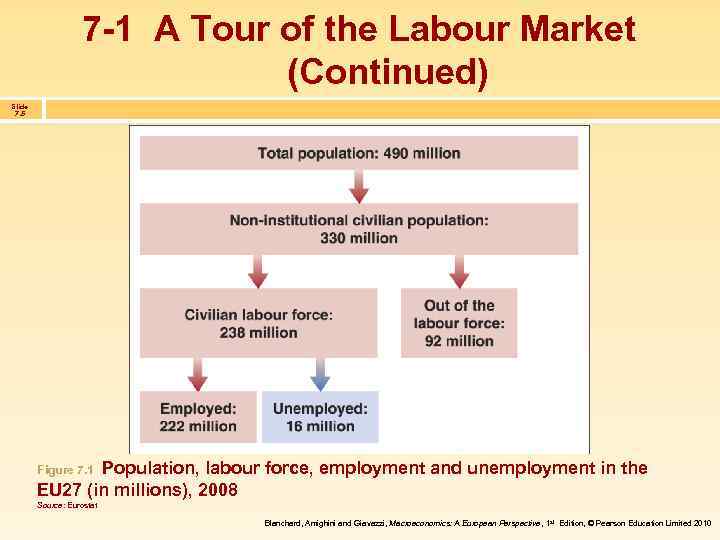
7 -1 A Tour of the Labour Market (Continued) Slide 7. 5 Population, labour force, employment and unemployment in the EU 27 (in millions), 2008 Figure 7. 1 Source: Eurostat Blanchard, Amighini and Giavazzi, Macroeconomics: A European Perspective , 1 st Edition, © Pearson Education Limited 2010
7 -1 A Tour of the Labour Market (Continued) Slide 7. 6 The Large Flows of Workers An unemployment rate may reflect two very different realities. It may reflect an active labour market, with many separations and many hires, or it may reflect a sclerotic labour market, with few separations, few hires and a stagnant unemployment pool. The European Labour Force Survey (EU LFS) produces employment data, including the movements of workers. Blanchard, Amighini and Giavazzi, Macroeconomics: A European Perspective , 1 st Edition, © Pearson Education Limited 2010
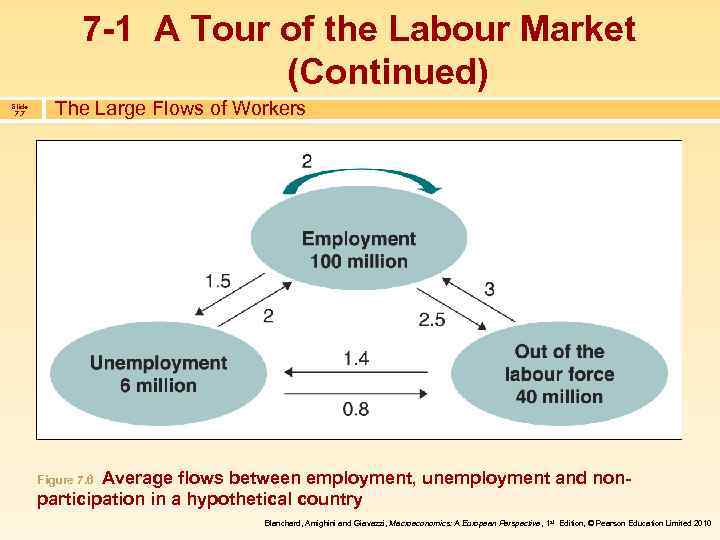
7 -1 A Tour of the Labour Market (Continued) Slide 7. 7 The Large Flows of Workers Average flows between employment, unemployment and nonparticipation in a hypothetical country Figure 7. 6 Blanchard, Amighini and Giavazzi, Macroeconomics: A European Perspective , 1 st Edition, © Pearson Education Limited 2010
7 -1 A Tour of the Labour Market (Continued) Slide 7. 8 The Large Flows of Workers From the EU LFS data we conclude that: • The flows of workers in and out of employment are large. Separations consist of: Quits, or workers leaving their jobs for a better alternative, and layoffs, which come from changes in employment levels across firms. • The flows in and out of unemployment are large in relation to the number of unemployed. The average duration of unemployment is about three months. • There are large flows in and out of the labour force, much of them directly to and from employment. Discouraged workers are classified as “out of the labour force” but they may take a job if they find it. The non-employment rate is the ration of population minus employment to population. Blanchard, Amighini and Giavazzi, Macroeconomics: A European Perspective , 1 st Edition, © Pearson Education Limited 2010
The European Union Labour Force Survey Slide 7. 9 The European Union Labour Force Survey (EU LFS) is a quarterly sample survey covering the population in private households in the EU. In providing data on employment, unemployment and inactivity, the EU LFS is an important source of information about the situation and trends in the labour market in the EU. The quarterly EU LFS also forms the basis for Eurostat’s calculation of monthly unemployment figures. For more on the LFS: (http: //circa. europa. eu/irc/dsis/employment/info/data/eu_lfs/ index. htm). Blanchard, Amighini and Giavazzi, Macroeconomics: A European Perspective , 1 st Edition, © Pearson Education Limited 2010
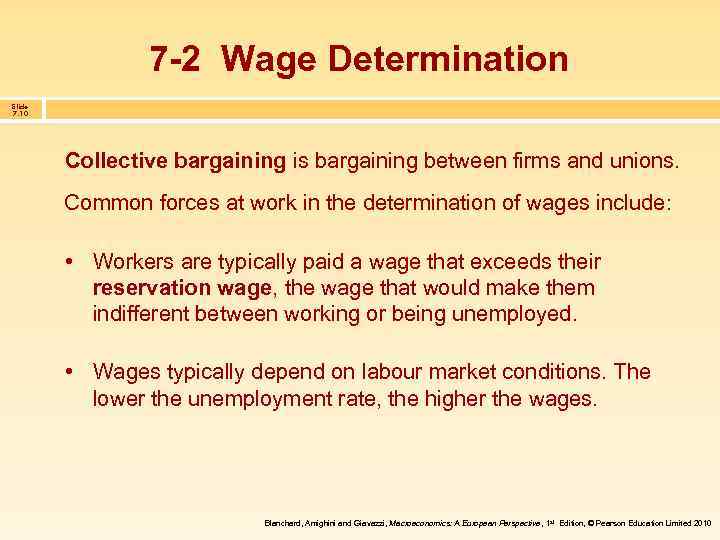
7 -2 Wage Determination Slide 7. 10 Collective bargaining is bargaining between firms and unions. Common forces at work in the determination of wages include: • Workers are typically paid a wage that exceeds their reservation wage, the wage that would make them indifferent between working or being unemployed. • Wages typically depend on labour market conditions. The lower the unemployment rate, the higher the wages. Blanchard, Amighini and Giavazzi, Macroeconomics: A European Perspective , 1 st Edition, © Pearson Education Limited 2010
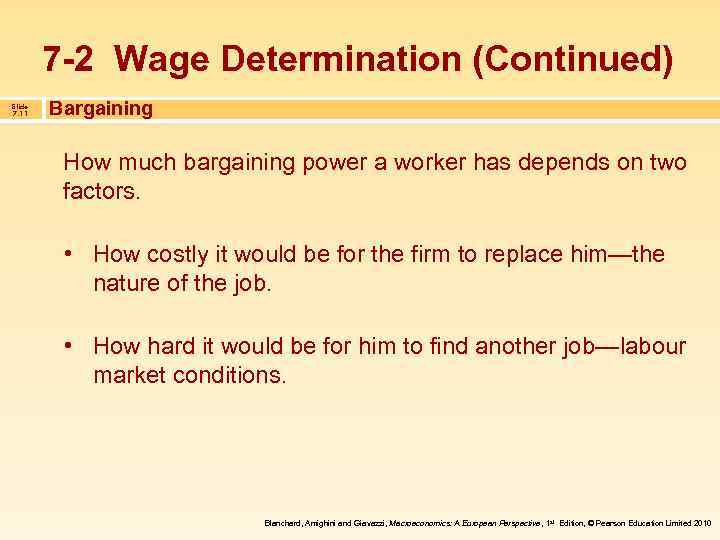
7 -2 Wage Determination (Continued) Slide 7. 11 Bargaining How much bargaining power a worker has depends on two factors. • How costly it would be for the firm to replace him—the nature of the job. • How hard it would be for him to find another job—labour market conditions. Blanchard, Amighini and Giavazzi, Macroeconomics: A European Perspective , 1 st Edition, © Pearson Education Limited 2010
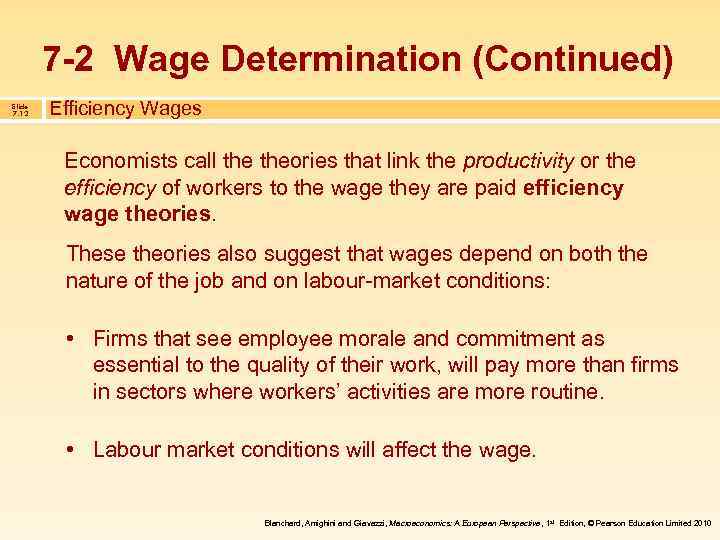
7 -2 Wage Determination (Continued) Slide 7. 12 Efficiency Wages Economists call theories that link the productivity or the efficiency of workers to the wage they are paid efficiency wage theories. These theories also suggest that wages depend on both the nature of the job and on labour-market conditions: • Firms that see employee morale and commitment as essential to the quality of their work, will pay more than firms in sectors where workers’ activities are more routine. • Labour market conditions will affect the wage. Blanchard, Amighini and Giavazzi, Macroeconomics: A European Perspective , 1 st Edition, © Pearson Education Limited 2010
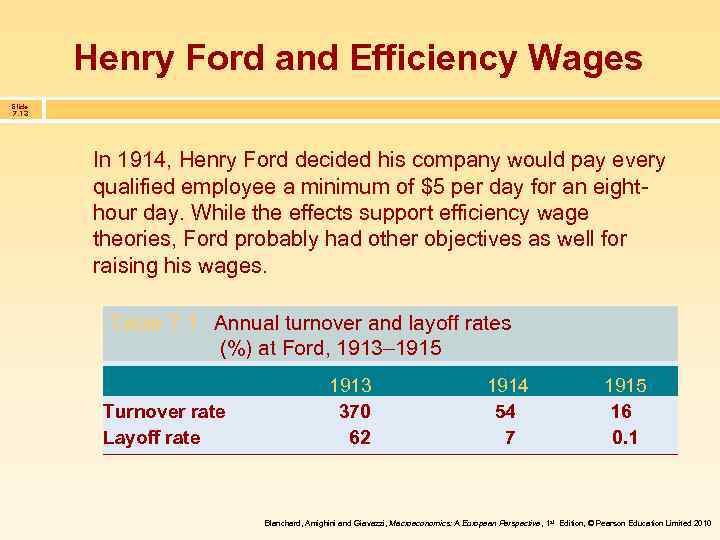
Henry Ford and Efficiency Wages Slide 7. 13 In 1914, Henry Ford decided his company would pay every qualified employee a minimum of $5 per day for an eighthour day. While the effects support efficiency wage theories, Ford probably had other objectives as well for raising his wages. Table 7. 1 Annual turnover and layoff rates (%) at Ford, 1913– 1915 Turnover rate Layoff rate 1913 370 62 1914 54 7 1915 16 0. 1 Blanchard, Amighini and Giavazzi, Macroeconomics: A European Perspective , 1 st Edition, © Pearson Education Limited 2010
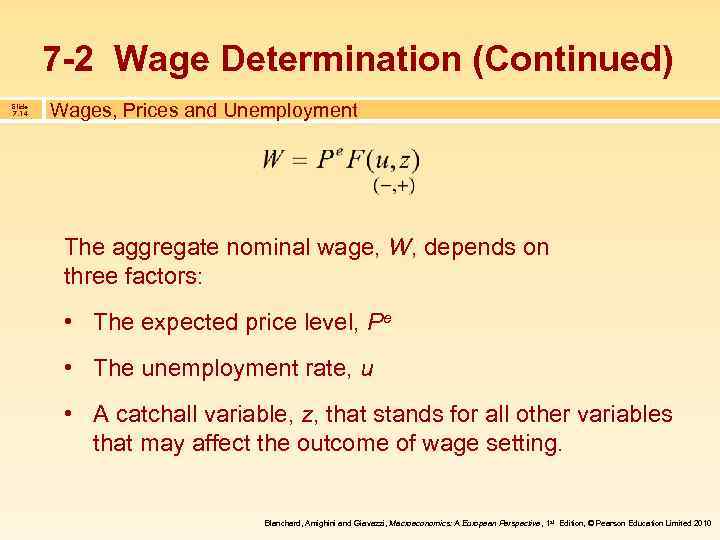
7 -2 Wage Determination (Continued) Slide 7. 14 Wages, Prices and Unemployment The aggregate nominal wage, W, depends on three factors: • The expected price level, Pe • The unemployment rate, u • A catchall variable, z, that stands for all other variables that may affect the outcome of wage setting. Blanchard, Amighini and Giavazzi, Macroeconomics: A European Perspective , 1 st Edition, © Pearson Education Limited 2010
7 -2 Wage Determination (Continued) Slide 7. 15 Wages, Prices and Unemployment The Expected Price Level Both workers and firms care about real wages (W/P), not nominal wages (W). • Workers do not care about how many dollars they receive but about how many goods they can buy with those dollars. They care about W/P. • Firms do not care about the nominal wages they pay but about the nominal wages, W, they pay relative to the price of the goods they sell, P. They also care about W/P. Blanchard, Amighini and Giavazzi, Macroeconomics: A European Perspective , 1 st Edition, © Pearson Education Limited 2010
7 -2 Wage Determination (Continued) Slide 7. 16 Wages, Prices and Unemployment The Unemployment Rate Also affecting the aggregate wage is the unemployment rate, u. If we think of wages as being determined by bargaining, then higher unemployment weakens workers’ bargaining power, forcing them to accept lower wages. Higher unemployment allows firms to pay lower wages and still keep workers willing to work. Blanchard, Amighini and Giavazzi, Macroeconomics: A European Perspective , 1 st Edition, © Pearson Education Limited 2010
7 -2 Wage Determination (Continued) Slide 7. 17 Wages, Prices and Unemployment The Other Factors The third variable, z, is a catchall variable that stands for all the factors that affect wages, given the expected price level and the unemployment rate. Unemployment insurance is the payment of unemployment benefits to workers who lose their jobs. Blanchard, Amighini and Giavazzi, Macroeconomics: A European Perspective , 1 st Edition, © Pearson Education Limited 2010
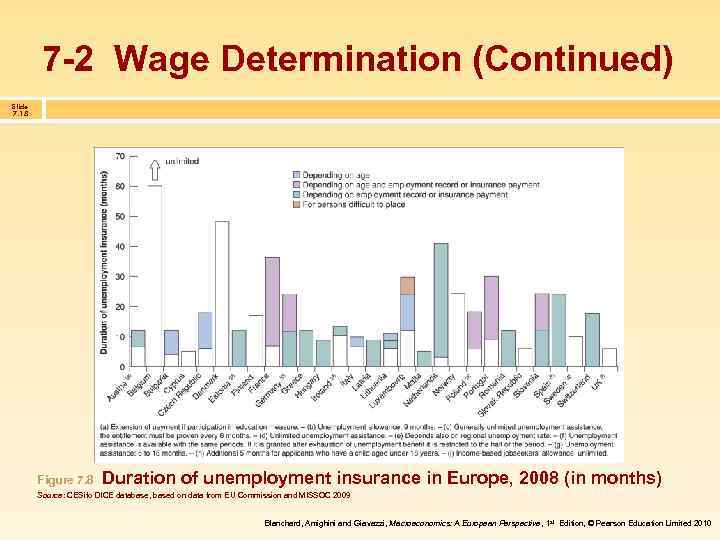
7 -2 Wage Determination (Continued) Slide 7. 18 Figure 7. 8 Duration of unemployment insurance in Europe, 2008 (in months) Source: CESifo DICE database, based on data from EU Commission and MISSOC 2009 Blanchard, Amighini and Giavazzi, Macroeconomics: A European Perspective , 1 st Edition, © Pearson Education Limited 2010
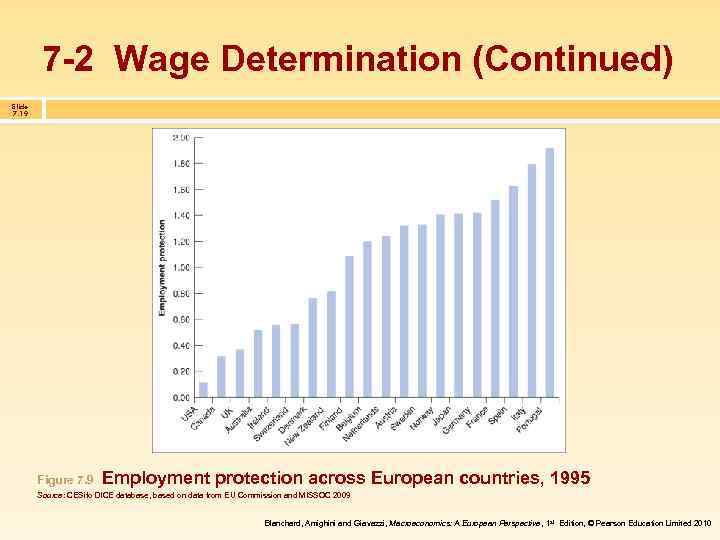
7 -2 Wage Determination (Continued) Slide 7. 19 Figure 7. 9 Employment protection across European countries, 1995 Source: CESifo DICE database, based on data from EU Commission and MISSOC 2009 Blanchard, Amighini and Giavazzi, Macroeconomics: A European Perspective , 1 st Edition, © Pearson Education Limited 2010
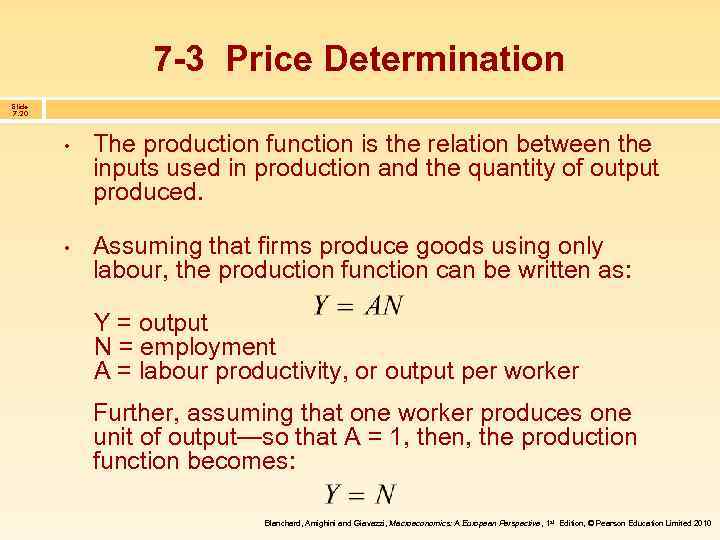
7 -3 Price Determination Slide 7. 20 • • The production function is the relation between the inputs used in production and the quantity of output produced. Assuming that firms produce goods using only labour, the production function can be written as: Y = output N = employment A = labour productivity, or output per worker Further, assuming that one worker produces one unit of output—so that A = 1, then, the production function becomes: Blanchard, Amighini and Giavazzi, Macroeconomics: A European Perspective , 1 st Edition, © Pearson Education Limited 2010
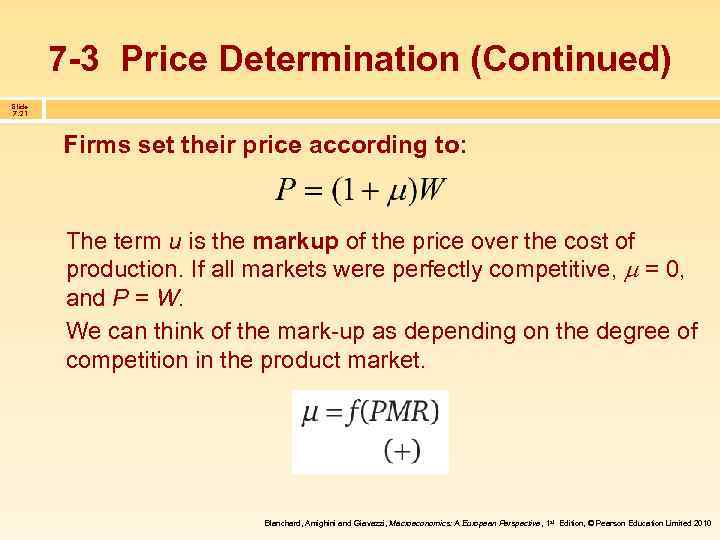
7 -3 Price Determination (Continued) Slide 7. 21 Firms set their price according to: The term u is the markup of the price over the cost of production. If all markets were perfectly competitive, = 0, and P = W. We can think of the mark-up as depending on the degree of competition in the product market. Blanchard, Amighini and Giavazzi, Macroeconomics: A European Perspective , 1 st Edition, © Pearson Education Limited 2010
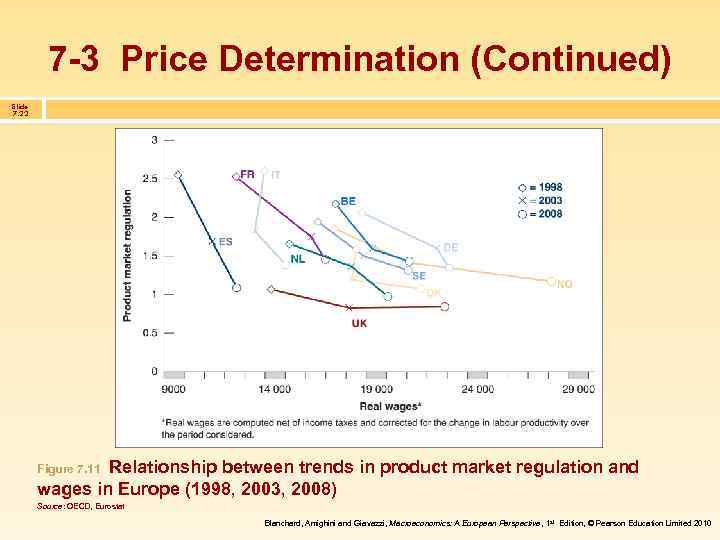
7 -3 Price Determination (Continued) Slide 7. 22 Relationship between trends in product market regulation and wages in Europe (1998, 2003, 2008) Figure 7. 11 Source: OECD, Eurostat Blanchard, Amighini and Giavazzi, Macroeconomics: A European Perspective , 1 st Edition, © Pearson Education Limited 2010
7 -4 The Natural Rate of Unemployment Slide 7. 23 • In this section we will look at the implications of wage and price determination for unemployment. • Let’s assume that nominal wages depend on the actual price level, P, rather than on the expected price level, . • Wage setting and price setting determine the equilibrium rate of unemployment. Blanchard, Amighini and Giavazzi, Macroeconomics: A European Perspective , 1 st Edition, © Pearson Education Limited 2010
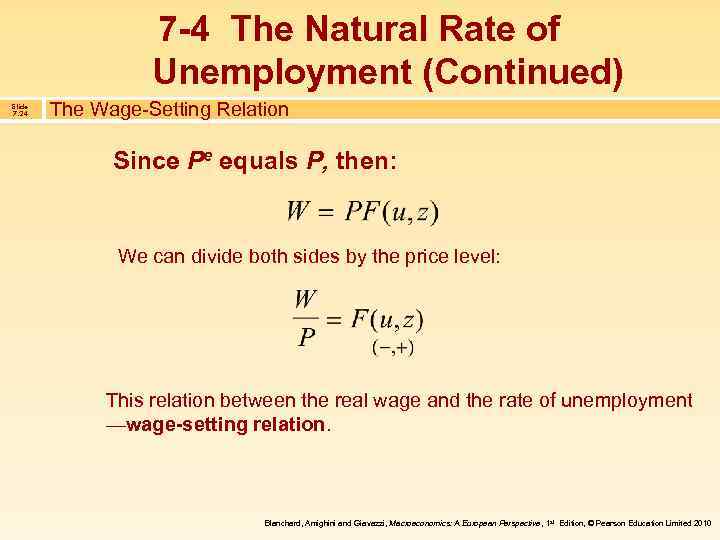
7 -4 The Natural Rate of Unemployment (Continued) Slide 7. 24 The Wage-Setting Relation Since Pe equals P, then: We can divide both sides by the price level: This relation between the real wage and the rate of unemployment —wage-setting relation. Blanchard, Amighini and Giavazzi, Macroeconomics: A European Perspective , 1 st Edition, © Pearson Education Limited 2010
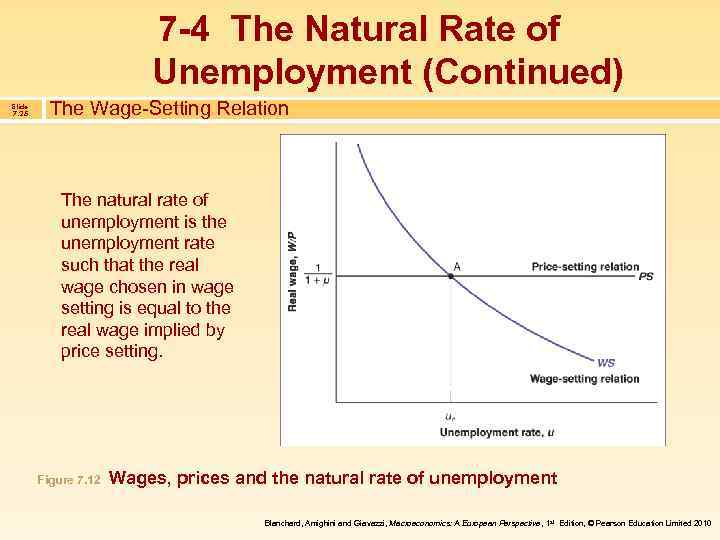
7 -4 The Natural Rate of Unemployment (Continued) Slide 7. 25 The Wage-Setting Relation The natural rate of unemployment is the unemployment rate such that the real wage chosen in wage setting is equal to the real wage implied by price setting. Figure 7. 12 Wages, prices and the natural rate of unemployment Blanchard, Amighini and Giavazzi, Macroeconomics: A European Perspective , 1 st Edition, © Pearson Education Limited 2010
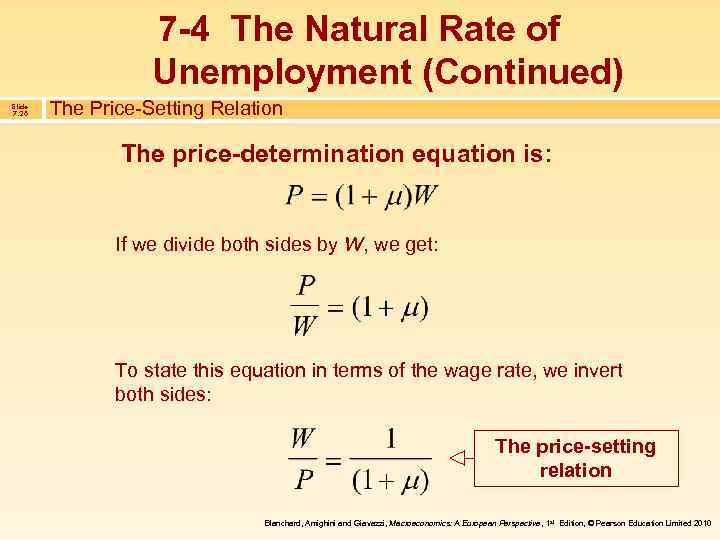
7 -4 The Natural Rate of Unemployment (Continued) Slide 7. 26 The Price-Setting Relation The price-determination equation is: If we divide both sides by W, we get: To state this equation in terms of the wage rate, we invert both sides: The price-setting relation Blanchard, Amighini and Giavazzi, Macroeconomics: A European Perspective , 1 st Edition, © Pearson Education Limited 2010
7 -4 The Natural Rate of Unemployment (Continued) Slide 7. 27 The Price-Setting Relation • • The price-setting relation in equation (7. 6) is drawn as the horizontal line PS (for price setting) in Figure 7. 6. The real wage implied by price setting is 1/(1 = µ); it does not depend on the unemployment rate. Blanchard, Amighini and Giavazzi, Macroeconomics: A European Perspective , 1 st Edition, © Pearson Education Limited 2010
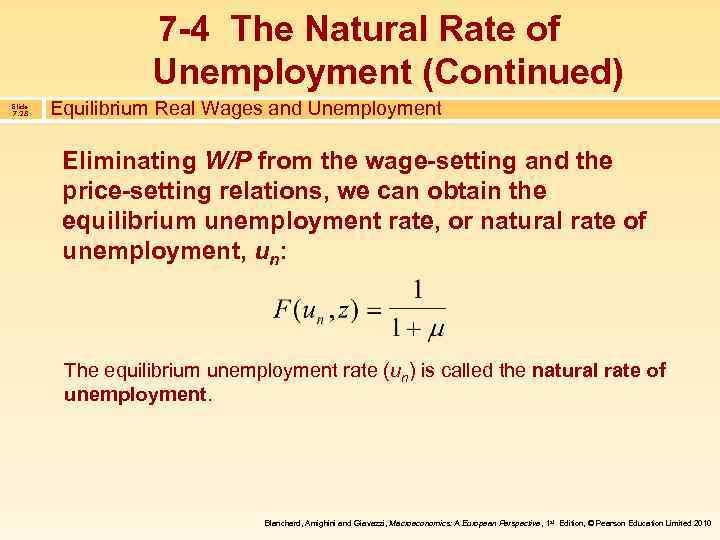
7 -4 The Natural Rate of Unemployment (Continued) Slide 7. 28 Equilibrium Real Wages and Unemployment Eliminating W/P from the wage-setting and the price-setting relations, we can obtain the equilibrium unemployment rate, or natural rate of unemployment, un: The equilibrium unemployment rate (un) is called the natural rate of unemployment. Blanchard, Amighini and Giavazzi, Macroeconomics: A European Perspective , 1 st Edition, © Pearson Education Limited 2010
7 -4 The Natural Rate of Unemployment (Continued) Slide 7. 29 Equilibrium real wages and unemployment The positions of the wage-setting and price-setting curves, and thus the equilibrium unemployment rate, depend on both z and μ. • At a given unemployment rate, higher unemployment benefits lead to a higher real wage. A higher unemployment rate is needed to bring the real wage back to what firms are willing to pay. • By letting firms increase their prices given the wage, less stringent enforcement of antitrust legislation leads to a decrease in the real wage. Blanchard, Amighini and Giavazzi, Macroeconomics: A European Perspective , 1 st Edition, © Pearson Education Limited 2010
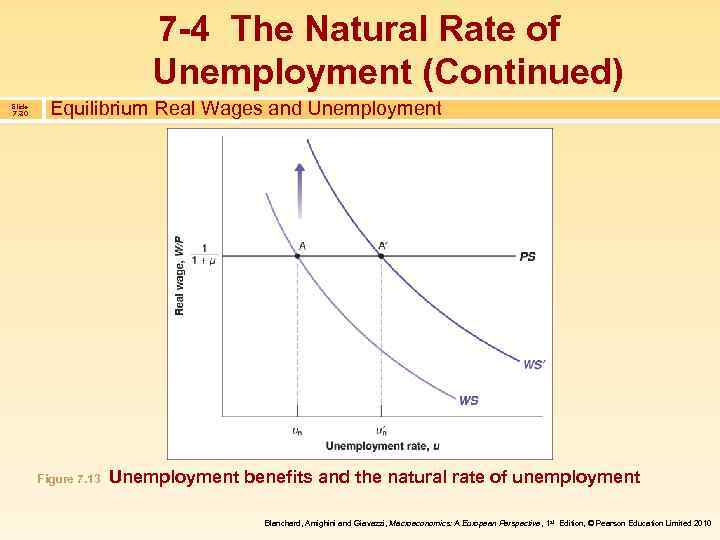
7 -4 The Natural Rate of Unemployment (Continued) Slide 7. 30 Equilibrium Real Wages and Unemployment Figure 7. 13 Unemployment benefits and the natural rate of unemployment Blanchard, Amighini and Giavazzi, Macroeconomics: A European Perspective , 1 st Edition, © Pearson Education Limited 2010
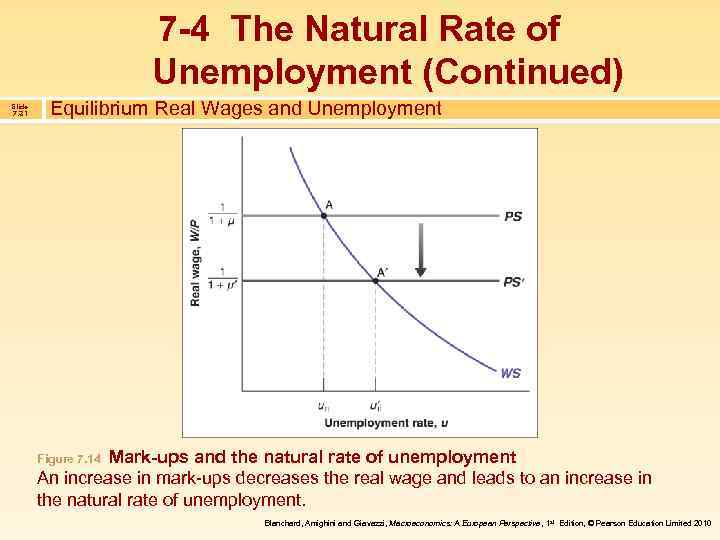
7 -4 The Natural Rate of Unemployment (Continued) Slide 7. 31 Equilibrium Real Wages and Unemployment Mark-ups and the natural rate of unemployment An increase in mark-ups decreases the real wage and leads to an increase in the natural rate of unemployment. Figure 7. 14 Blanchard, Amighini and Giavazzi, Macroeconomics: A European Perspective , 1 st Edition, © Pearson Education Limited 2010
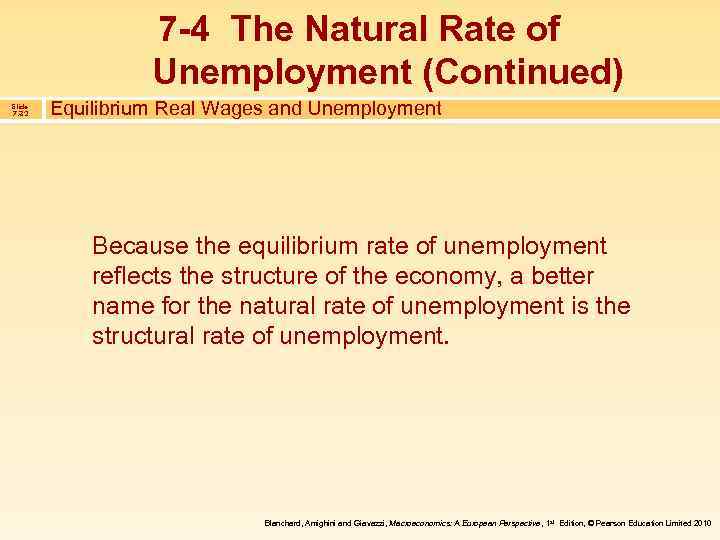
7 -4 The Natural Rate of Unemployment (Continued) Slide 7. 32 Equilibrium Real Wages and Unemployment Because the equilibrium rate of unemployment reflects the structure of the economy, a better name for the natural rate of unemployment is the structural rate of unemployment. Blanchard, Amighini and Giavazzi, Macroeconomics: A European Perspective , 1 st Edition, © Pearson Education Limited 2010
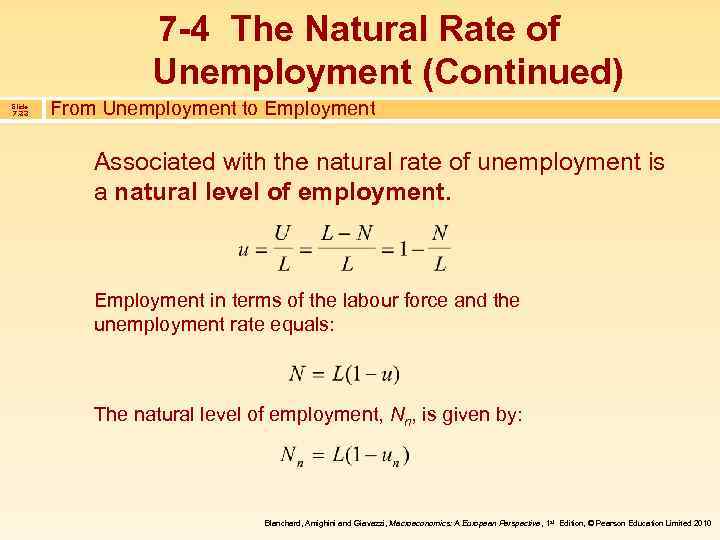
7 -4 The Natural Rate of Unemployment (Continued) Slide 7. 33 From Unemployment to Employment Associated with the natural rate of unemployment is a natural level of employment. Employment in terms of the labour force and the unemployment rate equals: The natural level of employment, Nn, is given by: Blanchard, Amighini and Giavazzi, Macroeconomics: A European Perspective , 1 st Edition, © Pearson Education Limited 2010
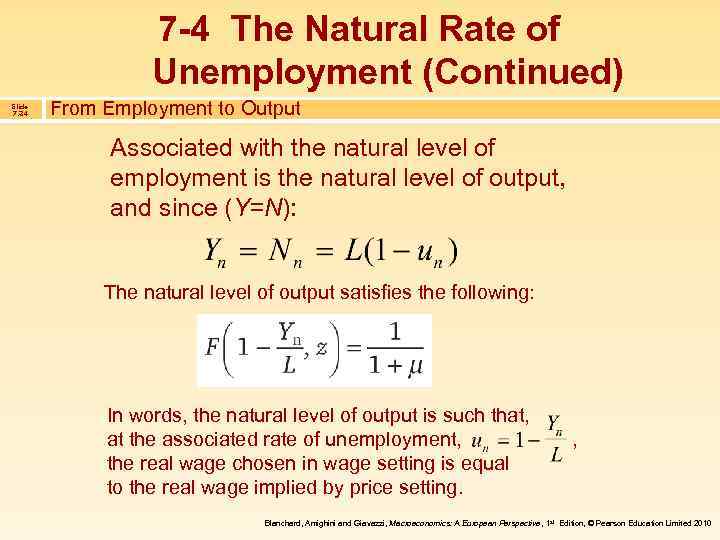
7 -4 The Natural Rate of Unemployment (Continued) Slide 7. 34 From Employment to Output Associated with the natural level of employment is the natural level of output, and since (Y=N): The natural level of output satisfies the following: In words, the natural level of output is such that, at the associated rate of unemployment, the real wage chosen in wage setting is equal to the real wage implied by price setting. , Blanchard, Amighini and Giavazzi, Macroeconomics: A European Perspective , 1 st Edition, © Pearson Education Limited 2010
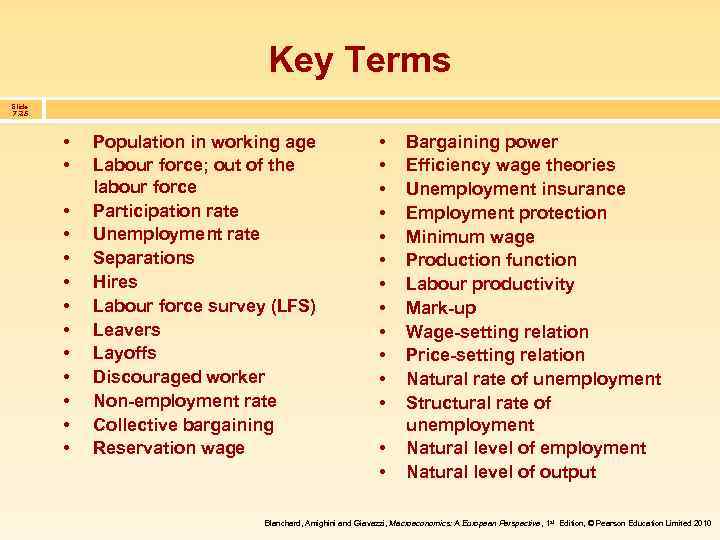
Key Terms Slide 7. 35 • • • • Population in working age Labour force; out of the labour force Participation rate Unemployment rate Separations Hires Labour force survey (LFS) Leavers Layoffs Discouraged worker Non-employment rate Collective bargaining Reservation wage • • • • Bargaining power Efficiency wage theories Unemployment insurance Employment protection Minimum wage Production function Labour productivity Mark-up Wage-setting relation Price-setting relation Natural rate of unemployment Structural rate of unemployment Natural level of output Blanchard, Amighini and Giavazzi, Macroeconomics: A European Perspective , 1 st Edition, © Pearson Education Limited 2010
Скачать презентацию CHAPTER 7 THE LABOUR MARKET Blanchard Amighini and
Blanchard - Macroeconomics - Chapter 7.ppt