


 Скачать презентацию Chapter 7 The Church Transmits God s Revelation FAITH
97abe257071711268f62f8b5e788e23b.ppt
- Количество слайдов: 89
 Chapter 7: The Church Transmits God’s Revelation FAITH AND REVELATION
 1. Christ After the Resurrection BASIC QUESTIONS In what sense has the Church been in existence from the beginning? Why does the Church have the power to forgive sins? What did Christ’s appearance to St. Thomas reveal? What did Christ’s appearance on the road to Emmaus reveal? What did Christ’s appearance on the shore of Lake Galilee reveal? KEY IDEAS The Church, as a human family living in communion with God and one another, has been present in a hidden way from the beginning. Christ gave his disciples his divine power to forgive sins. Christ’s appearance to St. Thomas confirms both the necessity of faith and his physical Resurrection. His appearance on the Road to Emmaus revealed that Christ fulfilled the Messianic prophesies of the Old Testament. Christ confirmed St. Peter’s authority as chief shepherd of his Church when he appeared to the Apostles in Galilee.
 1. Christ After the Resurrection Anticipatory Set Read Christ’s appearance on the Road to Emmaus (Lk 24: 13– 32), and then discuss the following questions: Why do you think the two disciples did not recognize Christ? How did the two disciples unconsciously know their companion was Christ even before they knew it with certainty? What message did Christ teach the two disciples?
 1. Christ After the Resurrection What are the two beginning points of the Church ’s history? They are Pentecost and the moment of creation. Why is the moment of creation, properly speaking, the beginning of the Chur God’s original intent—by creating Adam and Eve in his image—was a family of men and women living in communion with their Creator and with each other. This is the self-same nature of the Church. What destroyed this original plan? Original Sin destroyed it. What is the essence of both the Old and the New Testaments? The Old Testament reveals how God worked to restore the communion between himself and human beings. The New Testament reveals the ultimate act of restoration through Christ’s Sacrifice on the Cross, his Resurrection, and the gift of the Holy Spirit at Pentecost.
 1. Christ After the Resurrection Just before his Ascension, what did Christ instruct his disciples to do? He commissioned them to continue his ministry on earth. Why would the Apostles naturally be overwhelmed with their task? There were eleven of them, and they were mostly uneducated. Their leader had been mocked, tortured, and crucified by both the religious and political authorities. What assistance did Christ promise his Apostles? He promised them the Holy Spirit, who would “teach you all things, and bring to your remembrance all that I have said to you. ”
 1. Christ After the Resurrection Guided Exercise Complete a paragraph shrink on the two paragraphs beginning, “Meditating on this truth, ” and “The eminent fourth-century historian. ”
 1. Christ After the Resurrection JESUS BESTOWS HIS AUTHORITY ON THE APOSTLES What power did Christ give his Apostles on the night of his Resurrection? He gave them the power to forgive sins. How was the Apostles’ power to forgive sins an extension of God’s power to forgive s Only God has the power to forgive sins. Christ, being God, exercised this power during his public ministry. Christ gave his Apostles—and they to their successors— this divine power. DOUBTING THOMAS What does the story of “Doubting Thomas” reveal? First, it reveals that faith is necessary to grasp the reality of Christ’s Resurrection. Second, it reveals that the Resurrection was not an allegorical story or a symbolic representation of a transformation that took place within the Apostles: Jesus Christ rose bodily from the dead, bearing the marks of his Crucifixion.
 1. Christ After the Resurrection Guided Exercise Complete a Think/Pair/Share on the following question: Christ said to St. Thomas, “Have you have believed because you have seen me? Blessed are those who have not seen and yet believe” (Jn 20: 29). How do those words apply to us today?
 1. Christ After the Resurrection THE ROAD TO EMMAUS: JESUS REVEALED IN THE EUCHARIST What did the risen Christ explain to the two disciples on the road to Emm Christ illumined the Scriptures, showing how the history of Revelation pointed toward the events that had just taken place in Jerusalem. Christ was the fulfillment of all the covenants and the hope for mankind. When did the two disciples recognize their companion was Christ? They recognized him as he broke and blessed the bread and wine when they sat down for a meal. What was the meaning of “the breaking of the bread” in the early Church It meant the celebration of the Eucharist, the Mass.
 1. Christ After the Resurrection ST. PETER’S REDEMPTION IN GALILEE Why might the Apostles have been surprised that Christ told them to return to Galilee? They were then in Jerusalem, the capital of Israel, and many were expecting Christ to reestablish the independent, temporal Kingdom of Israel immediately, whereas Galilee was an out-of-the-way place. What prophecy was fulfilled by the Apostles’ return to Galilee? Isaiah foretold that Galilee would be the place where the restoration of the Kingdom of Israel would begin: “In the latter time [God] will make glorious the way of the sea, the land beyond the Jordan, Galilee of the nations” (Is 9: 1). What did the miraculous catch of 153 fish symbolize? Greek naturalists had identified 153 different kinds of fish in the world. Symbolically, the Apostles had caught every kind of fish. Since Christ had called the Apostles to be “fishers of men, ” this implied the Apostles, with Christ’s help, would win converts from every
 1. Christ After the Resurrection Why did Christ ask St. Peter three times if he loved him? By the charcoal fire on the shore of Lake of Galilee, Christ gave St. Peter the opportunity to reverse his threefold denial of Christ by the charcoal fire in the courtyard in Jerusalem. What vocation did Christ reconfirm in St. Peter? St. Peter was to be the shepherd who would tend Christ’s “lambs, ” that is, all believers. In other words, Christ was repeating his invitation to St. Peter to be the rock upon which he would build his Church.
 1. Christ After the Resurrection Closure Write a paragraph summarizing what the Apostles learned from Christ’s appearances after the Resurrection.
 1. Christ After the Resurrection Homework Assignment Reading RESTORING THE KINGDOM through THE RIDDLE. Study Questions 1– 6. Practical Exercises 1– 2, 4. Workbook Questions 1– 8.
 1. Christ After the Resurrection Alternative Assessment Read silently Christ’s appearance to St. Mary Magdalene (Jn 20: 1– 18), and then free write for five minutes about what this passage reveals.
 2. Pentecost BASIC QUESTIONS What did Christ do during the forty days he appeared to his Apostles after his Resurrection? Why did the Apostles replace Judas? What is Pentecost? What was the message of St. Peter’s first sermon at Pentecost? What is the answer to the riddle, “How can David’s son be David’s Lord? KEY IDEAS Christ taught his disciples about the Kingdom of God during the forty days after his Resurrection and before his Ascension. The disciples waited in Jerusalem for the Holy Spirit. The Apostles elected St. Matthias to replace Judas, which restored their number to twelve. On Pentecost the Apostles were filled with the Holy Spirit. St. Peter’s first sermon showed that Christ, the very person that his audience had a hand in crucifying, was raised from the dead, fulfilling the prophecy that God would neither abandon his soul to Hades nor let his Holy One see corruption. David called the Messiah both his son and his Lord because Christ was a descendant of David, thus his son, and the preexisting Son of God, thus David’s Lord.
 2. Pentecost Anticipatory Set Read silently about the Ascension of Christ and the election of St. Matthias (Acts 1).
 2. Pentecost RESTORING THE KINGDOM What prophecy of St. John the Baptist had Christ not yet fulfilled? He was to baptize with the Holy Spirit and with fire. What did Christ say the Apostles’ ministry will be? After having received the Holy Spirit, they would be Christ’s universal witnesses. What does the phrase, “in Jerusalem and in all Judea and Samaria and to the end of the earth, ” It describes the restored Davidic Kingdom: the center at Jerusalem, then Judea (that which was left after the division between Israel and Judah), Samaria (the lost kingdom of Israel), and the ends of the earth (all the Gentile nations). According to the Catechism no. 1546, what is the nature of the common priesthood of all believers The Church is a kingdom of priests. Every baptized person participates in Christ’s priesthood according to his or her own vocation.
 2. Pentecost How does the New Kingdom differ from David’s kingdom? David’s was a temporal empire, whereas the Church encompasses all nations and times with Christ reigning from Heaven, guiding his ministers to handle the earthly affairs of the kingdom. How did Christ spend the time between his Resurrection and his Ascensi He prepared the Apostles for their ministry as he had spent forty days in the desert preparing for his own. Why did Christ instruct the Apostles to remain in Jerusalem? They were to await the coming baptism of the Holy Spirit.
 2. Pentecost Guided Exercise Free write for a few minutes on how Zechariah’s prophecy (Zec 2: 11– 12) has been fulfilled in the Church.
 2. Pentecost THE ELECTION OF ST. MATTHIAS On what authority did St. Peter decide the Church needed to choose a succes Judas? Christ had told St. Peter to “feed his sheep, ” that is, to be the chief shepherd of the Church. Why was it important that there be twelve Apostles? St. Peter understood the choice of the Twelve was significant: a symbol of the Twelve Tribes of Israel. Appointed by Christ to be the leader of the Apostles and of the Christian community, he decided it was necessary to replace Judas before the restoration of the kingdom began. What criteria were used to choose the successor of Judas? Judas’s replacement had to have been with Christ from his Baptism until the Ascension so he could be an eyewitness to the Resurrection.
 2. Pentecost Guided Exercise Complete a Focused Reading of the paragraph beginning, “In Greek, ” using the following question: In the Church, what is the connection between the words office and bishop?
 2. Pentecost PENTECOST What does Pentecost mean, and what did the Jews celebrate at this feast? Pentecost comes from the Greek for “fiftieth”; it is the fiftieth day after Passover and the feast on which the Jews celebrated the giving of the Law to Moses on Mt. Sinai. In what sense was Pentecost an international event? Jews from all over the world gathered in Jerusalem to celebrate this festival. What two similes did St. Luke use to describe the descent of the Holy Spi There was a sound like the rush of a mighty wind, and tongues as of fire appeared.
 2. Pentecost How did the assembled Jews from the various nations react to the Apostle speaking in various languages? They were amazed, although some thought they might have been drunk. What was St. Peter’s message to the crowds in Jerusalem? Christ and the events unfolding before their eyes fulfilled the covenants and inaugurated the restoration of the Kingdom of Israel. They were seeing what the prophet Joel had foretold: the Spirit of God poured out on everyone.
 2. Pentecost THE RIDDLE: HOW CAN DAVID’S SON BE DAVID’S LORD? What does the question, “How can David’s son be David’s Lord? ” mean w applied to Christ? How can Christ be both the Son of God and the Son of David? If Christ is truly divine, how could he also have been born of a woman? Why is it understandable that Christ asked people this riddle during his publ ministry? It is at the core of who the Messiah is: a Son of David and the Son of God. Was this question ever answered in the Gospels? No.
 2. Pentecost Who answered this riddle? St. Peter, at Pentecost, inspired by the Holy Spirit, answered it. What challenges did St. Peter face with his audience during his sermon at Some mocked the Apostles, saying they were drunk; others had earlier turned against Christ and demanded his Crucifixion; still others looked down on the Apostles because they were from Galilee. What approach did St. Peter adopt to persuade the crowd? He appealed to their understanding of the Scriptures and showed how Christ had fulfilled them.
 2. Pentecost How did St. Peter explain the behavior of the disciples at Pentecost? He explained that the prophesy of Joel has been fulfilled: these are the last days in which God was pouring out his Spirit on ordinary sons and daughters of Israel. What was the point of Christ’s miracles according to St. Peter? They were evidence—which many in St. Peter’s audience had personally witnessed or heard about from others—that Jesus is the Messiah sent to them by God. According to St. Peter, how does Psalm 16 prophesy that the Messiah would rise from “Thou wilt not let thy Holy One see corruption” (Acts 13: 35; cf. Ps 16: 10). According to St. Peter, why did David call his son “my Lord”? The Son of David is also the Son of God; he entered history to accomplish the work of salvation, and now he lives and reigns at the right hand of God the Father.
 2. Pentecost Guided Exercise Perform a paragraph shrink on the paragraph beginning, “Jesus, being of both human and divine natures. ”
 2. Pentecost Closure Write a paragraph summarizing the message of St. Peter’s Pentecost sermon.
 2. Pentecost Homework Assignment Reading ST. PETER’S AUTHORITY through ST. PHILIP BAPTIZES THE ETHIOPIAN Study Questions 7– 13. Practical Exercise 3 & 7. Workbook Questions 9– 16.
 2. Pentecost Alternative Assessment Free write for five minutes on how Christ gave new meaning to the Jewish feast of Pentecost as he had done for the Passover.
 3. The Primitive Church BASIC QUESTIONS What did the primitive Church do? Who was St. Stephen? How did the early Church worship? Who was the Ethiopian eunuch, and why was he important? KEY IDEAS The primitive Church grew quickly under St. Peter’s leadership and devoted herself to preaching, the Eucharist and prayers, and caring for one another. After he had been arrested and brought before the Sanhedrin, St. Stephen the deacon delivered a courageous but inflammatory summary of Jewish history. Accused of blasphemy, St. Stephen was stoned to death: the first martyr. The primitive Church worshiped in the synagogue publicly on the Sabbath and then celebrated the Eucharist in their homes privately on Sunday. Led by the Holy Spirit, St. Philip showed the Ethiopian eunuch that Jesus was the fulfillment of the Scriptures (Old Testament). When he asked for Baptism, the Apostle complied. The Ethiopian, who was barred from Judaism because he could not be circumcised, was the first Gentile convert baptized into the Church.
 3. The Primitive Church Anticipatory Set Perform a focused reading of Catechism, no. 781 (cf. FROM THE CATECHISM at the end of the chapter), using the following question: In what particular way does God desire that his universal salvific will be carried out?
 3. The Primitive Church ST. PETER’S AUTHORITY How did St. Peter show his authority on Pentecost? He preached to the crowd and urged them to repent, believe, and be baptized. About 3000 were baptized that day. What did the followers of Christ do during the days after Pentecost? “They devoted themselves to the Apostles’ teaching and fellowship, to the breaking of bread, and the prayers” (Acts 2: 42). They listened to the Apostles’ preaching, took part in the Eucharist, and prayed. They shared their belongings with each other and the poor. Who spoke for the Church when the Apostles were arrested by the Sanhed St. Peter. Why were the Sanhedrin forced to release the Apostles? Had they arrested the Twelve, they feared a riot.
 3. The Primitive Church Guided Exercise Work with a partner to brainstorm reasons why many of the early conversions were relatively easy to achieve.
 3. The Primitive Church THE MARTYRDOM OF ST. STEPHEN What is “The Way”? It was what the early Church called herself. What is a deacon? He is a man the Apostles ordained to assist in the day-to-day activities of the Church. Extension: Deacon comes from the Greek for “servant. ” Why did St. Stephen come to the attention of the Jewish authorities? He worked miracles and was a dynamic speaker.
 3. The Primitive Church What was the subject of St. Stephen’s preaching before the chief priests? He explained how the coming of Christ had been prophesied throughout the Scriptures (Old Testament). Why did the court declare St. Stephen had committed blasphemy? He said he was having a vision and saw Christ standing at the right hand of God. Extension: This was a problem for the Sanhedrin because St. Stephen was saying that Jesus, whom they had condemned to death, was God’s Anointed (Messiah, or Christ). What did the authorities do to St. Stephen? They stoned him to death; thus, he is the first Christian martyr.
 3. The Primitive Church Guided Exercise Complete a Think/Pair/Write/Share using the following question: What was the effect of the persecution that the Jewish authorities had launched against the Church?
 3. The Primitive Church EARLY CHRISTIAN WORSHIP What did the early Christians consider their place in Judaism? They considered themselves Jews who kept the Sabbath and followed Jewish Law, the only difference being that they recognized the Messiah. How did the early Christians worship? They worshiped at the synagogue publicly on the Sabbath and celebrated the Eucharist in their homes privately on Sunday. What does it mean to say the synagogue and Temple are united in the Christ The first part of the Mass, the Liturgy of the Word, is drawn from the synagogue liturgy with its scriptural readings and prayers. The second part of the Mass, the Liturgy of the Eucharist, developed from the Temple liturgy of the thank offering and the Passover as Christ celebrated it at the Last Supper.
 3. The Primitive Church ST. PHILIP BAPTIZES THE ETHIOPIAN Who was the first Gentile to whom an Apostle preached? St. Philip preached to an Ethiopian eunuch. Why did St. Philip preach to him? He was sent by an angel. Why was it not surprising that the eunuch was reading the prophesy of Is Since the time of Solomon, there had been a Jewish presence in Ethiopia, and, as a result, there were a good number of converts to the Jewish faith living there.
 3. The Primitive Church Why could the Ethiopian eunuch not have become a Jew? According to Deuteronomy 23: 1, a eunuch could not be part of the Jewish community because he could not have been circumcised. What did Isaiah promise to pious eunuchs? God promised they would one day be more important to him than sons and daughters. Extension: This is fulfilled by those who make themselves eunuchs for the sake of the Kingdom of God, that is, accept the vocation to celibacy. What was an effective argument used by the early Christians to gain conv They showed how Christ fulfilled the Scriptures. What was the significance of the Baptism of the Ethiopian eunuch? He was the first Gentile baptized a Christian, bypassing Judaism. This was a sign that the Gospel is for everyone. Extension: Ethiopia was the farthest part of the known world.
 3. The Primitive Church Closure Write a paragraph arguing the Baptism of the Ethiopian eunuch showed that the Church is for every person on earth without distinction.
 3. The Primitive Church Homework Assignment Reading SAUL THE PERSECUTOR through THE COUNCIL OF JERUSALEM. Study Questions 14– 19. Practical Exercise 8. Workbook Questions 17– 25.
 3. The Primitive Church Alternative Assessment Work with a partner to complete Practical Exercise 8 about St. Stephen and the effect of martyrs.
 4. Saul and the Conversion of the Gentiles BASIC QUESTIONS Who was Saul? What is the significance of the conversion of Cornelius? What is the significance of the Council of Jerusalem? KEY IDEAS Saul was a zealous Jew who persecuted the primitive Church until Christ appeared to him personally and made him an Apostle. God revealed to St. Peter that the proselyte Cornelius and all his household should be baptized without becoming Jews first. At the Council of Jerusalem, St. Peter’s decision that Gentile converts did not have to follow the Mosaic Law was accepted by the Church.
 4. Saul and the Conversion of the Gentiles Anticipatory Set Conduct a Think/Pair/Share on the following questions: Do you think the Apostles imagined soon everyone in the world would be living the Mosaic Law and making pilgrimages to the Temple? Why might they have assumed this?
 4. Saul and the Conversion of the Gentiles SAUL THE PERSECUTOR Who was Saul? He was an educated Jew and Roman citizen who was zealous for the Mosaic Law and willing to go to any length to curb abuses of it. Why did Saul lead the persecution of the early Church? The new practices and teachings being introduced by the believers of Christ must have seemed an abomination to him.
 4. Saul and the Conversion of the Gentiles SAUL’S CONVERSION What did Christ mean when he said to Saul, “Why do you persecute me? ” Saul was persecuting the Church, the Mystical Body of Christ. Therefore, he was persecuting Christ himself. Why did Ananias argue with Christ? He was afraid to go to Saul because he was a mortal danger to Christians. Why were Christians in Jerusalem reluctant to bring St. Paul to the Apostl They had a hard time believing Saul had really converted to Christ.
 4. Saul and the Conversion of the Gentiles ARE CHRISTIANS BOUND BY THE MOSAIC LAW? What was the basic question the Church had to answer with respect to Gentiles? Did a Gentile have to become a Jew first before he could become a Christian? Who was Cornelius? He was a Roman commander and a proselyte of the gate. What did the voice in the “kill and eat” vision mean by the command, “What God ha cleansed, you must not call unclean”? First, all foods are clean, that is, may be eaten; this is a departure from Jewish dietary regulations. Second, if a man has been cleaned by Baptism, he is acceptable to God. How did St. Peter know Cornelius and his household should be baptized? They had received the gift of the Holy Spirit, and this convinced St. Peter that they had the right to be baptized. Extension: Cornelius and his household received the Holy Spirit before they were baptized.
 4. Saul and the Conversion of the Gentiles THE COUNCIL OF JERUSALEM Where did Sts. Paul and Barnabas go? They traveled to Antioch, preached Christ, and won many Gentile converts. What was the first name used to describe followers of Christ, and what new name did they Antioch? They called their religion “The Way. ” In Antioch they were called Christians for the first time. What did the Jewish Christians who came to Antioch claim? They told the Gentile converts they could not be saved unless they were circumcised and followed the Law of Moses. How did St. Paul correct St. Peter? When these Jewish Christians appeared, St. Peter withdrew from eating with the Gentile Christians. St. Paul confronted St. Peter publicly, arguing, “If you, though a Jew, live like a Gentile and not like a Jew, how can you compel the Gentiles to live like Jews? ” (Gal 2: 14)
 4. Saul and the Conversion of the Gentiles When was the Council of Jerusalem? It was held about AD 50. What position did St. Peter take during the council? Both Jewish and Gentile converts to Christianity are saved by grace and not by following the Mosaic Law. Therefore, Gentile converts should not be burdened with Jewish customs and laws. Why was it remarkable that St. James should support St. Peter? It was remarkable someone who loved and followed the Mosaic Law so perfectly would be so detached as not to impose it on others.
 4. Saul and the Conversion of the Gentiles Guided Exercise Work with a partner to write the points St. Peter makes in Acts 15: 7– 11.
 4. Saul and the Conversion of the Gentiles Guided Exercise Work with a partner to answer Practical Exercise 9 about the Church’s decision in the Council of Jerusalem as a fulfillment of Mosaic Law.
 4. Saul and the Conversion of the Gentiles Closure Write a paragraph summarizing the significance of the Council of Jerusalem.
 4. Saul and the Conversion of the Gentiles Homework Assignment Reading WHAT JESUS TAUGHT ABOUT THE END OF HISTORY through THE VISION OF THE HEAVENLY LITURGY Study Questions 20– 26. Practical Exercise 9. Workbook Questions 26– 32.
 4. Saul and the Conversion of the Gentiles Alternative Assessment Free write about how the Church might be different if the Council of Jerusalem had decided that everyone who converted to Christianity had to follow the Mosaic Law completely.
 5. The End Times and the Heavenly Liturgy BASIC QUESTIONS What are the end times? How is the Book of Revelation like the liturgy? KEY IDEAS The New Testament can be said to reference three “end times”: the end of the Old Covenant, which was marked by the destruction of the Temple AD 70; the final historical epoch which began after the Resurrection of Christ; and the absolute end of history when Christ will return in glory. The Book of Revelation is a kind of vision of the heavenly liturgy, and, like the Mass, it has two parts that are akin to the Liturgy of the Word and the Liturgy of the Eucharist.
 5. The End Times and the Heavenly Liturgy Anticipatory Set Read one of Christ’s discourses about the end of the age (Mt 24: 1– 44).
 5. The End Times and the Heavenly Liturgy WHAT JESUS TAUGHT ABOUT THE END OF HISTORY What did the early Christians seem to expect would take place soon? They seemed to believe that the end of the world was imminent. What did Christ foretell about the end of the world? He said that some of those standing with him would “see the Son of Man coming in his kingdom” (Mt 6: 28), and “this generation will not pass away” (Mt 24: 34) before things he described will take place. What actually did end? Though the earth itself was not destroyed, the world of the Old Covenant —the world of man being separated from God—was brought to a sudden and catastrophic end.
 5. The End Times and the Heavenly Liturgy What do Christians seek regarding the end of the world? Christ will establish a new Heaven and a new earth without pain and suffering in which his people will dwell in the eternal love of God. Can anyone predict when the end of the world will come? No; that is reserved for God. What is the first key to understanding the prophecies in the Book of Reve The first key is to examine the historical setting in which the book was written.
 5. The End Times and the Heavenly Liturgy THE END OF THE OLD COVENANT What had St. John the Apostle witnessed by the end of his life? He had witnessed the end of Israel, which had been destroyed by the Romans. What did Florus do? His cruel rule of Judea was marked by massacres of innocent Jews. How did fanatical Jews respond to Florus’s oppression? They revolted, attacked Roman soldiers, and murdered any Jews they suspected of collaborating with the Romans.
 5. The End Times and the Heavenly Liturgy How did the revolt go at first? At first it was successful, but then the Romans sent their best general, Vespasian, who turned the tide in Rome’s favor. What did the Christians do when the Romans closed in on Jerusalem? They withdrew from Jerusalem to the town of Pella in the mountains across the Jordan. This fulfilled Christ’s words, “Let those who are in Judea flee to the mountains. ” How were the sufferings of the Jews in Jerusalem under siege by Titus? Jerusalem was crammed with refugees, who suffered terrible starvation. The inhabitants either died of starvation or were killed in battle or during the sack of the city. Over 1, 000 perished, and the rest were sold as slaves or thrown to the lions. Jerusalem was destroyed.
 5. The End Times and the Heavenly Liturgy What happened to the Temple? As Christ had prophesied, the Temple was razed and not rebuilt. How did Christ’s original followers interpret these events? They saw them as the fulfillment of Christ’s words, “Truly, I say to you, this generation will not pass away till all these things take place. ” The Greek word for generation usually refers to a period of about forty years, and the destruction of Jerusalem and the Temple came almost exactly forty years after Christ’s prophesy. To what two ends of time does the Book of Revelation refer? It refers to the end of the world when Christ will return and the historical epoch that began after the Resurrection of Jesus Christ, that is, the last 2000 years.
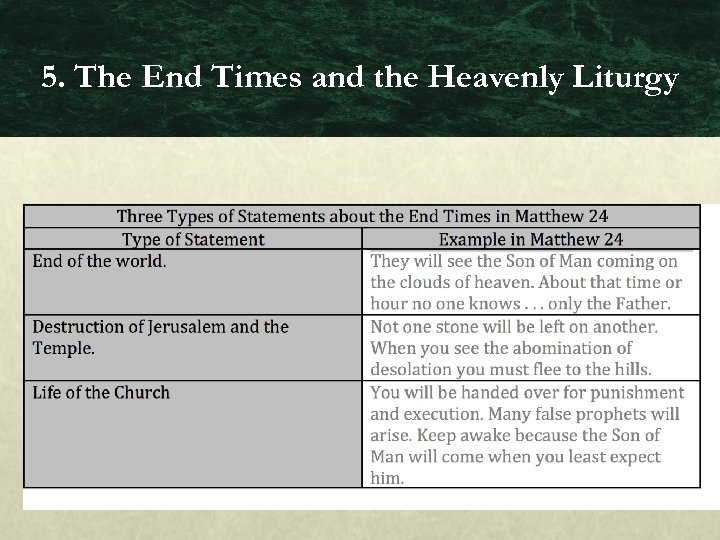
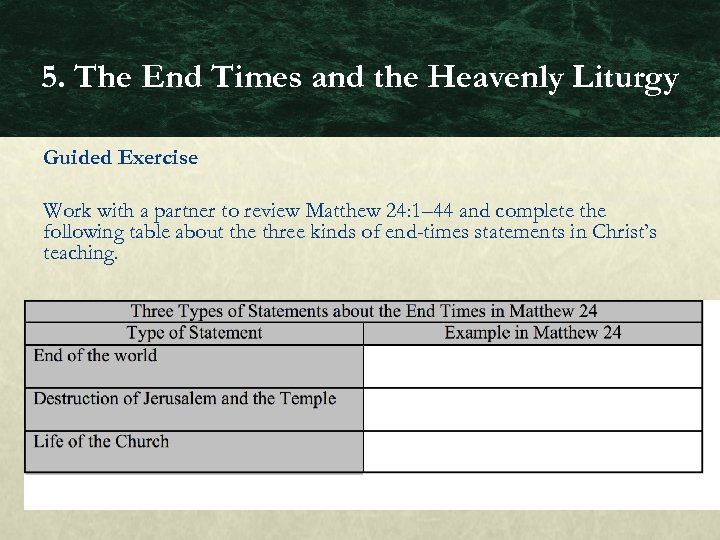 5. The End Times and the Heavenly Liturgy Guided Exercise Work with a partner to review Matthew 24: 1– 44 and complete the following table about the three kinds of end-times statements in Christ’s teaching.
 5. The End Times and the Heavenly Liturgy
 5. The End Times and the Heavenly Liturgy Guided Exercise Complete a Think/Pair/Share using the following question: In what sense was the destruction of the Temple the end of the world?
 5. The End Times and the Heavenly Liturgy THE VISION OF THE HEAVENLY LITURGY What is the second to open up the Book of Revelation for understanding? key The Mass, or Divine Liturgy, is the second key. Of what is the Book of Revelation a vision? It is a vision of the heavenly liturgy, that is, the loving act of worship and praise that occurs continually in Heaven. The liturgy Christians celebrate on earth is a participation in the heavenly one. How are the Book of Revelation and the liturgy related? The structure of Revelation is the same as that of the liturgy. The Book of Revelation is divided in two parts, the first corresponding to the Liturgy of the Word and the second corresponding to the Liturgy of the Eucharist.
 5. The End Times and the Heavenly Liturgy The Liturgy of the Word When did St. John’s vision take place? It took place on Sunday, the Lord’s Day, when Christians everywhere were celebrating the Mass. Who is “one like a son of man”? It is Christ. How is the beginning the Book of Revelation similar to the beginning of This section, a call to repentance, is like the Penitential Rite before the Liturgy of the Word.
 5. The End Times and the Heavenly Liturgy Guided Exercise Review St. John’s vision of Christ knocking at the door (Rev 3: 20), thinking about the following question: How does the open door relate to human freedom?
 5. The End Times and the Heavenly Liturgy In St. John’s vision of God enthroned with all the heavenly beings forever worshiping what would St. John’s original hearers have been reminded? They would have thought of the Temple in Jerusalem. What is the relationship between the Lion of Judah and the Lamb? These are both symbols of Christ. Extension: The Lion of Judah is the image of a conquering champion. The victory of salvation was won by the Lamb of God, who was slain. What do the seven seals represent? They are a series of symbolic events that hold reference to both events of the time and lasting truths of the Faith. How do the four horsemen suggest the Jewish war of revolt? The first horse rides out to conquer, and the other three bring war, famine, and death. The Jewish rebels started the war against Rome to free Israel, but the result was a terrible war, the starvation of the inhabitants of Jerusalem, and the deaths of over one million.
 5. The End Times and the Heavenly Liturgy What is the mark received by the 144, 000? The cross-shaped Tau is put on the foreheads of the servants of God— 12, 000 from each of the tribes of Israel—to protect them from destruction. What is the dual meaning of those who are marked? They are both the Jewish Christians who fled to the mountains across the Jordan and the full number of those who will be saved at the end of time. How does the seventh seal recall the Exodus from Egypt? The seven angels blow seven trumpets, and each of the first six trumpets releases a plague to punish the earth, recalling the plagues the Egyptians suffered. As in the Book of Exodus, the wicked refuse to repent. What is the overall story told in this section of the Book of Revelation? God calls people to repentance. Some repent; others do not. God protects those who remain faithful to him, and those who are not are left to suffer the misery of their abandonment.
 5. The End Times and the Heavenly Liturgy The Heavenly Eucharist When was the Ark of the Covenant supposed to have reappeared, accordin Second Book of Maccabees? It would be rediscovered when “God gathers his people together again and shows his mercy” (2 Mc 2: 7). What does St. John introduce immediately following his description of the St. John gave the vision of a woman with child pursued by the great red dragon. What does the great dragon in the vision wish to do? It wants to devour the child after he will have been born.
 5. The End Times and the Heavenly Liturgy What is the destiny of the child? He is to rule all the nations with a rod of iron, and he is caught up to God and to his throne. What happened to the woman? She flees into the wilderness where she was protected by God.
 5. The End Times and the Heavenly Liturgy How is the Blessed Virgin Mary the New Ark of the Covenant? The Ark contained the tablets of the Law, some manna from Heaven, and Aaron’s rod. The Blessed Virgin Mary bore in her womb her Son, who is the Word of God, the Bread of Life, and the one who will rule the nations with a rod of iron. She carried Christ in her womb; therefore, she contained these things inside herself as the Ark contained its contents. How is the woman like the Church? As the woman was attacked by the dragon but protected by God in the wilderness, the Church was attacked by the Devil but was kept safe in the mountainous area of Pella. How does the vision of the woman with child relate to Adam and Eve? The serpent/dragon tempted Adam and Eve and conquered them. Christ and his Mother, the New Adam and New Eve, overcome the beast.
 5. The End Times and the Heavenly Liturgy Closure Write a paragraph summarizing how the Book of Revelation is like the Mass.
 5. The End Times and the Heavenly Liturgy Homework Assignment Reading THE BEASTS through CONCLUSION. Study Questions 27– 33. Practical Exercise 5. Workbook Questions 33– 43.
 5. The End Times and the Heavenly Liturgy Alternative Assessment Free write for five minutes about St. John’s vision as an allegory of the saving action of Christ’s life, Death, and Resurrection.
 6. The End of the World BASIC QUESTIONS What are the two beasts of Revelation? What is the New Jerusalem? What is God’s Final Judgment? KEY IDEAS The two beasts in Revelation 13 represent corrupt governments that persecute the Church and seduce people. The New Jerusalem is the city of the redeemed. It has no Temple because God will dwell directly with his people. God will recompense us for the good or evil we have done. Persons and even particular churches will be lost if they choose not to adhere to the Faith, of which the seven churches of Asia are an example.
 6. The End of the World Anticipatory Set Read silently the Catechism, no. 676, and then complete a Think/Pair/Share using the following question: Against what does the Church warn us in the Catechism, no. 676?
 6. The End of the World THE BEASTS What are the meaning of the horns and the diadems of the first beast? The horns symbolize power, and the diadems symbolize royal authority. What is the significance of the beast having seven heads? This beast possesses a kind of diabolic perfection. Overall, what does the beast represent? The beast seems to represent the seductive power of temporal might. This may refer both to the powerful, tyrannical governments of the day, such as the Roman Empire or the dynasty of Herod, and to any corrupt government that has existed since.
 6. The End of the World What kind of creature is the second beast? It is a lamb in disguise, a kind of counterfeit Christ that can work miracles yet seduces people to do evil. What is the significance of the number 666? It might be a numerological reference to Nero or to anyone who can seduce with the tyranny of power.
 6. The End of the World THE NEW JERUSALEM What is the overall narrative of the Book of Revelation? It is the symbolic retelling of the conquest of Christ over sin and death. Extension: This is the same narrative re-presented during each Mass. What is the New Jerusalem? It is the new “place” where God dwells with his people. What is the effect of God dwelling with his people in the New Jerusalem? There is no longer suffering, sadness, or death.
 6. The End of the World How is the New Jerusalem like the Garden of Eden? God and his people dwell together as it was in the Garden, and God’s original intent for creation is realized because his people live in joy, love, and worship. Why is there no Temple in the New Jerusalem? God himself is the Temple and provides the city’s light. How does the New Jerusalem fulfill what the prophets foresaw through th Covenant? According to the Davidic Covenant, the kings of the earth will bring their glory into Jerusalem, and its gates will never be shut. This is what is promised in the New Jerusalem.
 6. The End of the World Guided Exercise Complete a Think/Pair/Write/Share using the following question: The New Jerusalem can be compared to a bride adorned for her husband. What can this comparison tell us about the New Jerusalem?
 6. The End of the World Guided Exercise Free write for five minutes about how the New Jerusalem is already present on earth through the Mass.
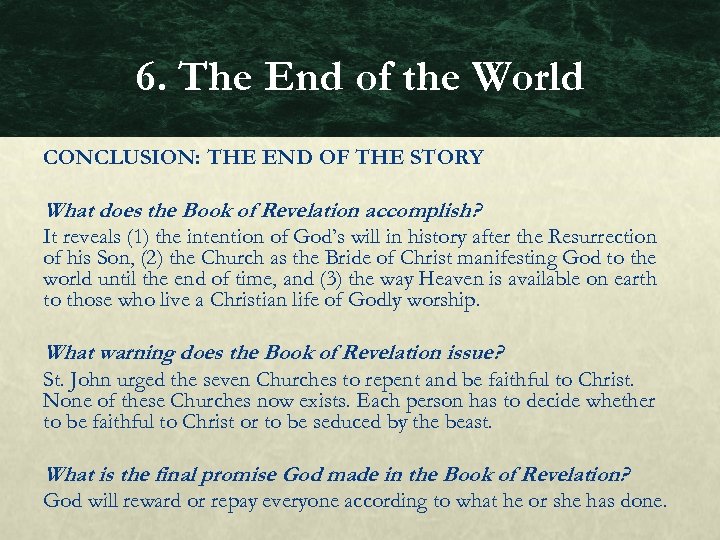 6. The End of the World CONCLUSION: THE END OF THE STORY What does the Book of Revelation accomplish? It reveals (1) the intention of God’s will in history after the Resurrection of his Son, (2) the Church as the Bride of Christ manifesting God to the world until the end of time, and (3) the way Heaven is available on earth to those who live a Christian life of Godly worship. What warning does the Book of Revelation issue? St. John urged the seven Churches to repent and be faithful to Christ. None of these Churches now exists. Each person has to decide whether to be faithful to Christ or to be seduced by the beast. What is the final promise God made in the Book of Revelation? God will reward or repay everyone according to what he or she has done.
 6. The End of the World Closure Read silently the Parable of the Sheep and the Goats (Mt 25: 31– 46) and review the quote at the end of the chapter (Rev 22: 12– 13). Write a paragraph relating those two passages to the warning of the Book of Revelation.
 6. The End of the World Homework Assignment Study Questions 34– 35. Practical Exercise 6. Worksheet Questions 44– 49.
 6. The End of the World Alternative Assessment According to the Sacred Scriptures, no one can really imagine how Heaven will be. Free write for a few minutes about what you think or hope about Heaven.
 THE END