


 Скачать презентацию Chapter 7 Supply Chain Management Chapter 7 Supply
907db8ad2a735f5d34ad482d7991d203.ppt
- Количество слайдов: 65
 Chapter 7 Supply Chain Management Chapter 7: Supply Chain Management
 Introduction Chapter 7: Supply Chain Management
 Palm Inc. n n n During the year 2000, Palm Inc. was selling every PDA (computerized Personal Digital Assistant) that wasn’t nailed down. In the last few years, Palm has developed a strategic supply chain management function. They have gone from doing business with hundreds of suppliers to developing deep relationships with only a few suppliers Chapter 7: Supply Chain Management 3
 Palm Inc. continued n n The secret to driving the cost so low was working closely with their suppliers to hit tight cost targets for the display, the processor, the memory, the battery, and the mechanicals. The result of their new strategic emphasis on supply chain management has been a 20 -30 percent reduction in materials costs and a 27 percent reduction in overall costs, an increase in inventory turns from 3 to 22, and a 30 percent increase in profit margins. Chapter 7: Supply Chain Management 4
 B 2 B Networks and Private Exchanges n n B 2 B Online Marketplaces Private Exchanges ¡ ¡ ¡ HP Ace Hardware IBM Chapter 7: Supply Chain Management 5
 B 2 B Online Internet Marketplaces n n When the Internet revolution began, a number of organizations rushed to establish B 2 B online marketplaces for entire industries including steel, automobile manufacturing, and electronics. More recently, however, a number of firms including HP, IBM, and Wal-Mart created their own private exchanges (also called corporate marketplaces). Chapter 7: Supply Chain Management 6
 B 2 B Online Internet Marketplaces continued n n n These links allow the parties to collaborate and manage the supply chain in real time. Ace Hardware provides another example. Ace's motivation for the development of its system was the desire to manage its inventory more efficiently and be able to collaborate with suppliers in real time. Chapter 7: Supply Chain Management 7
 B 2 B Online Internet Marketplaces continued n n n Ace used its supply chain management software to link the computer systems located in its 14 distribution centers with nine suppliers. IBM's system provides links to over 20, 000 of its suppliers. IBM further estimates that it realized almost $400 million in savings that year due to the increased efficiency of its Web-based procurement system. Chapter 7: Supply Chain Management 8
 Dell Computer n n Direct Model Use of Information Technology ¡ n provides suppliers with access to Dell’s inventories Minimum Inventory Levels Chapter 7: Supply Chain Management 9
 Dell Computer n n n Classic case in supply chain management. Established in 1984, Dell experienced supply problems in 1993 and thereupon completely redesigned its supply chain process along the lines of what its founder, Michael Dell, called the “direct” model. Between 1993 and 1998, Dell's earnings subsequently grew at 65 percent per year. Chapter 7: Supply Chain Management 10
 Dell Computer continued n n Dell's supply chain redesign was based on the following elements. First, Dell sells directly to customers, eliminating the wholesaler and retailer. Second, Dell also takes advantage of new information technologies in their communications with suppliers who can access Dell's component inventories, production plans, and forecasts in real time and thus keep their production precisely matched to Dell's needs. Third, Dell deliberately maintains absolute minimum inventory levels at every stage of production, averaging 4 days overall Chapter 7: Supply Chain Management 11
 Supply Chain Management Crusade n n Focus is on entire value chain Includes ¡ ¡ ¡ lean production JIT TQM purchasing product/service design Chapter 7: Supply Chain Management 12
 Defining Supply Chain Management n n n Coordination and integration of all supply chain activities into seamless process. Enables organizations to plan and collaborate across supply chain. Goal is to deliver right product to right place at right time in order to maximize profit. Chapter 7: Supply Chain Management 13
 Strategic Advantages of Supply Chain n n Supply chain management includes the supply, storage, and movement of materials, information, personnel, equipment, and finished goods within the organization and between its environment. Goal of supply chain management is to integrate the entire process of satisfying the customer’s needs all along the supply chain. Chapter 7: Supply Chain Management 14
 Strategic Advantages of Supply Chain Management continued n n Supply chain costs often represent 50% or more of total operating costs Firms that have implemented supply chain management ¡ Have 45% supply chain cost advantage ¡ 50% lower inventory ¡ 17% faster delivery of final product ¡ Larger market shares and higher customer loyalty Chapter 7: Supply Chain Management 15
 Supply Chain Strategy n n n Supply chain strategy needs to be tailored to meet the needs of its customers which isn’t always the lowest cost. In situations where the goods are basic commodities with standard benefits (food, home supplies, standard clothing), then cost reduction will be the focus. In fashion goods, timeliness should be the focus of the supply chain. Chapter 7: Supply Chain Management 16
 Strategic Need for Supply Chain Management n n Total supply chain costs represent better than half, and in some cases three-quarters, of the total operating expenses for most organizations. The broader concept of the supply chain includes the supply, storage, and movement of materials, information, personnel, equipment, and finished goods within the organization and between it and its environment. Chapter 7: Supply Chain Management 17
 Strategic Need for Supply Chain Management continued n As organizations have continued to adopt more efficient production techniques such as lean manufacturing, total quality management, inventory reduction techniques to reduce costs and improve the quality, functionality, and speed of delivery of their products and services to customers, the costs and delays of procuring the requisite inputs and distributing the resulting goods and services are taking a greater and greater fraction of the total cost and time. Chapter 7: Supply Chain Management 18
 Other Factors Driving Need to Better Manage Supply Chain n n Increasing global competition Outsourcing E-commerce Shorter life cycles Greater supply chain complexity Chapter 7: Supply Chain Management 19
 Measures of Supply Chain Performance n n Lower inventories, will be reflected in less need for working capital (WC) and a higher return on asset (ROA) ratio. Lower cost to carry these inventories will be seen in a reduced cost of goods sold (CGS), and thus a higher contribution margin, return on sales (ROS), and operating income. Chapter 7: Supply Chain Management 20
 Operations-Oriented Measures n n n Performance measures related to inventory reduction: First we calculate the aggregate inventory value (at cost) on average for the year (AAIV): AAIV = raw materials + work-in-process + finished goods % Assets in Inventories = AAIV/total assets Another inventory measure is the inventory turnover (or “turns, ” as it is sometimes called): Inventory turnover (“turns”) = annual cost of goods sold/AAIV Chapter 7: Supply Chain Management 21
 Supply Chain Design n The supply chain consists of the network of organizations that supply inputs to the business unit, the business unit itself, and the customer network. Chapter 7: Supply Chain Management 22
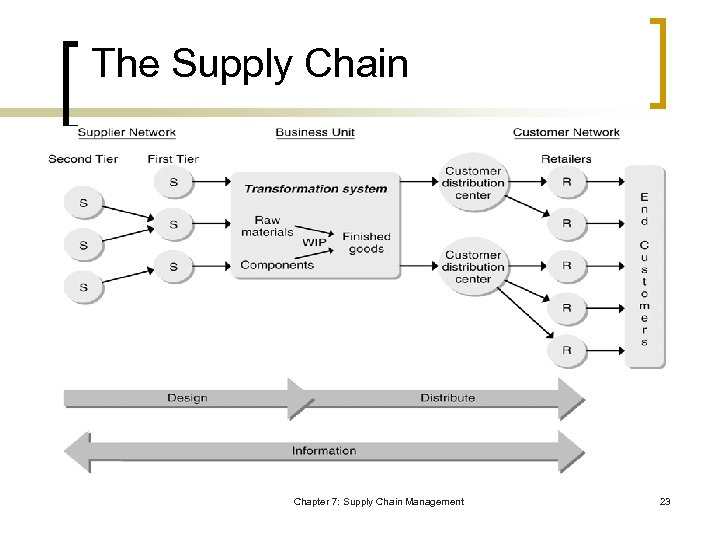 The Supply Chain Chapter 7: Supply Chain Management 23
 Logistics Chapter 7: Supply Chain Management
 Logistics n Planning and controlling efficient, effective flows of goods, services, and information from one point to another. Chapter 7: Supply Chain Management 25
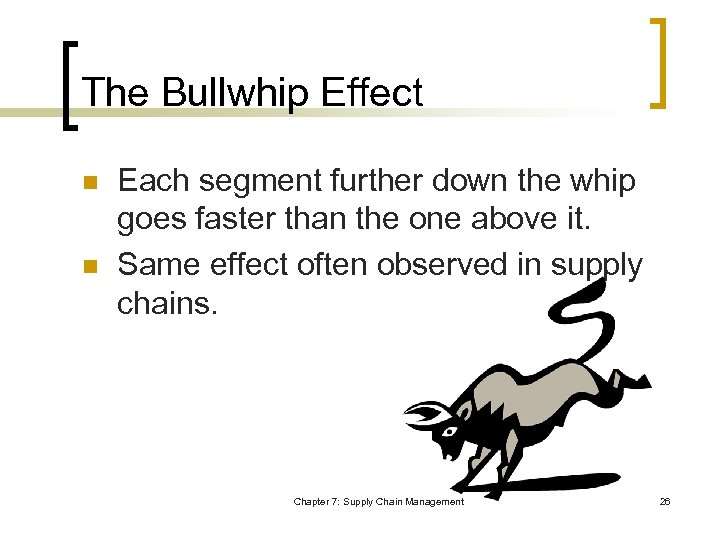 The Bullwhip Effect n n Each segment further down the whip goes faster than the one above it. Same effect often observed in supply chains. Chapter 7: Supply Chain Management 26
 Transportation Chapter 7: Supply Chain Management
 Modes of Transportation and Routing n n Water Rail Truck Air Chapter 7: Supply Chain Management 28
 Factors to Consider in Transportation Decisions n n n n Cost per unit shipped Ability to fill the transporting vehicle Total shipment cost Safety of contents Shipping time Availability of insurance Perishability n n n Difficulty of arranging shipment Delivery accommodations Seasonal considerations Consolidation possibilities Size of product Chapter 7: Supply Chain Management 29
 Location n n Besides distributing outputs to customers by transporting them, if there is a facilitating good, we can also locate where our customers can easily obtain them. Advances in information and telecommunications technology have allowed some pure service organizations (i. e. , those without a facilitating good) to reach their recipients through phone, cable, the Internet, or microwave links. Chapter 7: Supply Chain Management 30
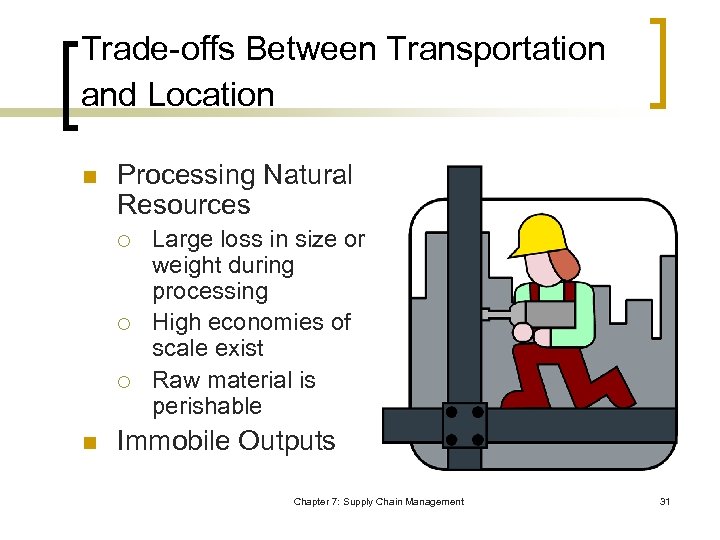 Trade-offs Between Transportation and Location n Processing Natural Resources ¡ ¡ ¡ n Large loss in size or weight during processing High economies of scale exist Raw material is perishable Immobile Outputs Chapter 7: Supply Chain Management 31
 Processing Natural Resources n Organizations that process natural or basic resources as raw materials or other essential inputs to obtain their outputs will locate near their resource if one of the following conditions holds: ¡ ¡ ¡ There is a large loss in size or weight during processing. High economies of scale exist for the product. The raw material is perishable. Chapter 7: Supply Chain Management 32
 Immobile Outputs n n The outputs of some organizations may be relatively immobile, such as dams, roads, buildings, and bridges. The organization locates itself at the construction site and transports all required inputs to that location Chapter 7: Supply Chain Management 33
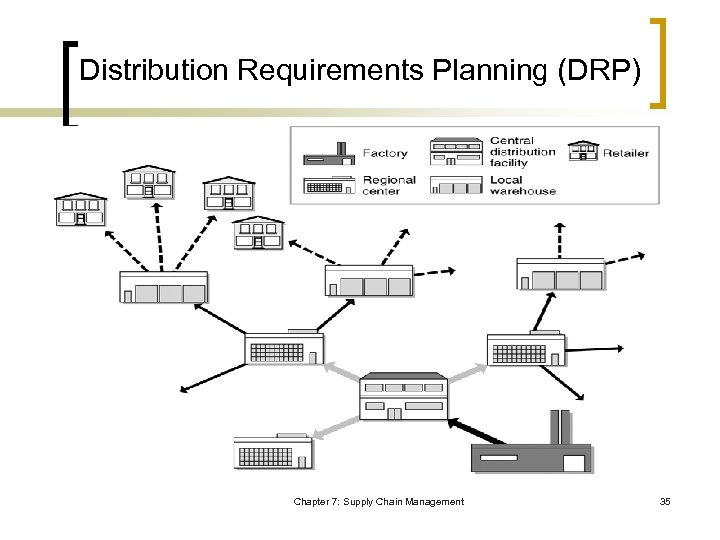
 Distribution Requirements Planning n The distribution process is illustrated on the next slide where retailers order from local warehouses, the warehouses are supplied from regional centers, and the regional centers draw from the central distribution facility, which gets inventory directly from the factory. Chapter 7: Supply Chain Management 34
 Distribution Requirements Planning (DRP) Chapter 7: Supply Chain Management 35
 Purchasing/Procurement Chapter 7: Supply Chain Management
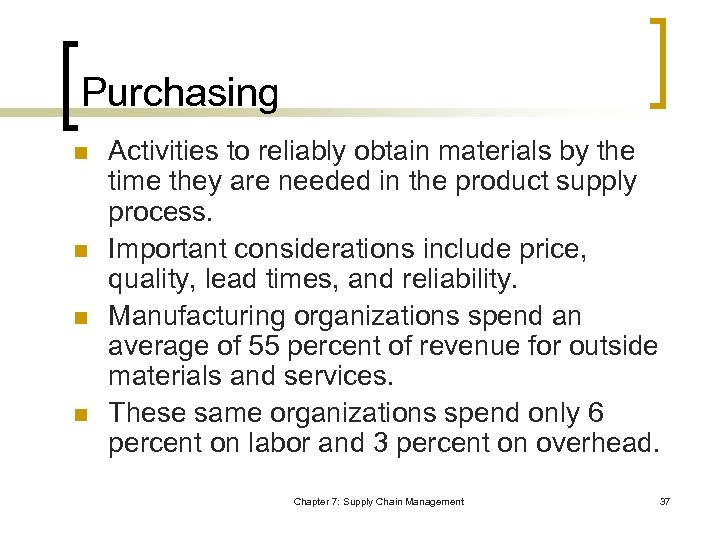 Purchasing n n Activities to reliably obtain materials by the time they are needed in the product supply process. Important considerations include price, quality, lead times, and reliability. Manufacturing organizations spend an average of 55 percent of revenue for outside materials and services. These same organizations spend only 6 percent on labor and 3 percent on overhead. Chapter 7: Supply Chain Management 37
 Purchasing Versus Procurement n Purchasing implies a monetary transaction. n Procurement is simply the responsibility for acquiring the goods and services the organization needs. Chapter 7: Supply Chain Management 38
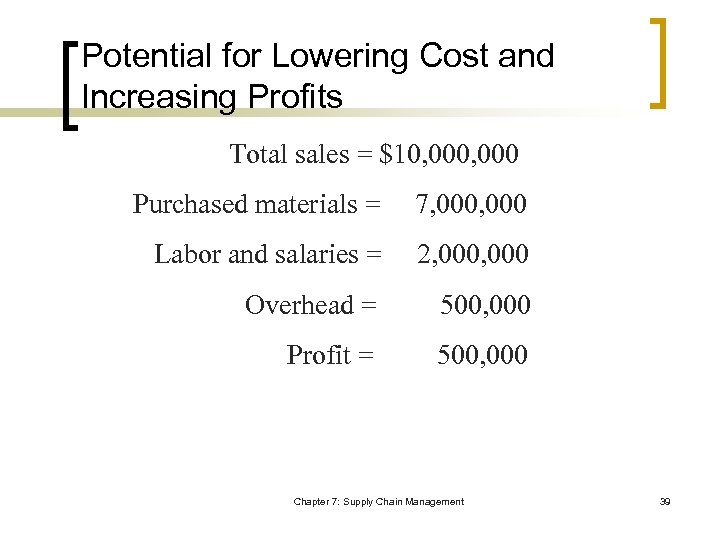 Potential for Lowering Cost and Increasing Profits Total sales = $10, 000 Purchased materials = 7, 000 Labor and salaries = 2, 000 Overhead = 500, 000 Profit = 500, 000 Chapter 7: Supply Chain Management 39
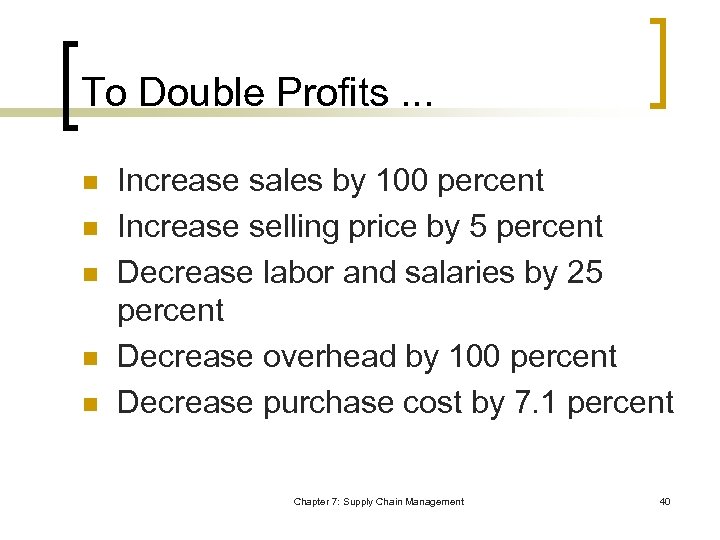 To Double Profits. . . n n n Increase sales by 100 percent Increase selling price by 5 percent Decrease labor and salaries by 25 percent Decrease overhead by 100 percent Decrease purchase cost by 7. 1 percent Chapter 7: Supply Chain Management 40
 JIT and Purchasing Widespread use of JIT has increased importance of purchasing and procurement since delays in the receipt of materials will stop a JIT program dead in its tracks. Chapter 7: Supply Chain Management 41
 Differences Between Purchasing by Individuals and Organizations n n Organizations purchase larger volumes and dollar amounts. Organization may be larger than its suppliers. Very few suppliers exist for certain organizational goods, whereas many typically exist for consumer goods. Certain discounts may be available to organizations. Chapter 7: Supply Chain Management 42
 Value Analysis n n A special responsibility of purchasing, or purchasing working jointly with engineering/design and operations (and sometimes even the supplier), is to regularly evaluate the function of purchased items or services, especially those that are expensive or used in high volumes. The goal is to either reduce the cost of the item or improve its performance. Chapter 7: Supply Chain Management 43
 Key Elements of Effective Purchasing n n n They leverage their buying power. They commit to a small number of dependable suppliers. They work with and help their suppliers reduce total cost. Chapter 7: Supply Chain Management 44
 Supplier Management Chapter 7: Supply Chain Management
 Supplier Selection and Vendor Analysis n Characteristics of a good supplier are: ¡ ¡ Deliveries are made on time and are of the quality and in the quantity specified. Prices are fair, and efforts are made to hold or reduce the price. Able to react to unforeseen changes. Supplier continually improves products and services. Supplier is willing to share information and be an important link in the supply chain. Chapter 7: Supply Chain Management 46
 Supplier Relationships n n In the past, most customers purchased from the lowest bidders who could meet their quality and delivery needs. Customers are seeking a closer, more cooperative relationship with their suppliers. Chapter 7: Supply Chain Management 47
 Supplier Certification and Audits n n n Sole-sourcing arrangements are becoming virtual partnerships with the customer. This means longer-term relationships. Suppliers are being certified or qualified so that their shipments do not need to be inspected by the customer —the items go directly to the production line. Chapter 7: Supply Chain Management 48
 Outsourcing and Global Sourcing n n Outsourcing is the process of contracting with external suppliers for goods and services that were formally provided internally. Global sourcing is an important aspect of supply chain outsourcing strategy and we see it occurring more and more. Chapter 7: Supply Chain Management 49
 Primary Reasons Outsourcing Occurring n n n 1. The fall of communism and the economic insulation it had maintained. 2. The advent of telecommunications and computer technology that physically allowed work that previously had to be done locally or regionally to now be conducted overseas. Outsourcing in general is a major strategic element of SCM these days, not just for production materials but for a wide range of services as well. Chapter 7: Supply Chain Management 50
 The Role of Information Technology in Supply Chain Management Chapter 7: Supply Chain Management
 Role of Information Technology n n n In the not-too-distant past, the primary means of communication between members of a supply chain was paper. One problem with paper-based systems has been the time and money that is wasted rekeying the same information into different computer systems. Much of this problem has been solved with UPC and RFID being used extensively. Chapter 7: Supply Chain Management 52
 Role of Information Technology n n n More and more computing power is becoming available for less and less money, hence it is becoming omnipresent, appearing everywhere we go and in everything we buy. Growth of networks. As a result the growth of computers, which support networks, and networks that support people’s needs (business transactions, communication, blogging, etc. ), has exploded. Chapter 7: Supply Chain Management 53
 Electronic Business n n (e-business) is the use of electronic information technology to help various groups of business people communicate and conduct business transactions. Three primary advantages: ¡ ¡ ¡ enhanced productivity and reduced costs Speed creation of new value opportunities Chapter 7: Supply Chain Management 54
 E-Commerce n n Traditional means of communication was paper Electronic commerce is a term used to describe a variety of approaches for conducting business in a paperless environment ¡ Electronic Data Interchange (EDI) ¡ Bar Coding and Scanning ¡ Databases ¡ Email ¡ Electronic funds transfer ¡ Internet ¡ Point of sale terminals ¡ ERP systems ¡ RFID Chapter 7: Supply Chain Management 55
 Internet n n n The most significant information technology development for supply chain management. The Web will be the global infrastructure for electronic commerce. The Web will allow various forms of purchasing fulfillment to take place, from placing electronic catalogues on a Web site to holding joint purchasing bazaars, exchanges, and auction marketplaces involving massive amounts of materials Chapter 7: Supply Chain Management 56
 Intranets n n Web-based networks that allow all employees of a firm to intercommunicate. They are usually firewall protected and use existing Internet technologies to create portals for company-specific information and communication, such as newsletters, training, human resource information and forms, product information, and so on. Chapter 7: Supply Chain Management 57
 Extranets n n Private networks to allow the organization to securely interact with external parties. They use Internet protocols and public telecommunication systems to work with external vendors, suppliers, dealers, customers, and so on. Chapter 7: Supply Chain Management 58
 Customer Relationship Management (CRM) Systems n n Designed to collect and interpret customer-based data. CRM systems provide comprehensive customer data so the firm can provide better customer service and design and offer the most appropriate products and services for them. Chapter 7: Supply Chain Management 59
 Enterprise Resource Planning (ERP) Systems n n Facilitate communication throughout the supply chain and over the Internet. The ERP system embodies much more than just the supply chain, it also includes all the electronic information concerning the various parts of the firm. Chapter 7: Supply Chain Management 60
 Successful Supply Chain Management n The basic requirements for successful supply chain management are trustworthy partners, good communication, appropriate performance measures, and competent managers with vision. Chapter 7: Supply Chain Management 61
 Examples of Visionary SCM Innovations n Dell’s “direct model” and Palm’s “strategic sourcing”. Wal-Mart’s “cross-docking” technique of offloading goods from incoming trucks at a warehouse directly into outbound distribution trucks instead of being placed into inventory. “delayed differentiation” where final modules are either inventoried for last-minute assembly to customer order, or differentiating features are added to the final product upon receipt of the customer’s order. Chapter 7: Supply Chain Management 62
 Examples of Visionary SCM Innovations continued n Sport Obermeyer’s and Hewlett. Packard’s “postponement” approach to delayed differentiation where variety and customization is delayed until as late in the production process as possible, sometimes even arranging with the carrier to perform the final customization (called channel assembly). Chapter 7: Supply Chain Management 63
 Chapter 7: Supply Chain Management 64
 Copyright 2006 John Wiley & Sons, Inc. All rights reserved. Reproduction or translation of this work beyond that named in Section 117 of the United States Copyright Act without the express written consent of the copyright owner is unlawful. Requests for further information should be addressed to the Permissions Department, John Wiley & Sons, Inc. Adopters of the textbook are granted permission to make back-up copies for their own use only, to make copies for distribution to students of the course the textbook is used in, and to modify this material to best suit their instructional needs. Under no circumstances can copies be made for resale. The Publisher assumes no responsibility for errors, omissions, or damages, caused by the use of these programs or from the use of the information contained herein. Chapter 7: Supply Chain Management 65