 Скачать презентацию Chapter 7 Segmentation Targeting and Positioning Building the
b27f519affa74541e1e7a459ec9b3673.ppt
- Количество слайдов: 42



Chapter 7 Segmentation, Targeting, and Positioning: Building the Right Relationships with the Right Customers
Learning Goals 1. 2. 3. 4. Understand the three steps of target marketing, market segmentation, target marketing, and market positioning Explore the major bases for segmenting consumer and business marketing strategy Explain how companies identify attractive market segments and choose target marketing strategy Discuss how companies position their products for maximum competitive advantage in the marketplace 2
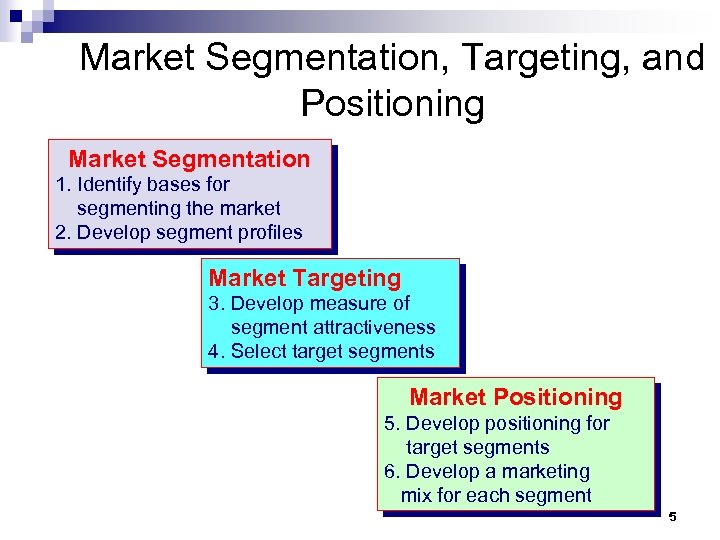
Market Segmentation, Targeting, and Positioning Market Segmentation 1. Identify bases for segmenting the market 2. Develop segment profiles Market Targeting 3. Develop measure of segment attractiveness 4. Select target segments Market Positioning 5. Develop positioning for target segments 6. Develop a marketing mix for each segment 5
Definition n Market Segmentation: ¨ Dividing a market into distinct groups with distinct needs, characteristics, or behavior who might require separate products or marketing mixes. Goal 2: List and discuss major bases for segmentation 6
Learning Goals 1. 2. 3. 4. Understand the three steps of target marketing, market segmentation, target marketing, and market positioning Explore and discuss the major bases for segmenting consumer and business marketing strategy Explain how companies identify attractive market segments and choose target marketing strategy Discuss how companies position their products for maximum competitive advantage in the marketplace 7
Segmenting Consumer Markets Geographical segmentation n Demographic segmentation n ¨ Most n popular segmentation Psychographic segmentation ¨ Lifestyle, social class, and personality-based segmentation n Behavioral segmentation Goal 2: List and discuss major bases for segmentation 8
Geographic Segmentation Variables n n World region or country U. S. region State City n n Neighborhood City or metro size Density Climate Goal 2: List and discuss major bases for segmentation 9
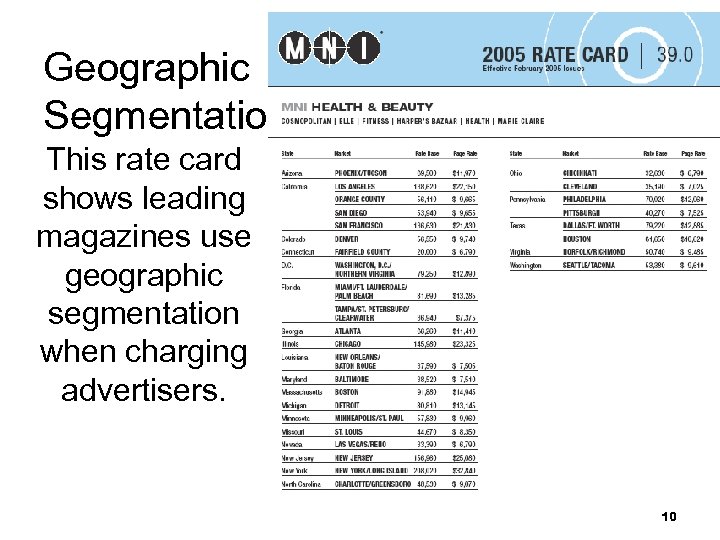
Geographic Segmentation This rate card shows leading magazines use geographic segmentation when charging advertisers. 10
Demographic Segmentation Variables n n n Age Gender Family size Family life cycle Income n n n Occupation Education Religion Race Generation Nationality Goal 2: List and discuss major bases for segmentation 11
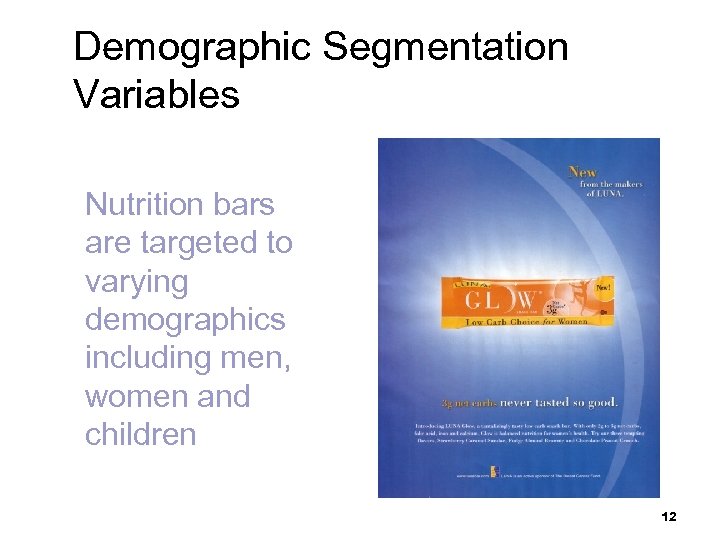
Demographic Segmentation Variables Nutrition bars are targeted to varying demographics including men, women and children 12
Behavioral Segmentation Variables n n n Occasions Benefits User status n n User rates Loyalty status Readiness stage Attitude toward the product Goal 2: List and discuss major bases for segmentation 13
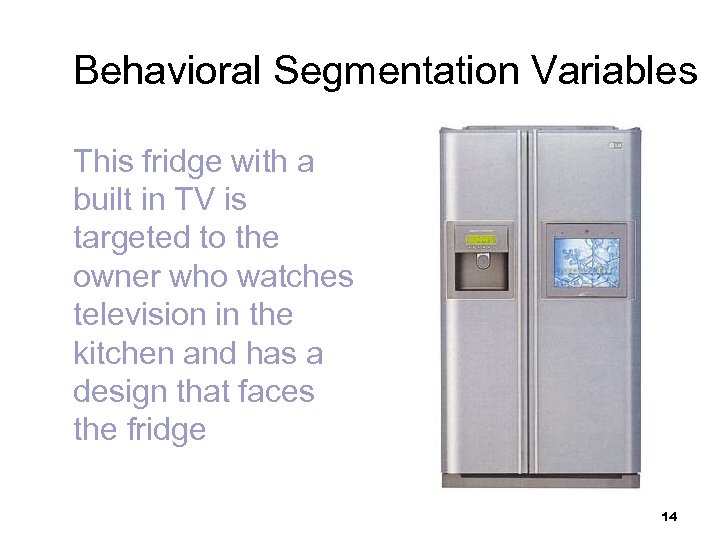
Behavioral Segmentation Variables This fridge with a built in TV is targeted to the owner who watches television in the kitchen and has a design that faces the fridge 14
Discussion Question n Based on the car examples on the following slide, how do car manufacturers use the following segments when marketing products? Geographic ¨ Demographic ¨ Psychographic ¨ Behavioral ¨ 15
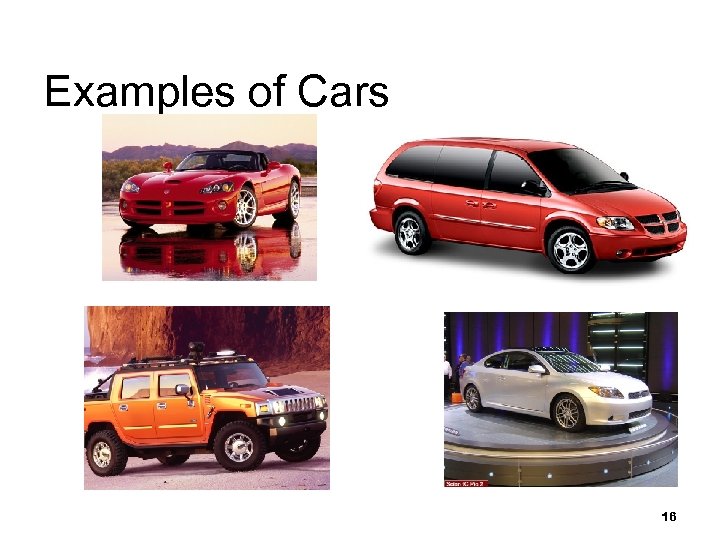
Examples of Cars 16
Major Segmentation Variables for Business Markets Demographic 1. 2. 3. Industry: Which industries should we serve? Company size: What size companies should we serve? Location: What geographical areas should we serve? Operating Variables 4. 5. 6. Technology: What customer technologies should we focus on? User or nonuser status: Should we serve heavy users, medium users, light users, or nonusers? Customer capabilities: Should we serve customers needing many or few services? Purchasing Approaches 7. 8. Purchasing-function organization: Should we serve companies with highly centralized or decentralized purchasing organizations? Power structure: Should we serve companies that are engineering dominated, financially dominated, and so on? 17
Segmenting International Markets n Geographic segmentation ¨ Location n or region Economic factors ¨ Population n income or level of economic development Political and legal factors ¨ Type/stability of government, monetary regulations, amount of bureaucracy, etc. n Cultural factors ¨ Language, religion, values, attitudes, customs, behavioral patterns Goal 2: List and discuss major bases for segmentation 18
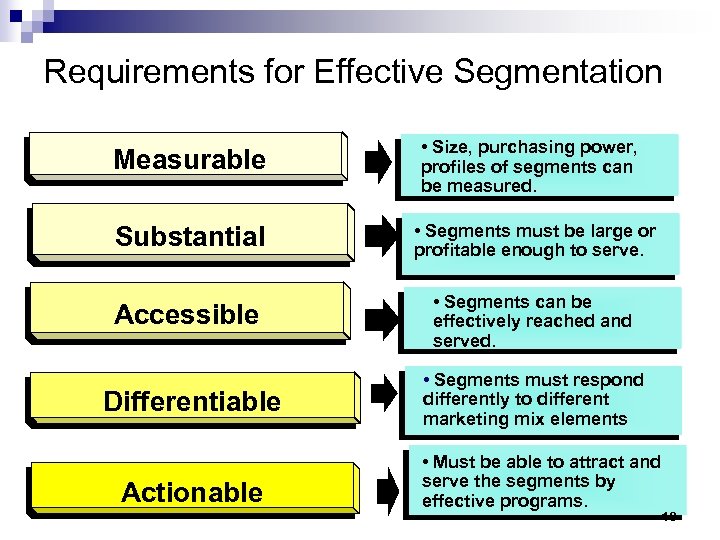
Requirements for Effective Segmentation Measurable • Size, purchasing power, profiles of segments can be measured. Substantial • Segments must be large or profitable enough to serve. Accessible • Segments can be effectively reached and served. Differentiable Actionable • Segments must respond differently to different marketing mix elements • Must be able to attract and serve the segments by effective programs. 19
Learning Goals 1. 2. 3. 4. Understand the three steps of target marketing, market segmentation, target marketing, and market positioning Explore and discuss the major bases for segmenting consumer and business marketing strategy Explain how companies identify attractive market segments and choose target marketing strategy Discuss how companies position their products for maximum competitive advantage in the marketplace 20
Target Marketing n Target Market ¨ Consists of a set of buyers who share common needs or characteristics that the company decides to serve 21
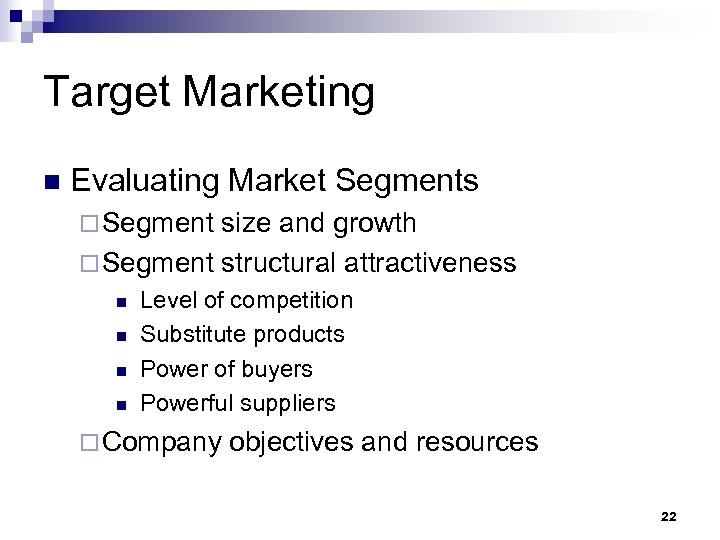
Target Marketing n Evaluating Market Segments ¨ Segment size and growth ¨ Segment structural attractiveness n n Level of competition Substitute products Power of buyers Powerful suppliers ¨ Company objectives and resources 22

Kmart has been targeting the growing Hispanic Market 7 - 23 23
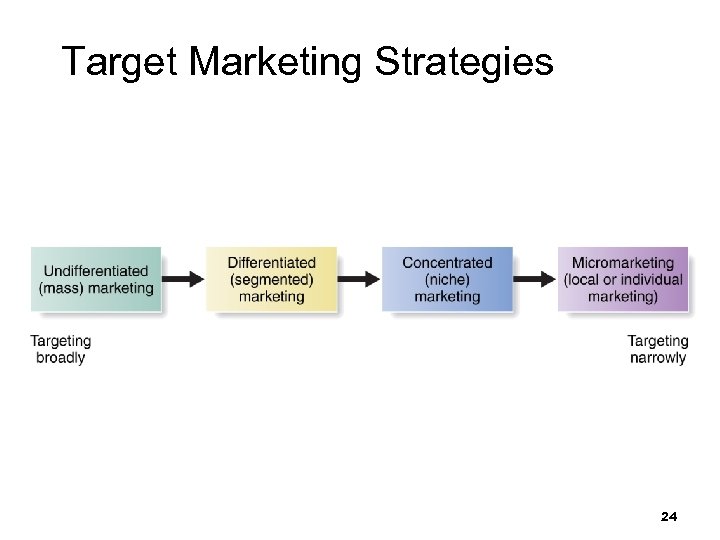
Target Marketing Strategies 24
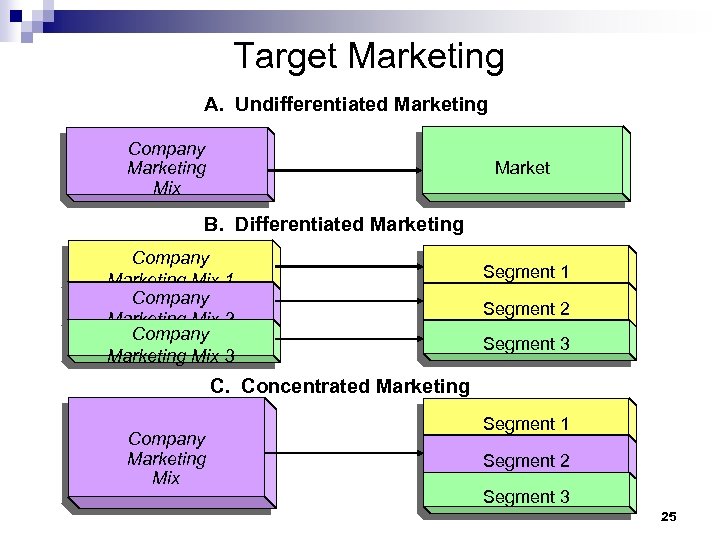
Target Marketing A. Undifferentiated Marketing Company Marketing Mix Market B. Differentiated Marketing Company Marketing Mix 1 Company Marketing Mix 2 Company Marketing Mix 3 Segment 1 Segment 2 Segment 3 C. Concentrated Marketing Company Marketing Mix Segment 1 Segment 2 Segment 3 25
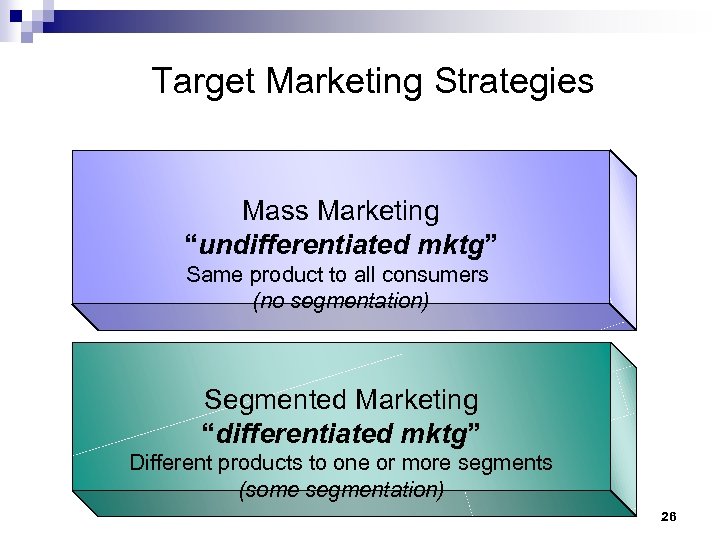
Target Marketing Strategies Mass Marketing “undifferentiated mktg” Same product to all consumers (no segmentation) Segmented Marketing “differentiated mktg” Different products to one or more segments (some segmentation) 26
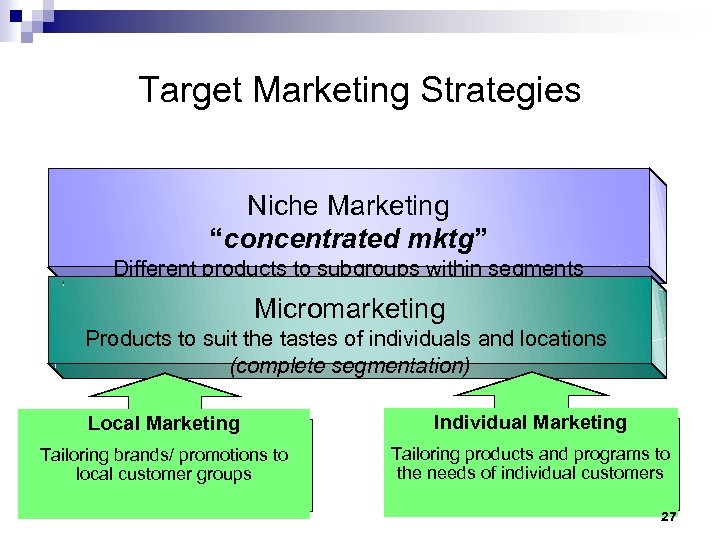
Target Marketing Strategies Niche Marketing “concentrated mktg” Different products to subgroups within segments Micromarketing Products to suit the tastes of individuals and locations (complete segmentation) Local Marketing Individual Marketing Tailoring brands/ promotions to local customer groups Tailoring products and programs to the needs of individual customers 27
Target Marketing Strategies n Niche Marketing Niches can be identified by dividing a segment into subsegments or by defining a group seeking a distinctive mix of benefits ¨ Niches are fairly small and attract one or a few competitors ¨ Niche marketers understand their niches’ needs so well that their customers willingly pay a price premium ¨ Both small and large companies can practice niche marketing ¨ 28
Target Marketing Strategies n Characteristics of an attractive niche: The customers in the niche have a distinct set of needs ¨ They will pay a premium to the firm best satisfying their needs ¨ The nicher has the required skills to serve the niche in a superior fashion ¨ The nicher gains certain economies through specialization ¨ The niche has sufficient size, profit and growth potential ¨ 29
Target Marketing Strategies n Local Marketing Local marketing leads to ğ marketing programs tailored to the needs and wants of local customer groups ¨ Those in favor of localizing a company’s marketing ğ see national advertising as wasteful since it fails to address local target groups ¨ Those against local marketing ğ argue that it drives up manufacturing and marketing costs by reducing economies of scale ¨ 30
Target Marketing Strategies n Individual Marketing The ultimate level of segmentation leads to “customized” or “one-to-one marketing”. ¨ Technological developments permit companies to return to customized marketing ¨ Mass customization the ability to produce on a mass basis individually designed products to meet each customer’s requirements ¨ 31
Positioning n Positioning: ¨ The place the product occupies in consumers’ minds relative to competing products ¨ Typically defined by consumers on the basis of important attributes ¨ Involves implanting the brand’s unique benefits and differentiation in the customer mind ¨ Positioning maps that plot perceptions of brands are commonly used Goal 4: Discuss how companies position their products 35
Positioning n n Positioning the act of designing the company’s offering and image to occupy a distinctive place in the target market’s mind Marketers must: Plan positions to give their products the greatest advantage in selected target markets, ¨ Design marketing mixes to create these planned positions. ¨ n Positioning maps that plot perceptions of brands are commonly used. 36
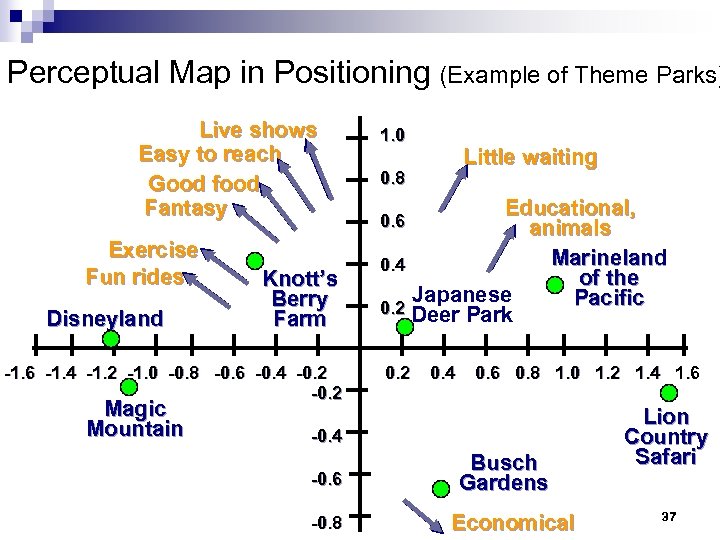
Perceptual Map in Positioning (Example of Theme Parks) Live shows Easy to reach Good food Fantasy Exercise Fun rides Disneyland Knott’s Berry Farm -1. 6 -1. 4 -1. 2 -1. 0 -0. 8 -0. 6 -0. 4 -0. 2 Magic Mountain 1. 0 Little waiting 0. 8 Educational, animals Marineland 0. 4 of the Japanese Pacific 0. 2 Deer Park 0. 6 0. 2 0. 4 0. 6 0. 8 1. 0 1. 2 1. 4 1. 6 -0. 4 -0. 6 -0. 8 Busch Gardens Economical Lion Country Safari 37
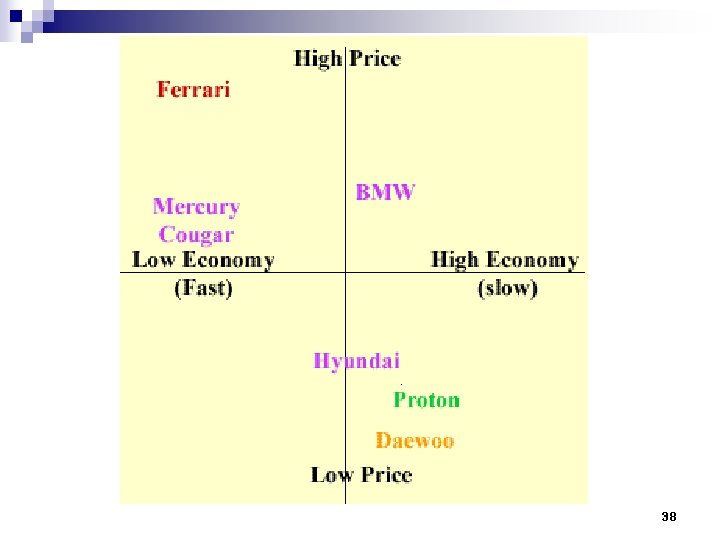
38
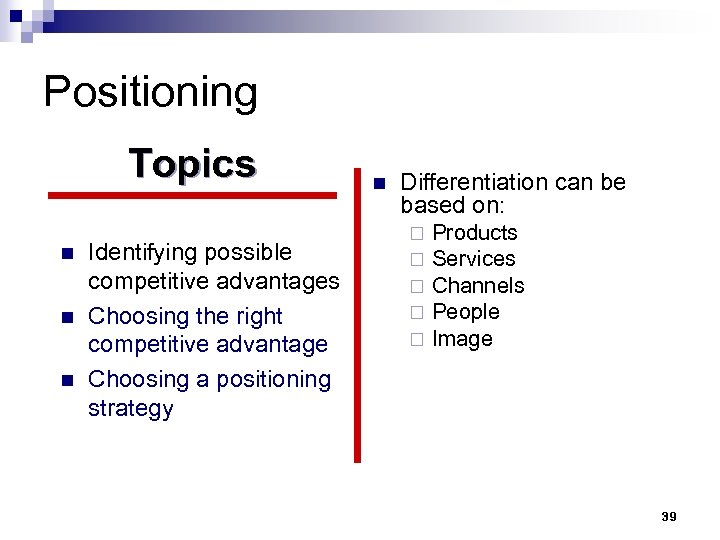
Positioning Topics n n n Identifying possible competitive advantages Choosing the right competitive advantage Choosing a positioning strategy n Differentiation can be based on: ¨ ¨ ¨ Products Services Channels People Image Goal 4: Discuss how companies position their products 39
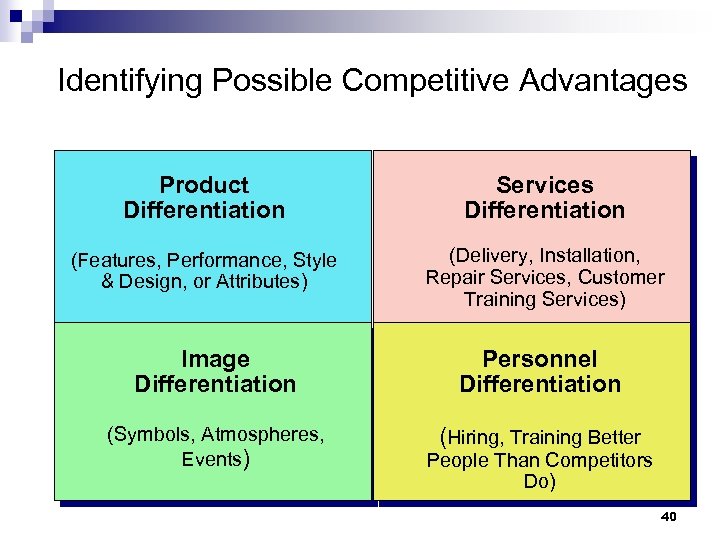
Identifying Possible Competitive Advantages Product Differentiation Services Differentiation (Features, Performance, Style & Design, or Attributes) (Delivery, Installation, Repair Services, Customer Training Services) Image Differentiation Personnel Differentiation (Symbols, Atmospheres, Events) (Hiring, Training Better People Than Competitors Do) 40
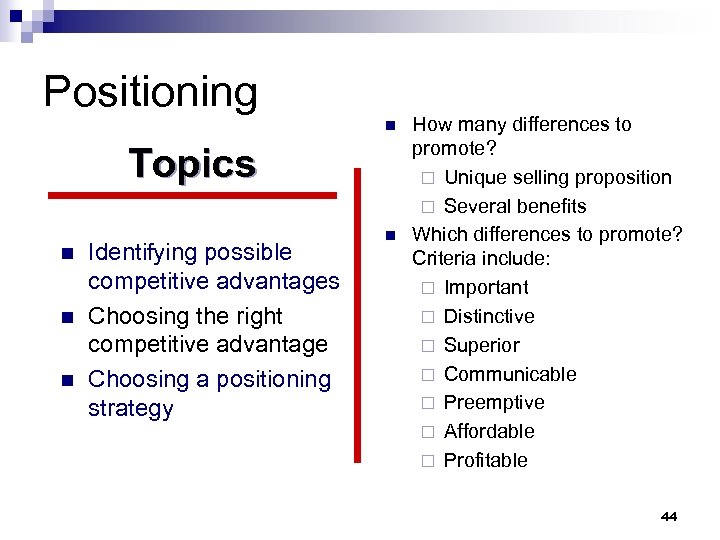
Positioning n Topics n n n Identifying possible competitive advantages Choosing the right competitive advantage Choosing a positioning strategy n How many differences to promote? ¨ Unique selling proposition ¨ Several benefits Which differences to promote? Criteria include: ¨ Important ¨ Distinctive ¨ Superior ¨ Communicable ¨ Preemptive ¨ Affordable ¨ Profitable Goal 4: Discuss how companies position their products 44
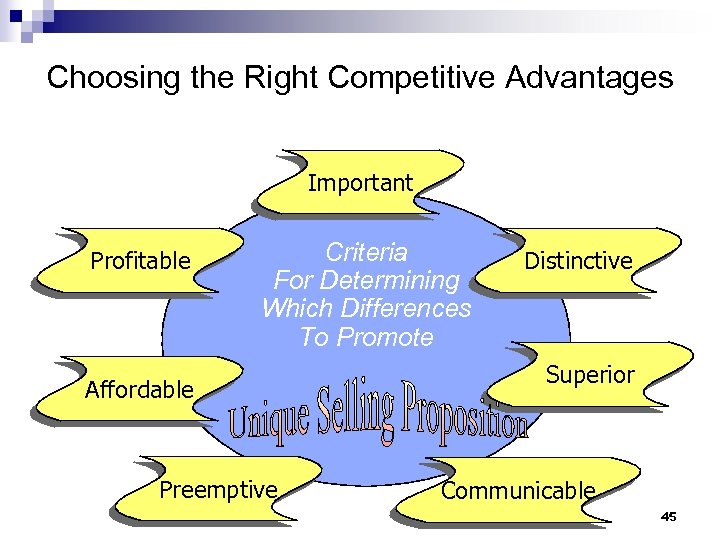
Choosing the Right Competitive Advantages Important Profitable Criteria For Determining Which Differences To Promote Affordable Preemptive Distinctive Superior Communicable 45
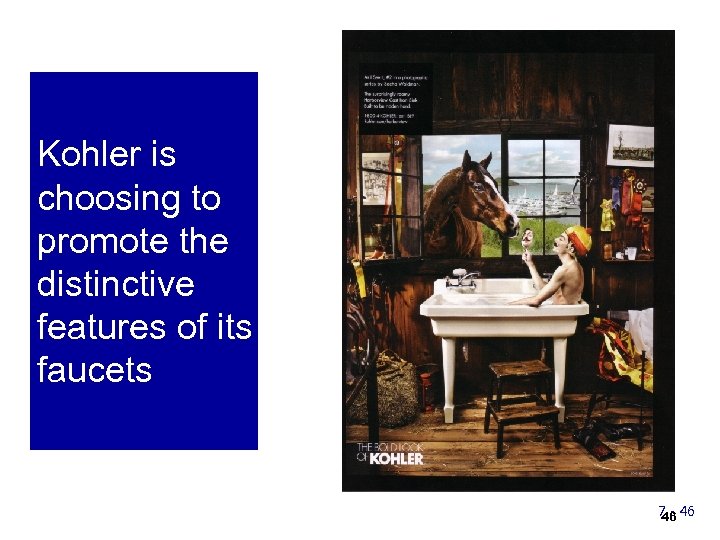
Kohler is choosing to promote the distinctive features of its faucets 7 - 46 46
Positioning Topics n n n Identifying possible competitive advantages Choosing the right competitive advantage Choosing a positioning strategy n n Value propositions represent the full positioning of the brand Possible value propositions: ¨ More for more ¨ More for the same ¨ More for less ¨ The same for less ¨ Less for much less Goal 4: Discuss how companies position their products 47
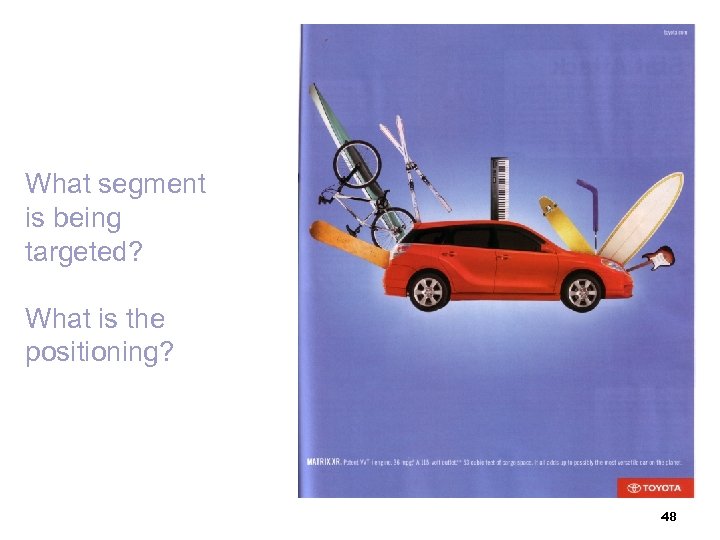
What segment is being targeted? What is the positioning? 48
Product Position Statement Positioning statements summarize the company or brand positioning n For [target end user] n Who wants/needs [compelling reason to buy] n The [product name] is a [product category] n That provides [key benefit]. n Unlike [main competitor], n The [product name] [key differentiation] 51
Communicating the Positioning Companies must be certain to DELIVER their value propositions n Positions must be monitored and adapted over time n Goal 4: Discuss how companies position their products 52
Скачать презентацию Chapter 7 Segmentation Targeting and Positioning Building the
b27f519affa74541e1e7a459ec9b3673.ppt