


 Скачать презентацию Chapter 7 Remote Connectivity and Vo IP Hacking
38f54804592e401151808f79bb34aa4b.ppt
- Количество слайдов: 75
 Chapter 7 Remote Connectivity and Vo. IP Hacking
 Wardialing
 Hardware If using dial-up modems, use COM ports Multiple lines make it easier to dial ranges of numbers more quickly – One call per minute per modem – A 10, 000 -number range takes a whole week of 24 -hour dialing for a single modem
 Legal Issues There a lot of laws restricting telephone hacking Get written permission, specifying the phone number ranges War. VOX records calls; may be illegal to use
 Software Old school – Tone. Loc , THC-Scan, Tele. Sweep, Phone. Sweep HD Moore's New Tool – War. VOX
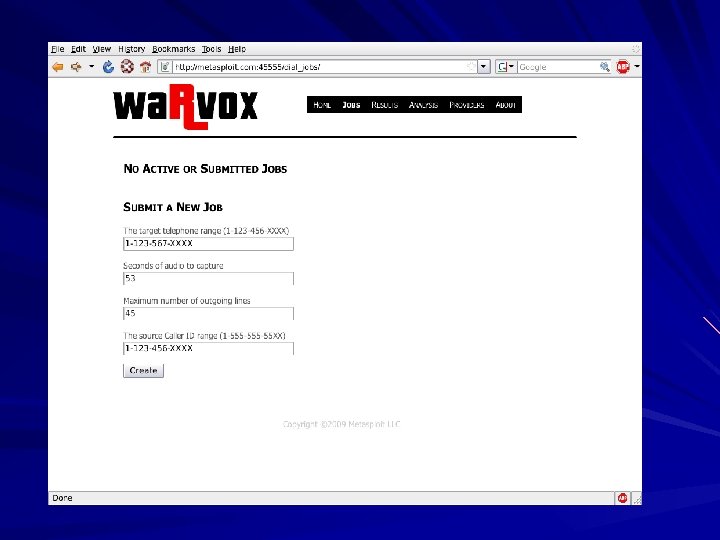
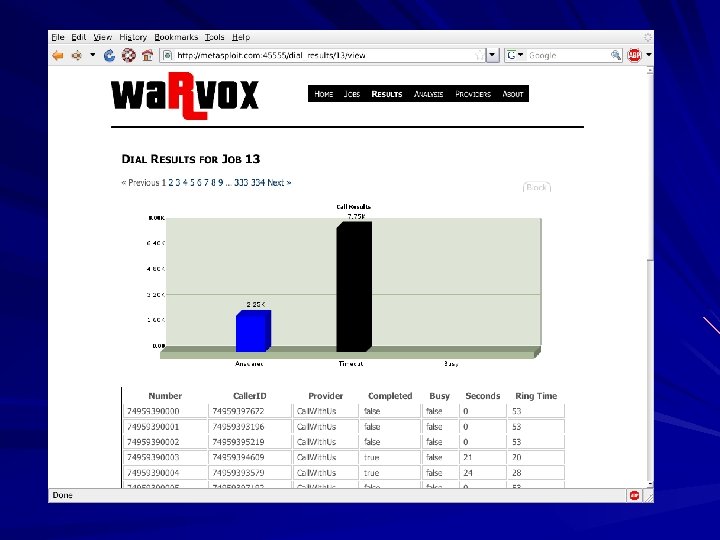
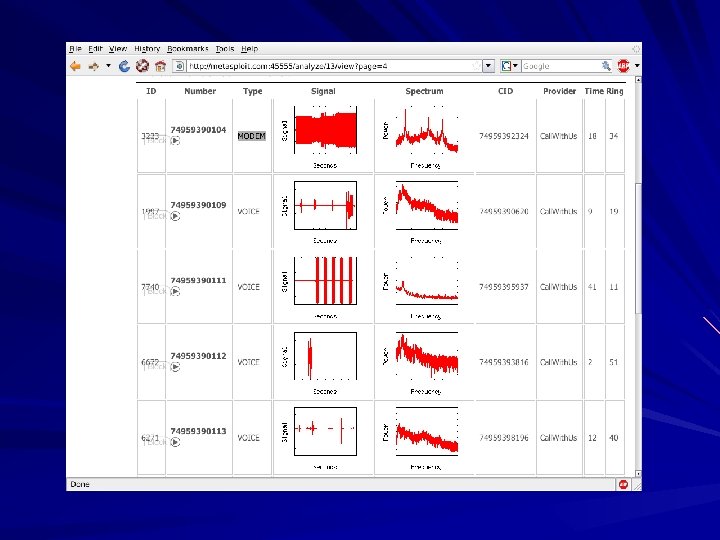
 Uses Vo. IP Captures audio Dials ranges of numbers Records 53 seconds of audio from each one Captured audio analyzed with Digital Signal Processing – Fast Fourier Transform to create a signature
 Dial-Up Security Measures 1. Inventory dial-up lines 2. Consolidate all dial-up connectivity to a 3. 4. 5. central modem bank in the DMZ, with an IDS, firewall, and logging Make analog lines harder to find Physically secure telecommunications closets Monitor dial-up logs
 Dial-Up Security Measures 6. Don't use a company banner; just a warning to unauthorized users 7. Require multifactor authentication 8. Require dial-back authentication 9. Train help desk to be cautious giving out or resetting access credentials 10. Centralize provisioning of dial-up connectivity
 Dial-Up Security Measures 11. Establish firm policies for dial-up access 12. Return to step 1: wardial your network every six months
 Voicemail Hacking Brute-force attack tools are available But usually users leave the password at an obvious default
 Virtual Private Network (VPN) Hacking
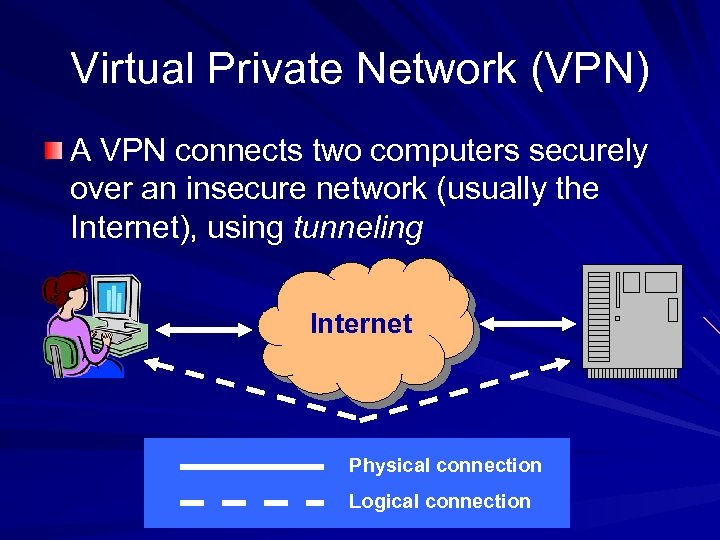 Virtual Private Network (VPN) A VPN connects two computers securely over an insecure network (usually the Internet), using tunneling Internet Physical connection Logical connection
 Tunneling An Ethernet frame is encapsulated in an IP packet, so it can be sent over the Internet – It can be done with other protocols too Usually the frame is also encrypted, so that only the intended recipient can read it The end result is like you used a long cable to connect the two computers
 Cost Savings You could use a T-1 line or a POTS phone call with a modem, to make a secure connection between two computers But a VPN is much cheaper, requiring only an Internet connection at each end
 Two Common VPN Standards IPsec/L 2 TP (IP Security with Layer 2 Tunneling Protocol) – Most secure and modern method PPTP (Point-to-Point Tunneling Protocol) – Microsoft proprietary
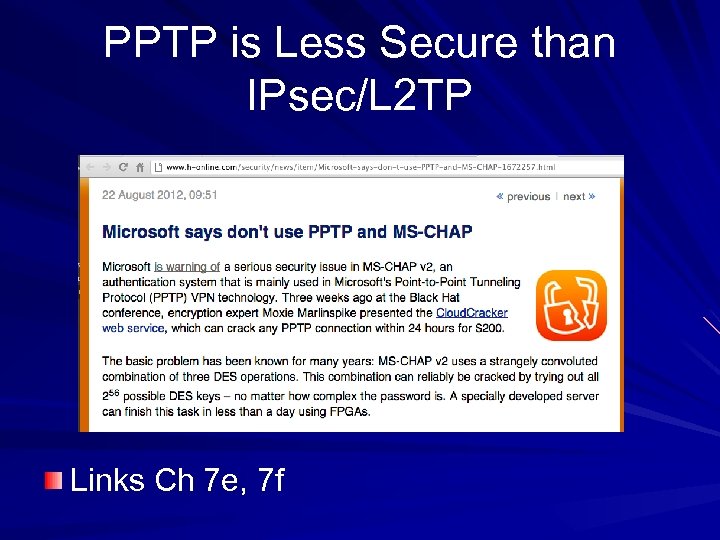 PPTP is Less Secure than IPsec/L 2 TP Links Ch 7 e, 7 f
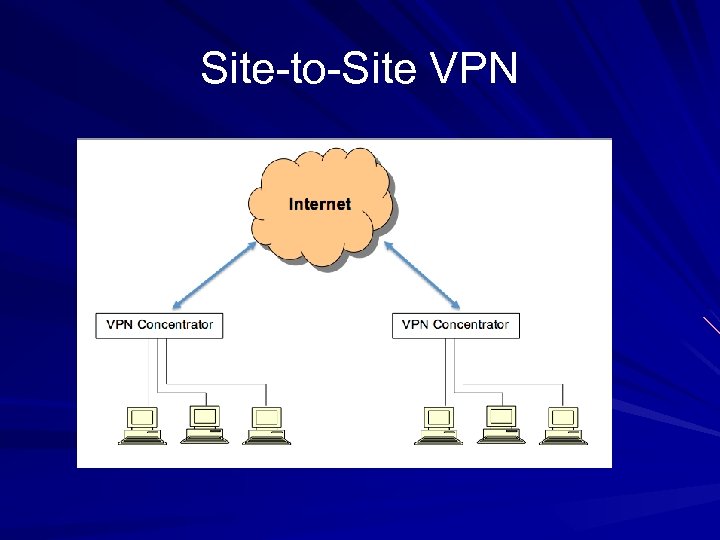 Site-to-Site VPN
 Site-to-Site VPN Concentrators also called VPN Gateways Cisco VPN Concentrators allow IPsec to be used without L 2 TP No client interaction required No login or credentials; to users, it's just another network link
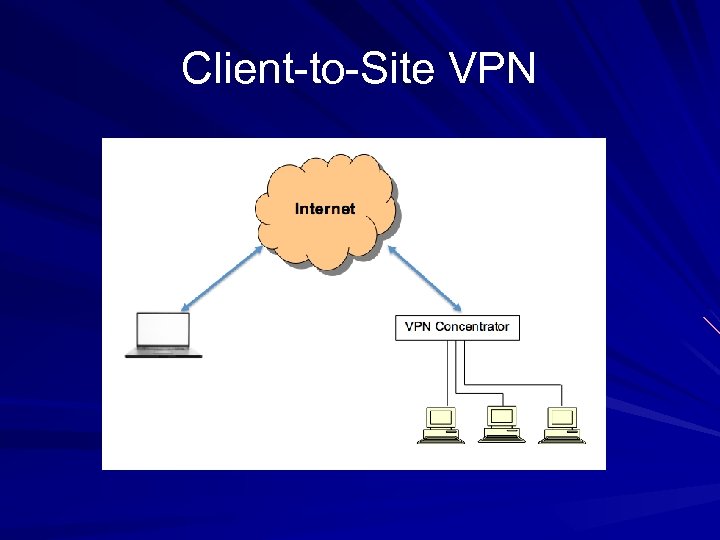 Client-to-Site VPN
 Client-to-Site VPN Remote user needs a software VPN client – Cisco VPN "thick client" – Web browser for SSL VPNs Two modes – All traffic from client system goes through VPN – "Split Tunnel" – Internet traffic does not pass through VPN – Split Tunnels bridge corporate network to Internet and should be avoided
 Authentication and Tunnel Establishment in IPsec IKE (Internet Key Exchange) Phase 1 Mutual authentication (both client & server) – Main mode Three separate 2 -way handshakes – Aggressive mode Only three messages Faster but less secure
 Authentication and Tunnel Establishment in IPsec IKE (Internet Key Exchange) Phase 2 Establishing the IPsec tunnel
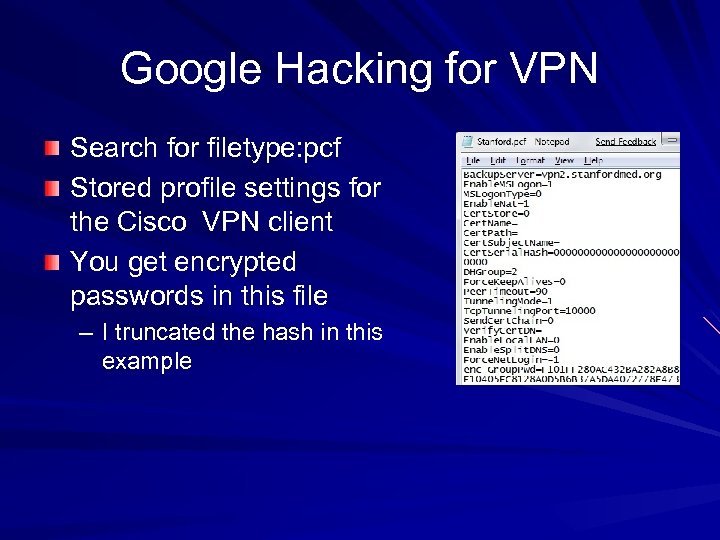 Google Hacking for VPN Search for filetype: pcf Stored profile settings for the Cisco VPN client You get encrypted passwords in this file – I truncated the hash in this example
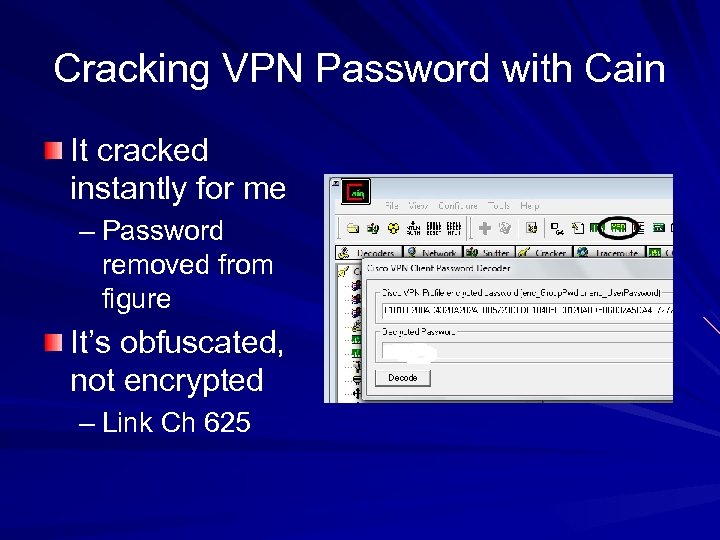 Cracking VPN Password with Cain It cracked instantly for me – Password removed from figure It’s obfuscated, not encrypted – Link Ch 625
 Probing IPsec VPN Servers UDP port 500 Tools – Nmap Basic detection – ike-scan Fingerprinting – IKEProber Older tool Allows attacker to create IKE initiator packets
 Attacking IKE Aggressive Mode IKEProbe can identify whether a VPN server is in Aggressive Mode IKECrack can capture authentication messages and perform an offline brute force attack Cain can also do this
 Hacking Citrix VPNs
 Citrix is Popular 100% of Fortune 100 companies Citrix Access Gateway
 Common Citrix Deployments Remote Desktop – Whole computer desktop accessed remotely Commercial Off-The-Shelf (COTS) application – Often Microsoft Office Custom application – Often too insecure to expose to the Internet
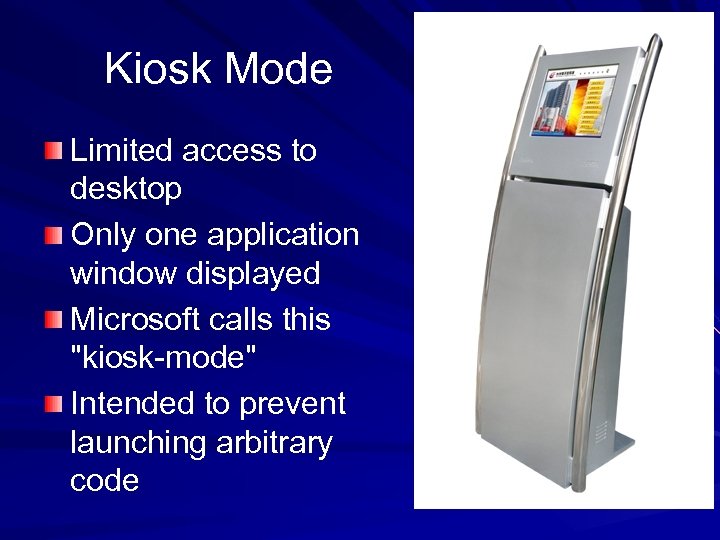 Kiosk Mode Limited access to desktop Only one application window displayed Microsoft calls this "kiosk-mode" Intended to prevent launching arbitrary code
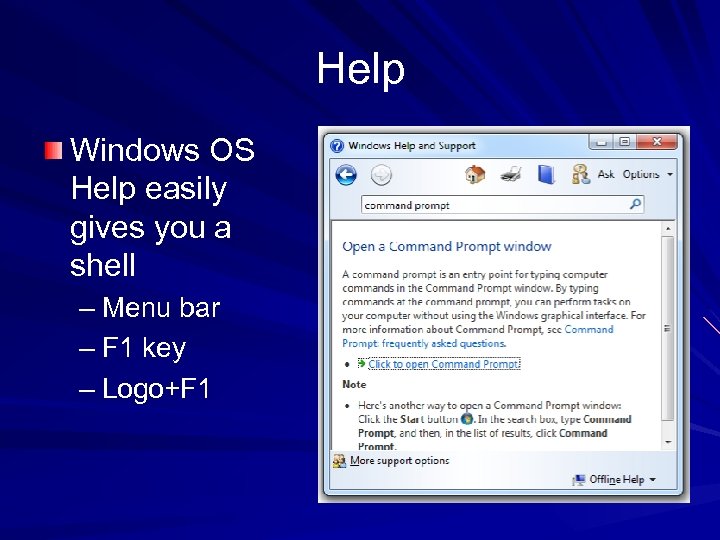 Help Windows OS Help easily gives you a shell – Menu bar – F 1 key – Logo+F 1
 Microsoft Office Ways to spawn a shell – Help – Printing – Hyperlinks – Saving – Visual Basic for Applications (VBA)
 Using VBA in MS Office to Spawn a Shell Alt+F 11 opens a VBA editor Right-click in left pane, Insert, Module Enter this script – Sub get. CMD() – Shell "cmd. exe /c cmd. exe" – End Sub Press F 5 to run it
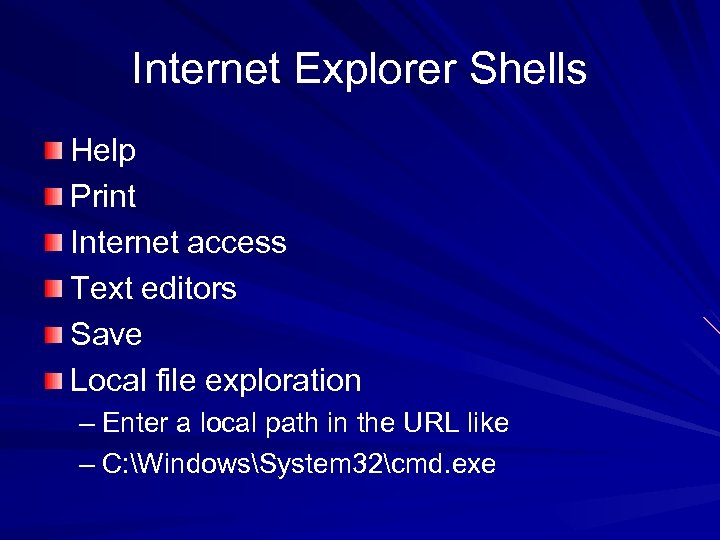 Internet Explorer Shells Help Print Internet access Text editors Save Local file exploration – Enter a local path in the URL like – C: WindowsSystem 32cmd. exe
 Microsoft Games and Calculator Help "About Calculator"
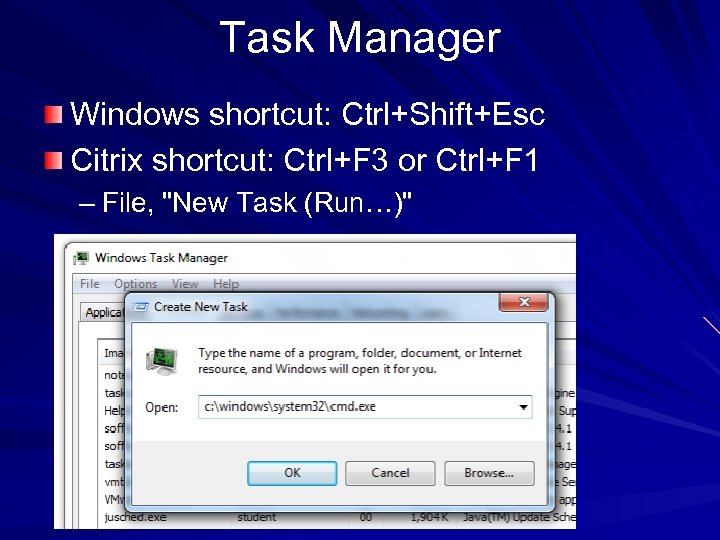 Task Manager Windows shortcut: Ctrl+Shift+Esc Citrix shortcut: Ctrl+F 3 or Ctrl+F 1 – File, "New Task (Run…)"
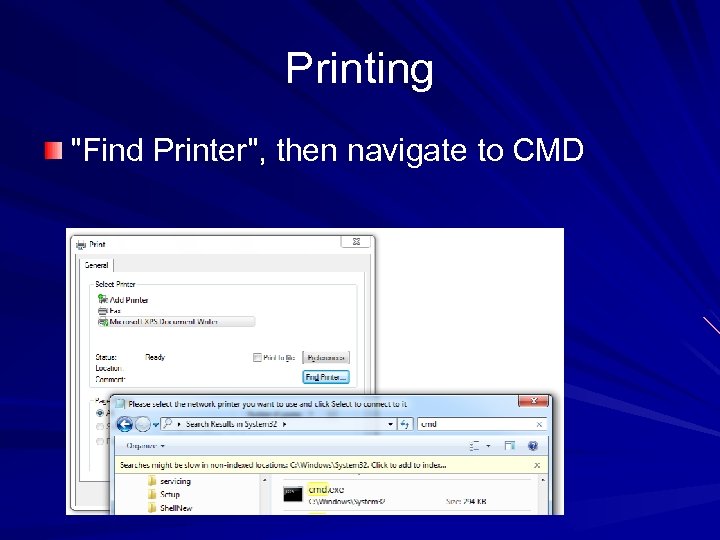 Printing "Find Printer", then navigate to CMD
 Hyperlinks Just type into the application – file: ///c: /windows/system 32/cmd. exe – Enter, Shift+Click to launch CMD
 Internet Access Post cmd. exe on a Web site Download & run it Use SET to post a malicious Java applet & run it
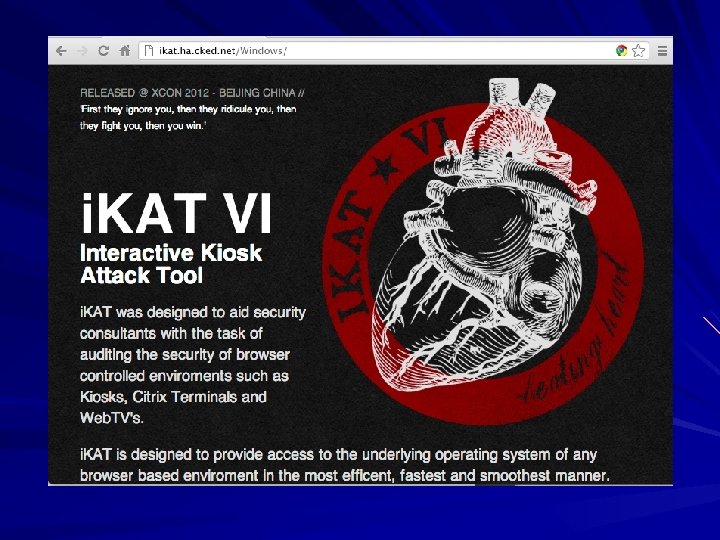
 EULAs/Text Editors If EULA is spawned in Notpad, Wordpad, or a similar text editor – Help – Print – Click a link – Save
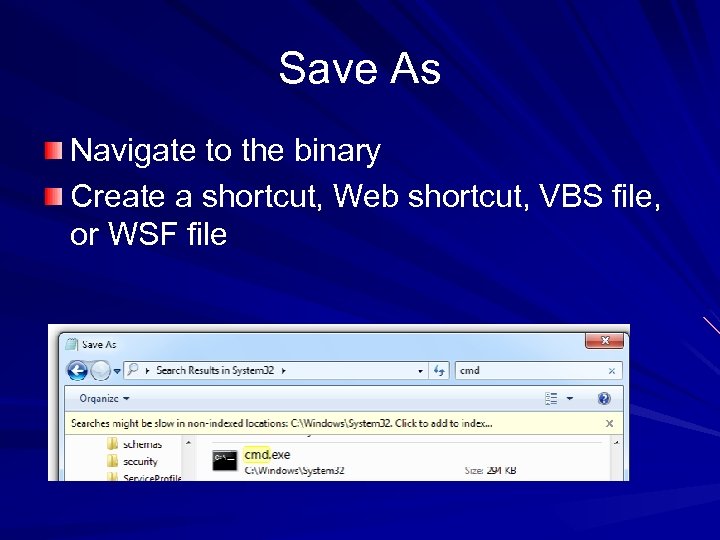 Save As Navigate to the binary Create a shortcut, Web shortcut, VBS file, or WSF file
 Citrix Hacking Countermeasures Place Citrix instances in a segmented VPN Multifactor authentication
 Voice Over IP (Vo. IP) Attacks
 Voice over IP (Vo. IP) Voice on an IP Network Most Vo. IP solutions rely on multiple protocols, at least one for signaling and one for transport of the encoded voice traffic The two most common signaling protocols are H. 323 and Session Initiation Protocol (SIP) – Their role is to manage call setup, modification, and closing
 H. 323 is a suite of protocols – Defined by the International Telecommunication Union (ITU – The deployed base is larger than SIP – Encoding is ASN. 1 – different than text, a bit like C++ Data Structures (link Ch 618) – Designed to make integration with the public switched telephone network (PSTN) easier
 Session Initiation Protocol (SIP) The Internet Engineering Task Force (IETF) protocol People are migrating from H. 323 to SIP Used to signal voice traffic, and also other data like instant messaging (IM) Similar to the HTTP protocol The encoding is text (UTF 8) SIP uses port 5060 (TCP/UDP) for communication
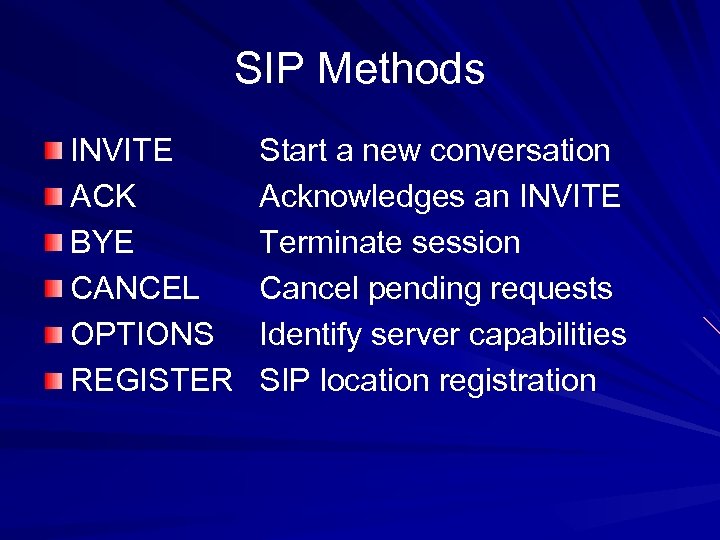 SIP Methods INVITE ACK BYE CANCEL OPTIONS REGISTER Start a new conversation Acknowledges an INVITE Terminate session Cancel pending requests Identify server capabilities SIP location registration
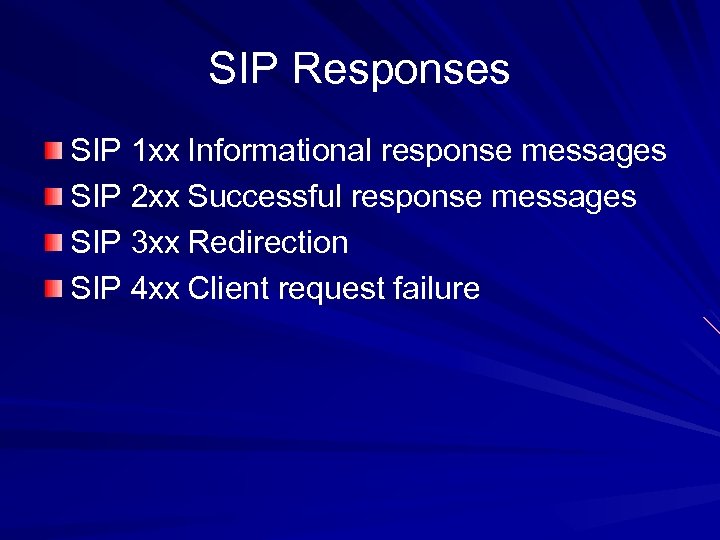 SIP Responses SIP 1 xx Informational response messages SIP 2 xx Successful response messages SIP 3 xx Redirection SIP 4 xx Client request failure
 Real-time Transport Protocol (RTP) Transports the encoded voice traffic Control channel for RTP is provided by the Real-time Control Protocol (RTCP) Consists mainly of quality of service (Qo. S) information (delay, packet loss, jitter, and so on) – Timing is more critical for Vo. IP than other IP traffic
 Link Ch 7 c
 Pillaging TFTP SIP phones load configuration settings from TFTP servers on boot-up – Files contain usernames, passwords, etc. – Security through obscurity: filenames are "secret" Scan for UDP port 69 to find TFTP server Brute force the filenames
 Pillaging TFTP Countermeasures Network-layer access restrictions – Only allow known Vo. IP phones to access the TFTP server Disable access to the settings menu on IP phones Disable Web server on IP phones Use signed configuration files to prevent tampering
 Enumerating Vo. IP Users Wardialing works, of course But there are other techniques for Vo. IP, specific to the SIP Gateway Two open source SIP Gateways – Asterisk – SIP Express Router Cisco Vo. IP Systems
 Asterisk REGISTER Messages
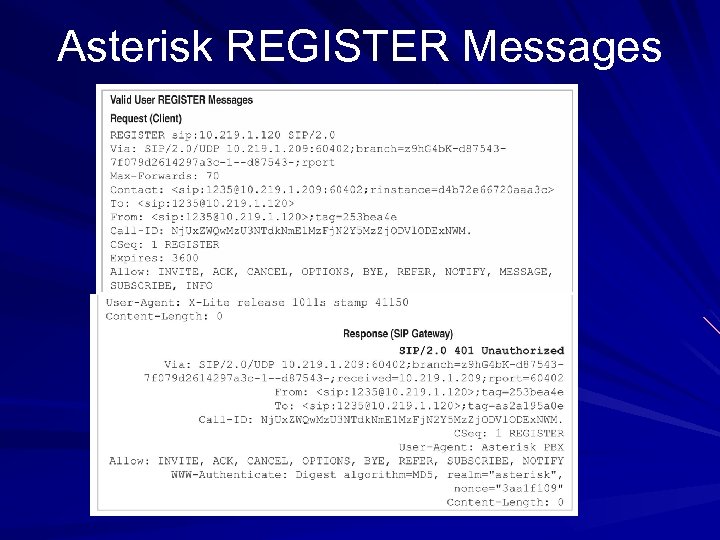
 Asterisk REGISTER User Enumeration User agent identifies the server REGISTER request with a valid username but unauthorized returns 401 error REGISTER request with invalid username returns 403 error User enumeration is easy : )
 SIP Express OPTIONS User Enumeration Same trick works – OPTIONS with valid user returns 200 – OPTIONS with invalid user returns 404: User Not Found
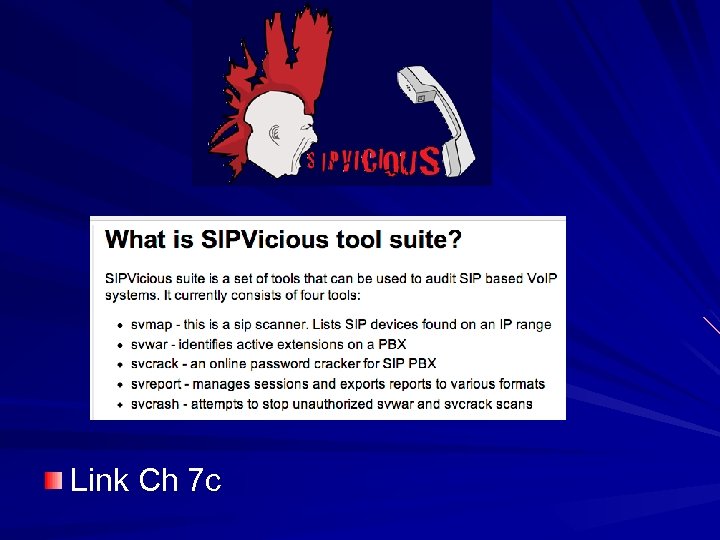
 SIPVicious svwar Enumerates users with OPTIONS, REGISTER, and INVITE techniques Other tools – Si. Vu. S – SIPScan – sipsak
 Cisco IP Phone Boot Process 1. Phone sends Cisco Discovery Protocol (CDP) Voice VLAN Query request 2. A Cisco device in range responds with the Voice VLAN information 3. The phone configures that VLAN on its Ethernet port 4. Phone sends DHCP request to find TFTP server
 Cisco IP Phone Boot Process 5. DHCP server tells the phone the TFTP server's address 6. Phone downloads Certificate Trust List, Initial Trust List, and phone configuration from the TFTP server 7. Configuration file contains all settings needed to register the phone with the call server
 Cisco User Enumeration Cisco Directory Services can be dumped completely with Automated Corporate Enumerator
 Vo. IP Enumeration Countermeasures Segment networks Place IDS/IPS systems in strategic areas Software developers need to fix these vulns
 Interception Attacks Use ARP poisoning to get in the middle Sniff UDP traffic Identify RTP codec – G. 711 is "toll quality" but uses a lot of bandwidth – G. 729 uses less bandwidth but lowers call quality – G. 722 is common in enterprises today; same bandwidth consumed as G. 711 but better quality
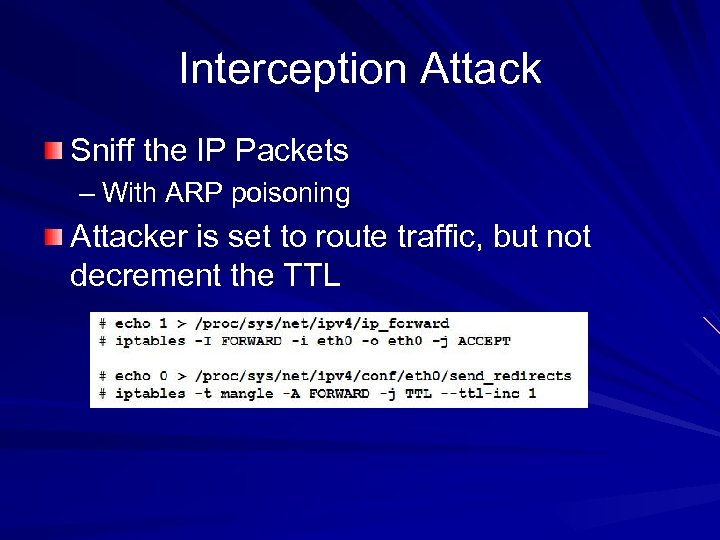 Interception Attack Sniff the IP Packets – With ARP poisoning Attacker is set to route traffic, but not decrement the TTL
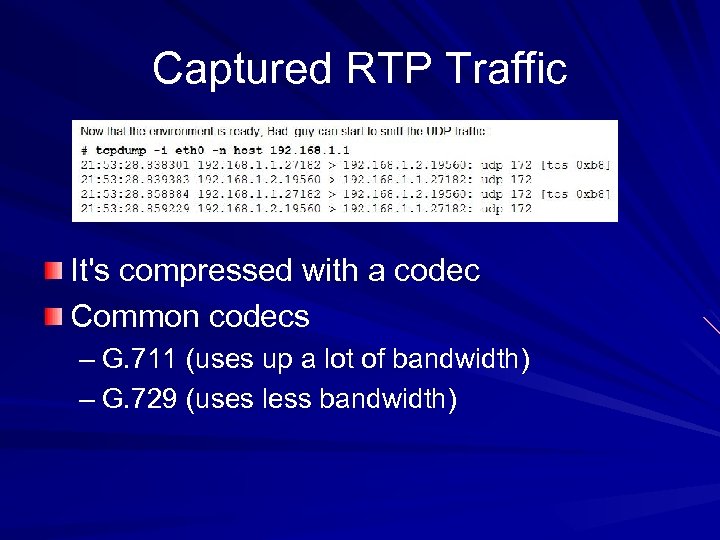 Captured RTP Traffic It's compressed with a codec Common codecs – G. 711 (uses up a lot of bandwidth) – G. 729 (uses less bandwidth)
 VOMIT vomit - voice over misconfigured internet telephones – Converts G. 711 to WAV – It works because many IP phones don't or can't encrypt traffic – Link Ch 620 Scapy is an even better tool, plays traffic from eth 0 right out the speakers – Link Ch 621
 Playing the Captured Traffic Wireshark VOMIT scapy UCSniff handles many codecs
 Offline Analysis Wireshark can play streams Dialed numbers appear in Wireshark packet parsing
 Interception Countermeasures Encryption: Secure RTP, TLS, and Multimedia Internet Keying (MIKEY) – Often disabled for performance Layer 7 firewall can block rogue RTP traffic and Do. S attacks Signed configuration and firmware files
 Denial of Service SIP INVITE flood Flood with any sort of traffic Countermeasures – Network segmentation – Encrypted protocols
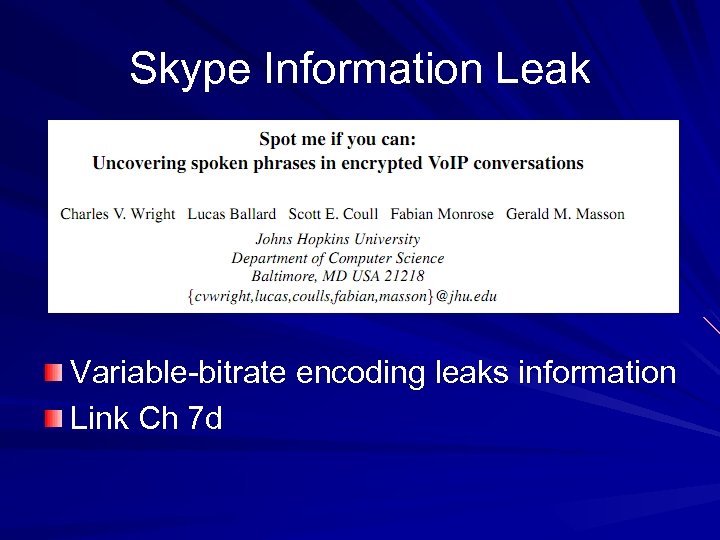 Skype Information Leak Variable-bitrate encoding leaks information Link Ch 7 d