


 Скачать презентацию Chapter 7 Power and Politics Chapter 7 Stephen
Chapter 7-Power & Politics.ppt
- Количество слайдов: 32
 Chapter 7 Power and Politics Chapter 7, Stephen P. Robbins and Nancy Langton, Fundamentals of Organizational Behaviour, Second Canadian Edition. Copyright © 2004 Pearson Education Canada Inc.
 Chapter Outline • • • A Definition of Power Bases of Power Dependency: The Key to Power Influence Tactics Empowerment: Giving Power to Employees The Abuse of Power: Harassment in the Workplace • Politics: Power in Action Chapter 7, Nancy Langton and Stephen P. Robbins, Fundamentals of Organizational Behaviour, Third Canadian Edition Copyright © 2007 Pearson Education Canada 7 -2
 Power and Politics 1. 2. 3. 4. 5. 6. 7. Questions for Consideration What is power? How does one get power? How does dependency affect power? What tactics can be used to increase power? What does it mean to be empowered? How are power and harassment related? Why do people engage in politics? Chapter 7, Stephen P. Robbins and Nancy Langton, Fundamentals of Organizational Behaviour, Second Canadian Edition. Copyright © 2004 Pearson Education Canada Inc.
 Power and Politics • Power • Politics Chapter 7, Stephen P. Robbins and Nancy Langton, Fundamentals of Organizational Behaviour, Second Canadian Edition. Copyright © 2004 Pearson Education Canada Inc.
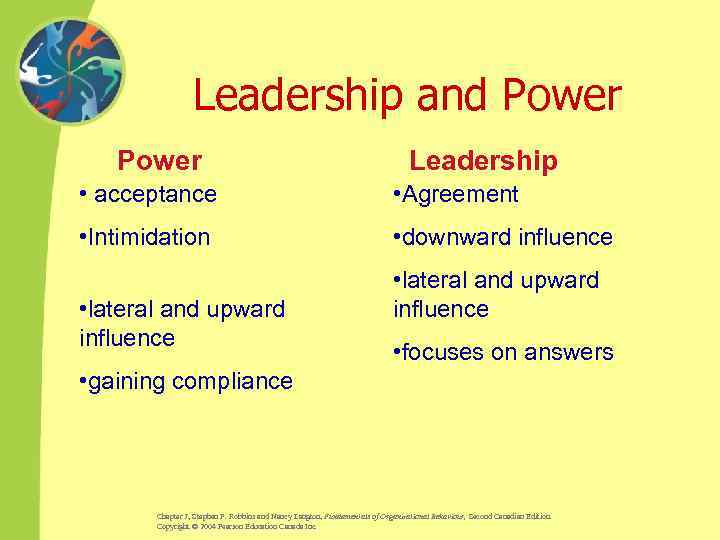 Leadership and Power Leadership • acceptance • Agreement • Intimidation • downward influence • lateral and upward influence • focuses on answers • gaining compliance Chapter 7, Stephen P. Robbins and Nancy Langton, Fundamentals of Organizational Behaviour, Second Canadian Edition. Copyright © 2004 Pearson Education Canada Inc.
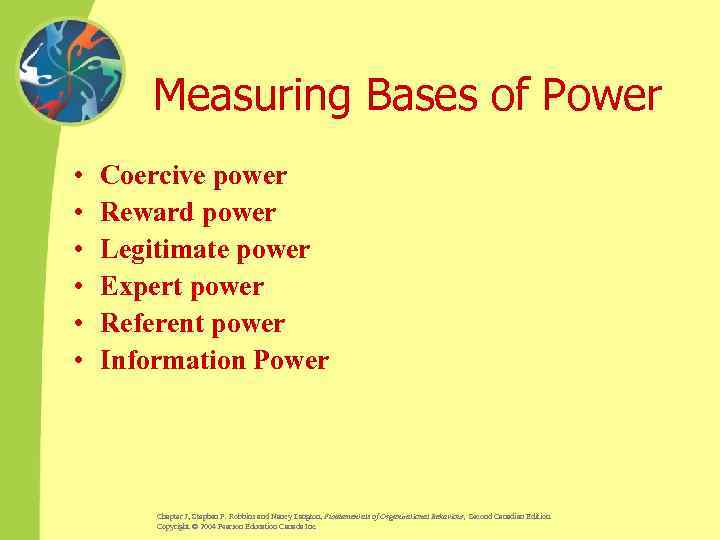 Measuring Bases of Power • • • Coercive power Reward power Legitimate power Expert power Referent power Information Power Chapter 7, Stephen P. Robbins and Nancy Langton, Fundamentals of Organizational Behaviour, Second Canadian Edition. Copyright © 2004 Pearson Education Canada Inc.
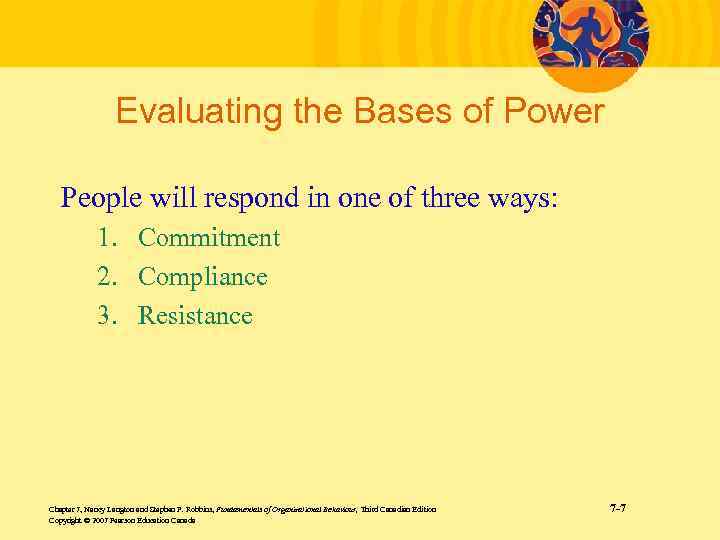 Evaluating the Bases of Power People will respond in one of three ways: 1. Commitment 2. Compliance 3. Resistance Chapter 7, Nancy Langton and Stephen P. Robbins, Fundamentals of Organizational Behaviour, Third Canadian Edition Copyright © 2007 Pearson Education Canada 7 -7
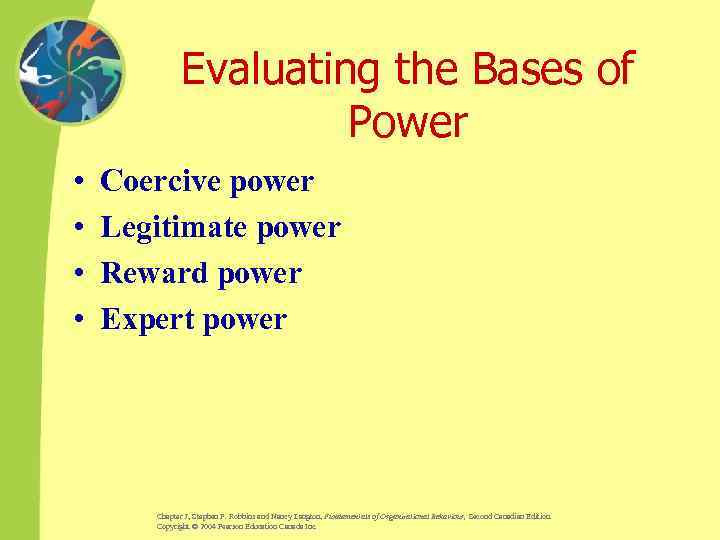 Evaluating the Bases of Power • • Coercive power Legitimate power Reward power Expert power Chapter 7, Stephen P. Robbins and Nancy Langton, Fundamentals of Organizational Behaviour, Second Canadian Edition. Copyright © 2004 Pearson Education Canada Inc.
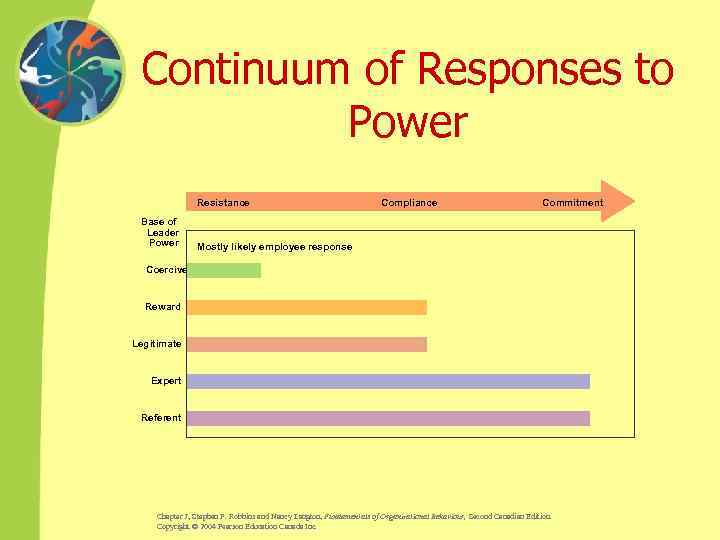 Continuum of Responses to Power Resistance Base of Leader Power Compliance Commitment Mostly likely employee response Coercive Reward Legitimate Expert Referent Chapter 7, Stephen P. Robbins and Nancy Langton, Fundamentals of Organizational Behaviour, Second Canadian Edition. Copyright © 2004 Pearson Education Canada Inc.
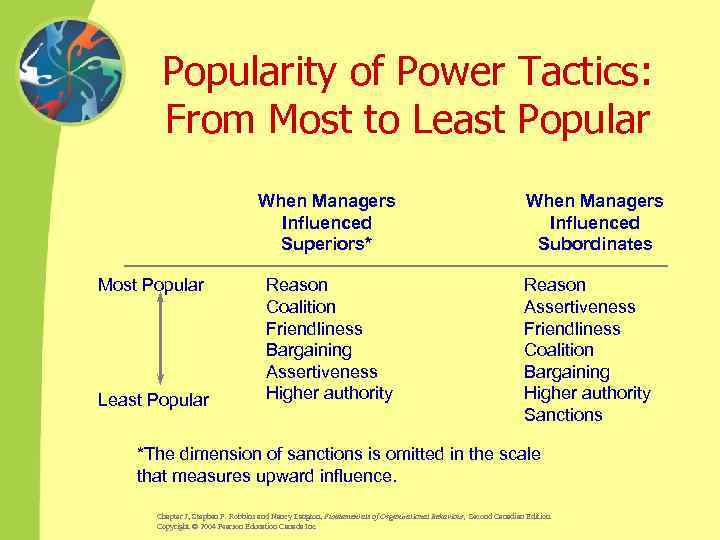 Popularity of Power Tactics: From Most to Least Popular When Managers Influenced Superiors* Most Popular Least Popular Reason Coalition Friendliness Bargaining Assertiveness Higher authority When Managers Influenced Subordinates Reason Assertiveness Friendliness Coalition Bargaining Higher authority Sanctions *The dimension of sanctions is omitted in the scale that measures upward influence. Chapter 7, Stephen P. Robbins and Nancy Langton, Fundamentals of Organizational Behaviour, Second Canadian Edition. Copyright © 2004 Pearson Education Canada Inc.
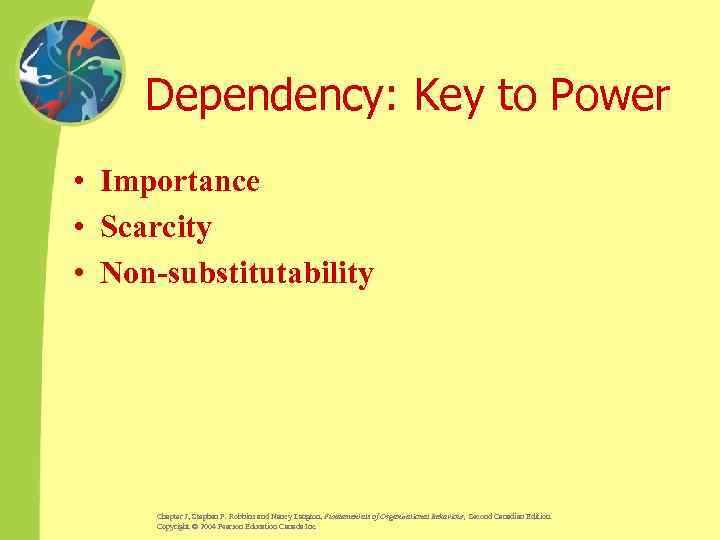 Dependency: Key to Power • Importance • Scarcity • Non-substitutability Chapter 7, Stephen P. Robbins and Nancy Langton, Fundamentals of Organizational Behaviour, Second Canadian Edition. Copyright © 2004 Pearson Education Canada Inc.
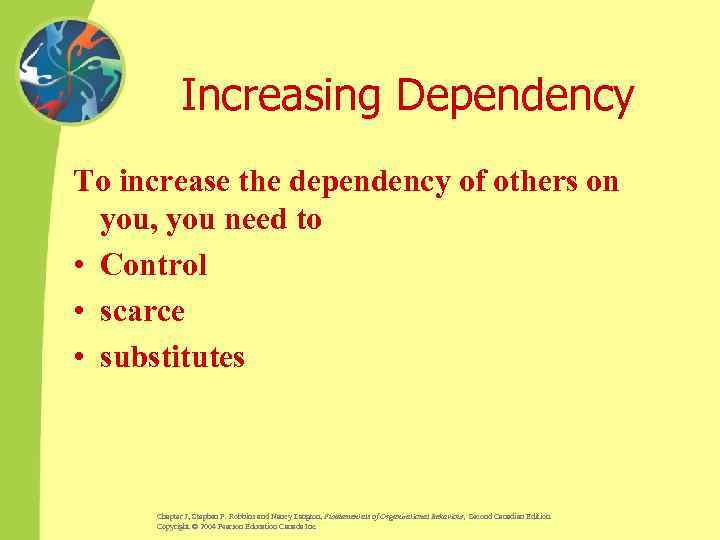 Increasing Dependency To increase the dependency of others on you, you need to • Control • scarce • substitutes Chapter 7, Stephen P. Robbins and Nancy Langton, Fundamentals of Organizational Behaviour, Second Canadian Edition. Copyright © 2004 Pearson Education Canada Inc.
 Empowerment: Giving Power to Employees • The freedom and the ability of employees to make decisions and commitments • Managers disagree over definition of empowerment Chapter 7, Stephen P. Robbins and Nancy Langton, Fundamentals of Organizational Behaviour, Second Canadian Edition. Copyright © 2004 Pearson Education Canada Inc.
 Conditions for True Empowerment • • Clear definitions Relevant skills Support Recognition Chapter 7, Stephen P. Robbins and Nancy Langton, Fundamentals of Organizational Behaviour, Second Canadian Edition. Copyright © 2004 Pearson Education Canada Inc.
 Characteristics of Empowered People • Sense of self-determination • Sense of meaning • Sense of competence • Sense of impact Chapter 7, Stephen P. Robbins and Nancy Langton, Fundamentals of Organizational Behaviour, Second Canadian Edition. Copyright © 2004 Pearson Education Canada Inc.
 The Abuse of Power: Workplace Bullying • Bullying can happen across levels of the organization, or among co-workers. Chapter 7, Nancy Langton and Stephen P. Robbins, Fundamentals of Organizational Behaviour, Third Canadian Edition Copyright © 2007 Pearson Education Canada 7 -16
 The Abuse of Power: Sexual Harassment • The Supreme Court of Canada defines sexual harassment as – Unwelcome behaviour of a sexual nature in the workplace that negatively affects the work environment or leads to adverse job-related consequences for the employee. Chapter 7, Nancy Langton and Stephen P. Robbins, Fundamentals of Organizational Behaviour, Third Canadian Edition Copyright © 2007 Pearson Education Canada 7 -17
 Examples of Sexual Harassment • There is disagreement as to what specifically constitutes sexual harassment. Chapter 7, Nancy Langton and Stephen P. Robbins, Fundamentals of Organizational Behaviour, Third Canadian Edition Copyright © 2007 Pearson Education Canada 7 -18
 Examples of Sexual Harassment • More subtle forms (harder to interpret) – Unwanted looks or comments – Off-colour jokes – Sexual artifacts such as nude calendars in the workplace – Sexual innuendo – Misinterpretations of where the line between “being friendly” ends and “harassment” begins Chapter 7, Stephen P. Robbins and Nancy Langton, Fundamentals of Organizational Behaviour, Second Canadian Edition. Copyright © 2004 Pearson Education Canada Inc.
 Politics: Power in Action • Those activities that influence, or attempt to influence, the distribution of advantages and disadvantages within the organization. Chapter 7, Stephen P. Robbins and Nancy Langton, Fundamentals of Organizational Behaviour, Second Canadian Edition. Copyright © 2004 Pearson Education Canada Inc.
 Why Do We Get Politics? • differing values • Resources • Performance outcomes Chapter 7, Stephen P. Robbins and Nancy Langton, Fundamentals of Organizational Behaviour, Second Canadian Edition. Copyright © 2004 Pearson Education Canada Inc.
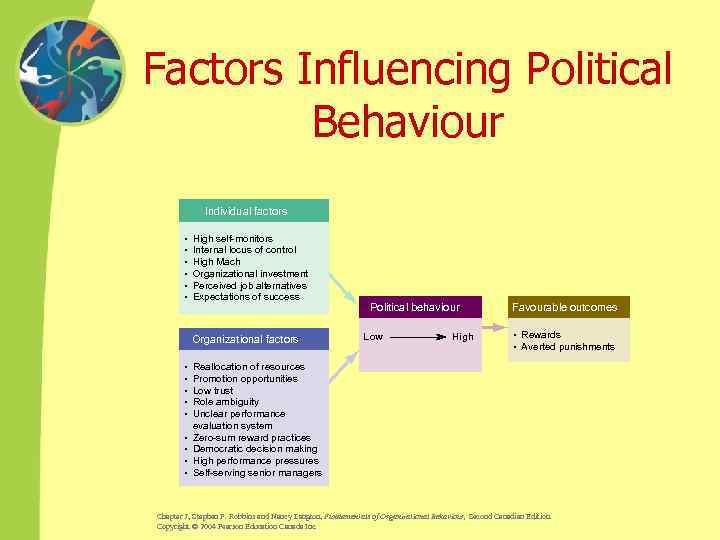 Factors Influencing Political Behaviour Individual factors • • • High self-monitors Internal locus of control High Mach Organizational investment Perceived job alternatives Expectations of success Organizational factors • • • Political behaviour Low High Favourable outcomes • Rewards • Averted punishments Reallocation of resources Promotion opportunities Low trust Role ambiguity Unclear performance evaluation system Zero-sum reward practices Democratic decision making High performance pressures Self-serving senior managers Chapter 7, Stephen P. Robbins and Nancy Langton, Fundamentals of Organizational Behaviour, Second Canadian Edition. Copyright © 2004 Pearson Education Canada Inc.
 Influence Tactics • • • Rational persuasion Inspirational appeals Consultation Ingratiation Personal appeals Exchange Coalition tactics Pressure Legitimating tactics Chapter 7, Nancy Langton and Stephen P. Robbins, Fundamentals of Organizational Behaviour, Third Canadian Edition Copyright © 2007 Pearson Education Canada 7 -23
 What Individual Factors Contribute to Politics? • • • High self-monitors Internal locus of control High mach Organizational investment Perceived job alternatives Expectations of success Chapter 7, Stephen P. Robbins and Nancy Langton, Fundamentals of Organizational Behaviour, Second Canadian Edition. Copyright © 2004 Pearson Education Canada Inc.
 What Organizational Factors Contribute to Politics? • • • Reallocation of rewards Promotion opportunities Low trust Role ambiguity Unclear performance evaluation system Zero-sum reward practices Democratic decision-making High performance pressure Self-serving senior managers Chapter 7, Stephen P. Robbins and Nancy Langton, Fundamentals of Organizational Behaviour, Second Canadian Edition. Copyright © 2004 Pearson Education Canada Inc.
 Types of Political Activity • • • Attacking Control coalitions Networking obligations impressions Chapter 7, Stephen P. Robbins and Nancy Langton, Fundamentals of Organizational Behaviour, Second Canadian Edition. Copyright © 2004 Pearson Education Canada Inc.
 Impression Management • The process by which individuals attempt to control the impression others form of them • More likely used by high self-monitors than low self-monitors Chapter 7, Stephen P. Robbins and Nancy Langton, Fundamentals of Organizational Behaviour, Second Canadian Edition. Copyright © 2004 Pearson Education Canada Inc.
 • • Exhibit 7 -8 Impression Management (IM) Techniques Conformity Excuses Apologies Acclamations Flattery Favours Association Chapter 7, Stephen P. Robbins and Nancy Langton, Fundamentals of Organizational Behaviour, Second Canadian Edition. Copyright © 2004 Pearson Education Canada Inc.
 Concepts to Skills: Politicking • • Framing arguments Right image Organizational resources Indispensable Visible Allies Other members Support Chapter 7, Stephen P. Robbins and Nancy Langton, Fundamentals of Organizational Behaviour, Second Canadian Edition. Copyright © 2004 Pearson Education Canada Inc.
 Making Office Politics Work • • Nobody - everybody opinions paid back opposition Chapter 7, Stephen P. Robbins and Nancy Langton, Fundamentals of Organizational Behaviour, Second Canadian Edition. Copyright © 2004 Pearson Education Canada Inc.
 Summary and Implications • Power is a two-way street. • Few employees relish being powerless in their jobs and organization. • People respond differently to various power bases. • Expert power is the most strongly and consistently related to effective employee performance. Chapter 7, Stephen P. Robbins and Nancy Langton, Fundamentals of Organizational Behaviour, Second Canadian Edition. Copyright © 2004 Pearson Education Canada Inc.
 Summary and Implications • The power of the manager may also play a role in determining job satisfaction. • The effective manager accepts the political nature of organizations. • The more political that employees perceive an organization, the lower their satisfaction. • Regardless of level in the organization, some people are more politically “astute” than others. • The politically naive and inept tend to feel continually powerless. Chapter 7, Stephen P. Robbins and Nancy Langton, Fundamentals of Organizational Behaviour, Second Canadian Edition. Copyright © 2004 Pearson Education Canada Inc.