Скачать презентацию Chapter 7 parties and interest groups I Political
a970dd5de1fc10955d2d2bc2222abac5.ppt
- Количество слайдов: 12
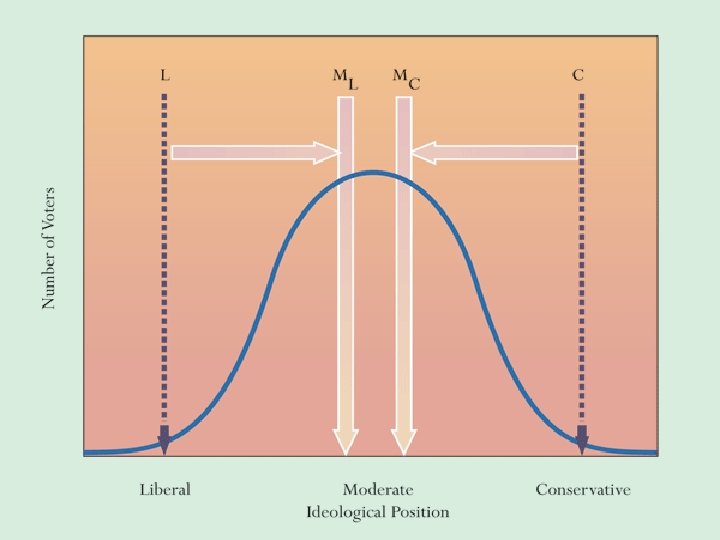
 Chapter 7 (parties and interest groups) I. Political organization – parties and groups that function as intermediaries between individuals and government. • Political Parties – organizations that seek to achieve power by winning public office. • Interest Groups – organizations seeking to ______ government policy. II. Political Parties and Democratic Government A. “Responsible” Party system – System in which competitive parties adopt principles, recruit candidates and direct campaigns based upon the ______, and hold their elected officials responsible for enacting it. (parties are powerful and essential). B. Winning trumps _______ system – “Winning has generally been more important than any principles or policies” in the U. S. Parties in the U. S. are more concerned with vote-maximizing that platforms. Since more votes are at the _____ of the distribution, a middle-of-the-road approach is attractive in our system (Fig. 7. 3). C. However, since the 1970 s, we have seen steady party polarization. See Table 7. 1/Fig. 7. 4
 D. Erosion of Traditional party functions • today, parties play less of a role in recruiting candidates. • the primary system now selects the party’s ______, not party leaders. • parties are not as needed as a means of communication with voters. Candidates can do that themselves (i. e. web, tv, radio…). • parties have _____ control over the politician’s behavior once in office. Politicians do not have to “play-ball” with party leaders. • American political parties no longer perform social welfare functions (trading off social services in exchange for votes) because ______ does that.
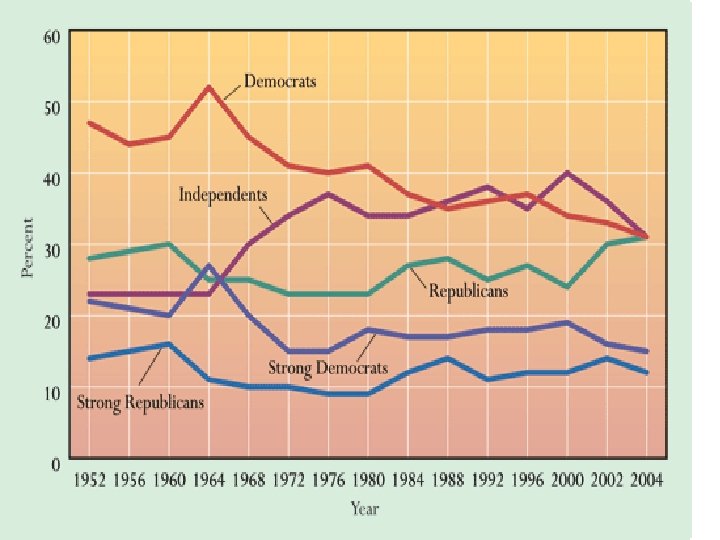
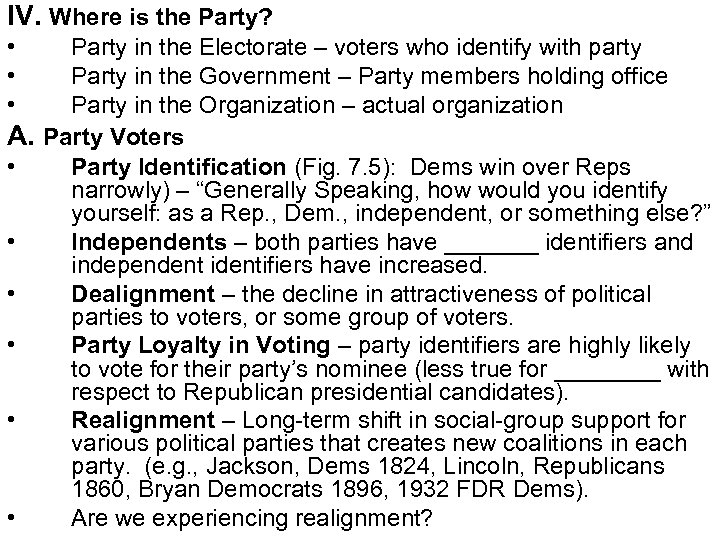 IV. Where is the Party? • • • Party in the Electorate – voters who identify with party Party in the Government – Party members holding office Party in the Organization – actual organization A. Party Voters • Party Identification (Fig. 7. 5): Dems win over Reps narrowly) – “Generally Speaking, how would you identify yourself: as a Rep. , Dem. , independent, or something else? ” • Independents – both parties have _______ identifiers and independent identifiers have increased. • Dealignment – the decline in attractiveness of political parties to voters, or some group of voters. • Party Loyalty in Voting – party identifiers are highly likely to vote for their party’s nominee (less true for ____ with respect to Republican presidential candidates). • Realignment – Long-term shift in social-group support for various political parties that creates new coalitions in each party. (e. g. , Jackson, Dems 1824, Lincoln, Republicans 1860, Bryan Democrats 1896, 1932 FDR Dems). • Are we experiencing realignment?
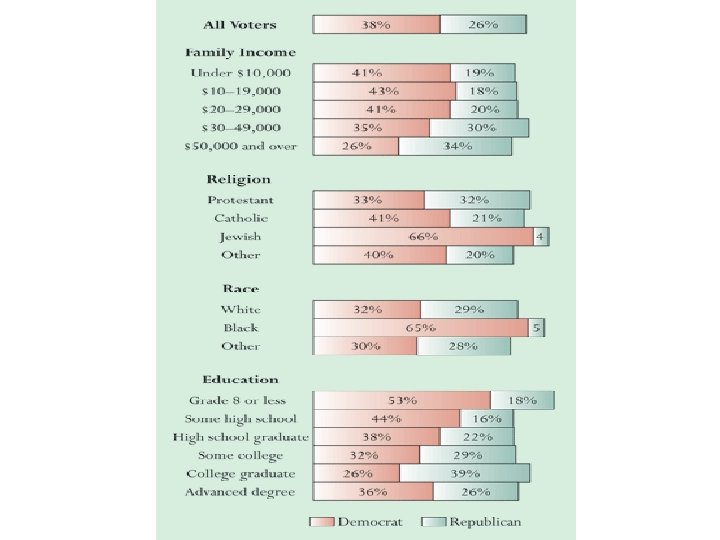
 Yes: socioeconomic cleavages have largely given way to cleavages based on ideology, gender, religion, and race. Party in government is _______. No: No new majority party has emerged and it is happening too slowly to tell right now. VI. Who is in the parties? Income, education are positively related to Republican Identification. Other groupings: T-47, figure 11. 4 p 410) VII. Why the two-party system? Many other democracies have ______ party systems; why not us? Third parties are not successful (Table 7. 4 next slide) • Cultural Consensus – Americans share the same political values relative to most other industrialized democracies. • Winner-take-all-electoral system (U. S. ) – winners are determined by plurality; winner takes all. Only one party or voting coalition can win an election. Losers get _______. There is no incentive for a party to form and represent the views of a few percentage of the population (two main parties stay at the center where the majority of votes are).
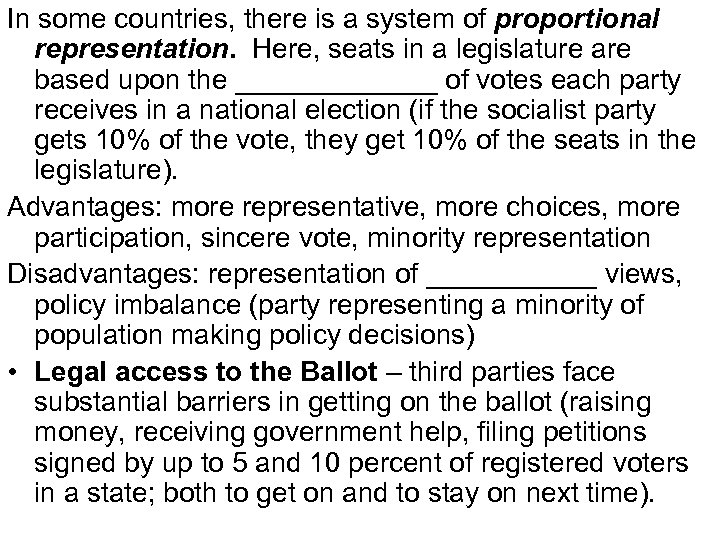 In some countries, there is a system of proportional representation. Here, seats in a legislature are based upon the _______ of votes each party receives in a national election (if the socialist party gets 10% of the vote, they get 10% of the seats in the legislature). Advantages: more representative, more choices, more participation, sincere vote, minority representation Disadvantages: representation of ______ views, policy imbalance (party representing a minority of population making policy decisions) • Legal access to the Ballot – third parties face substantial barriers in getting on the ballot (raising money, receiving government help, filing petitions signed by up to 5 and 10 percent of registered voters in a state; both to get on and to stay on next time).
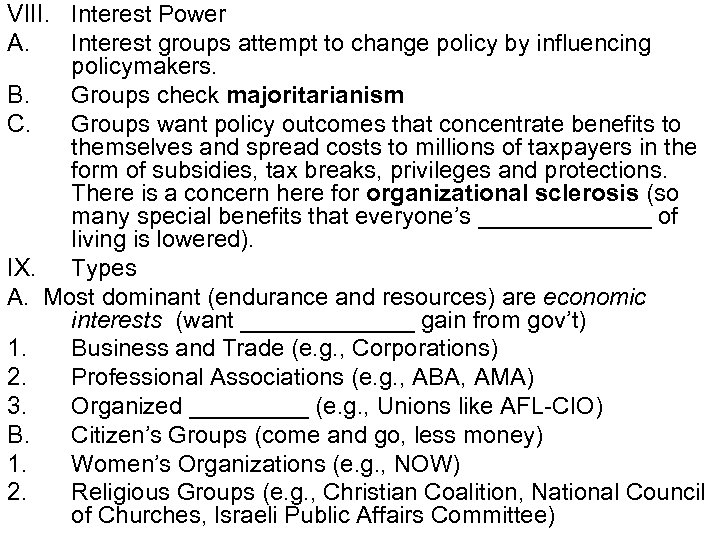 VIII. Interest Power A. Interest groups attempt to change policy by influencing policymakers. B. Groups check majoritarianism C. Groups want policy outcomes that concentrate benefits to themselves and spread costs to millions of taxpayers in the form of subsidies, tax breaks, privileges and protections. There is a concern here for organizational sclerosis (so many special benefits that everyone’s _______ of living is lowered). IX. Types A. Most dominant (endurance and resources) are economic interests (want _______ gain from gov’t) 1. Business and Trade (e. g. , Corporations) 2. Professional Associations (e. g. , ABA, AMA) 3. Organized _____ (e. g. , Unions like AFL-CIO) B. Citizen’s Groups (come and go, less money) 1. Women’s Organizations (e. g. , NOW) 2. Religious Groups (e. g. , Christian Coalition, National Council of Churches, Israeli Public Affairs Committee)
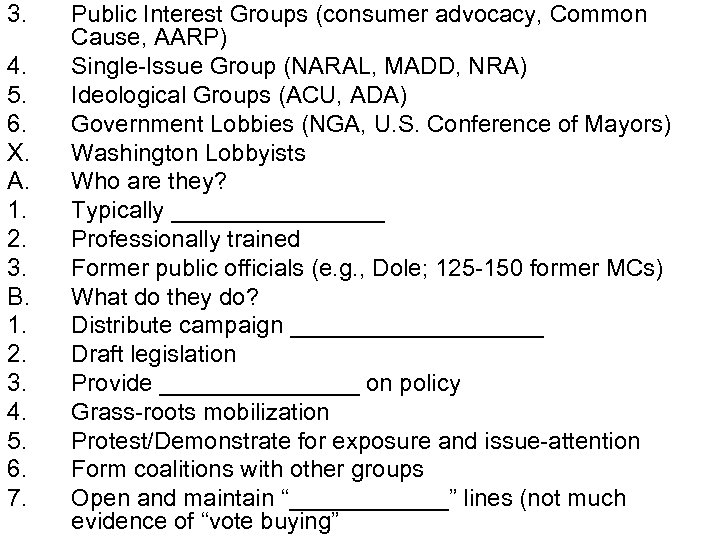 3. 4. 5. 6. X. A. 1. 2. 3. B. 1. 2. 3. 4. 5. 6. 7. Public Interest Groups (consumer advocacy, Common Cause, AARP) Single-Issue Group (NARAL, MADD, NRA) Ideological Groups (ACU, ADA) Government Lobbies (NGA, U. S. Conference of Mayors) Washington Lobbyists Who are they? Typically ________ Professionally trained Former public officials (e. g. , Dole; 125 -150 former MCs) What do they do? Distribute campaign __________ Draft legislation Provide ________ on policy Grass-roots mobilization Protest/Demonstrate for exposure and issue-attention Form coalitions with other groups Open and maintain “______” lines (not much evidence of “vote buying”
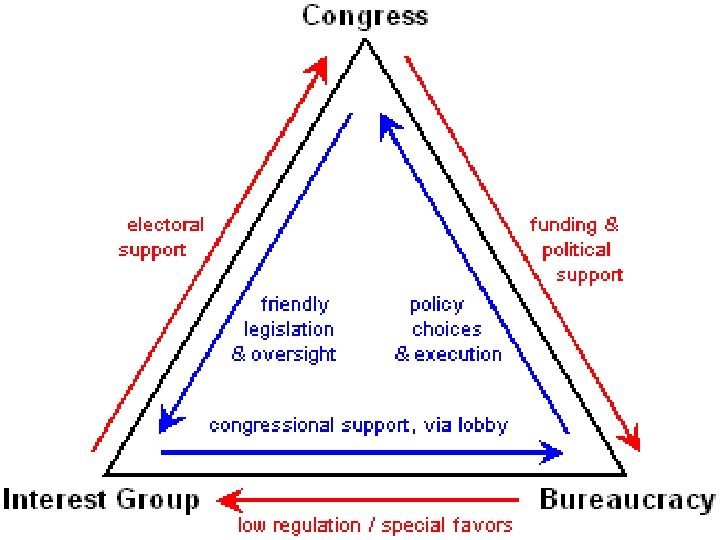
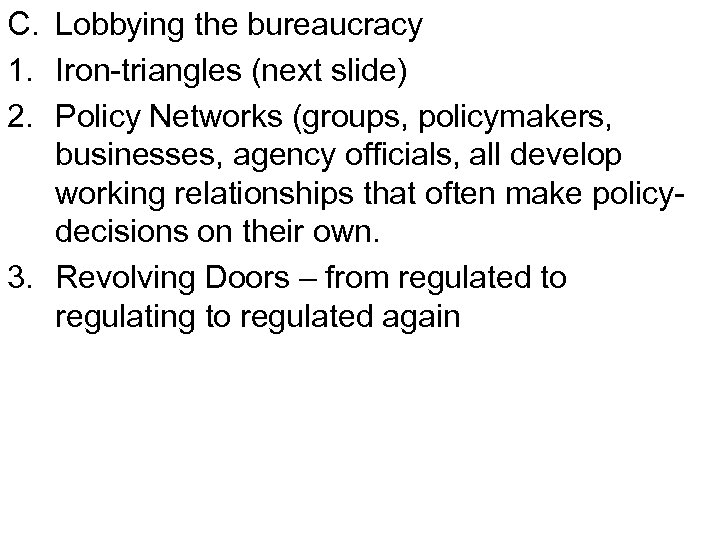 C. Lobbying the bureaucracy 1. Iron-triangles (next slide) 2. Policy Networks (groups, policymakers, businesses, agency officials, all develop working relationships that often make policydecisions on their own. 3. Revolving Doors – from regulated to regulating to regulated again