


 Скачать презентацию Chapter 7 Part II Housekeeping Adlaw Doldrums
b2ef557b00dbbccb06e4d0e8746642ca.ppt
- Количество слайдов: 40
 Chapter 7 Part II
 Housekeeping Adlaw Doldrums! Break for Speaker
 What is the Constitutional Process for Enacting a Law?
 Bicameralism What was the Great Compromise? n Why was it critical to the ratification of the constitution? n How is the senate different from the house? n Why is bicameralism key to making the Great Compromise work? n
 Checks and Balances How is does bicameralism it fit into the checks and balances of the US Constitution? n Does the constitution require the states to have bicameral legislatures? n How does the legislative veto violate bicameralism? n How might presenting this to the senate have changed the n
 Presidential Veto Why does the constitution give the president a veto? n Who did they have in mind as president when they put the veto in? n What can Congress do it the president vetoes a bill? n
 Presentment Clause n n n What is the president’s role once legislation has passed the house and senate? What if he does not sign it? pocket veto - The Constitution grants the President 10 days to review a measure passed by the Congress. If the President has not signed the bill after 10 days, it becomes law without his signature. However, if Congress adjourns during
 When may Houses of Congress Act Unilaterally? n n (a) The House of Representatives alone was given the power to initiate impeachments. Art. I, § 2, cl. 5; (b) The Senate alone was given the power to conduct trials following impeachment on charges initiated by the House and to convict following trial. Art. I, § 3, cl. 6; (c) The Senate alone was given final unreviewable power to approve or to disapprove Presidential appointments. Art. II, § 2, cl. 2; (d) The Senate alone was given unreviewable power to ratify treaties negotiated by the
 What is the significance of these narrow exceptions?
 The Ruling Why did the court find this was a major constitutional issue? n What did the court rule? n Has this crippled government function? n Does it strengthen agency powers? n
 Post-Chadha Congress enacted a law requiring notice of certain agency actions and created a delay in their implementation to allow it to pass a law to override them n It is much harder to do, which leaves the agencies more latitude than before Chadha n
 The Appointments Process n n n The ultimate control over an agency is through hiring and firing agency personnel, or at least through having that option available There are few cases on the appointments process so the constitutional limitations are unclear Understanding the process depends on understanding the legislative framework on the agencies
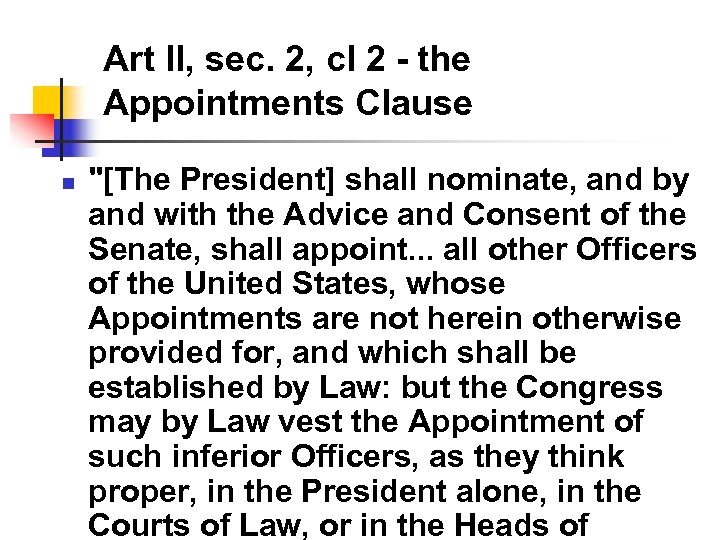 Art II, sec. 2, cl 2 - the Appointments Clause n "[The President] shall nominate, and by and with the Advice and Consent of the Senate, shall appoint. . . all other Officers of the United States, whose Appointments are not herein otherwise provided for, and which shall be established by Law: but the Congress may by Law vest the Appointment of such inferior Officers, as they think proper, in the President alone, in the Courts of Law, or in the Heads of
 Officers of the United States Appointed by the president with advice and consent of the senate n Major policy role and answer to the president n
 Inferior offices Can be appointed by the president, the department heads, or the courts n No advice and consent n
 Limitations in the Enabling Legislation n Congress creates and shapes the executive branch n Without specific appropriations, there would be no White House and the president would have to rent space from his own pocket Congress follows the Constitutional guidelines for appointments n Congress makes the close calls Congress can impose additional requirements n Limitations on who can be appointed as in the FEC n Limitations on removal, as in independent
 Civil Service Congress developed the Civil Service to protect workers from losing their jobs every time the administration changed n Most personnel are civil service and can only be fired for cause with due process n Limited due process for security agencies n
 Pros and Cons of the Civil Service Why is important to you if you want to be a government lawyer? n What are the problems with the system? n How high should it go? n Career track problem for senior people without lucrative outside jobs n
 Tenure of Office Act – 1867 n n n If Congress is silent on removal, the officer serves at the discretion of the President This Act limited the right of presidents to remove cabinet members without the consent of the Senate n President Andrew Johnson removed the Secretary of War n Was impeached, but not removed by one vote There are now no limitations on removal
 Myers v. US, 272 US 52 (1926) – 474 n n Why all this concern about postmasters? President Wilson discharged an Oregon postmaster without cause Postmaster sued for back pay under a law passed after the Tenure in Office Act that required the senate to approve appointment and removal of postmasters Chief Justice and Ex-President Taft wrote the opinion, which found that the Tenure in Office Act and related acts an unconstitutional limit on presidential power.
 Humphrey’s Executor v. US, 295 US 602 (1935) n n n Less than 10 years later, Meyers is again at issue - what is the political change over that period? Why was the FTC controversial at that time? What was the restriction on removing FTC commissioners? n As a post-Myer's requirement, congress only allowed FTC
 Myers Redux n n n How did the lawsuit arise? n President fired Humphrey from the FTC n Humphrey died and his executor sued for the pay for the rest of his term Did the court change its view on the removal power? n The court said this exceeded the president's power What type of agency does this create? n This is the first case to really recognize the independent agency
 Why did the court allow this status for the FTC? n n n The court explains that the FTC exists to carry out specific policies spelled out by congress and is not meant to an arm of the executive branch The court focuses on the quasi-judicial functions of the agency, which were more unusual at the time, but are no longer limited to independent agencies This quasi-judicial analysis has not been important in the latter cases
 How could the president fire an FTC commissioner? n n In theory the president could state a cause and fire a commissioner, but it has not happened Does this mean that they always stay when the president in unhappy with them? It has not been an issue because they get hounded out of office if there is cause This is an area where the presidents have
 Buckley v. Valeo – 464 n n How are the members of the Federal Election Commission (FEC) chosen? n Two members appointed by the President pro tempore of the Senate, two by the Speaker of the House, and two by the President (all subject to confirmation by both Houses of Congress), and the Secretary of the Senate and the Clerk of the House as ex officio nonvoting members What is the legal challenge based on,
 Who may appoint officers other than the president? n n n Courts of Law, or the Heads of Departments Do the Speaker of the House or the president pro tempore of the Senate come under this language? What type of agency is FEC? How does allowing congress to appoint commission members undermine separation of powers? Why did Congress say this was a special
 Congressional Powers n n n Which clause of the constitution does Congress rely on for its power to enact this commission selection process? Why does the court reject this? What agency powers can congress exercise through its own committees? n If this were all the agency does, it could be a congressional committee and does not violate separation of
 The Role of the FEC n n What does FEC do that is forbidden to Congress? Was the selection process for the FEC commissioners constitutional?
 President Nixon and the Independent Counsel What was the Saturday night massacre? n Why do the liberals really hate Bork? n He carried out Nixon's order to fire Cox n Nixon's firing of the independent prosecutor was the background for this law n
 What was Clinton's biggest political mistake? Not vetoing the renewal of the Independent counsel law n Hubris - it had been attacking Republicans and he was going to have the most ethical administration n
 Morrison v. Olson, 487 US 654 (1988) – 478 Why was Olson suing and what did he want? n What triggers the appointment of an independent counsel? n Why will this always be political? n Reno and Gore n Ashcroft and Halliburton n
 Appointing the Independent Prosecutor Who makes the appointment? n Three judge panel appoints the counsel n Can the Independent Counsel be removed by someone under the control of the president? n The AG can remove for good cause, mental disability, or other good reasons n
 How did the court modify Myers/Humphrey? n Changed to a core function standard n Is it an "inferior" official - yes, because of the limited mandate n Is this a critical area for the president to control the exercise of discretion? - no, that is why it is independent n Does the president retain enough control? - yes, good cause is good enough, and this is exercised through someone (AG) the president controls
 What was the key issue in Olson? Key issue is the limitation of the removal power to good cause, rather than at-will n Does this impermissibly interfere with the president's power to carry out the laws? n Majority says no, rejects the use of "quasi-legislative/quasi-judicial" labels and focuses on separation of powers n
 Why is Olsen the wrong person to challenge the law? The problem for Olson in attacking the law is that if the IC is not faithfully carrying out the laws, then there would be good cause to remove him, and if he is, then what is the justification for removing him? n The case would have been much more interesting if the AG had removed the IC and he was suing to continue in his job n
 Intimidation by the IC n n Scalia sees this as a stark limitation on the president's power to exclusively control the executive branch He points out that while the IC may not intimidate the president, it will affect executive branch officers who are subject to what seems political prosecution
 Was Scalia Right? n n n What was he worried about as regards the power of the office? n He stresses the broad powers of the IC What would it cost you to be investigated? Was Scalia right about the impact of the IC?
 Mistretta v. US – 1989 n n This case attacked the US Sentencing Commission as an impermissible limitation on the Judicial Branch What was the purpose of the US Sentencing Commission? n Meant as a liberal attack on disparate sentencing that resulted in the poor and minorities
 How did the Sentencing Commission Affect Sentencing? n n All sentences were made longer and the judges lost discretion to shorten them. n While white collar criminals did more jail time, n First time drug offenders and the like did a lot more time. Often much more than under the previous system Also limited and eliminated various ways to shorten a sentence.
 The Mistretta Ruling n n n The Court upheld this commission because of it peculiar nature, finding that it did not unduly affect the judicial branch Is there any right to judicial discretion? n Probably limited by the power of congress to set sentences - nothing says judges are allowed sentencing discretion Back before the United States Supreme Court this Term on whether allowing