 Скачать презентацию Chapter 7 Networks Mobile Business Mc Graw-Hill Irwin Copyright
506bb816fe04df42c4cc29789bd3bd3f.ppt
- Количество слайдов: 37



Chapter 7 Networks: Mobile Business Mc. Graw-Hill/Irwin Copyright © 2013 by The Mc. Graw-Hill Companies, Inc. All rights reserved.
CHAPTER OVERVIEW Chapter 7 • SECTION 7. 1 – Connectivity: The Business Value of a Networked World § Overview of a Connected World § Benefits of a Connected World § Challenges of a Connected World • SECTION 7. 2 – Mobility: The Business Value of a Wireless World § Wireless Network Categories § Business Applications of Wireless Networks § Benefits of Business Mobility § Challenges of Business Mobility 7 -2
Chapter 7 SECTION 7. 1 CONNECTIVITY 7 -3
LEARNING OUTCOMES Chapter 7 1. Explain the five different networking elements creating a connected world 2. Identify the benefits of a connected world 3. Identify the challenges of a connected world 7 -4
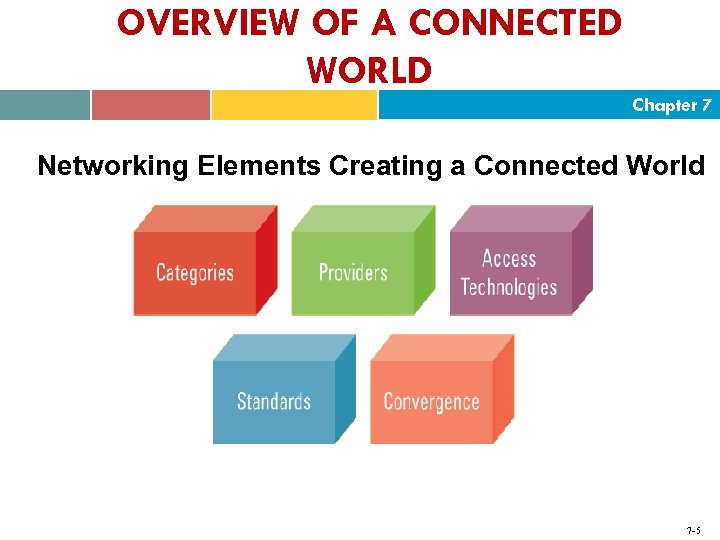
OVERVIEW OF A CONNECTED WORLD Chapter 7 Networking Elements Creating a Connected World 7 -5
Network Categories Chapter 7 • Local area network (LAN) – Connects a group of computers in close proximity, such as in an office building, school, or home • Wide area network (WAN) – Spans a large geographic area such as a state, province, or country • Metropolitan area network (MAN) – A large computer network usually spanning a city 7 -6
Network Providers Chapter 7 • National service providers (NSPs) – Private companies that own and maintain the worldwide backbone that supports the Internet • Network access points (NAPs) – Traffic exchange points in the routing hierarchy of the Internet that connects NSPs • Regional service providers (RSPs) – Offer Internet service by connecting to NSPs, but they also can connect directly to each other 7 -7
Network Access Technologies Chapter 7 • Bandwidth – The maximum amount of data that can pass from one point to another in a unit of time § Bit rate § Modem 7 -8
Network Access Technologies Chapter 7 • Broadband – A high-speed Internet connection that is always connected § Digital subscriber line § Internet cable connection § T 1 lines 7 -9
Network Protocols Chapter 7 • Protocol – A standard that specifies the format of data as well as the rules to be followed during transmission • Transmission control protocol/Internet protocol (TCP/IP) – Provides the technical foundation for the public Internet as well as for large numbers of private networks • Domain name system – Converts IP addresses into domains 7 -10
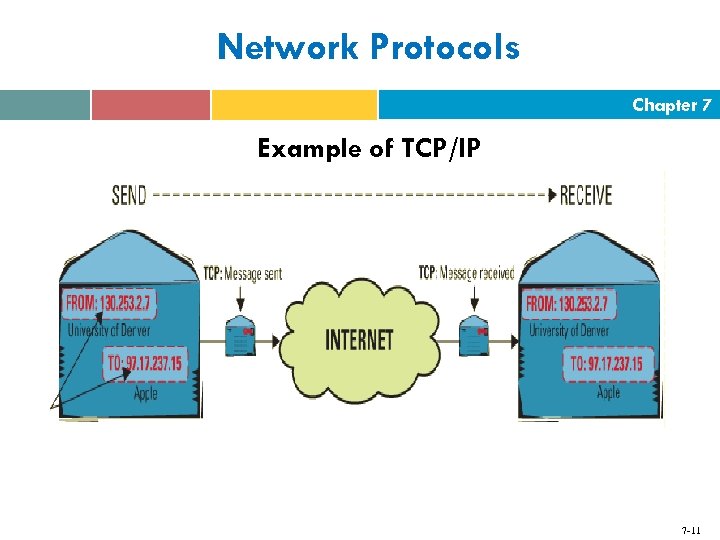
Network Protocols Chapter 7 Example of TCP/IP 7 -11
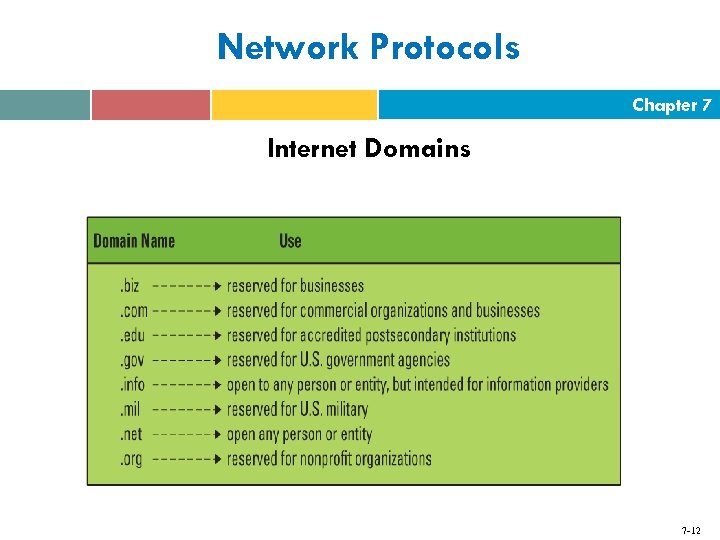
Network Protocols Chapter 7 Internet Domains 7 -12
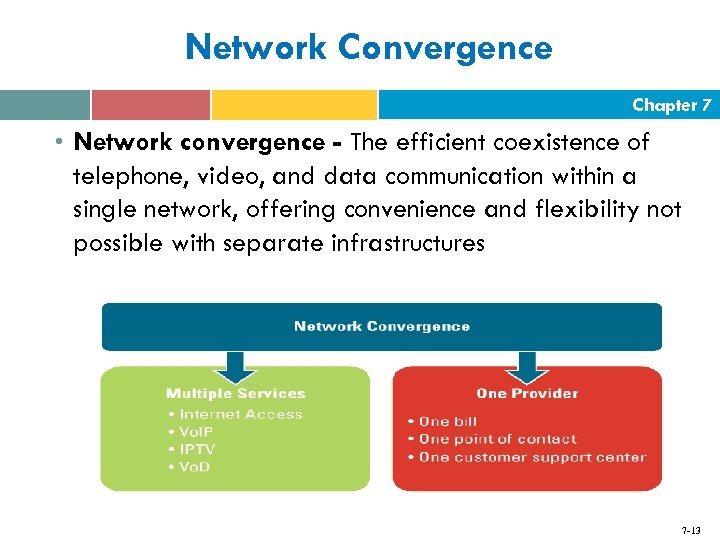
Network Convergence Chapter 7 • Network convergence - The efficient coexistence of telephone, video, and data communication within a single network, offering convenience and flexibility not possible with separate infrastructures 7 -13
Network Convergence Chapter 7 • Unified communication (UC) – The integration of communication channels into a single service • Peer-to-peer (P 2 P) – A computer network that relies on the computing power and bandwidth of the participants in the network rather than a centralized server 7 -14
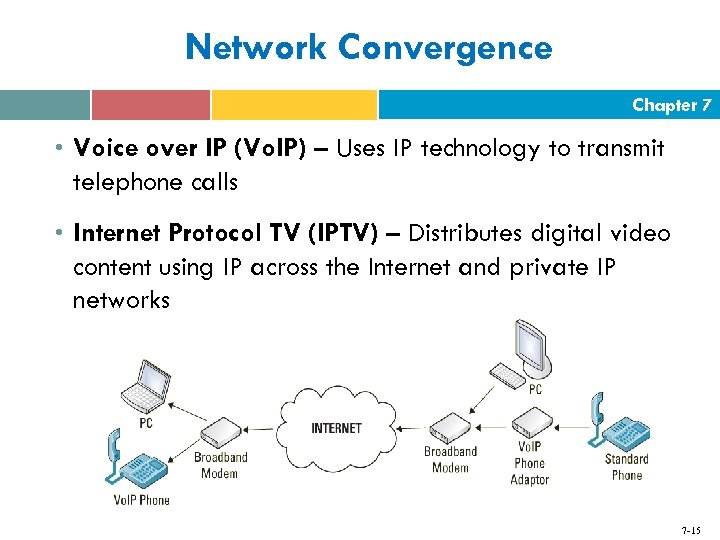
Network Convergence Chapter 7 • Voice over IP (Vo. IP) – Uses IP technology to transmit telephone calls • Internet Protocol TV (IPTV) – Distributes digital video content using IP across the Internet and private IP networks 7 -15
BENEFITS OF A CONNECTED WORLD Chapter 7 • Networks offer many advantages for a business, including § Sharing resources § Providing opportunities § Reducing travel 7 -16
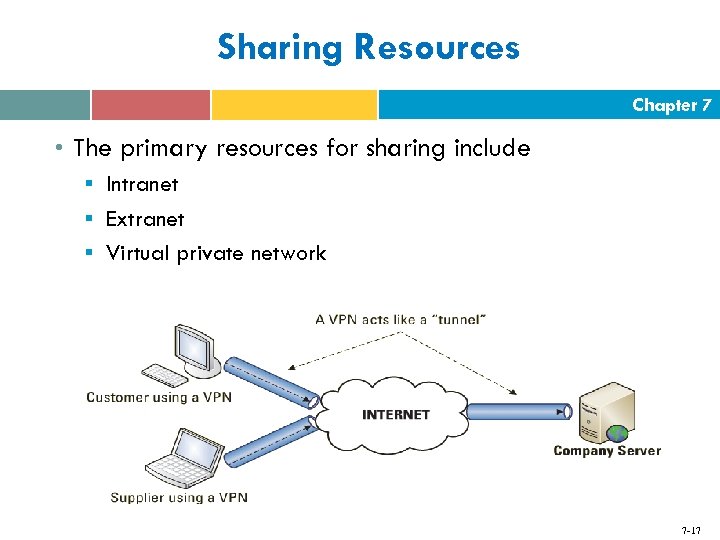
Sharing Resources Chapter 7 • The primary resources for sharing include § Intranet § Extranet § Virtual private network 7 -17
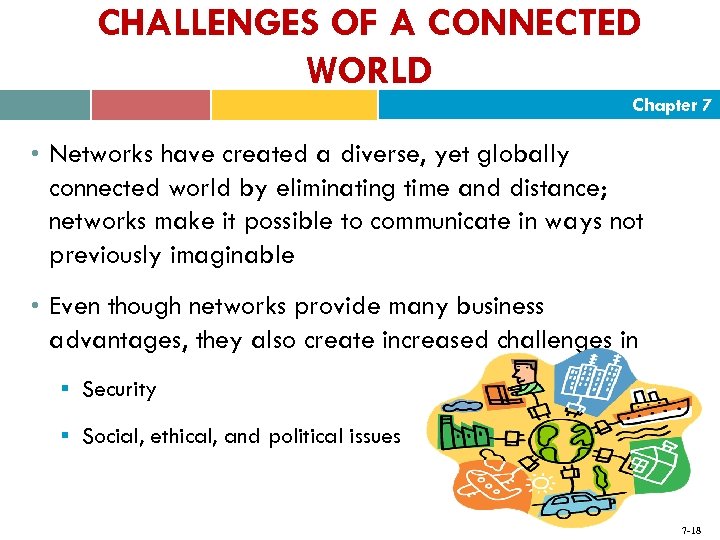
CHALLENGES OF A CONNECTED WORLD Chapter 7 • Networks have created a diverse, yet globally connected world by eliminating time and distance; networks make it possible to communicate in ways not previously imaginable • Even though networks provide many business advantages, they also create increased challenges in § Security § Social, ethical, and political issues 7 -18
Security Chapter 7 • SSL Certificate – An electronic document that confirms the identity of a website or server and verifies that a public key belongs to a trustworthy individual or company • Secure hypertext transfer protocol (SHTTP or HTTPS) – A combination of HTTP and SSL to provide encryption and secure identification of an Internet server 7 -19
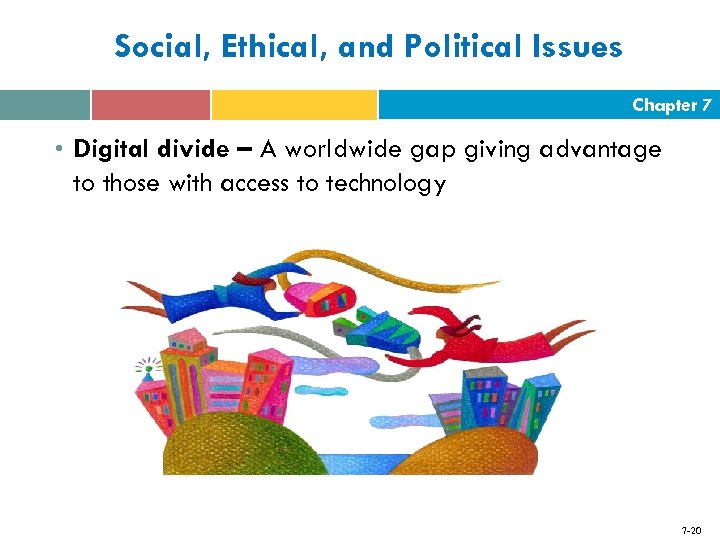
Social, Ethical, and Political Issues Chapter 7 • Digital divide – A worldwide gap giving advantage to those with access to technology 7 -20
Chapter 7 SECTION 7. 2 MOBILITY 7 -21
LEARNING OUTCOMES Chapter 7 4. Explain the different wireless network categories 5. Explain the different wireless network business applications 6. Identify the benefits of business mobility 7. Identify the challenges of business mobility 7 -22
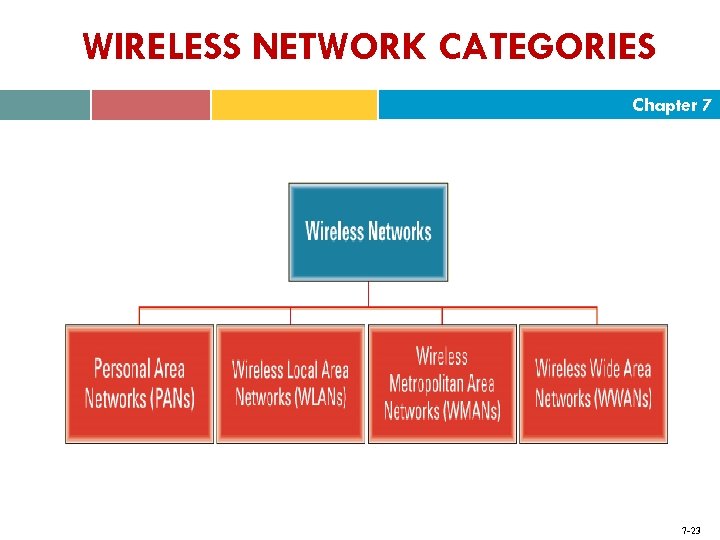
WIRELESS NETWORK CATEGORIES Chapter 7 7 -23
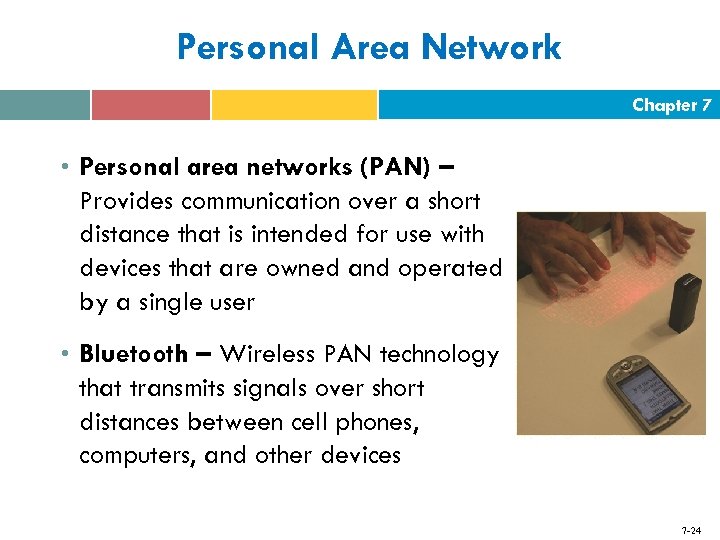
Personal Area Network Chapter 7 • Personal area networks (PAN) – Provides communication over a short distance that is intended for use with devices that are owned and operated by a single user • Bluetooth – Wireless PAN technology that transmits signals over short distances between cell phones, computers, and other devices 7 -24
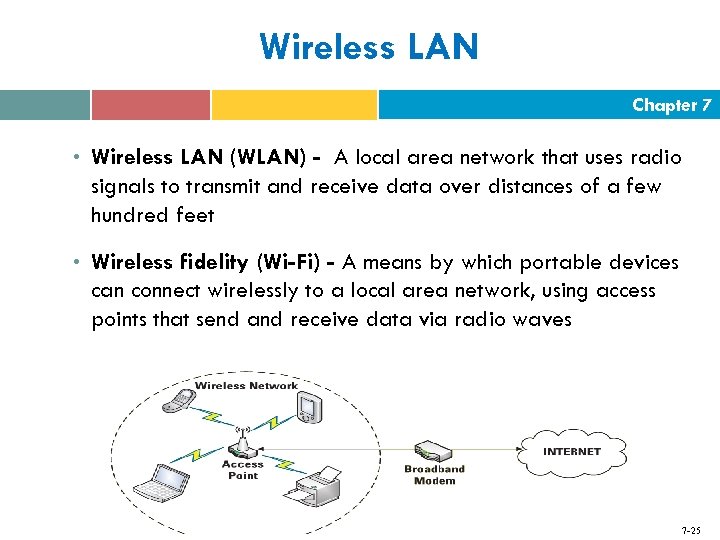
Wireless LAN Chapter 7 • Wireless LAN (WLAN) - A local area network that uses radio signals to transmit and receive data over distances of a few hundred feet • Wireless fidelity (Wi-Fi) - A means by which portable devices can connect wirelessly to a local area network, using access points that send and receive data via radio waves 7 -25
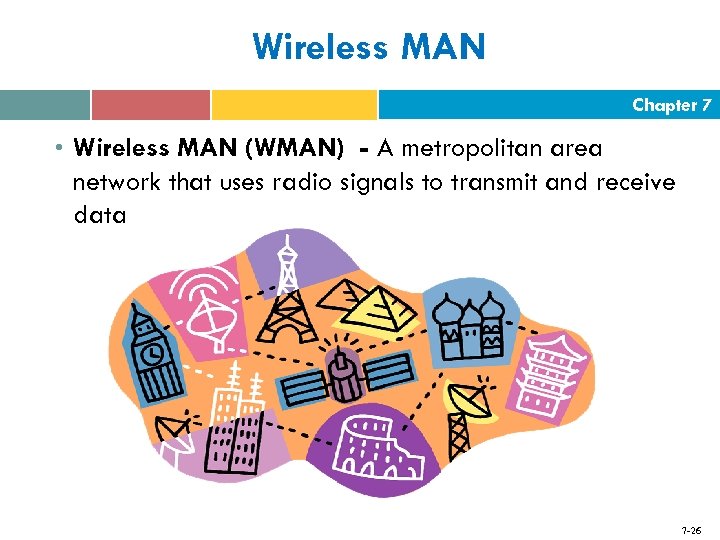
Wireless MAN Chapter 7 • Wireless MAN (WMAN) - A metropolitan area network that uses radio signals to transmit and receive data 7 -26
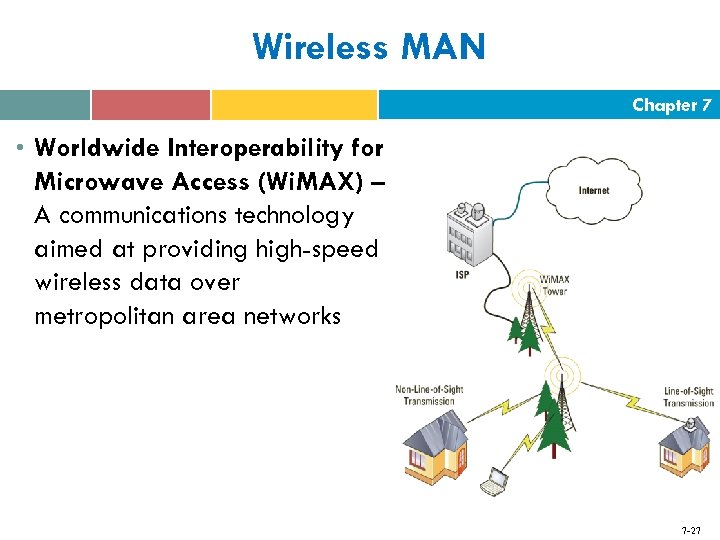
Wireless MAN Chapter 7 • Worldwide Interoperability for Microwave Access (Wi. MAX) – A communications technology aimed at providing high-speed wireless data over metropolitan area networks 7 -27
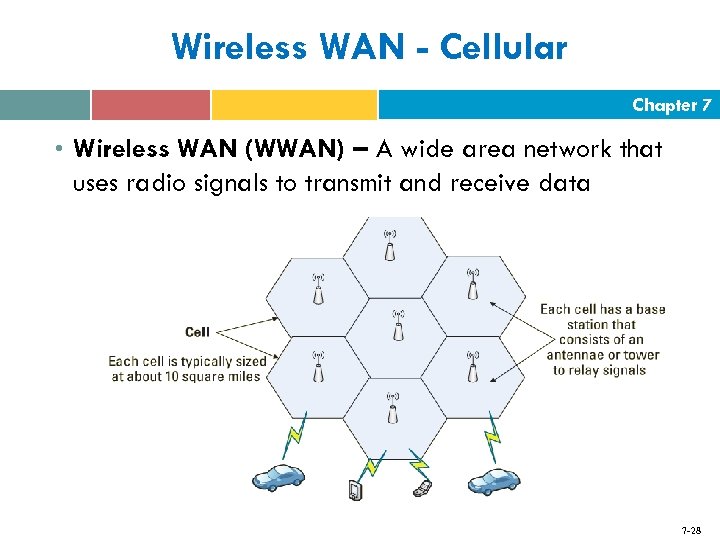
Wireless WAN - Cellular Chapter 7 • Wireless WAN (WWAN) – A wide area network that uses radio signals to transmit and receive data 7 -28
Wireless WAN - Cellular Chapter 7 • Smartphone – Offer more advanced computing ability and connectivity than basic cell phones • 3 G – A service that brings wireless broadband to mobile phones • Streaming – A method of sending audio and video files over the Internet 7 -29
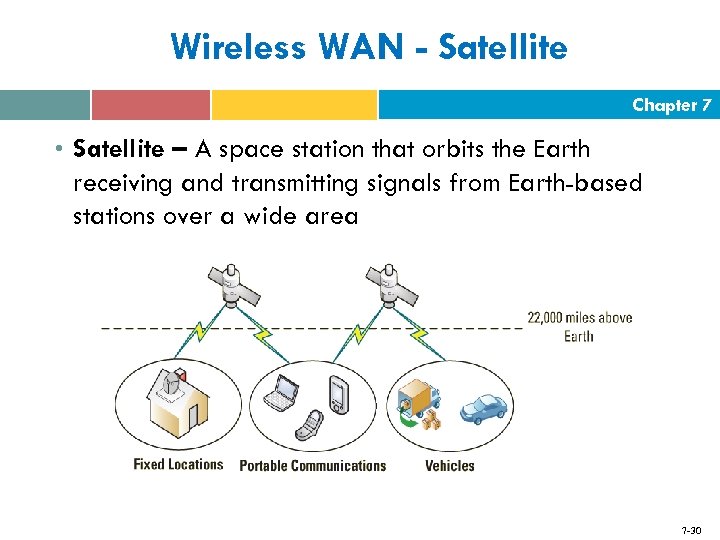
Wireless WAN - Satellite Chapter 7 • Satellite – A space station that orbits the Earth receiving and transmitting signals from Earth-based stations over a wide area 7 -30
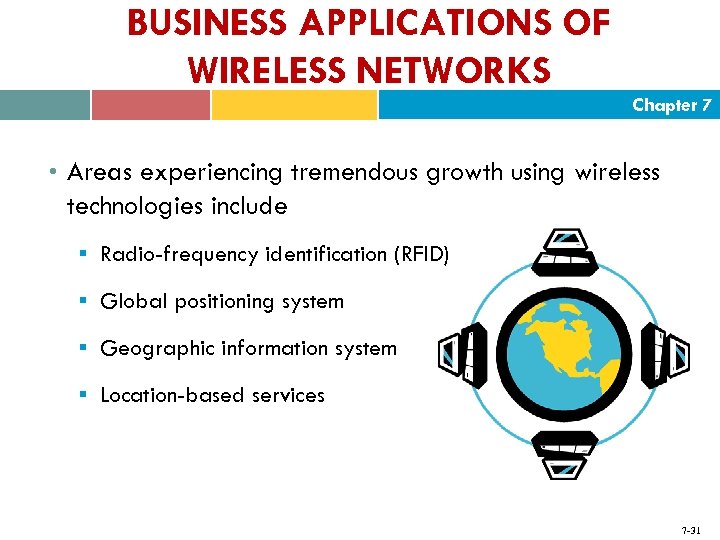
BUSINESS APPLICATIONS OF WIRELESS NETWORKS Chapter 7 • Areas experiencing tremendous growth using wireless technologies include § Radio-frequency identification (RFID) § Global positioning system § Geographic information system § Location-based services 7 -31
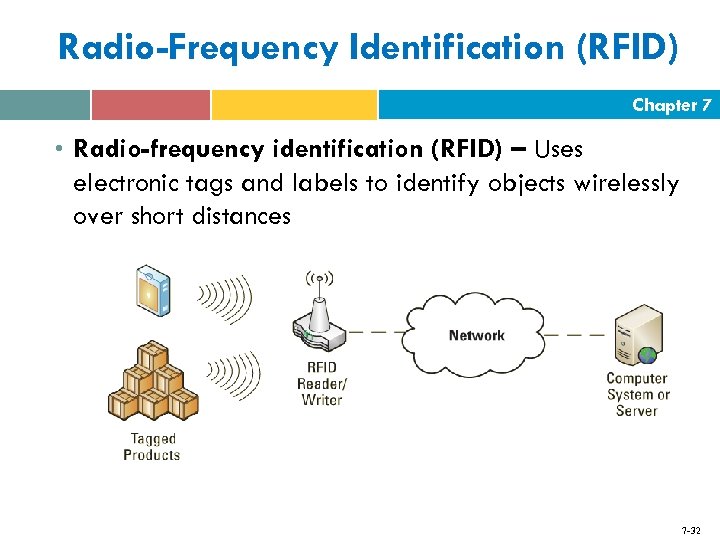
Radio-Frequency Identification (RFID) Chapter 7 • Radio-frequency identification (RFID) – Uses electronic tags and labels to identify objects wirelessly over short distances 7 -32
Global Positioning System Chapter 7 • Global positioning system (GPS) – A satellite-based navigation system providing extremely accurate position, time, and speed information • Some cell phone providers equip their phones with GPS chips that enable users to be located to within a geographical location about the size of a tennis court 7 -33
Geographic Information Systems (GIS) Chapter 7 • Geographic information system (GIS) – Consists of hardware, software, and data that provide location information for display on a multidimensional map 7 -34
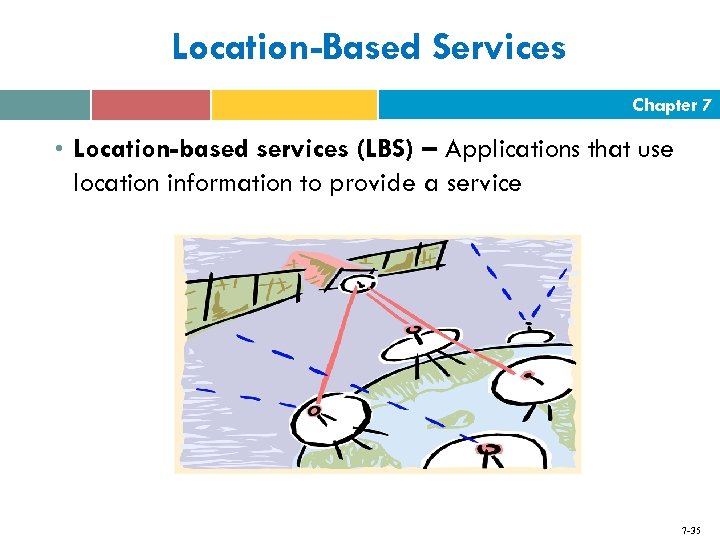
Location-Based Services Chapter 7 • Location-based services (LBS) – Applications that use location information to provide a service 7 -35
BENEFITS OF BUSINESS MOBILITY Chapter 7 • Enhance mobility • Provides immediate data access • Increases location and monitoring capability • Improves work flow • Provides mobile business opportunities • Provides alternative to wiring 7 -36
CHALLENGES OF BUSINESS MOBILITY Chapter 7 • Protecting against theft • Protecting wireless connections • Preventing viruses on a mobile device • Addressing privacy concerns with RFID and LBS 7 -37
Скачать презентацию Chapter 7 Networks Mobile Business Mc Graw-Hill Irwin Copyright
506bb816fe04df42c4cc29789bd3bd3f.ppt