


 Скачать презентацию Chapter 7 Marketing Channel Strategy and Management
e4ce135a42881a7968706c2fc0b8d027.ppt
- Количество слайдов: 32
 Chapter 7 Marketing Channel Strategy and Management
 What is a marketing channel? A marketing channel consists of individuals and firms involved in the process of making a product or service available for consumption or use by consumers and industrial users. 2
 Role of the channel in marketing strategy Links a producer to buyers Performs sales, advertising, and promotion Influences the firm’s pricing strategy Affects product strategy through branding policies, willingness to stock and customize offerings, install, maintain, offer credit, etc. 3
 The Channel-Selection Decision Fundamental Questions The marketing manager must answer the following questions: Who are potential customers? Where do they buy? When do they buy? How do they buy? What do they buy? - Avon Cosmetics example 4
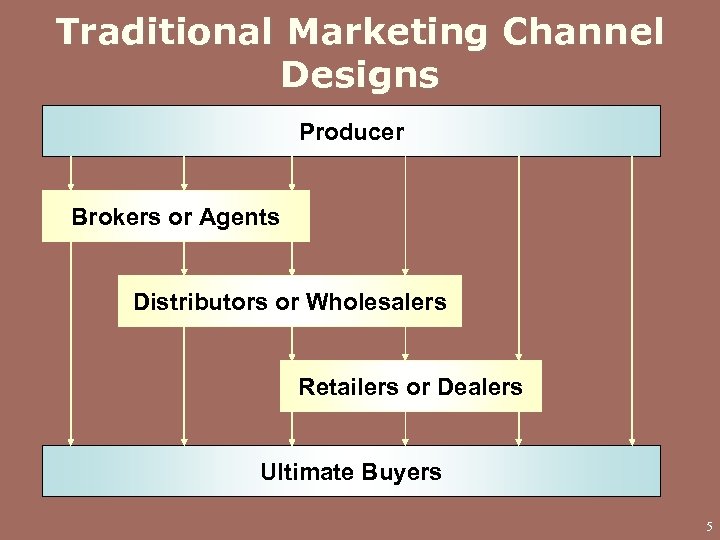 Traditional Marketing Channel Designs Producer Brokers or Agents Distributors or Wholesalers Retailers or Dealers Ultimate Buyers 5
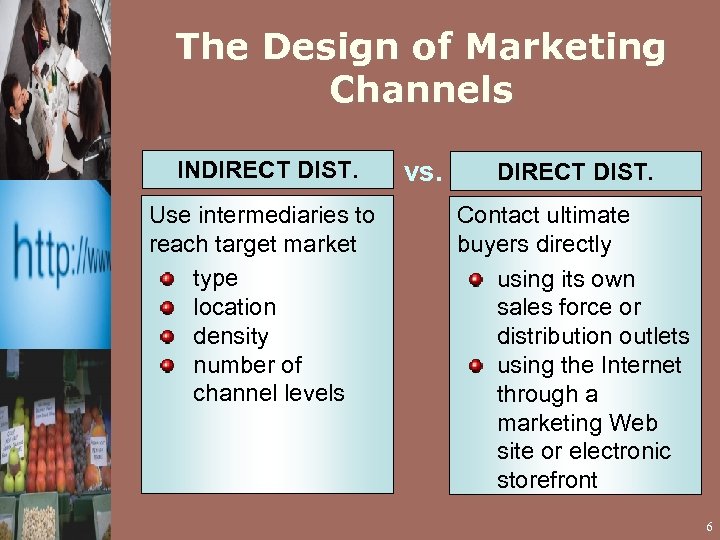 The Design of Marketing Channels INDIRECT DIST. Use intermediaries to reach target market type location density number of channel levels vs. DIRECT DIST. Contact ultimate buyers directly using its own sales force or distribution outlets using the Internet through a marketing Web site or electronic storefront 6
 The Design of Marketing Channels Direct distribution is typically used when: Buyers are easily identifiable Personal selling is a major component of the communication mix Organization has a wide variety of offerings for the target market Sufficient resources are available 7
 The Design of Marketing Channels Direct distribution must be considered when: Intermediaries are not available for reaching target markets Intermediaries do not possess the capacity to service the requirements of target markets 8
 The Design of Marketing Channels Indirect distribution must be considered when: Intermediaries can perform distribution functions more efficiently and less expensively Customers are hard to reach directly Organization does not have resources to perform distribution function 9
 The Design of Marketing Channels Electronic marketing channels employ some form of electronic communication, including the Internet, to make products and services available for consumption or use by consumers and industrial users. 10
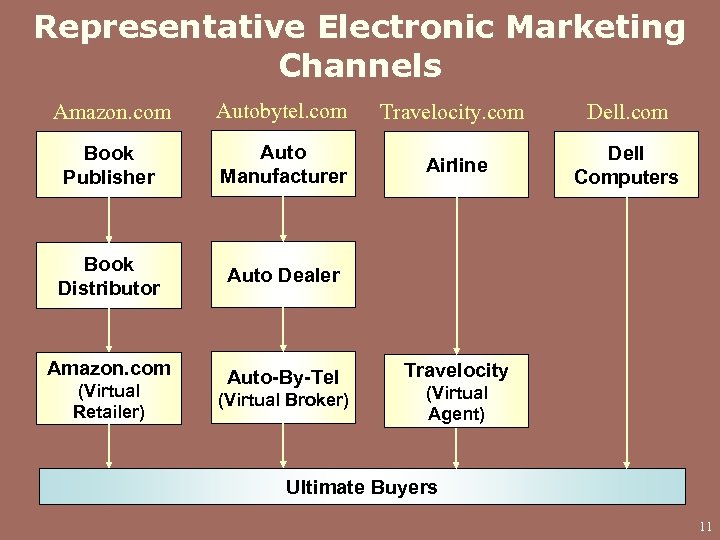 Representative Electronic Marketing Channels Amazon. com Autobytel. com Travelocity. com Dell. com Book Publisher Auto Manufacturer Airline Dell Computers Book Distributor Auto Dealer Amazon. com Auto-By-Tel (Virtual Retailer) (Virtual Broker) Travelocity (Virtual Agent) Ultimate Buyers 11
 The Design of Marketing Channels Disintermediation is the elimination of traditional intermediaries and direct distribution through electronic marketing channels. 12
 Channel Selection at the Retail Level Channel Selection Decisions 1. Which channel and intermediaries will provide the best coverage of the target market? 2. Which channel and intermediaries will best satisfy the buying requirements of the target market? 3. Which channel and intermediaries will be the most profitable? 13
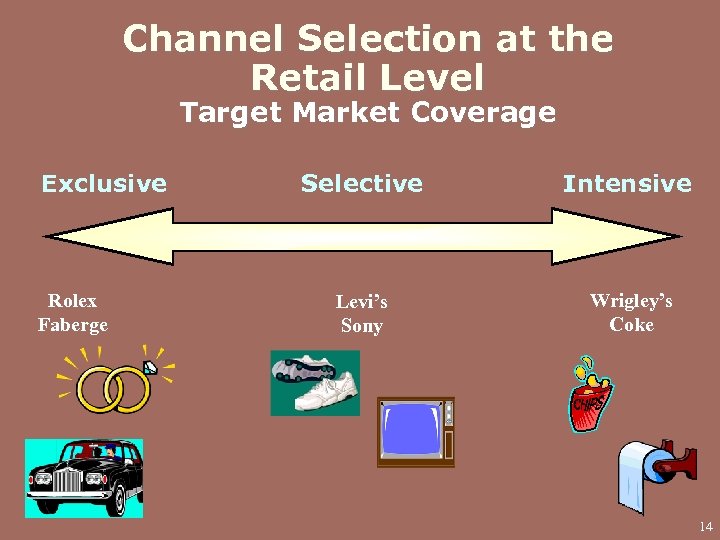 Channel Selection at the Retail Level Target Market Coverage Exclusive Rolex Faberge Selective Intensive Levi’s Sony Wrigley’s Coke 14
 Channel Selection at the Retail Level Effective Distribution occurs when a limited number of retail outlets account for a significant fraction of the market potential. Example: A marketer distributes the product through 40% of available outlets, but these outlets account for 80% of the market. 15
 Channel Selection at the Retail Level Satisfying Buyer Requirements Information Convenience Variety Attendant services 16
 Channel Selection at the Retail Level Profitability Margins = Revenues – Channel Costs Channel costs are: - Distribution costs - Advertising costs - Selling costs 17
 Channel Selection at Other Levels of Distribution Types of Wholesaler Specialty wholesaler – Limited line of items within a product line General-merchandise wholesaler – Wide assortment of products General-line wholesaler – Complete assortment of items in a single retailing field Combination 18
 Dual Distribution occurs when an organization distributes its offering through two or more different marketing channels that may or may not compete for similar buyers the main consideration is whether it will provide incremental sales revenue or cannibalize existing sales 19
 Dual Distribution When is it used own brand private store brand distribution to large and small retailers multibrand strategy geographic factors 20
 Dual Distribution Example Hallmark Sells Hallmark brand cards through Hallmark stores and selected department stores Sells Ambassador brand cards through discount drugstore chains 21
 Multi-Channel Marketing Multi-channel marketing involves the blending of an electronic marketing channel and a traditional channel in ways that are mutually reinforcing in attracting, retaining, and building relationships with customers. 22
 Multi-Channel Marketing Justifications An electronic marketing channel can provide incremental revenue (Victoria’s Secret) An electronic marketing channel can leverage the presence of a traditional channel (Ethan Allen) Multi-channel marketing can satisfy buyer requirements (Clinique division of Estée Lauder) 23
 Multi-Channel Marketing Considerations Actual incremental revenue or merely cannibalization? Incremental cost to launch and sustain an electronic forefront Disintermediation – a traditional intermediary member is replaced by electronic storefront 24
 Satisfying Intermediary Requirements and Trade Relations Intermediary Requirements Improvements in product assortments Trade discounts Fill-rate standards Promotional support Lead-time requirements Product-service exclusivity agreements 25
 Satisfying Intermediary Requirements and Trade Relations Channel Conflict arises when one channel member believes another channel member is engaged in behavior that is preventing it from achieving its goals. 26
 Satisfying Intermediary Requirements and Trade Relations Sources of Channel Conflict Channel member bypasses another member and sells or buys direct Uneven distribution of profit margins among channel members Manufacturer believes channel member is not giving its products adequate attention 27
 Satisfying Intermediary Requirements and Trade Relations Channel Power Channel Captain is a channel member that takes on the role of coordinating, directing, and supporting other channel members. 28
 Satisfying Intermediary Requirements and Trade Relations Forms of Channel Captain Power Ability to reward or coerce other members Expertness Identification with a particular channel member (Referent Power) Legitimate right to dictate the behavior of other members 29
 Channel-Modification Decisions Reasons Shifts in the geographical concentration of buyers Inability of existing intermediaries to meet the needs of buyers Costs of distribution 30
 Channel-Modification Decisions Basic Objectives 1. Provide the best coverage of the target market sought 2. Satisfy the buying requirements of the target market 3. Maximize revenue and minimize cost 31
 Channel-Modification Decisions Qualitative Factors 1. Will the change improve the effective coverage of the target markets sought? How? 2. Will the change improve the satisfaction of buyer needs? How? 3. Which marketing functions, if any, must be absorbed in order to make the change? 4. Does the organization have the resources to perform new functions? 5. What effect will the change have on other channel participants? 6. What will be the effect of the change on the achievement of long-range organizational objectives? 32