 Скачать презентацию Chapter 7 Government Subsidies and Income Support for
ead7d54ac9c938a115652b9022e72109.ppt
- Количество слайдов: 41



Chapter 7 Government Subsidies and Income Support for the Poor Copyright © 2002 Thomson Learning, Inc. Thomson Learning™ is a trademark used herein under license. ALL RIGHTS RESERVED. Instructors of classes adopting PUBLIC FINANCE: A CONTEMPORARY APPLICATION OF THEORY TO POLICY, Seventh Edition by David N. Hyman assigned textbook may reproduce material from this publication for classroom use or in a secure electronic network environment that prevents downloading or reproducing the copyrighted material. Otherwise, no part of this work covered by the copyright hereon may be reproduced or used in any form or by any means—graphic, electronic, or mechanical, including, but not limited to, photocopying, recording, taping, Web distribution, information networks, or information storage and retrieval systems—without the written permission of the publisher. Printed in the United States of America ISBN 0 -03 -033652 -X Copyright © 2002 by Thomson Learning, Inc.
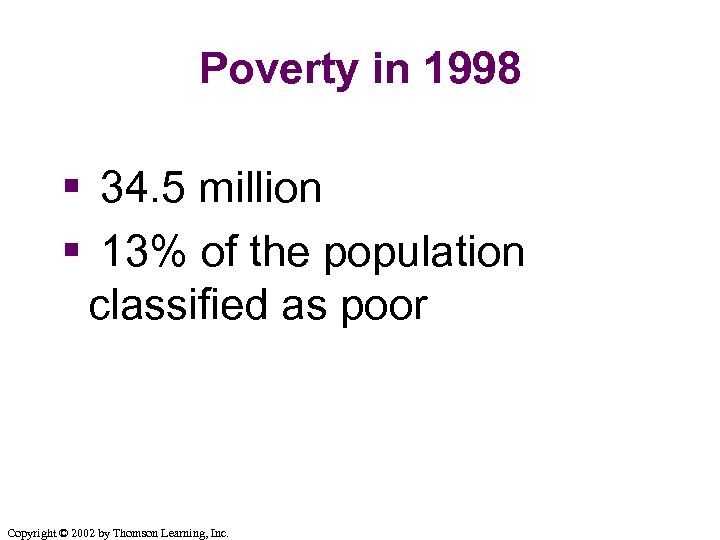
Poverty in 1998 § 34. 5 million § 13% of the population classified as poor Copyright © 2002 by Thomson Learning, Inc.
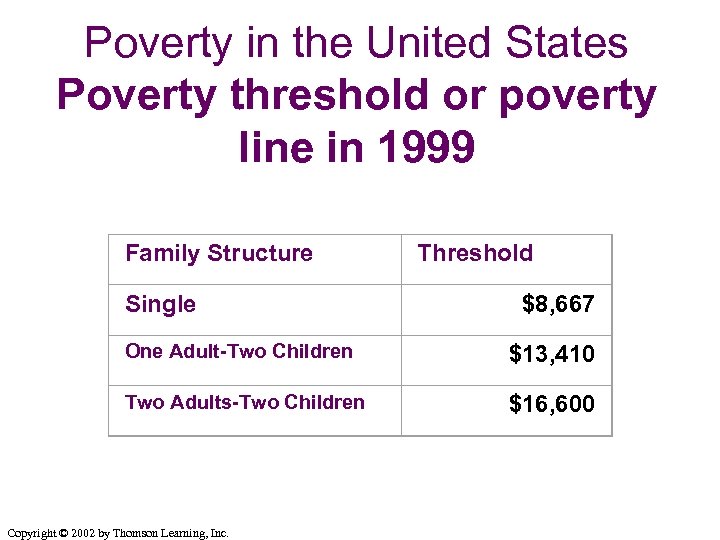
Poverty in the United States Poverty threshold or poverty line in 1999 Family Structure Single Threshold $8, 667 One Adult-Two Children $13, 410 Two Adults-Two Children $16, 600 Copyright © 2002 by Thomson Learning, Inc.
Poverty line § The Poverty Line was originally created by the Social Security Administration as three times the cost of a nutritionally adequate diet § It is updated annually for inflation using the CPI Copyright © 2002 by Thomson Learning, Inc.
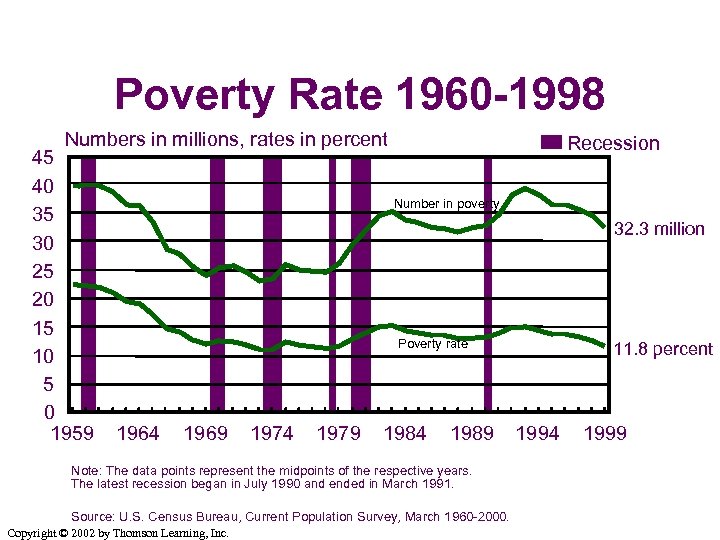
Poverty Rate 1960 -1998 Numbers in millions, rates in percent Recession 45 40 Number in poverty 35 32. 3 million 30 25 20 15 Poverty rate 11. 8 percent 10 5 0 1959 1964 1969 1974 1979 1984 1989 1994 1999 Note: The data points represent the midpoints of the respective years. The latest recession began in July 1990 and ended in March 1991. Source: U. S. Census Bureau, Current Population Survey, March 1960 -2000. Copyright © 2002 by Thomson Learning, Inc.
Changing the Poverty Line § A new definition proposed during the Clinton Administration would have included child care and other expenses and would raise threshold to almost $20, 000. Copyright © 2002 by Thomson Learning, Inc.
Why We Have Government Programs to Aid the Poor § We are concerned about Equity. Efficiency Trade-Offs. § It creates the Positive Externality of Social Stability. Copyright © 2002 by Thomson Learning, Inc.
Entitlement Programs Government programs that guarantee recipients benefits as long as they meet eligibility tests. § Means Tests are typically income and wealth criteria that must be met to be eligible for a program. § Status Tests are typically disability, children, and age criteria that must be met to be eligible for a program. Copyright © 2002 by Thomson Learning, Inc.
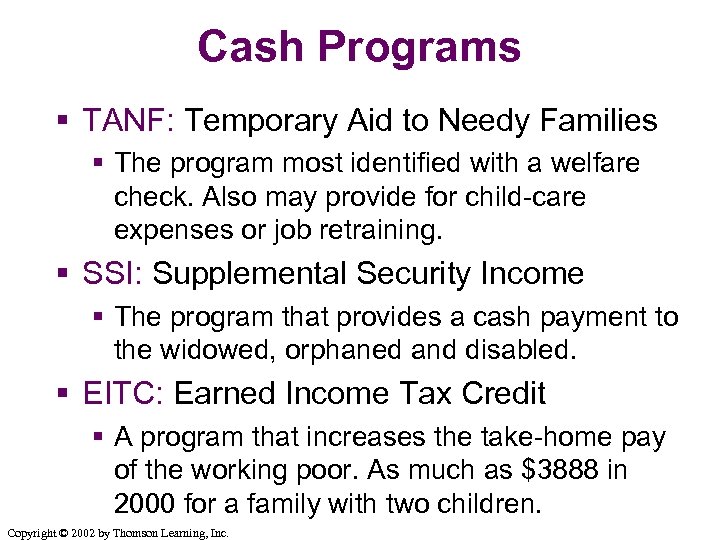
Cash Programs § TANF: Temporary Aid to Needy Families § The program most identified with a welfare check. Also may provide for child-care expenses or job retraining. § SSI: Supplemental Security Income § The program that provides a cash payment to the widowed, orphaned and disabled. § EITC: Earned Income Tax Credit § A program that increases the take-home pay of the working poor. As much as $3888 in 2000 for a family with two children. Copyright © 2002 by Thomson Learning, Inc.
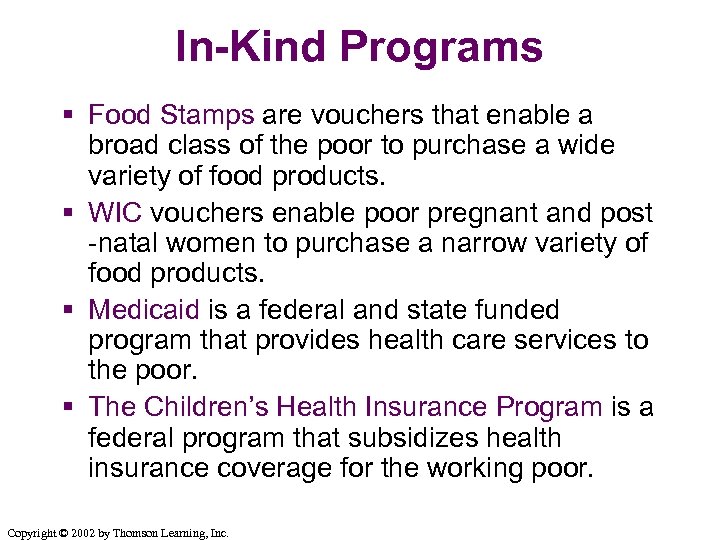
In-Kind Programs § Food Stamps are vouchers that enable a broad class of the poor to purchase a wide variety of food products. § WIC vouchers enable poor pregnant and post -natal women to purchase a narrow variety of food products. § Medicaid is a federal and state funded program that provides health care services to the poor. § The Children’s Health Insurance Program is a federal program that subsidizes health insurance coverage for the working poor. Copyright © 2002 by Thomson Learning, Inc.
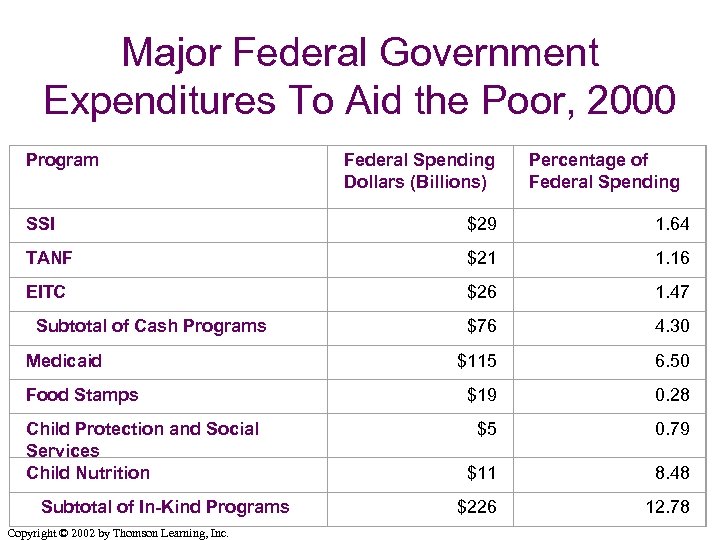
Major Federal Government Expenditures To Aid the Poor, 2000 Program Federal Spending Dollars (Billions) Percentage of Federal Spending SSI $29 1. 64 TANF $21 1. 16 EITC $26 1. 47 $76 4. 30 $115 6. 50 $19 0. 28 $5 0. 79 $11 8. 48 $226 12. 78 Subtotal of Cash Programs Medicaid Food Stamps Child Protection and Social Services Child Nutrition Subtotal of In-Kind Programs Copyright © 2002 by Thomson Learning, Inc.
Price Distorting Subsidies § Price Distorting Subsidies lower the price of the particular good relative to others for eligible people. Copyright © 2002 by Thomson Learning, Inc.
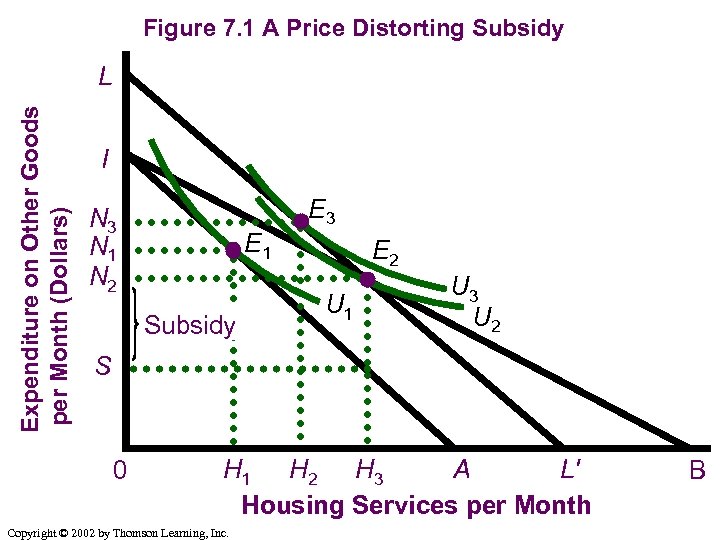
Figure 7. 1 A Price Distorting Subsidy Expenditure on Other Goods per Month (Dollars) L I E 3 N 1 N 2 E 1 Subsidy E 2 U 1 U 3 U 2 S 0 H 1 H 2 H 3 A L' Housing Services per Month Copyright © 2002 by Thomson Learning, Inc. B
Dead Weight Loss or Excess Burden § Dead Weight Loss (sometimes called Excess Burden ) is the measure of the dollar value of the distortion that exceeds the amount transferred to the recipient. Copyright © 2002 by Thomson Learning, Inc.
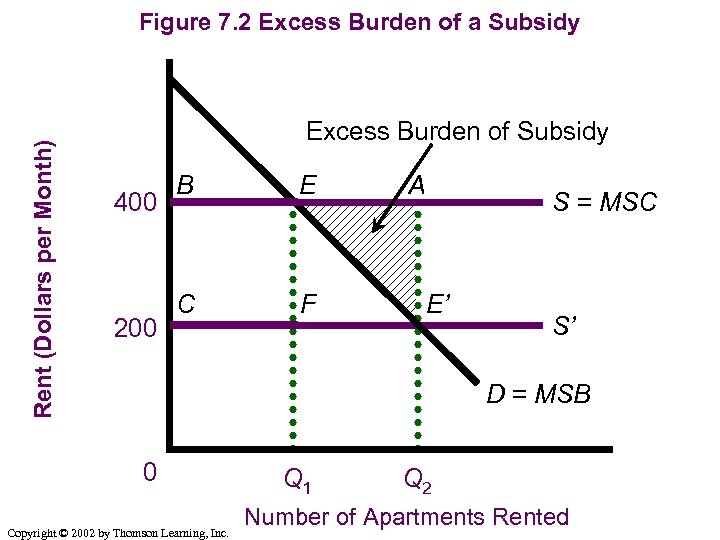
Rent (Dollars per Month) Figure 7. 2 Excess Burden of a Subsidy Excess Burden of Subsidy 400 200 B E C F A S = MSC E’ S’ D = MSB 0 Copyright © 2002 by Thomson Learning, Inc. Q 1 Q 2 Number of Apartments Rented
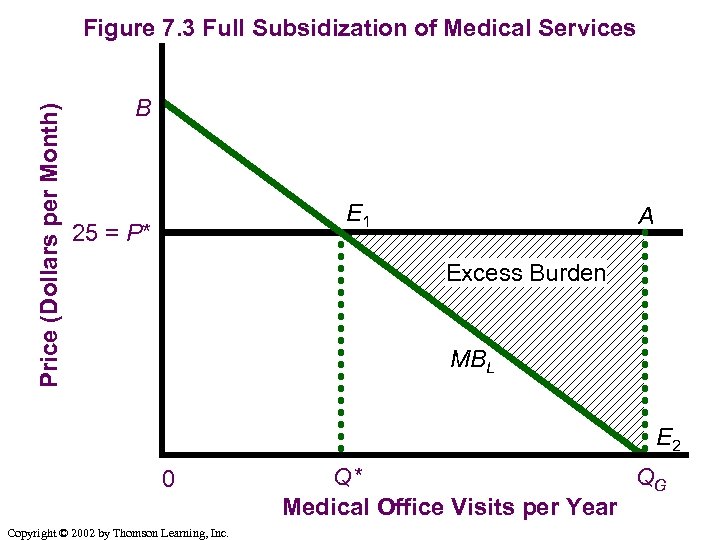
Price (Dollars per Month) Figure 7. 3 Full Subsidization of Medical Services B E 1 25 = P* A Excess Burden MBL E 2 0 Copyright © 2002 by Thomson Learning, Inc. Q* QG Medical Office Visits per Year
Additional Effects of Subsidies: The Case of Increasing Costs § Medicaid not only costs taxpayers money to pay for the program, it also increases the amount they pay for medical services by increasing demand for those services. Copyright © 2002 by Thomson Learning, Inc.
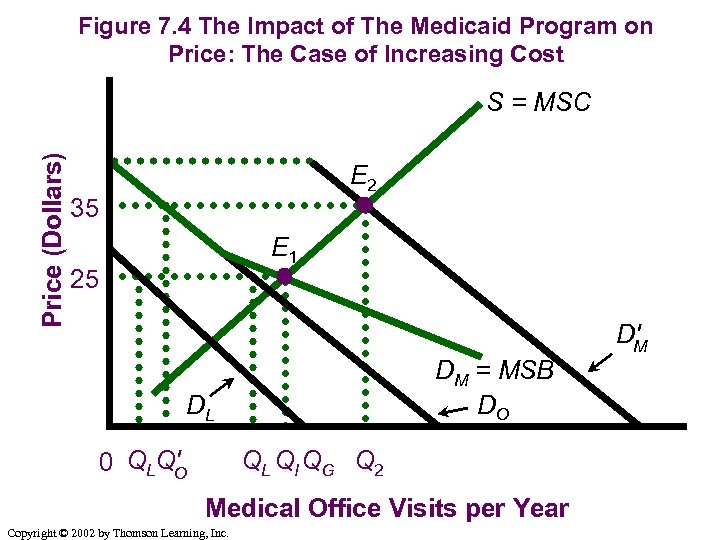
Figure 7. 4 The Impact of The Medicaid Program on Price: The Case of Increasing Cost Price (Dollars) S = MSC E 2 35 E 1 25 DM = MSB DO DL 0 QLQ' O QL QI QG Q 2 Medical Office Visits per Year Copyright © 2002 by Thomson Learning, Inc. D' M
Subsidizing Housing § Providing an Apartment: This subsidy allocates a standard apartment to an eligible recipient. With this type of subsidy the recipient cannot supplement the subsidy with their cash. It is a “take it or leave it” option. § Housing Vouchers: This subsidy allows the recipient a particular allotment of vouchers to rent housing but the recipient may supplement the subsidy with their cash. § Cash: This subsidy is not restricted to spending on housing. Copyright © 2002 by Thomson Learning, Inc.
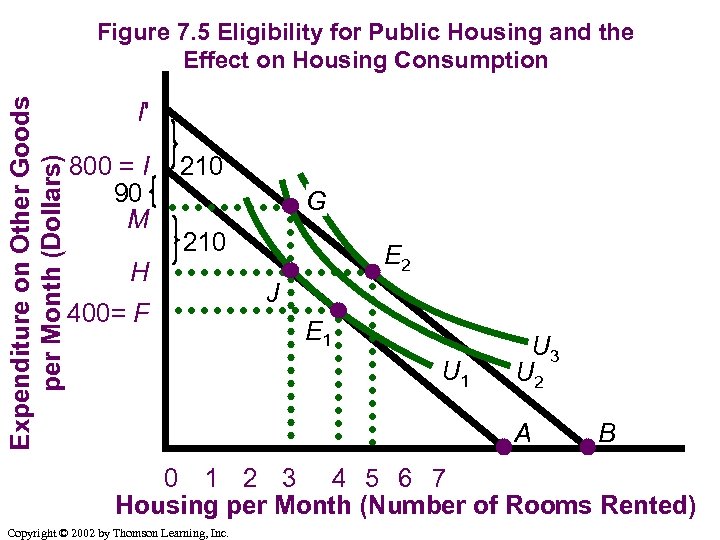
Expenditure on Other Goods per Month (Dollars) Figure 7. 5 Eligibility for Public Housing and the Effect on Housing Consumption I' 800 = I 210 90 M 210 H 400= F G E 2 J E 1 U 3 U 2 A B 0 1 2 3 4 5 6 7 Housing per Month (Number of Rooms Rented) Copyright © 2002 by Thomson Learning, Inc.
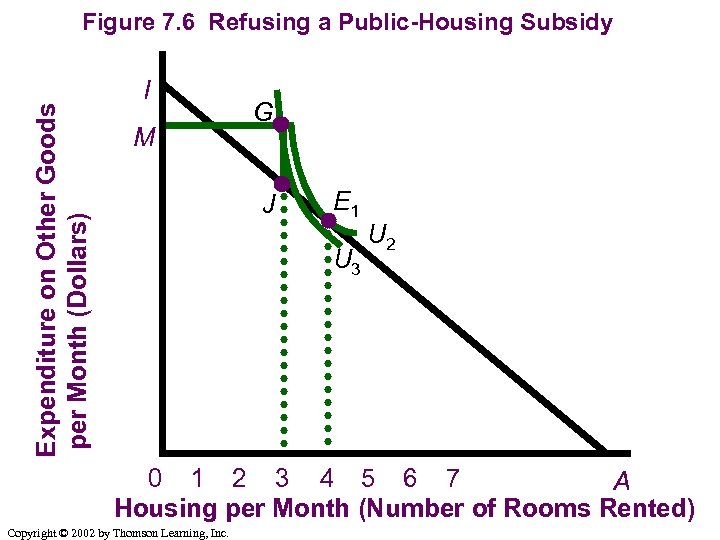
Expenditure on Other Goods per Month (Dollars) Figure 7. 6 Refusing a Public-Housing Subsidy I M G J E 1 U 3 U 2 0 1 2 3 4 5 6 7 A Housing per Month (Number of Rooms Rented) Copyright © 2002 by Thomson Learning, Inc.
Subsidizing Food § Food Stamps are the subsidy that allows the recipient a particular allotment of vouchers to buy food but the recipient may supplement the subsidy with their cash. It is illegal to sell the food stamps though it may be in the recipients interests for them to do so. Copyright © 2002 by Thomson Learning, Inc.
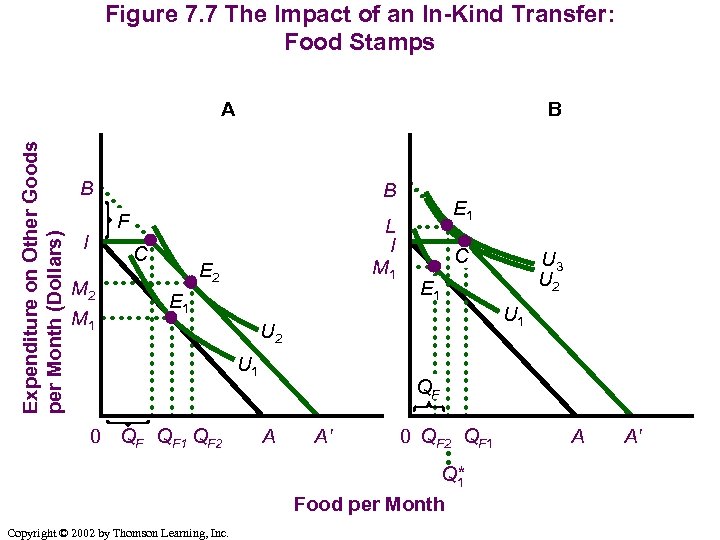
Figure 7. 7 The Impact of an In-Kind Transfer: Food Stamps Expenditure on Other Goods per Month (Dollars) A B B B F I C M 2 M 1 L I M 1 E 2 E 1 C E 1 QF A A' 0 QF 2 QF 1 Q* 1 Food per Month Copyright © 2002 by Thomson Learning, Inc. U 3 U 2 U 1 0 QF QF 1 QF 2 E 1 A A'
The Impact of Government Assistance Programs on Work § Transfers could cause people to work more or less depending on whether leisure is a normal good. Copyright © 2002 by Thomson Learning, Inc.
International Food Subsidies § Several nations use a price-reducing subsidy to make food more affordable. § Programs that reduce the price of food benefit higher-income people as well. § Some nations only subsidize food that is typically consumed by the poor. § Some nations distribute food directly. Copyright © 2002 by Thomson Learning, Inc.
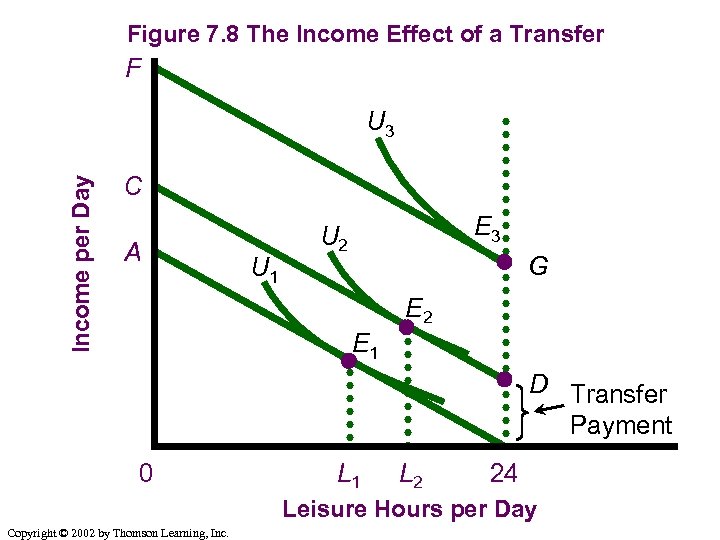
Figure 7. 8 The Income Effect of a Transfer F Income per Day U 3 C A U 1 E 3 U 2 G E 2 E 1 D Transfer Payment 0 L 1 L 2 24 Leisure Hours per Day Copyright © 2002 by Thomson Learning, Inc.
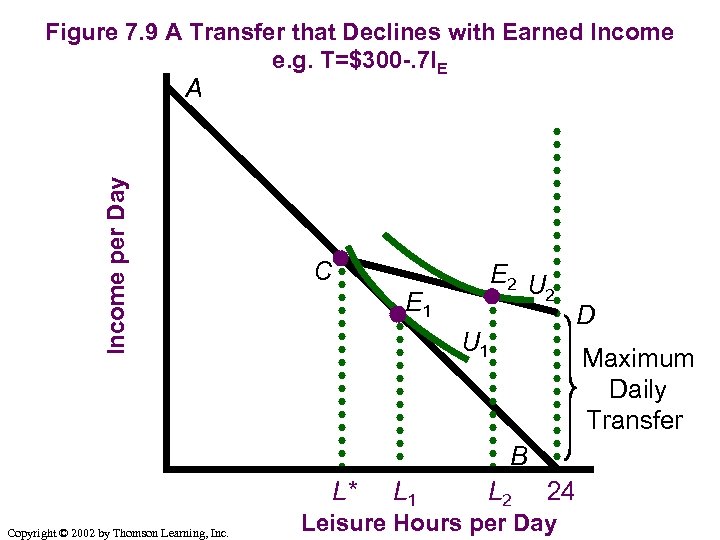
Figure 7. 9 A Transfer that Declines with Earned Income e. g. T=$300 -. 7 IE Income per Day A C E 2 U 2 E 1 U 1 D Maximum Daily Transfer B L* Copyright © 2002 by Thomson Learning, Inc. L 1 L 2 24 Leisure Hours per Day
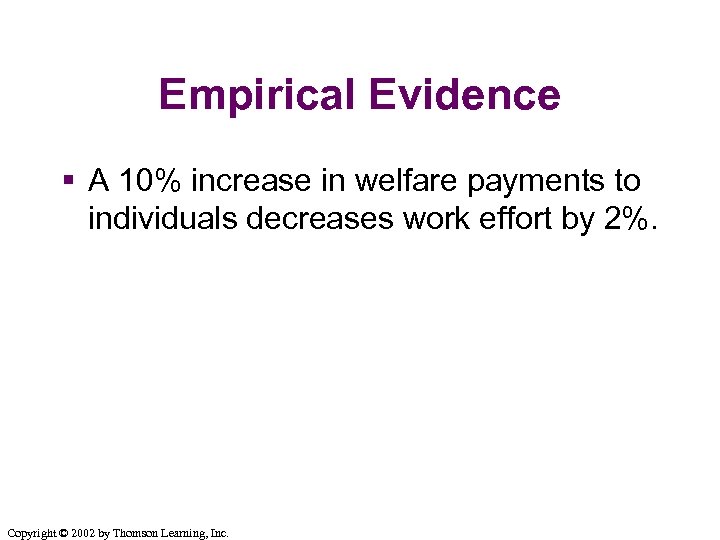
Empirical Evidence § A 10% increase in welfare payments to individuals decreases work effort by 2%. Copyright © 2002 by Thomson Learning, Inc.
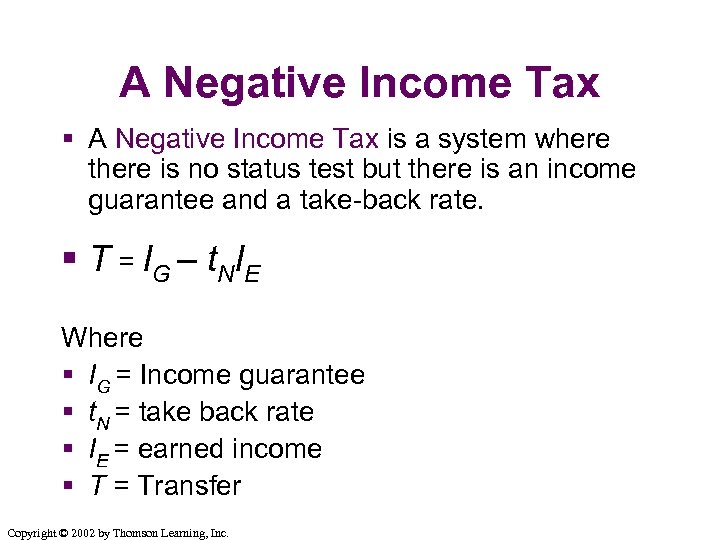
A Negative Income Tax § A Negative Income Tax is a system where there is no status test but there is an income guarantee and a take-back rate. § T = IG – t. NIE Where § IG = Income guarantee § t. N = take back rate § IE = earned income § T = Transfer Copyright © 2002 by Thomson Learning, Inc.
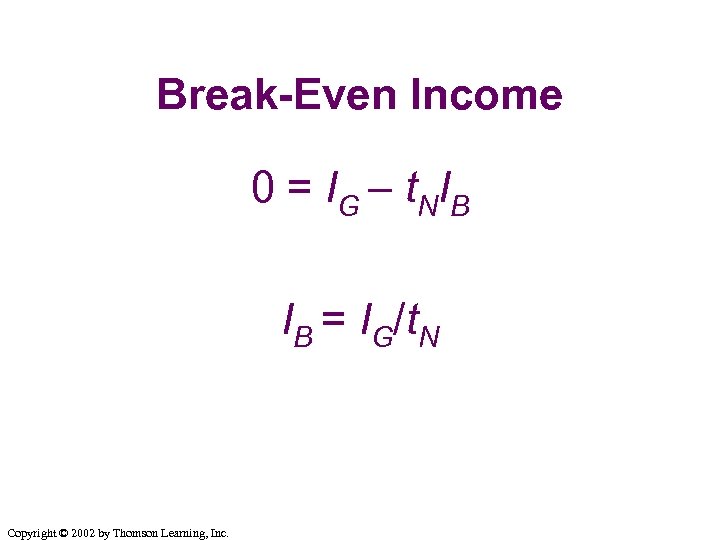
Break-Even Income 0 = IG – t. NIB IB = IG/t. N Copyright © 2002 by Thomson Learning, Inc.
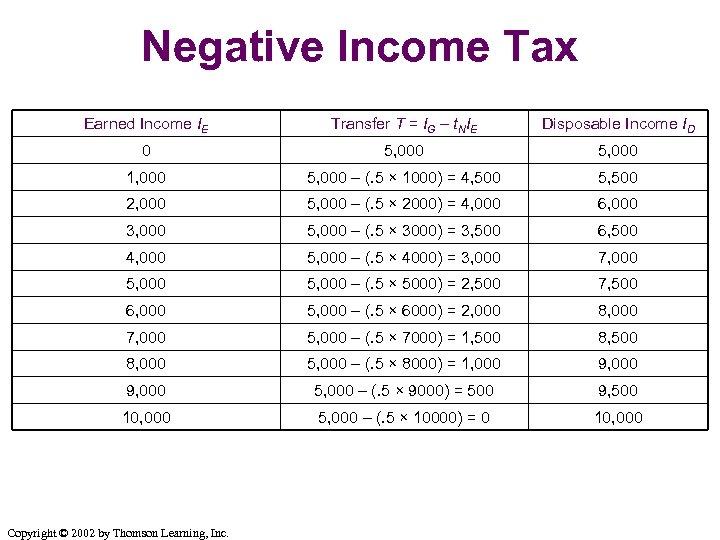
Negative Income Tax Earned Income IE Transfer T = IG – t. NIE Disposable Income ID 0 5, 000 1, 000 5, 000 – (. 5 × 1000) = 4, 500 5, 500 2, 000 5, 000 – (. 5 × 2000) = 4, 000 6, 000 3, 000 5, 000 – (. 5 × 3000) = 3, 500 6, 500 4, 000 5, 000 – (. 5 × 4000) = 3, 000 7, 000 5, 000 – (. 5 × 5000) = 2, 500 7, 500 6, 000 5, 000 – (. 5 × 6000) = 2, 000 8, 000 7, 000 5, 000 – (. 5 × 7000) = 1, 500 8, 000 5, 000 – (. 5 × 8000) = 1, 000 9, 000 5, 000 – (. 5 × 9000) = 500 9, 500 10, 000 5, 000 – (. 5 × 10000) = 0 10, 000 Copyright © 2002 by Thomson Learning, Inc.
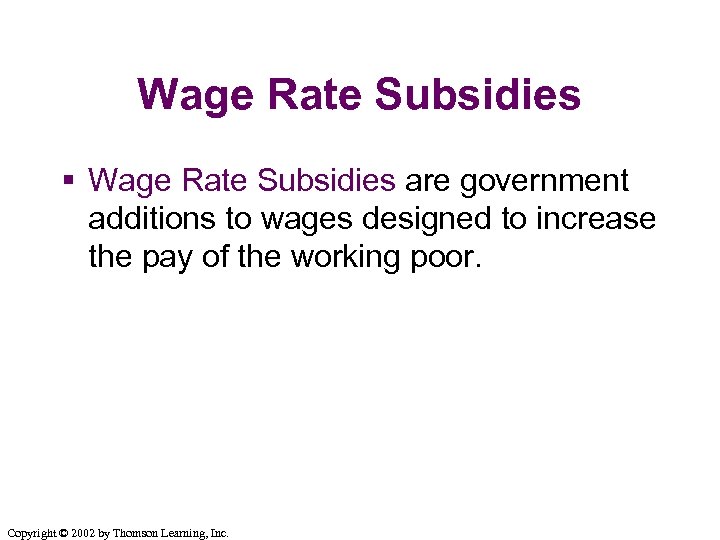
Wage Rate Subsidies § Wage Rate Subsidies are government additions to wages designed to increase the pay of the working poor. Copyright © 2002 by Thomson Learning, Inc.
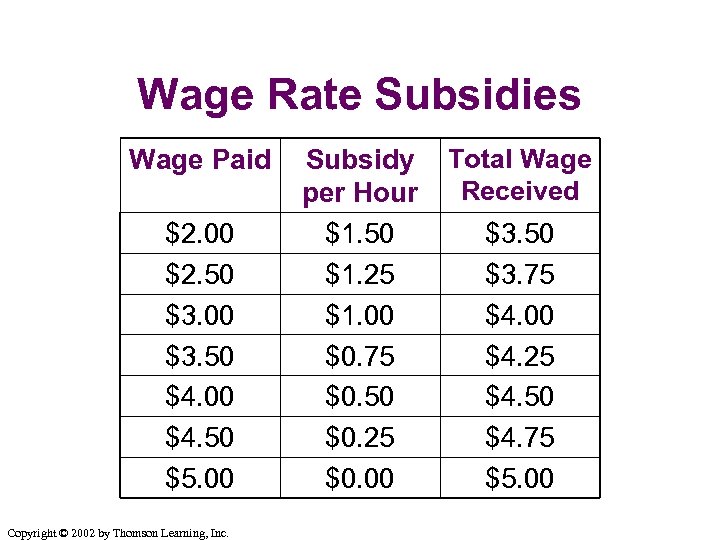
Wage Rate Subsidies Wage Paid $2. 00 $2. 50 $3. 00 $3. 50 $4. 00 $4. 50 $5. 00 Copyright © 2002 by Thomson Learning, Inc. Subsidy per Hour $1. 50 $1. 25 $1. 00 $0. 75 $0. 50 $0. 25 $0. 00 Total Wage Received $3. 50 $3. 75 $4. 00 $4. 25 $4. 50 $4. 75 $5. 00
EITC § The Earned Income Tax Credit goes to the working poor and varies with the number of children. Typically the recipient receives the assistance with their tax refund but papers can be filed to receive the money in their paychecks throughout the year. Copyright © 2002 by Thomson Learning, Inc.
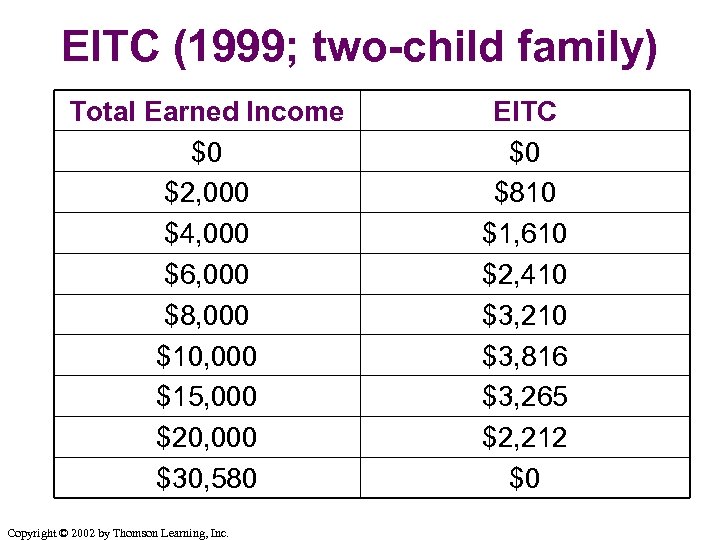
EITC (1999; two-child family) Total Earned Income $0 $2, 000 $4, 000 $6, 000 $8, 000 $10, 000 $15, 000 $20, 000 $30, 580 Copyright © 2002 by Thomson Learning, Inc. EITC $0 $810 $1, 610 $2, 410 $3, 210 $3, 816 $3, 265 $2, 212 $0
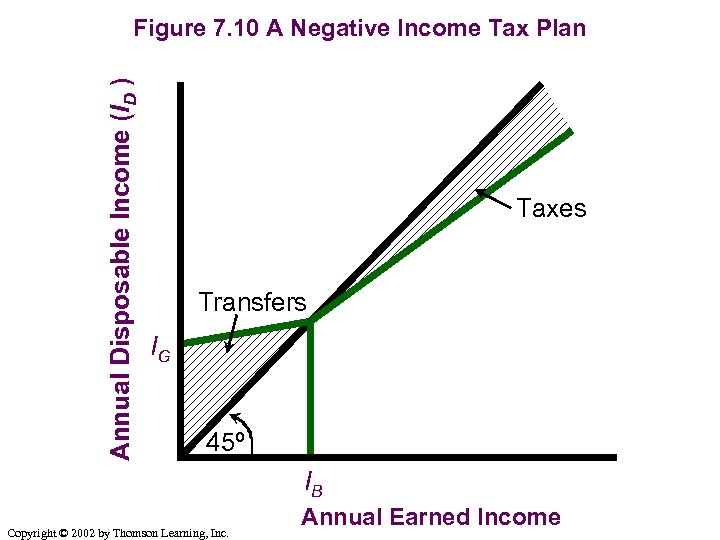
Annual Disposable Income (ID ) Figure 7. 10 A Negative Income Tax Plan Taxes Transfers IG 45º IB Copyright © 2002 by Thomson Learning, Inc. Annual Earned Income
Wisconsin Work’s § § Stringent Work Requirements Child Care Subsidies Health Insurance Coverage Welfare dependency in WI has dropped 60% since 1987 Copyright © 2002 by Thomson Learning, Inc.
Welfare Reform of 1996 § Time Limits: § 5 -year lifetime limit § 2 -years at a time § if states meet certain goals they can waive this rule for up to 20% of their caseloads. § Work and Training: § subsidized child care § Teen Mothers: § no longer eligible to receive their own payments § must live with responsible adult. § Refusal to work: recipients with children over five who refuse work can be denied aid and have their children placed in foster care Copyright © 2002 by Thomson Learning, Inc.
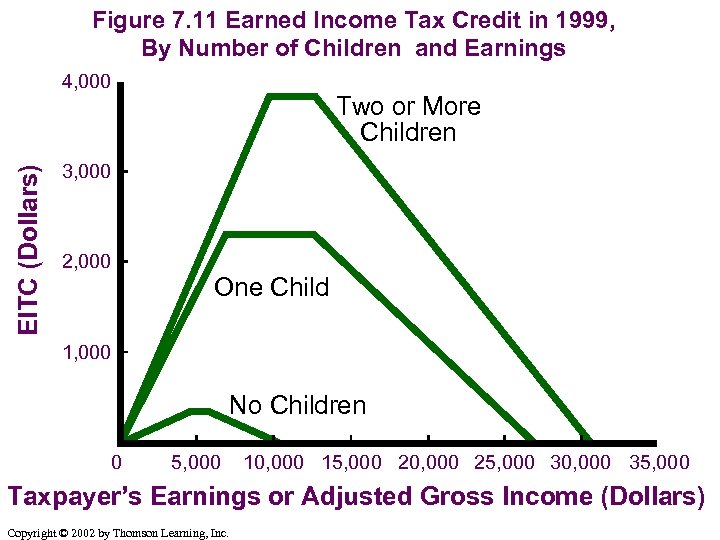
Figure 7. 11 Earned Income Tax Credit in 1999, By Number of Children and Earnings EITC (Dollars) 4, 000 Two or More Children 3, 000 2, 000 One Child 1, 000 No Children 0 5, 000 10, 000 15, 000 20, 000 25, 000 30, 000 35, 000 Taxpayer’s Earnings or Adjusted Gross Income (Dollars) Copyright © 2002 by Thomson Learning, Inc.
Programs to Aid the Poor and the Distribution of Money Income in the US § Most of the “War on Poverty” began in the 1960 s. § The share of income going to each quintile (20% grouping) has remained constant during that time. Copyright © 2002 by Thomson Learning, Inc.
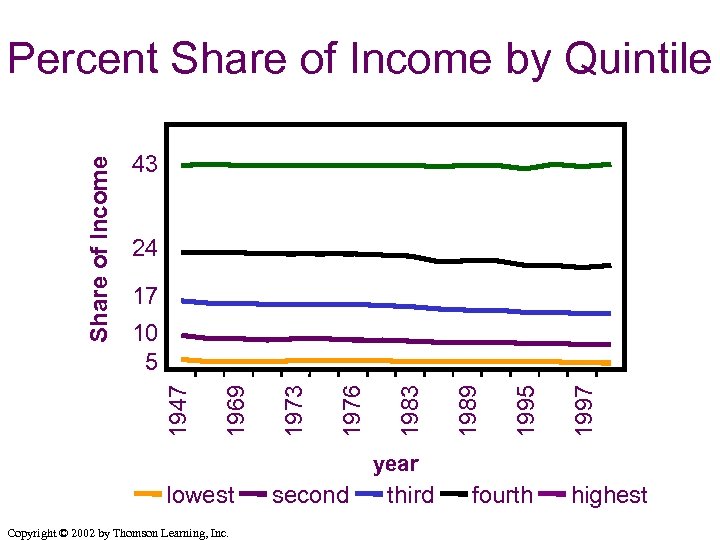
43 24 17 1995 1989 1983 1976 1973 1969 10 5 1947 Share of Income Percent Share of Income by Quintile year lowest Copyright © 2002 by Thomson Learning, Inc. second third fourth highest
Скачать презентацию Chapter 7 Government Subsidies and Income Support for
ead7d54ac9c938a115652b9022e72109.ppt