


 Скачать презентацию Chapter 7 Energy The money of physics Physics
647ed6a0ba097d68e56427a4e417e4bd.ppt
- Количество слайдов: 25
 Chapter 7 Energy The “money” of physics Physics 1 (Garcia) SJSU
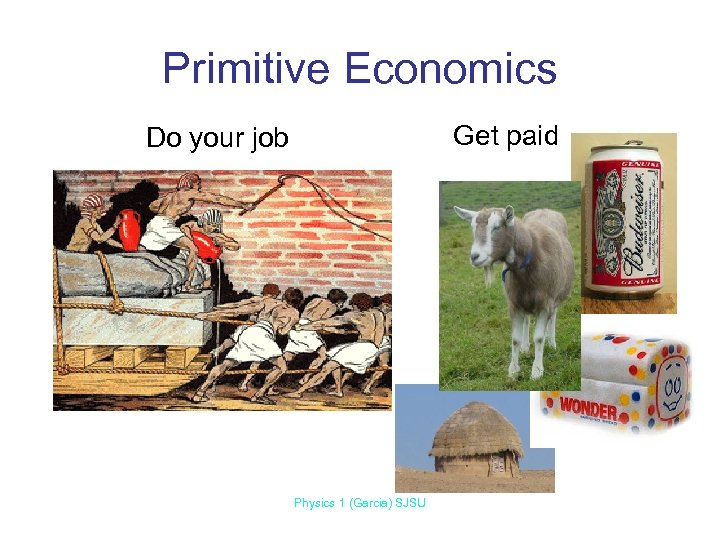 Primitive Economics Get paid Do your job Physics 1 (Garcia) SJSU
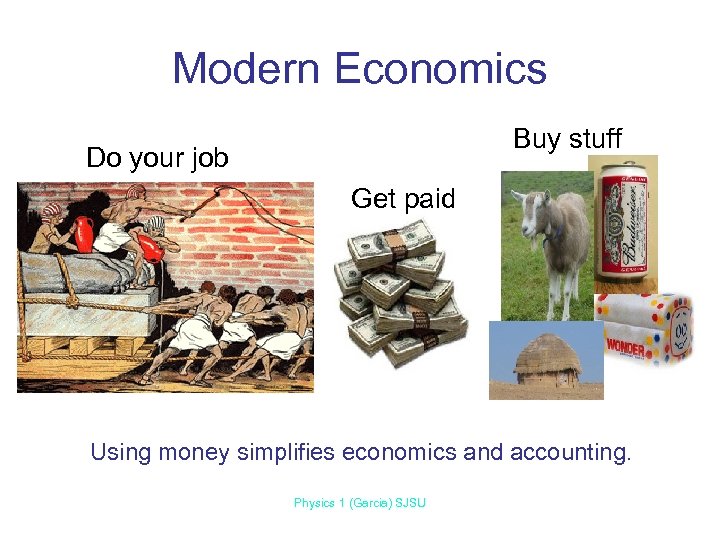 Modern Economics Buy stuff Do your job Get paid Using money simplifies economics and accounting. Physics 1 (Garcia) SJSU
 Why Energy Helps Motion, in general, is hard to calculate. Using forces, momentum, acceleration, etc. gets complicated because they are all vectors (have magnitude & direction). Energy is not a vector; it’s just a number. Can predict motion by figuring out how much energy that motion will “cost. ” Physics 1 (Garcia) SJSU
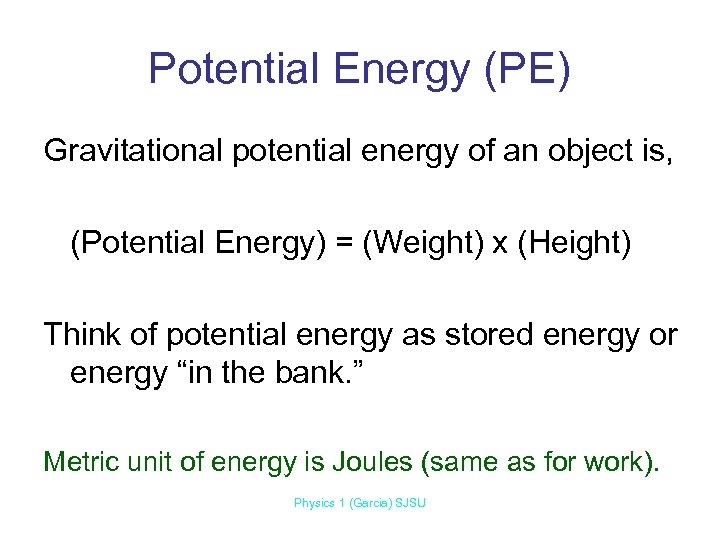 Potential Energy (PE) Gravitational potential energy of an object is, (Potential Energy) = (Weight) x (Height) Think of potential energy as stored energy or energy “in the bank. ” Metric unit of energy is Joules (same as for work). Physics 1 (Garcia) SJSU
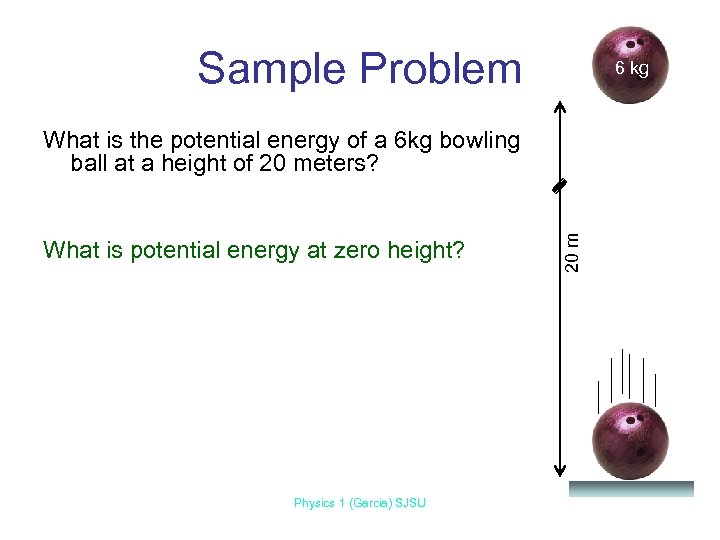 Sample Problem 6 kg What is potential energy at zero height? Physics 1 (Garcia) SJSU 20 m What is the potential energy of a 6 kg bowling ball at a height of 20 meters?
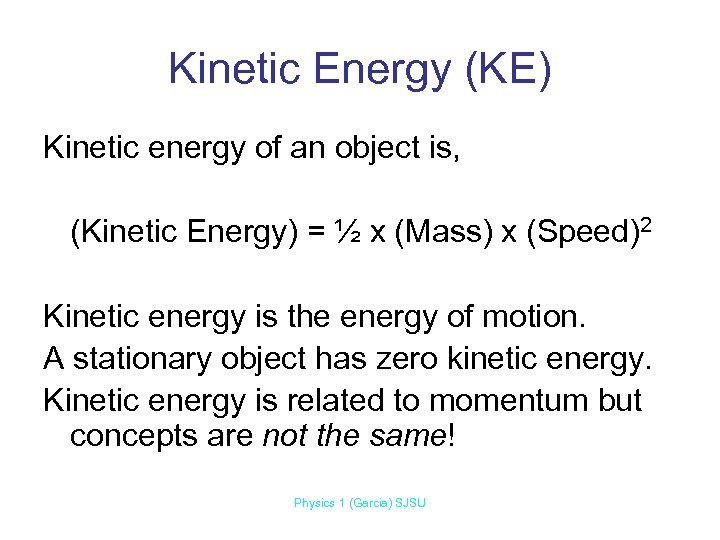 Kinetic Energy (KE) Kinetic energy of an object is, (Kinetic Energy) = ½ x (Mass) x (Speed)2 Kinetic energy is the energy of motion. A stationary object has zero kinetic energy. Kinetic energy is related to momentum but concepts are not the same! Physics 1 (Garcia) SJSU
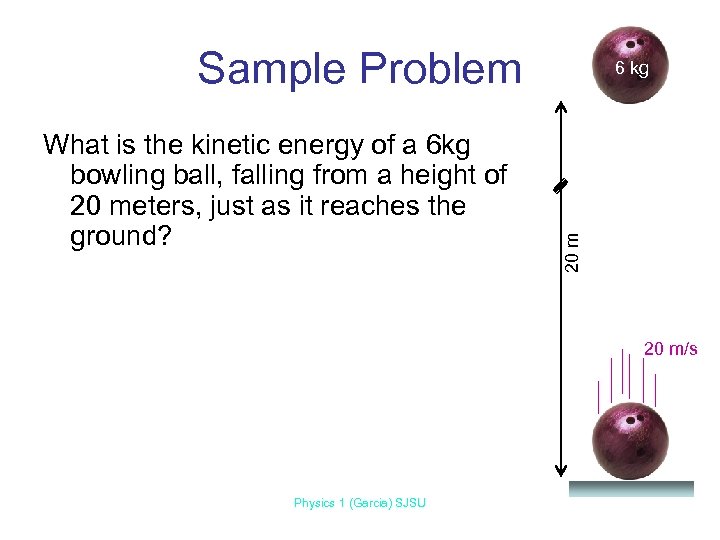 Sample Problem 20 m What is the kinetic energy of a 6 kg bowling ball, falling from a height of 20 meters, just as it reaches the ground? 6 kg 20 m/s Physics 1 (Garcia) SJSU
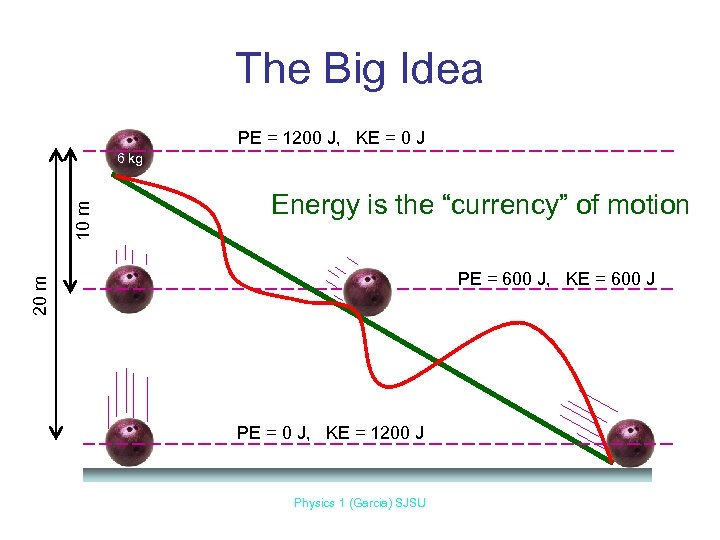 The Big Idea PE = 1200 J, KE = 0 J Energy is the “currency” of motion PE = 600 J, KE = 600 J 20 m 10 m 6 kg PE = 0 J, KE = 1200 J Physics 1 (Garcia) SJSU
 Conservation of Energy Conservation of mechanical energy is (Potential Energy) + (Kinetic Energy) stays constant during motion. Energy “bookkeeping” makes motion simple. Physics 1 (Garcia) SJSU
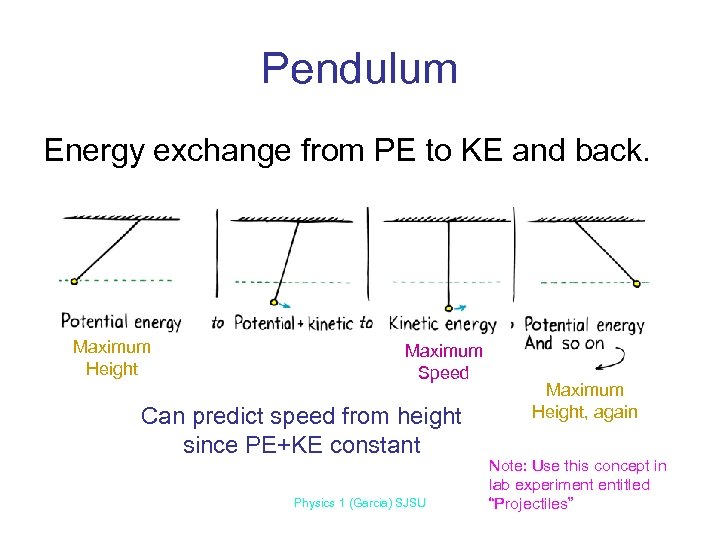 Pendulum Energy exchange from PE to KE and back. Maximum Height Maximum Speed Can predict speed from height since PE+KE constant Physics 1 (Garcia) SJSU Maximum Height, again Note: Use this concept in lab experiment entitled “Projectiles”
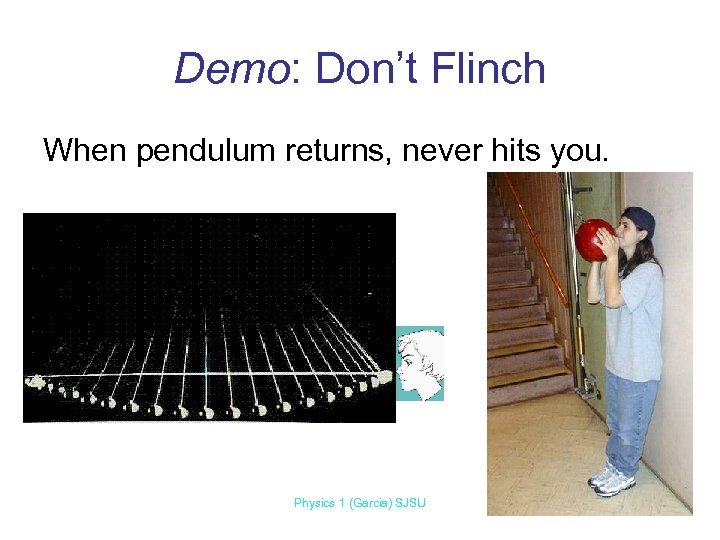 Demo: Don’t Flinch When pendulum returns, never hits you. Physics 1 (Garcia) SJSU
 Movie: Bowling Ball Pendulum Physics 1 (Garcia) SJSU
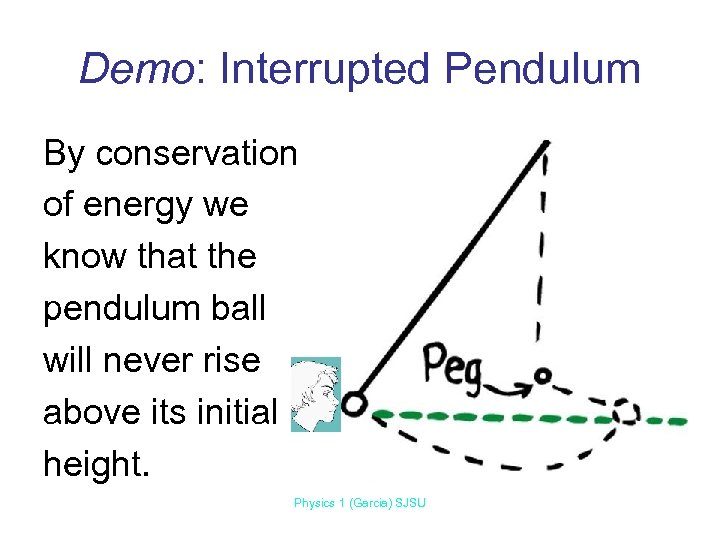 Demo: Interrupted Pendulum By conservation of energy we know that the pendulum ball will never rise above its initial height. Physics 1 (Garcia) SJSU
 Demo: Bunny Bash www. bunnybash. org Physics 1 (Garcia) SJSU
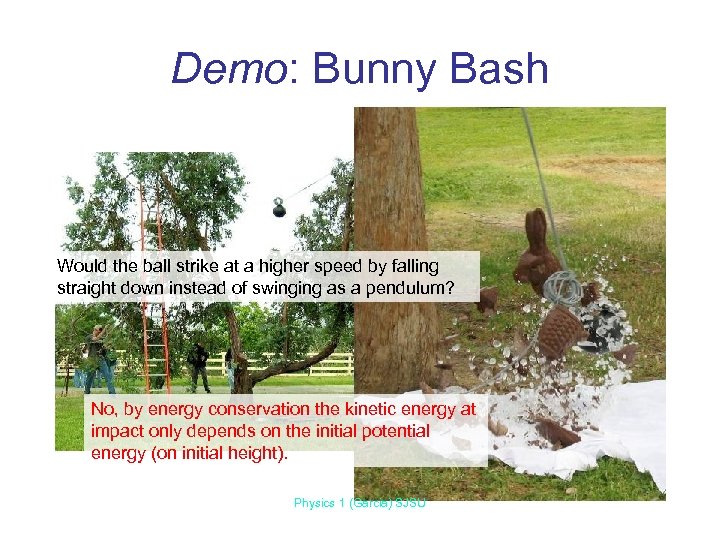 Demo: Bunny Bash Would the ball strike at a higher speed by falling straight down instead of swinging as a pendulum? No, by energy conservation the kinetic energy at impact only depends on the initial potential energy (on initial height). Physics 1 (Garcia) SJSU
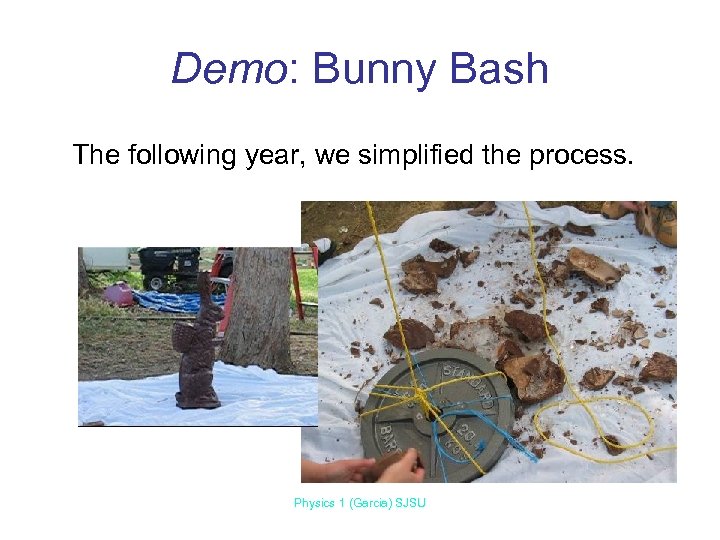 Demo: Bunny Bash The following year, we simplified the process. Physics 1 (Garcia) SJSU
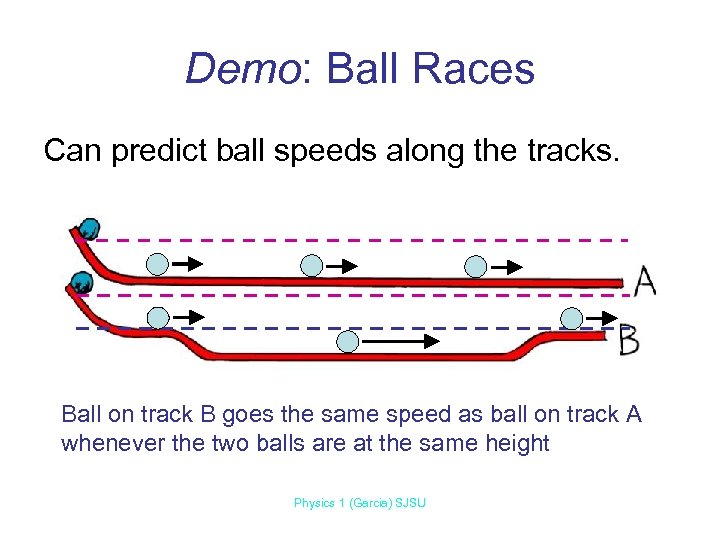 Demo: Ball Races Can predict ball speeds along the tracks. Ball on track B goes the same speed as ball on track A whenever the two balls are at the same height Physics 1 (Garcia) SJSU
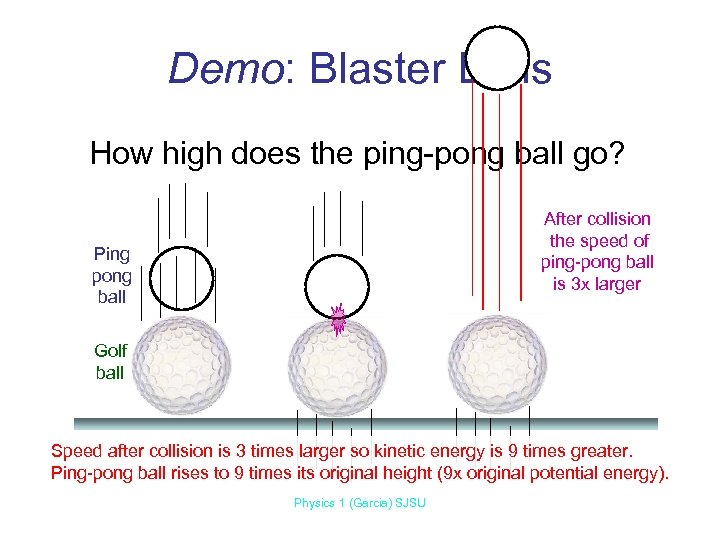 Demo: Blaster Balls How high does the ping-pong ball go? After collision the speed of ping-pong ball is 3 x larger Ping pong ball Golf ball Speed after collision is 3 times larger so kinetic energy is 9 times greater. Ping-pong ball rises to 9 times its original height (9 x original potential energy). Physics 1 (Garcia) SJSU
 Work Define work done on an object by a force as (Work) = (Force) X (Distance traveled) Force acting in direction of motion: Positive work. Force acting in opposite direction: Negative work. Force perpendicular to motion: Zero work Physics 1 (Garcia) SJSU
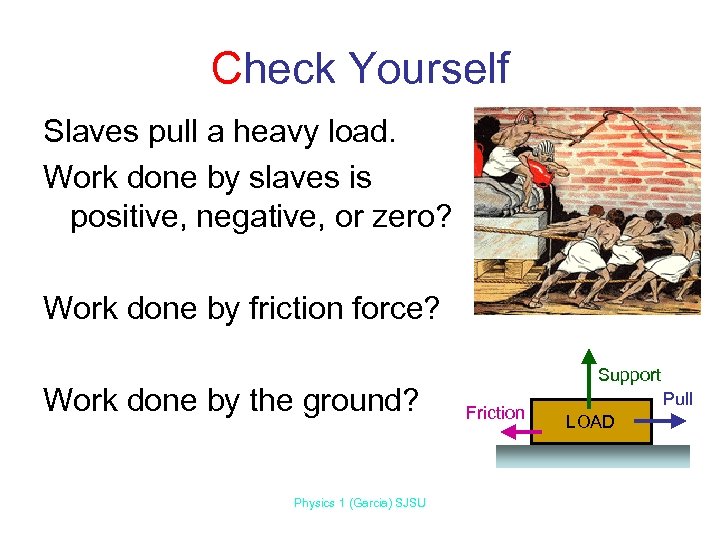 Check Yourself Slaves pull a heavy load. Work done by slaves is positive, negative, or zero? Work done by friction force? Work done by the ground? Physics 1 (Garcia) SJSU Support Friction Pull LOAD
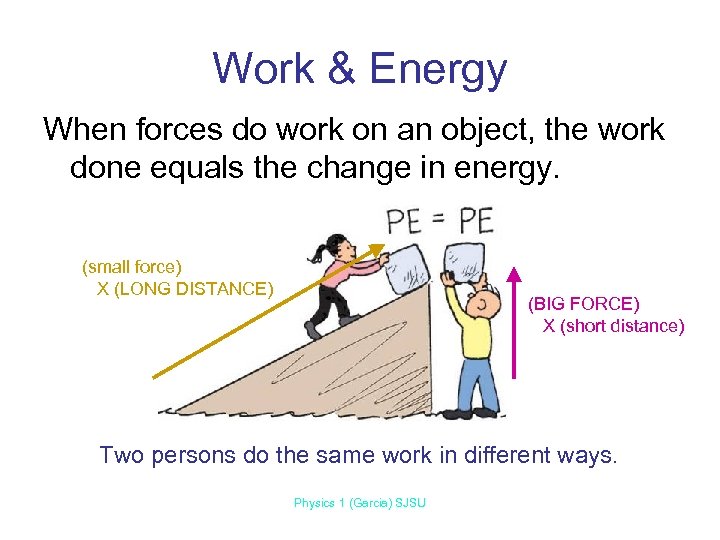 Work & Energy When forces do work on an object, the work done equals the change in energy. (small force) X (LONG DISTANCE) (BIG FORCE) X (short distance) Two persons do the same work in different ways. Physics 1 (Garcia) SJSU
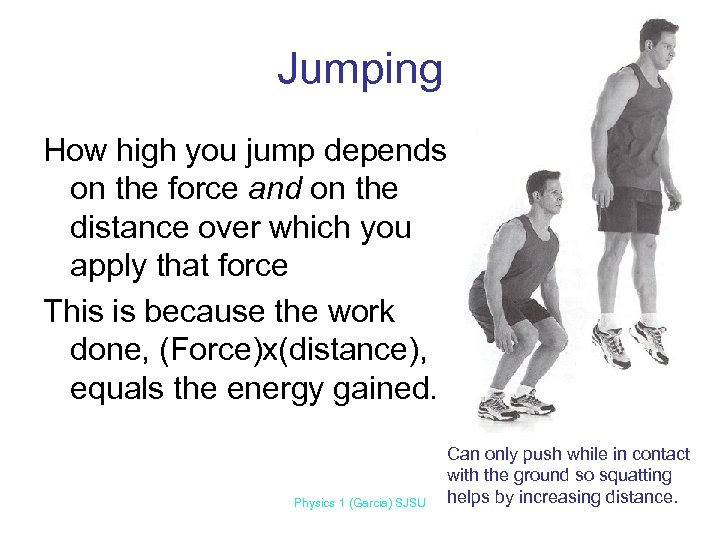 Jumping How high you jump depends on the force and on the distance over which you apply that force This is because the work done, (Force)x(distance), equals the energy gained. Physics 1 (Garcia) SJSU Can only push while in contact with the ground so squatting helps by increasing distance.
 Check Yourself Compared with going 30 mph, a car going 60 mph has ____ times the kinetic energy. Four times the KE means ____ times the work required to stop the car. Four times the work means ____ times the distance (same friction force on brakes). Physics 1 (Garcia) SJSU
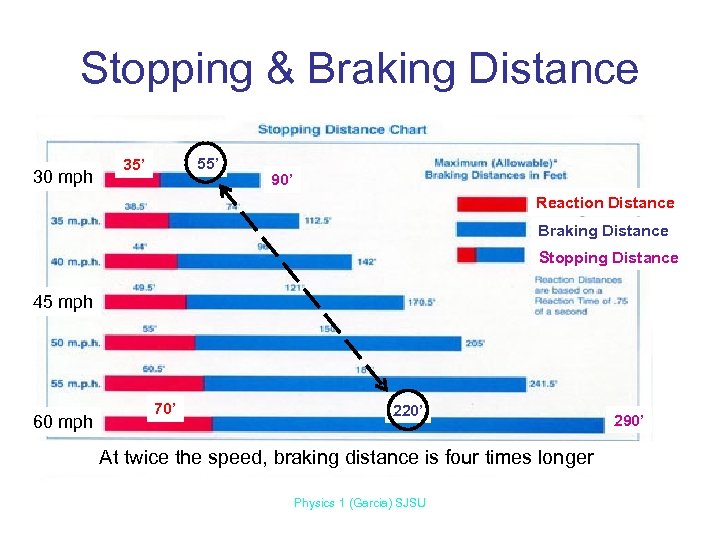 Stopping & Braking Distance 30 mph 55’ 35’ 90’ Reaction Distance Braking Distance Stopping Distance 45 mph 60 mph 70’ 220’ At twice the speed, braking distance is four times longer Physics 1 (Garcia) SJSU 290’