


 Скачать презентацию Chapter 7 Energy Conservation Lecture 14 HNRT 228
654095b616cf8004bb1c8f6e5e270e5f.ppt
- Количество слайдов: 84
 Chapter 7 Energy Conservation Lecture #14 HNRT 228 Spring 2015 Energy and the Environment 1
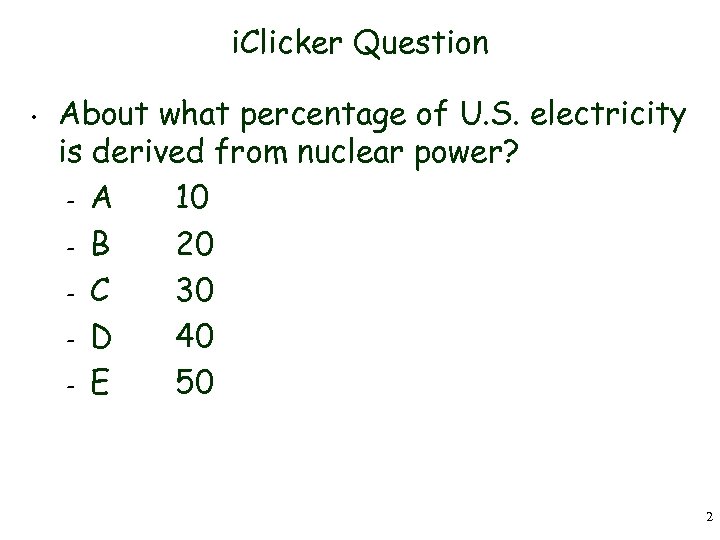 i. Clicker Question • About what percentage of U. S. electricity is derived from nuclear power? – A 10 – B 20 – C 30 – D 40 – E 50 2
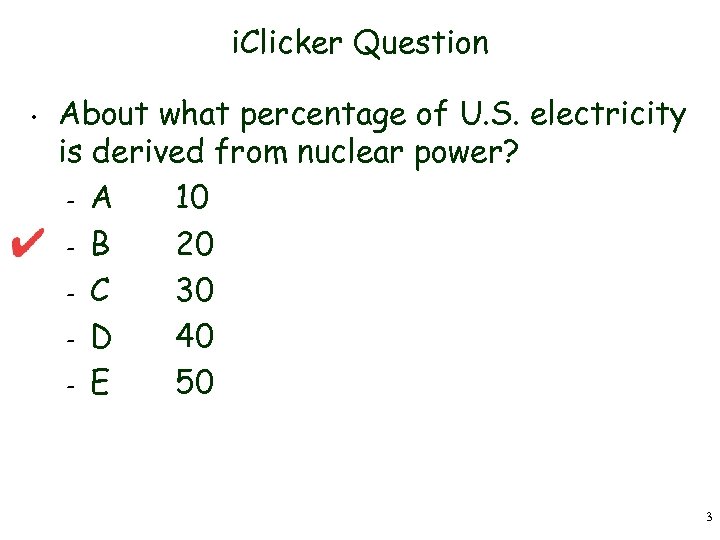 i. Clicker Question • About what percentage of U. S. electricity is derived from nuclear power? – A 10 – B 20 – C 30 – D 40 – E 50 3
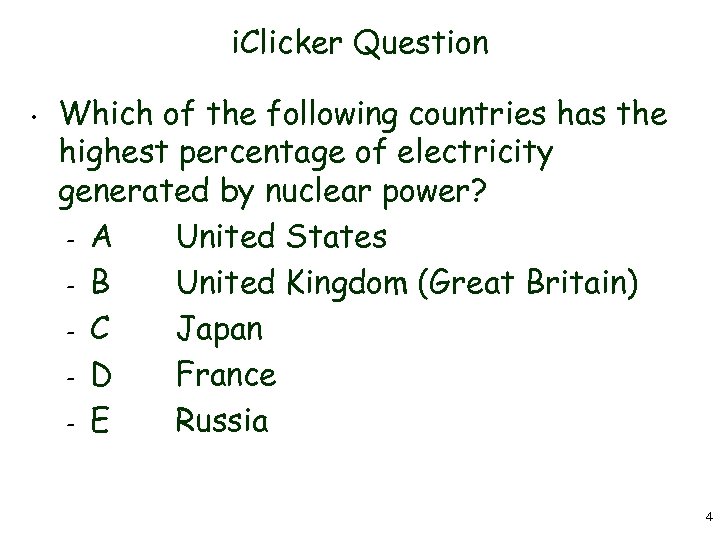 i. Clicker Question • Which of the following countries has the highest percentage of electricity generated by nuclear power? – A United States – B United Kingdom (Great Britain) – C Japan – D France – E Russia 4
 i. Clicker Question • Which of the following countries has the highest percentage of electricity generated by nuclear power? – A United States – B United Kingdom (Great Britain) – C Japan – D France – E Russia 5
 i. Clicker Question • Which of the following describes the Roentgen? – A the unit of absorbed dose equivalent. – B the unit of absorbed dose. – C the unit of exposure to ionizing radiation – D all of the above – E none of the above 6
 i. Clicker Question • Which of the following describes the Roentgen? – A the unit of absorbed dose equivalent. – B the unit of absorbed dose. – C the unit of exposure to ionizing radiation – D all of the above – E none of the above 7
 i. Clicker Question • Which of the following describes the RAD? – A the unit of absorbed dose equivalent. – B the unit of absorbed dose. – C the unit of exposure to ionizing radiation – D all of the above – E none of the above 8
 i. Clicker Question • Which of the following describes the RAD? – A the unit of absorbed dose equivalent. – B the unit of absorbed dose. – C the unit of exposure to ionizing radiation – D all of the above – E none of the above 9
 i. Clicker Question • Which of the following describes the REM? – A the unit of absorbed dose equivalent. – B the unit of absorbed dose. – C the unit of exposure to ionizing radiation – D all of the above – E none of the above 10
 i. Clicker Question • Which of the following describes the REM? – A the unit of absorbed dose equivalent. – B the unit of absorbed dose. – C the unit of exposure to ionizing radiation – D all of the above – E none of the above 11
 i. Clicker Question • Which statement is true about fusion? – A Fusion is just another name for nuclear fission. – B Fusion and fission are variations of the same nuclear process. – C Fusion is the breakup of heavier chemical elements into lighter chemical elements. – D Fusion is the process of producing heavier chemical elements from lighter chemical elements. – E Fusion is the process of converting energy into matter. 12
 i. Clicker Question • Which statement is true about fusion? – A Fusion is just another name for nuclear fission. – B Fusion and fission are variations of the same nuclear process. – C Fusion is the breakup of heavier chemical elements into lighter chemical elements. – D Fusion is the process of producing heavier chemical elements from lighter chemical elements. – E Fusion is the process of converting energy into matter. 13
 Overview of Chapter • Energy Conservation – Space Heating – Thermal Insulation – Air Infiltration – Lighting – Appliances – Some considerations of agriculture and industry 14
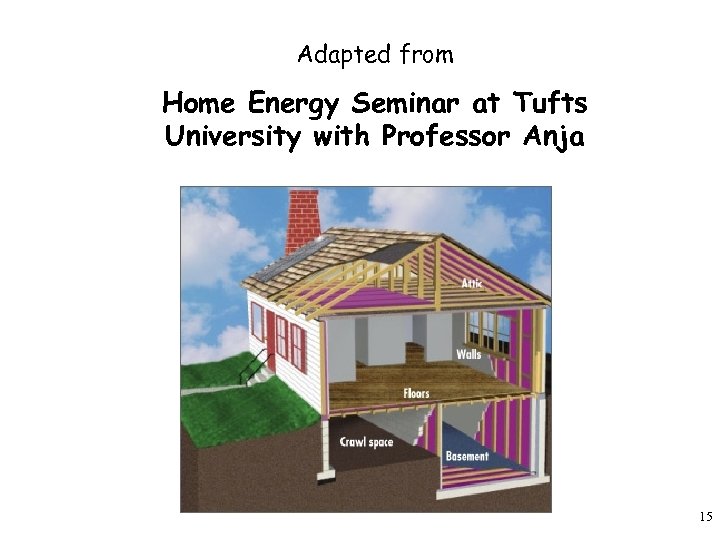 Adapted from Home Energy Seminar at Tufts University with Professor Anja 15
 Home Energy Seminar Overview • Home Energy - Lights • Home Energy - Appliances • • Fridges, Washing machines, AC Home Energy - A little Physics • Building diagnostics • Insulation vs. Air-tightness • Home Energy - Windows • Home Energy - Heating Systems 16
 N. B. Addressing Energy Conservation Issues May Help Address Other Issues Energy Security National Security Job Security Air Pollution 17
 Efficiency Thoughts An estimated 94% of materials become waste before a product is even manufactured. Only 6 per cent of materials extracted each year are embodied in durable goods! 18
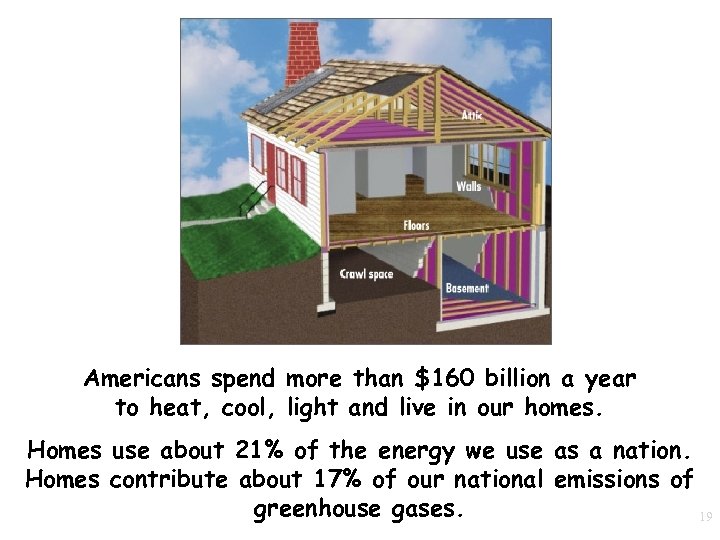 Home Energy Seminary Save Money! Protect the Climate! Americans spend more than $160 billion a year to heat, cool, light and live in our homes. Homes use about 21% of the energy we use as a nation. Homes contribute about 17% of our national emissions of greenhouse gases. 19
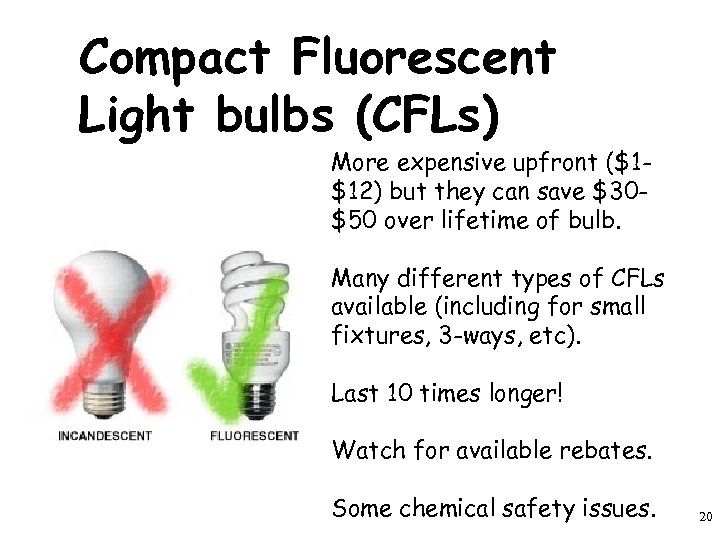 Compact Fluorescent Light bulbs (CFLs) More expensive upfront ($1$12) but they can save $30$50 over lifetime of bulb. Many different types of CFLs available (including for small fixtures, 3 -ways, etc). Last 10 times longer! Watch for available rebates. Some chemical safety issues. 20
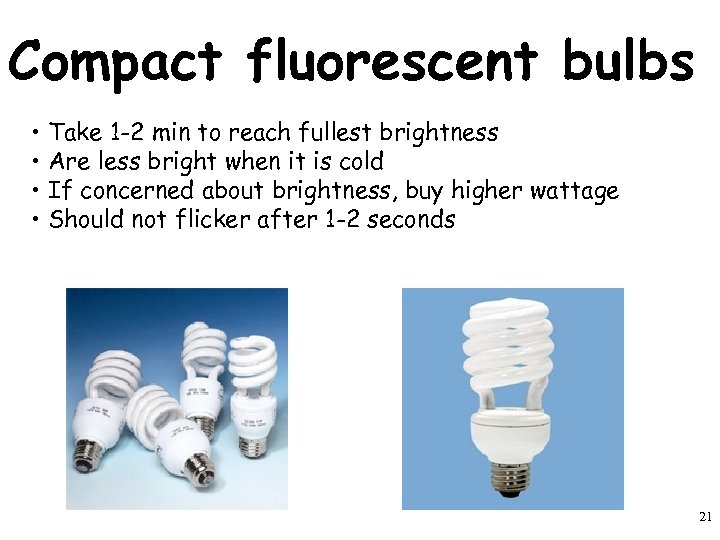 Compact fluorescent bulbs • Take 1 -2 min to reach fullest brightness • Are less bright when it is cold • If concerned about brightness, buy higher wattage • Should not flicker after 1 -2 seconds 21
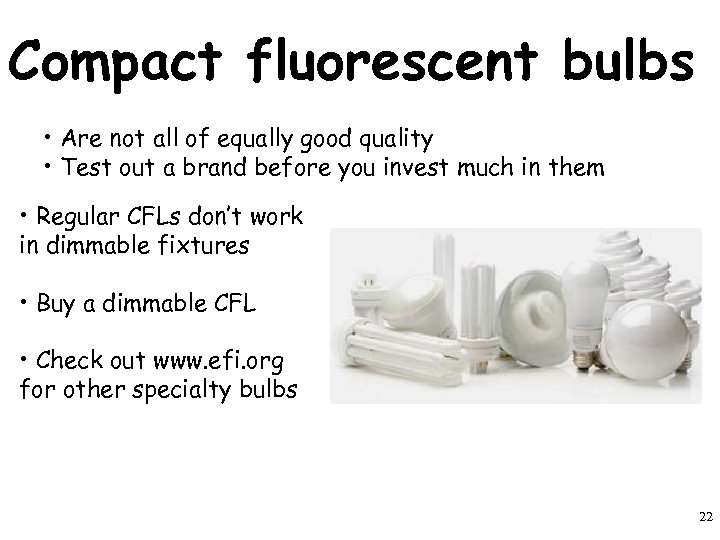 Compact fluorescent bulbs • Are not all of equally good quality • Test out a brand before you invest much in them • Regular CFLs don’t work in dimmable fixtures • Buy a dimmable CFL • Check out www. efi. org for other specialty bulbs 22
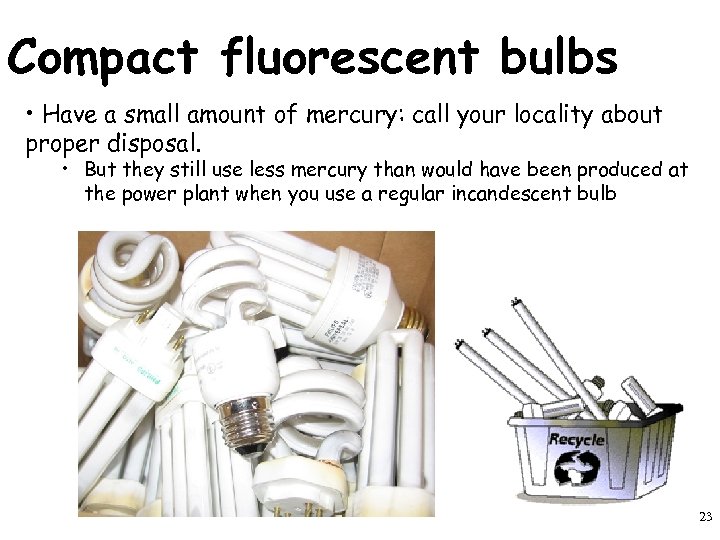 Compact fluorescent bulbs • Have a small amount of mercury: call your locality about proper disposal. • But they still use less mercury than would have been produced at the power plant when you use a regular incandescent bulb 23
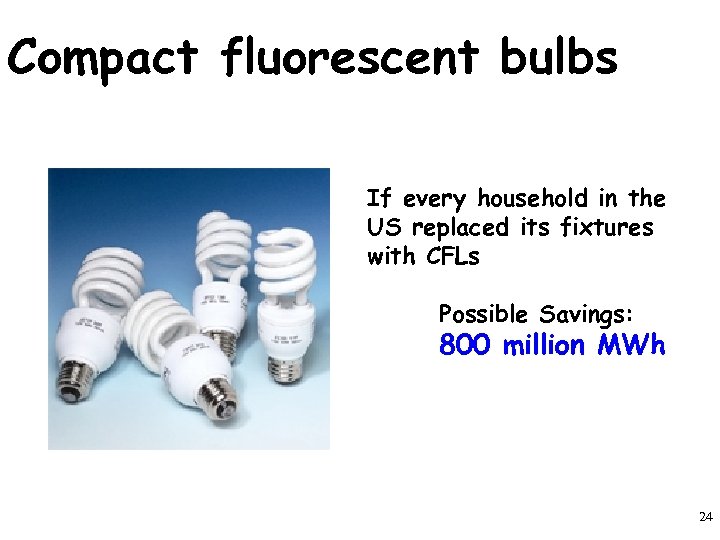 Compact fluorescent bulbs If every household in the US replaced its fixtures with CFLs Possible Savings: 800 million MWh 24
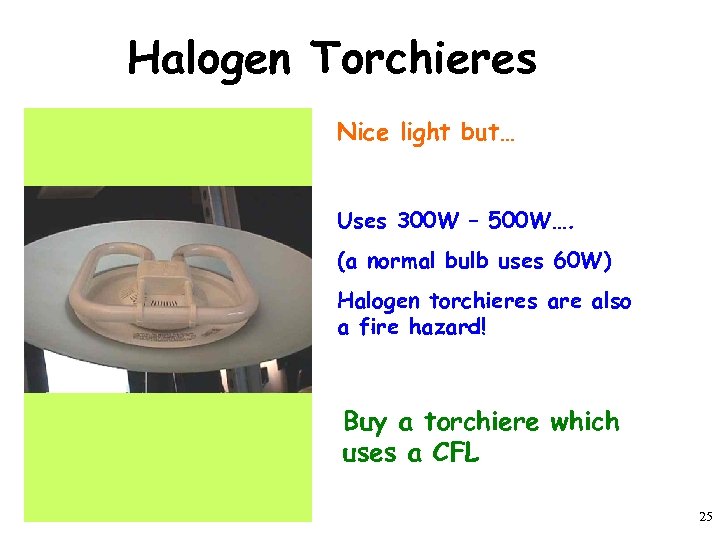 Halogen Torchieres Energy Hog! Nice light but… Uses 300 W – 500 W…. (a normal bulb uses 60 W) Halogen torchieres are also a fire hazard! Buy a torchiere which uses a CFL 25
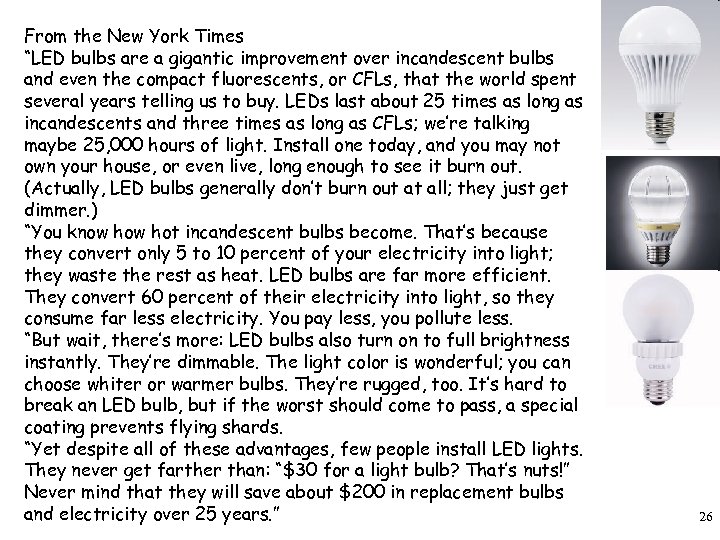 From the New York Times “LED bulbs are a gigantic improvement over incandescent bulbs and even the compact fluorescents, or CFLs, that the world spent several years telling us to buy. LEDs last about 25 times as long as incandescents and three times as long as CFLs; we’re talking maybe 25, 000 hours of light. Install one today, and you may not own your house, or even live, long enough to see it burn out. (Actually, LED bulbs generally don’t burn out at all; they just get dimmer. ) “You know hot incandescent bulbs become. That’s because they convert only 5 to 10 percent of your electricity into light; they waste the rest as heat. LED bulbs are far more efficient. They convert 60 percent of their electricity into light, so they consume far less electricity. You pay less, you pollute less. “But wait, there’s more: LED bulbs also turn on to full brightness instantly. They’re dimmable. The light color is wonderful; you can choose whiter or warmer bulbs. They’re rugged, too. It’s hard to break an LED bulb, but if the worst should come to pass, a special coating prevents flying shards. “Yet despite all of these advantages, few people install LED lights. They never get farther than: “$30 for a light bulb? That’s nuts!” Never mind that they will save about $200 in replacement bulbs and electricity over 25 years. ” 26
 Appliances Energy Star: www. energystar. gov Look for the energy star label! More than 35 product categories are available with the ENERGY STAR label. Careful! Energy Star appliances are rated by size class. Look for the smallest appliance that fits your needs. 27
 28
28
 Refrigerator If your refrigerator is more than 8 years old, it makes sense to replace it. The new one will pay for itself in energy savings in about 3 -6 years. Again! Energy Star appliances are rated by size class. Look for the smallest refrigerator that fits your needs! Side-by-side are least efficient. 29
 i. Clicker Question • How many fewer power plants might be needed if every household changed to compact fluorescent lighting? – A About one – B More than one – C More than 100 30
 i. Clicker Question • How many fewer power plants might be needed if every household changed to compact fluorescent lighting? – A About one – B More than one – C More than 100 31
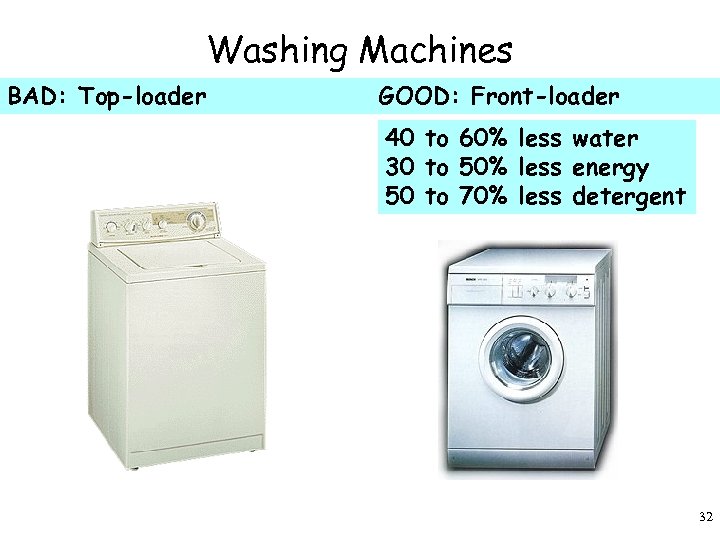 Washing Machines BAD: Top-loader GOOD: Front-loader 40 to 60% less water 30 to 50% less energy 50 to 70% less detergent 32
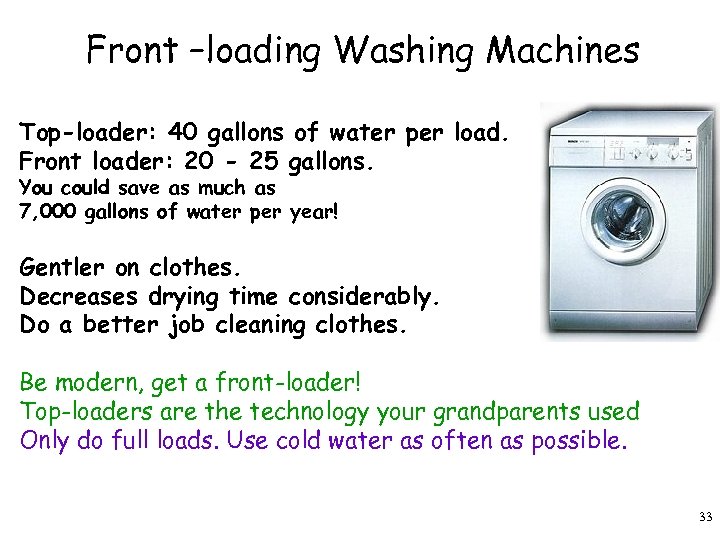 Front –loading Washing Machines Top-loader: 40 gallons of water per load. Front loader: 20 - 25 gallons. You could save as much as 7, 000 gallons of water per year! Gentler on clothes. Decreases drying time considerably. Do a better job cleaning clothes. Be modern, get a front-loader! Top-loaders are the technology your grandparents used Only do full loads. Use cold water as often as possible. 33
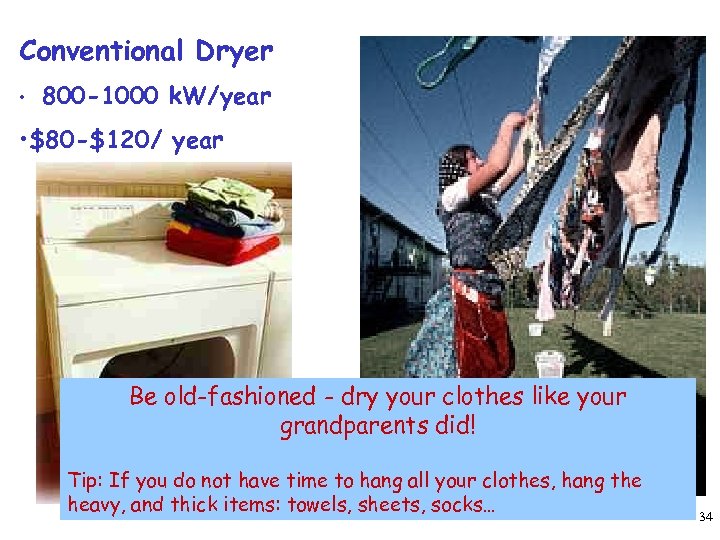 Conventional Dryer • 800 -1000 k. W/year • $80 -$120/ year Be old-fashioned - dry your clothes like your grandparents did! Tip: If you do not have time to hang all your clothes, hang the heavy, and thick items: towels, sheets, socks… 34
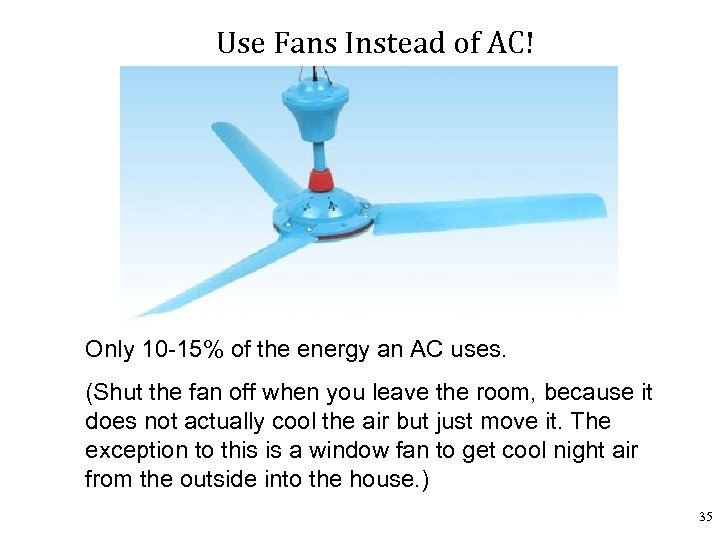 Use Fans Instead of AC! Only 10 -15% of the energy an AC uses. (Shut the fan off when you leave the room, because it does not actually cool the air but just move it. The exception to this is a window fan to get cool night air from the outside into the house. ) 35
 Be cheap! Turn it off! Most electricity is used by things that are on a lot and use a lot of power: Refrigerator (500 k. Wh-1300 k. Wh per year) Freezer (500 k. Wh-1300 k. Wh per year) Desktop Computer (300 -1000 k. Wh per year) Lights Don’t forget to turn your heat or AC off /down! 36
 i. Clicker Question • Which type of washing machine conserves the most energy and water? – A Top loader – B Front loader – C There is no difference 37
 i. Clicker Question • Which type of washing machine conserves the most energy and water? – A Top loader – B Front loader – C There is no difference 38
 Myth WRONG! Turning off your computer will harm it. This used to be true back when computers had green screens and punched cards…… 39
 Myth WRONG! Leaving your heat on is more efficient than turning it down because you need so much energy to heat the house back up. Think about it! It’s as if you’d claim that putting down your suitcase while waiting for the bus uses more energy than holding it up the whole time, because you’d have to pick it up again. 40
 Get a Home Energy Audit A professional will be able to analyze your house and give you advise. You’ll get most out of it, if you are well educated. Prepare well and ask lot’s of questions. 41
 A Little Physics: How Heat Travels: Convection The flow of hot and cold gases This is how heat travels through leaks, cracks and gaps in your house. 42
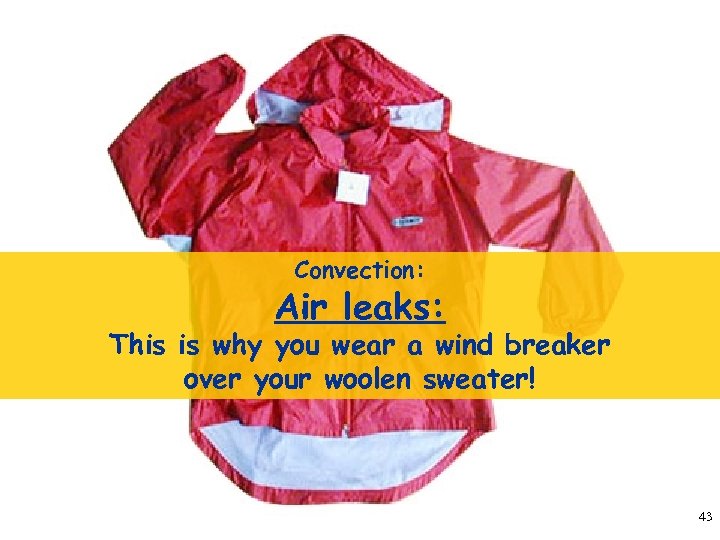 Will she be warm enough in Convection: the winter? Air leaks: This is why you wear a wind breaker over your woolen sweater! 43
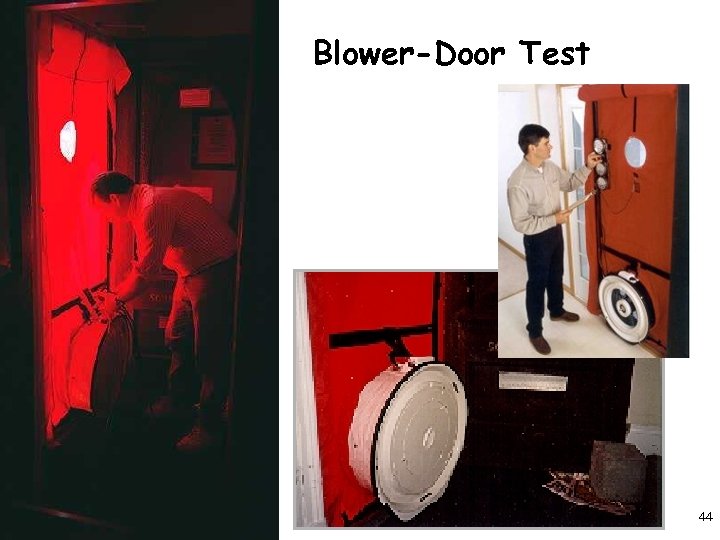 Blower-Door Test 44
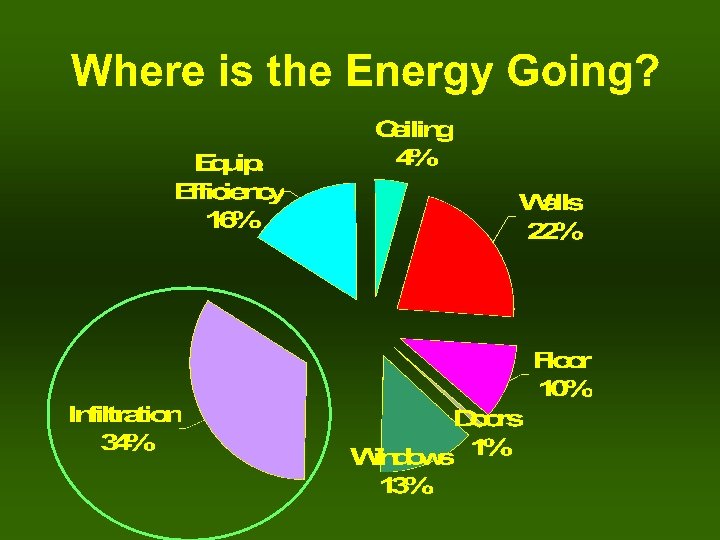 45
45
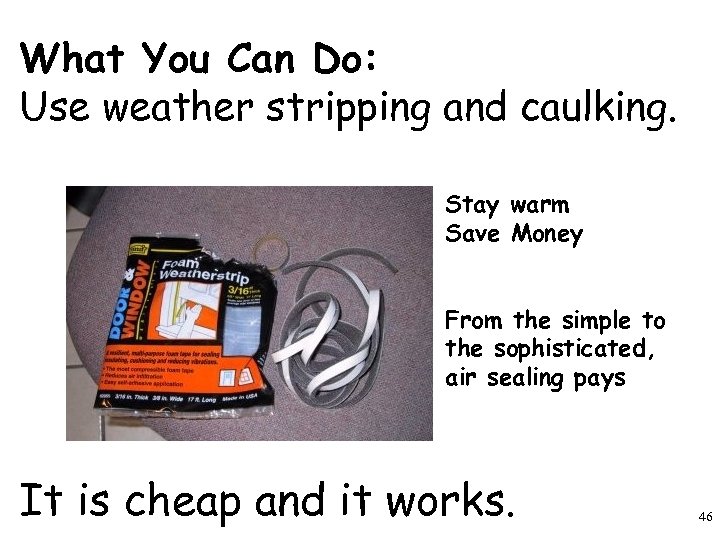 What You Can Do: Use weather stripping and caulking. Stay warm Save Money From the simple to the sophisticated, air sealing pays It is cheap and it works. 46
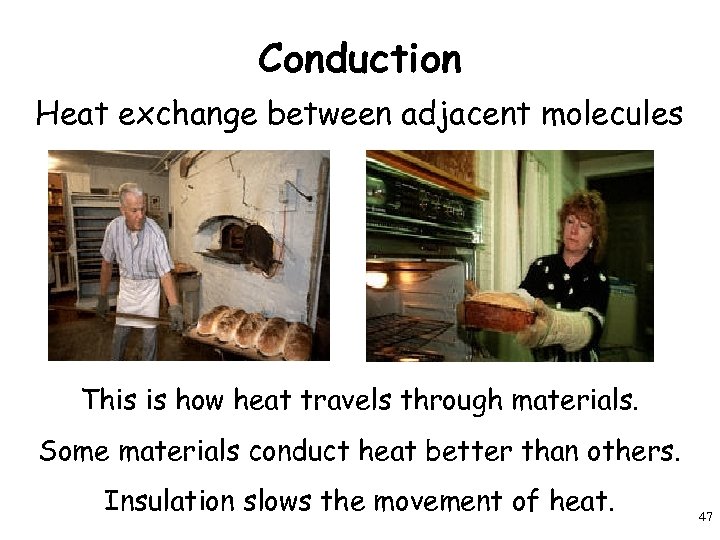 Conduction Heat exchange between adjacent molecules This is how heat travels through materials. Some materials conduct heat better than others. Insulation slows the movement of heat. 47
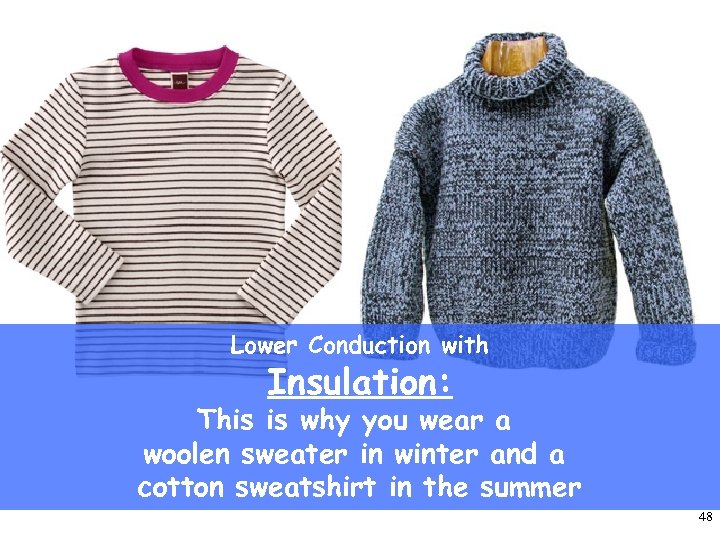 Lower Conduction with Insulation: This is why you wear a woolen sweater in winter and a cotton sweatshirt in the summer 48
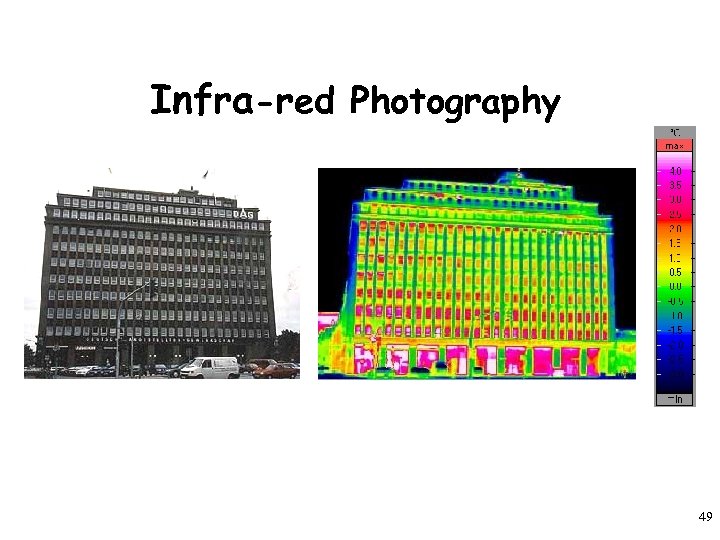 Infra-red Photography 49
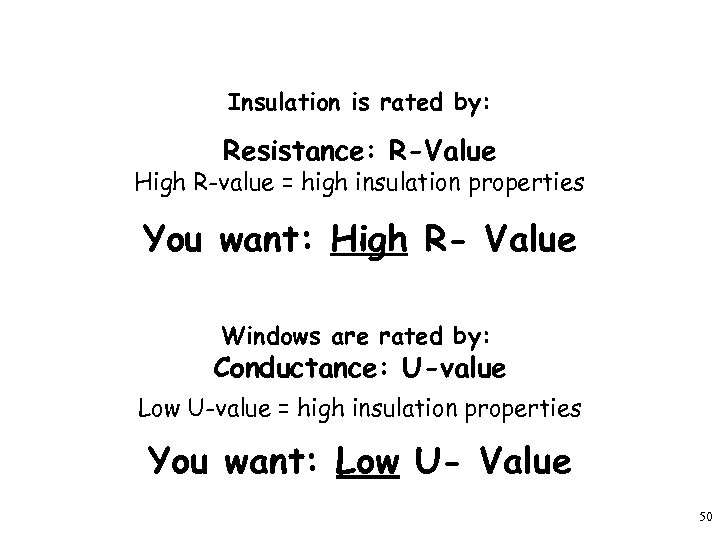 Insulation is rated by: Resistance: R-Value High R-value = high insulation properties You want: High R- Value Windows are rated by: Conductance: U-value Low U-value = high insulation properties You want: Low U- Value 50
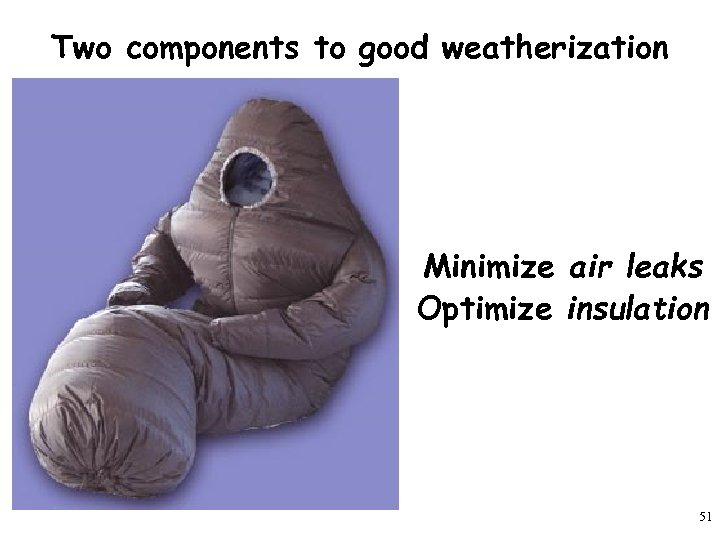 Two components to good weatherization Minimize air leaks Optimize insulation 51
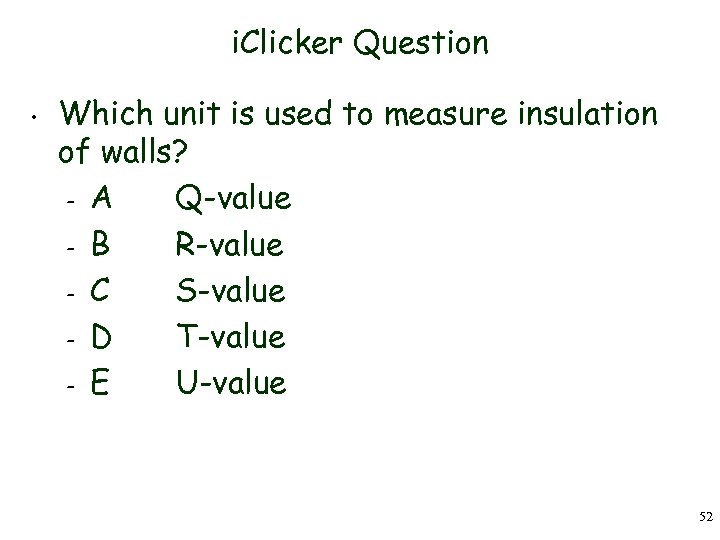 i. Clicker Question • Which unit is used to measure insulation of walls? – A Q-value – B R-value – C S-value – D T-value – E U-value 52
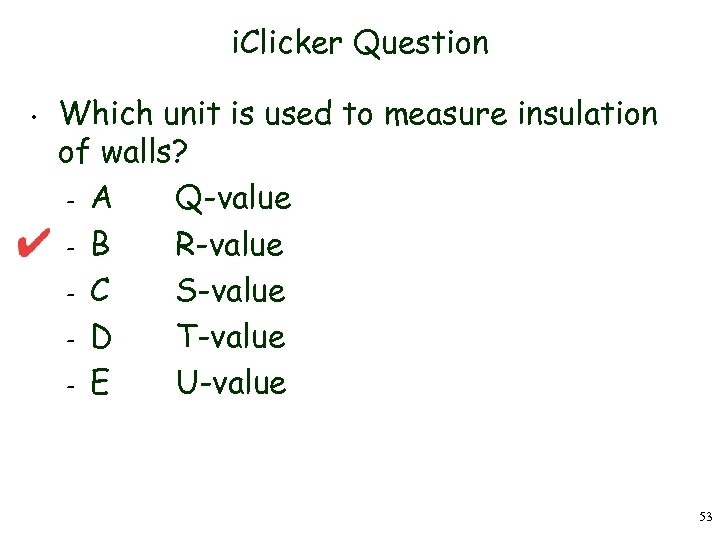 i. Clicker Question • Which unit is used to measure insulation of walls? – A Q-value – B R-value – C S-value – D T-value – E U-value 53
 i. Clicker Question • Which unit is used to measure insulation of windows? – A Q-value – B R-value – C S-value – D T-value – E U-value 54
 i. Clicker Question • Which unit is used to measure insulation of windows? – A Q-value – B R-value – C S-value – D T-value – E U-value 55
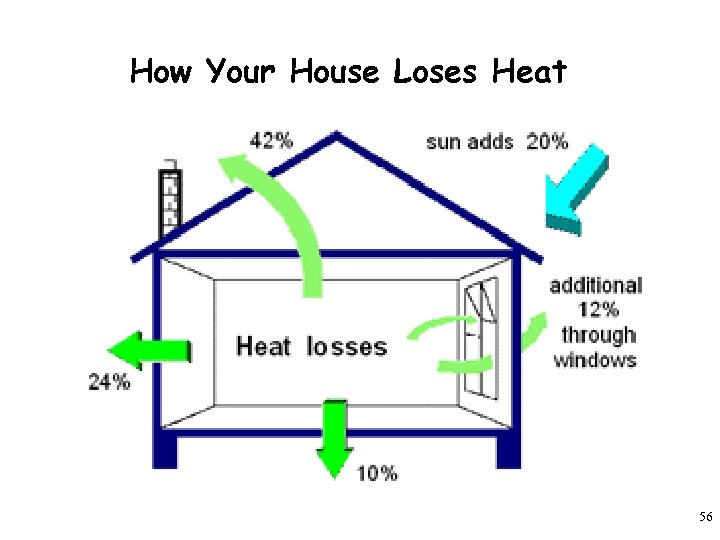 How Your House Loses Heat 56
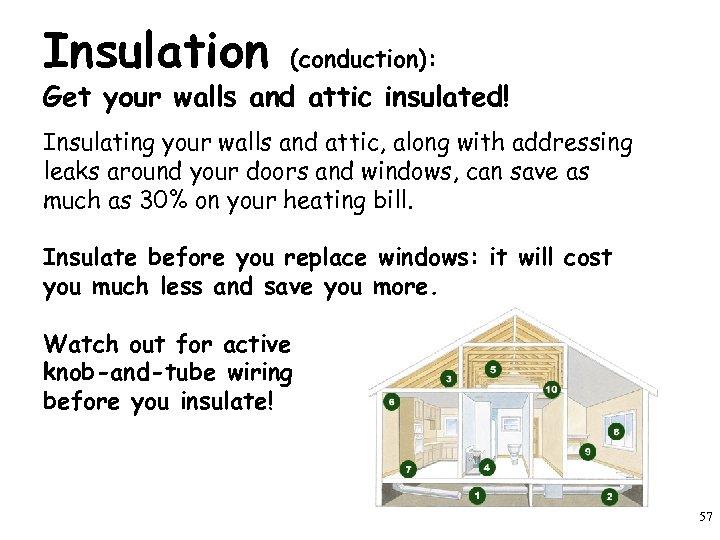 Insulation (conduction): Get your walls and attic insulated! Insulating your walls and attic, along with addressing leaks around your doors and windows, can save as much as 30% on your heating bill. Insulate before you replace windows: it will cost you much less and save you more. Watch out for active knob-and-tube wiring before you insulate! 57
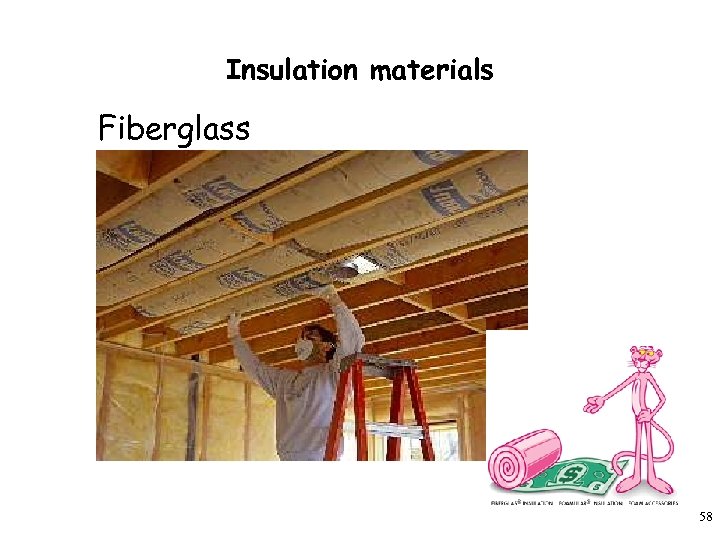 Insulation materials Fiberglass 58
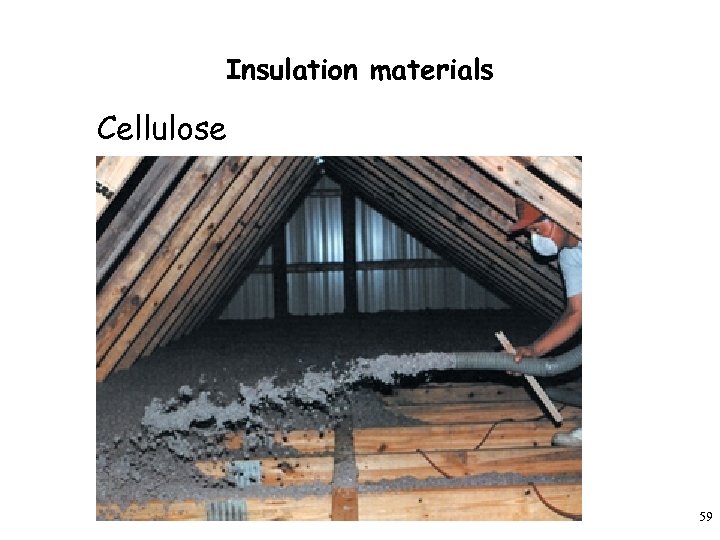 Insulation materials Cellulose 59
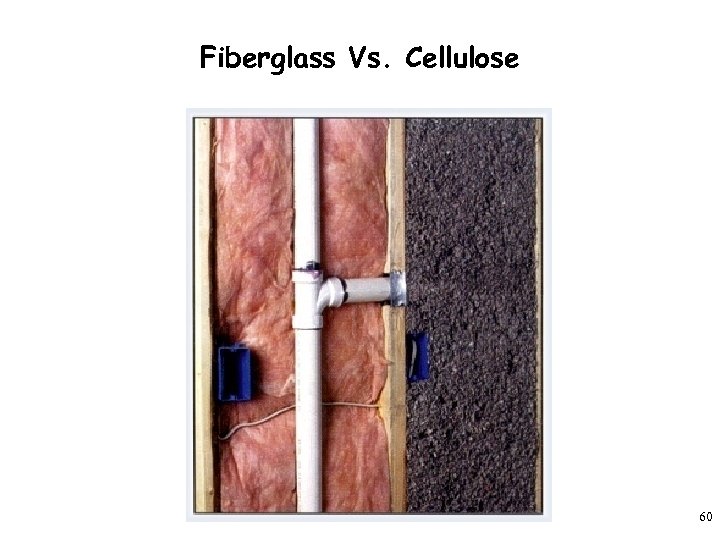 Fiberglass Vs. Cellulose 60
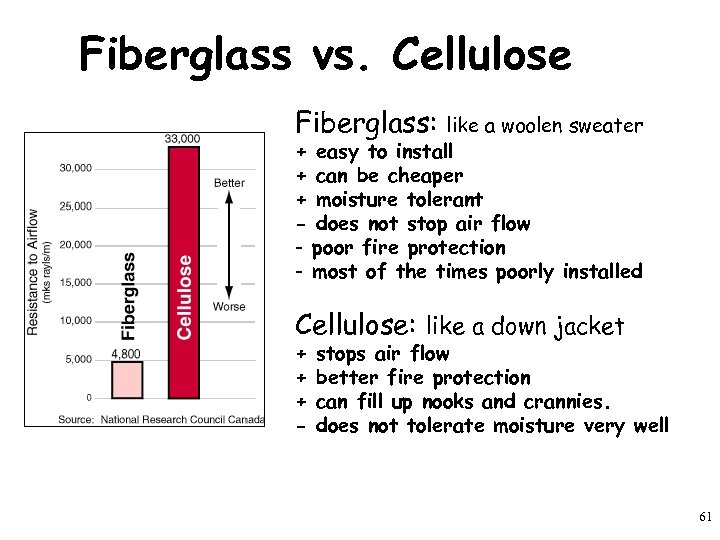 Fiberglass vs. Cellulose Fiberglass: like a woolen sweater + easy to install + can be cheaper + moisture tolerant - does not stop air flow - poor fire protection - most of the times poorly installed Cellulose: like a down jacket + + + - stops air flow better fire protection can fill up nooks and crannies. does not tolerate moisture very well 61
 i. Clicker Question • Which of the following will conserve more energy. – A A wall with R-value 12 – B A wall with R-value 14 – C A wall with R-value 16 – D A wall with R-value 18 – E A wall with R-value 20 62
 i. Clicker Question • Which of the following will conserve more energy. – A A wall with R-value 12 – B A wall with R-value 14 – C A wall with R-value 16 – D A wall with R-value 18 – E A wall with R-value 20 63
 i. Clicker Question • Which of the following will conserve more energy. – A A window with U-value 0. 12 – B A window with U-value 0. 14 – C A window with U-value 0. 16 – D A window with U-value 0. 18 – E A window with U-value 0. 20 64
 i. Clicker Question • Which of the following will conserve more energy. – A A window with U-value 0. 12 – B A window with U-value 0. 14 – C A window with U-value 0. 16 – D A window with U-value 0. 18 – E A window with U-value 0. 20 65
 66
66
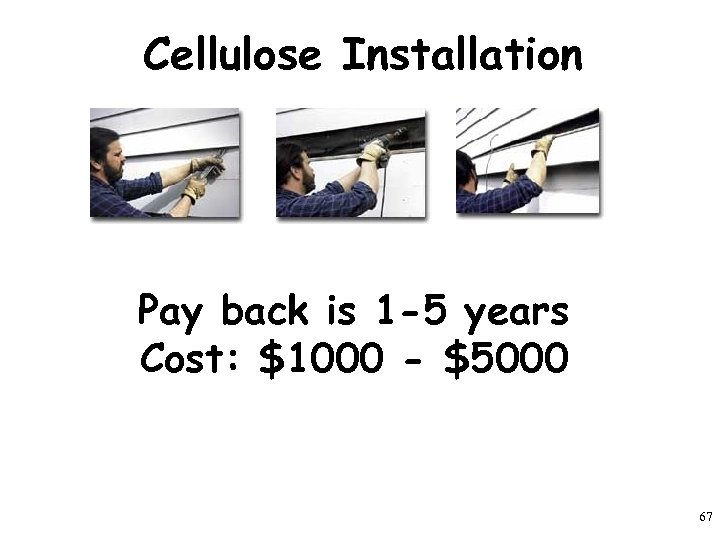 Cellulose Installation Pay back is 1 -5 years Cost: $1000 - $5000 67
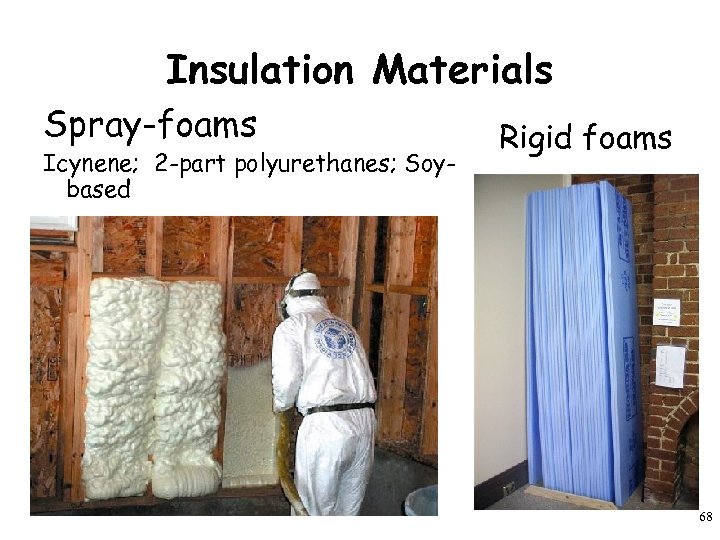 Insulation Materials Spray-foams Icynene; 2 -part polyurethanes; Soybased Rigid foams 68
 General Insulation Strategies Use an insulation that air-seals and insulates – Spray foam – Dense-pack (or wet-spray) cellulose When practical, insulate the outermost plane – Attic roof rather than floor joists – Crawlspace floor and walls rather than ceiling – Basement walls rather than ceiling Slide by Paul Eldrenkamp 69 @ Byggmeister
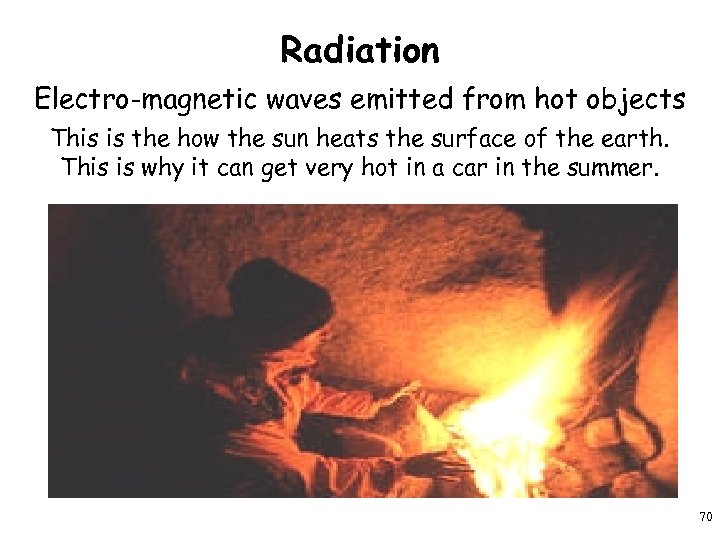 Radiation Electro-magnetic waves emitted from hot objects This is the how the sun heats the surface of the earth. This is why it can get very hot in a car in the summer. 70
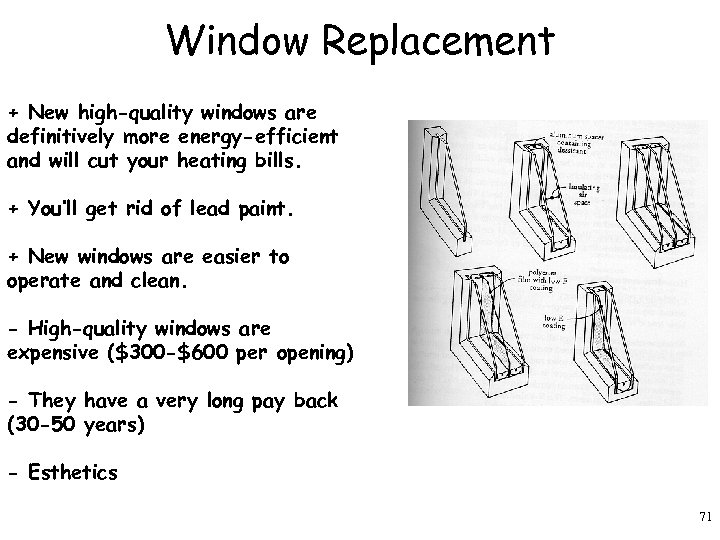 Window Replacement + New high-quality windows are definitively more energy-efficient and will cut your heating bills. + You’ll get rid of lead paint. + New windows are easier to operate and clean. - High-quality windows are expensive ($300 -$600 per opening) - They have a very long pay back (30 -50 years) - Esthetics 71
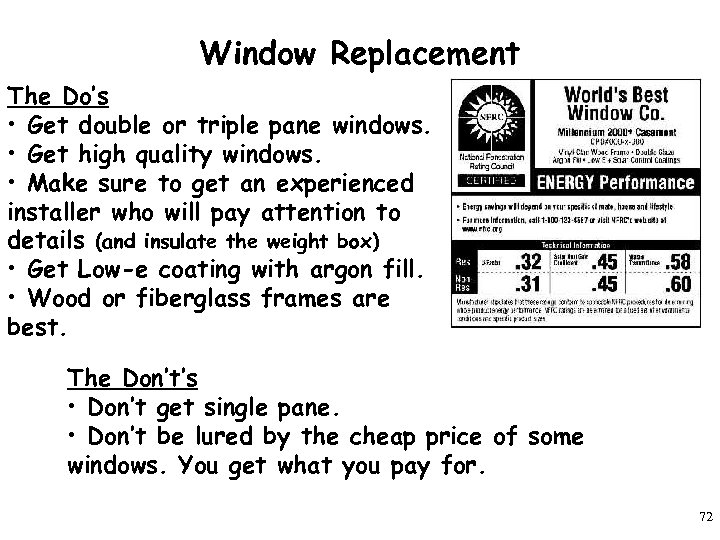 Window Replacement The Do’s • Get double or triple pane windows. • Get high quality windows. • Make sure to get an experienced installer who will pay attention to details (and insulate the weight box) • Get Low-e coating with argon fill. • Wood or fiberglass frames are best. The Don’t’s • Don’t get single pane. • Don’t be lured by the cheap price of some windows. You get what you pay for. 72
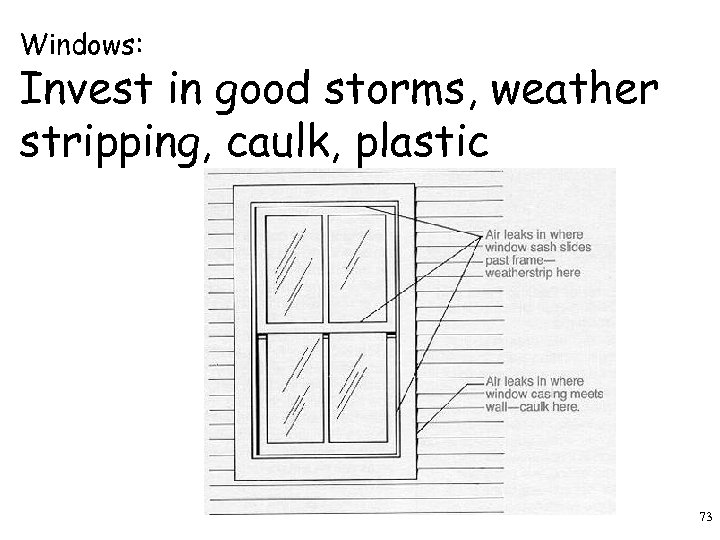 Windows: Invest in good storms, weather stripping, caulk, plastic 73
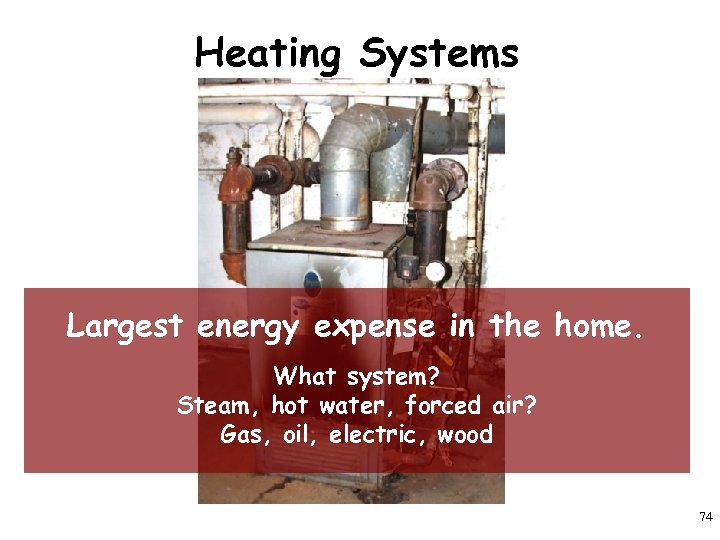 Heating Systems Largest energy expense in the home. What system? Steam, hot water, forced air? Gas, oil, electric, wood 74
 Sizing? Most systems are oversized To tell how much, see how long it runs out of each hour during cold weather. If less than half the time, a smaller system will save energy. Replacing your system: Insist on a heat loss analysis If your plumber sizes the system by the old system, take your business elsewhere! 75
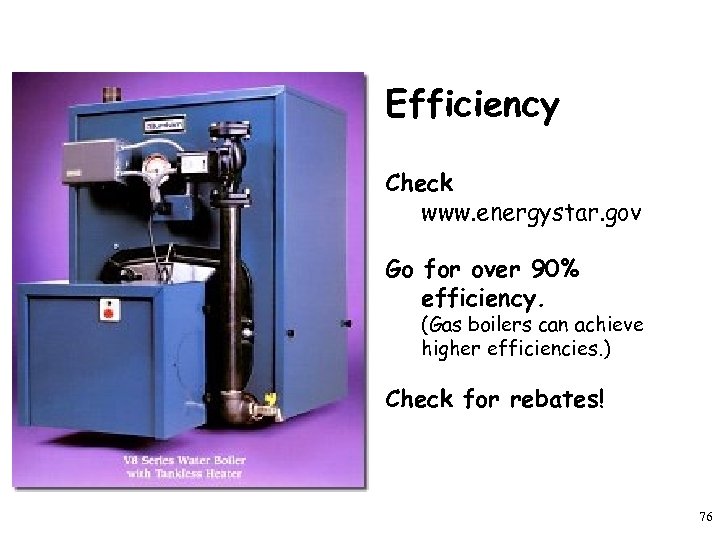 Efficiency Check www. energystar. gov Go for over 90% efficiency. (Gas boilers can achieve higher efficiencies. ) Check for rebates! 76
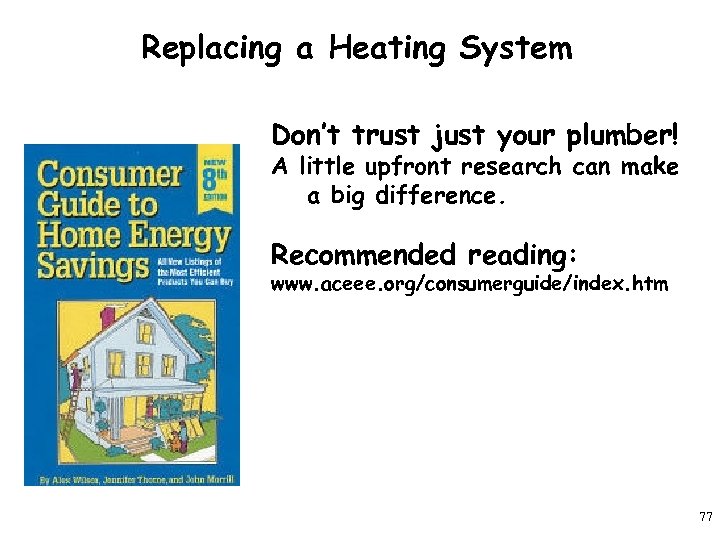 Replacing a Heating System Don’t trust just your plumber! A little upfront research can make a big difference. Recommended reading: www. aceee. org/consumerguide/index. htm 77
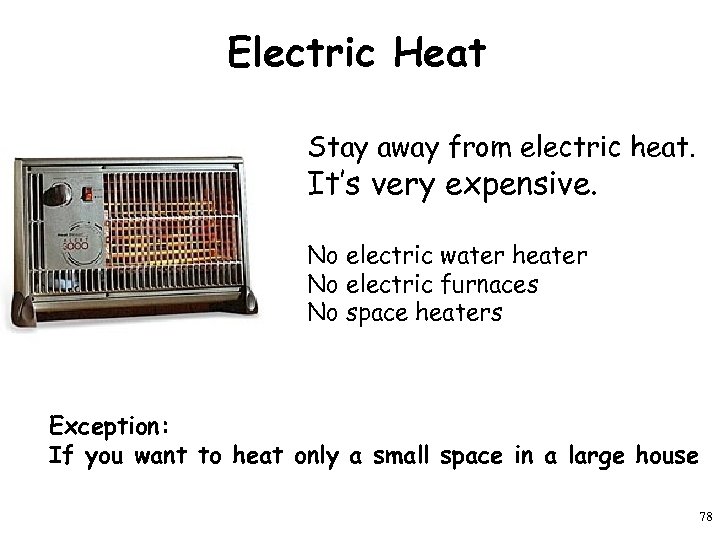 Electric Heat Stay away from electric heat. It’s very expensive. No electric water heater No electric furnaces No space heaters Exception: If you want to heat only a small space in a large house 78
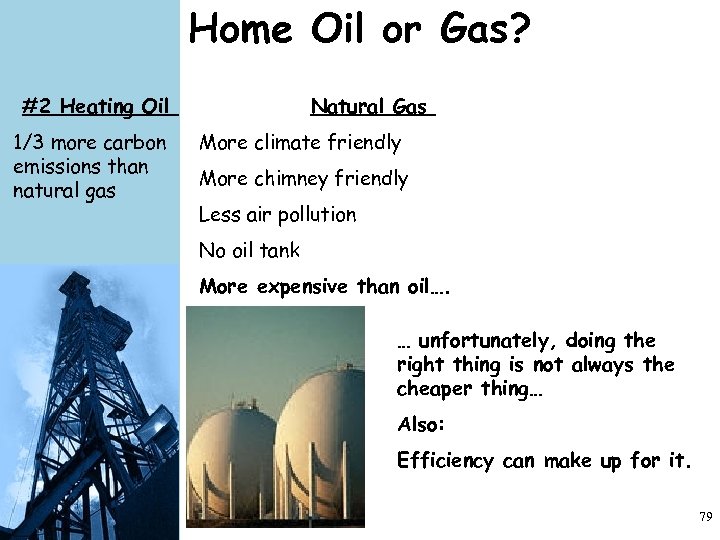 Home Oil or Gas? #2 Heating Oil 1/3 more carbon emissions than natural gas Natural Gas More climate friendly More chimney friendly Less air pollution No oil tank More expensive than oil…. … unfortunately, doing the right thing is not always the cheaper thing… Also: Efficiency can make up for it. 79
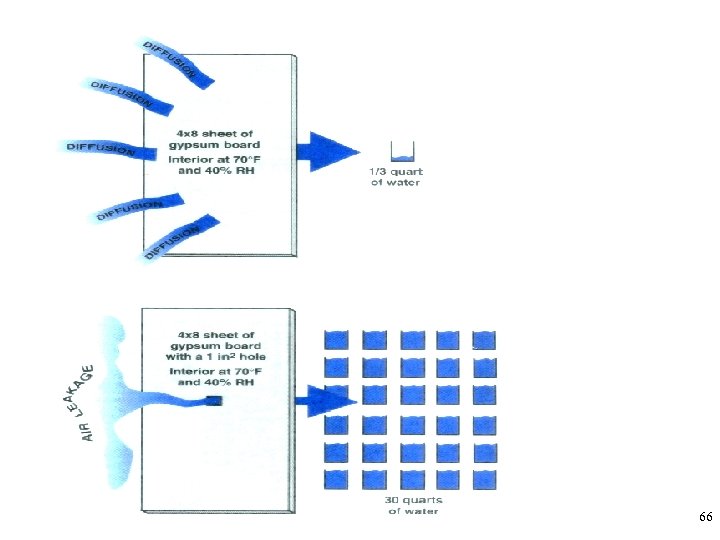
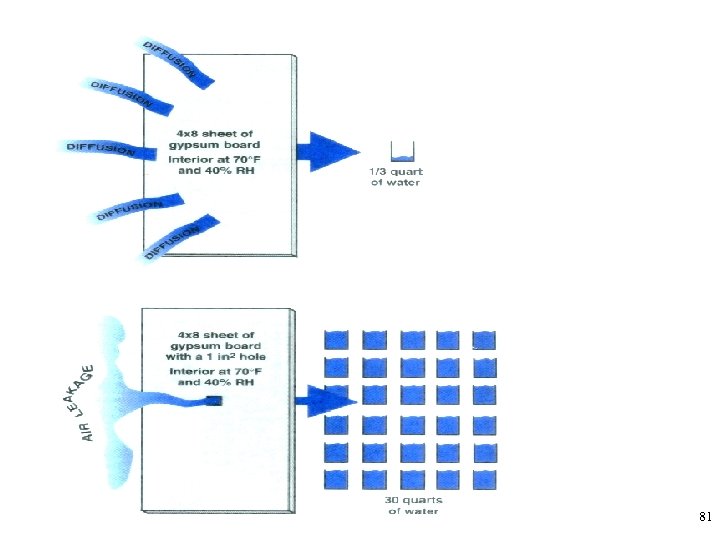
 High-cost but low-impact issues Vapor barriers – – – Vapor diffusion varies largely Ø based upon climate Big difference between a vapor barrier and an air barrier Vapor barrier can be painted 80
 81
81
 High-cost but low-impact issues – – Roof venting Cold roof vs. hot roof (vented vs. unvented) Instead of investing heavily in venting, invest in better roof insulation 82
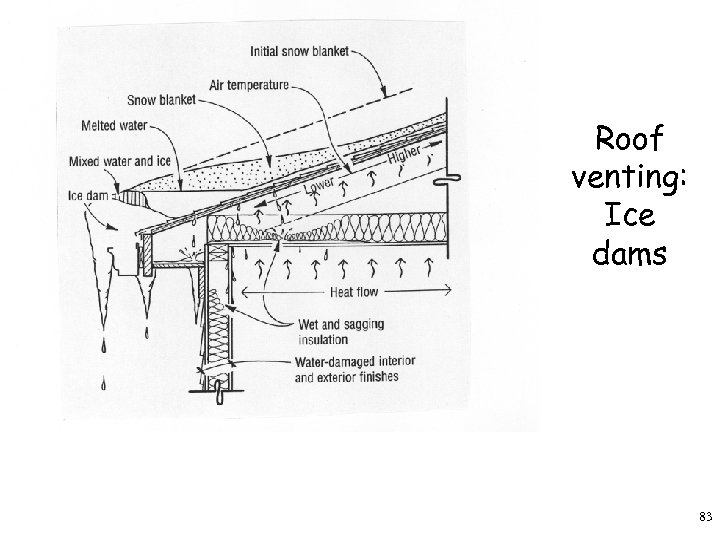 Roof venting: Ice dams 83
 Summary • • • Saving energy in a home does more than just save money. Solve the big problems first—health & safety issues Control moisture and pollutants at source Air-seal and insulate (with the same material if possible) Perform pre- and post-weatherization evaluations (blower door, infrared) 84