


 Скачать презентацию Chapter 7 Corporate Restructuring Strategy 1 A
2b1461ff8783b5fcd7a93c3fe34f9e03.ppt
- Количество слайдов: 35
 Chapter 7 Corporate Restructuring Strategy 1
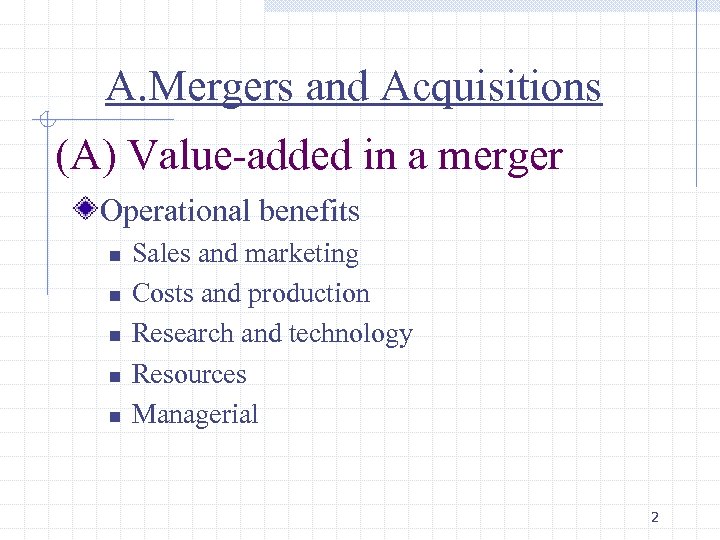 A. Mergers and Acquisitions (A) Value-added in a merger Operational benefits n n n Sales and marketing Costs and production Research and technology Resources Managerial 2
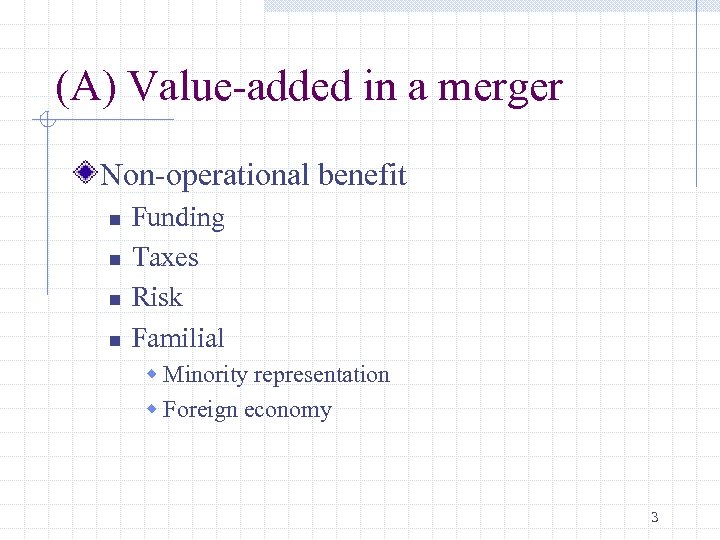 (A) Value-added in a merger Non-operational benefit n n Funding Taxes Risk Familial w Minority representation w Foreign economy 3
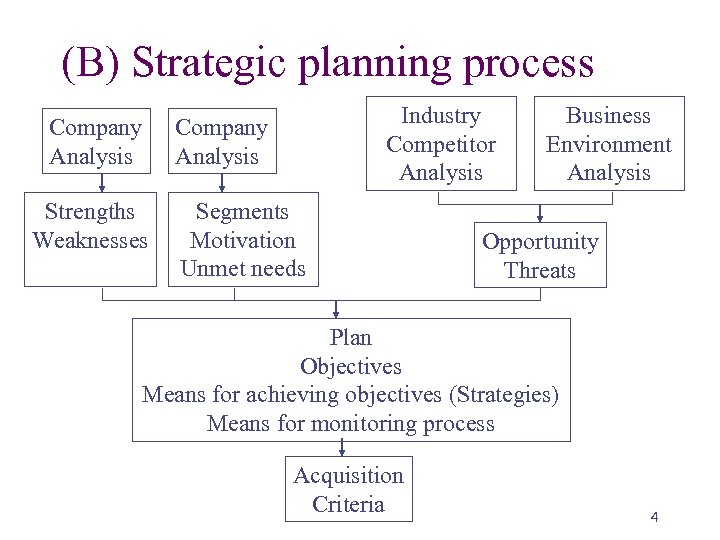 (B) Strategic planning process Company Analysis Strengths Weaknesses Industry Competitor Analysis Company Analysis Segments Motivation Unmet needs Business Environment Analysis Opportunity Threats Plan Objectives Means for achieving objectives (Strategies) Means for monitoring process Acquisition Criteria 4
 (B) Strategic planning process Company Analysis n n n Aggregate Analysis by Product Type Production and Cost Analysis Financial Capacity Performance Review 5
 (B) Strategic planning process n Identification of Strengths and Weakness w Marketing Ratings w Manufacturing Ratings w Financial Ratings w Creativity Ratings w Management and Personal Ratings 6
 (B) Strategic planning process Customer Analysis Industry and Competitor Analysis Environment Analysis 7
 ( C )Buy Strategies The pursuit of value-added n n Horizontal acquisitions Vertical acquisitions Conglomerate acquisitions Joint ventures 8
 ( C )Buy Strategies The pursuit of bargains n n Diversifiers Cash needy Time pressured Problem child 9
 B. Tender Offer (A)Characteristics A tender offer usually means a cash or securities bid for a company, made directly to the company’s shareholders without consultation or cooperation from its management, often as a prelude to a wholesale takeover of the company 10
 (B) Strategy Offensive Strategies n n n Undervalued assets Gain control Portfolio, etc. Defensive Strategies n Evaluating the tender offer in short and long term(Green mail) 11
 (B) Strategy n Accessing the possibility of better alternatives w Finding a white knight w Prefer stock issue with special voting right w Sell assets n n n Developing tactics to induce better offer Block or slow the timetable Pac-Man Maneuver w Counter tender offer 12
 (C) Corporate policy Winners n n The management of the aggressor company The shareholders of the target company(50% premium) Investment bankers Merger lawyers Losers n n The management and the employees of the target company The shareholders of the aggressor company 13
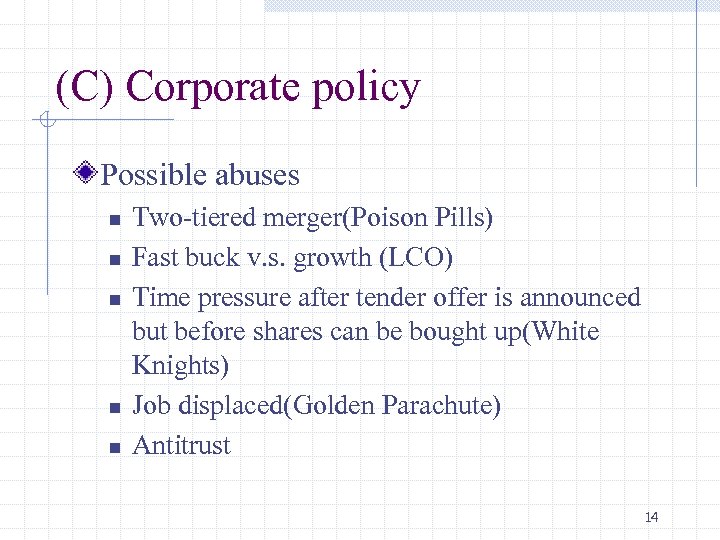 (C) Corporate policy Possible abuses n n n Two-tiered merger(Poison Pills) Fast buck v. s. growth (LCO) Time pressure after tender offer is announced but before shares can be bought up(White Knights) Job displaced(Golden Parachute) Antitrust 14
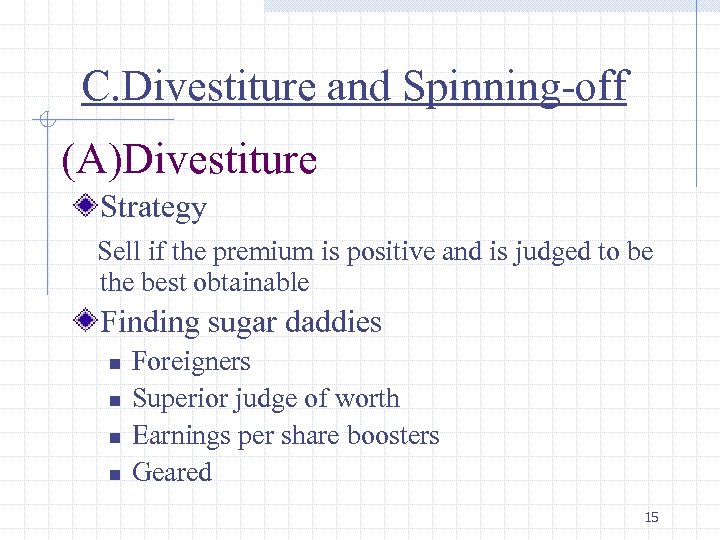 C. Divestiture and Spinning-off (A)Divestiture Strategy Sell if the premium is positive and is judged to be the best obtainable Finding sugar daddies n n Foreigners Superior judge of worth Earnings per share boosters Geared 15
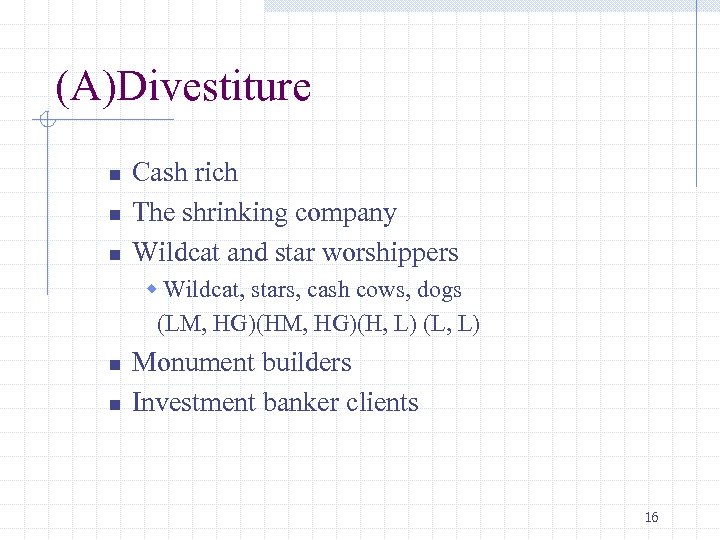 (A)Divestiture n n n Cash rich The shrinking company Wildcat and star worshippers w Wildcat, stars, cash cows, dogs (LM, HG)(H, L) (L, L) n n Monument builders Investment banker clients 16
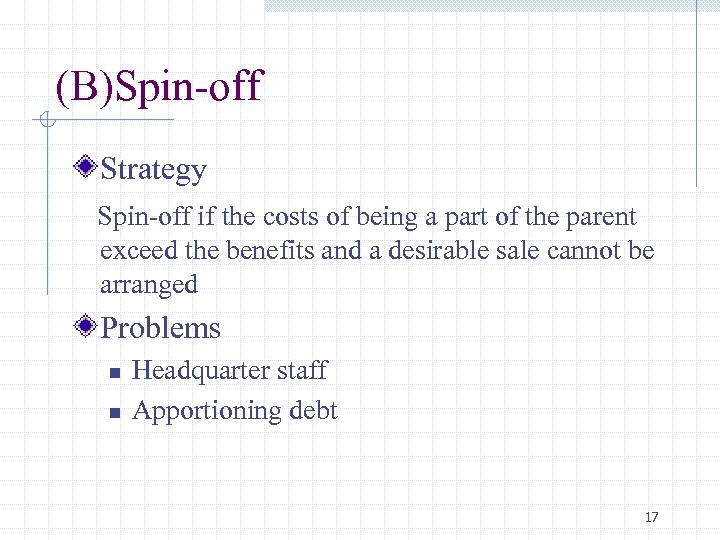 (B)Spin-off Strategy Spin-off if the costs of being a part of the parent exceed the benefits and a desirable sale cannot be arranged Problems n n Headquarter staff Apportioning debt 17
 (B)Spin-off What company should consider a spin-off strategy? n Unrelated divisions 18
 D. Leverage Buy Out (LBO) A leverage buyout (LBO) is any acquisition of a company which leaves the acquired operating entity with a greater than traditional debt-to-worth ratio. n By type of financing w Secured financing purchase price = collateralized asset + investing equity+ notes taken back by seller w Unsecured financing purchase price = venture capital + Mezzanine financing + senior debt 19
 D. Leverage Buy Out (LBO) n By type of transaction w Asset acquisitions The formation of a new corporation, which acquires the assets of the target, company. n Tax issue w Stock acquisitions Stock redemption, tender offers, pure stock acquisitions and reverse mergers n Public companies 20
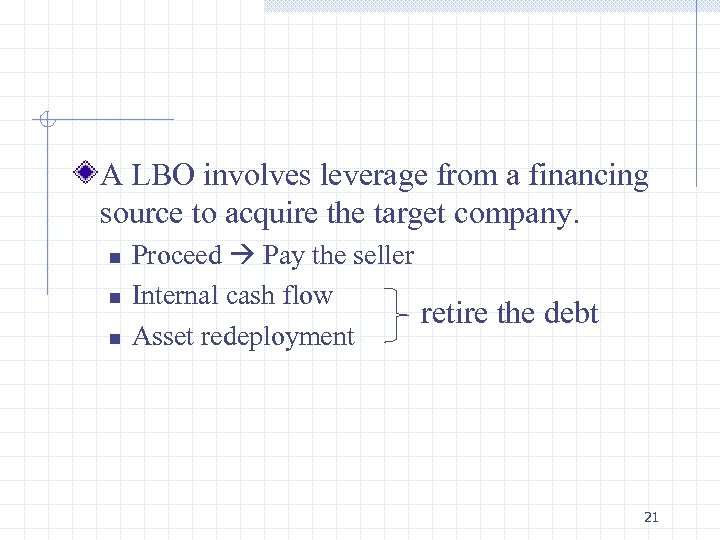 A LBO involves leverage from a financing source to acquire the target company. n n n Proceed Pay the seller Internal cash flow retire the debt Asset redeployment 21
 Features of target companies n n Operating loss Capital intensive Market undervalued Trouble companies 22
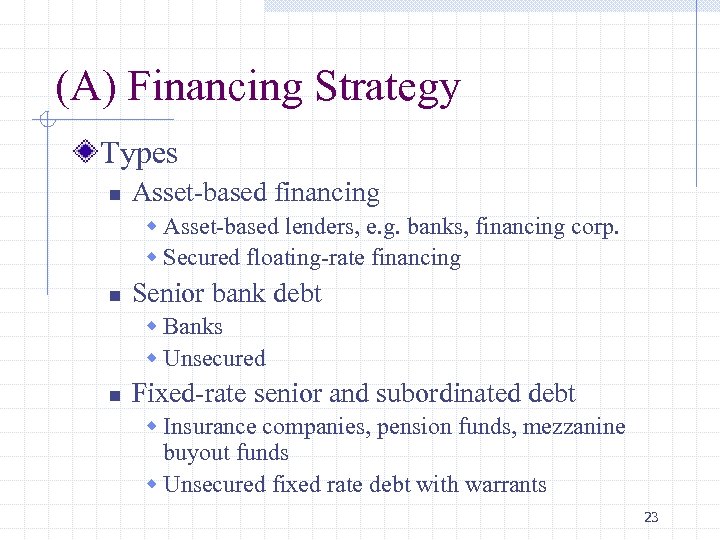 (A) Financing Strategy Types n Asset-based financing w Asset-based lenders, e. g. banks, financing corp. w Secured floating-rate financing n Senior bank debt w Banks w Unsecured n Fixed-rate senior and subordinated debt w Insurance companies, pension funds, mezzanine buyout funds w Unsecured fixed rate debt with warrants 23
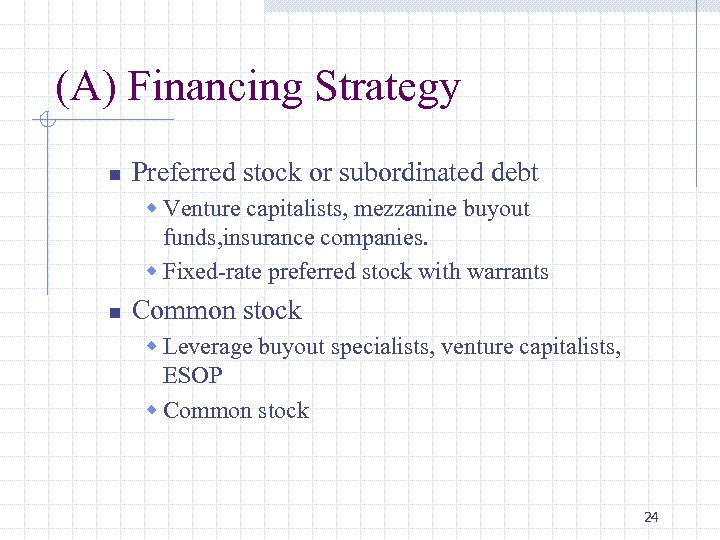 (A) Financing Strategy n Preferred stock or subordinated debt w Venture capitalists, mezzanine buyout funds, insurance companies. w Fixed-rate preferred stock with warrants n Common stock w Leverage buyout specialists, venture capitalists, ESOP w Common stock 24
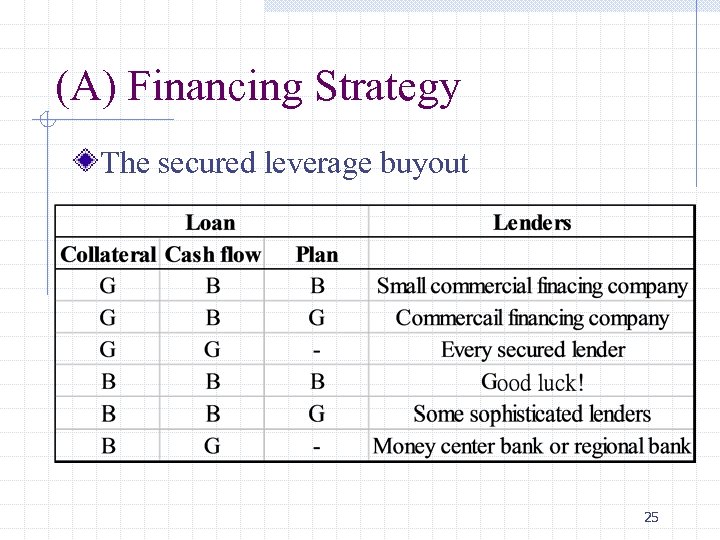 (A) Financing Strategy The secured leverage buyout 25
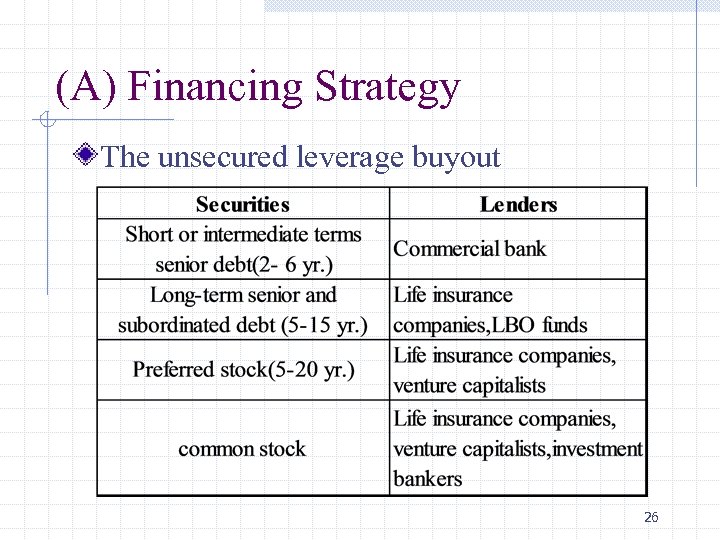 (A) Financing Strategy The unsecured leverage buyout 26
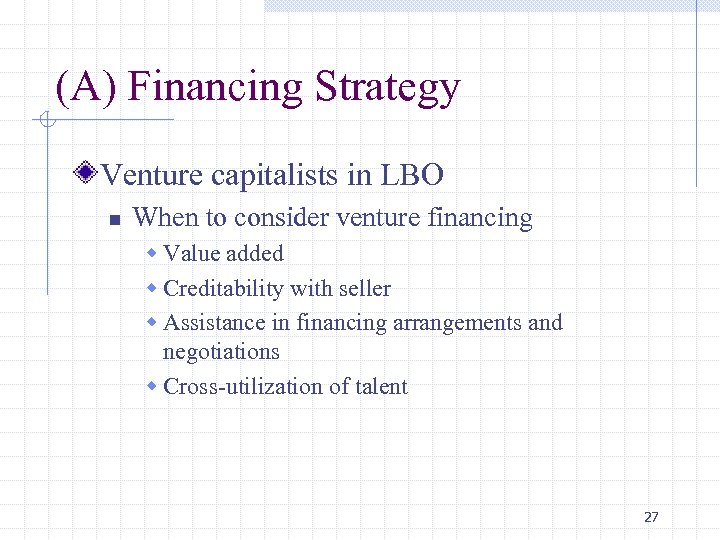 (A) Financing Strategy Venture capitalists in LBO n When to consider venture financing w Value added w Creditability with seller w Assistance in financing arrangements and negotiations w Cross-utilization of talent 27
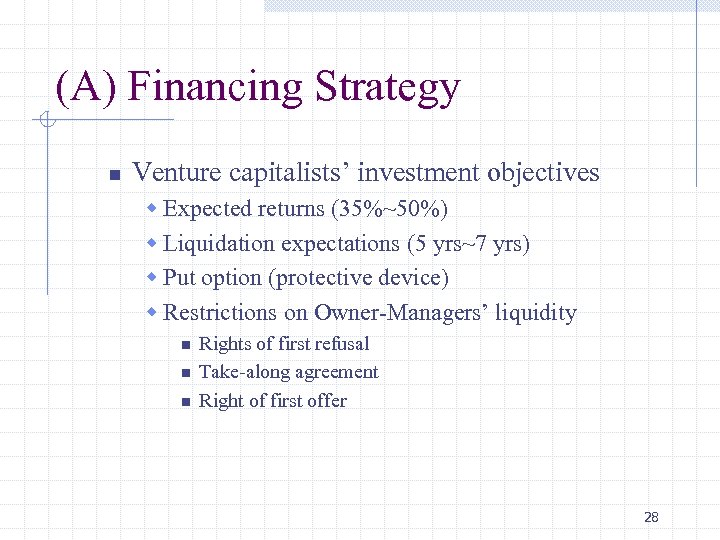 (A) Financing Strategy n Venture capitalists’ investment objectives w Expected returns (35%~50%) w Liquidation expectations (5 yrs~7 yrs) w Put option (protective device) w Restrictions on Owner-Managers’ liquidity n n n Rights of first refusal Take-along agreement Right of first offer 28
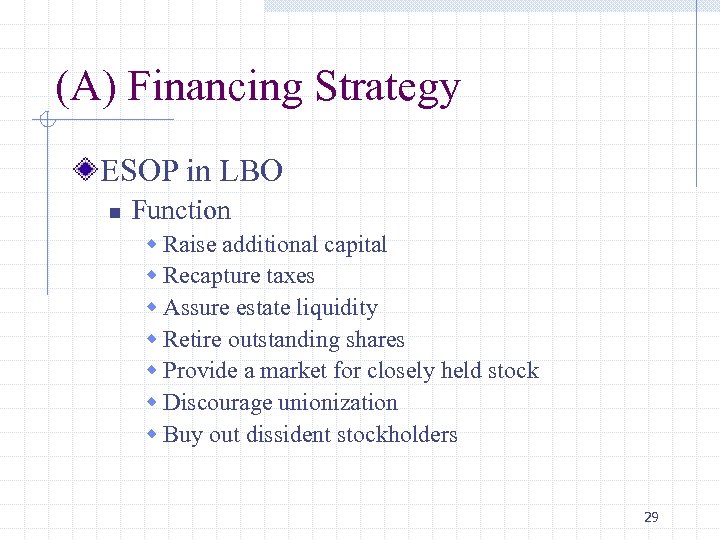 (A) Financing Strategy ESOP in LBO n Function w Raise additional capital w Recapture taxes w Assure estate liquidity w Retire outstanding shares w Provide a market for closely held stock w Discourage unionization w Buy out dissident stockholders 29
 (A) Financing Strategy w Acquire other companies w Combat tender offers w Broaden the appeal of unions w Shelter excess accumulated earnings w Refinancing existing debt w Maximize IRS investment tax credit w Divest subsidiaries w Purchase key main insurance 30
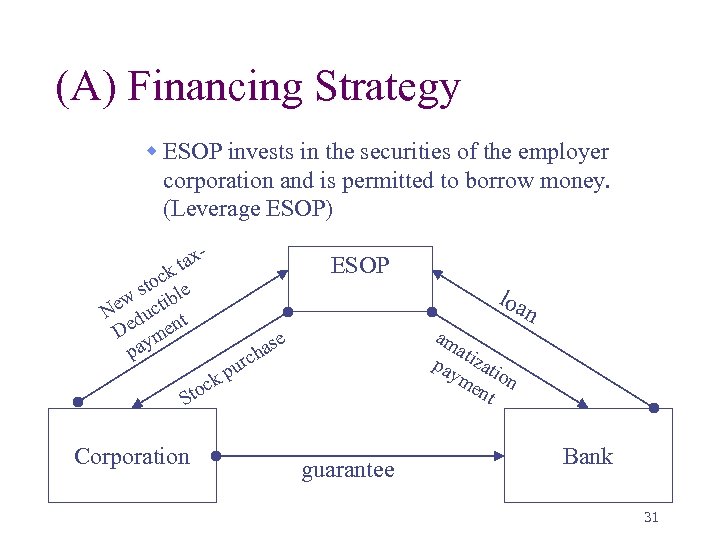 (A) Financing Strategy w ESOP invests in the securities of the employer corporation and is permitted to borrow money. (Leverage ESOP) tax k toc le s ew ctib N du t De men pay ESOP loa n am ati pay zati me on nt ase ch r u kp toc S Corporation guarantee Bank 31
 (A) Financing Strategy w ESOP is integrated in the financial plan of LBO n n Cash flow Debt amortization Purchase stock loan 32
 (B) Corporate policy How risky are LBOs? n n Highly leveraged, increase failure (Thatcher Glass LBO) Over-leveraged, bad loan, junk bond (Dr Pepper LBO, 3 times net worth) Overpriced LBO failures (5~15%) (Eli Witt, Oppenheimer & Co. ) 33
 (B) Corporate policy Why owners should consider a LBO? n For the closely held company, a LBO can provide the selling shareholders with benefit that are not fully appreciated. w Liquidity for stock, market stability w Diversification w Family estate tax savings w Reverse LBO 34
 (B) Corporate policy Why management should consider a LBO? n n Opportunity to create personal wealth Conflict of interest (stand on buyout side) 35