 Скачать презентацию Chapter 7 Consumer Behavior Mc Graw-Hill Irwin Copyright
e7a4dc3f9692580dca4595447b1efa7b.ppt
- Количество слайдов: 17



Chapter 7 Consumer Behavior Mc. Graw-Hill/Irwin Copyright © 2009 by The Mc. Graw-Hill Companies, Inc. All rights reserved.
Chapter Objectives • • • Total utility and marginal utility Law of diminishing marginal utility Marginal utility-to-price ratios Deriving the demand curve Income and substitution effects Appendix: the indifference curve model 7 -2
Utility • Diminishing marginal utility (again) • Satisfaction obtained from consumption • Three characteristics – Differs from usefulness – Subjective – Difficult to quantify 7 -3
Utility • Total utility – Total satisfaction from a specific quantity • Marginal utility – Extra satisfaction from an additional unit • Law of diminishing marginal utility – Explains downward sloping demand 7 -4
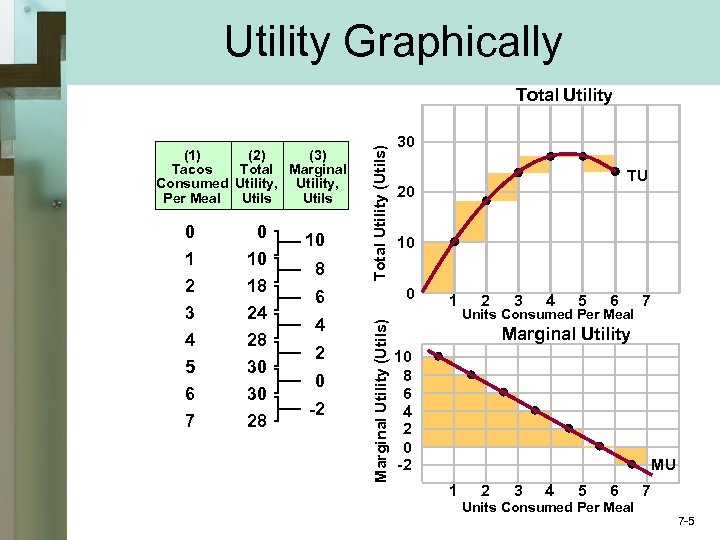
Utility Graphically (1) (2) (3) Tacos Total Marginal Consumed Utility, Per Meal Utils 1 2 3 4 5 6 7 0 ] 18 ] 24 ] 28 ] 30 ] 28 10 8 4 2 0 -2 30 TU 20 10 0 6 Marginal Utility (Utils) 0 Total Utility (Utils) Total Utility 1 2 3 4 5 6 Units Consumed Per Meal 7 Marginal Utility 10 8 6 4 2 0 -2 MU 1 2 3 4 5 6 Units Consumed Per Meal 7 7 -5
Theory of Consumer Behavior • Key dimensions of the consumer problem – Rational behavior – Preferences – Budget constraint – Prices 7 -6
Theory of Consumer Behavior • Find utility maximizing combination of goods • Utility maximizing rule – Allocate income – Last dollar spent on each good yields same marginal utility – Marginal utility per dollar 7 -7
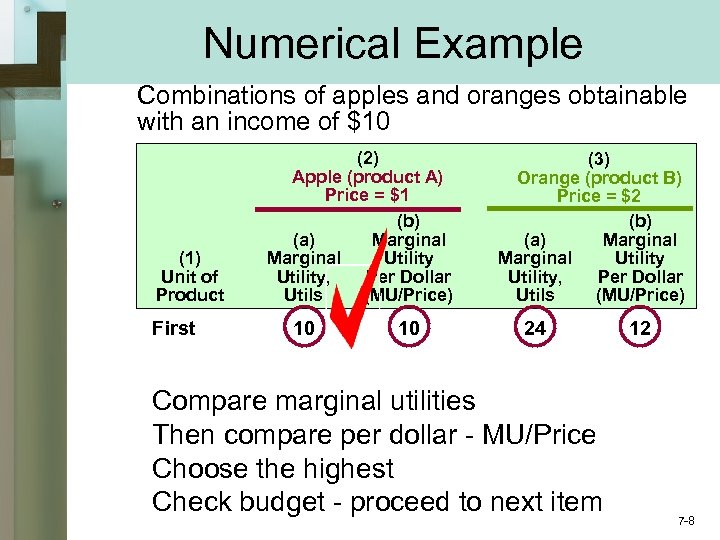
Numerical Example Combinations of apples and oranges obtainable with an income of $10 (1) Unit of Product (2) Apple (product A) Price = $1 (b) Marginal (a) Utility Marginal Per Dollar Utility, (MU/Price) Utils First Second Third Compare Fourth 10 10 8 8 7 7 marginal utilities 6 6 (3) Orange (product B) Price = $2 (b) Marginal (a) Utility Marginal Per Dollar Utility, (MU/Price) Utils 24 20 18 16 Then compare per dollar - MU/Price Fifth 5 5 12 Choose the highest 4 Sixth 4 6 Check budget - proceed to next item Seventh 3 3 4 12 10 9 8 6 3 2 7 -8
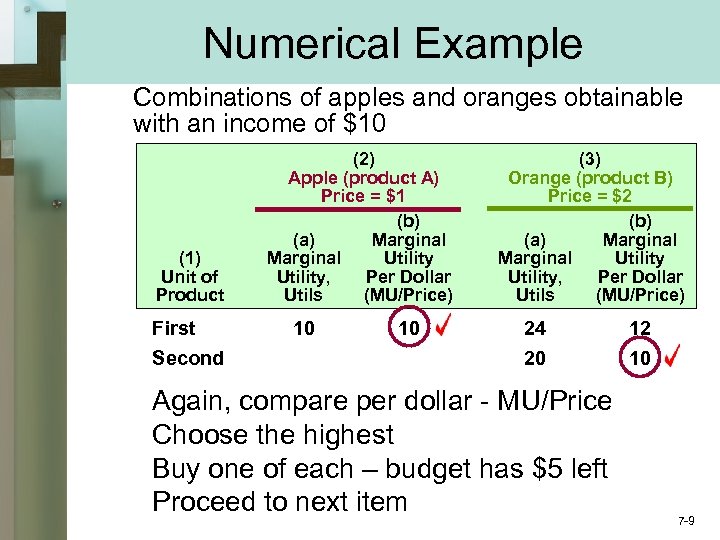
Numerical Example Combinations of apples and oranges obtainable with an income of $10 (1) Unit of Product First Second Third Again, Fourth (3) Orange (product B) Price = $2 (b) Marginal (a) Utility Marginal Per Dollar Utility, (MU/Price) Utils (2) Apple (product A) Price = $1 (b) Marginal (a) Utility Marginal Per Dollar Utility, (MU/Price) Utils 10 8 7 compare 6 10 8 7 per dollar 6 - 24 12 20 10 18 9 MU/Price 16 8 Choose the highest 5 Fifth 5 12 Buy one of each – budget has $5 left Sixth 4 4 6 Proceed to next item 3 Seventh 3 4 6 3 2 7 -9
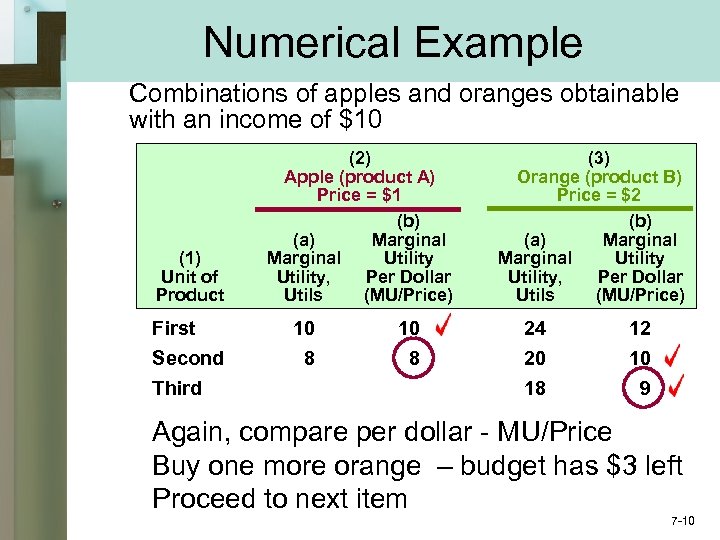
Numerical Example Combinations of apples and oranges obtainable with an income of $10 (1) Unit of Product First Second Third Fourth (2) Apple (product A) Price = $1 (b) Marginal (a) Utility Marginal Per Dollar Utility, (MU/Price) Utils 10 8 7 6 (3) Orange (product B) Price = $2 (b) Marginal (a) Utility Marginal Per Dollar Utility, (MU/Price) Utils 24 20 18 16 12 10 9 8 Again, compare per dollar - MU/Price 6 Fifth 5 5 12 Buy one more orange – budget has $3 3 left Sixth 4 4 6 Proceed to next item 3 Seventh 3 4 2 7 -10
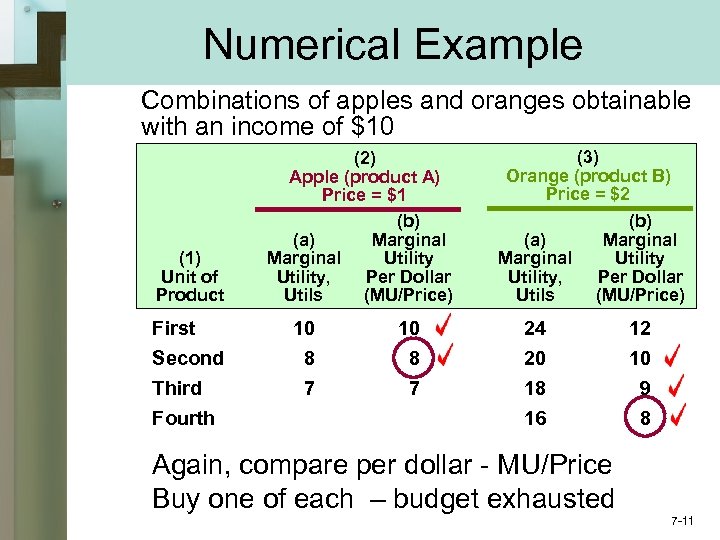
Numerical Example Combinations of apples and oranges obtainable with an income of $10 (1) Unit of Product First Second Third Fourth (2) Apple (product A) Price = $1 (b) Marginal (a) Utility Marginal Per Dollar Utility, (MU/Price) Utils 10 8 7 6 (3) Orange (product B) Price = $2 (a) Marginal Utility, Utils (b) Marginal Utility Per Dollar (MU/Price) 24 20 18 16 12 10 9 8 Fifth 5 5 12 Again, compare per dollar - MU/Price Sixth 4 4 6 Buy one of each – budget exhausted Seventh 3 3 4 6 3 2 7 -11
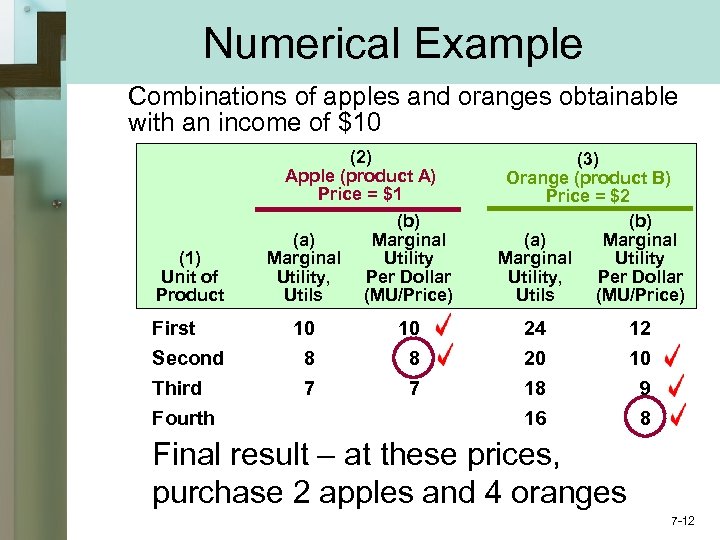
Numerical Example Combinations of apples and oranges obtainable with an income of $10 (2) Apple (product A) Price = $1 (1) Unit of Product (a) Marginal Utility, Utils (b) Marginal Utility Per Dollar (MU/Price) First Second Third Fourth 10 8 7 6 (3) Orange (product B) Price = $2 (b) Marginal (a) Utility Marginal Per Dollar Utility, (MU/Price) Utils 24 20 18 16 Fifth 5 12 Final result 5 – at these prices, Sixth 4 4 6 purchase 2 apples 3 and 4 oranges Seventh 3 4 12 10 9 8 6 3 2 7 -12
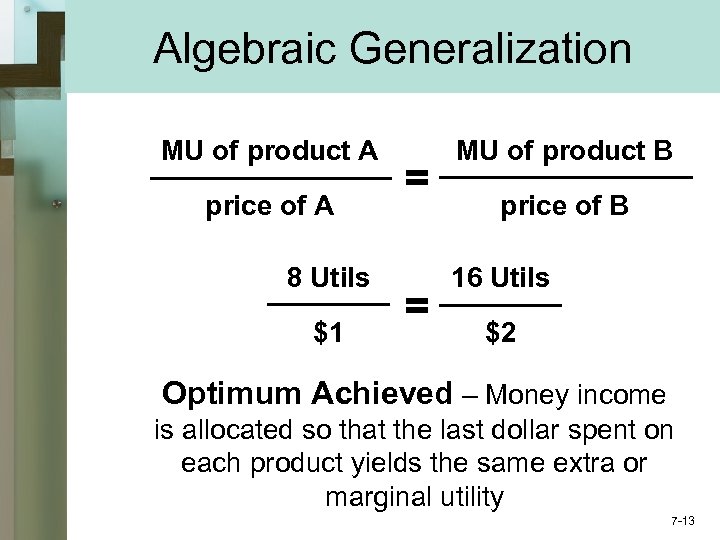
Algebraic Generalization MU of product A price of A 8 Utils $1 = = MU of product B price of B 16 Utils $2 Optimum Achieved – Money income is allocated so that the last dollar spent on each product yields the same extra or marginal utility 7 -13
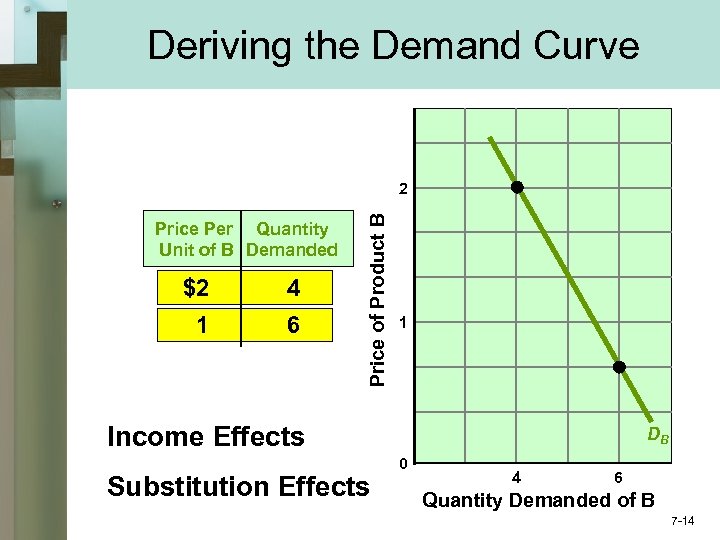
Deriving the Demand Curve Price Per Quantity Unit of B Demanded $2 4 1 6 Price of Product B 2 1 Income Effects Substitution Effects DB 0 4 6 Quantity Demanded of B 7 -14
Applications and Extensions • New products increase utility – i. Pods • The diamond-water paradox • The value of time • Medical care purchases • Cash and noncash gifts 7 -15
Behavioral Economics • Human instinct for variety • Consume more when there is more variety – M&Ms • Time inconsistency – Final exams – Retirement savings 7 -16
Key Terms • • • Law of diminishing marginal utility Utility Total utility Marginal utility Rational behavior Budget constraint Utility maximizing rule Income effect Substitution effect 7 -17
Скачать презентацию Chapter 7 Consumer Behavior Mc Graw-Hill Irwin Copyright
e7a4dc3f9692580dca4595447b1efa7b.ppt