 Скачать презентацию CHAPTER 7 Bonds and Their Valuation n n
6ba79fb0855ebd5b69cc9b1eac605bdc.ppt
- Количество слайдов: 33



CHAPTER 7 Bonds and Their Valuation n n Key features of bonds Bond valuation Measuring yield Assessing risk 7 -1
Video: Richter Smart Finance 7 -2
What is a bond? n A long-term debt instrument in which a borrower agrees to make payments of principal and interest, on specific dates, to the holders of the bond. 7 -3
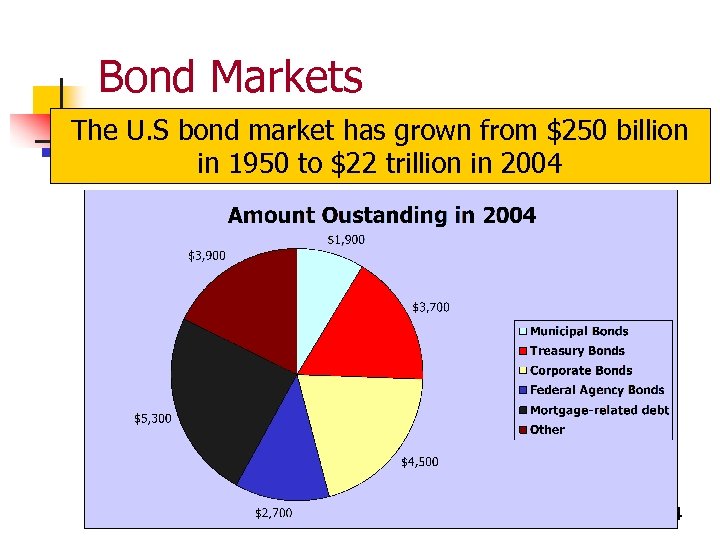
Bond Markets The U. S bond market has grown from $250 billion in 1950 to $22 trillion in 2004 7 -4
Key Features of a Bond n n n Par value – face amount of the bond, which is paid at maturity (assume $1, 000). Coupon interest rate – stated interest rate (generally fixed) paid by the issuer. Multiply by par value to get dollar payment of interest. Maturity date – years until the bond must be repaid. Issue date – when the bond was issued. Yield to maturity - rate of return earned on a bond held until maturity (also called the “promised yield”). 7 -5
Effect of a call provision n Allows issuer to refund the bond issue if rates decline (helps the issuer, but hurts the investor). Borrowers are willing to pay more, and lenders require more, for callable bonds. Most bonds have a deferred call and a declining call premium. 7 -6
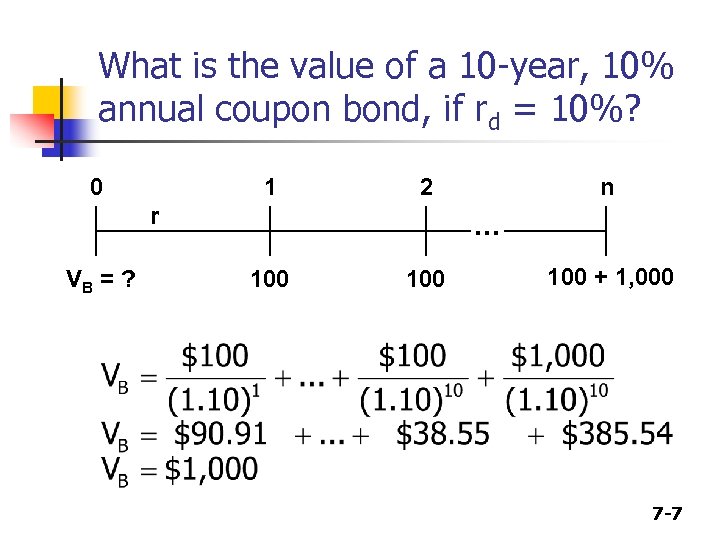
What is the value of a 10 -year, 10% annual coupon bond, if rd = 10%? 0 1 2 r VB = ? n . . . 100 100 + 1, 000 7 -7
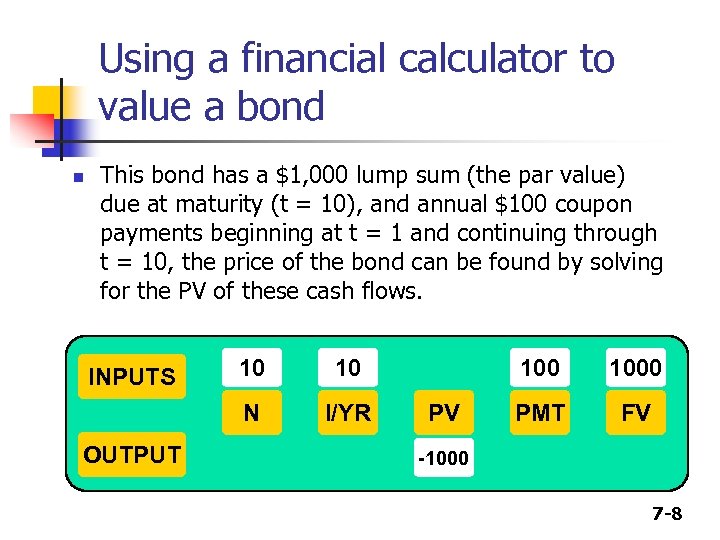
Using a financial calculator to value a bond n This bond has a $1, 000 lump sum (the par value) due at maturity (t = 10), and annual $100 coupon payments beginning at t = 1 and continuing through t = 10, the price of the bond can be found by solving for the PV of these cash flows. OUTPUT 10 10 N INPUTS I/YR 100 PV 1000 PMT FV -1000 7 -8
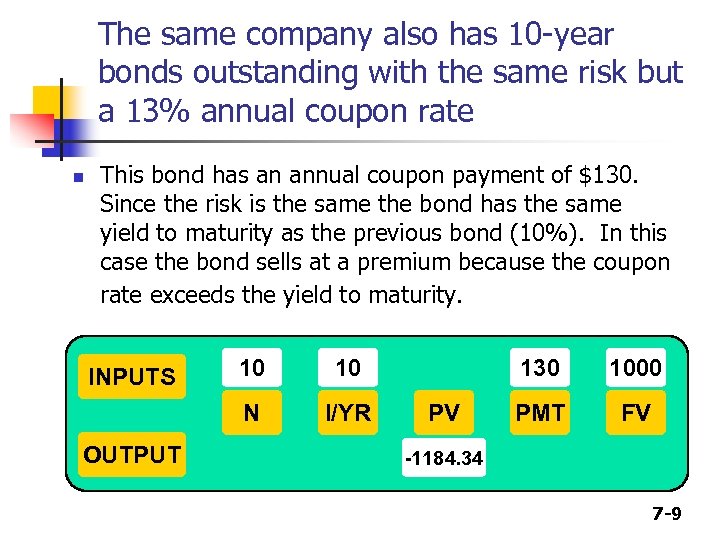
The same company also has 10 -year bonds outstanding with the same risk but a 13% annual coupon rate n This bond has an annual coupon payment of $130. Since the risk is the same the bond has the same yield to maturity as the previous bond (10%). In this case the bond sells at a premium because the coupon rate exceeds the yield to maturity. OUTPUT 10 10 N INPUTS I/YR 130 PV 1000 PMT FV -1184. 34 7 -9
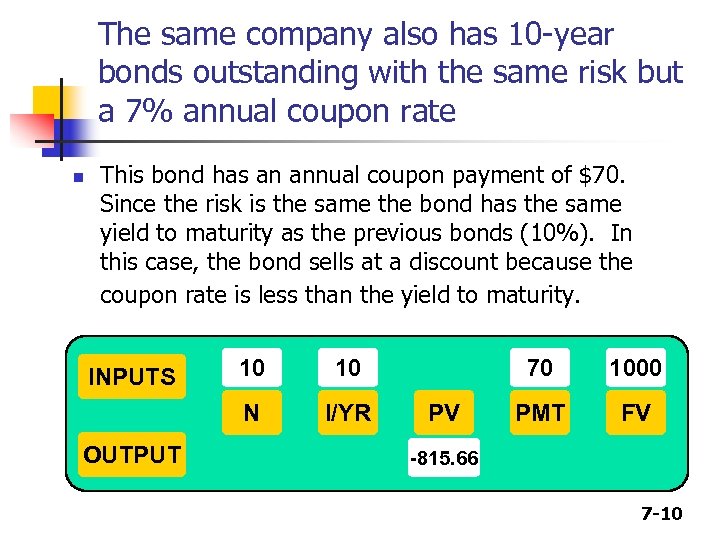
The same company also has 10 -year bonds outstanding with the same risk but a 7% annual coupon rate n This bond has an annual coupon payment of $70. Since the risk is the same the bond has the same yield to maturity as the previous bonds (10%). In this case, the bond sells at a discount because the coupon rate is less than the yield to maturity. OUTPUT 10 10 N INPUTS I/YR 70 PV 1000 PMT FV -815. 66 7 -10
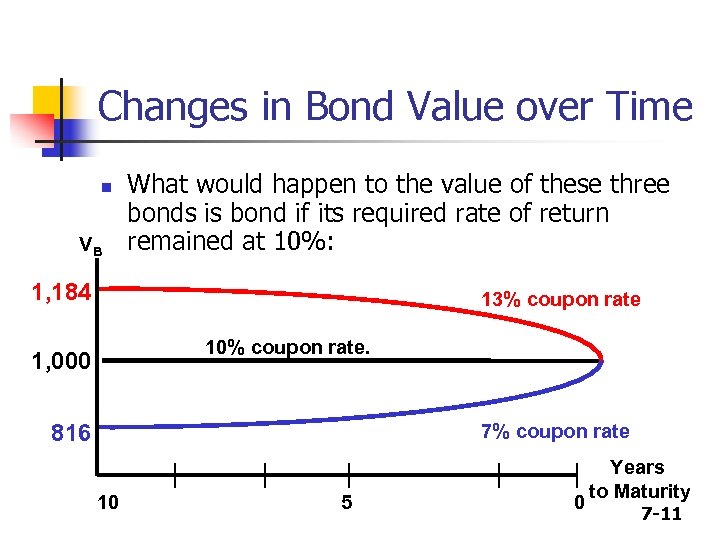
Changes in Bond Value over Time n VB What would happen to the value of these three bonds is bond if its required rate of return remained at 10%: 1, 184 13% coupon rate 10% coupon rate. 1, 000 816 7% coupon rate 10 5 0 Years to Maturity 7 -11
Bond values over time n n At maturity, the value of any bond must equal its par value. If rd remains constant: n The value of a premium bond would decrease over time, until it reached $1, 000. n The value of a discount bond would increase over time, until it reached $1, 000. n A value of a par bond stays at $1, 000. 7 -12
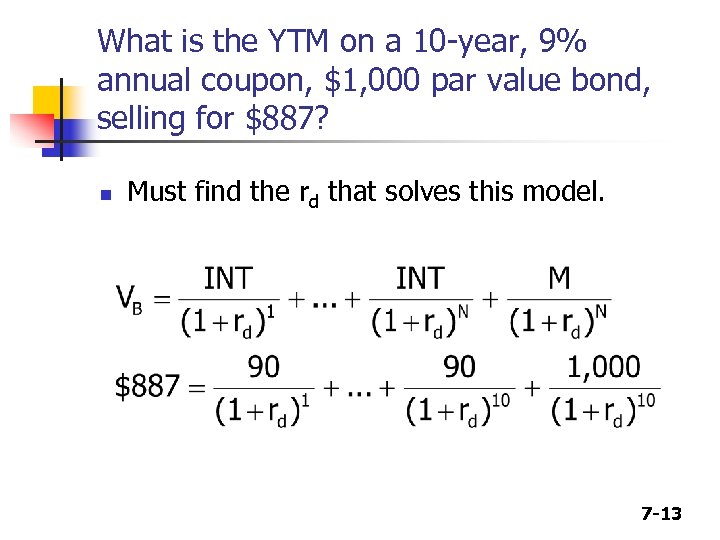
What is the YTM on a 10 -year, 9% annual coupon, $1, 000 par value bond, selling for $887? n Must find the rd that solves this model. 7 -13
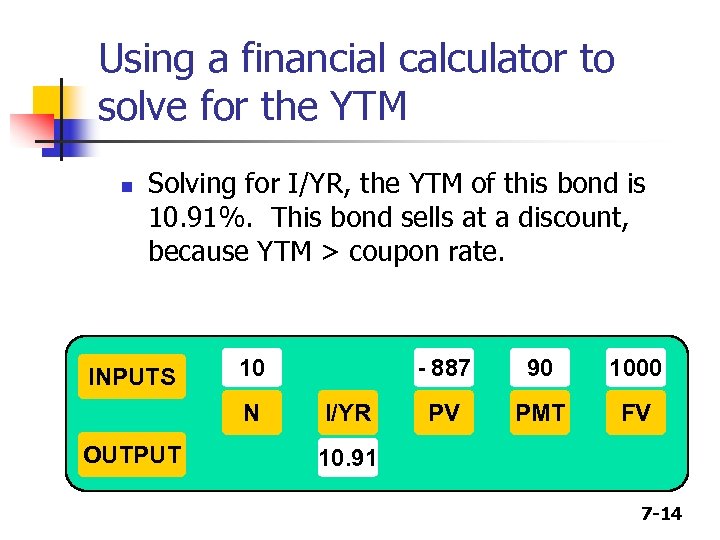
Using a financial calculator to solve for the YTM n Solving for I/YR, the YTM of this bond is 10. 91%. This bond sells at a discount, because YTM > coupon rate. INPUTS 10 N OUTPUT - 887 I/YR 90 1000 PV PMT FV 10. 91 7 -14
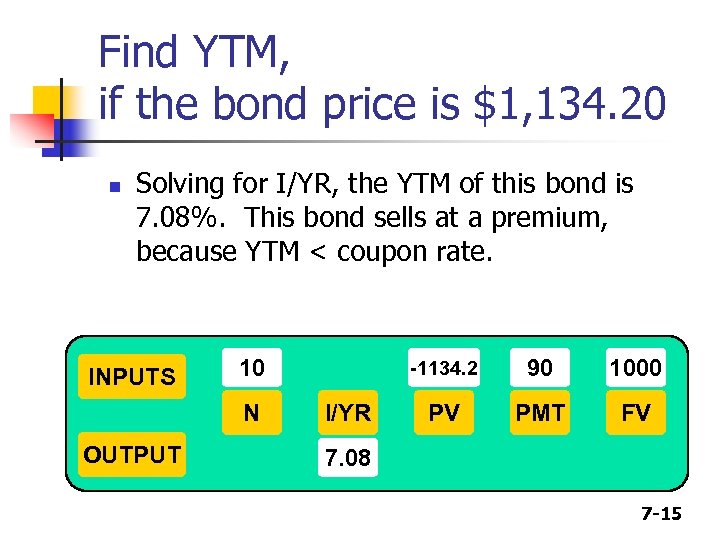
Find YTM, if the bond price is $1, 134. 20 n Solving for I/YR, the YTM of this bond is 7. 08%. This bond sells at a premium, because YTM < coupon rate. INPUTS 10 N OUTPUT -1134. 2 I/YR 90 1000 PV PMT FV 7. 08 7 -15
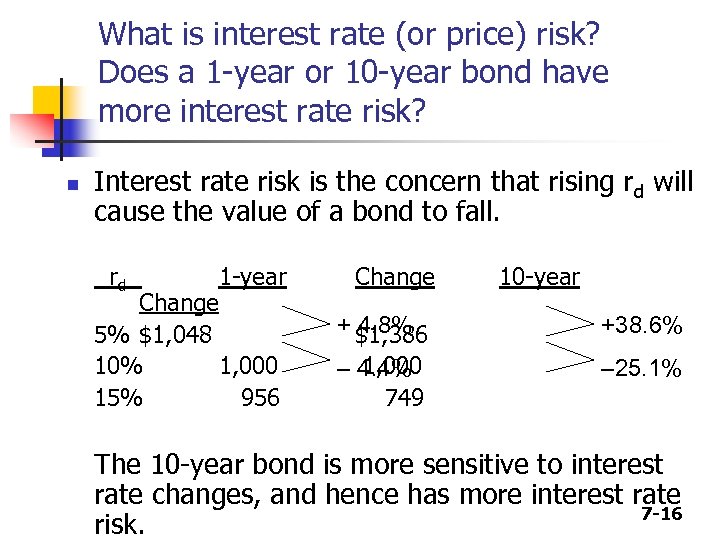
What is interest rate (or price) risk? Does a 1 -year or 10 -year bond have more interest rate risk? n Interest rate risk is the concern that rising rd will cause the value of a bond to fall. rd 1 -year Change 5% $1, 048 10% 1, 000 15% 956 Change 10 -year + $1, 386 4. 8% +38. 6% 1, 000 – 4. 4% 749 – 25. 1% The 10 -year bond is more sensitive to interest rate changes, and hence has more interest rate 7 -16 risk.
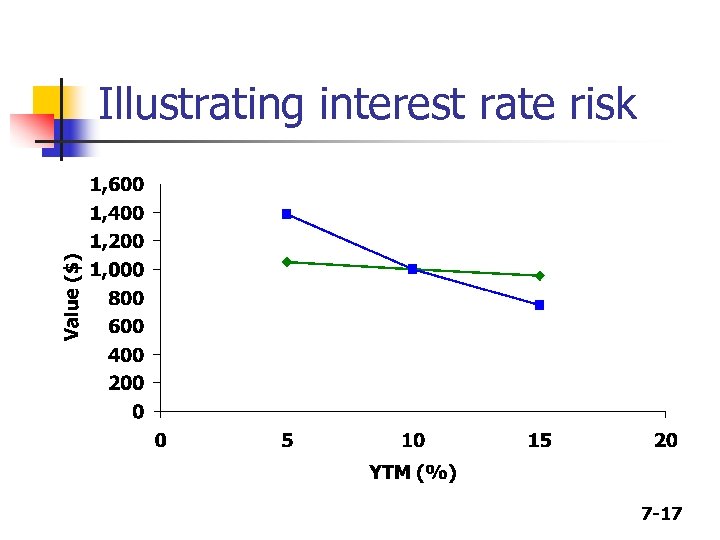
Illustrating interest rate risk 7 -17
What is reinvestment rate risk? n Reinvestment rate risk is the concern that rd will fall, and future CFs will have to be reinvested at lower rates, hence reducing income. EXAMPLE: Suppose you just won $500, 000 playing the lottery. You intend to invest the money and live off the interest. 7 -18
Reinvestment rate risk example n n You may invest in either a 10 -year bond or a series of ten 1 -year bonds. Both 10 -year and 1 -year bonds currently yield 10%. If you choose the 1 -year bond strategy: n n After Year 1, you receive $50, 000 in income and have $500, 000 to reinvest. But, if 1 -year rates fall to 3%, your annual income would fall to $15, 000. If you choose the 10 -year bond strategy: n You can lock in a 10% interest rate, and $50, 000 annual income. 7 -19
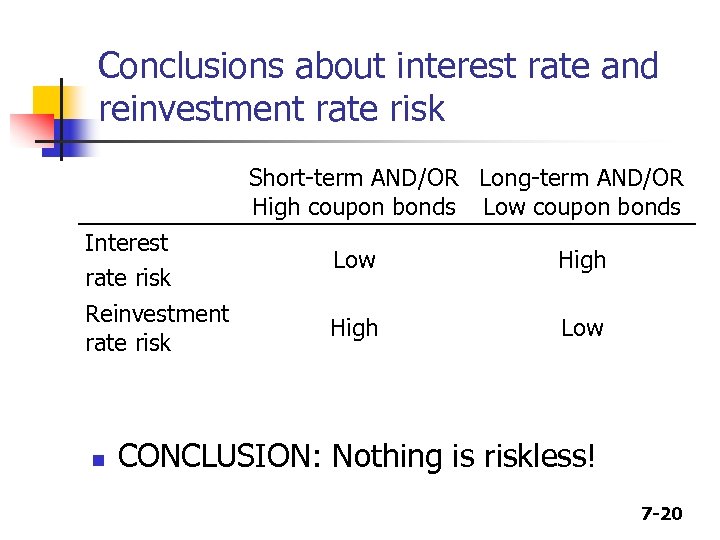
Conclusions about interest rate and reinvestment rate risk Short-term AND/OR Long-term AND/OR High coupon bonds Low coupon bonds Interest rate risk Low High Reinvestment rate risk High Low n CONCLUSION: Nothing is riskless! 7 -20
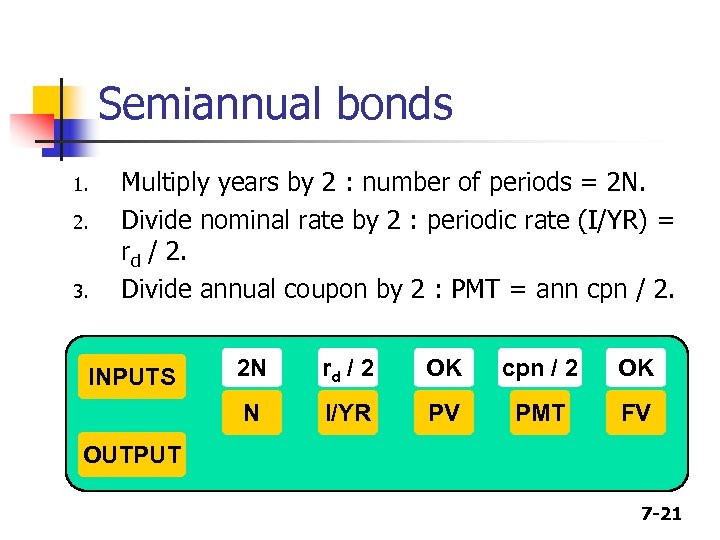
Semiannual bonds 1. 2. 3. Multiply years by 2 : number of periods = 2 N. Divide nominal rate by 2 : periodic rate (I/YR) = rd / 2. Divide annual coupon by 2 : PMT = ann cpn / 2. 2 N rd / 2 OK cpn / 2 OK N INPUTS I/YR PV PMT FV OUTPUT 7 -21
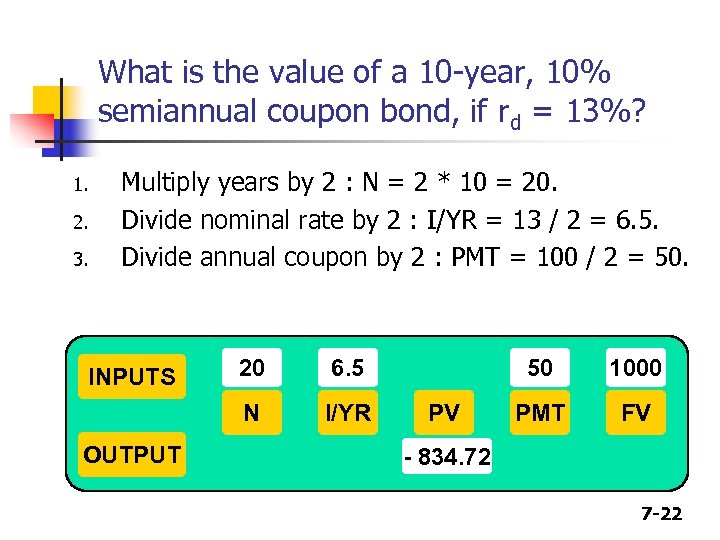
What is the value of a 10 -year, 10% semiannual coupon bond, if rd = 13%? 1. 2. 3. Multiply years by 2 : N = 2 * 10 = 20. Divide nominal rate by 2 : I/YR = 13 / 2 = 6. 5. Divide annual coupon by 2 : PMT = 100 / 2 = 50. OUTPUT 20 6. 5 N INPUTS I/YR 50 PV 1000 PMT FV - 834. 72 7 -22
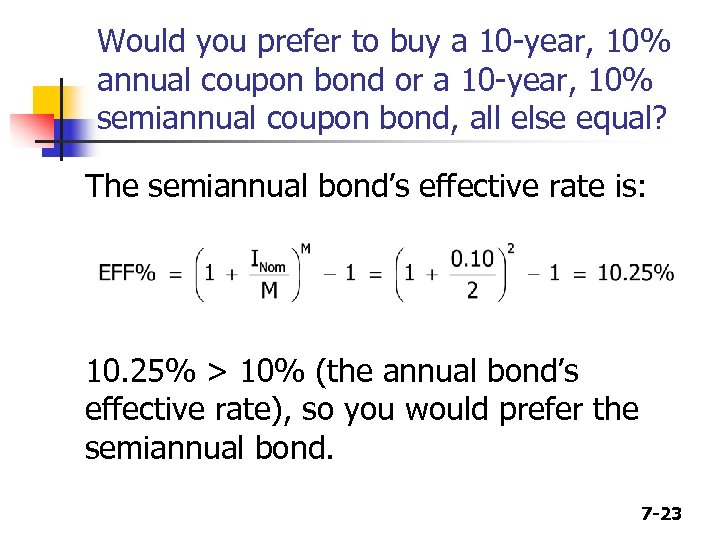
Would you prefer to buy a 10 -year, 10% annual coupon bond or a 10 -year, 10% semiannual coupon bond, all else equal? The semiannual bond’s effective rate is: 10. 25% > 10% (the annual bond’s effective rate), so you would prefer the semiannual bond. 7 -23
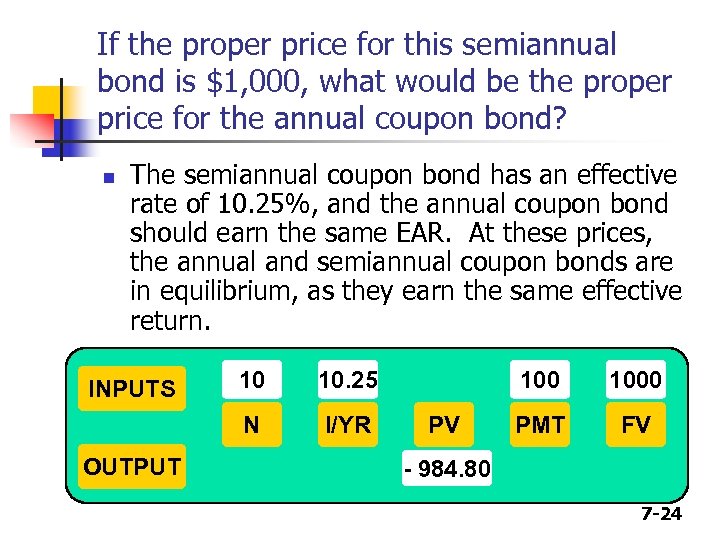
If the proper price for this semiannual bond is $1, 000, what would be the proper price for the annual coupon bond? n The semiannual coupon bond has an effective rate of 10. 25%, and the annual coupon bond should earn the same EAR. At these prices, the annual and semiannual coupon bonds are in equilibrium, as they earn the same effective return. OUTPUT 10 10. 25 N INPUTS I/YR 100 PV 1000 PMT FV - 984. 80 7 -24
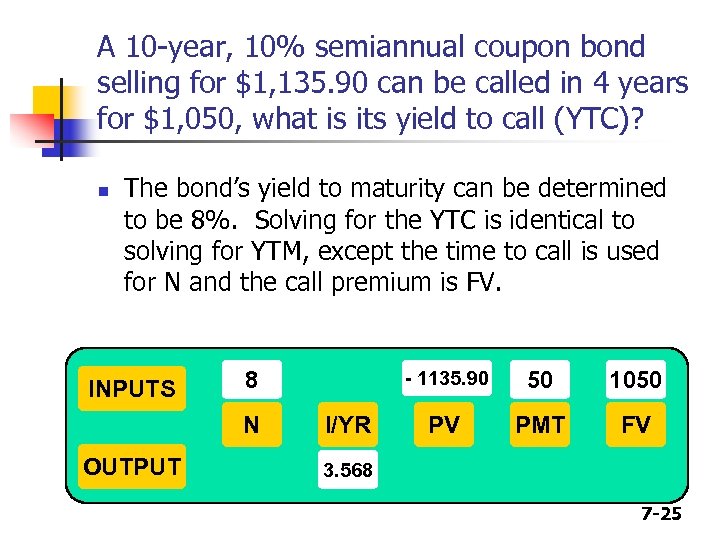
A 10 -year, 10% semiannual coupon bond selling for $1, 135. 90 can be called in 4 years for $1, 050, what is its yield to call (YTC)? n The bond’s yield to maturity can be determined to be 8%. Solving for the YTC is identical to solving for YTM, except the time to call is used for N and the call premium is FV. INPUTS 8 N OUTPUT - 1135. 90 I/YR 50 1050 PV PMT FV 3. 568 7 -25
Types of bonds n n n Mortgage bonds Debentures Subordinated debentures Investment-grade bonds Junk bonds 7 -26
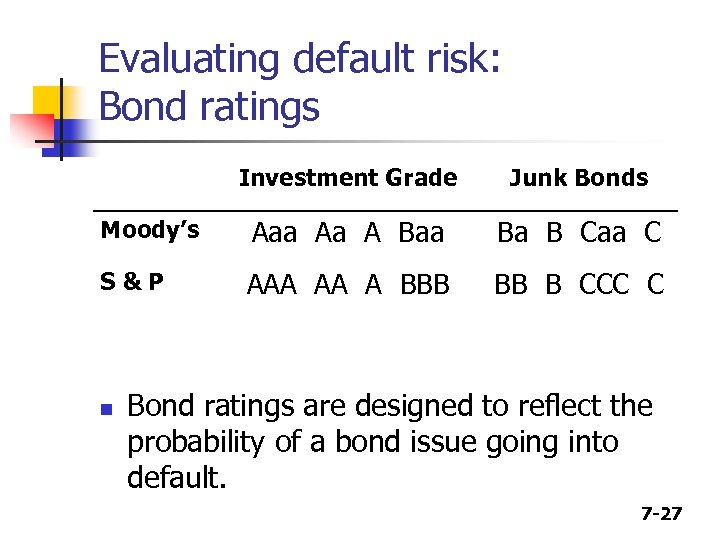
Evaluating default risk: Bond ratings Investment Grade Junk Bonds Moody’s Aaa Aa A Baa Ba B Caa C S&P AAA AA A BBB BB B CCC C n Bond ratings are designed to reflect the probability of a bond issue going into default. 7 -27
Video: Poulsen Smart Finance 7 -28
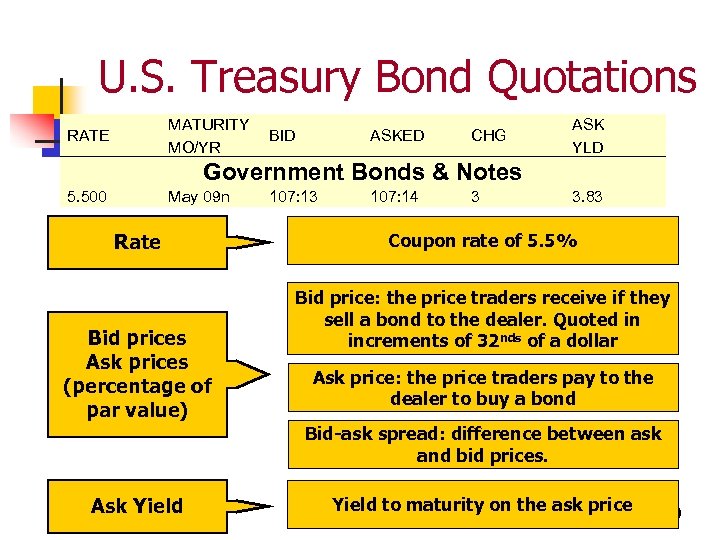
U. S. Treasury Bond Quotations MATURITY MO/YR RATE BID ASKED CHG ASK YLD Government Bonds & Notes 5. 500 May 09 n Rate Bid prices Ask prices (percentage of par value) 107: 13 107: 14 3 3. 83 Coupon rate of 5. 5% Bid price: the price traders receive if they sell a bond to the dealer. Quoted in increments of 32 nds of a dollar Ask price: the price traders pay to the dealer to buy a bond Bid-ask spread: difference between ask and bid prices. Ask Yield to maturity on the ask price 7 -29
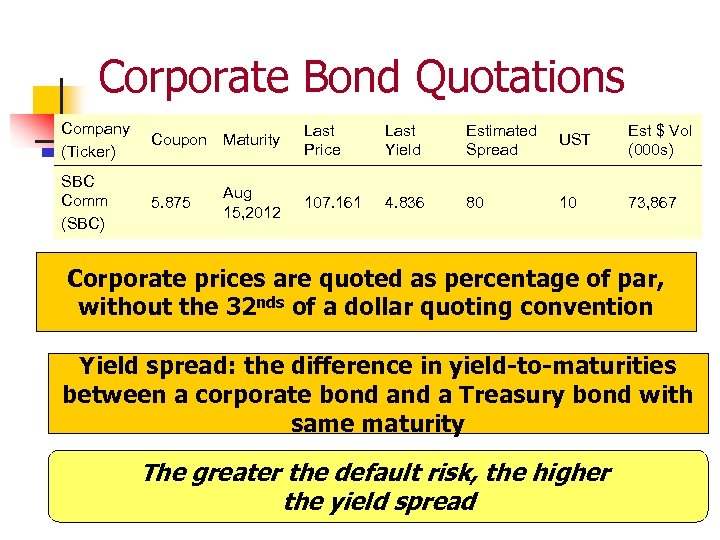
Corporate Bond Quotations Company (Ticker) Coupon Maturity SBC Comm (SBC) 5. 875 Aug 15, 2012 Last Price Last Yield Estimated Spread UST Est $ Vol (000 s) 107. 161 4. 836 80 10 73, 867 Corporate prices are quoted as percentage of par, without the 32 nds of a dollar quoting convention Yield spread: the difference in yield-to-maturities between a corporate bond a Treasury bond with same maturity The greater the default risk, the higher the yield spread 7 -30
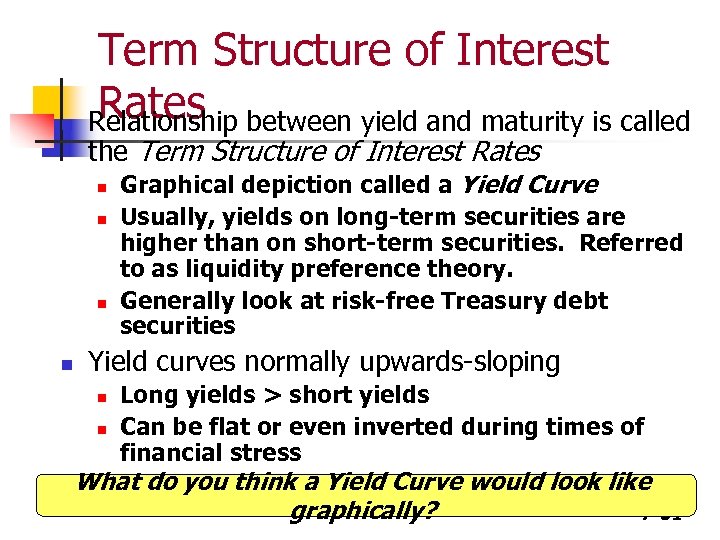
n Term Structure of Interest Rates Relationship between yield and maturity is called the Term Structure of Interest Rates n n Graphical depiction called a Yield Curve Usually, yields on long-term securities are higher than on short-term securities. Referred to as liquidity preference theory. Generally look at risk-free Treasury debt securities Yield curves normally upwards-sloping n n Long yields > short yields Can be flat or even inverted during times of financial stress What do you think a Yield Curve would look like graphically? 7 -31
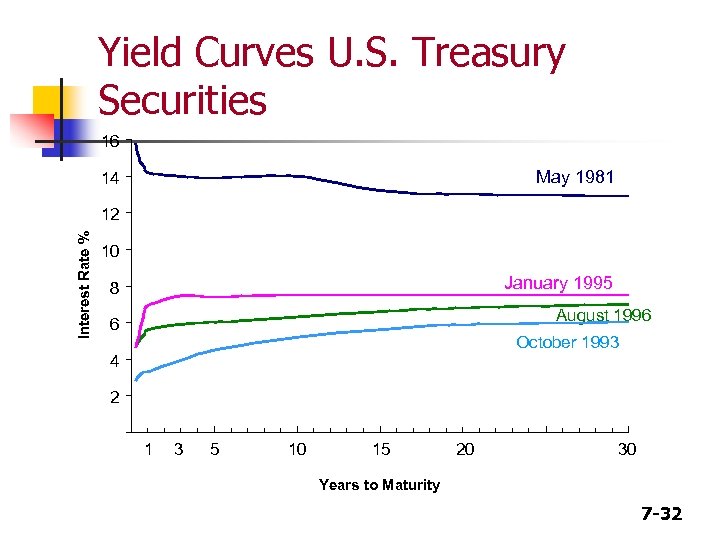
Yield Curves U. S. Treasury Securities 16 May 1981 14 Interest Rate % 12 10 January 1995 8 August 1996 6 October 1993 4 2 1 3 5 10 15 20 30 Years to Maturity 7 -32
Smart Concept: Expectations Theory Smart Finance 7 -33
Скачать презентацию CHAPTER 7 Bonds and Their Valuation n n
6ba79fb0855ebd5b69cc9b1eac605bdc.ppt