 Скачать презентацию Chapter 7 Bonds and Their Valuation Key Features
606d11fac65f96e1ac4b529fe3450a1f.ppt
- Количество слайдов: 58



Chapter 7 Bonds and Their Valuation Key Features of Bonds Bond Valuation Measuring Yield Assessing Risk 7 -1 © 2013 Cengage Learning. All Rights Reserved. May not be scanned, copied, or duplicated, or posted to a publicly accessible website, in whole or in part.
What is a bond? • A long-term debt instrument in which a borrower agrees to make payments of principal & interest, on specific dates, to the holders of the bond. 1. Treasury bonds 2. Corporate bonds 3. Foreign bonds 7 -2 © 2013 Cengage Learning. All Rights Reserved. May not be scanned, copied, or duplicated, or posted to a publicly accessible website, in whole or in part.
Bond Markets • • • Primarily traded in the over-the-counter (OTC) market Most bonds are owned by and traded among large financial institutions. Default risk is often referred to as “credit risk” – Changes and affect the bond price 7 -3 © 2013 Cengage Learning. All Rights Reserved. May not be scanned, copied, or duplicated, or posted to a publicly accessible website, in whole or in part.
Key Features of a Bond • • • Par value: face amount of the bond, which is paid at maturity (assume $1, 000) Coupon interest rate: stated interest rate (generally fixed) paid by the issuer. Multiply by par value to get dollar payment of interest Maturity date: years until the bond must be repaid Issue date: when the bond was issued Yield to maturity (YTM): rate of return earned on a bond held until maturity – also called the “promised yield” 7 -4 © 2013 Cengage Learning. All Rights Reserved. May not be scanned, copied, or duplicated, or posted to a publicly accessible website, in whole or in part.
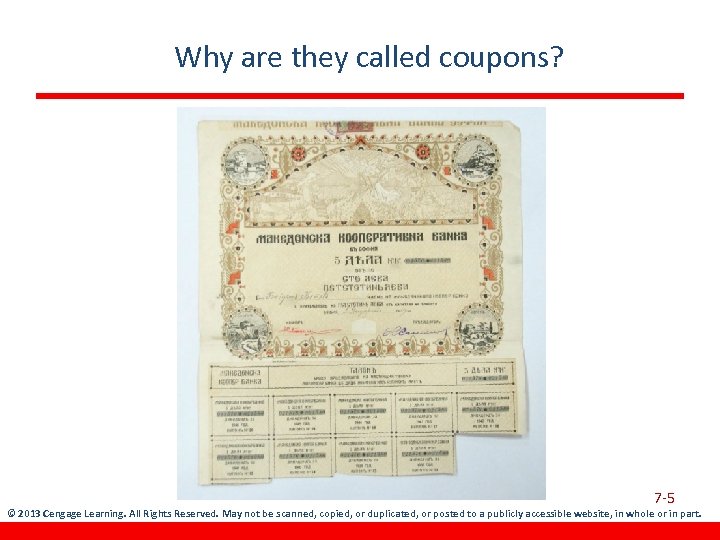
Why are they called coupons? 7 -5 © 2013 Cengage Learning. All Rights Reserved. May not be scanned, copied, or duplicated, or posted to a publicly accessible website, in whole or in part.
Effect of a Call Provision • Allows issuer to refund the bond issue if rates decline • Borrowers are willing to pay more, and lenders require more, for callable bonds. • – Helps the issuer, but hurts the investor Most bonds have a deferred call & a declining call premium. 7 -6 © 2013 Cengage Learning. All Rights Reserved. May not be scanned, copied, or duplicated, or posted to a publicly accessible website, in whole or in part.
What is a sinking fund? • • Provision to pay off a loan over its life rather than all at maturity Similar to amortization on a term loan Reduces risk to investor, shortens average maturity But not good for investors if rates decline after issuance 7 -7 © 2013 Cengage Learning. All Rights Reserved. May not be scanned, copied, or duplicated, or posted to a publicly accessible website, in whole or in part.
How are sinking funds executed? 1. Call x% of the issue at par, for sinking fund purposes – Likely to be used if rd is below the coupon rate and the bond sells at a premium. 2. Buy bonds in the open market. – Likely to be used if rd is above the coupon rate and the bond sells at a discount. 7 -8 © 2013 Cengage Learning. All Rights Reserved. May not be scanned, copied, or duplicated, or posted to a publicly accessible website, in whole or in part.
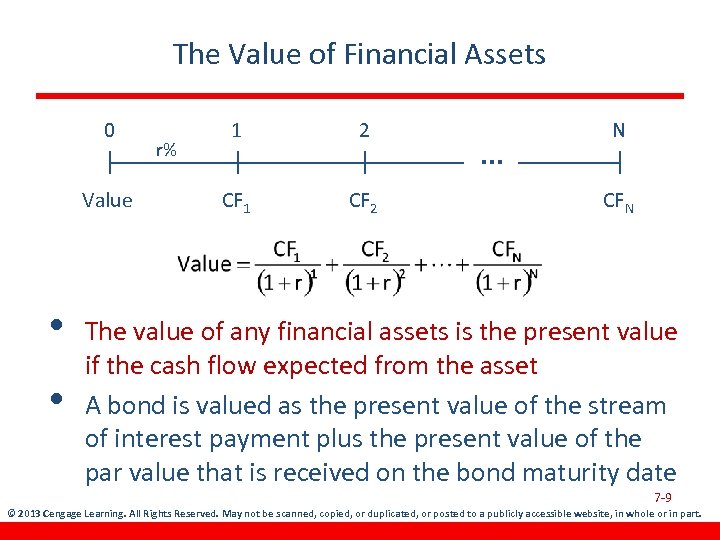
The Value of Financial Assets 0 Value • • r% 1 2 CF 1 CF 2 . . . N CFN The value of any financial assets is the present value if the cash flow expected from the asset A bond is valued as the present value of the stream of interest payment plus the present value of the par value that is received on the bond maturity date 7 -9 © 2013 Cengage Learning. All Rights Reserved. May not be scanned, copied, or duplicated, or posted to a publicly accessible website, in whole or in part.
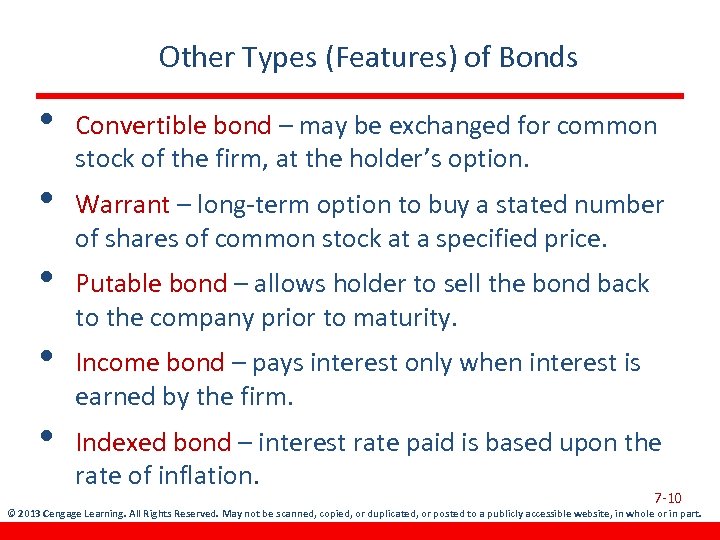
Other Types (Features) of Bonds • • • Convertible bond – may be exchanged for common stock of the firm, at the holder’s option. Warrant – long-term option to buy a stated number of shares of common stock at a specified price. Putable bond – allows holder to sell the bond back to the company prior to maturity. Income bond – pays interest only when interest is earned by the firm. Indexed bond – interest rate paid is based upon the rate of inflation. 7 -10 © 2013 Cengage Learning. All Rights Reserved. May not be scanned, copied, or duplicated, or posted to a publicly accessible website, in whole or in part.
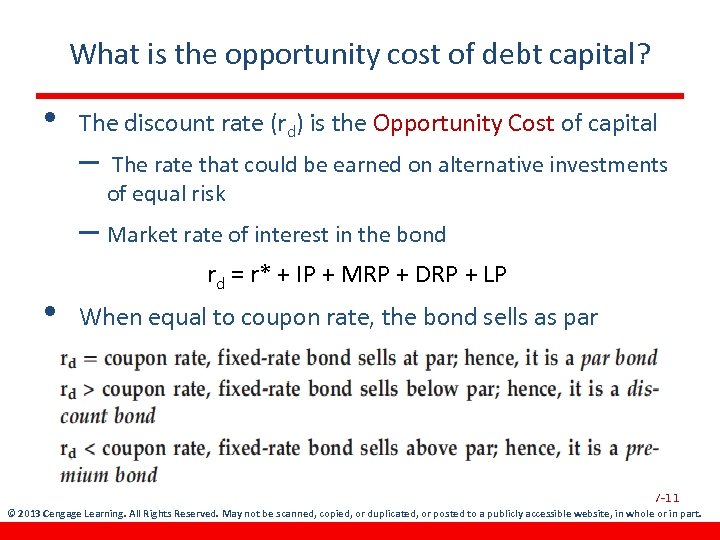
What is the opportunity cost of debt capital? • The discount rate (rd) is the Opportunity Cost of capital – The rate that could be earned on alternative investments of equal risk – Market rate of interest in the bond • rd = r* + IP + MRP + DRP + LP When equal to coupon rate, the bond sells as par 7 -11 © 2013 Cengage Learning. All Rights Reserved. May not be scanned, copied, or duplicated, or posted to a publicly accessible website, in whole or in part.
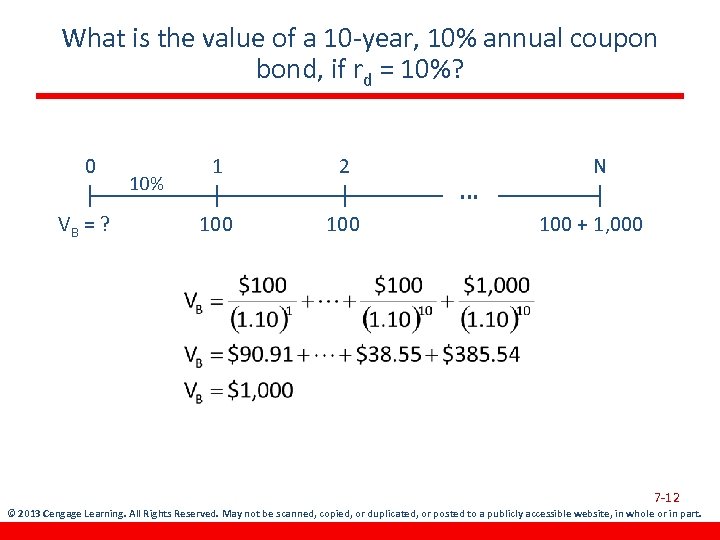
What is the value of a 10 -year, 10% annual coupon bond, if rd = 10%? 0 VB = ? 10% 1 2 100 . . . N 100 + 1, 000 7 -12 © 2013 Cengage Learning. All Rights Reserved. May not be scanned, copied, or duplicated, or posted to a publicly accessible website, in whole or in part.
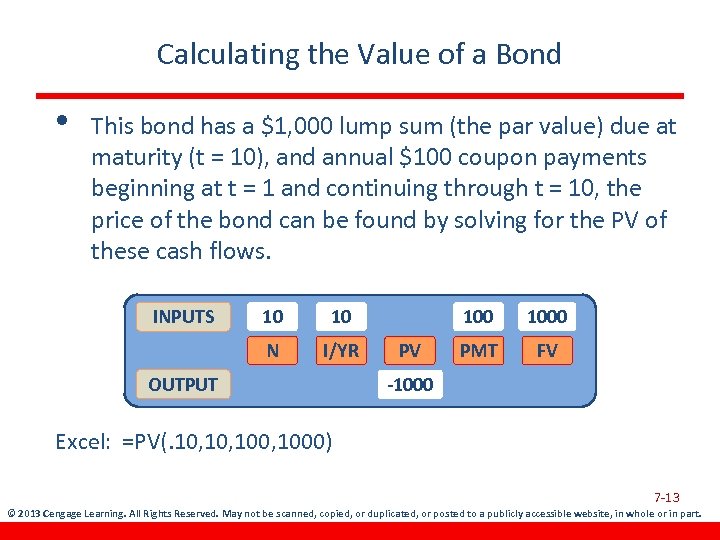
Calculating the Value of a Bond • This bond has a $1, 000 lump sum (the par value) due at maturity (t = 10), and annual $100 coupon payments beginning at t = 1 and continuing through t = 10, the price of the bond can be found by solving for the PV of these cash flows. INPUTS 10 10 N I/YR OUTPUT 100 PV 1000 PMT FV -1000 Excel: =PV(. 10, 100, 1000) 7 -13 © 2013 Cengage Learning. All Rights Reserved. May not be scanned, copied, or duplicated, or posted to a publicly accessible website, in whole or in part.
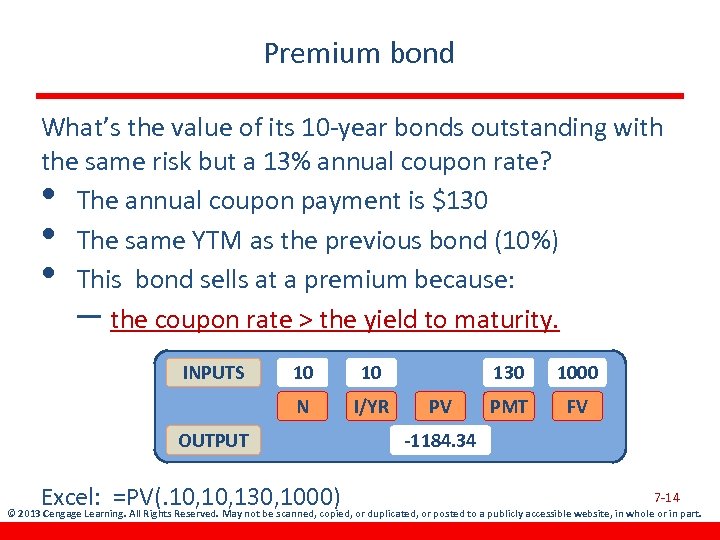
Premium bond What’s the value of its 10 -year bonds outstanding with the same risk but a 13% annual coupon rate? • The annual coupon payment is $130 • The same YTM as the previous bond (10%) • This bond sells at a premium because: – the coupon rate > the yield to maturity. INPUTS 10 N OUTPUT 10 I/YR 130 PV 1000 PMT FV -1184. 34 Excel: =PV(. 10, 130, 1000) or duplicated, or posted to a publicly accessible website, in whole 7 -14 part. © 2013 Cengage Learning. All Rights Reserved. May not be scanned, copied, or in
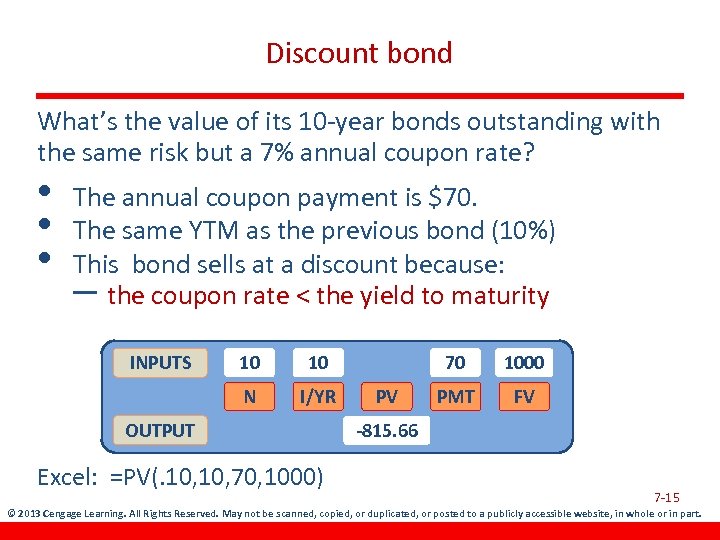
Discount bond What’s the value of its 10 -year bonds outstanding with the same risk but a 7% annual coupon rate? • • • The annual coupon payment is $70. The same YTM as the previous bond (10%) This bond sells at a discount because: – the coupon rate < the yield to maturity INPUTS 10 10 N I/YR OUTPUT Excel: =PV(. 10, 70, 1000) 70 PV 1000 PMT FV -815. 66 7 -15 © 2013 Cengage Learning. All Rights Reserved. May not be scanned, copied, or duplicated, or posted to a publicly accessible website, in whole or in part.
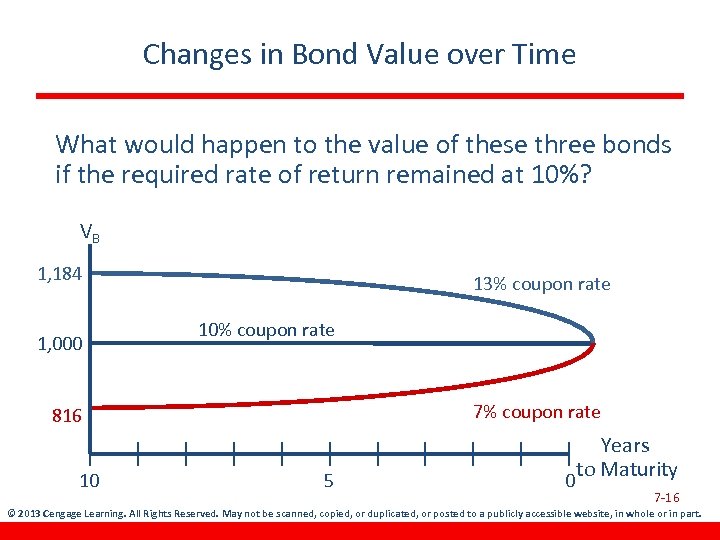
Changes in Bond Value over Time What would happen to the value of these three bonds if the required rate of return remained at 10%? VB 1, 184 1, 000 13% coupon rate 10% coupon rate 7% coupon rate 816 10 5 Years to Maturity 0 7 -16 © 2013 Cengage Learning. All Rights Reserved. May not be scanned, copied, or duplicated, or posted to a publicly accessible website, in whole or in part.
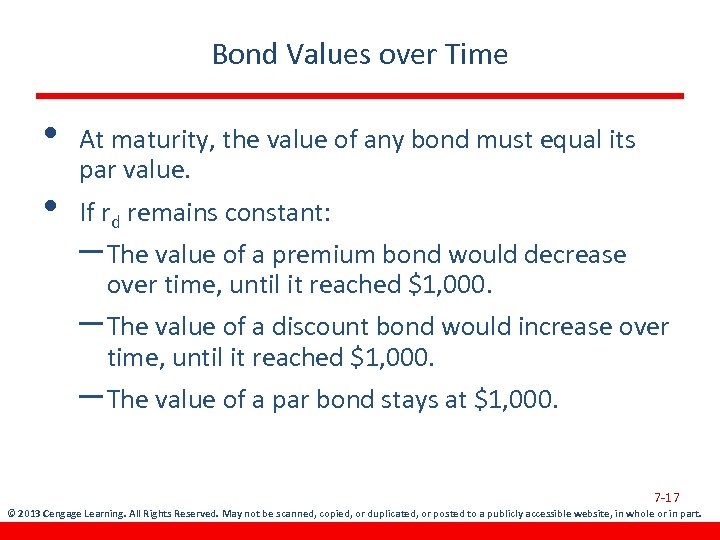
Bond Values over Time • • At maturity, the value of any bond must equal its par value. If rd remains constant: – The value of a premium bond would decrease over time, until it reached $1, 000. – The value of a discount bond would increase over time, until it reached $1, 000. – The value of a par bond stays at $1, 000. 7 -17 © 2013 Cengage Learning. All Rights Reserved. May not be scanned, copied, or duplicated, or posted to a publicly accessible website, in whole or in part.
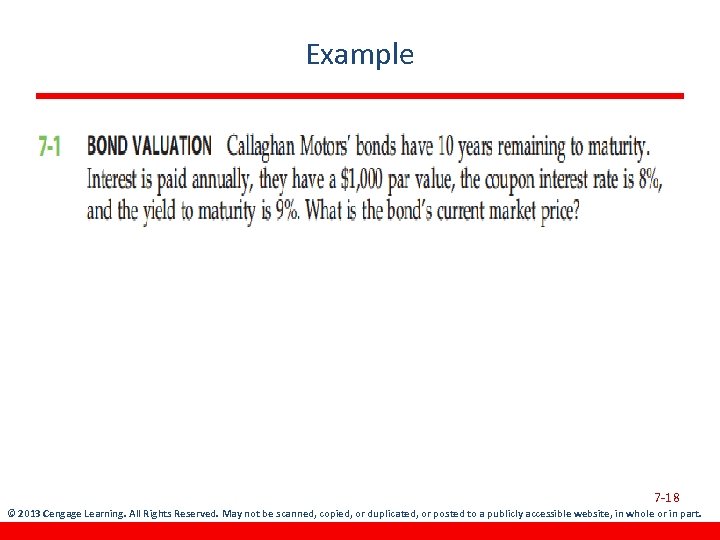
Example 7 -18 © 2013 Cengage Learning. All Rights Reserved. May not be scanned, copied, or duplicated, or posted to a publicly accessible website, in whole or in part.
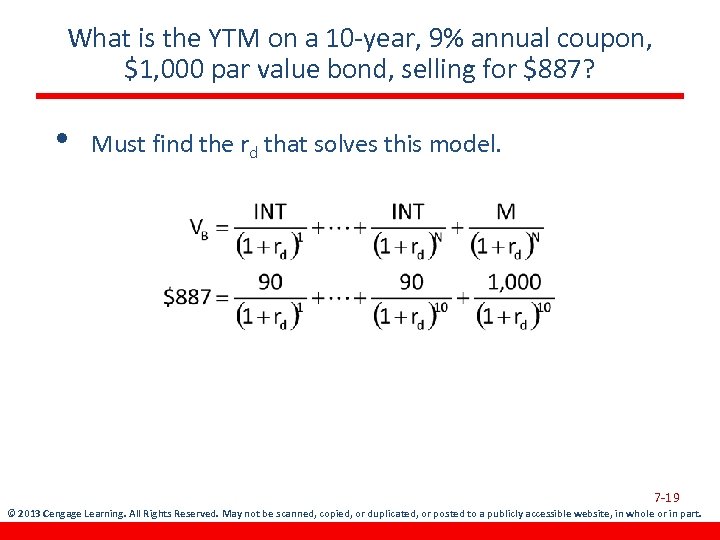
What is the YTM on a 10 -year, 9% annual coupon, $1, 000 par value bond, selling for $887? • Must find the rd that solves this model. 7 -19 © 2013 Cengage Learning. All Rights Reserved. May not be scanned, copied, or duplicated, or posted to a publicly accessible website, in whole or in part.
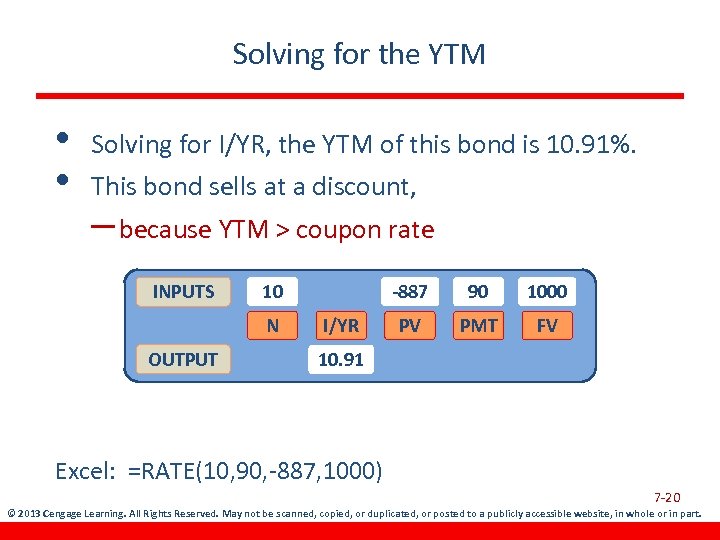
Solving for the YTM • • Solving for I/YR, the YTM of this bond is 10. 91%. This bond sells at a discount, – because YTM > coupon rate INPUTS 10 N OUTPUT -887 I/YR 90 1000 PV PMT FV 10. 91 Excel: =RATE(10, 90, -887, 1000) 7 -20 © 2013 Cengage Learning. All Rights Reserved. May not be scanned, copied, or duplicated, or posted to a publicly accessible website, in whole or in part.
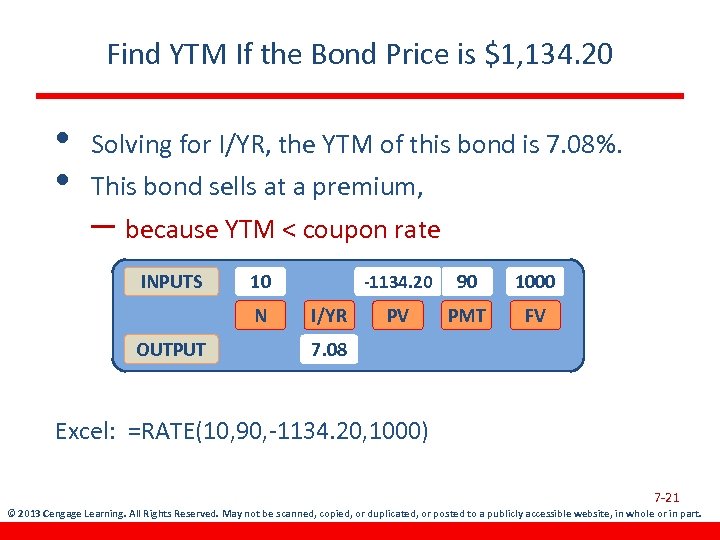
Find YTM If the Bond Price is $1, 134. 20 • • Solving for I/YR, the YTM of this bond is 7. 08%. This bond sells at a premium, – because YTM < coupon rate INPUTS 10 N OUTPUT -1134. 20 I/YR 90 1000 PV PMT FV 7. 08 Excel: =RATE(10, 90, -1134. 20, 1000) 7 -21 © 2013 Cengage Learning. All Rights Reserved. May not be scanned, copied, or duplicated, or posted to a publicly accessible website, in whole or in part.
Yield to Maturity (YTM) § § § Bond promised rate of return: The return investor will receive if all the promised payments are made YTM changes as the interest rates change If you buy a bond on its issuance date & hold it till maturity you will receive the YTM calculated on the purchase date If you buy a bond later on, the YTM will depend on your purchase price YTM equals to expected rate of return only when: o Probability of default is zero & the bond is not callable 7 -22 © 2013 Cengage Learning. All Rights Reserved. May not be scanned, copied, or duplicated, or posted to a publicly accessible website, in whole or in part.
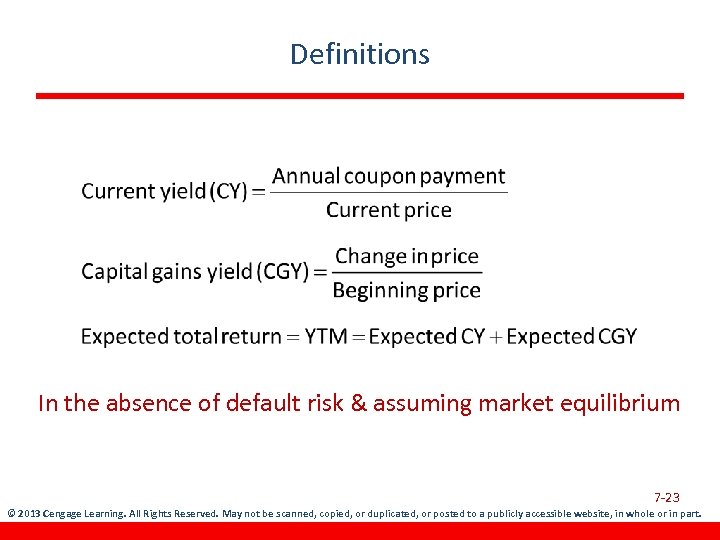
Definitions In the absence of default risk & assuming market equilibrium 7 -23 © 2013 Cengage Learning. All Rights Reserved. May not be scanned, copied, or duplicated, or posted to a publicly accessible website, in whole or in part.
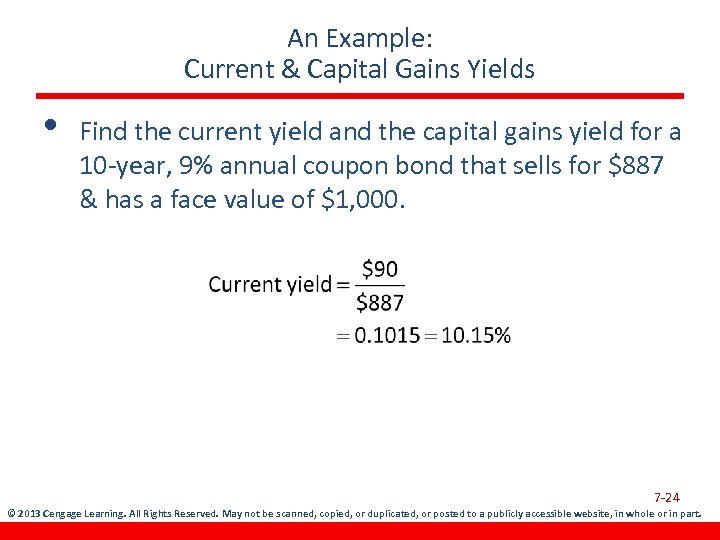
An Example: Current & Capital Gains Yields • Find the current yield and the capital gains yield for a 10 -year, 9% annual coupon bond that sells for $887 & has a face value of $1, 000. 7 -24 © 2013 Cengage Learning. All Rights Reserved. May not be scanned, copied, or duplicated, or posted to a publicly accessible website, in whole or in part.
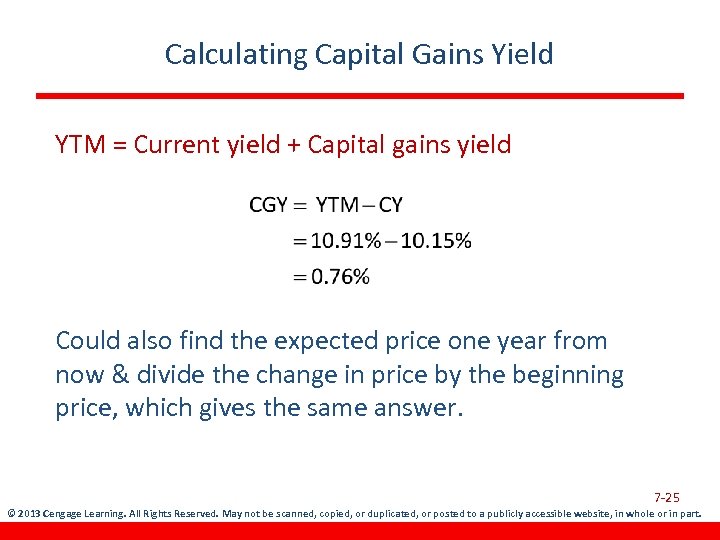
Calculating Capital Gains Yield YTM = Current yield + Capital gains yield Could also find the expected price one year from now & divide the change in price by the beginning price, which gives the same answer. 7 -25 © 2013 Cengage Learning. All Rights Reserved. May not be scanned, copied, or duplicated, or posted to a publicly accessible website, in whole or in part.
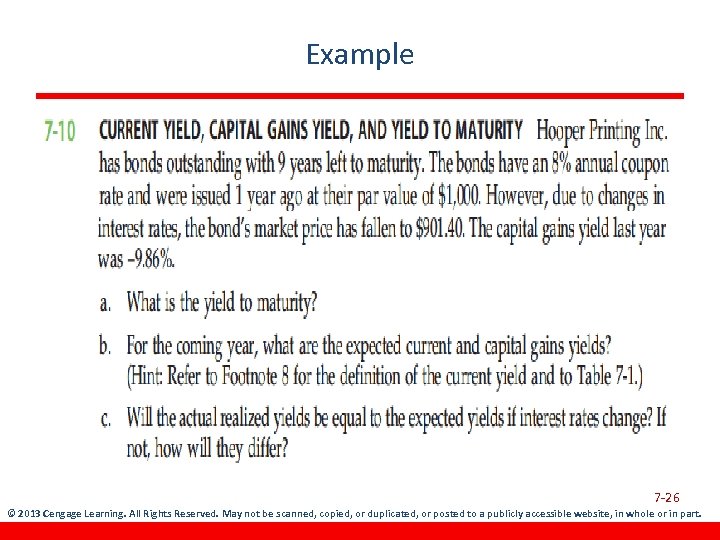
Example 7 -26 © 2013 Cengage Learning. All Rights Reserved. May not be scanned, copied, or duplicated, or posted to a publicly accessible website, in whole or in part.
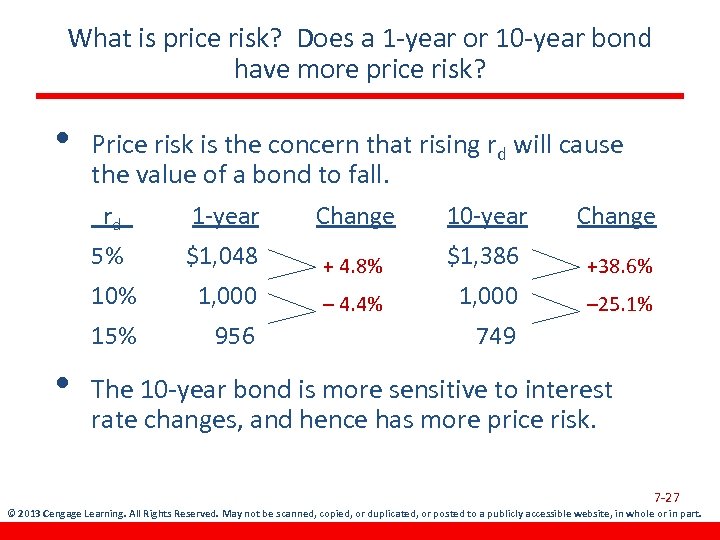
What is price risk? Does a 1 -year or 10 -year bond have more price risk? • Price risk is the concern that rising rd will cause the value of a bond to fall. rd Change 10 -year Change 5% $1, 048 + 4. 8% $1, 386 +38. 6% 10% 1, 000 – 4. 4% 1, 000 – 25. 1% 15% • 1 -year 956 749 The 10 -year bond is more sensitive to interest rate changes, and hence has more price risk. 7 -27 © 2013 Cengage Learning. All Rights Reserved. May not be scanned, copied, or duplicated, or posted to a publicly accessible website, in whole or in part.
Why does the value of the bond decrease if interest rates go up? 7 -28 © 2013 Cengage Learning. All Rights Reserved. May not be scanned, copied, or duplicated, or posted to a publicly accessible website, in whole or in part.
Why does a longer-term bond have more sensitivity to interest rate movements (higher interest rate risk) than shorter-term bonds? 7 -29 © 2013 Cengage Learning. All Rights Reserved. May not be scanned, copied, or duplicated, or posted to a publicly accessible website, in whole or in part.
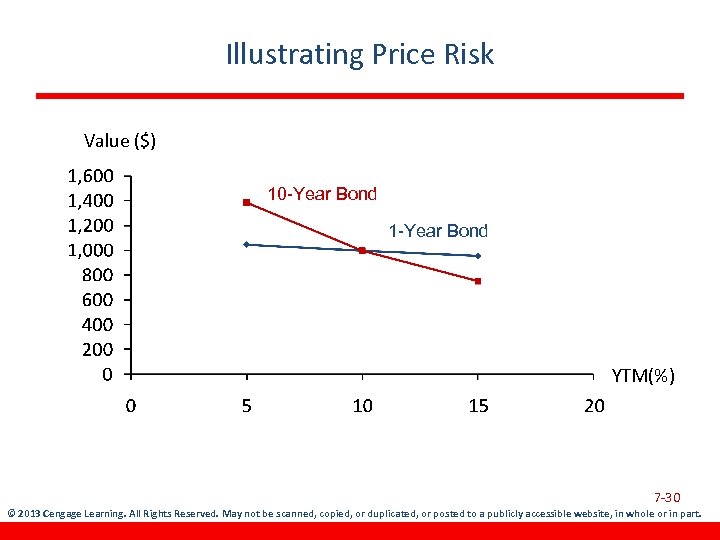
Illustrating Price Risk Value ($) 10 -Year Bond 1 -Year Bond YTM(%) 7 -30 © 2013 Cengage Learning. All Rights Reserved. May not be scanned, copied, or duplicated, or posted to a publicly accessible website, in whole or in part.
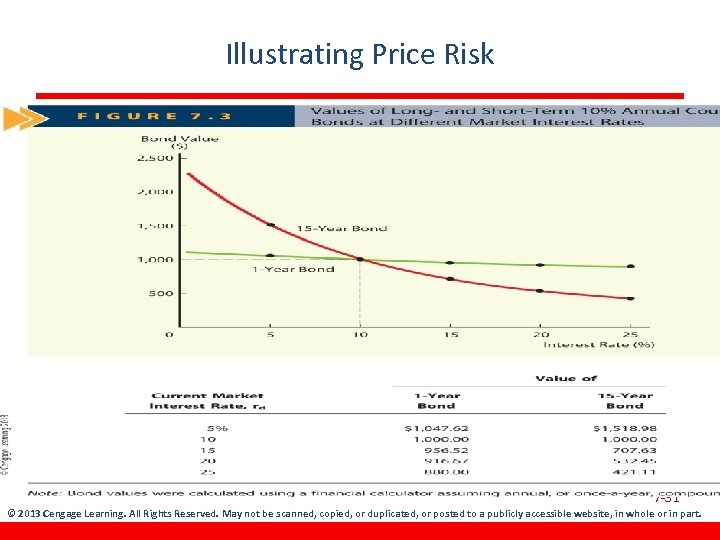
Illustrating Price Risk 7 -31 © 2013 Cengage Learning. All Rights Reserved. May not be scanned, copied, or duplicated, or posted to a publicly accessible website, in whole or in part.
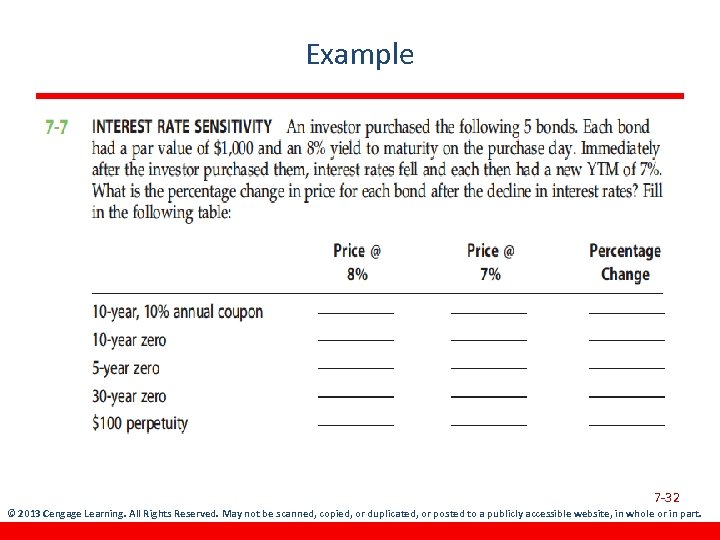
Example 7 -32 © 2013 Cengage Learning. All Rights Reserved. May not be scanned, copied, or duplicated, or posted to a publicly accessible website, in whole or in part.
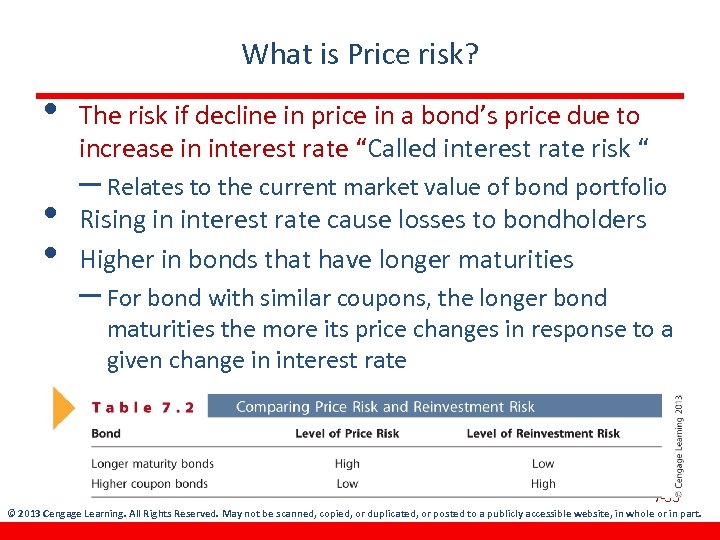
What is Price risk? • • • The risk if decline in price in a bond’s price due to increase in interest rate “Called interest rate risk “ – Relates to the current market value of bond portfolio Rising in interest rate cause losses to bondholders Higher in bonds that have longer maturities – For bond with similar coupons, the longer bond maturities the more its price changes in response to a given change in interest rate 7 -33 © 2013 Cengage Learning. All Rights Reserved. May not be scanned, copied, or duplicated, or posted to a publicly accessible website, in whole or in part.
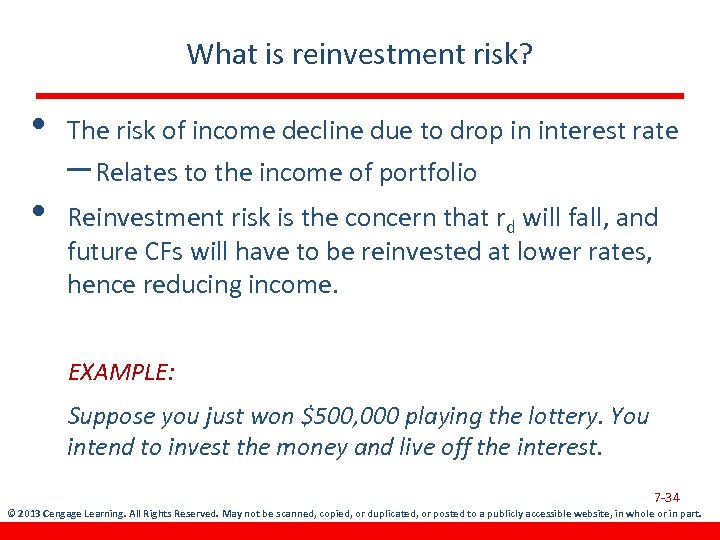
What is reinvestment risk? • The risk of income decline due to drop in interest rate • Reinvestment risk is the concern that rd will fall, and future CFs will have to be reinvested at lower rates, hence reducing income. – Relates to the income of portfolio EXAMPLE: Suppose you just won $500, 000 playing the lottery. You intend to invest the money and live off the interest. 7 -34 © 2013 Cengage Learning. All Rights Reserved. May not be scanned, copied, or duplicated, or posted to a publicly accessible website, in whole or in part.
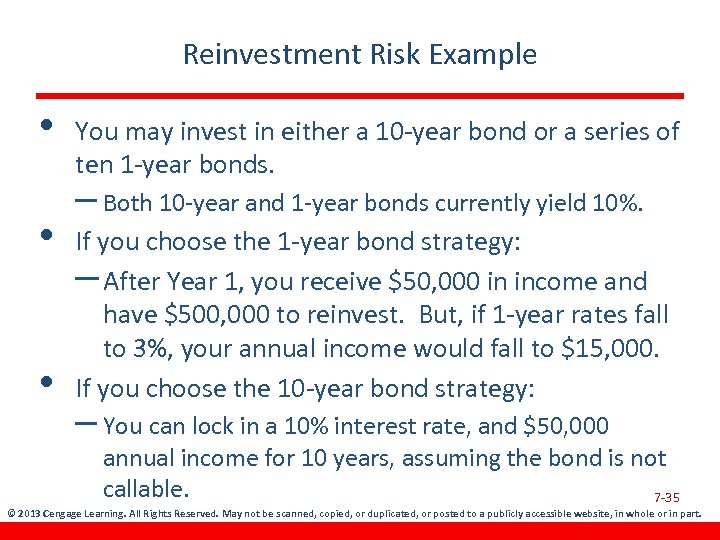
Reinvestment Risk Example • • • You may invest in either a 10 -year bond or a series of ten 1 -year bonds. – Both 10 -year and 1 -year bonds currently yield 10%. If you choose the 1 -year bond strategy: – After Year 1, you receive $50, 000 in income and have $500, 000 to reinvest. But, if 1 -year rates fall to 3%, your annual income would fall to $15, 000. If you choose the 10 -year bond strategy: – You can lock in a 10% interest rate, and $50, 000 annual income for 10 years, assuming the bond is not callable. 7 -35 © 2013 Cengage Learning. All Rights Reserved. May not be scanned, copied, or duplicated, or posted to a publicly accessible website, in whole or in part.
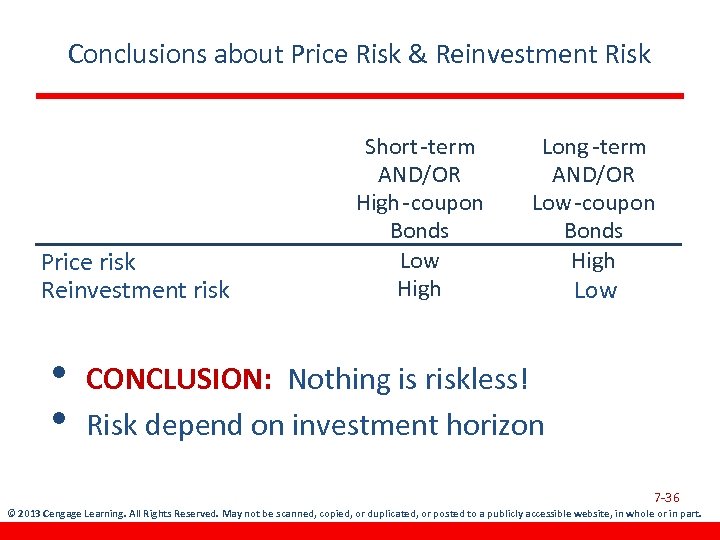
Conclusions about Price Risk & Reinvestment Risk Price risk Reinvestment risk • • Short-term AND/OR High -coupon Bonds Low High Long -term AND/OR Low-coupon Bonds High Low CONCLUSION: Nothing is riskless! Risk depend on investment horizon 7 -36 © 2013 Cengage Learning. All Rights Reserved. May not be scanned, copied, or duplicated, or posted to a publicly accessible website, in whole or in part.
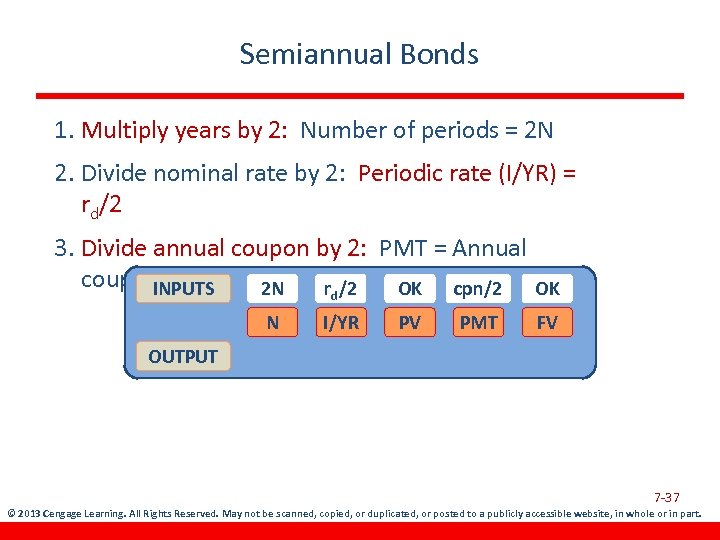
Semiannual Bonds 1. Multiply years by 2: Number of periods = 2 N 2. Divide nominal rate by 2: Periodic rate (I/YR) = rd/2 3. Divide annual coupon by 2: PMT = Annual coupon/2 INPUTS 2 N OK cpn/2 r /2 d N I/YR PV PMT OK FV OUTPUT 7 -37 © 2013 Cengage Learning. All Rights Reserved. May not be scanned, copied, or duplicated, or posted to a publicly accessible website, in whole or in part.
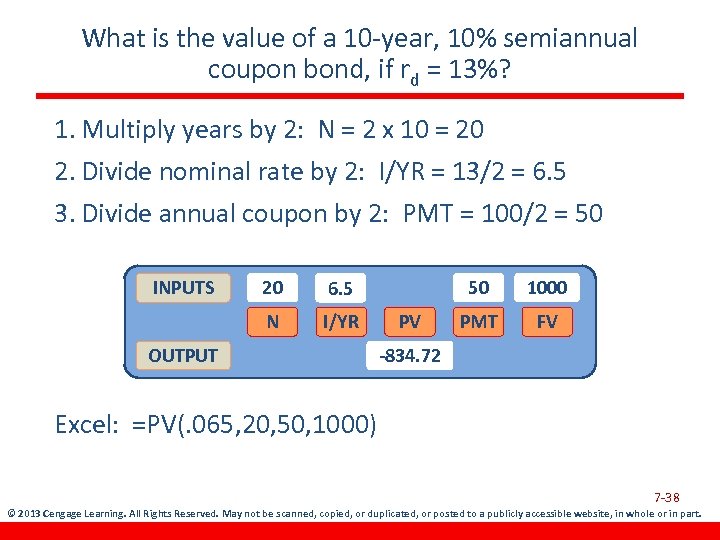
What is the value of a 10 -year, 10% semiannual coupon bond, if rd = 13%? 1. Multiply years by 2: N = 2 x 10 = 20 2. Divide nominal rate by 2: I/YR = 13/2 = 6. 5 3. Divide annual coupon by 2: PMT = 100/2 = 50 INPUTS 20 6. 5 N I/YR OUTPUT 50 PV 1000 PMT FV -834. 72 Excel: =PV(. 065, 20, 50, 1000) 7 -38 © 2013 Cengage Learning. All Rights Reserved. May not be scanned, copied, or duplicated, or posted to a publicly accessible website, in whole or in part.
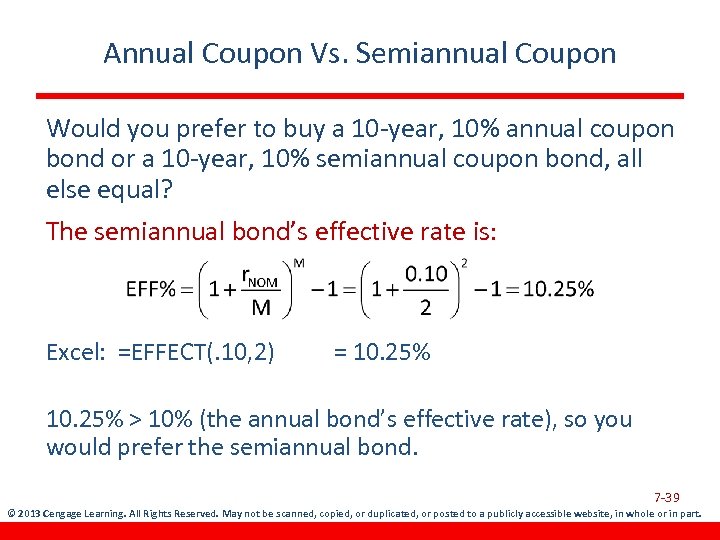
Annual Coupon Vs. Semiannual Coupon Would you prefer to buy a 10 -year, 10% annual coupon bond or a 10 -year, 10% semiannual coupon bond, all else equal? The semiannual bond’s effective rate is: Excel: =EFFECT(. 10, 2) = 10. 25% > 10% (the annual bond’s effective rate), so you would prefer the semiannual bond. 7 -39 © 2013 Cengage Learning. All Rights Reserved. May not be scanned, copied, or duplicated, or posted to a publicly accessible website, in whole or in part.
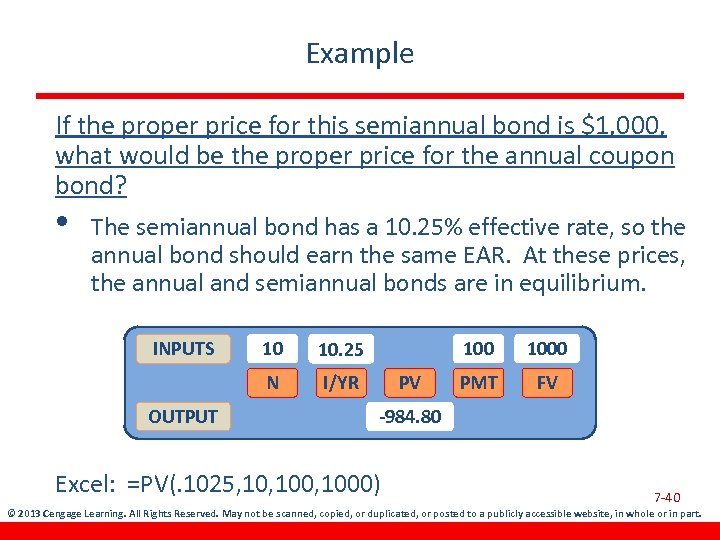
Example If the proper price for this semiannual bond is $1, 000, what would be the proper price for the annual coupon bond? • The semiannual bond has a 10. 25% effective rate, so the annual bond should earn the same EAR. At these prices, the annual and semiannual bonds are in equilibrium. INPUTS 10. 25 N OUTPUT 10 100 I/YR PV 1000 PMT FV -984. 80 Excel: =PV(. 1025, 100, 1000) 7 -40 © 2013 Cengage Learning. All Rights Reserved. May not be scanned, copied, or duplicated, or posted to a publicly accessible website, in whole or in part.
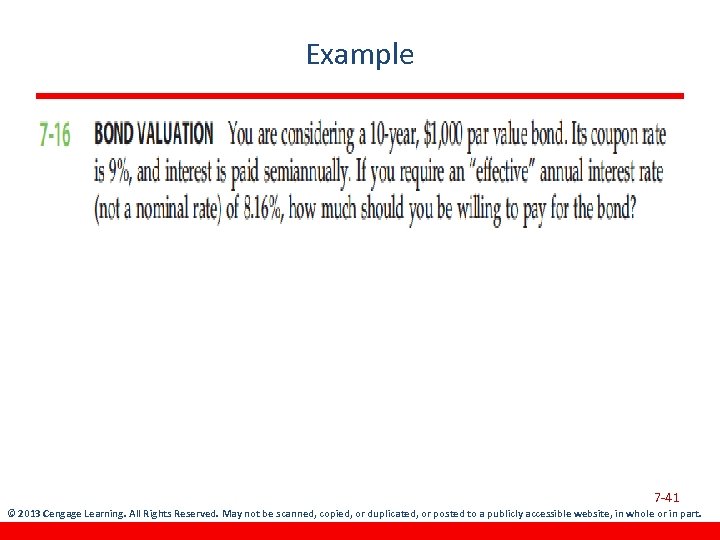
Example 7 -41 © 2013 Cengage Learning. All Rights Reserved. May not be scanned, copied, or duplicated, or posted to a publicly accessible website, in whole or in part.
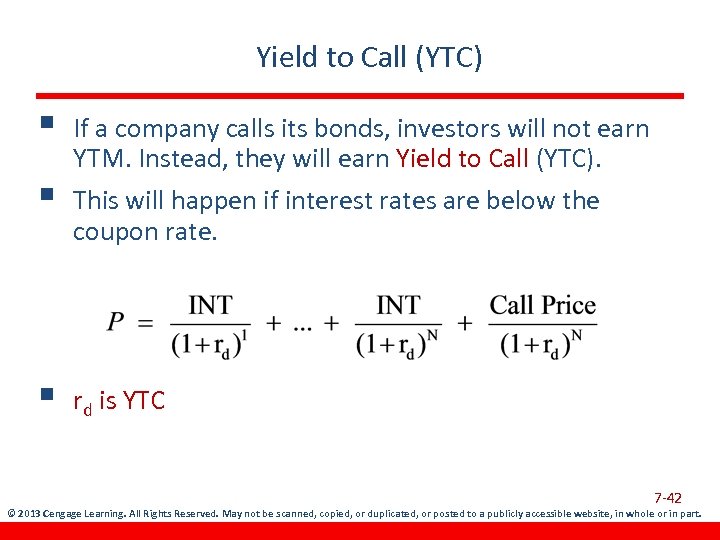
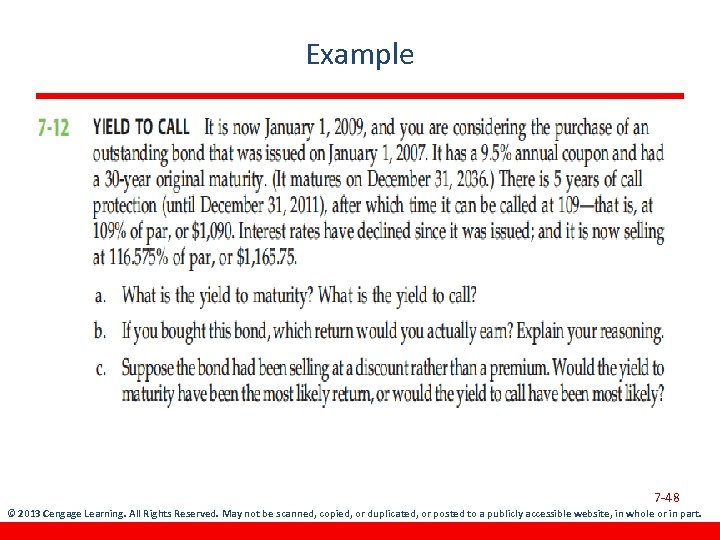
Yield to Call (YTC) § § § If a company calls its bonds, investors will not earn YTM. Instead, they will earn Yield to Call (YTC). This will happen if interest rates are below the coupon rate. rd is YTC 7 -42 © 2013 Cengage Learning. All Rights Reserved. May not be scanned, copied, or duplicated, or posted to a publicly accessible website, in whole or in part.
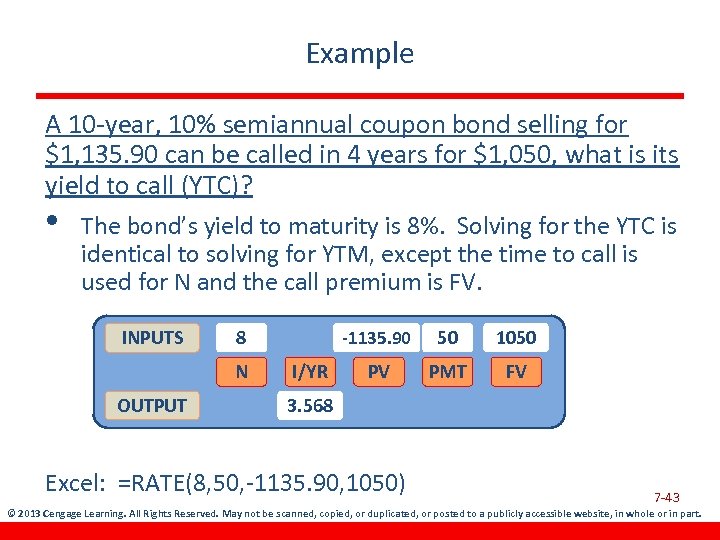
Example A 10 -year, 10% semiannual coupon bond selling for $1, 135. 90 can be called in 4 years for $1, 050, what is its yield to call (YTC)? • The bond’s yield to maturity is 8%. Solving for the YTC is identical to solving for YTM, except the time to call is used for N and the call premium is FV. INPUTS 8 N OUTPUT -1135. 90 I/YR 50 1050 PV PMT FV 3. 568 Excel: =RATE(8, 50, -1135. 90, 1050) 7 -43 © 2013 Cengage Learning. All Rights Reserved. May not be scanned, copied, or duplicated, or posted to a publicly accessible website, in whole or in part.
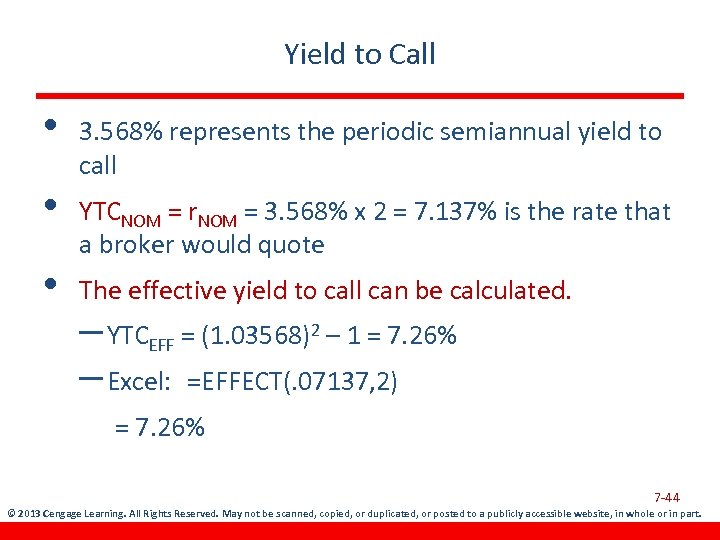
Yield to Call • • • 3. 568% represents the periodic semiannual yield to call YTCNOM = r. NOM = 3. 568% x 2 = 7. 137% is the rate that a broker would quote The effective yield to call can be calculated. – YTCEFF = (1. 03568)2 – 1 = 7. 26% – Excel: =EFFECT(. 07137, 2) = 7. 26% 7 -44 © 2013 Cengage Learning. All Rights Reserved. May not be scanned, copied, or duplicated, or posted to a publicly accessible website, in whole or in part.
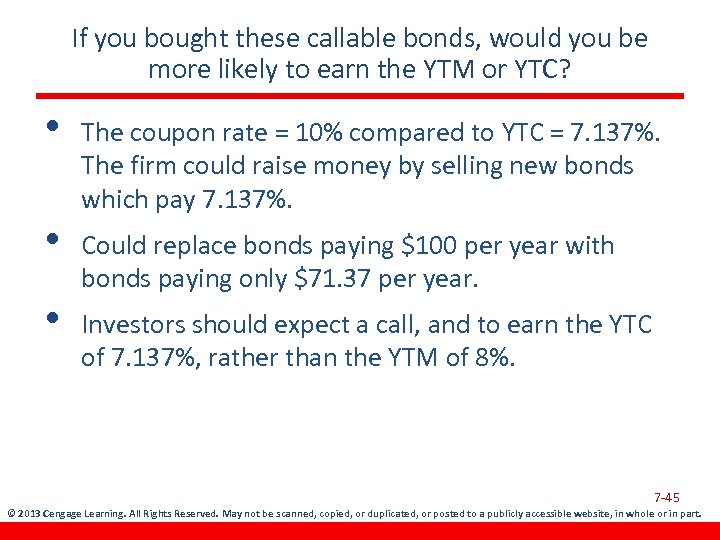
If you bought these callable bonds, would you be more likely to earn the YTM or YTC? • • • The coupon rate = 10% compared to YTC = 7. 137%. The firm could raise money by selling new bonds which pay 7. 137%. Could replace bonds paying $100 per year with bonds paying only $71. 37 per year. Investors should expect a call, and to earn the YTC of 7. 137%, rather than the YTM of 8%. 7 -45 © 2013 Cengage Learning. All Rights Reserved. May not be scanned, copied, or duplicated, or posted to a publicly accessible website, in whole or in part.
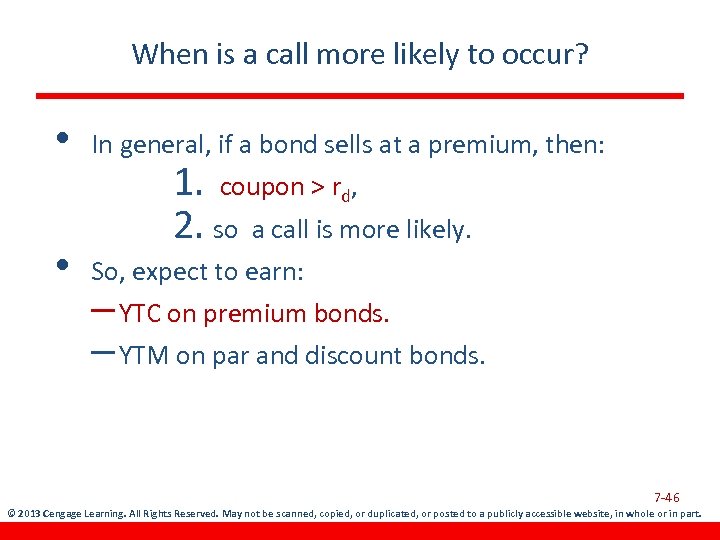
When is a call more likely to occur? • In general, if a bond sells at a premium, then: • So, expect to earn: 1. coupon > rd, 2. so a call is more likely. – YTC on premium bonds. – YTM on par and discount bonds. 7 -46 © 2013 Cengage Learning. All Rights Reserved. May not be scanned, copied, or duplicated, or posted to a publicly accessible website, in whole or in part.
If you buy a callable bond & interest rates decline, will the value of your bond rise as much as it would have risen if the bond was not callable? 7 -47 © 2013 Cengage Learning. All Rights Reserved. May not be scanned, copied, or duplicated, or posted to a publicly accessible website, in whole or in part.
Example 7 -48 © 2013 Cengage Learning. All Rights Reserved. May not be scanned, copied, or duplicated, or posted to a publicly accessible website, in whole or in part.
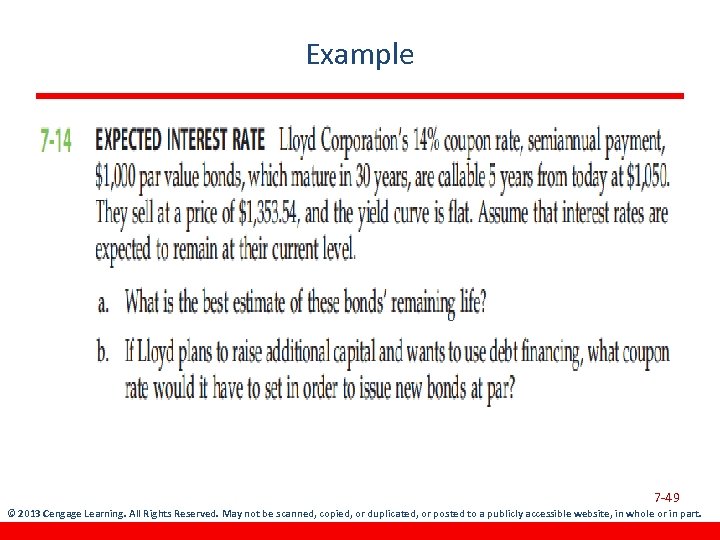
Example 7 -49 © 2013 Cengage Learning. All Rights Reserved. May not be scanned, copied, or duplicated, or posted to a publicly accessible website, in whole or in part.
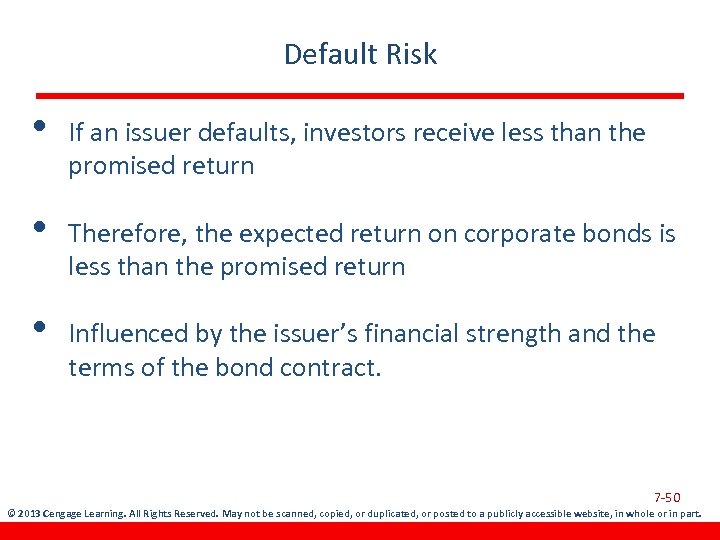
Default Risk • If an issuer defaults, investors receive less than the promised return • Therefore, the expected return on corporate bonds is less than the promised return • Influenced by the issuer’s financial strength and the terms of the bond contract. 7 -50 © 2013 Cengage Learning. All Rights Reserved. May not be scanned, copied, or duplicated, or posted to a publicly accessible website, in whole or in part.
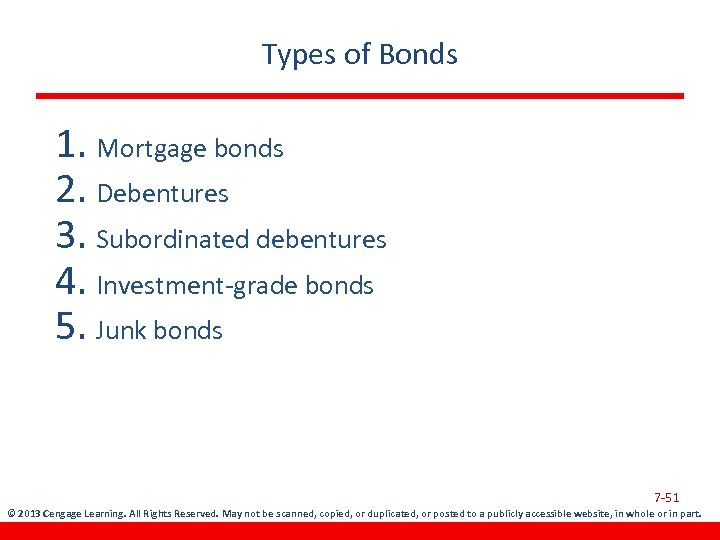
Types of Bonds 1. Mortgage bonds 2. Debentures 3. Subordinated debentures 4. Investment-grade bonds 5. Junk bonds 7 -51 © 2013 Cengage Learning. All Rights Reserved. May not be scanned, copied, or duplicated, or posted to a publicly accessible website, in whole or in part.
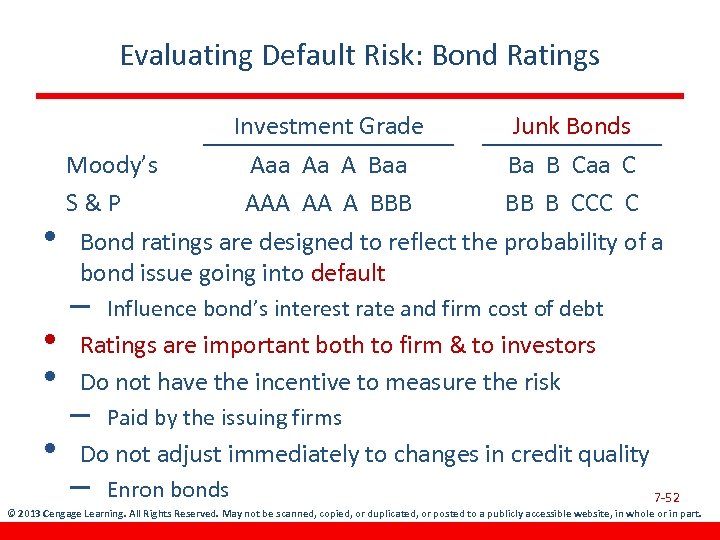
Evaluating Default Risk: Bond Ratings • • Investment Grade Junk Bonds Moody’s Aaa Aa A Baa Ba B Caa C S&P AAA AA A BBB BB B CCC C Bond ratings are designed to reflect the probability of a bond issue going into default – Influence bond’s interest rate and firm cost of debt Ratings are important both to firm & to investors Do not have the incentive to measure the risk – Paid by the issuing firms Do not adjust immediately to changes in credit quality – Enron bonds 7 -52 © 2013 Cengage Learning. All Rights Reserved. May not be scanned, copied, or duplicated, or posted to a publicly accessible website, in whole or in part.
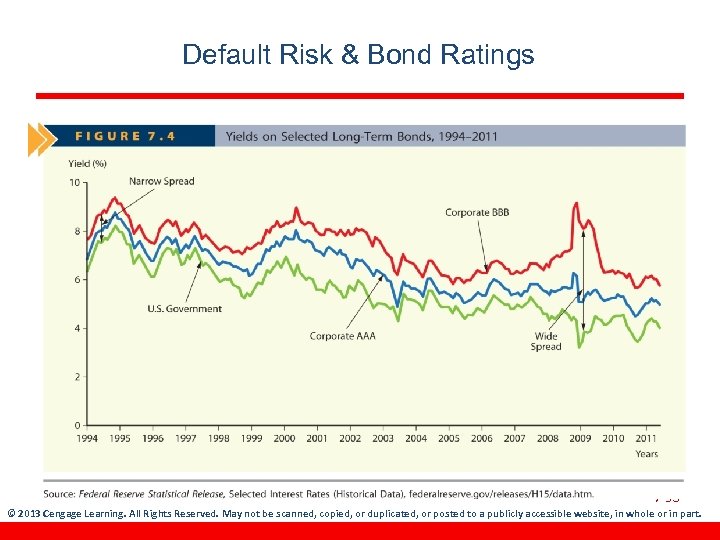
Default Risk & Bond Ratings 7 -53 © 2013 Cengage Learning. All Rights Reserved. May not be scanned, copied, or duplicated, or posted to a publicly accessible website, in whole or in part.
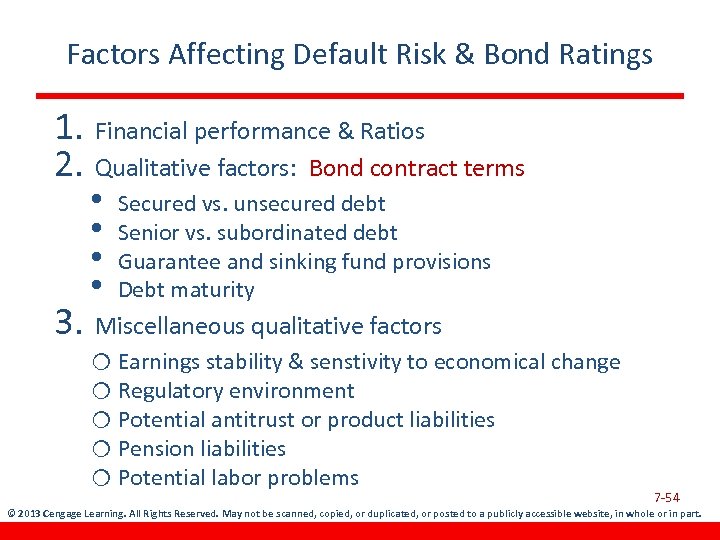
Factors Affecting Default Risk & Bond Ratings 1. Financial performance & Ratios 2. Qualitative factors: Bond contract terms • • Secured vs. unsecured debt Senior vs. subordinated debt Guarantee and sinking fund provisions Debt maturity 3. Miscellaneous qualitative factors o Earnings stability & senstivity to economical change o Regulatory environment o Potential antitrust or product liabilities o Pension liabilities o Potential labor problems 7 -54 © 2013 Cengage Learning. All Rights Reserved. May not be scanned, copied, or duplicated, or posted to a publicly accessible website, in whole or in part.
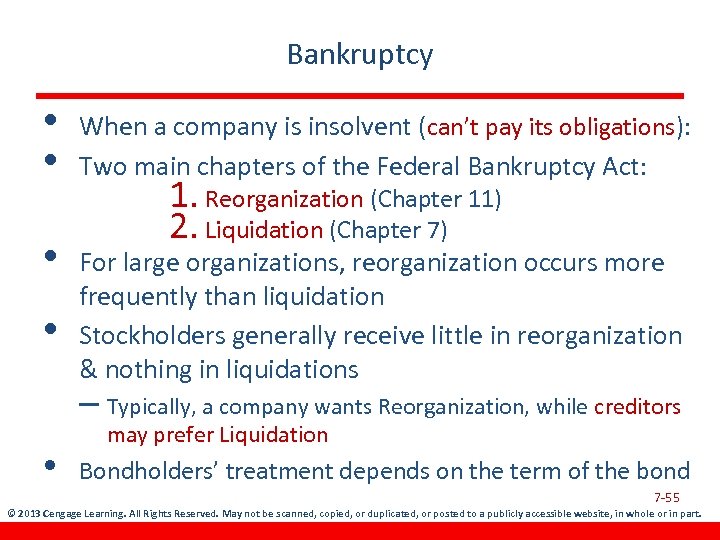
Bankruptcy • • When a company is insolvent (can’t pay its obligations): Two main chapters of the Federal Bankruptcy Act: • For large organizations, reorganization occurs more frequently than liquidation Stockholders generally receive little in reorganization & nothing in liquidations • 1. Reorganization (Chapter 11) 2. Liquidation (Chapter 7) – Typically, a company wants Reorganization, while creditors • may prefer Liquidation Bondholders’ treatment depends on the term of the bond 7 -55 © 2013 Cengage Learning. All Rights Reserved. May not be scanned, copied, or duplicated, or posted to a publicly accessible website, in whole or in part.
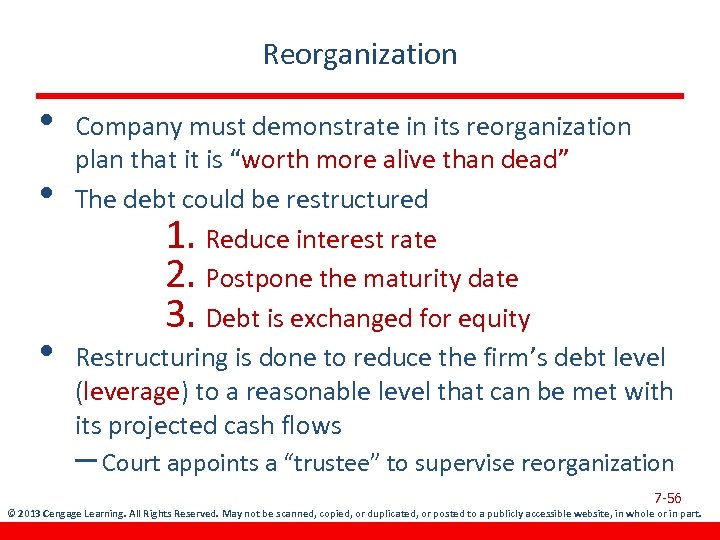
Reorganization • • • Company must demonstrate in its reorganization plan that it is “worth more alive than dead” The debt could be restructured 1. Reduce interest rate 2. Postpone the maturity date 3. Debt is exchanged for equity Restructuring is done to reduce the firm’s debt level (leverage) to a reasonable level that can be met with its projected cash flows – Court appoints a “trustee” to supervise reorganization 7 -56 © 2013 Cengage Learning. All Rights Reserved. May not be scanned, copied, or duplicated, or posted to a publicly accessible website, in whole or in part.
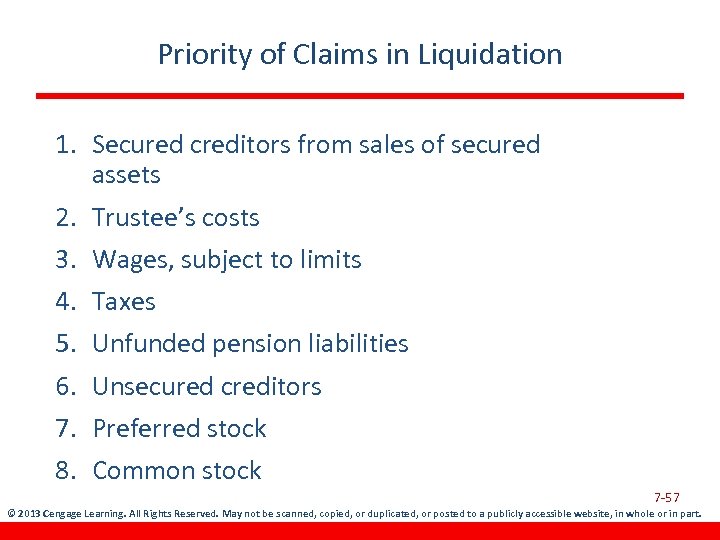
Priority of Claims in Liquidation 1. Secured creditors from sales of secured assets 2. Trustee’s costs 3. Wages, subject to limits 4. Taxes 5. Unfunded pension liabilities 6. Unsecured creditors 7. Preferred stock 8. Common stock 7 -57 © 2013 Cengage Learning. All Rights Reserved. May not be scanned, copied, or duplicated, or posted to a publicly accessible website, in whole or in part.
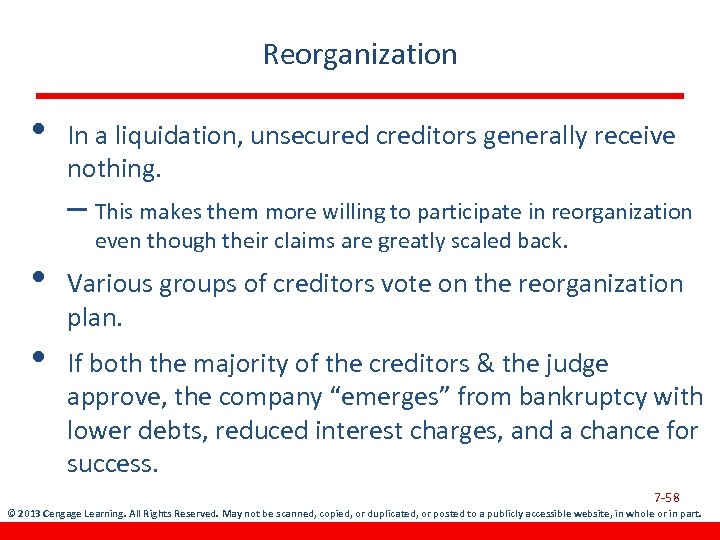
Reorganization • In a liquidation, unsecured creditors generally receive nothing. – This makes them more willing to participate in reorganization • • even though their claims are greatly scaled back. Various groups of creditors vote on the reorganization plan. If both the majority of the creditors & the judge approve, the company “emerges” from bankruptcy with lower debts, reduced interest charges, and a chance for success. 7 -58 © 2013 Cengage Learning. All Rights Reserved. May not be scanned, copied, or duplicated, or posted to a publicly accessible website, in whole or in part.
Скачать презентацию Chapter 7 Bonds and Their Valuation Key Features
606d11fac65f96e1ac4b529fe3450a1f.ppt