


 Скачать презентацию CHAPTER 6 Time Value of Money n n
cd15127227f89d72362b764b920bdfee.ppt
- Количество слайдов: 44
 CHAPTER 6 Time Value of Money n n n Future value Present value Annuities Rates of return Amortization 6 -1
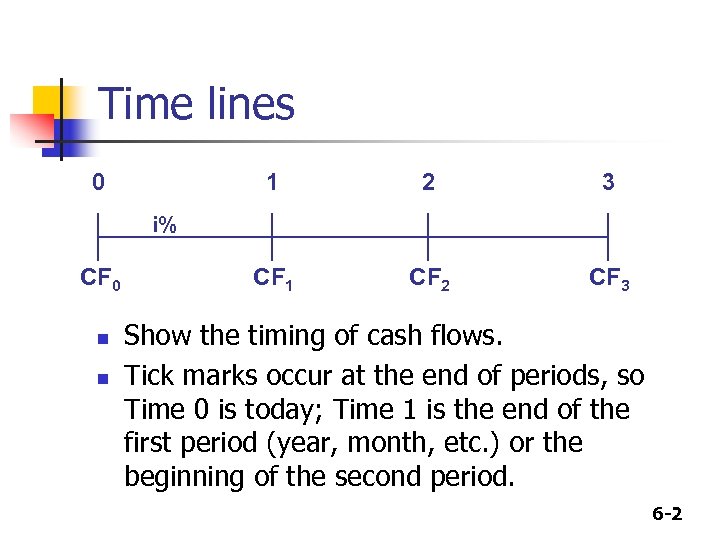 Time lines 0 1 2 3 CF 1 CF 2 CF 3 i% CF 0 n n Show the timing of cash flows. Tick marks occur at the end of periods, so Time 0 is today; Time 1 is the end of the first period (year, month, etc. ) or the beginning of the second period. 6 -2
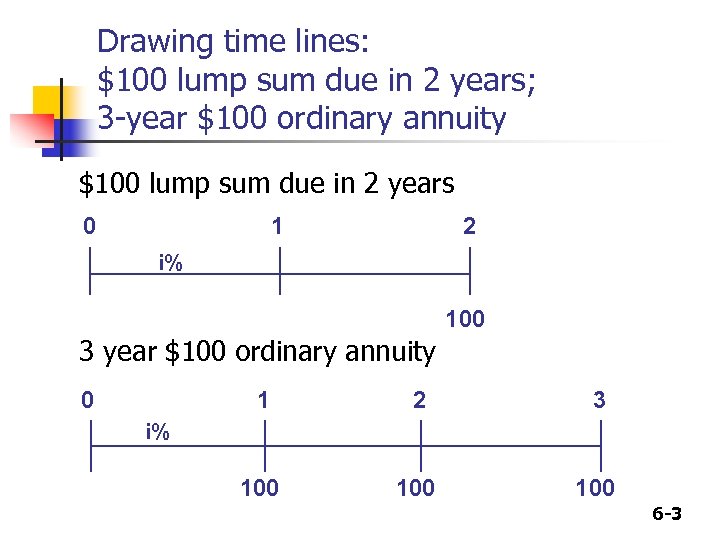 Drawing time lines: $100 lump sum due in 2 years; 3 -year $100 ordinary annuity $100 lump sum due in 2 years 0 1 2 i% 100 3 year $100 ordinary annuity 0 1 2 3 100 100 i% 6 -3
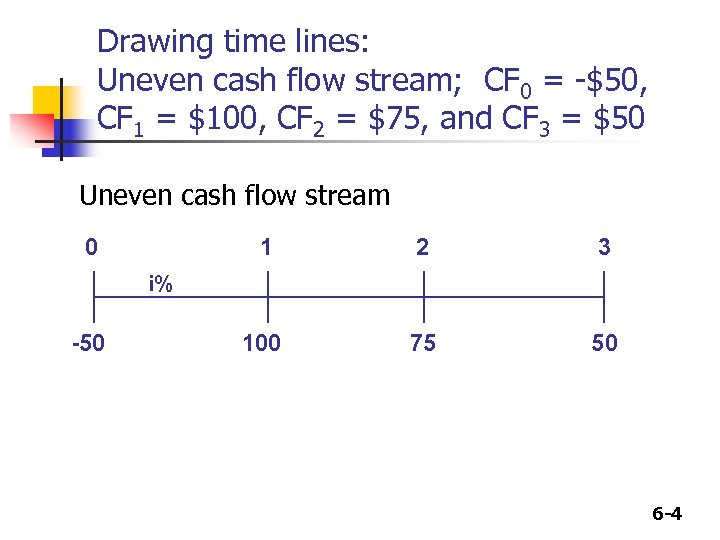 Drawing time lines: Uneven cash flow stream; CF 0 = -$50, CF 1 = $100, CF 2 = $75, and CF 3 = $50 Uneven cash flow stream 0 1 2 3 100 75 50 i% -50 6 -4
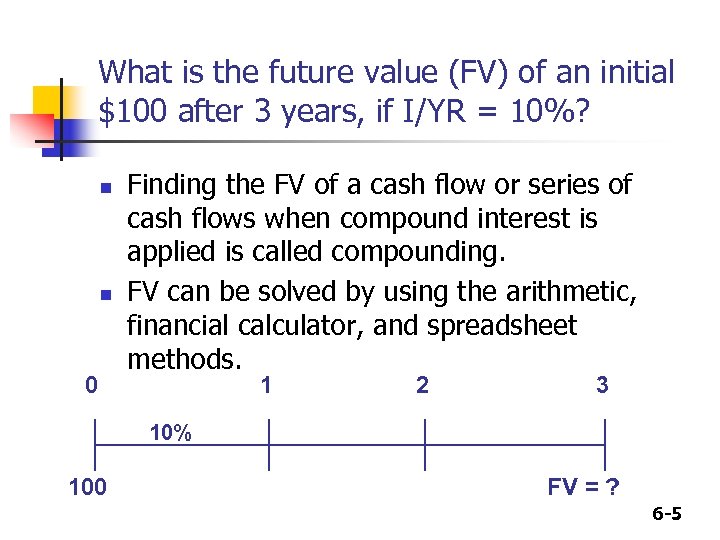 What is the future value (FV) of an initial $100 after 3 years, if I/YR = 10%? n n 0 Finding the FV of a cash flow or series of cash flows when compound interest is applied is called compounding. FV can be solved by using the arithmetic, financial calculator, and spreadsheet methods. 1 2 3 10% 100 FV = ? 6 -5
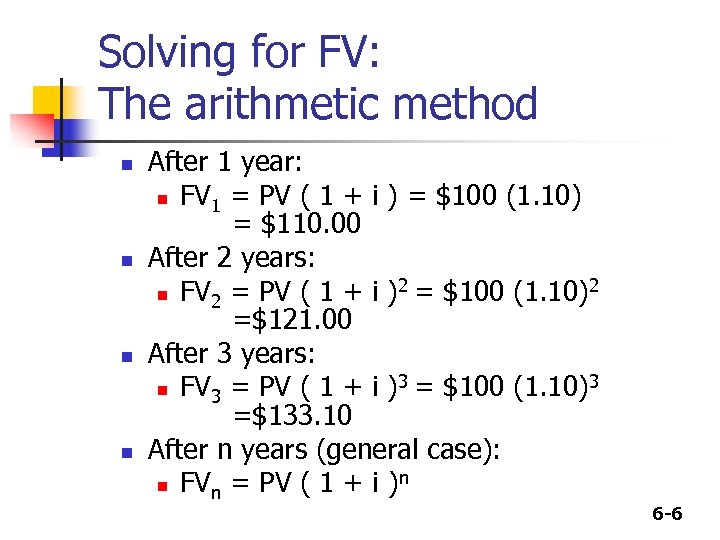 Solving for FV: The arithmetic method n n After 1 year: n FV 1 = PV ( 1 + i ) = $100 (1. 10) = $110. 00 After 2 years: 2 2 n FV 2 = PV ( 1 + i ) = $100 (1. 10) =$121. 00 After 3 years: 3 3 n FV 3 = PV ( 1 + i ) = $100 (1. 10) =$133. 10 After n years (general case): n n FVn = PV ( 1 + i ) 6 -6
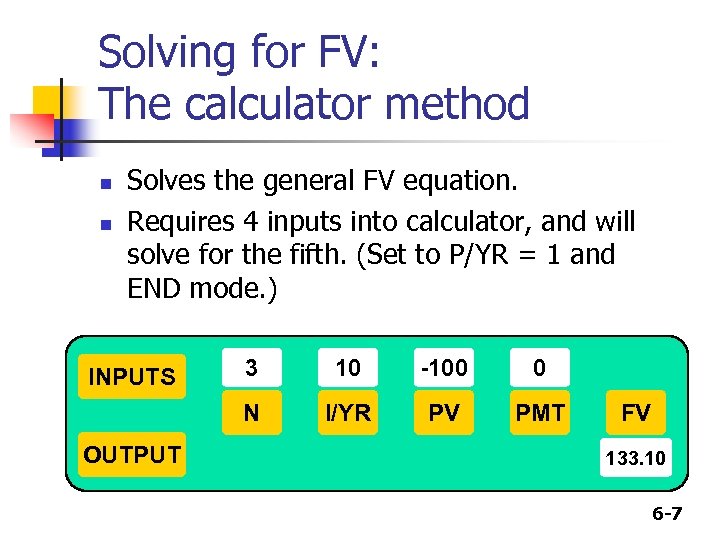 Solving for FV: The calculator method n n Solves the general FV equation. Requires 4 inputs into calculator, and will solve for the fifth. (Set to P/YR = 1 and END mode. ) OUTPUT 3 10 -100 0 N INPUTS I/YR PV PMT FV 133. 10 6 -7
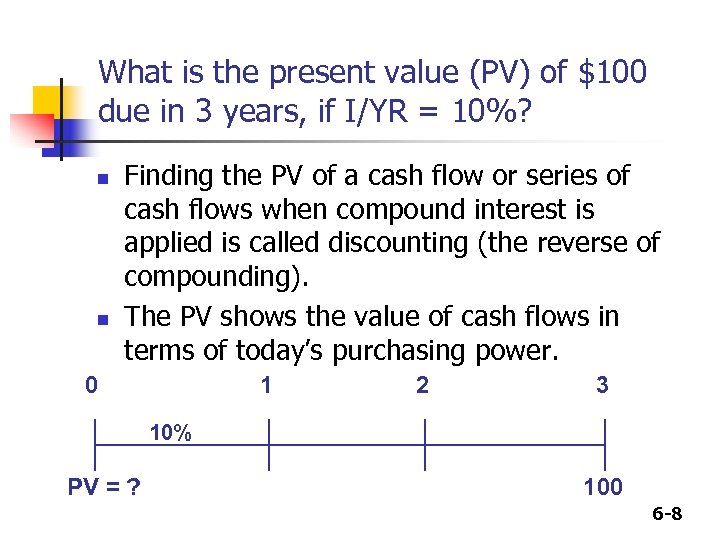 What is the present value (PV) of $100 due in 3 years, if I/YR = 10%? n n Finding the PV of a cash flow or series of cash flows when compound interest is applied is called discounting (the reverse of compounding). The PV shows the value of cash flows in terms of today’s purchasing power. 0 1 2 3 10% PV = ? 100 6 -8
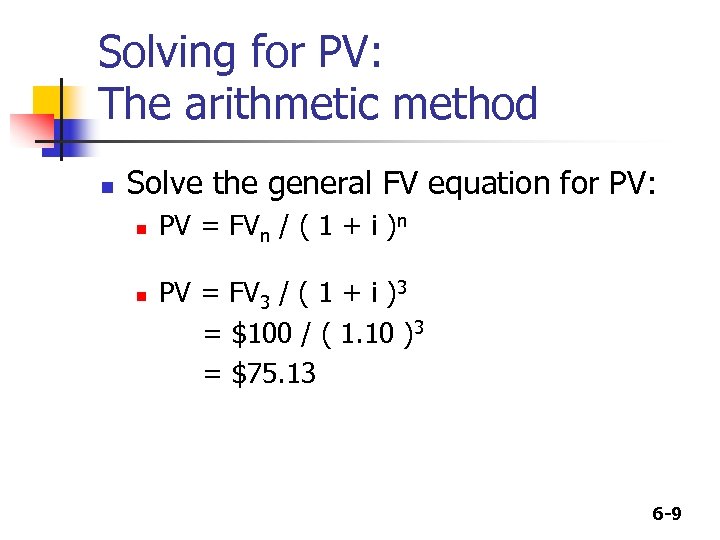 Solving for PV: The arithmetic method n Solve the general FV equation for PV: n n PV = FVn / ( 1 + i )n PV = FV 3 / ( 1 + i )3 = $100 / ( 1. 10 )3 = $75. 13 6 -9
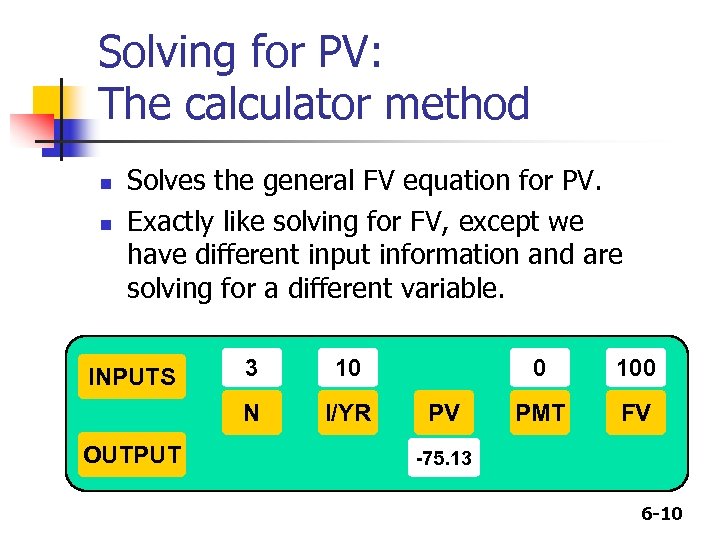 Solving for PV: The calculator method n n Solves the general FV equation for PV. Exactly like solving for FV, except we have different input information and are solving for a different variable. OUTPUT 3 10 N INPUTS I/YR 0 PV 100 PMT FV -75. 13 6 -10
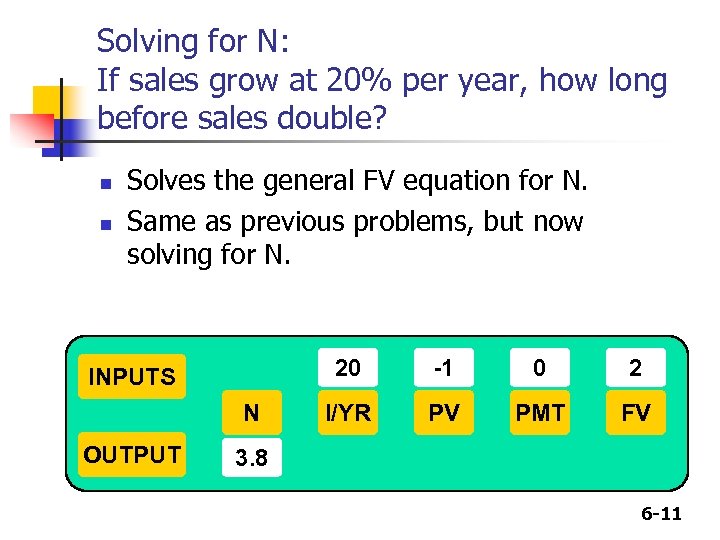 Solving for N: If sales grow at 20% per year, how long before sales double? n n Solves the general FV equation for N. Same as previous problems, but now solving for N. 20 INPUTS N OUTPUT -1 0 2 I/YR PV PMT FV 3. 8 6 -11
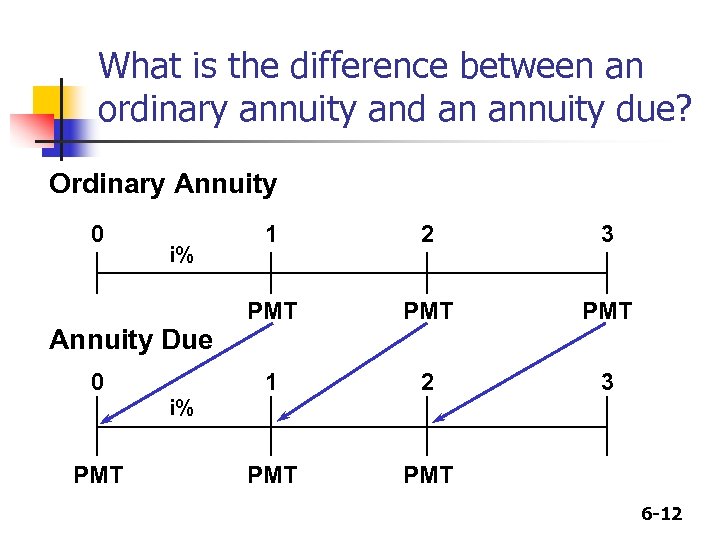 What is the difference between an ordinary annuity and an annuity due? Ordinary Annuity 0 i% Annuity Due 0 PMT i% 1 2 3 PMT PMT 1 2 3 PMT 6 -12
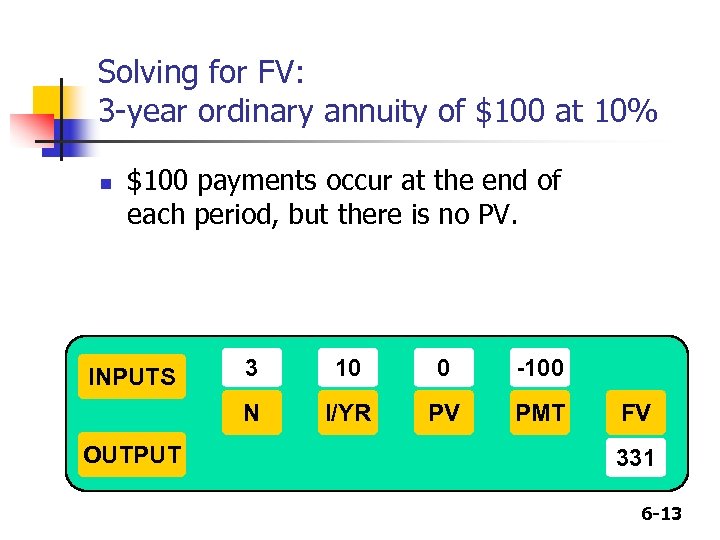 Solving for FV: 3 -year ordinary annuity of $100 at 10% n $100 payments occur at the end of each period, but there is no PV. OUTPUT 3 10 0 -100 N INPUTS I/YR PV PMT FV 331 6 -13
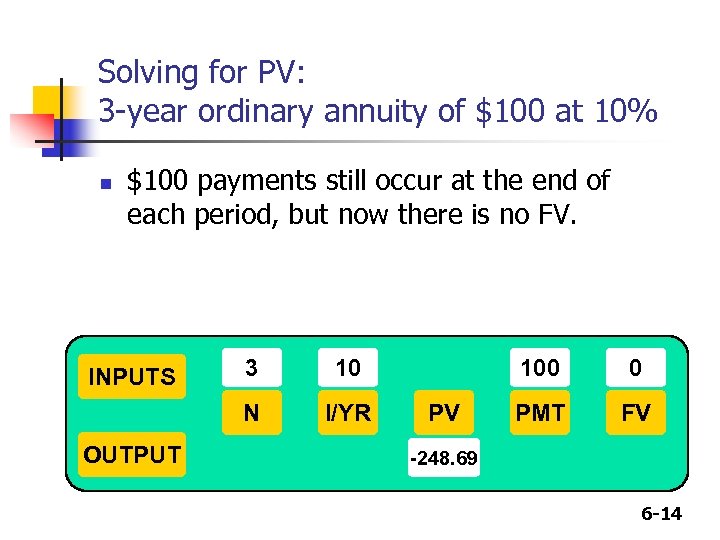 Solving for PV: 3 -year ordinary annuity of $100 at 10% n $100 payments still occur at the end of each period, but now there is no FV. OUTPUT 3 10 N INPUTS I/YR 100 PV 0 PMT FV -248. 69 6 -14
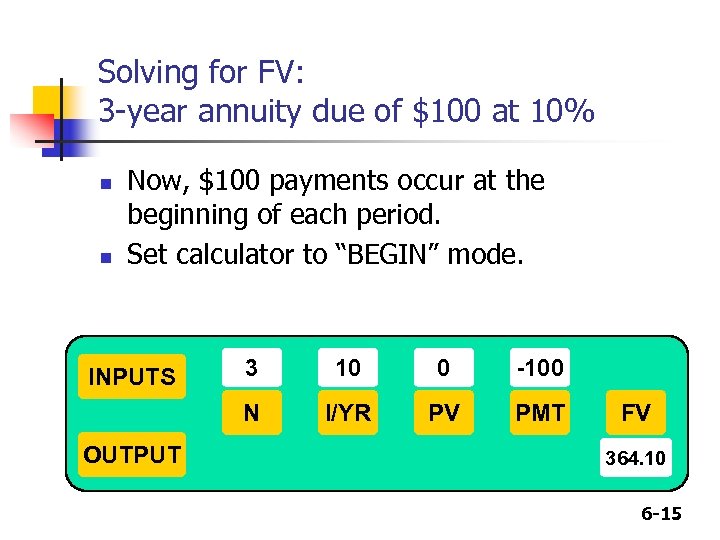 Solving for FV: 3 -year annuity due of $100 at 10% n n Now, $100 payments occur at the beginning of each period. Set calculator to “BEGIN” mode. OUTPUT 3 10 0 -100 N INPUTS I/YR PV PMT FV 364. 10 6 -15
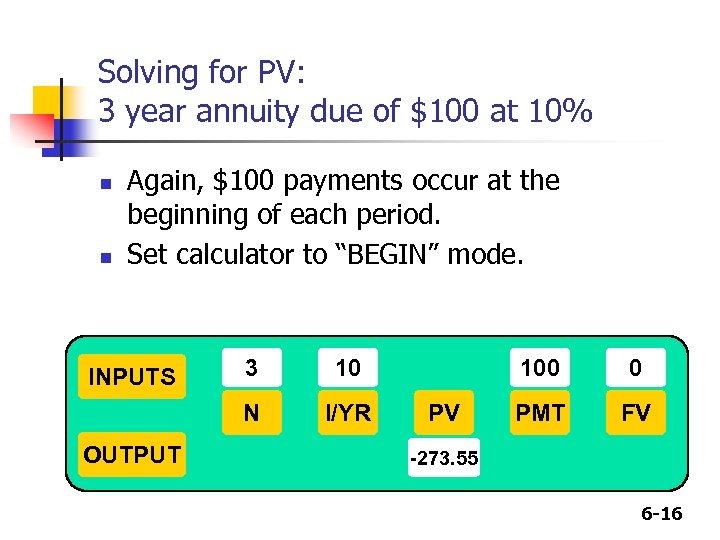 Solving for PV: 3 year annuity due of $100 at 10% n n Again, $100 payments occur at the beginning of each period. Set calculator to “BEGIN” mode. OUTPUT 3 10 N INPUTS I/YR 100 PV 0 PMT FV -273. 55 6 -16
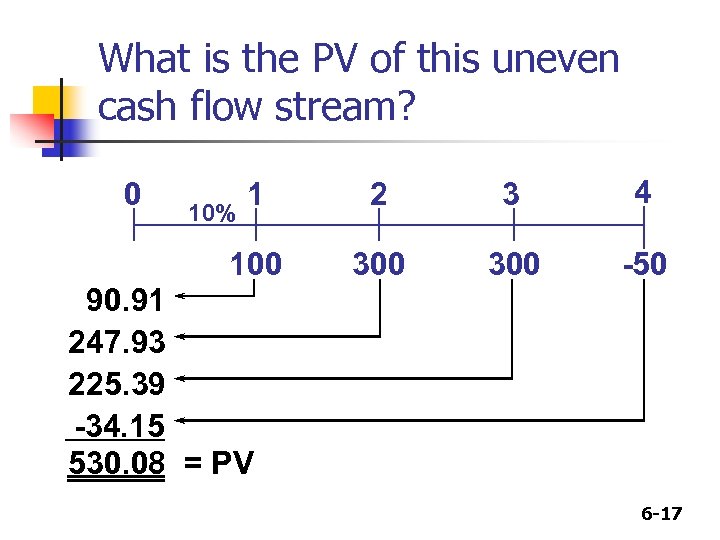 What is the PV of this uneven cash flow stream? 1 2 3 4 100 0 300 -50 10% 90. 91 247. 93 225. 39 -34. 15 530. 08 = PV 6 -17
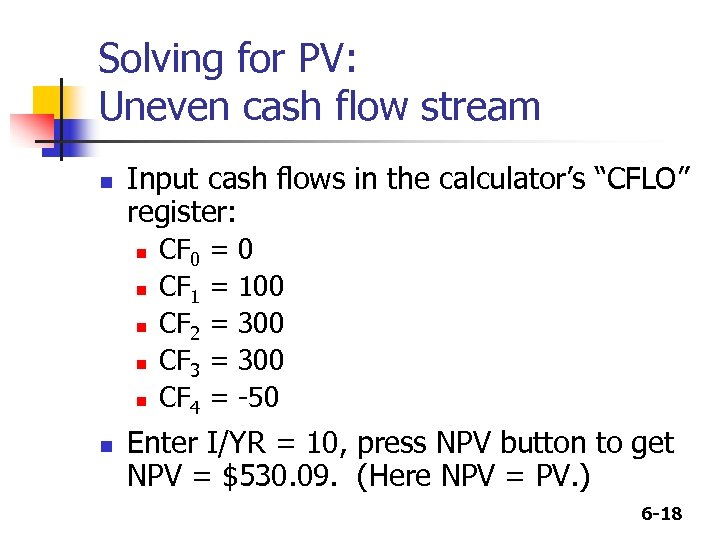 Solving for PV: Uneven cash flow stream n Input cash flows in the calculator’s “CFLO” register: n n n CF 0 CF 1 CF 2 CF 3 CF 4 = = = 0 100 300 -50 Enter I/YR = 10, press NPV button to get NPV = $530. 09. (Here NPV = PV. ) 6 -18
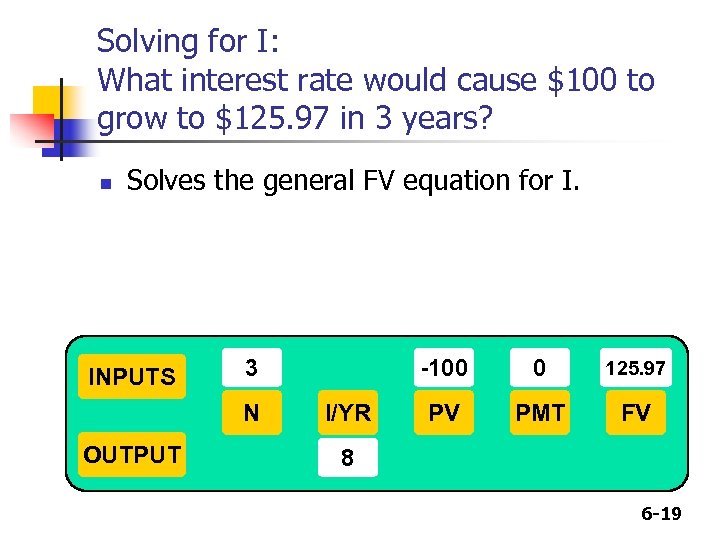 Solving for I: What interest rate would cause $100 to grow to $125. 97 in 3 years? n Solves the general FV equation for I. INPUTS 3 N OUTPUT -100 I/YR 0 125. 97 PV PMT FV 8 6 -19
 The Power of Compound Interest A 20 -year-old student wants to start saving for retirement. She plans to save $3 a day. Every day, she puts $3 in her drawer. At the end of the year, she invests the accumulated savings ($1, 095) in an online stock account. The stock account has an expected annual return of 12%. How much money will she have when she is 65 years old? 6 -20
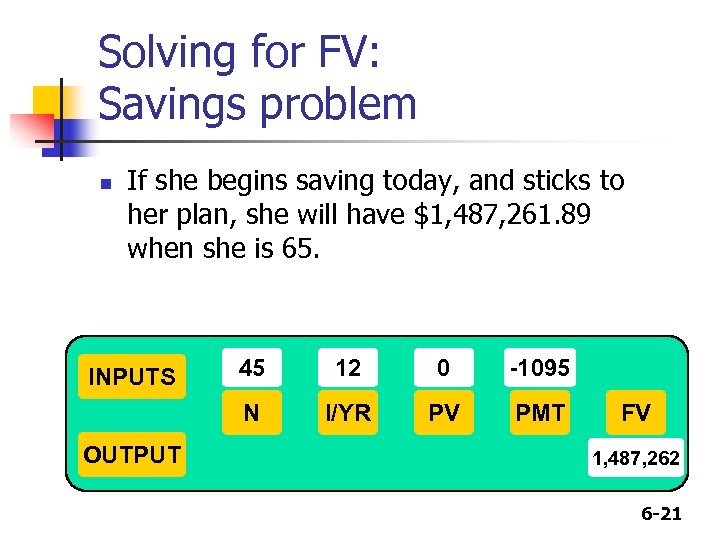 Solving for FV: Savings problem n If she begins saving today, and sticks to her plan, she will have $1, 487, 261. 89 when she is 65. OUTPUT 45 12 0 -1095 N INPUTS I/YR PV PMT FV 1, 487, 262 6 -21
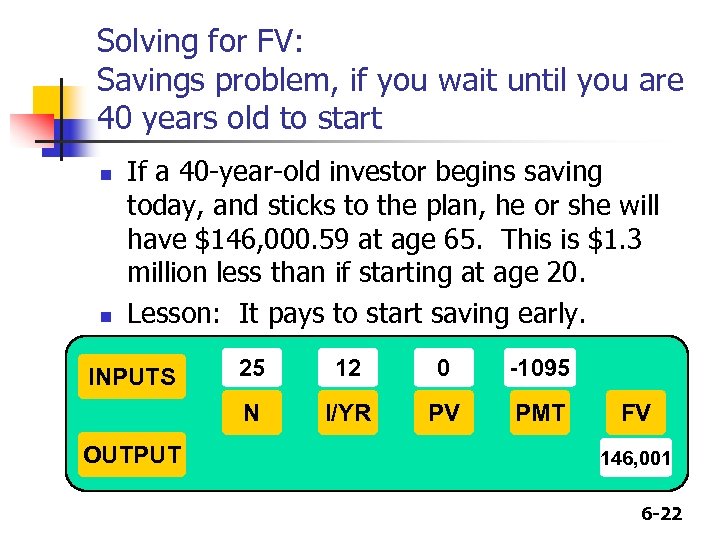 Solving for FV: Savings problem, if you wait until you are 40 years old to start n n If a 40 -year-old investor begins saving today, and sticks to the plan, he or she will have $146, 000. 59 at age 65. This is $1. 3 million less than if starting at age 20. Lesson: It pays to start saving early. OUTPUT 25 12 0 -1095 N INPUTS I/YR PV PMT FV 146, 001 6 -22
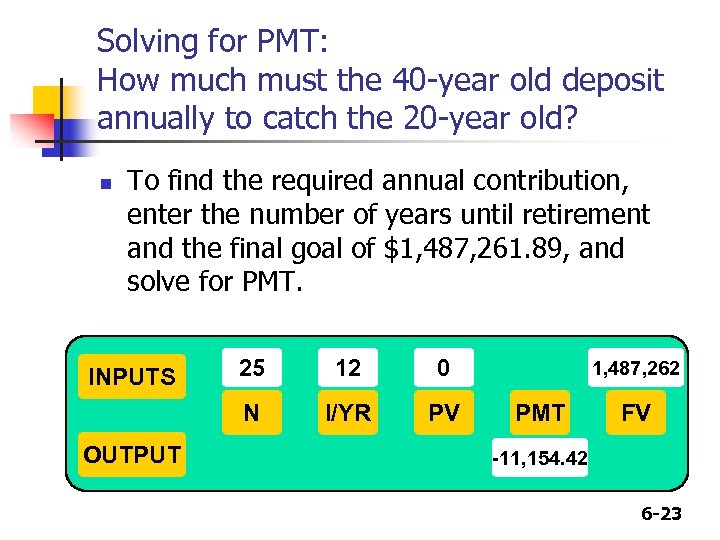 Solving for PMT: How much must the 40 -year old deposit annually to catch the 20 -year old? n To find the required annual contribution, enter the number of years until retirement and the final goal of $1, 487, 261. 89, and solve for PMT. OUTPUT 25 12 0 N INPUTS I/YR PV 1, 487, 262 PMT FV -11, 154. 42 6 -23
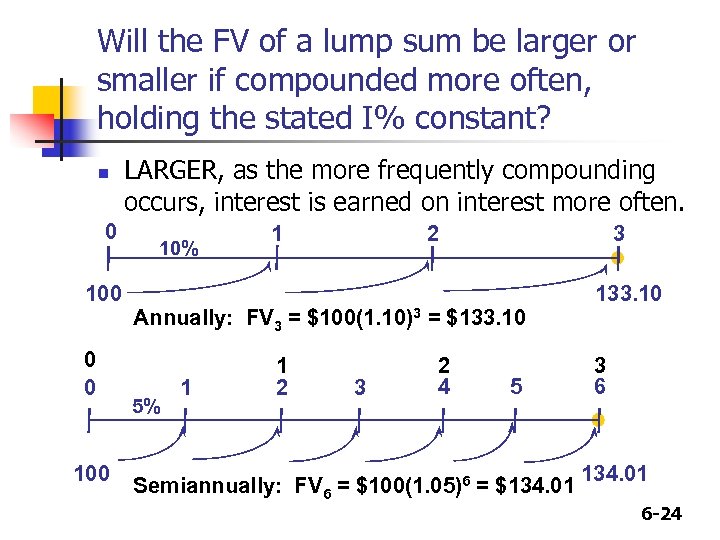 Will the FV of a lump sum be larger or smaller if compounded more often, holding the stated I% constant? n 0 100 0 0 100 LARGER, as the more frequently compounding occurs, interest is earned on interest more often. 10% 1 2 3 Annually: FV 3 = $100(1. 10)3 = $133. 10 5% 1 1 2 3 2 4 5 Semiannually: FV 6 = $100(1. 05)6 = $134. 01 133. 10 3 6 134. 01 6 -24
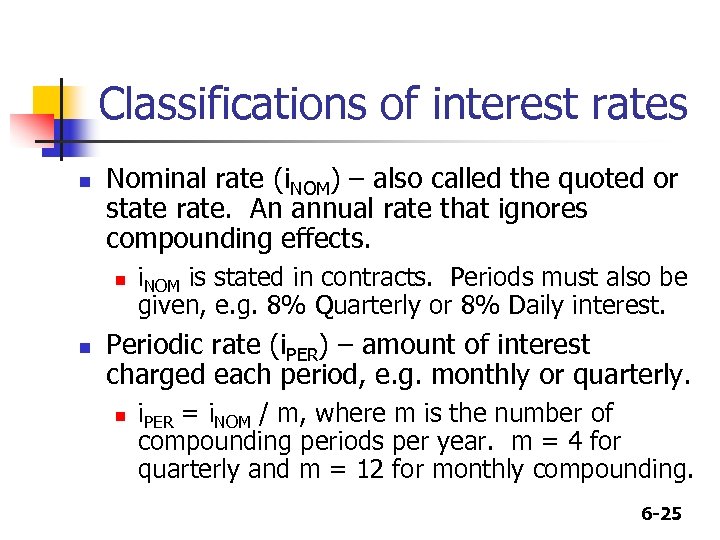 Classifications of interest rates n Nominal rate (i. NOM) – also called the quoted or state rate. An annual rate that ignores compounding effects. n n i. NOM is stated in contracts. Periods must also be given, e. g. 8% Quarterly or 8% Daily interest. Periodic rate (i. PER) – amount of interest charged each period, e. g. monthly or quarterly. n i. PER = i. NOM / m, where m is the number of compounding periods per year. m = 4 for quarterly and m = 12 for monthly compounding. 6 -25
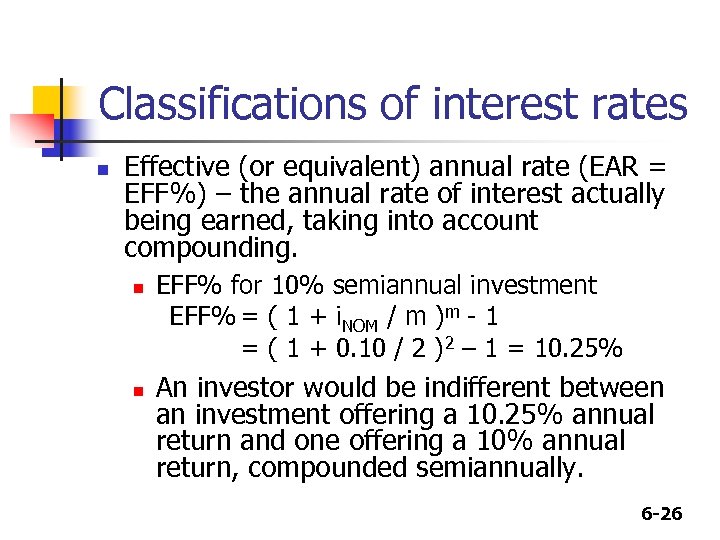 Classifications of interest rates n Effective (or equivalent) annual rate (EAR = EFF%) – the annual rate of interest actually being earned, taking into account compounding. n n EFF% for 10% semiannual investment EFF% = ( 1 + i. NOM / m )m - 1 = ( 1 + 0. 10 / 2 )2 – 1 = 10. 25% An investor would be indifferent between an investment offering a 10. 25% annual return and one offering a 10% annual return, compounded semiannually. 6 -26
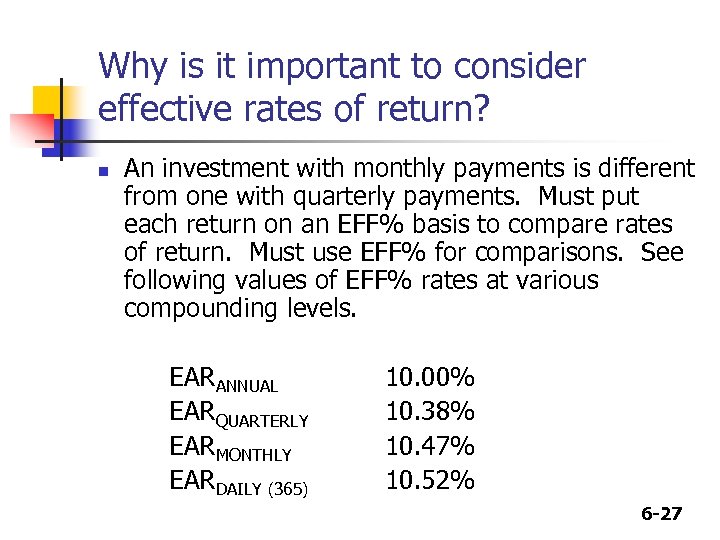 Why is it important to consider effective rates of return? n An investment with monthly payments is different from one with quarterly payments. Must put each return on an EFF% basis to compare rates of return. Must use EFF% for comparisons. See following values of EFF% rates at various compounding levels. EARANNUAL EARQUARTERLY EARMONTHLY EARDAILY (365) 10. 00% 10. 38% 10. 47% 10. 52% 6 -27
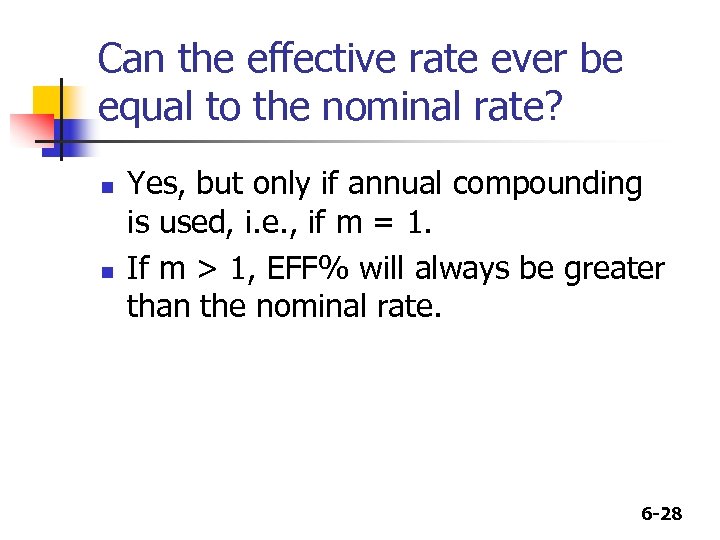 Can the effective rate ever be equal to the nominal rate? n n Yes, but only if annual compounding is used, i. e. , if m = 1. If m > 1, EFF% will always be greater than the nominal rate. 6 -28
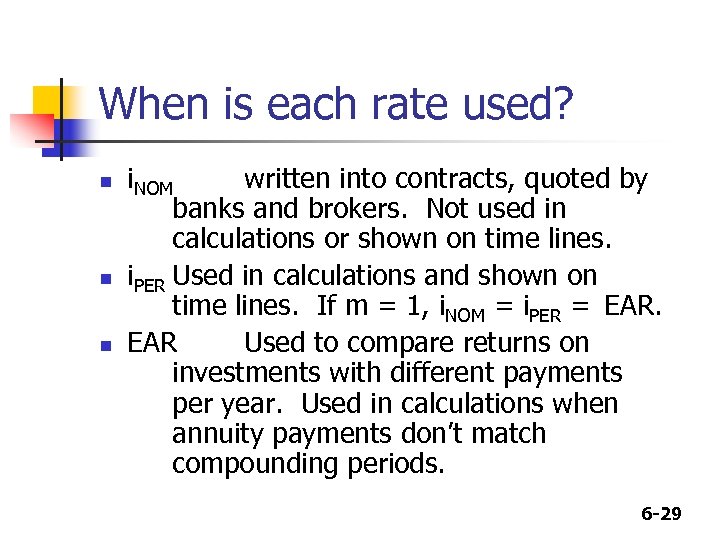 When is each rate used? n n n i. NOM written into contracts, quoted by banks and brokers. Not used in calculations or shown on time lines. i. PER Used in calculations and shown on time lines. If m = 1, i. NOM = i. PER = EAR Used to compare returns on investments with different payments per year. Used in calculations when annuity payments don’t match compounding periods. 6 -29
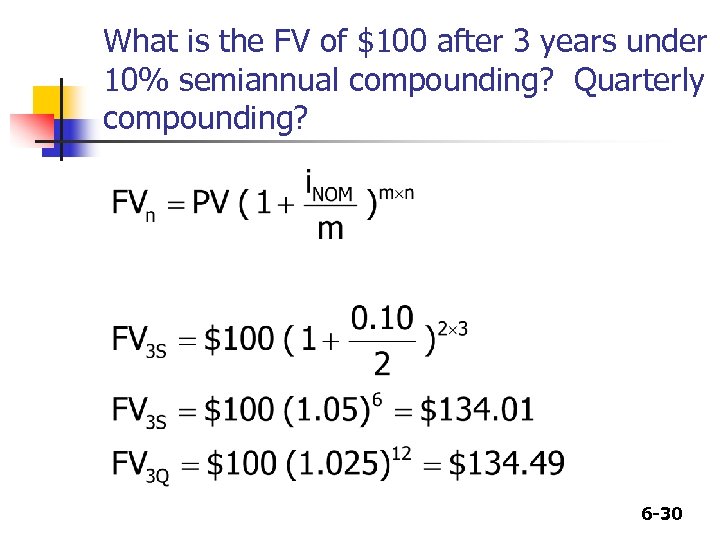 What is the FV of $100 after 3 years under 10% semiannual compounding? Quarterly compounding? 6 -30
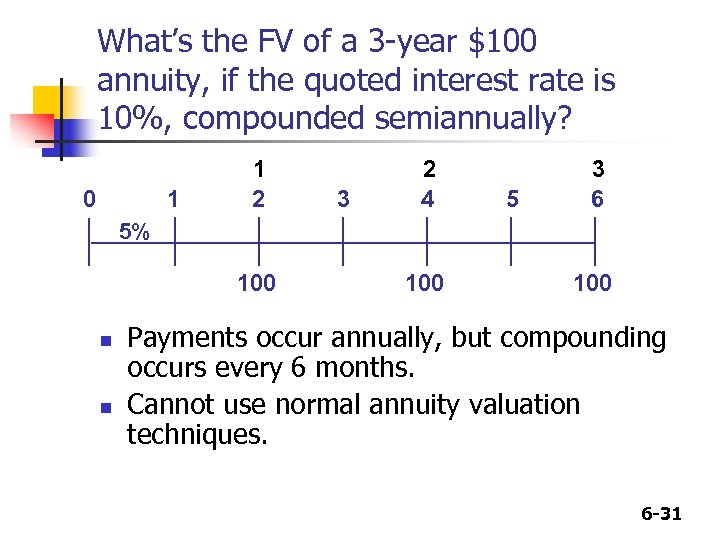 What’s the FV of a 3 -year $100 annuity, if the quoted interest rate is 10%, compounded semiannually? 0 1 1 2 3 2 4 5 3 6 5% 100 n n 100 Payments occur annually, but compounding occurs every 6 months. Cannot use normal annuity valuation techniques. 6 -31
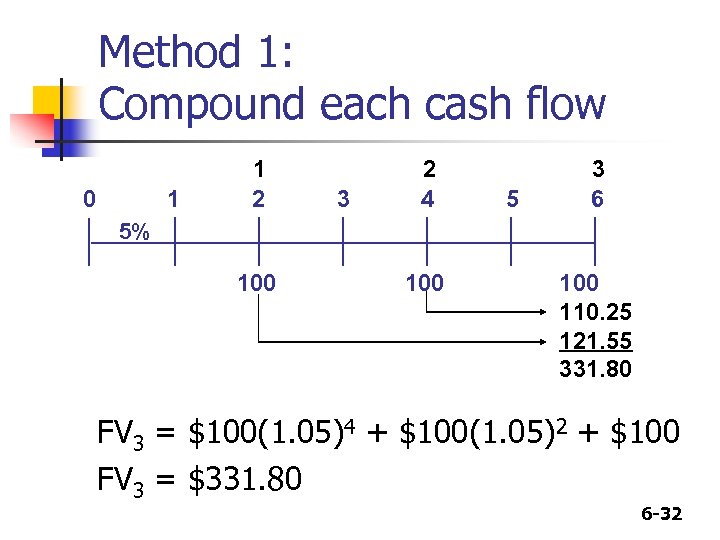 Method 1: Compound each cash flow 0 1 1 2 3 2 4 5 3 6 5% 100 100 110. 25 121. 55 331. 80 FV 3 = $100(1. 05)4 + $100(1. 05)2 + $100 FV 3 = $331. 80 6 -32
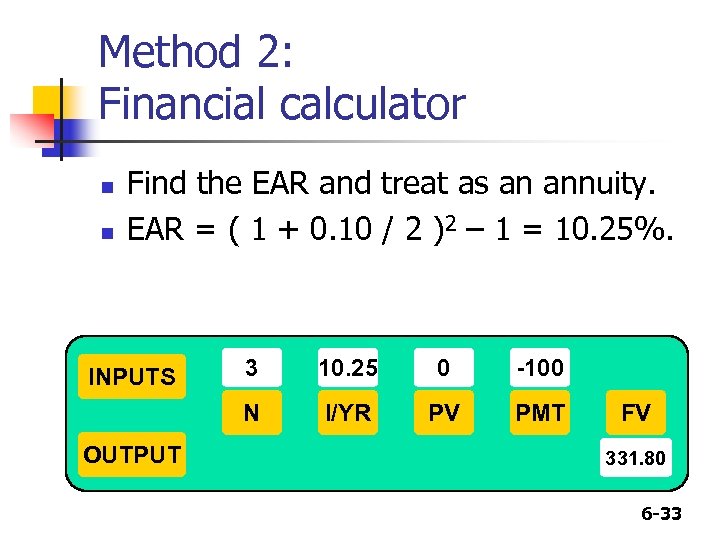 Method 2: Financial calculator n n Find the EAR and treat as an annuity. EAR = ( 1 + 0. 10 / 2 )2 – 1 = 10. 25%. OUTPUT 3 10. 25 0 -100 N INPUTS I/YR PV PMT FV 331. 80 6 -33
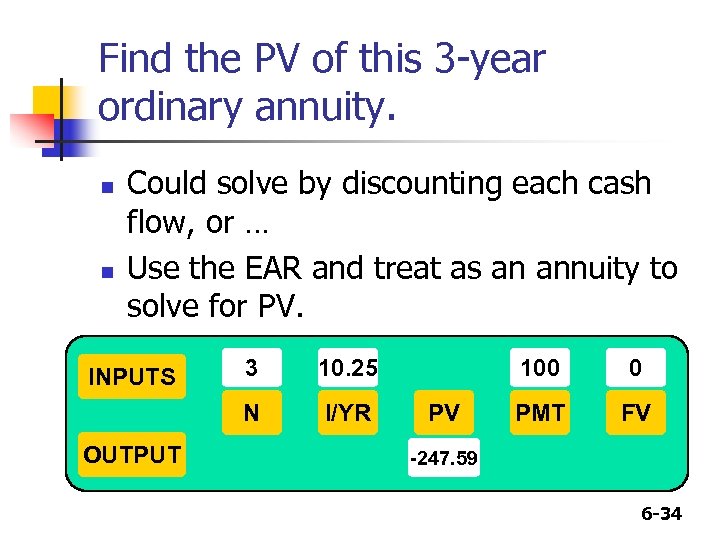 Find the PV of this 3 -year ordinary annuity. n n Could solve by discounting each cash flow, or … Use the EAR and treat as an annuity to solve for PV. OUTPUT 3 10. 25 N INPUTS I/YR 100 PV 0 PMT FV -247. 59 6 -34
 Loan amortization n Amortization tables are widely used for home mortgages, auto loans, business loans, retirement plans, etc. Financial calculators and spreadsheets are great for setting up amortization tables. EXAMPLE: Construct an amortization schedule for a $1, 000, 10% annual rate loan with 3 equal payments. 6 -35
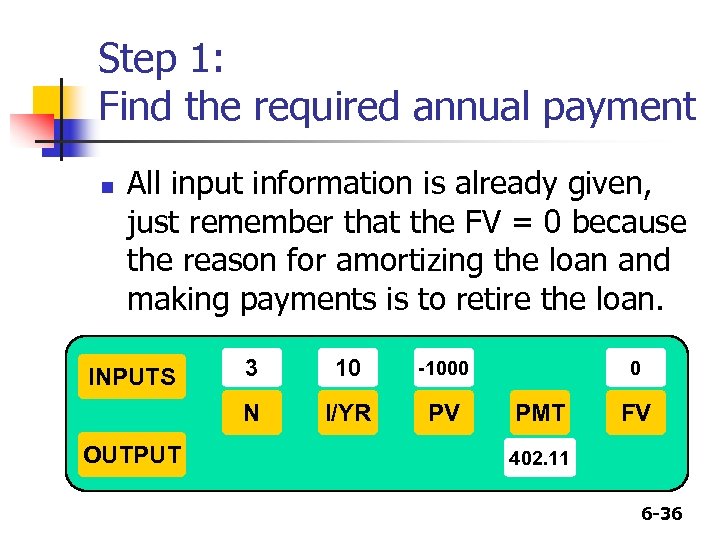 Step 1: Find the required annual payment n All input information is already given, just remember that the FV = 0 because the reason for amortizing the loan and making payments is to retire the loan. OUTPUT 3 10 -1000 N INPUTS I/YR PV 0 PMT FV 402. 11 6 -36
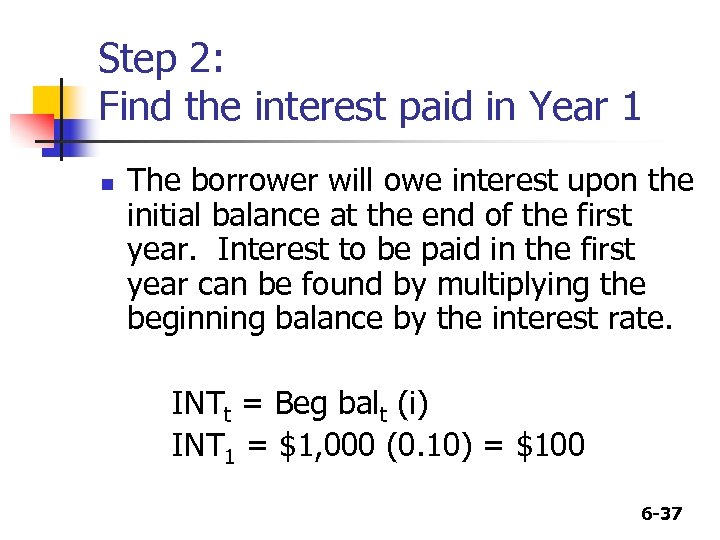 Step 2: Find the interest paid in Year 1 n The borrower will owe interest upon the initial balance at the end of the first year. Interest to be paid in the first year can be found by multiplying the beginning balance by the interest rate. INTt = Beg balt (i) INT 1 = $1, 000 (0. 10) = $100 6 -37
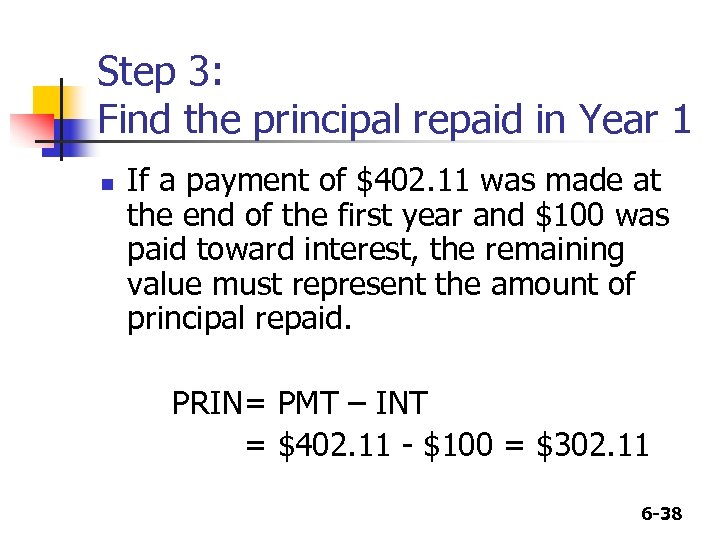 Step 3: Find the principal repaid in Year 1 n If a payment of $402. 11 was made at the end of the first year and $100 was paid toward interest, the remaining value must represent the amount of principal repaid. PRIN= PMT – INT = $402. 11 - $100 = $302. 11 6 -38
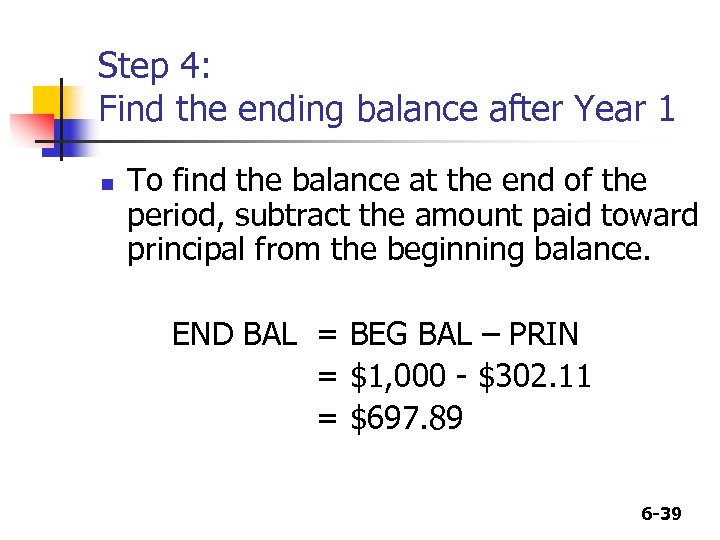 Step 4: Find the ending balance after Year 1 n To find the balance at the end of the period, subtract the amount paid toward principal from the beginning balance. END BAL = BEG BAL – PRIN = $1, 000 - $302. 11 = $697. 89 6 -39
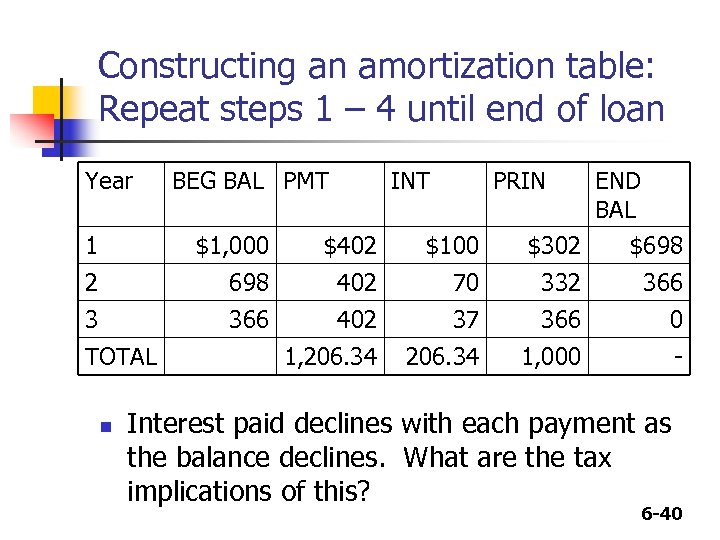 Constructing an amortization table: Repeat steps 1 – 4 until end of loan Year BEG BAL PMT INT PRIN END BAL 1 $1, 000 $402 $100 $302 $698 2 698 402 70 332 366 3 366 402 37 366 0 1, 206. 34 1, 000 - TOTAL n Interest paid declines with each payment as the balance declines. What are the tax implications of this? 6 -40
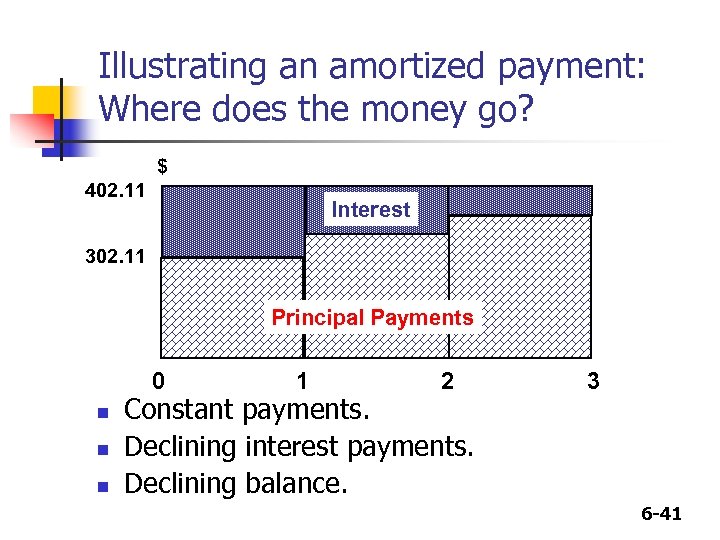 Illustrating an amortized payment: Where does the money go? $ 402. 11 Interest 302. 11 Principal Payments 0 n n n 1 2 Constant payments. Declining interest payments. Declining balance. 3 6 -41
 Partial amortization n n Bank agrees to lend a home buyer $220, 000 to buy a $250, 000 home, requiring a $30, 000 down payment. The home buyer only has $7, 500 in cash, so the seller agrees to take a note with the following terms: n n Face value = $22, 500 7. 5% nominal interest rate Payments made at the end of the year, based upon a 20 -year amortization schedule. Loan matures at the end of the 10 th year. 6 -42
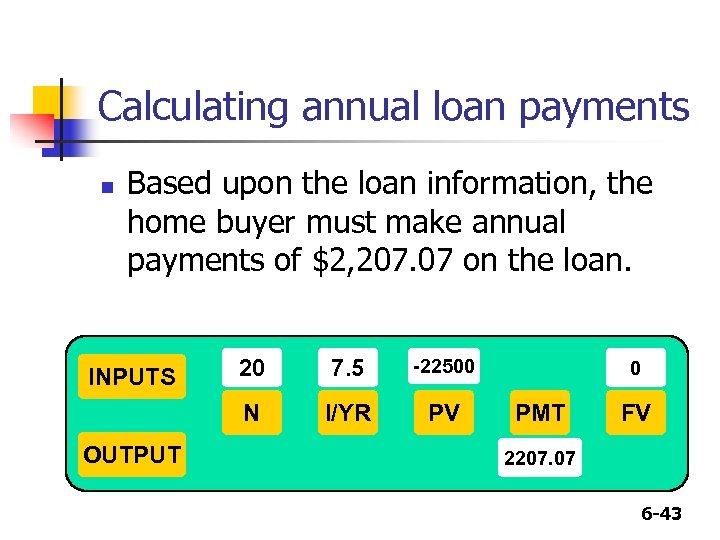 Calculating annual loan payments n Based upon the loan information, the home buyer must make annual payments of $2, 207. 07 on the loan. OUTPUT 20 7. 5 -22500 N INPUTS I/YR PV 0 PMT FV 2207. 07 6 -43
 Determining the balloon payment n n Using an amortization table (spreadsheet or calculator), it can be found that at the end of the 10 th year, the remaining balance on the loan will be $15, 149. 54. Therefore, n Balloon payment = $15, 149. 54 n Final payment = $17, 356. 61 6 -44