 Скачать презентацию Chapter 6 theory of Consumer behavior l Chapter
d077759c424527509e4a8475df114b12.ppt
- Количество слайдов: 45



Chapter 6 theory of Consumer behavior l Chapter 2 talks about market demand, but market is made of many individuals with different incomes, tastes, etc. l Individual consumer is assumed to be rational and wish to maximize his/her well-being. 1
In this chapter you will encounter: • Indifference curve • The marginal rate of substitution (MRS) • The concept of utility • The budget line • The equilibrium market basket • Deriving individual demand curve and market demand curve 2
6. 1 Consumer preferences and utility l Complete information l Preference ordering 3
The concept of utility Why people consumer? To satisfy their unlimited desire, to be satisfactory. Utility indicated the level of enjoyment or preference attached by this consumer to this market baskets. 4
The utility Function utility l Benefits consumers obtain from the goods and services they consume. 5
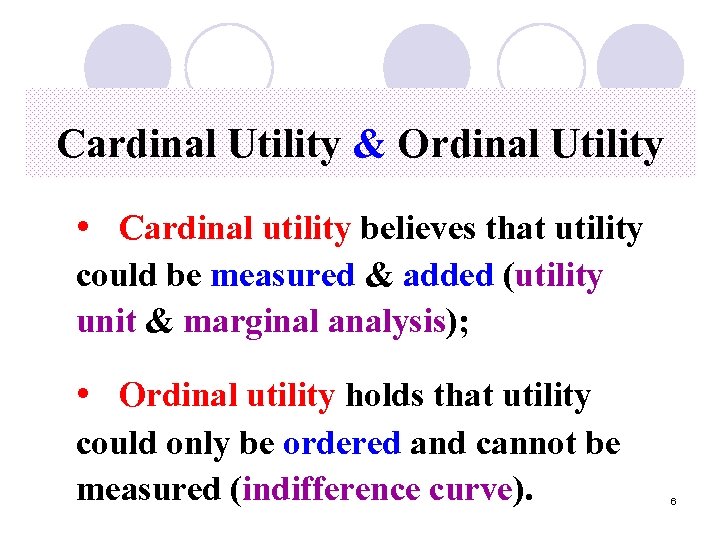
Cardinal Utility & Ordinal Utility • Cardinal utility believes that utility could be measured & added (utility unit & marginal analysis); • Ordinal utility holds that utility could only be ordered and cannot be measured (indifference curve). 6
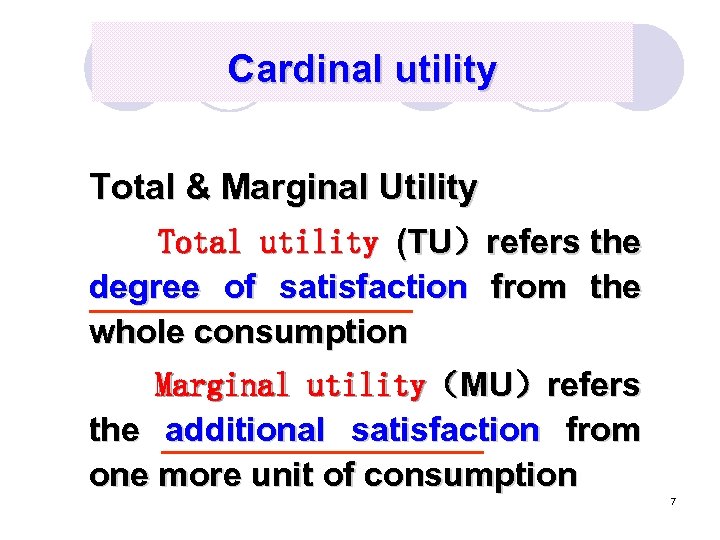
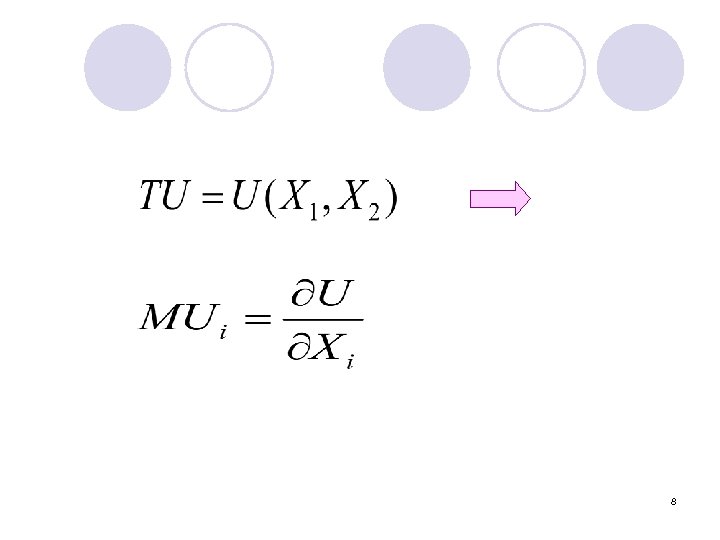
Cardinal utility Total & Marginal Utility Total utility (TU)refers the degree of satisfaction from the whole consumption Marginal utility(MU)refers the additional satisfaction from one more unit of consumption 7
8
Law of Diminishing Utility l As more of a product is consumed, the degree of satisfaction consumers get from every additional unit is decreasing. l Marginal utility (MU) is decreasing. l The law of diminishing utility. 9
Ordinal utility • Ordinal utility holds that utility cannot be measured but can be ordered according to consumers’ preferences. • Different product combinations may be viewed as having same utility, • And these combinations of same utility consist of one Indifference Curve (IC). 10
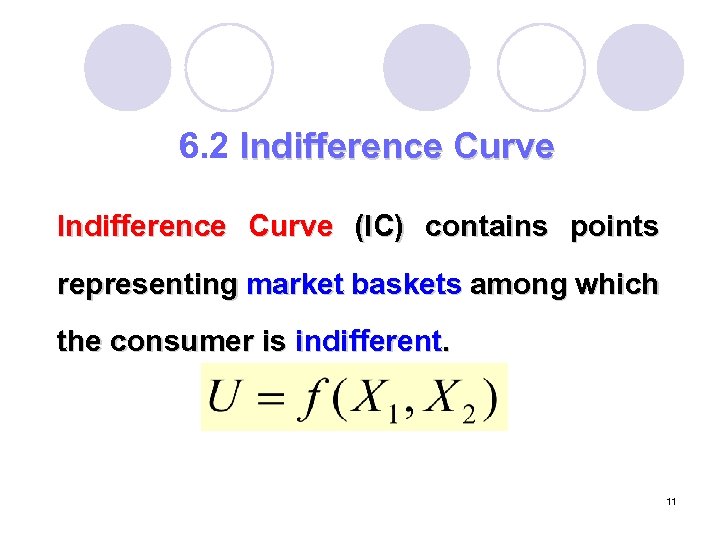
6. 2 Indifference Curve (IC) contains points representing market baskets among which the consumer is indifferent. 11
l indifference curve A locus of points representing different bundles of goods and services, each of which yields the same level of total utility. 12
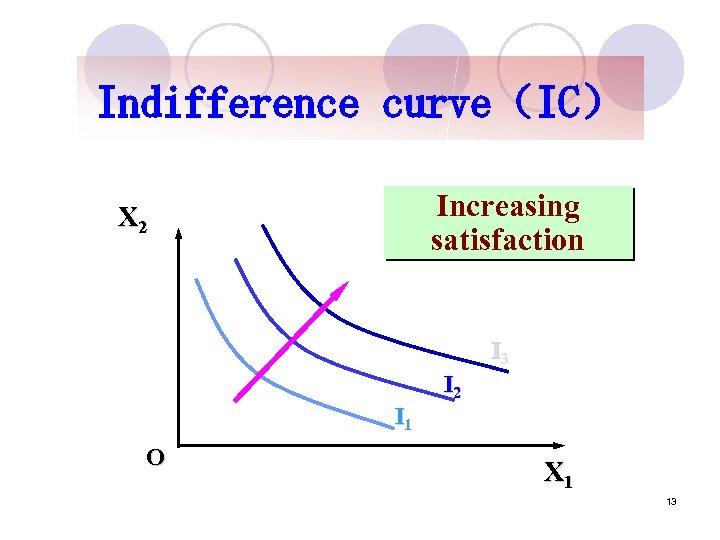
Indifference curve(IC) Increasing satisfaction X 2 I 3 I 2 I 1 O X 1 13
The important things of IC 1. IC is convex to the origin. 2. Every indifference curve must (? ) slope downward and to the right; 3. Indifference curves cannot intersect. 4. 14
Another important but not mentioned thing about IC: A consumer has many indifference curves; How do you understand this attribute? 15
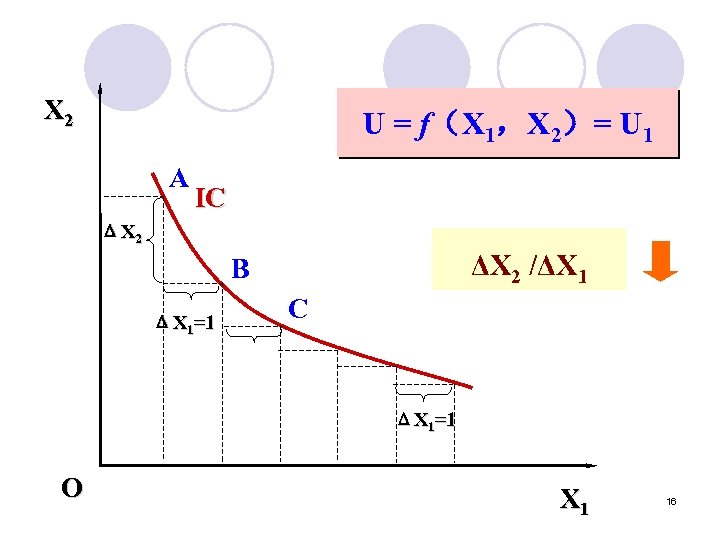
X 2 U = f(X 1,X 2)= U 1 A IC ΔX 2 /ΔX 1 B ΔX 1=1 C ΔX 1=1 O X 1 16
Marginal Rate of Substitution (MRS) MRS is defined as the number of units of good Y that must be given up if consumer is to receive an extra unit of good X and to maintain a constant level of 17
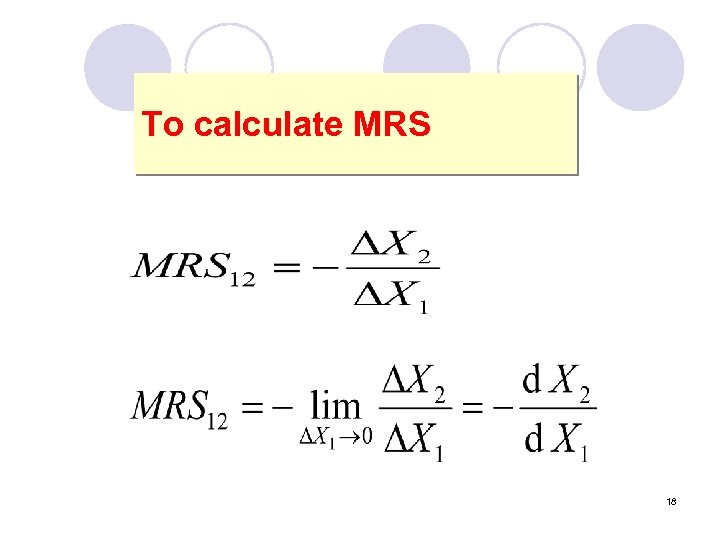
To calculate MRS 18
• Not all indifference curves must slope downward. • Can you name some other cases? • What will the IC of substitutes & complements? 19
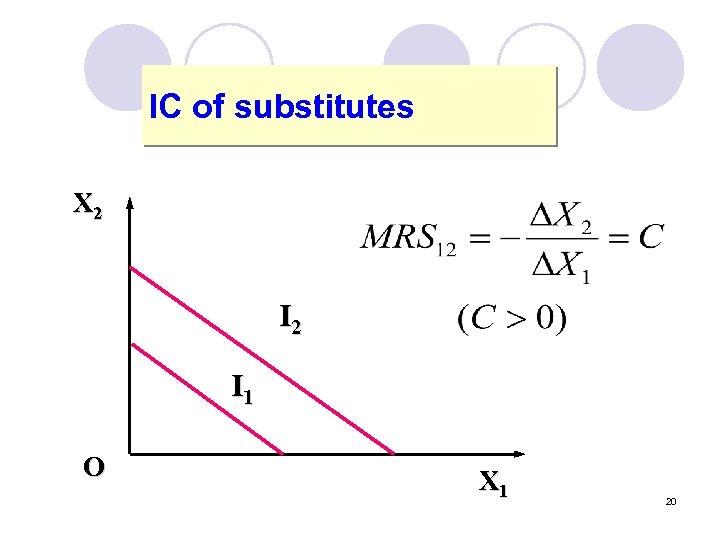
IC of substitutes X 2 I 1 O X 1 20
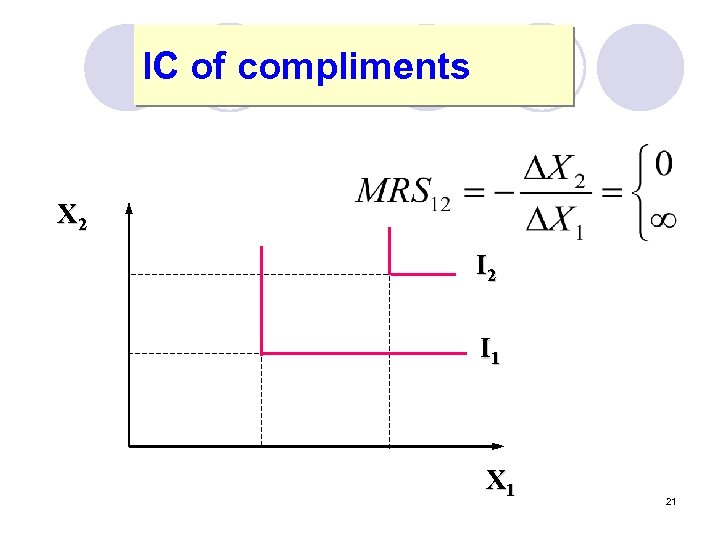
IC of compliments X 2 I 1 X 1 21
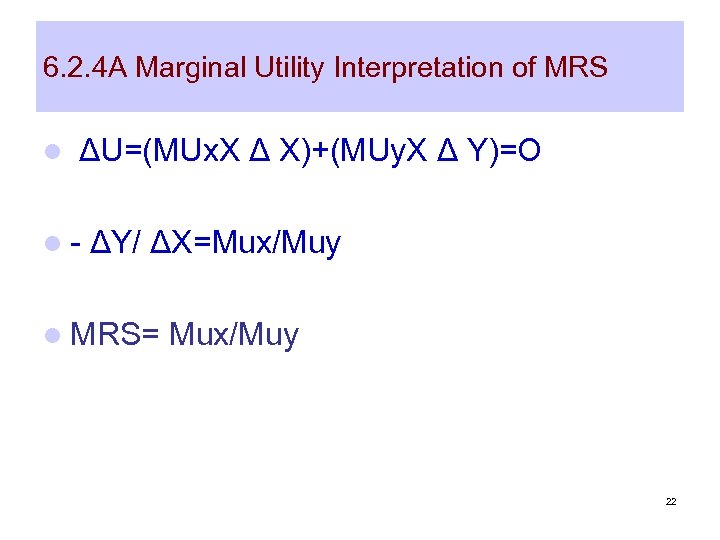
6. 2. 4 A Marginal Utility Interpretation of MRS l ΔU=(MUx. X Δ X)+(MUy. X Δ Y)=O l- ΔY/ ΔX=Mux/Muy l MRS= Mux/Muy 22
The budget line • Consumers want to be most satisfactory, but to be constrained by their income (budget). • Budget refers to various possible combinations of products that consumers can buy when their income & products’ prices are set. 23
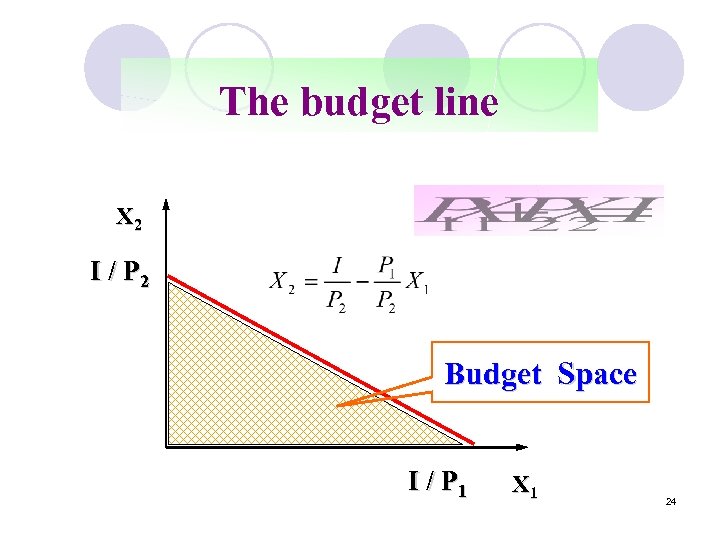
The budget line X 2 I / P 2 Budget Space I / P 1 X 1 24
Variation of budget line Discuss P 1& P 2 hold constant while I changes; l I holds constant while P 1&P 2 change proportionately; l I holds constant while P 1 or P 2 changes; l I, P 1&P 2 increase or decrease l 25
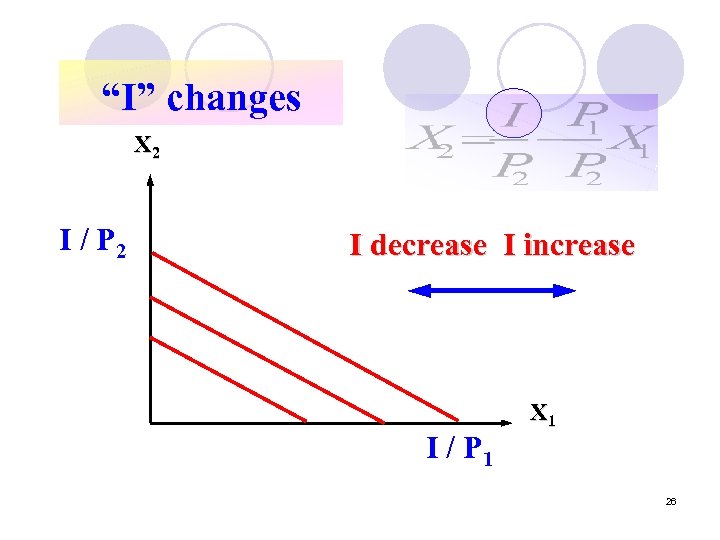
“I” changes X 2 I / P 2 I decrease I increase I / P 1 X 1 26
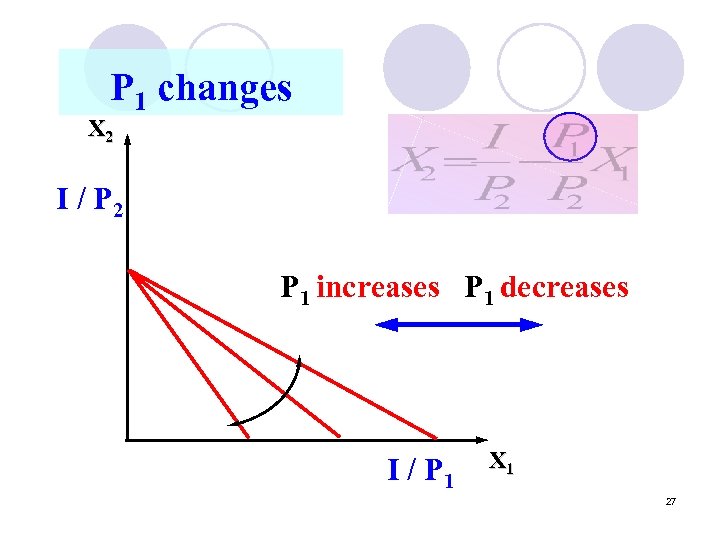
P 1 changes X 2 I / P 2 P 1 increases P 1 decreases I / P 1 X 1 27
Question What if P 2 changes ? And I, P 1 & P 2 change? 28
The Equilibrium of Market Basket • Consumers want to be most satisfactory; • But they are constrained by their income (budget). • Consumers (rational) want to maximize their utility with limited income. 29
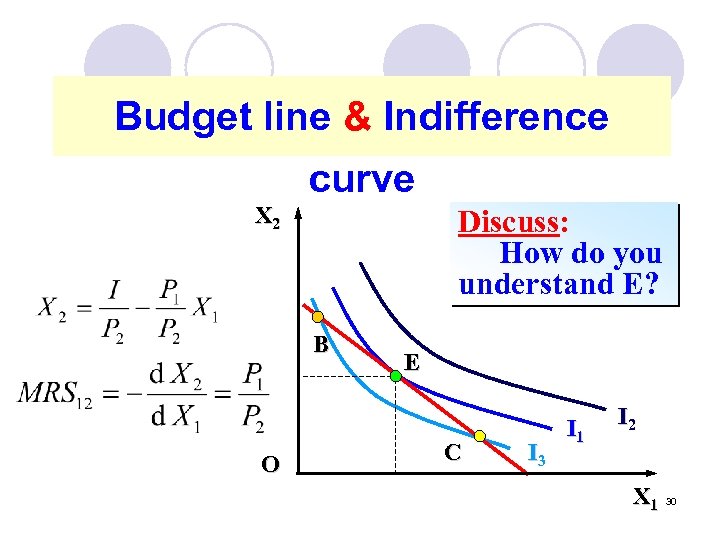
Budget line & Indifference curve X 2 Discuss: How do you understand E? B O E C I 3 I 1 I 2 X 1 30
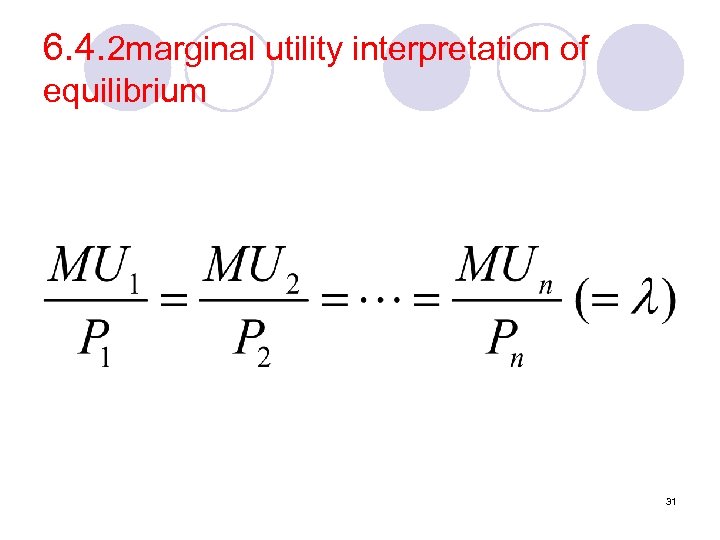
6. 4. 2 marginal utility interpretation of equilibrium 31
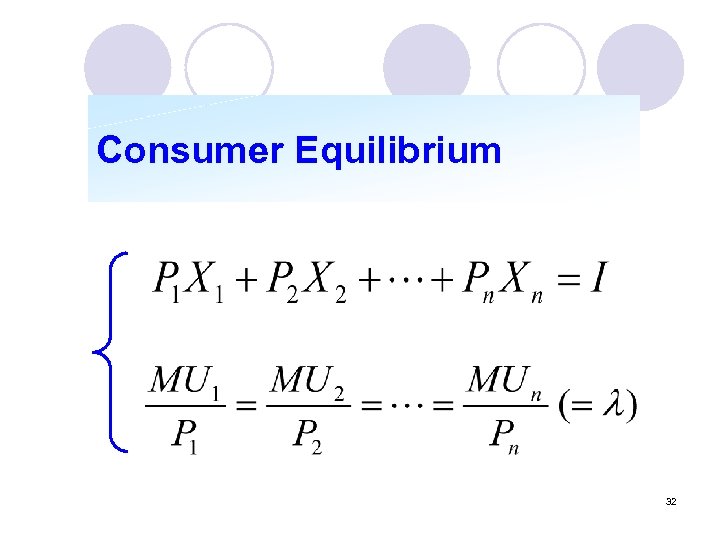
Consumer Equilibrium 32
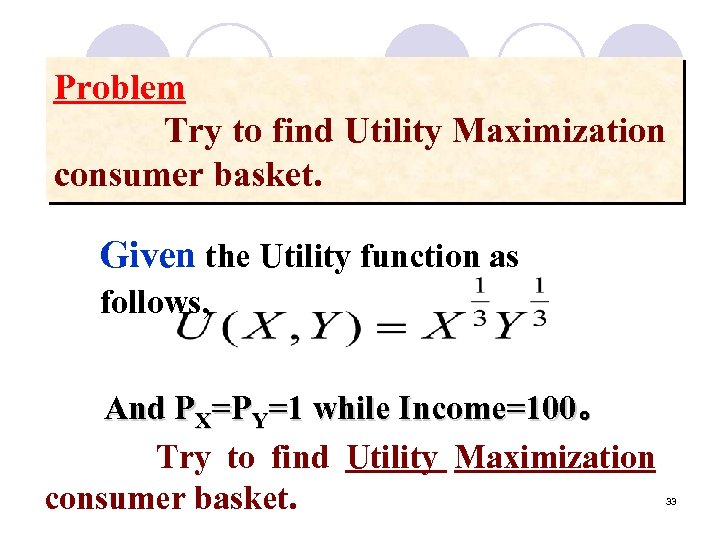
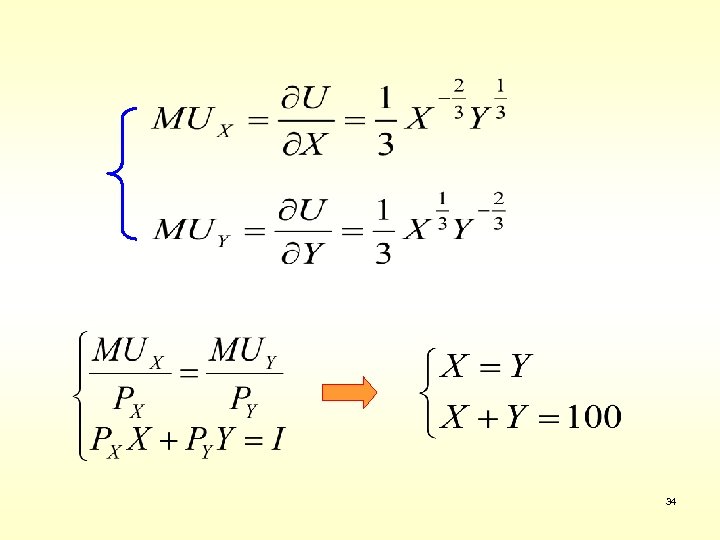
Problem Try to find Utility Maximization consumer basket. Given the Utility function as follows, And PX=PY=1 while Income=100。 Try to find Utility Maximization consumer basket. 33
34
Concluding remarks • Consumer basket is determined by both prices of product & his / her income. • What if only prices change? • What if only income changes? 35
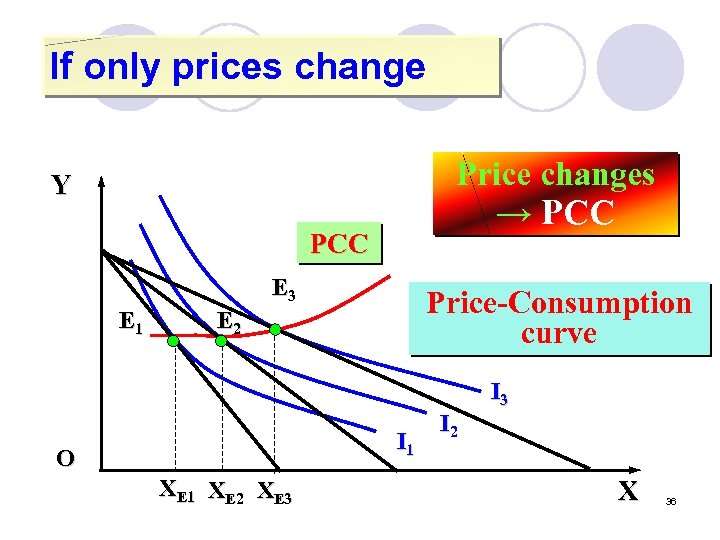
If only prices change Price changes Y → PCC E 3 E 1 Price-Consumption curve E 2 I 3 I 1 O XE 1 XE 2 XE 3 I 2 X 36
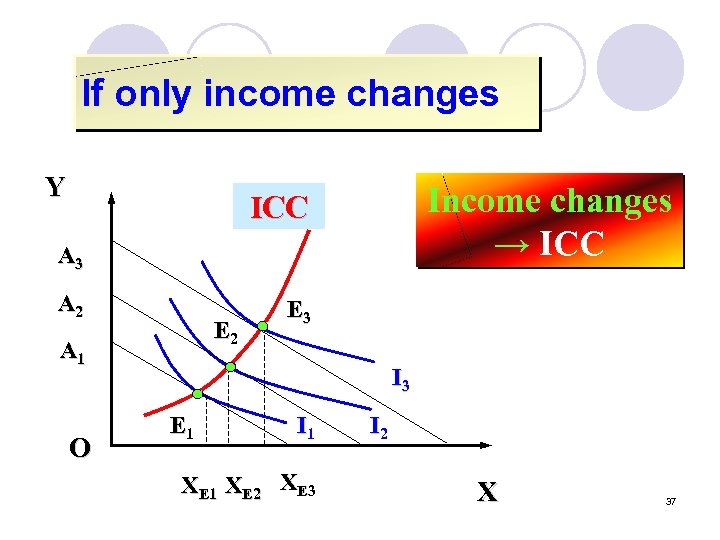
If only income changes Y Income changes → ICC A 3 A 2 E 2 A 1 O E 3 I 3 E 1 I 1 XE 2 XE 3 I 2 X 37
Deriving individual demand curve A consumer’s demand curve shows how much he or her will purchase of the goods in question at various prices of this good (when other prices and the consumer’s income are 38
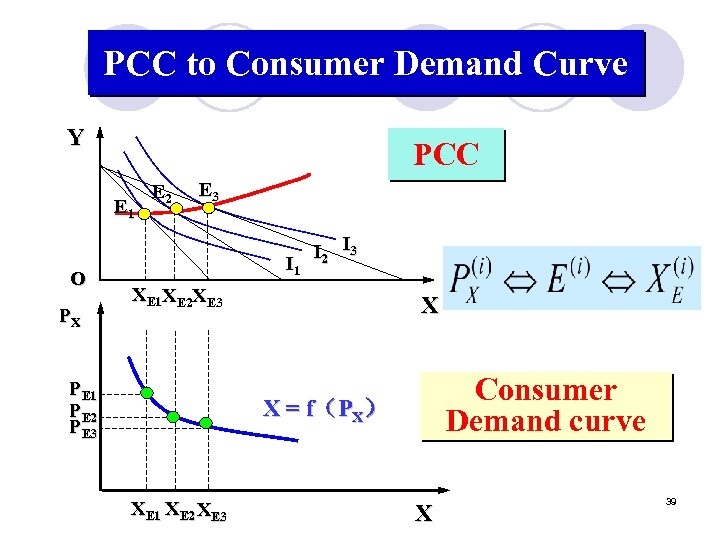
PCC to Consumer Demand Curve Y PCC E 1 O PX E 2 E 3 I 1 I 2 I 3 XE 1 XE 2 XE 3 PE 1 PE 2 PE 3 X Consumer Demand curve X = f(PX) XE 1 XE 2 XE 3 X 39
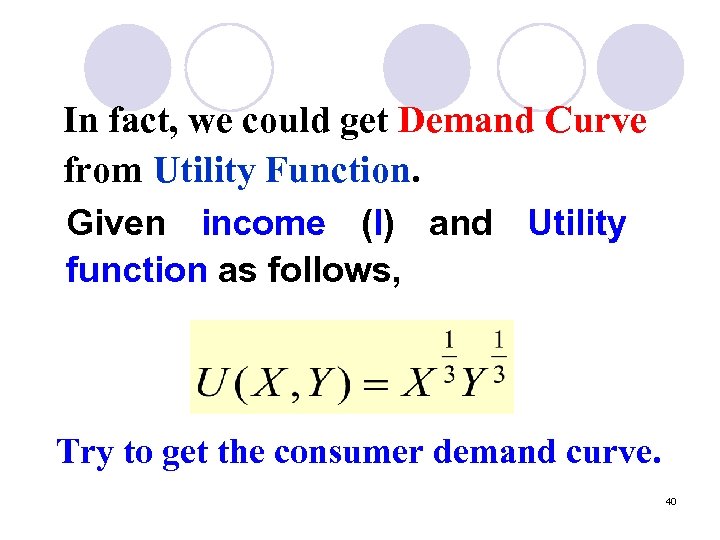
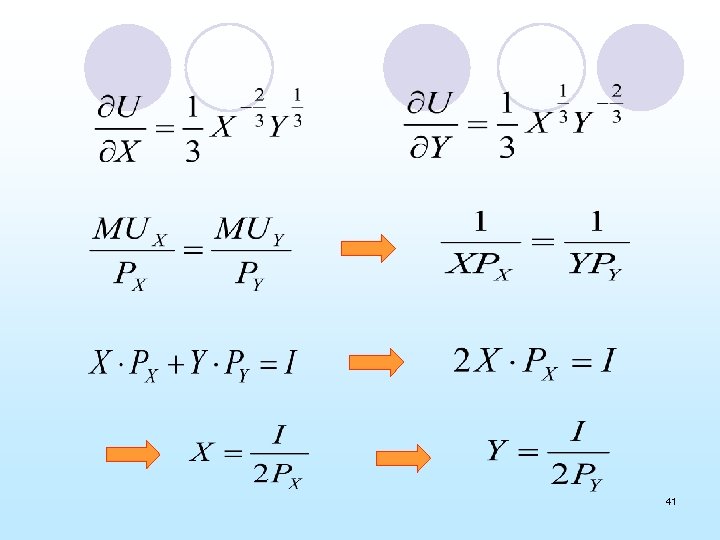
In fact, we could get Demand Curve from Utility Function. Given income (I) and Utility function as follows, Try to get the consumer demand curve. 40
41
To get market demand curve Summing individual consumer demand curve horizontally we get the market demand curve. 42
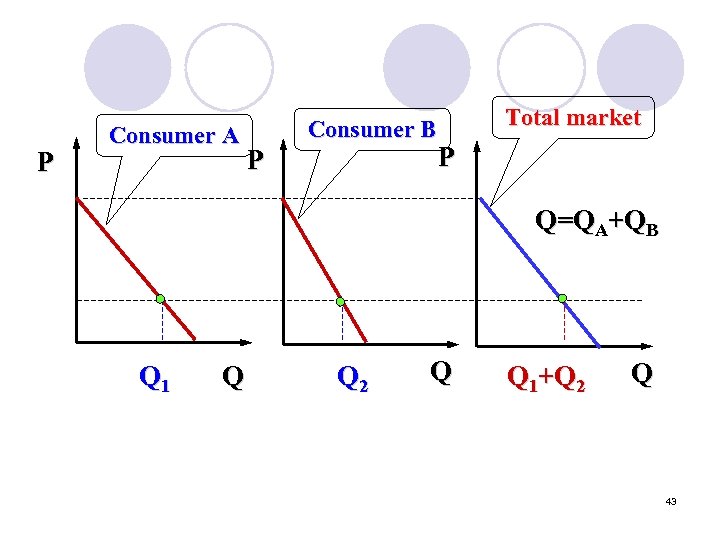
P Consumer A Consumer B P Total market P Q=QA+QB Q 1 Q Q 2 Q Q 1+Q 2 Q 43
The law of demand There is an inverse relationship between the price of a good and the quantity demanded assuming all other factors that might influence demand are held constant. 44
Consumer surplus Consumer Surplus (proposed by Marshell) is the excess of the price which a person would be willing to pay rather than go without the good over that which he actually does pay. 45
Скачать презентацию Chapter 6 theory of Consumer behavior l Chapter
d077759c424527509e4a8475df114b12.ppt