


 Скачать презентацию CHAPTER 6 THE STRUCTURE OF INTEREST RATES
4a2ce137839b9d08b9b332440e19ca90.ppt
- Количество слайдов: 26
 CHAPTER 6 THE STRUCTURE OF INTEREST RATES
 Interest Rate Changes & Differences Between Interest Rates Can Be Explained by Several Variables Term to Maturity. Default Risk. Tax Treatment. Marketability. Call or Put Features. Convertibility. 2
 Term (Maturity) Structure of Interest Rates May be studied visually by plotting a yield curve at a point in time. The yield curve may be ascending, flat, or descending. Several theories explain the shape of the yield curve. 3
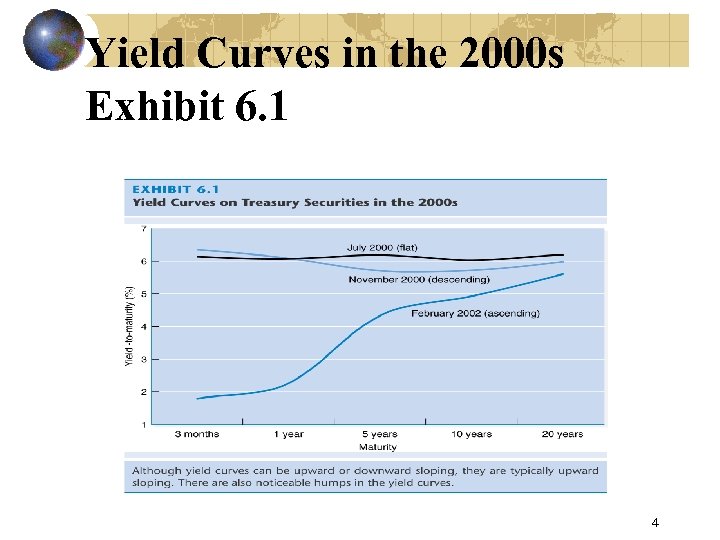 Yield Curves in the 2000 s Exhibit 6. 1 4
 The Expectations Theory of the Term Structure The slope of the yield curve reflects investors’ expectations about future interest rates. Ascending: future interest rates are expected to increase. Descending: future interest rates are expected to decrease. Long-term interest rates represent the geometric average of current and expected future interest rates. 5
 The Expectations Theory of Term Structure Investors are assumed to trade in a very efficient market with excellent information and minimal trading costs. Other theories discussed later presume less efficient markets. 6
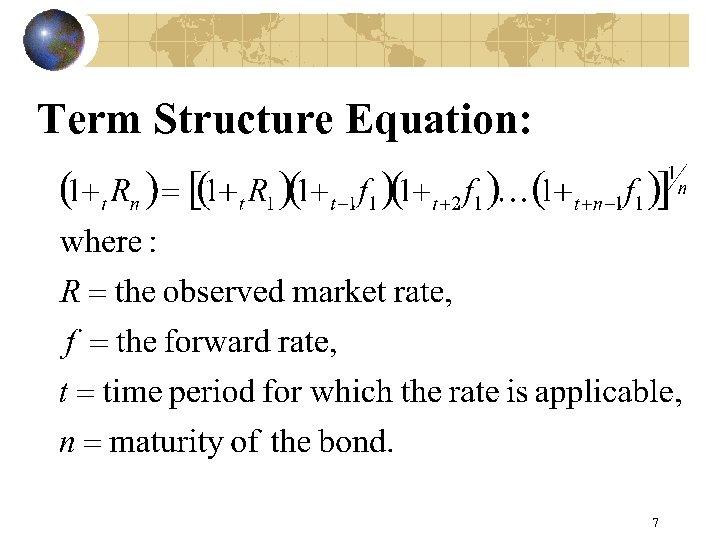 Term Structure Equation: 7
 Liquidity Premium Theory Long-term securities have greater risk and investors require greater premiums to give up liquidity. Long-term securities have greater price variability. Long-term securities have less marketability. The liquidity premium explains an upward sloping yield curve. 8
 Market Segmentation Theory Maturity preferences by investors may affect security prices (yields), explaining variations in yields by time Market participants have strong preferences for securities of particular maturity and buy and sell securities consistent with their maturity preferences. If market participants do not trade outside their maturity preferences, then discontinuities are possible in the yield curve. 9
 Preferred Habitat Theory The Preferred Habitat Theory is an extension of the Market Segmentation Theory. The Preferred Habitat Theory allows market participants to trade outside of their preferred maturity if adequately compensated for the additional risk. The Preferred Habitat Theory allows for humps or twists in the yield curve, but limits the discontinuities possible under Segmentation Theory. 10
 Which Theory is Right? Day-to-day changes in the term structure are most consistent with the Preferred Habitat Theory. However, in the long-run, expectations of future interest rates and liquidity premiums are important components of the position and shape of the yield curve. 11
 Yield Curves and the Business Cycle Interest rates are directly related to the level of economic activity. An ascending yield curve notes the market expectations of economic expansion and/or inflation. A descending yield curve forecasts lower rates possibly related to slower economic growth or lower inflation rates. Security markets respond to updated new information and expectations and reflect their reactions in security prices and yields. 12
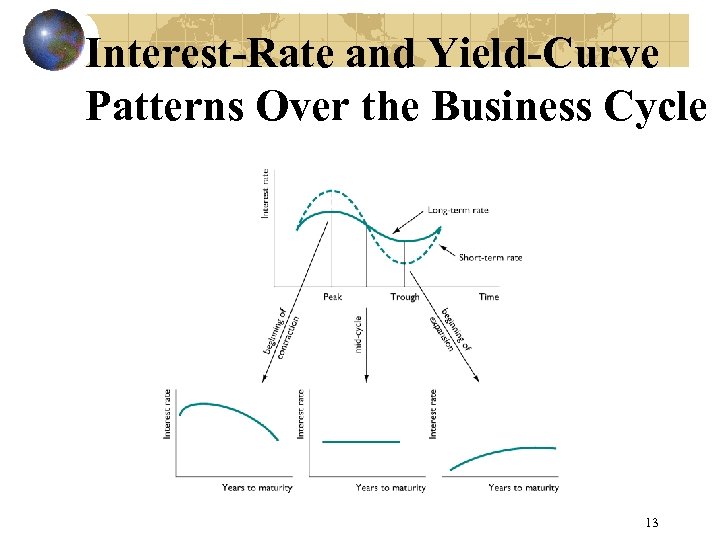 Interest-Rate and Yield-Curve Patterns Over the Business Cycle 13
 Default Risk is the Probability of the Borrowers not Honoring the Security Contract Losses may range from “interest a few days late” to a complete loss of principal. Risk averse investors want adequate compensation for expected default losses. 14
 Default Risk, cont. Investors charge a default risk premium (above riskless or less risky securities) for added risk assumed DRP = i - irf The default risk premium (DRP) is the difference between the promised or nominal rate and the yield on a comparable (same term) riskless security (Treasury security). Investors are satisfied if the default risk premium is equal to the expected default loss. 15
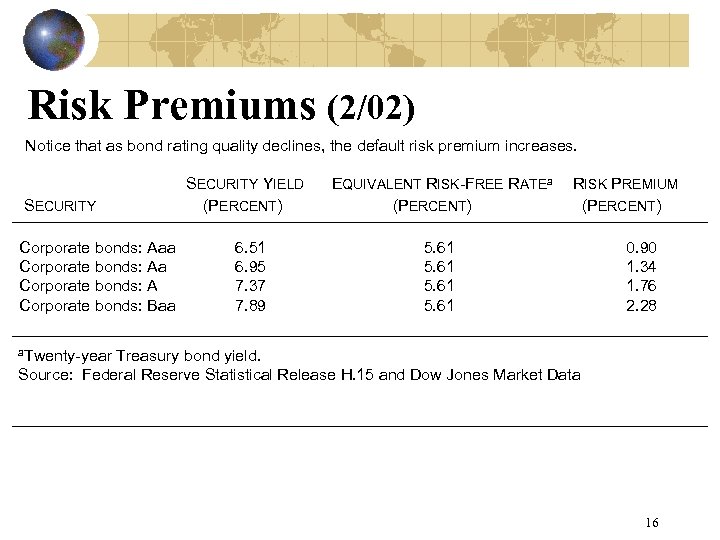 Risk Premiums (2/02) Notice that as bond rating quality declines, the default risk premium increases. SECURITY Corporate bonds: Aaa Corporate bonds: A Corporate bonds: Baa SECURITY YIELD (PERCENT) 6. 51 6. 95 7. 37 7. 89 EQUIVALENT RISK-FREE RATEa (PERCENT) RISK PREMIUM (PERCENT) 5. 61 0. 90 1. 34 1. 76 2. 28 a. Twenty-year Treasury bond yield. Source: Federal Reserve Statistical Release H. 15 and Dow Jones Market Data 16
 Default Risk Default risk premiums increase (widen) in periods of recession and decrease in economic expansion In good times, risky security prices are bid up; yields move nearer that of riskless securities. With increased economic pessimism, investors sell risky securities and buy “quality” widening the DRP. 17
 Default Risk Credit rating agencies measure and grade relative default risk security issuers Cash flow, level of debt, profitability, and variability of earnings are indicators of default riskiness. As conditions change, rating agencies alter rating of businesses and governmental debtors. 18
 Corporate Bond-Rating Systems, Exhibit 6. 7 19
 Tax Effects on Yields The taxation of capital gains and income affects the yield differences among securities The after-tax return, iat, is found by multiplying the before-tax return by one minus the marginal tax rate. iat = ibt(1 -t) Municipal bond interest income is tax exempt. Coupon income and capital gains have been taxed differently in the past, but are now both taxed at the same rate as ordinary income for individuals. 20
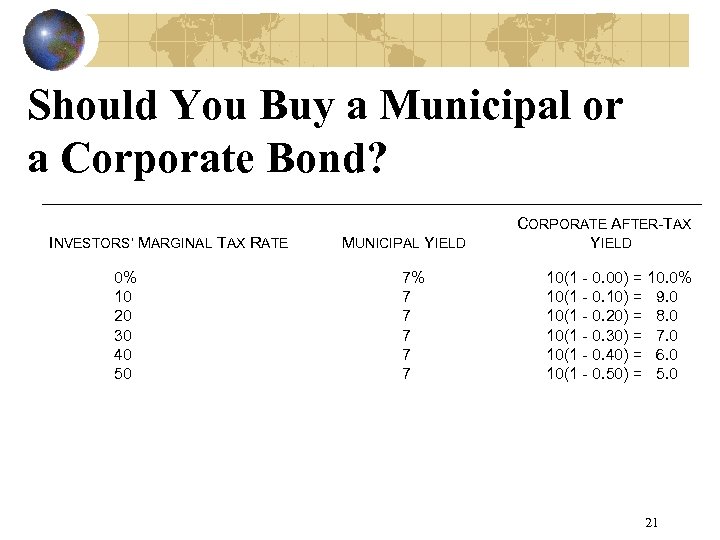 Should You Buy a Municipal or a Corporate Bond? INVESTORS’ MARGINAL TAX RATE 0% 10 20 30 40 50 MUNICIPAL YIELD 7% 7 7 7 CORPORATE AFTER-TAX YIELD 10(1 - 0. 00) = 10. 0% 10(1 - 0. 10) = 9. 0 10(1 - 0. 20) = 8. 0 10(1 - 0. 30) = 7. 0 10(1 - 0. 40) = 6. 0 10(1 - 0. 50) = 5. 0 21
 Differences in Marketability Affect Interest Yields Marketability - The costs and rapidity with which investors can resell a security. Cost of trade. Physical transfer cost. Search costs. Information costs. Securities with good marketability have higher prices (in demand) and lower yields. 22
 Bond Options and Yields Varied option provisions may explain yield differences between bonds An option is a contract provision which gives the holder the right, but not the obligation, to buy, sell, redeem, or convert a bond at some specified price within a defined future time period. 23
 Bond Options and Yields A call option permits the issuer (borrower) to call (refund) the bond before maturity Borrowers will “call” if interest rates decline. Investors in callable bonds face the risk of losing their high-yielding bonds. With increased call risk, investors demand a call interest premium (CIP). CIP = ic – inc > 0 A callable bond, ic, will be priced to yield a higher return (by the CIP) than a noncallable, inc, bond. 24
 Bond Options and Yields A put option permits the investor (lender) to terminate the bond at a designated price before maturity Investors are likely to “put” their bond back to the issuer during periods of increasing interest rates. The difference in interest rates between putable and nonputable bonds is called the put interest discount (PID). PID = ip – inp < 0 The yield on a putable bond, ip, will be lower than the yield on the nonputable bond, inp, by the PID. 25
 Bond Options and Yields A conversion option permits the investor to convert a bond into another security Convertible bonds generally have lower yields, icon than non-convertibles incon. The conversion yield discount (CYD) is the difference between the yields on convertibles relative to nonconvertibles. CYD = icon - incon < 0. Investors accept the lower yield on convertible bonds because they have an opportunity for increased rates of return through conversion. 26