 Скачать презентацию CHAPTER 6 THE EXECUTIVE BRANCH THE PRESIDENCY
2d39d413d2e0678bc6e4225fb06b7618.ppt
- Количество слайдов: 40



CHAPTER 6 “THE EXECUTIVE BRANCH”
THE PRESIDENCY 1. Article II of the Constitution gives the executive power to the President. a. The President must carry out the laws. 2. Who Has Served as President a. There has never been a woman President or Vice President. 3. George Washington was the first President of the U. S. (42 others since then)
A. Qualifications for President 1. 35 years old 2. Native Born Citizen 3. Resident in the U. S. for at least 14 years prior to being elected. B. How Long May a President Serve 1. May serve two four year terms. a. Half of another President’s term. (10 years total) b. 22 nd Amendment (1951) set term limits.
2. Presidential elections are held every four years. 3. President/Vice President take office on January 20 or first day after if it falls on a Sunday. a. Inauguration - ceremony in which the President takes the oath of office. b. President-elect - person who is to become President. c. Chief Justice reads the oath.
C. Benefits and Privileges of Serving as President. 1. Salary= $400, 000 (must pay taxes) 2. $50, 000 travel and entertainment allowance (Not taxable) 3. Live in the White House 4. Use of Air Force I 5. Use of Camp David (Vacation spot in Maryland) 6. Health Care and Retirement benefits.
D. The Vice President 1. Vice President Duties: a. Takes over if the President should die or be unable to perform his/her duties. (Has happened 9 times. ) b. President of the Senate. (Only votes if there is a tie. ) 2. The 12 th Amendment changed the way the Vice President was chosen.
a. Senate Chooses Vice Pres. if no majority is gotten from electoral college. b. Also set-up the Vice-President taking over the Presidency if the President is ill. 3. Last woman to run for Vice. President was Sarah Palin in 2008.
E. Presidential Succession 1. Order of Succession - list of government officials who would take over in their proper order. a. Vice President b. Speaker of the House c. President Pro Tempore d. Secretary of State
2. If Vice President dies, resigns, etc. and President is still in office President will nominate Vice President. a. Must receive majority vote in both House and Senate. b. Nixon nominated Ford after Agnew resigned.
POWERS AND ROLES OF THE PRESIDENT
A. Legislative Leader 1. President is the single most powerful official in the U. S. 2. Head of his/her political party. 3. Is the Chief of State - represents the U. S. 4. Is responsible for carrying out the laws. 5. Is the chief executive. 6. President can not make laws. a. Has a check and balance over legislation passed. (veto power)
b. Congress can override the veto 7. Constitution does not list the President’s responsibilities at great length. 8. State of the Union Address - message by the President, given to Congress that sets forth the programs and policies for the nation. B. Commander and Chief of the armed forces. (Can not declare war. )
1. President can send troops into action in foreign lands. 2. War Powers Act of 1973 a. Troops sent abroad must be brought back within 60 days unless Congress approves the action. b. 60 days can be changed to 90 if needed for safe removal of troops. c. President must notify Congress within 48 hours of sending troops into action.
C. Foreign Policy Leader 1. Foreign Policy - nations plan for dealing with other nations of the world. 2. Treaties - agreement with another nation. a. Promises must be kept by each country even if the chief executives of the two countries step down.
3. Executive Agreements - agreements between the two leaders of countries. a. Only last as long as the two leaders are in power. 4. Diplomacy - art of dealing with foreign governments. D. The Power of Appointment 1. President can appoint many officials to the U. S. Government. a. Some appointments require Senate approval.
E. Judicial Powers 1. Pardon - Keep people who have been, or who might be, convicted of federal crimes from being punished. a. President Ford used it to pardon Nixon. b. President Carter used it to pardon those who evaded the draft during Vietnam. 2. Reprieve - postpones the carrying out of a person’s sentence.
3. Commutation - Making a convicted person’s sentence less severe. F. The Power to Veto 1. President can only reject a bill or veto it. a. Congress can override Presidential veto with 2/3 vote of each house. 2. Franklin Roosevelt vetoed 635 bills while in office. (1933 -1945) 3. Harry Truman vetoed 250 while in office. (1945 -1953)
IN YOUR SMALL GROUPS DISCUSS IF YOU BELIEVE THE PRESIDENT HAS TOO MUCH POWER. IF SO WHY IF NOT WHY NOT. (3 MIN. ) ASSIGNMENT: WE TALKED ABOUT 7 MAIN POWERS THE PRESIDENT HAS. FIND 5 ARTICLES IN WHICH THE PRESIDENT IS EXERCISING THE POWERS THAT WE HAVE DISCUSSED. (SHOULD HAVE 5 SEPARATE ARTICLES)
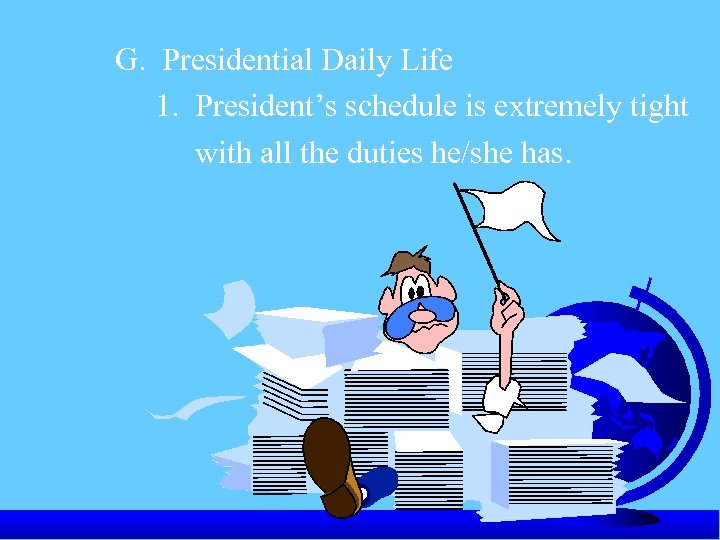
G. Presidential Daily Life 1. President’s schedule is extremely tight with all the duties he/she has.
WHAT ARE THE LIMITS OF THE PRESIDENT’S POWER A. Constitutional limits on the President’s Power 1. Limits on appointment 2. Limits on military 3. Limits on foreign relations 4. Limits on the power to veto B. Congressional Oversight - congressional power to take responsible care for the way the President is carrying out the law.
1. Congress can limit the actions of the President in carrying out laws by passing other laws. 2. Congress tries to pass acts that clarify the Constitution. a. War Powers Act
3. Civil Service Act - test that must be taken by some government employees appointed by the President. (Not the most important ones such as his cabinet. ) a. Civil Service Act end the spoils system - rewarding political supporters with appointments to office.
b. President James A. Garfield was killed by a person that thought they should have been appointed to office. C. How the Judicial Branch Limits the President 1. Judicial Review 2. Limits inherent powers - powers the President believes he/she has not listed in the Constitution. 3. Truman and the steel mills.
D. How Elections Limit the President 1. People can vote a President out if they don’t like him/her. 2. Why are other limits needed. a. Majorities aren’t always right. b. A lot of people don’t vote. IN YOUR SMALL GROUPS DISCUSS HOW/WHY YOU WOULD LIMIT THE POWER OF THE PRESIDENT (5 MIN. )
EXECUTIVE DEPARTMENTS AND THE CABINET A. Executive Office of the President. 1. President’s closest advisors. 2. Keeps President abreast on situations. a. Ex. - National Security Council, Chief of Staff B. Executive Departments 1. 15 of them
C. The Cabinet 1. George Washington had 3 cabinets. (War, Treasury, and State) 2. Secretary is the title given to the heads of cabinet offices. (Attorney General is head of the Justice Department. ) 3. Department heads are chosen by Presidential appointment. a. Senate must confirm or approve the President’s selections.
D. The Department of State 1. Conducts relations with other countries. a. Ambassadors - highest ranking U. S. official in a foreign country. b. Embassy - official residence of an ambassador. c. Ministers - represents the U. S. in smaller countries. d. Consul - work to improve trade between the U. S. and countries.
E. Department of Treasury (manages money) 1. Collects taxes & borrows money. 2. Supervises the printing of money. a. Counterfeiting - printing of fake money. 3. IRS is a branch under this department.
F. Department of Defense 1. Army/Navy/Air Force/Marines a. Joint Chiefs of Staff - highest military officers of the 4 armed forces. 2. Responsible for 4 military training schools. (the four academies) a. Upon graduation a person becomes an officer in the military. b. Women were admitted in 1976.
G. Department of Justice 1. Defends the U. S. if a suit is brought against it. 2. FBI and INS are branches under it. H. Department of the Interior 1. Manages the nations resources. I. Department of Agriculture 1. Helps farmers raise and market crops. J. Department of Commerce 1. Encourages U. S. trade and business 2. Bureau of Census is a branch under it.
K. Department of Labor 1. Gathers information on working conditions in business and industry. L. Department of Health and Human Services 1. Gathers information, conducts research, and runs programs to promote the health and well-being of all citizens.
M. Department of Housing and Urban Development (HUD) 1. Seeks to improve housing conditions and help people buy houses. N. Department of Transportation 1. Helps coordinate the nation’s ground, water , and air transportation. O. Department of Energy 1. Manages the countries energy policy. a. Tries to lessen the amount of wasted energy.
P. Department of Education 1. Provides information and advice on the nation’s school systems Q. Department of Veterans Affairs 1. Administers government benefits to U. S. veterans and their families.
F R. F F F F F Department of Homeland Security 1. Preserve freedoms, protect and secure America. 2. Identify and understand threats, assess vulnerabilities, determine potential impacts. 3. Issues passports and visas a. Passport - allow U. S. citizens to travel abroad. b. Visas - allow people from other countries into the U. S.
MAKE SURE YOU LOOK AT THE TABLE ON PAGE 107!!! ASSIGNMENT: 1. FIND OUT WHO SERVES IN PRESIDENT OBAMA’S CABINET? 2. FIND OUT WHO HIS CHIEF OF STAFF AND PRESS SECRETARY ARE.
INDEPENDENT AGENCIES AND REGULATORY COMMISSIONS 1. Help the President carry out specific duties. A. Independent Agencies 1. There are more than 60. a. Ex. Commission on Civil Rights
B. Regulatory Commissions 1. Have the power to make rules and bring violators to court. a. Ex. Interstate Commerce Commission (ICC) regulates, railroad, bus, truck, and water transportation that crosses state lines. - Oldest independent regulatory commission.
C. Who Runs the Regulatory Commissions 1. Appointed by President with Senate confirmation. a. Have very long terms. b. Because of this no President can nominate more than a few. 2. Because they are independent some people say they have too much power.
D. The Federal Bureaucracy 1. Bureaucracy - the many departments in the executive branch of government. a. Roughly 3 million people work in the bureaucracy. b. They work throughout the nation. 2. “Red Tape” - rules and regulations of the bureaucracy that often lead to delays. a. There are often many forms to fill out.
POSSIBLE ASSIGNMENTS: 1. Find articles on the powers of the President. 2. Treaty negotiation sheet. 3. “We the People Video” 4. Create a brochure on the cabinet or regulatory agency. 5. Case Study (pg. 29 -30) Possible with English class. 6. Reteaching (pg. 11 -12) 7. Test Form (pg. 21 -24)
Скачать презентацию CHAPTER 6 THE EXECUTIVE BRANCH THE PRESIDENCY
2d39d413d2e0678bc6e4225fb06b7618.ppt