


 Скачать презентацию Chapter 6 Just-in-time and lean thinking Content
42dcad969254f634ef4212626325081a.ppt
- Количество слайдов: 62
 Chapter 6 Just-in-time and lean thinking
 Content Just-in-time Lean thinking Vendor-managed inventory (VMI) Quick response
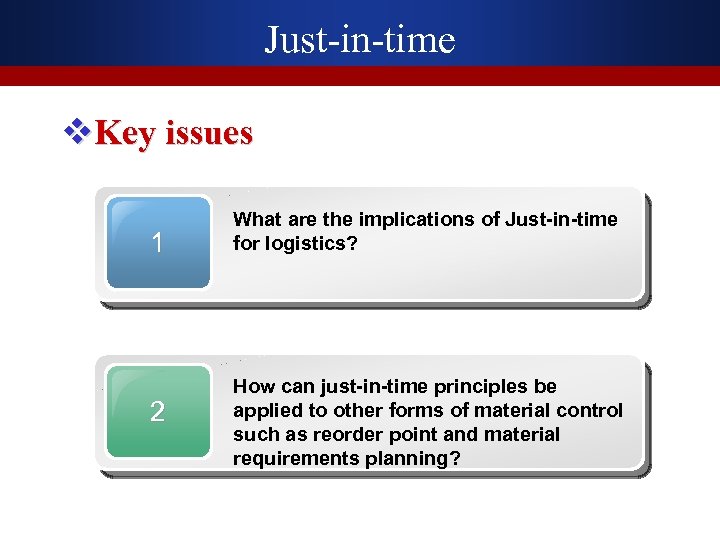 Just-in-time v. Key issues 1 2 What are the implications of Just-in-time for logistics? How can just-in-time principles be applied to other forms of material control such as reorder point and material requirements planning?
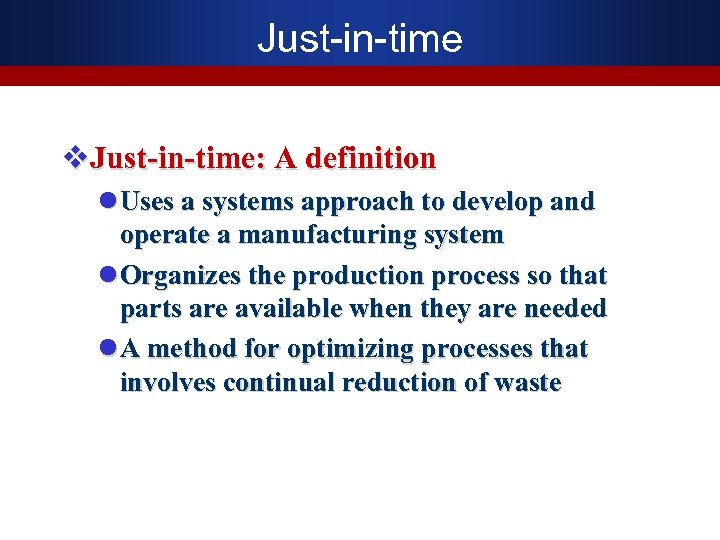 Just-in-time v. Just-in-time: A definition l Uses a systems approach to develop and operate a manufacturing system l Organizes the production process so that parts are available when they are needed l A method for optimizing processes that involves continual reduction of waste
 Just-in-time v. Little JIT l the application of JIT to logistics v. Central themes surrounding Just-in-time l Simplicity l Quality l Elimination of waste
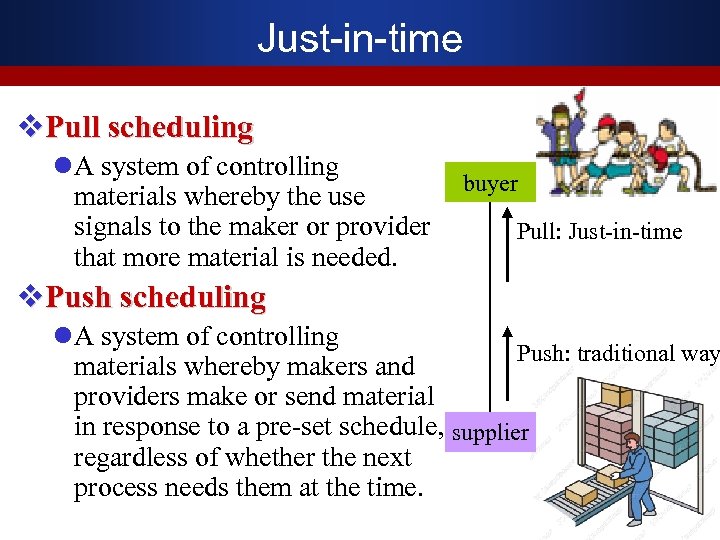 Just-in-time v. Pull scheduling l A system of controlling materials whereby the use signals to the maker or provider that more material is needed. buyer Pull: Just-in-time v. Push scheduling l A system of controlling Push: traditional way materials whereby makers and providers make or send material in response to a pre-set schedule, supplier regardless of whether the next process needs them at the time.
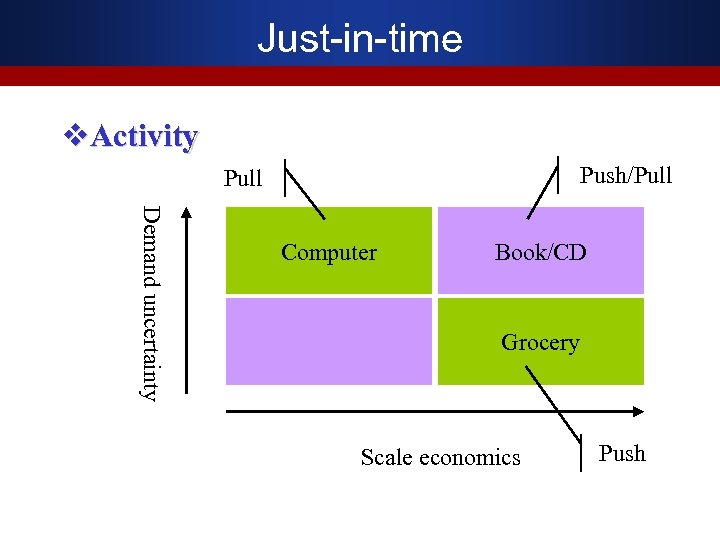 Just-in-time v. Activity Push/Pull Demand uncertainty Computer Book/CD Grocery Scale economics Push
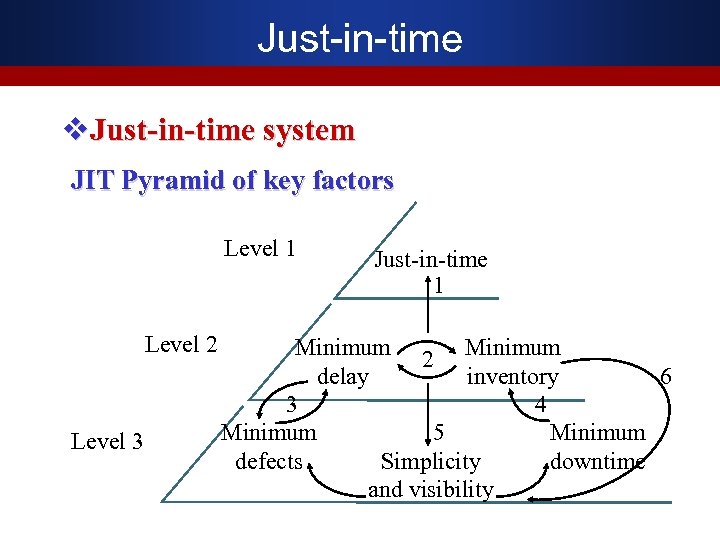 Just-in-time v. Just-in-time system JIT Pyramid of key factors Level 1 Level 2 Level 3 Just-in-time 1 Minimum 2 Minimum 6 inventory delay 3 4 Minimum 5 Simplicity defects downtime and visibility
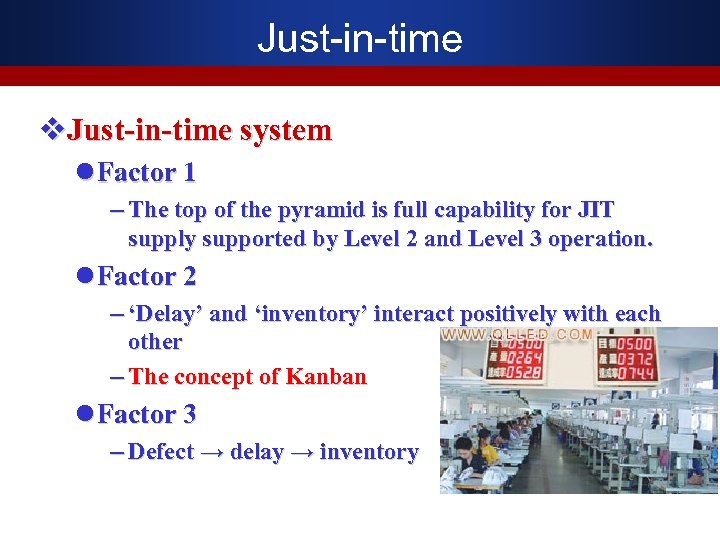 Just-in-time v. Just-in-time system l Factor 1 – The top of the pyramid is full capability for JIT supply supported by Level 2 and Level 3 operation. l Factor 2 – ‘Delay’ and ‘inventory’ interact positively with each other – The concept of Kanban l Factor 3 – Defect → delay → inventory
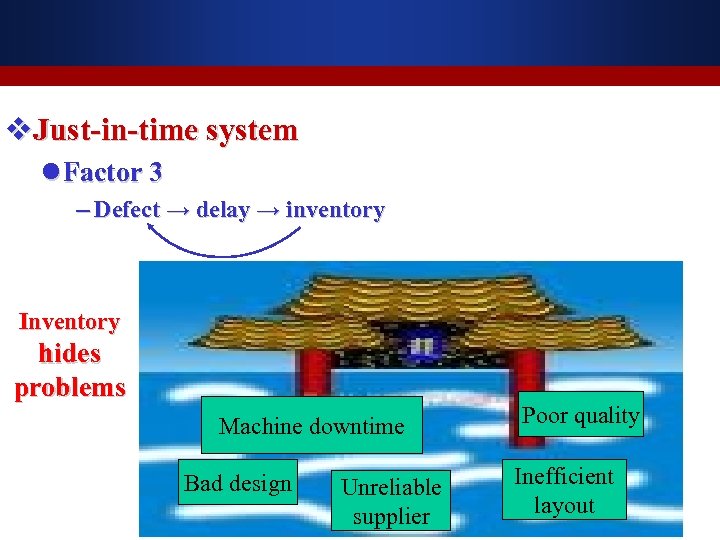 v. Just-in-time system l Factor 3 – Defect → delay → inventory Inventory hides problems Machine downtime Bad design Unreliable supplier Poor quality Inefficient layout
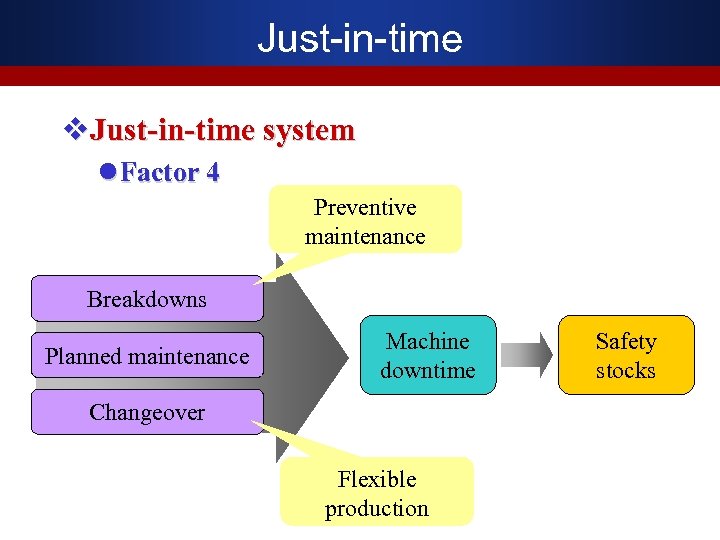 Just-in-time v. Just-in-time system l Factor 4 Preventive maintenance Breakdowns Planned maintenance Machine downtime Changeover Flexible production Safety stocks
 Just-in-time v. Just-in-time system l Factor 5 – Simply and visible process help to reduce inventory and could be better maintained. l Factor 6 – It’s more difficult to see the flow of a process with increased inventory.
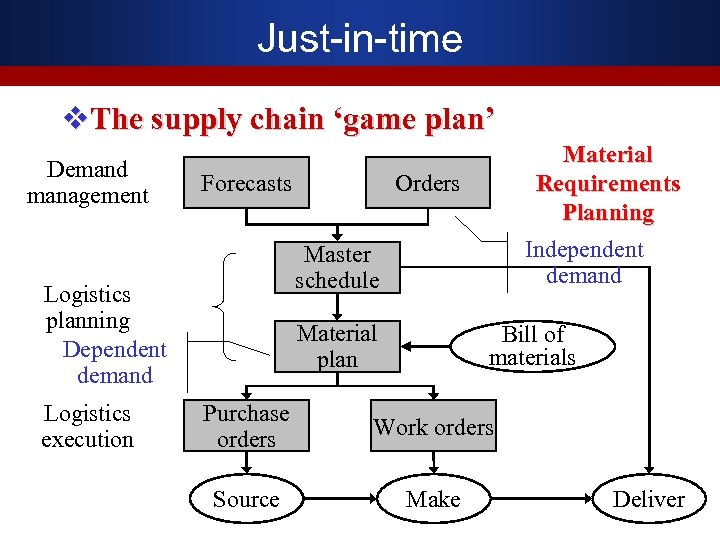 Just-in-time v. The supply chain ‘game plan’ Demand management Forecasts Orders Independent demand Master schedule Logistics planning Dependent demand Logistics execution Material Requirements Planning Material plan Bill of materials Purchase orders Work orders Source Make Deliver
 Just-in-time v. The supply chain ‘game plan’ l Independent demand – Demand for a product that is ordered directly by customers. – items are those items that we sell to customers l Dependent demand – Demand for parts or subassemblies that make up independent demand products. – items are those items whose demand is determined by other items
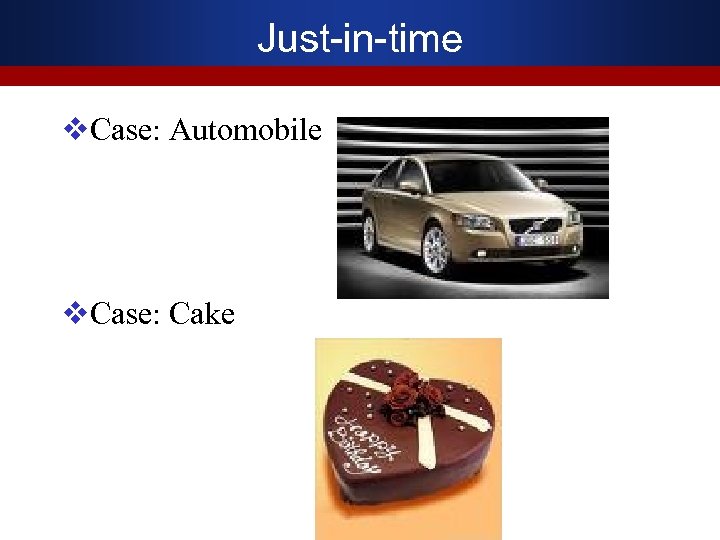 Just-in-time v. Case: Automobile v. Case: Cake
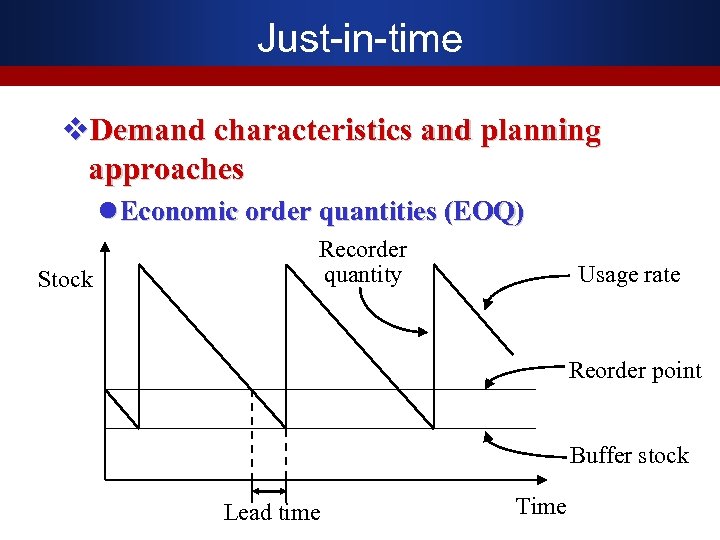 Just-in-time v. Demand characteristics and planning approaches l Economic order quantities (EOQ) Stock Recorder quantity Usage rate Reorder point Buffer stock Lead time Time
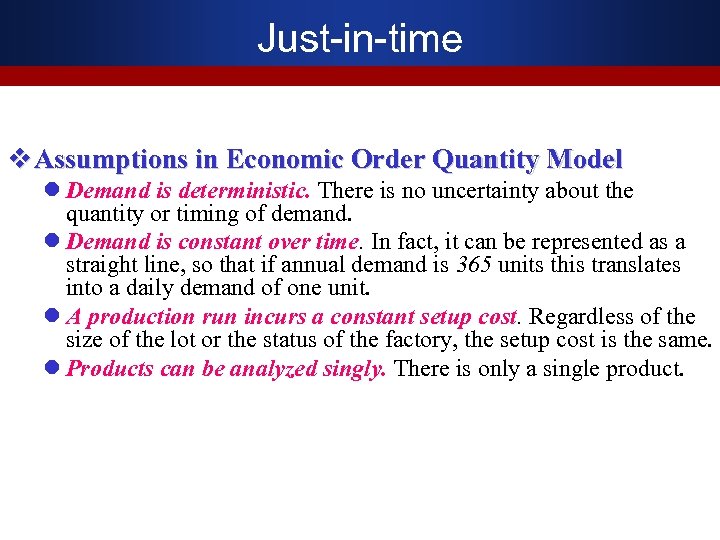 Just-in-time v Assumptions in Economic Order Quantity Model l Demand is deterministic. There is no uncertainty about the quantity or timing of demand. l Demand is constant over time. In fact, it can be represented as a straight line, so that if annual demand is 365 units this translates into a daily demand of one unit. l A production run incurs a constant setup cost. Regardless of the size of the lot or the status of the factory, the setup cost is the same. l Products can be analyzed singly. There is only a single product.
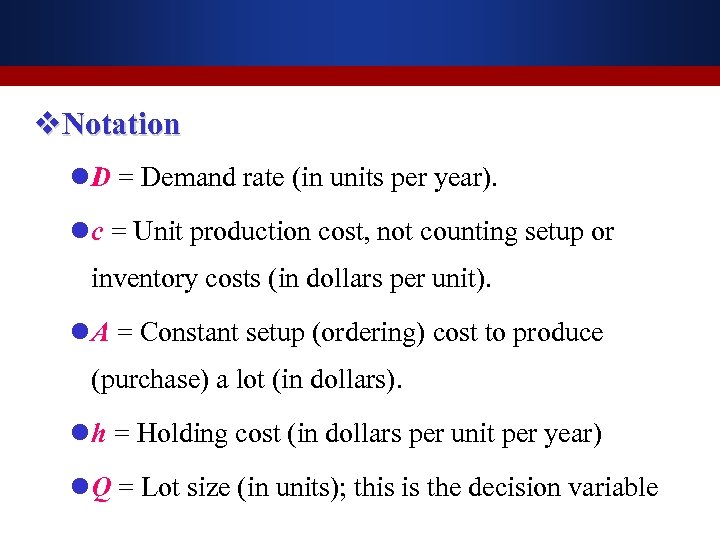 v. Notation l D = Demand rate (in units per year). l c = Unit production cost, not counting setup or inventory costs (in dollars per unit). l A = Constant setup (ordering) cost to produce (purchase) a lot (in dollars). l h = Holding cost (in dollars per unit per year) l Q = Lot size (in units); this is the decision variable
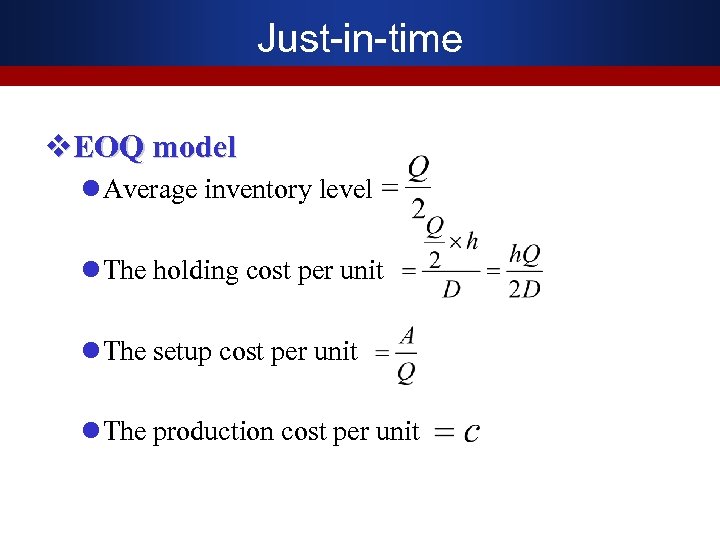 Just-in-time v. EOQ model l Average inventory level l The holding cost per unit l The setup cost per unit l The production cost per unit
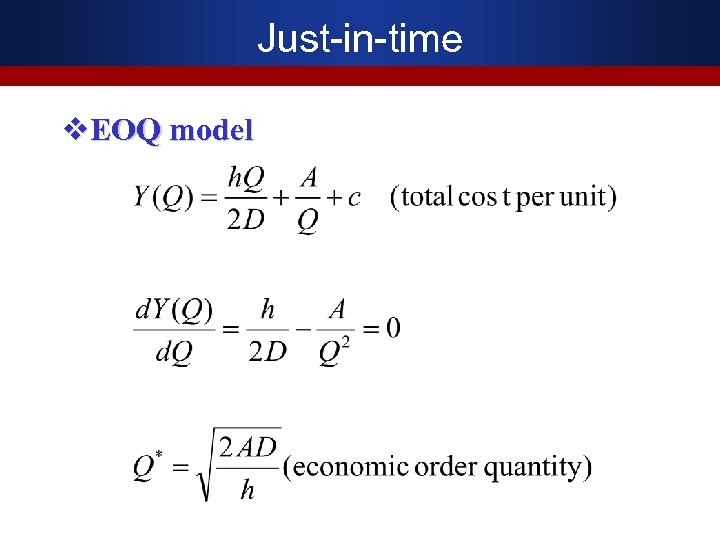 Just-in-time v. EOQ model
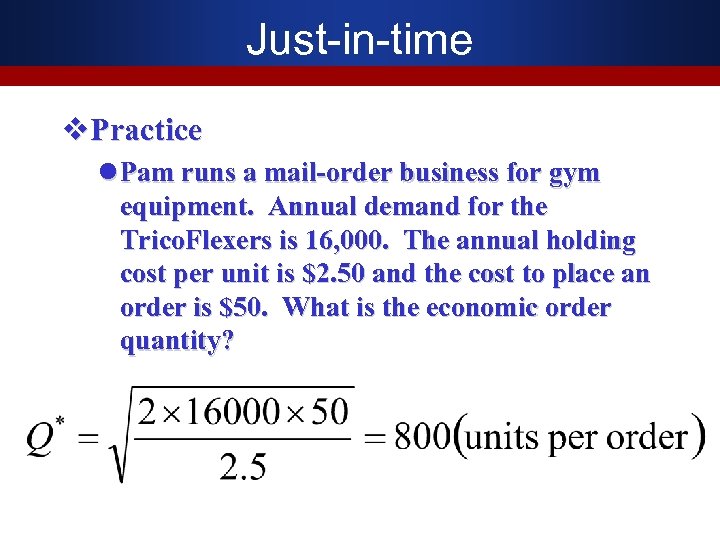 Just-in-time v. Practice l Pam runs a mail-order business for gym equipment. Annual demand for the Trico. Flexers is 16, 000. The annual holding cost per unit is $2. 50 and the cost to place an order is $50. What is the economic order quantity?
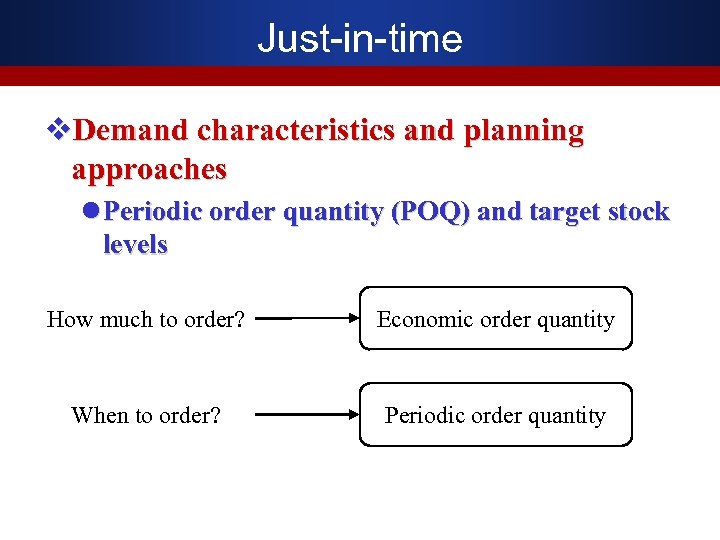 Just-in-time v. Demand characteristics and planning approaches l Periodic order quantity (POQ) and target stock levels How much to order? Economic order quantity When to order? Periodic order quantity
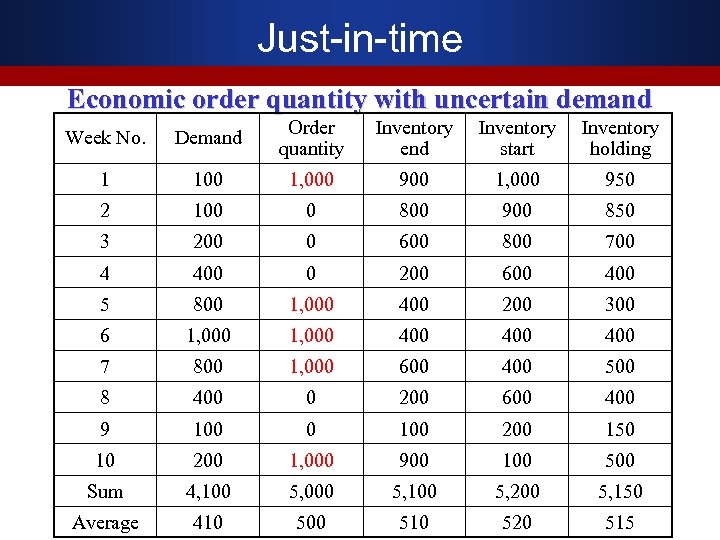 Just-in-time Economic order quantity with uncertain demand Week No. Demand Order quantity Inventory end Inventory start Inventory holding 1 100 1, 000 950 2 100 0 800 900 850 3 200 0 600 800 700 4 400 0 200 600 400 5 800 1, 000 400 200 300 6 1, 000 400 400 7 800 1, 000 600 400 500 8 400 0 200 600 400 9 100 0 100 200 150 10 200 1, 000 900 100 500 Sum 4, 100 5, 000 5, 100 5, 200 5, 150 Average 410 500 510 520 515
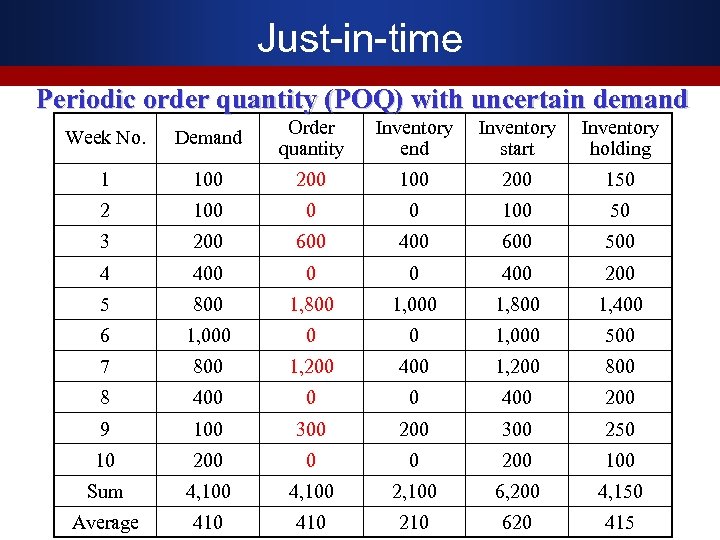 Just-in-time Periodic order quantity (POQ) with uncertain demand Week No. Demand Order quantity Inventory end Inventory start Inventory holding 1 100 200 150 2 100 0 0 100 50 3 200 600 400 600 500 4 400 0 0 400 200 5 800 1, 000 1, 800 1, 400 6 1, 000 0 0 1, 000 500 7 800 1, 200 400 1, 200 8 400 0 0 400 200 9 100 300 250 10 200 0 0 200 100 Sum 4, 100 2, 100 6, 200 4, 150 Average 410 210 620 415
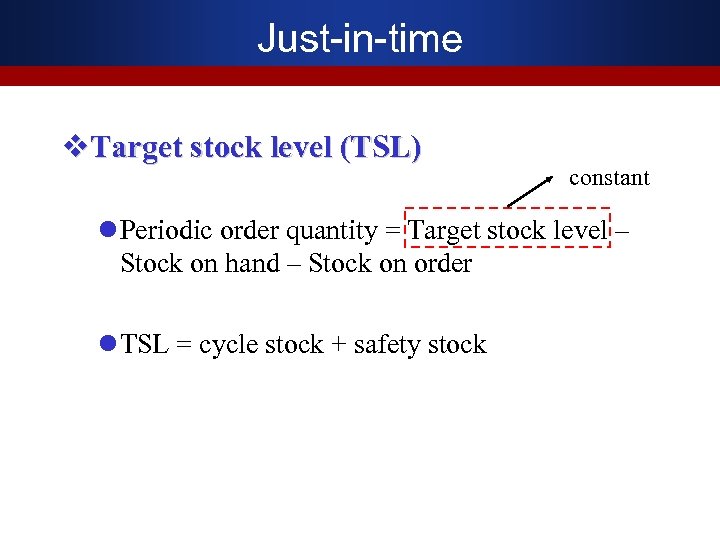 Just-in-time v. Target stock level (TSL) constant l Periodic order quantity = Target stock level – Stock on hand – Stock on order l TSL = cycle stock + safety stock
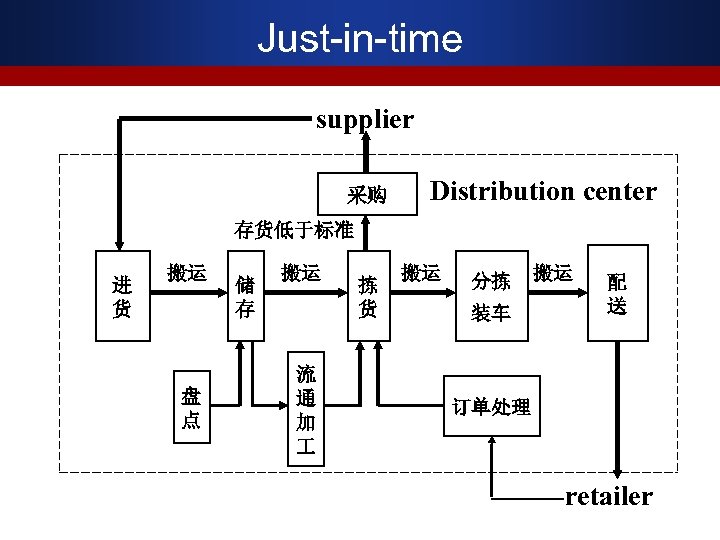 Just-in-time supplier 采购 Distribution center 存货低于标准 进 货 搬运 盘 点 储 存 搬运 流 通 加 拣 货 搬运 分拣 装车 搬运 配 送 订单处理 retailer
 Just-in-time v. JIT and material requirements planning (MRP) l Material requirements planning (MRP) - A methodology for defining the raw material requirements for a specific item, component, or sub -assembly ordered by a customer, or required by a business process. l MRP systems will usually define what is needed, when it is needed, and by having access to current inventories and pre-existing commitment of that inventory to other orders to other customers, will indicate what additional items need to be ordered to fulfill this order.
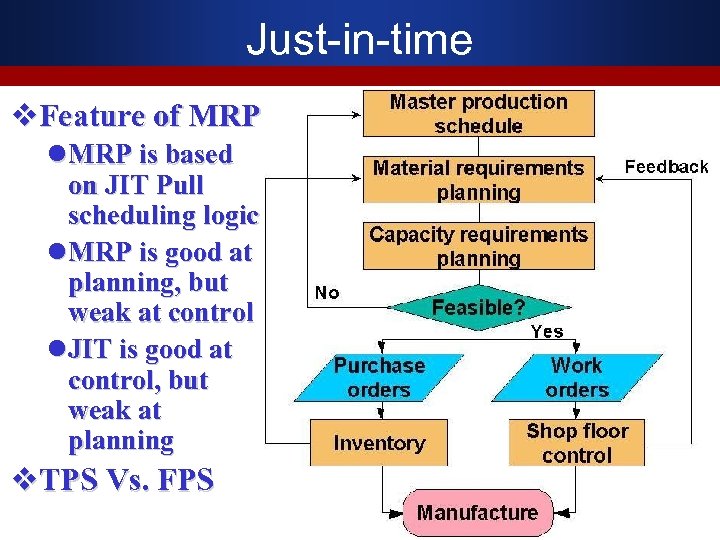 Just-in-time v. Feature of MRP l MRP is based on JIT Pull scheduling logic l MRP is good at planning, but weak at control l JIT is good at control, but weak at planning v. TPS Vs. FPS
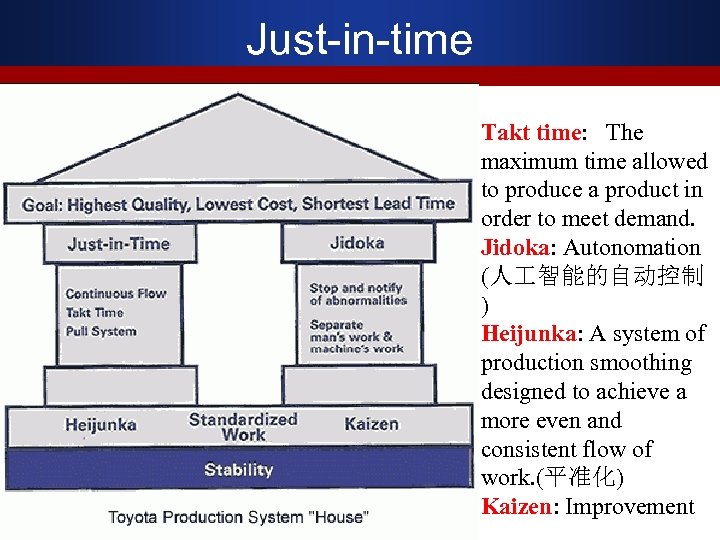 Just-in-time Takt time: The maximum time allowed to produce a product in order to meet demand. Jidoka: Autonomation (人 智能的自动控制 ) Heijunka: A system of production smoothing designed to achieve a more even and consistent flow of work. (平准化) Kaizen: Improvement
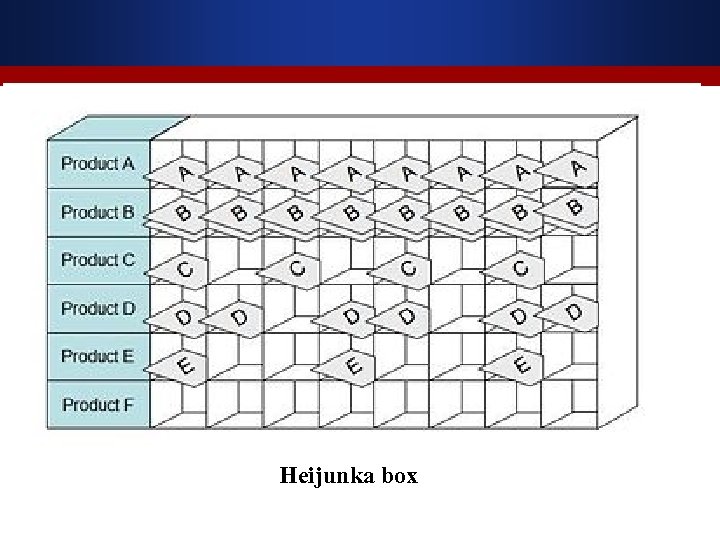 Heijunka box
 Content Just-in-time Lean thinking Vendor-managed inventory (VMI) Quick response
 Lean thinking v. Key issues 1 What are the principles of lean thinking? 2 How can the principles of lean thinking be applied to cutting waste out of supply chains?
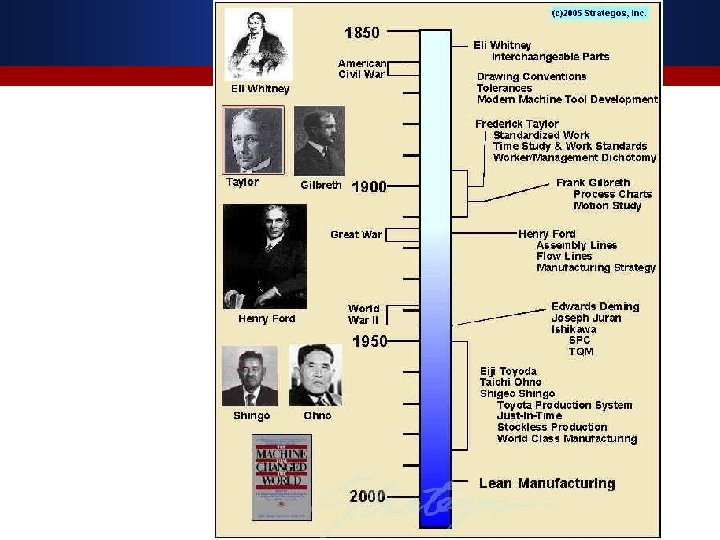
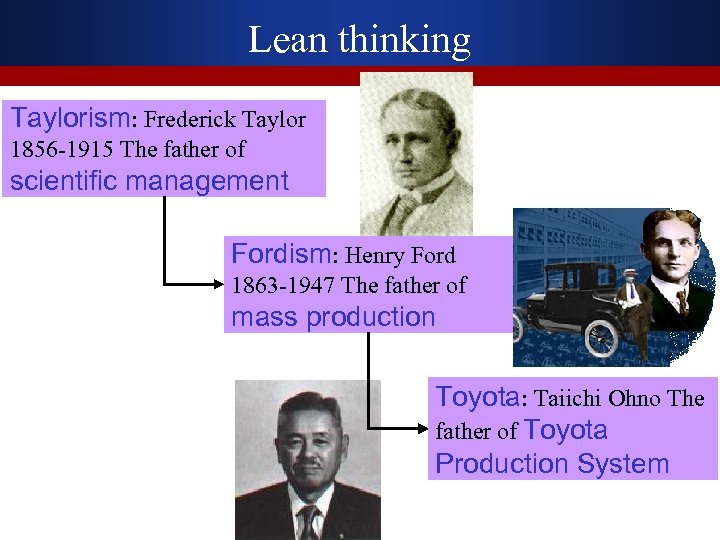 Lean thinking Taylorism: Frederick Taylor 1856 -1915 The father of scientific management Fordism: Henry Ford 1863 -1947 The father of mass production Toyota: Taiichi Ohno The father of Toyota Production System
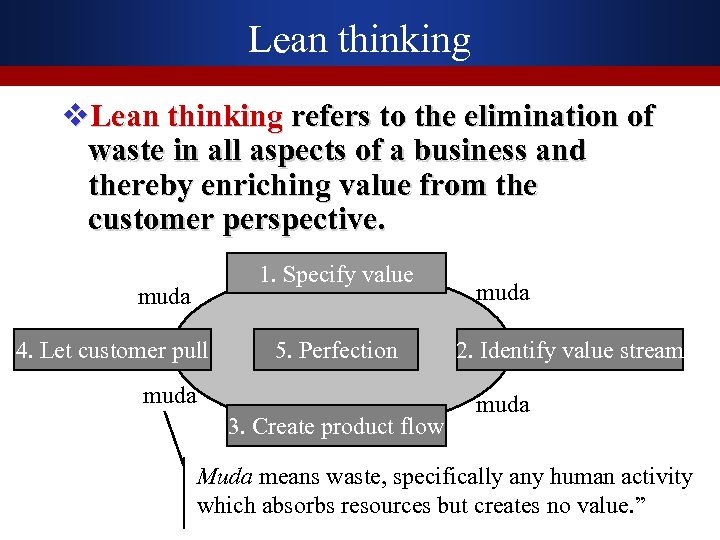 Lean thinking v. Lean thinking refers to the elimination of waste in all aspects of a business and thereby enriching value from the customer perspective. 1. Specify value muda 4. Let customer pull 5. Perfection muda 3. Create product flow muda 2. Identify value stream muda Muda means waste, specifically any human activity which absorbs resources but creates no value. ”
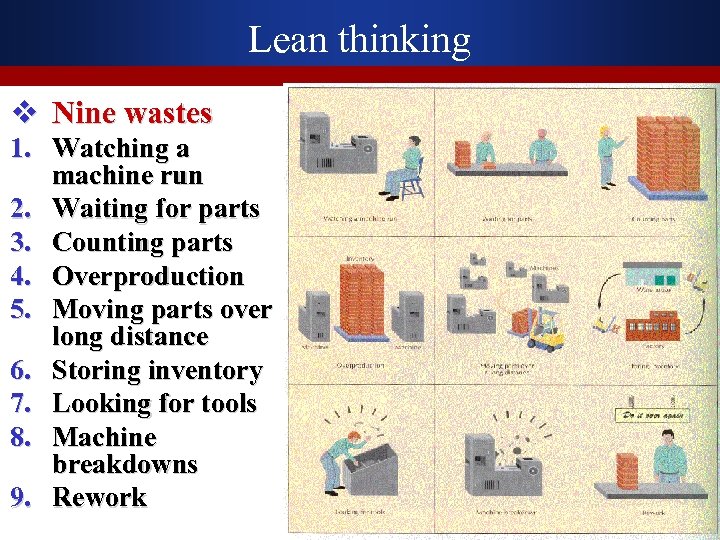 Lean thinking v Nine wastes 1. Watching a machine run 2. Waiting for parts 3. Counting parts 4. Overproduction 5. Moving parts over long distance 6. Storing inventory 7. Looking for tools 8. Machine breakdowns 9. Rework
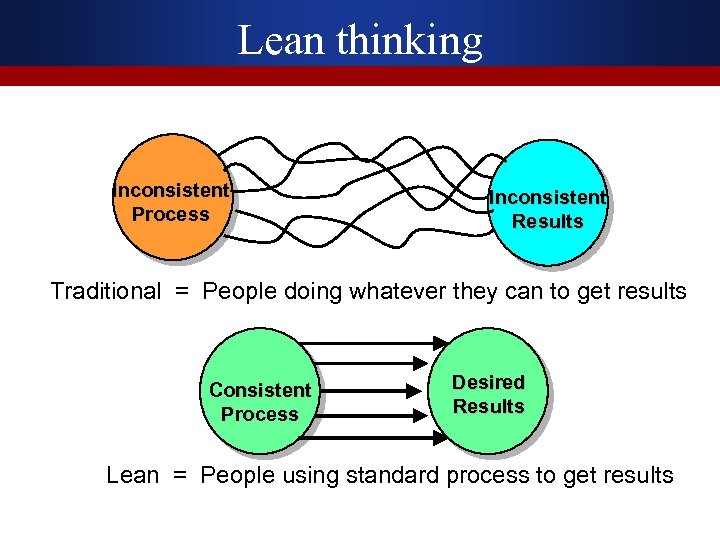 Lean thinking Inconsistent Process Inconsistent Results Traditional = People doing whatever they can to get results Consistent Process Desired Results Lean = People using standard process to get results
 Lean thinking v. Role of lean practices l Small-batch production – Reduce total cost across a supply chain, such as removing the waste of overproduction. l Rapid changeover – Rely on developments in machinery and product design – Provide the flexibility to make possible smallbatch production that responds to customer needs
 Lean thinking v. Design strategy l Lean product design – A reduction in the number of parts they contain and the materials from which they are made – Features that aid assembly, such as asymmetrical parts that can be assembled in only one way – Redundant features on common, core parts that allow variety to be achieved without complexity with the addition of peripheral parts – Modular designs that allow parts to be upgraded over the product life l Lean facility design
 Lean thinking v. Design strategy l Lean product design l Lean facility design – Modular design of equipment to allow prompt repair and maintenance – Modular design of layout to allow teams to be brought together with all the facilities they need – Small machines which can be moved to match the demand for them – Open systems architectures that allow equipment to fit together and work when it is moved and connected to other items
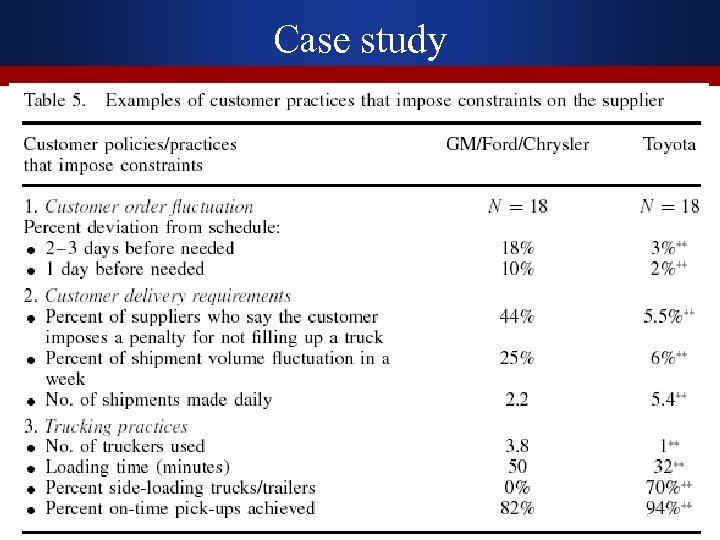
 Case study v. Barriers to knowledge transfers within suppliers’ plants (Dyer and Hatch, 2006) l Network constraints – Customer policies or constraints imposed by customers – Example: One supplier was required by GM to use large (4’× 5’) reusable containers. When filled with components, these containers weighed 200~300 pounds. By comparison, Toyota had the supplier use small (2’× 3’) reusable containers weighing 40 pounds when filled.
 Case study
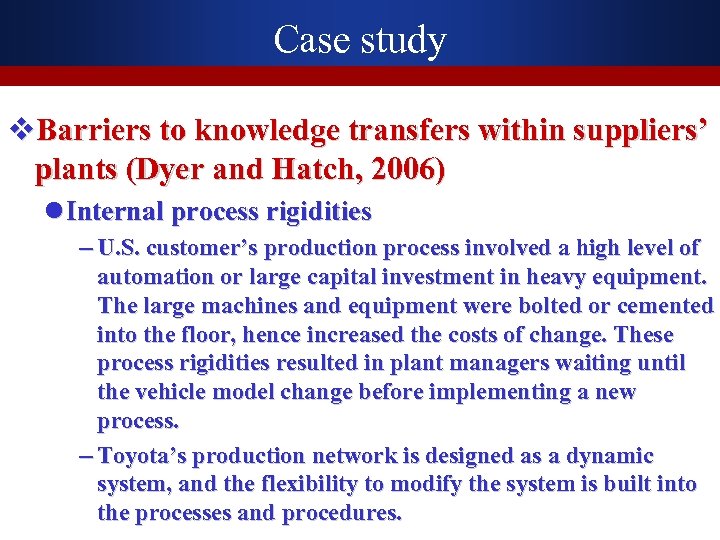 Case study v. Barriers to knowledge transfers within suppliers’ plants (Dyer and Hatch, 2006) l Internal process rigidities – U. S. customer’s production process involved a high level of automation or large capital investment in heavy equipment. The large machines and equipment were bolted or cemented into the floor, hence increased the costs of change. These process rigidities resulted in plant managers waiting until the vehicle model change before implementing a new process. – Toyota’s production network is designed as a dynamic system, and the flexibility to modify the system is built into the processes and procedures.
 Content Just-in-time Lean thinking Vendor-managed inventory (VMI) Quick response
 Vendor-managed inventory v. Key issue 1 How can suppliers help to reduce waste in the customer’s process?
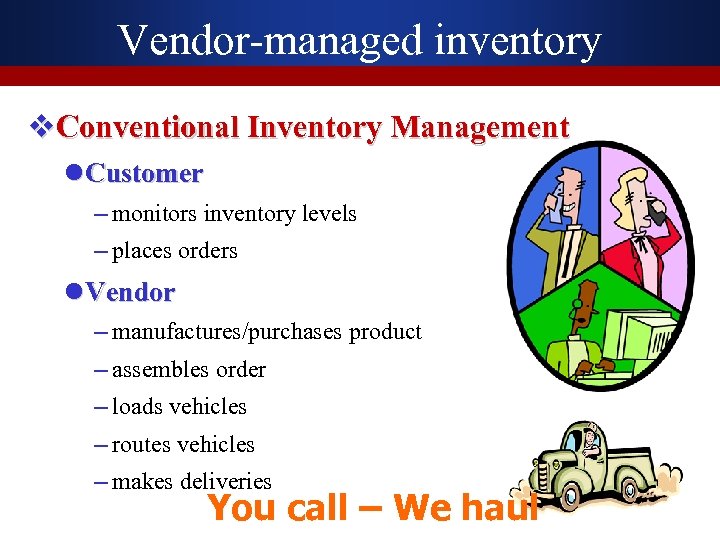 Vendor-managed inventory v. Conventional Inventory Management l Customer – monitors inventory levels – places orders l Vendor – manufactures/purchases product – assembles order – loads vehicles – routes vehicles – makes deliveries You call – We haul
 Vendor-managed inventory v. Problems with Conventional Inventory Management l Large variation in demands on production and transportation facilities l workload balancing l utilization of resources l unnecessary transportation costs l urgent Vs. non-urgent orders l setting priorities
 Vendor-managed inventory v. Vendor-managed inventory l Customer – trusts the vendor to manage the inventory l Vendor – monitors customers’ inventory – customers call/fax/e-mail – remote telemetry units – set levels to trigger call-in – controls inventory replenishment & decides – when to deliver – how much to deliver You rely – We – how to deliver supply
 Vendor-managed inventory v. VMI l. An approach to inventory and order fulfillment in the way that supplier, not the customer, is responsible for managing and replenishing inventory.
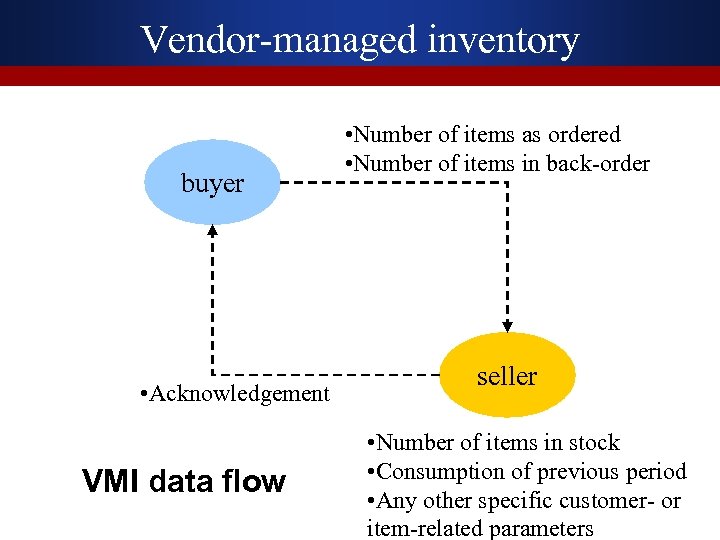 Vendor-managed inventory buyer • Acknowledgement VMI data flow • Number of items as ordered • Number of items in back-order seller • Number of items in stock • Consumption of previous period • Any other specific customer- or item-related parameters
 Vendor-managed inventory v. VMI does not stand for l The passing of the customer’s consumption history for a specific item, from the customer over to the supplier, who on the basis hereof, will follow-up the customer’s stock level and at the moment of the stock having reached a specific threshold, generates a purchasing order so as to replenish the stock. v. VMI in fact stands for l Granting inspection of the sales profile of a specific item to the supplier, who on the basis hereof, will optimize the replenishment policy and ensure the pre-defined service level towards the end users of his customer.
 Vendor-managed inventory v. Advantages of VMI l Customer – The stock as such disappears from the company’s balance sheet and this way clears the way for a higher amount of working capital. – Customer only have to supervise the stocks, instead of drawing up a detailed analysis for the placing of orders. – Reduce the time interval between receiving goods and making them available for consumption or sales. – Stocks with customer will be reduced, because the uncertainty due to variability in the supplier’s periods of delivery will drop.
 Vendor-managed inventory v. Advantages of VMI l. Vendor – more freedom in when & how to manufacture product and make deliveries – better coordination of inventory levels at different customers – better coordination of deliveries to decrease transportation cost (reduce the rush-order and related high cost)
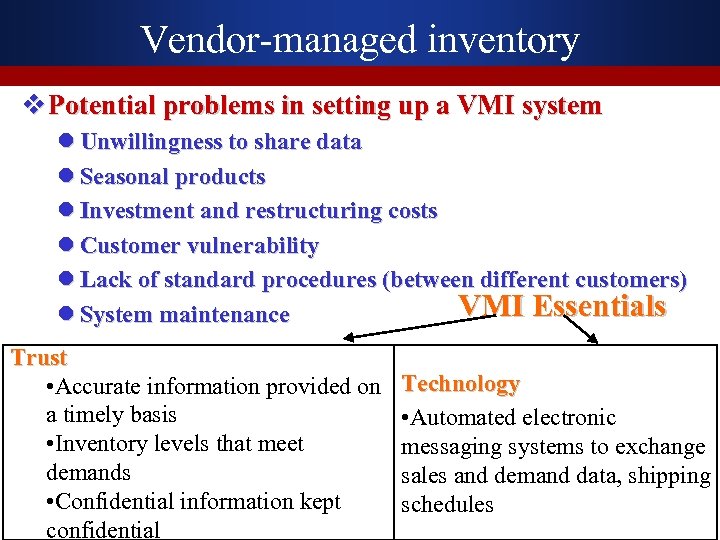 Vendor-managed inventory v Potential problems in setting up a VMI system l Unwillingness to share data l Seasonal products l Investment and restructuring costs l Customer vulnerability l Lack of standard procedures (between different customers) VMI Essentials l System maintenance Trust • Accurate information provided on a timely basis • Inventory levels that meet demands • Confidential information kept confidential Technology • Automated electronic messaging systems to exchange sales and demand data, shipping schedules
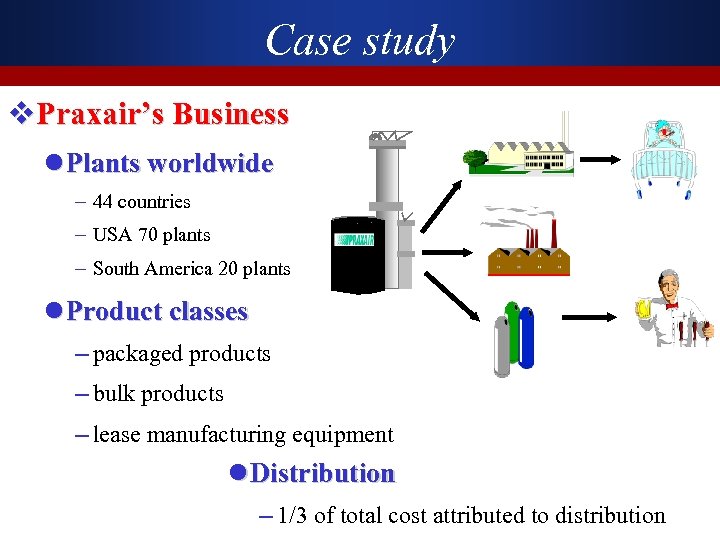 Case study v. Praxair’s Business l Plants worldwide – 44 countries – USA 70 plants – South America 20 plants l Product classes – packaged products – bulk products – lease manufacturing equipment l Distribution – 1/3 of total cost attributed to distribution
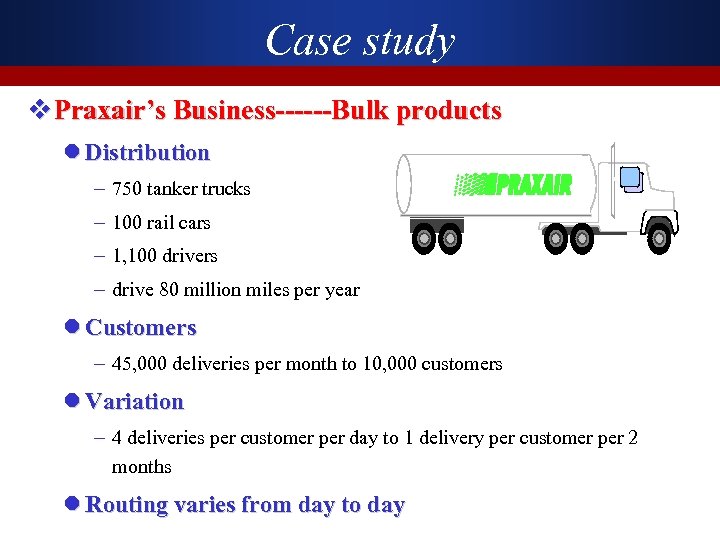 Case study v Praxair’s Business------Bulk products l Distribution – 750 tanker trucks – 100 rail cars – 1, 100 drivers – drive 80 million miles per year l Customers – 45, 000 deliveries per month to 10, 000 customers l Variation – 4 deliveries per customer per day to 1 delivery per customer per 2 months l Routing varies from day to day
 Case study v. VMI Implementation at Praxair l Convince management and employees of new methods of doing business l Convince customers to trust vendor to do inventory management l Pressure on vendor to perform - Trust easily shaken l Praxair currently manages 80% of bulk customers’ inventories
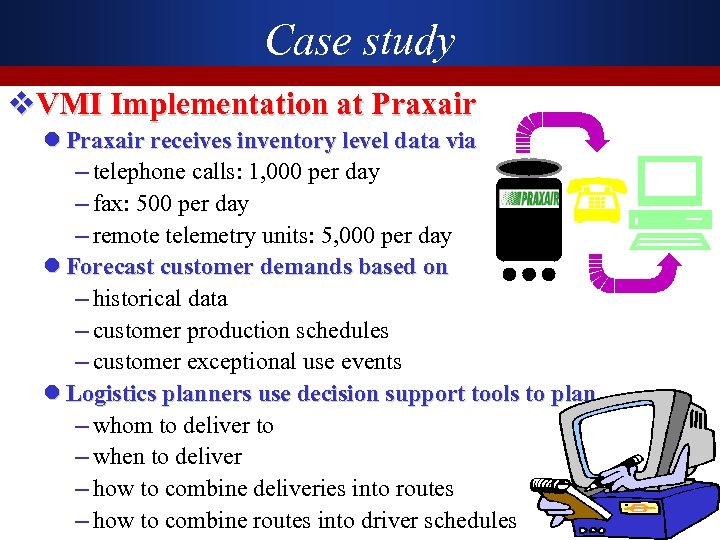 Case study v. VMI Implementation at Praxair l Praxair receives inventory level data via – telephone calls: 1, 000 per day – fax: 500 per day – remote telemetry units: 5, 000 per day l Forecast customer demands based on – historical data – customer production schedules – customer exceptional use events l Logistics planners use decision support tools to plan – whom to deliver to – when to deliver – how to combine deliveries into routes – how to combine routes into driver schedules
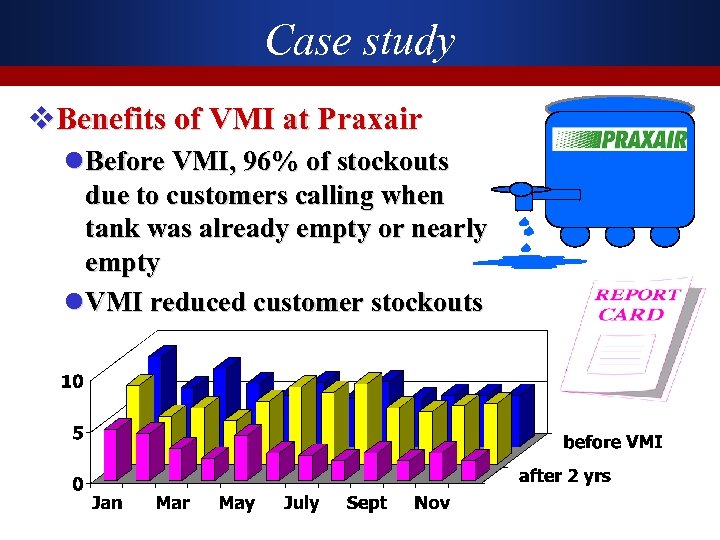 Case study v. Benefits of VMI at Praxair l Before VMI, 96% of stockouts due to customers calling when tank was already empty or nearly empty l VMI reduced customer stockouts
 Case study v. What’s needed to make VMI work l Information management is crucial to the success of VMI – inventory level data – historical usage data – planned usage schedules – planned and unplanned exceptional usage l Forecast future demand l Decision making: need to decide on a regular (daily) basis – whom to deliver to – when to deliver – How much to deliver – how to combine deliveries into routes – how to combine routes into driver schedules
 Content Just-in-time Lean thinking Vendor-managed inventory (VMI) Quick response
 Quick response v. The application of quick response in apparel industry l Development lead time have been compressed l Production lead time are shorter Zara case