


 Скачать презентацию Chapter 6 Insurance Company Operations Copyright
M06_REJDA_6117643_11_RMI_C06.ppt
- Количество слайдов: 19
 Chapter 6 • Insurance Company Operations Copyright © 2011 Pearson Prentice Hall. All rights reserved.
 Agenda • • • Rating and Ratemaking Underwriting Production Claim settlement Reinsurance Investments Copyright © 2011 Pearson Prentice Hall. All rights reserved. 6 -2
 Rating and Ratemaking • Ratemaking refers to the pricing of insurance and the calculation of insurance premiums – A rate is the price per unit of insurance – An exposure unit is the unit of measurement used in insurance pricing – Total premiums charged must be adequate for paying all claims and expenses during the policy period – Rates and premiums are determined by an actuary, using the company’s past loss experience and industry statistics Copyright © 2011 Pearson Prentice Hall. All rights reserved. 6 -3
 Underwriting • Underwriting refers to the process of selecting, classifying, and pricing applicants for insurance • A statement of underwriting policy establishes policies that are consistent with the company’s objectives, such as – Acceptable classes of business – Amounts of insurance that can be written • A line underwriter makes daily decisions concerning the acceptance or rejection of business Copyright © 2011 Pearson Prentice Hall. All rights reserved. 6 -4
 Underwriting • Important principles of underwriting: – The primary objective of underwriting is to attain an underwriting profit – The second principle is to select prospective insureds according to the company’s underwriting standards – The purpose of underwriting standards is to reduce adverse selection against the insurer • Adverse selection is the tendency of people with a higher-than -average chance of loss to seek insurance at standard rates. If not controlled by underwriting, this will result in higher-than -expected loss levels. – Underwriting should also maintain equity among the policyholders • One group of policyholders should not unduly subsidize another group Copyright © 2011 Pearson Prentice Hall. All rights reserved. 6 -5
 Underwriting • Underwriting starts with the agent in the field • Information for underwriting comes from: – – – The application The agent’s report An inspection report Physical inspection A physical examination and attending physician’s report MIB report • After reviewing the information, the underwriter can: – Accept the application subject to restrictions or modifications – Reject the application Copyright © 2011 Pearson Prentice Hall. All rights reserved. 6 -6
 Production • Production refers to the sales and marketing activities of insurers – Agents are often referred to as producers – Life insurers have an agency or sales department – Property and liability insurers have marketing departments • An agent should be a competent professional with a high degree of technical knowledge in a particular area of insurance and who also places the needs of his or her clients first Copyright © 2011 Pearson Prentice Hall. All rights reserved. 6 -7
 Claim Settlement • The objectives of claims settlement include: – Verification of a covered loss – Fair and prompt payment of claims – Personal assistance to the insured • Some laws prohibit unfair claims practices, such as: – Refusing to pay claims without conducting a reasonable investigation – Not attempting to provide prompt, fair, and equitable settlements – Offering lower settlements to compel insureds to institute lawsuits to recover amounts due Copyright © 2011 Pearson Prentice Hall. All rights reserved. 6 -8
 Claim Settlement • The claim process begins with a notice of loss • Next, the claim is investigated – A claims adjustor determines if a covered loss has occurred and the amount of the loss • The adjustor may require a proof of loss before the claim is paid • The adjustor decides if the claim should be paid or denied – Policy provisions address how disputes may be resolved Copyright © 2011 Pearson Prentice Hall. All rights reserved. 6 -9
 Reinsurance • Reinsurance is an arrangement by which the primary insurer that initially writes the insurance transfers to another insurer part or all of the potential losses associated with such insurance – The primary insurer is the ceding company – The insurer that accepts the insurance from the ceding company is the reinsurer – The retention limit is the amount of insurance retained by the ceding company – The amount of insurance ceded to the reinsurer is known as a cession Copyright © 2011 Pearson Prentice Hall. All rights reserved. 6 -10
 Reinsurance • Reinsurance is used to: – Increase underwriting capacity – Stabilize profits – Reduce the unearned premium reserve • The unearned premium reserve represents the unearned portion of gross premiums on all outstanding policies at the time of valuation – Provide protection against a catastrophic loss – Retire from business or from a line of insurance or territory – Obtain underwriting advice on a line for which the insurer has little experience Copyright © 2011 Pearson Prentice Hall. All rights reserved. 6 -11
 Types of Reinsurance Agreements • There are two principal forms of reinsurance: – Facultative reinsurance is an optional, case-by-case method that is used when the ceding company receives an application for insurance that exceeds its retention limit • Facultative reinsurance is often used when the primary insurer has an application for a large amount of insurance – Treaty reinsurance means the primary insurer has agreed to cede insurance to the reinsurer, and the reinsurer has agreed to accept the business • All business that falls within the scope of the agreement is automatically reinsured according to the terms of the treaty Copyright © 2011 Pearson Prentice Hall. All rights reserved. 6 -12
 Methods for Sharing Losses • There are two basic methods for sharing losses: – Under the Pro rata method, where the ceding company and reinsurer agree to share losses and premiums based on some proportion – Under the Excess method, where the reinsurer pays only when covered losses exceed aa certain level – Under a quota-share treaty, the ceding insurer and the reinsurer agree to share premiums and losses based on some proportion – Under a surplus-share treaty, the reinsurer agrees to accept insurance in excess of the ceding insurer’s retention limit, up to some maximum amount – An excess-of-loss treaty is designed for catastrophic protection – A reinsurance pool is an organization of insurers that underwrites insurance on a joint basis Copyright © 2011 Pearson Prentice Hall. All rights reserved. 6 -13
 Reinsurance Alternatives • Some insurers use the capital markets as an alternative to traditional reinsurance • Securitization of risk means that an insurable risk is transferred to the capital markets through the creation of a financial instrument, such as a futures contract • Catastrophe bonds are corporate bonds that permit the issuer of the bond to skip or reduce the interest payments if a catastrophic loss occurs – Catastrophe bonds are growing in importance and are now considered by many to be a standard supplement to traditional reinsurance. Copyright © 2011 Pearson Prentice Hall. All rights reserved. 6 -14
 Investments • Because premiums are paid in advance, they can be invested until needed to pay claims and expenses • Investment income is extremely important in reducing the cost of insurance to policyowners and offsetting unfavorable underwriting experience • Life insurance contracts are long-term; thus, safety of principal is a primary consideration • In contrast to life insurance, property insurance contracts are short-term in nature, and claim payments can vary widely depending on catastrophic losses, inflation, medical costs, etc Copyright © 2011 Pearson Prentice Hall. All rights reserved. 6 -15
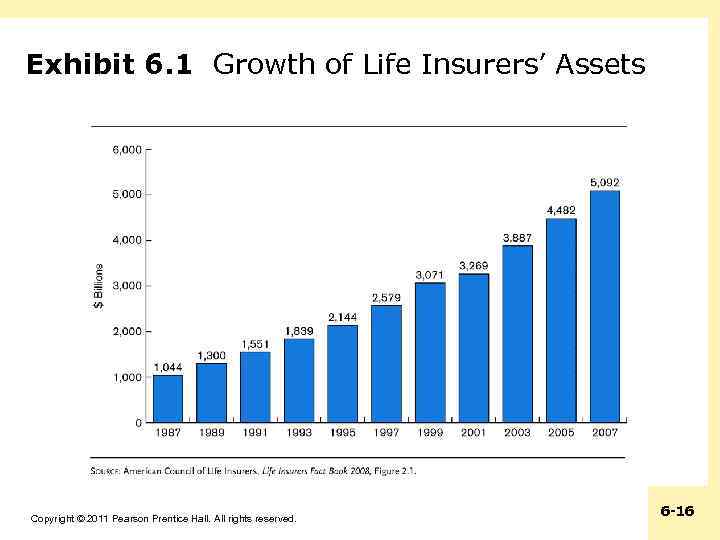 Exhibit 6. 1 Growth of Life Insurers’ Assets Copyright © 2011 Pearson Prentice Hall. All rights reserved. 6 -16
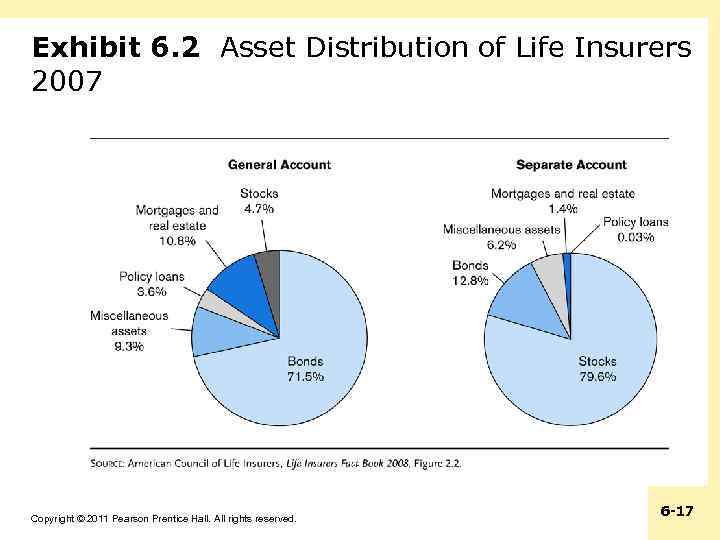 Exhibit 6. 2 Asset Distribution of Life Insurers 2007 Copyright © 2011 Pearson Prentice Hall. All rights reserved. 6 -17
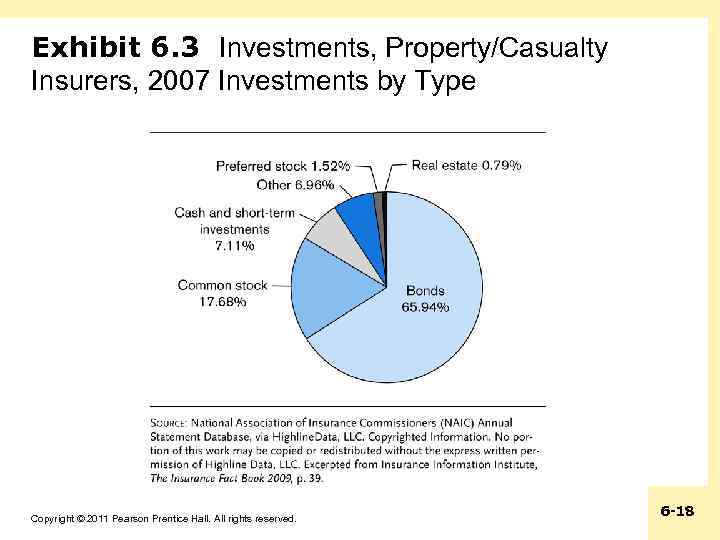 Exhibit 6. 3 Investments, Property/Casualty Insurers, 2007 Investments by Type Copyright © 2011 Pearson Prentice Hall. All rights reserved. 6 -18
 Other Insurance Company Functions • The electronic data processing area maintains information on premiums, claims, loss ratios, investments, and underwriting results • The accounting department prepares financial statements and develops budgets • In the legal department, attorneys are used in advanced underwriting and estate planning • Property and liability insurers provide numerous loss control services Copyright © 2011 Pearson Prentice Hall. All rights reserved. 6 -19