


 Скачать презентацию Chapter 6 From Demand to Welfare 1
447e6e74f7bbc9eac421b1df21d3917c.ppt
- Количество слайдов: 32
 Chapter 6 From Demand to Welfare 1
 Main Topics ¢Dissecting the effects of a price change ¢Measuring changes in consumer welfare using demand curves 2
 Dissecting the Effects of a Price Change ¢When a price increases two things happen: ¢That good becomes expensive relative to others; consumers shift their purchases away from the more expensive good ¢Consumers’ purchasing power falls ¢Economists have learned a lot about consumer demand welfare from thinking about price changes this way 3
 Dissecting the Effects of a Price Change ¢As the price of a good changes, the consumer’s well-being varies ¢An uncompensated price change is one with no change in income ¢A compensated price change is a price change and an income change that together leave the consumer’s well-being unaffected 4
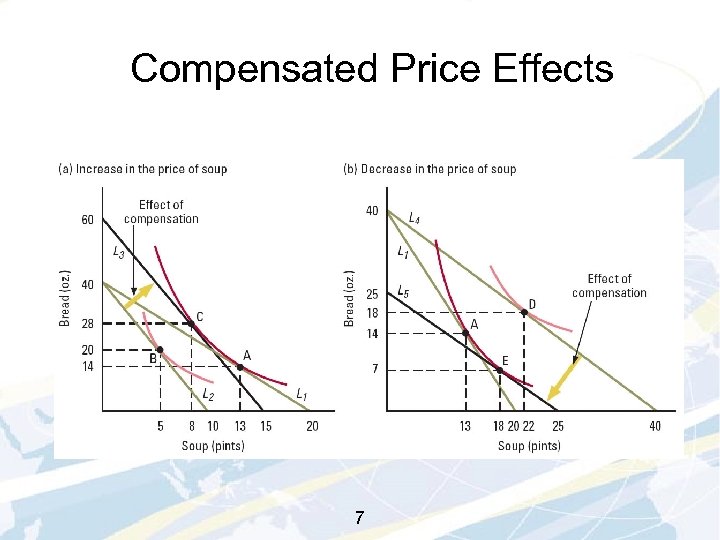
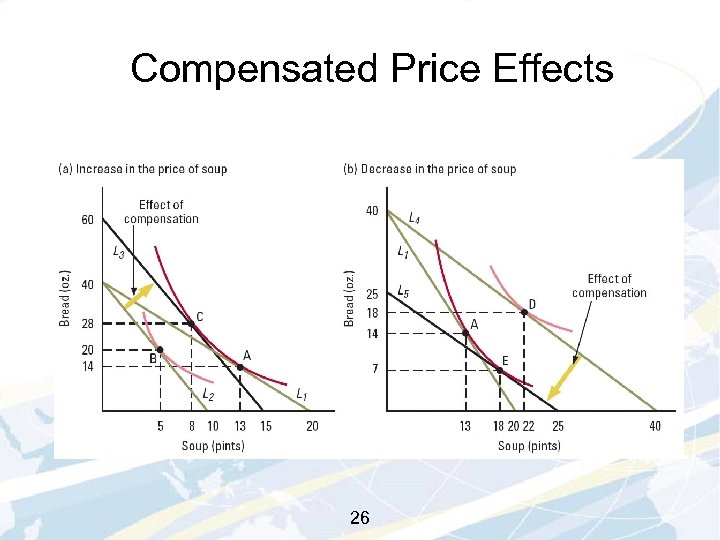
 ¢if M=10, PB=0. 25, then, ★if Ps=0. 5, then choose A ★if Ps=1, purchasing power declines, L 2, and choose B ¢As P increases, consumer is worse off b/c purchasing power is less ¢how much $ would need to give consumer to compensate him for the higher P? ¢ if M=15 now, then L 3 and C. ¢note that A~C ¢from L 2 -L 3: the effect of compensation on 5 BL
 ¢L 1 -L 2: uncompensated price change: price change with no change in M ¢L 1 -L 3: Compensated price change: price change and M change to leave the consumer unaffected ¢What about a reduction of Ps? ¢the consumer is better off ¢L 1 -L 3: compensated price change 6
 Compensated Price Effects 7
 Substitution and Income Effects ¢If we assume that the good is normal, then the increase in price will result in a fall in the quantity demanded. ¢This is for two reasons; the IE(have a limited budget, therefore can purchase lower quantities of the good) and the SE (swap with alternative goods that are cheaper). 8
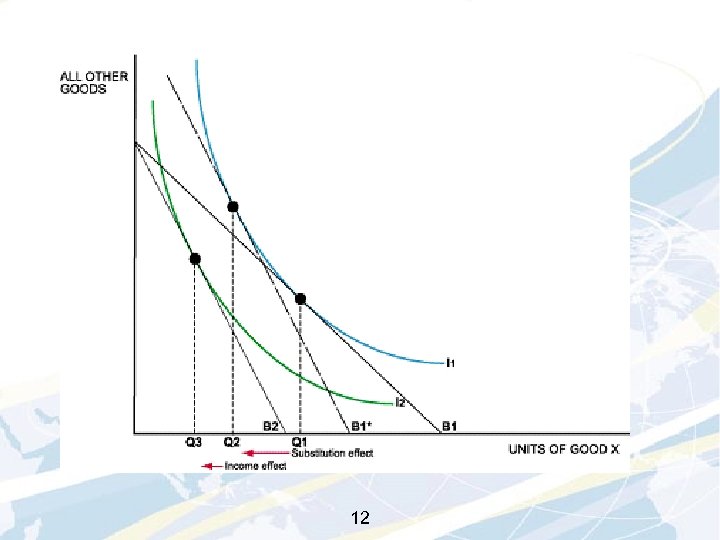
 ¢Due to the price of good x increasing, the budget line has pivoted from B 1 to B 2 and the consumption point has moved. ¢The decrease in the quantity demanded can be divided into two effects; 9
 1. SE: when the consumer switches consumption due to the price change alone but remains on the same indifference curve. ¢To identify the SE, a new BL needs to be constructed. The BL B 1* is added, this budget line needs to be parallel with the BL B 2 and tangent to I 1. ¢Therefore, the movement from Q 1 to Q 2 is purely due to the SE 10
 2. IE: consumption changes due to the having a change in purchasing power as a result of the price change. ¢The higher price means BL is B 2, hence the optimum consumption point is Q 2. ¢ This point is on a lower indifference curve (I 2). ¢Thus, in the case of a normal good, the IE and SE work to reinforce each other. 11
 12
12
 Direction of Substitution Effect ¢Substitution effect of price increase is: ¢Negative for price increase ¢Positive for price decrease ¢Consumer substitutes away from the good that becomes relatively more expensive 14 13
 Direction of Income Effect ¢ Direction of income effect depends on whether the good is normal or inferior ¢ Increase in the good’s price reduces the consumer’s purchasing power ¢Consumer will buy less of the good if it is normal, but more if it is inferior ¢ Income effect of a price increase is: ¢Negative for normal good ¢Positive for inferior good 15 14
 ¢IE: an increase in P will reduce purchasing power ¢this will reduce Q if good is normal and increase Q if good is inferior ¢IE<0 if good is normal ¢IE>0 if good is inferior ¢Normal good: IE and SE move in same direction, both are (-) if P increases and both direction are (+) if P falls ¢inferior: IE and SE move in opposite direction: opposite direction when P increases, IE increases Q while SE reduces it. 16 15
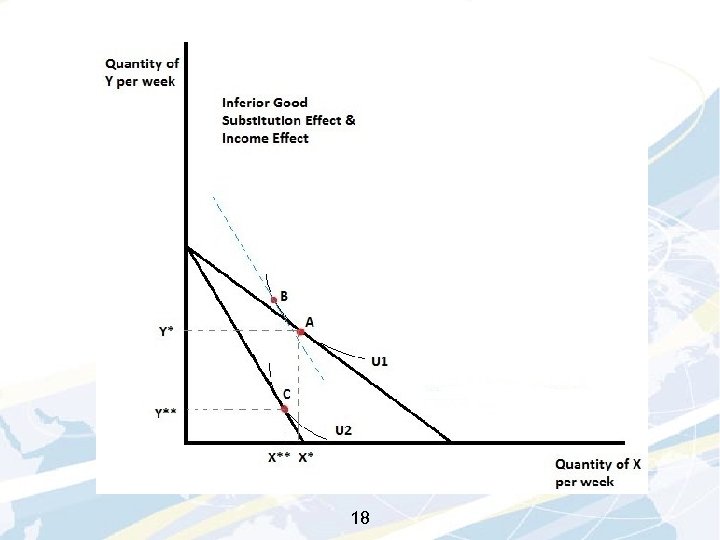
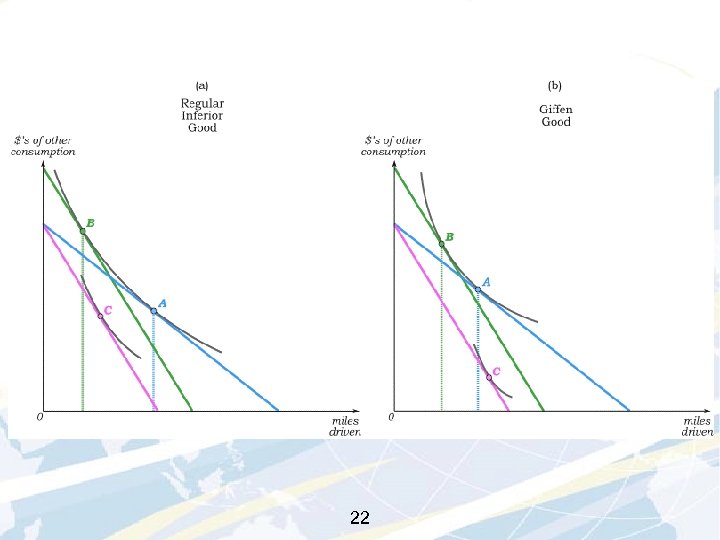
 Substitution & Income Effects for Inferior Goods ¢IE and SE work in opposite directions with inferior goods. ¢As the price of X rises there is a decrease in real income. You can see that point A is the original point for X* and Y* on the original Budget Constraint. 16
 ¢The price of X (inferior good) increased therefore decreasing the real income which caused the budget constraint to rotate inward because the X intercept changes as the price of X changes. ¢Since the price of X increased the SE sets in as X is substituted by Y as shown by the movement A-B. 17
 18
18
 ¢However, since X is an inferior good, demand for X increases as income decreases therefore countering the SE. ¢The IE is shown by the movement from B -C. ¢C is where the combination of the substitution effect and the income effect settles. 19
 Why Do Demand Curves Slope Downward? ¢ The Law of Demand states that demand curves slope downward ¢ SE is always consistent with Law of Demand ¢ For normal goods, IE reinforces substitution effect ¢Normal goods always obey the Law of Demand ¢ Theoretically, if IE for an inferior good is large enough to offset substitution effect, could violate Law of Demand 19 20
 ¢A drop in the price of inferior good would raise the purchasing power, making the consumer better off: she will consume more of the other goods and less of the inferior good. ¢Extreme Inferiority: Giffen Goods ¢IE>SE ¢and D curve slopes upward ¢Giffen goods are inferior, and the amount purchased increases as the price rises 21
 22
22
 ¢Giffen goods are hard to find b/c: 1. most goods are normal 2. if spending on a good is a small fraction of M, a large increase in good’s P will not affect M significantly 23
 Compensating Variation ¢ How can a consumer measure economics gains and losses in monetary terms? a common measure is compensating variation ¢ Compensating variation: the amount of money that exactly compensates the consumer for a change in circumstances ¢ Example: If the compensating variation for a gasoline tax is $50, then the consumer is better off with the tax as long as he receives a rebate for more than $50 ¢ Example: if CV for road improvement =$100, then the consumer is better off as long as his contribution is <$100 24
 ¢b/c 5$ fully compensate consumer from an increase in P from 0. 5 to 1, the compensating variation for this P increase is $5 ¢the compensating variation for P reduction is -$3. 75 ¢worked-out problem 6. 2 ¢in-text-exercise 6. 2 24 25
 Compensated Price Effects 26
 Consumer Surplus ¢ Consumer surplus is the net benefit a consume receives from participating in the market for some good ¢ and, the amount of money that would compensate the consumer for losing access to the market, compensating variation ¢ Consumer’s D curve measures the gross benefit of consuming a good ¢ Consumer surplus is area below the D curve and above a horizontal line at the price 27
 ¢if Q=1, the highest P the consumer is willing to pay is $4000, but Q=0 if P is higher. ¢Willingness to pay 1 st and 2 nd =$3000 and $2000 for 3 units and so on ¢the consumer’s net benefit is is the difference between his gross benefit and the amount he pays 28
 ¢if P=$1500, the consumer will buy 3 units: he is: ¢willing to pay $4000 for the first, pays $1500 and enjoys $2500 ¢his net benefit from 2 nd unit: $1500 ¢net benefit from the 3 rd =$500 ¢his consumer surplus: 2500+1500+500 29
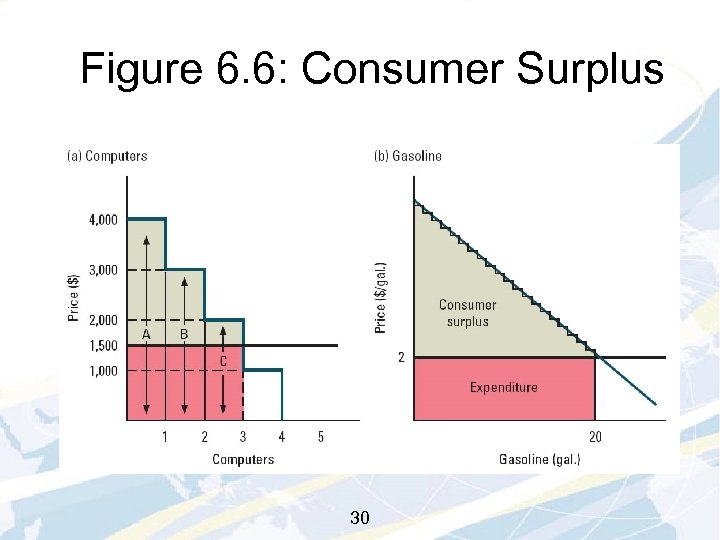 Figure 6. 6: Consumer Surplus 30
 Using Consumer Surplus to Measure Changes in Welfare ¢ Some public policies alter prices and amounts of traded goods ¢ Consumer surplus is useful, allows us to measure change in net economic benefit from the policy ¢ This is another way to describe compensating variation for the policy ¢ Example: ¢Policy reduces consumer surplus from $100 to $80 ¢Must provide her with $20 to compensate fully for the policy’s effects 30 31 6 -20
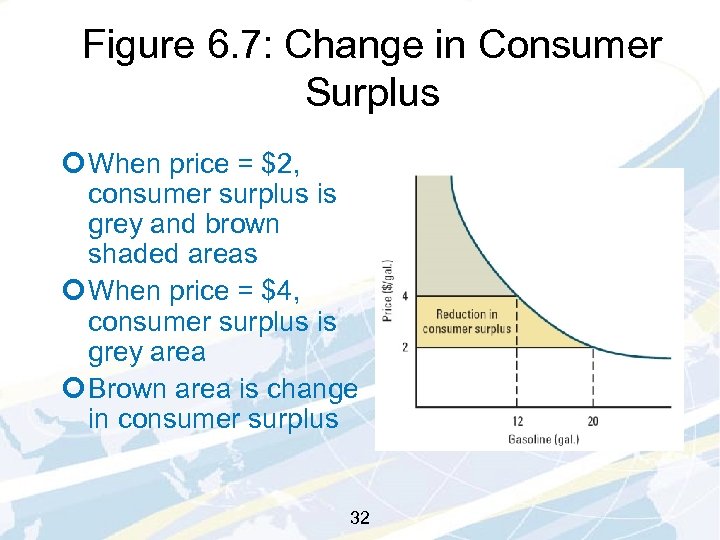 Figure 6. 7: Change in Consumer Surplus ¢ When price = $2, consumer surplus is grey and brown shaded areas ¢ When price = $4, consumer surplus is grey area ¢ Brown area is change in consumer surplus 32