


 Скачать презентацию Chapter 6 Financial Options 1 Topics in
3a0b9c5bdcfca37af546105bbf5b3992.ppt
- Количество слайдов: 28
 Chapter 6 Financial Options 1
 Topics in Chapter n n Financial Options Terminology Option Price Relationships Black-Scholes Option Pricing Model Put-Call Parity 2
 What is a financial option? n An option is a contract which gives its holder the right, but not the obligation, to buy (or sell) an asset at some predetermined price within a specified period of time. 3
 What is the single most important characteristic of an option? n It does not obligate its owner to take any action. It merely gives the owner the right to buy or sell an asset. 4
 Option Terminology n n Call option: An option to buy a specified number of shares of a security within some future period. Put option: An option to sell a specified number of shares of a security within some future period. 5
 Option Terminology n n Exercise (or strike) price: The price stated in the option contract at which the security can be bought or sold. Option price: The market price of the option contract. 6
 Option Terminology (Continued) n n n Expiration date: The date the option matures. Exercise value: The value of a call option if it were exercised today = Current stock price - Strike price. Note: The exercise value is zero if the stock price is less than the strike price. 7
 Option Terminology (Continued) n n Covered option: A call option written against stock held in an investor’s portfolio. Naked (uncovered) option: An option sold without the stock to back it up. 8
 Option Terminology (Continued) n n In-the-money call: A call whose exercise price is less than the current price of the underlying stock. Out-of-the-money call: A call option whose exercise price exceeds the current stock price. 9
 Option Terminology (Continued) n LEAPS: Long-term Equity Antici. Pation Securities that are similar to conventional options except that they are long-term options with maturities of up to 2 1/2 years. 10
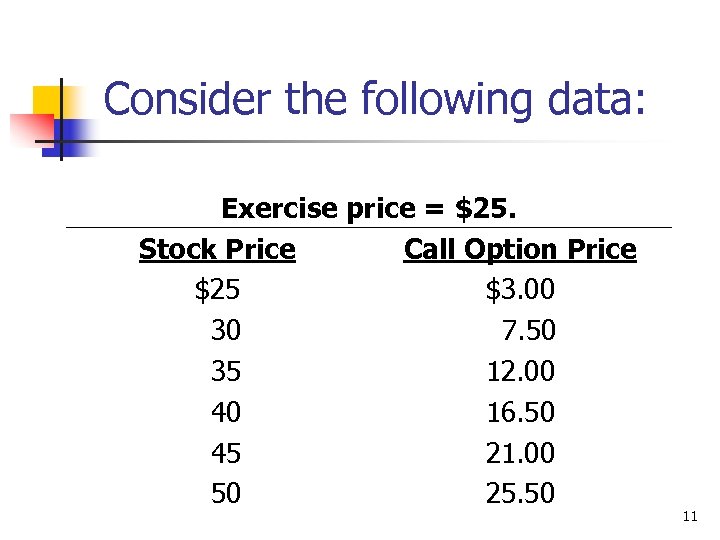 Consider the following data: Exercise price = $25. Stock Price Call Option Price $25 $3. 00 30 7. 50 35 12. 00 40 16. 50 45 21. 00 50 25. 50 11
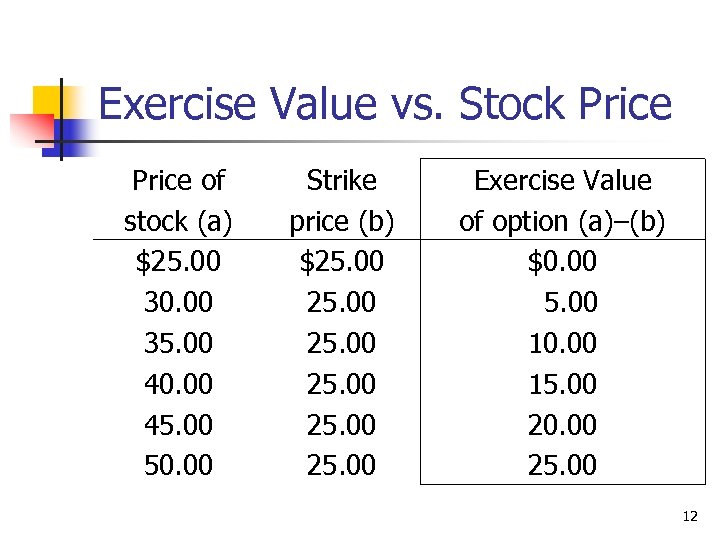 Exercise Value vs. Stock Price of stock (a) $25. 00 30. 00 35. 00 40. 00 45. 00 50. 00 Strike price (b) $25. 00 Exercise Value of option (a)–(b) $0. 00 5. 00 10. 00 15. 00 20. 00 25. 00 12
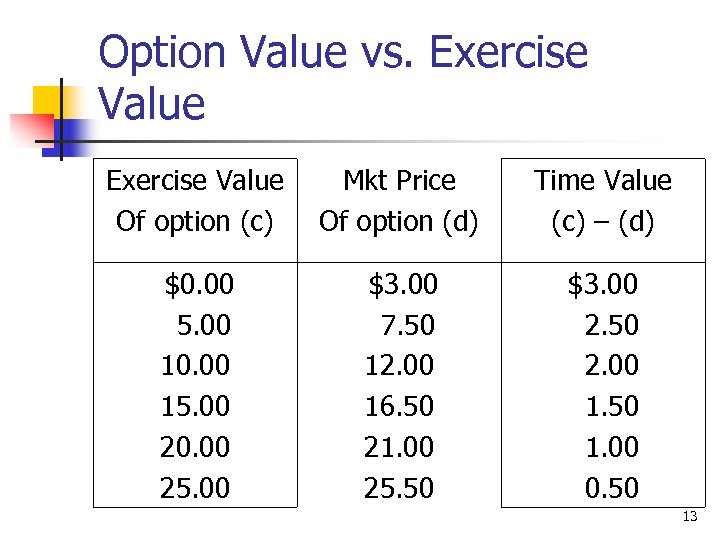 Option Value vs. Exercise Value Of option (c) Mkt Price Of option (d) Time Value (c) – (d) $0. 00 5. 00 10. 00 15. 00 20. 00 25. 00 $3. 00 7. 50 12. 00 16. 50 21. 00 25. 50 $3. 00 2. 50 2. 00 1. 50 1. 00 0. 50 13
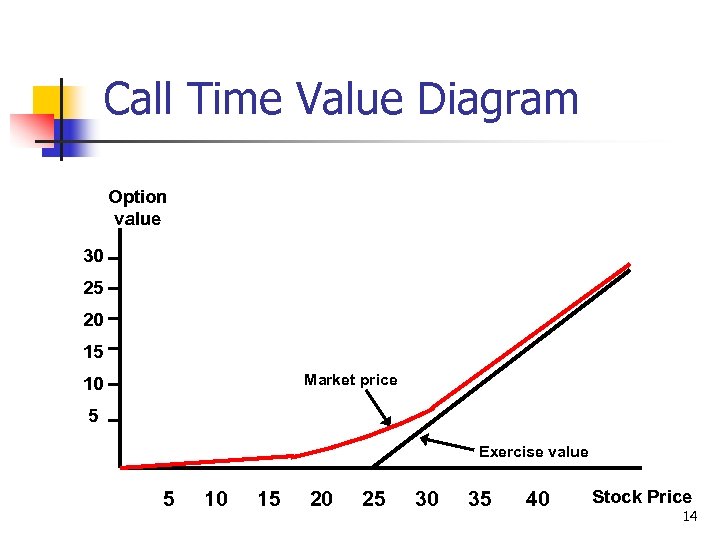 Call Time Value Diagram Option value 30 25 20 15 Market price 10 5 Exercise value 5 10 15 20 25 30 35 40 Stock Price 14
 Option Time Value Versus Exercise Value n n The time value, which is the option price less its exercise value, declines as the stock price increases. This is due to the declining degree of leverage provided by options as the underlying stock price increases, and the greater loss potential of options at higher option prices. 15
 Assumptions of the Black-Scholes Option Pricing Model? n n n The stock underlying the call option provides no dividends during the call option’s life. There are no transactions costs for the sale/purchase of either the stock or the option. RRF is known and constant during the option’s life. (More. . . ) 16
 Assumptions (Continued) n n Security buyers may borrow any fraction of the purchase price at the short-term risk-free rate. No penalty for short selling and sellers receive immediately full cash proceeds at today’s price. Call option can be exercised only on its expiration date. Security trading takes place in continuous time, and stock prices move randomly in continuous time. 17
![What are three equations that make up the OPM? V = P[N(d 1)] -](https://present5.com/presentation/3a0b9c5bdcfca37af546105bbf5b3992/image-18.jpg "What are three equations that make up the OPM? V = P[N(d 1)] -") What are three equations that make up the OPM? V = P[N(d 1)] - Xe -r t[N(d 2)] RF d 1 = ln(P/X) + [r. RF + ( 2/2)]t t 0. 5 d 2 = d 1 - t 0. 5 18
What are three equations that make up the OPM? V = P[N(d 1)] - Xe -r t[N(d 2)] RF d 1 = ln(P/X) + [r. RF + ( 2/2)]t t 0. 5 d 2 = d 1 - t 0. 5 18
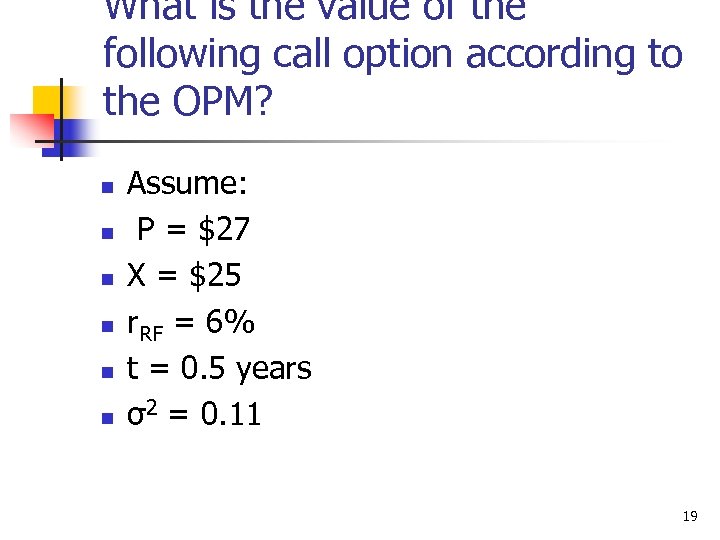 What is the value of the following call option according to the OPM? n n n Assume: P = $27 X = $25 r. RF = 6% t = 0. 5 years σ2 = 0. 11 19
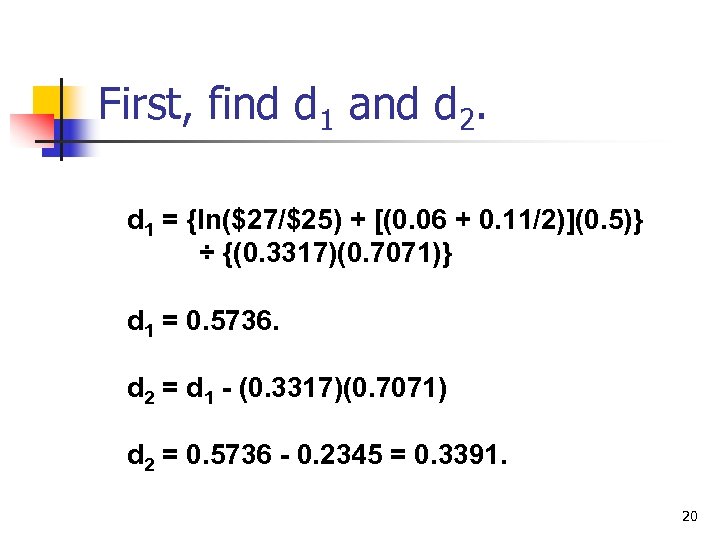 First, find d 1 and d 2. d 1 = {ln($27/$25) + [(0. 06 + 0. 11/2)](0. 5)} ÷ {(0. 3317)(0. 7071)} d 1 = 0. 5736. d 2 = d 1 - (0. 3317)(0. 7071) d 2 = 0. 5736 - 0. 2345 = 0. 3391. 20
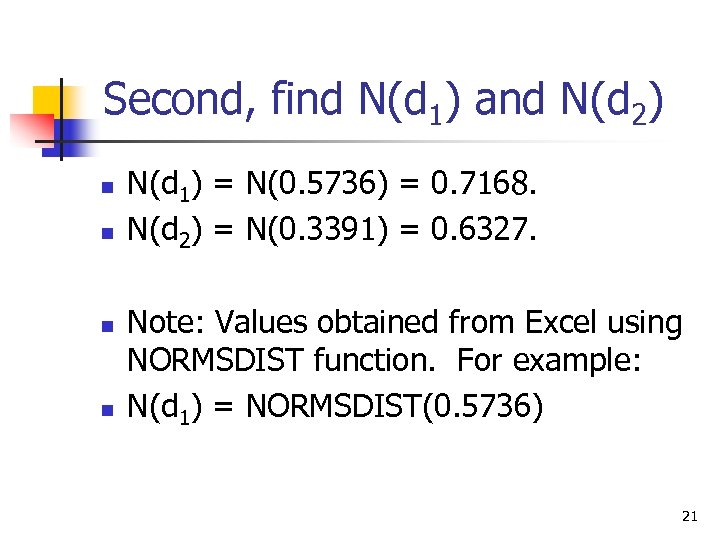 Second, find N(d 1) and N(d 2) n n N(d 1) = N(0. 5736) = 0. 7168. N(d 2) = N(0. 3391) = 0. 6327. Note: Values obtained from Excel using NORMSDIST function. For example: N(d 1) = NORMSDIST(0. 5736) 21
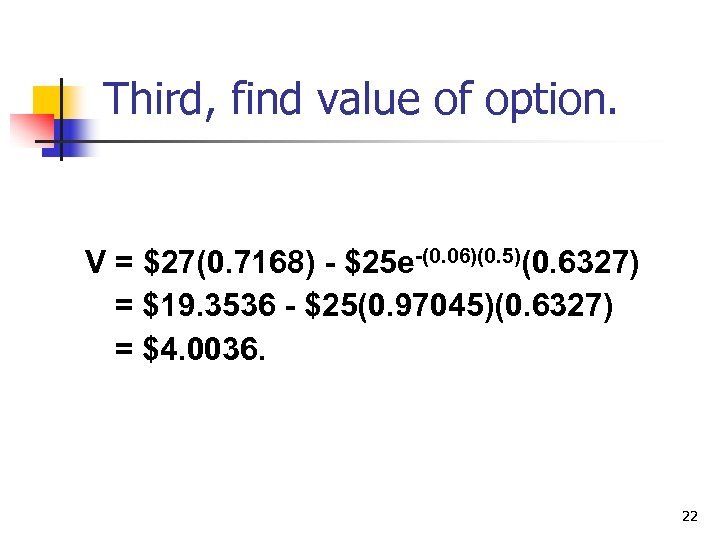 Third, find value of option. V = $27(0. 7168) - $25 e-(0. 06)(0. 5)(0. 6327) = $19. 3536 - $25(0. 97045)(0. 6327) = $4. 0036. 22
 What impact do the following parameters have on a call option’s value? n n Current stock price: Call option value increases as the current stock price increases. Exercise price: As the exercise price increases, a call option’s value decreases. 23
 Impact on Call Value (Continued) n n n Option period: As the expiration date is lengthened, a call option’s value increases (more chance of becoming in the money. ) Risk-free rate: Call option’s value tends to increase as r. RF increases (reduces the PV of the exercise price). Stock return variance: Option value increases with variance of the underlying stock (more chance of becoming in the money). 24
 Put Options n A put option gives its holder the right to sell a share of stock at a specified stock on or before a particular date. 25
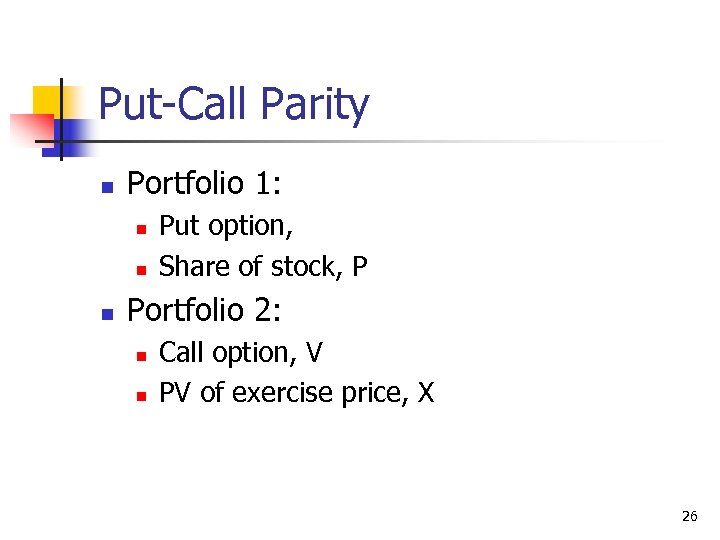 Put-Call Parity n Portfolio 1: n n n Put option, Share of stock, P Portfolio 2: n n Call option, V PV of exercise price, X 26
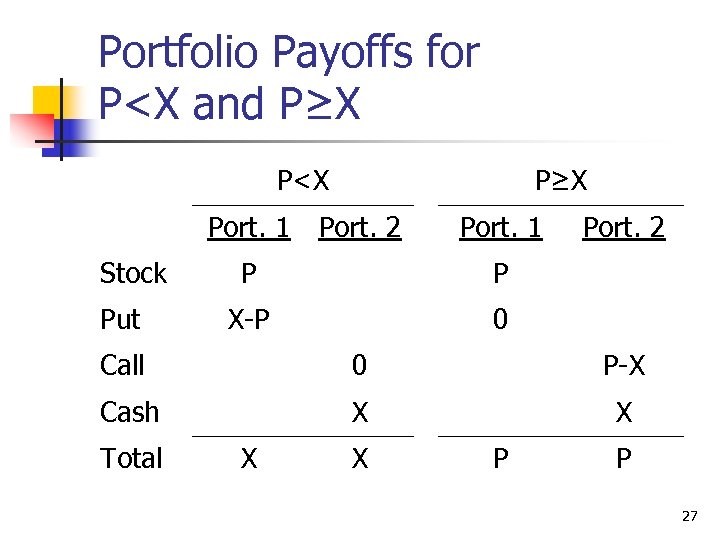 Portfolio Payoffs for P
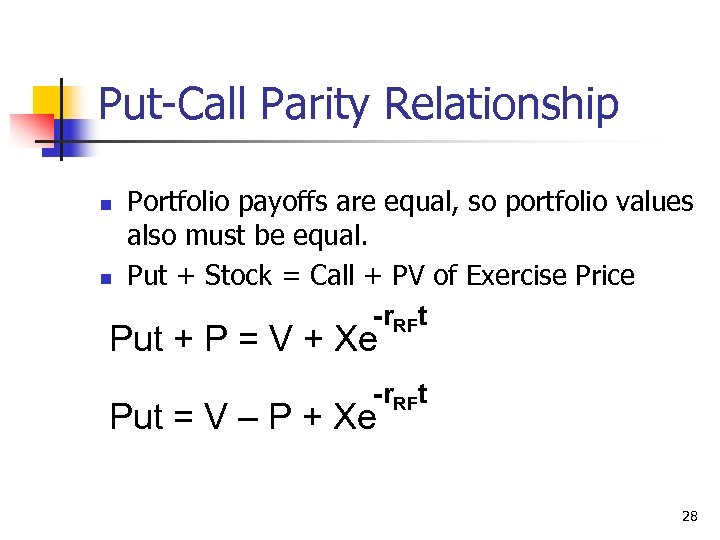 Put-Call Parity Relationship n n Portfolio payoffs are equal, so portfolio values also must be equal. Put + Stock = Call + PV of Exercise Price -r. RFt Put + P = V + Xe -r. RFt Put = V – P + Xe 28