


 Скачать презентацию Chapter 6 Educating Customers and Promoting the Value
06bbf48f3d53787ada9de2e01436c523.ppt
- Количество слайдов: 34
 Chapter 6 Educating Customers and Promoting the Value Proposition Copyright © 2008 Pearson Education Canada Services Marketing, Canadian Edition Chapter 6 - 1
 Learning Objectives - Chapter 6 § Reveal the distinctive nature of marketing communications for services § Setting communication objectives § Study the communications mix § Clarify the role of corporate design § Ascertain the potential value of internet Copyright © 2008 Pearson Education Canada Services Marketing, Canadian Edition Chapter 6 - 2
 Communicating Services Presents Both Challenges and Opportunities Copyright © 2008 Pearson Education Canada Services Marketing, Canadian Edition Chapter 6 - 3
 Difference between communications strategies of services and goods § Implications of intangibility in service performances § Customers are involved in production § Role of customer-contact personnel § Difficulty of evaluating many services § Need to bring supply and demand into balance Copyright © 2008 Pearson Education Canada Services Marketing, Canadian Edition Chapter 6 - 4
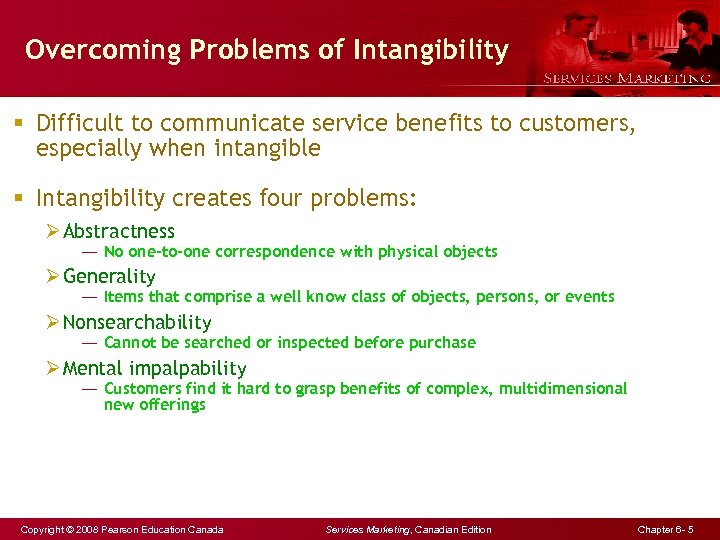 Overcoming Problems of Intangibility § Difficult to communicate service benefits to customers, especially when intangible § Intangibility creates four problems: Ø Abstractness ― No one-to-one correspondence with physical objects Ø Generality ― Items that comprise a well know class of objects, persons, or events Ø Nonsearchability ― Cannot be searched or inspected before purchase Ø Mental impalpability ― Customers find it hard to grasp benefits of complex, multidimensional new offerings Copyright © 2008 Pearson Education Canada Services Marketing, Canadian Edition Chapter 6 - 5
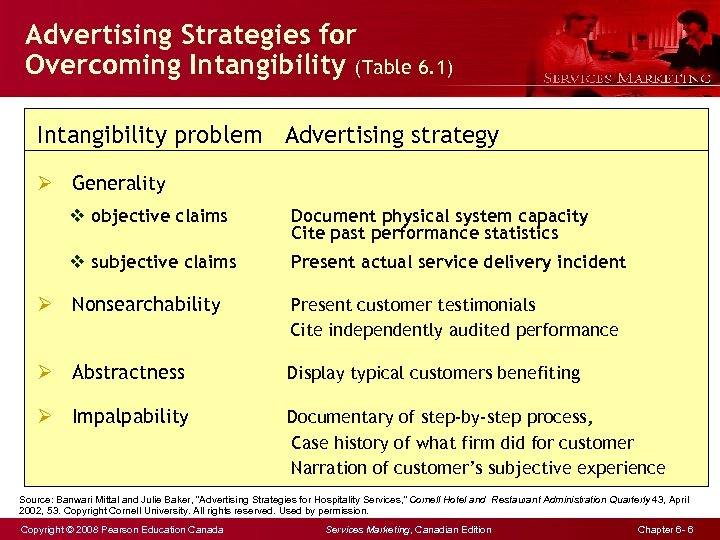 Advertising Strategies for Overcoming Intangibility (Table 6. 1) Intangibility problem Advertising strategy Ø Generality v objective claims Document physical system capacity Cite past performance statistics v subjective claims Present actual service delivery incident Ø Nonsearchability Present customer testimonials Cite independently audited performance Ø Abstractness Display typical customers benefiting Ø Impalpability Documentary of step-by-step process, Case history of what firm did for customer Narration of customer’s subjective experience Source: Banwari Mittal and Julie Baker, “Advertising Strategies for Hospitality Services, ” Cornell Hotel and Restaurant Administration Quarterly 43, April 2002, 53. Copyright Cornell University. All rights reserved. Used by permission. Copyright © 2008 Pearson Education Canada Services Marketing, Canadian Edition Chapter 6 - 6
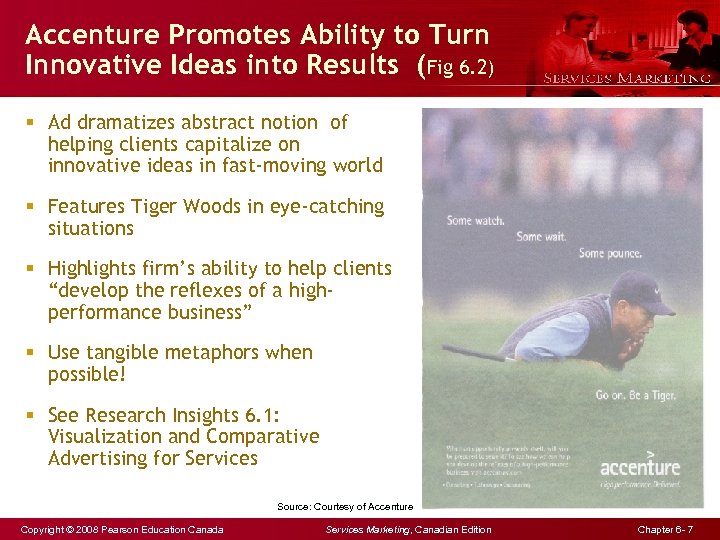 Accenture Promotes Ability to Turn Innovative Ideas into Results (Fig 6. 2) § Ad dramatizes abstract notion of helping clients capitalize on innovative ideas in fast-moving world § Features Tiger Woods in eye-catching situations § Highlights firm’s ability to help clients “develop the reflexes of a highperformance business” § Use tangible metaphors when possible! § See Research Insights 6. 1: Visualization and Comparative Advertising for Services Source: Courtesy of Accenture Copyright © 2008 Pearson Education Canada Services Marketing, Canadian Edition Chapter 6 - 7
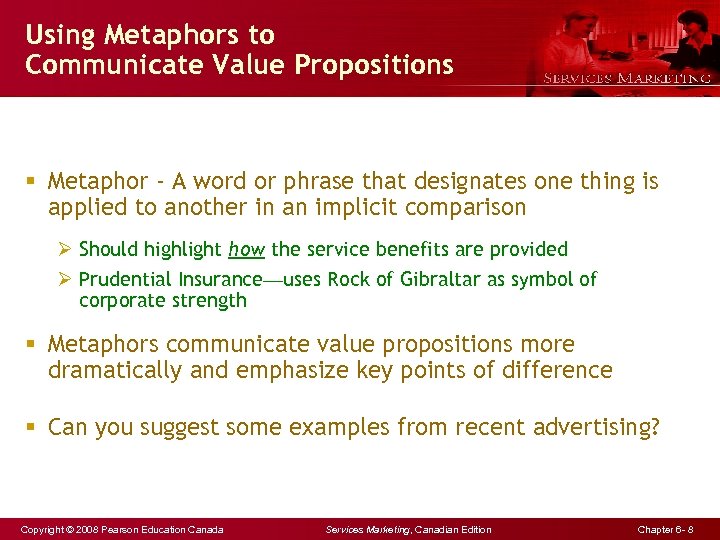 Using Metaphors to Communicate Value Propositions § Metaphor - A word or phrase that designates one thing is applied to another in an implicit comparison Ø Should highlight how the service benefits are provided Ø Prudential Insurance—uses Rock of Gibraltar as symbol of corporate strength § Metaphors communicate value propositions more dramatically and emphasize key points of difference § Can you suggest some examples from recent advertising? Copyright © 2008 Pearson Education Canada Services Marketing, Canadian Edition Chapter 6 - 8
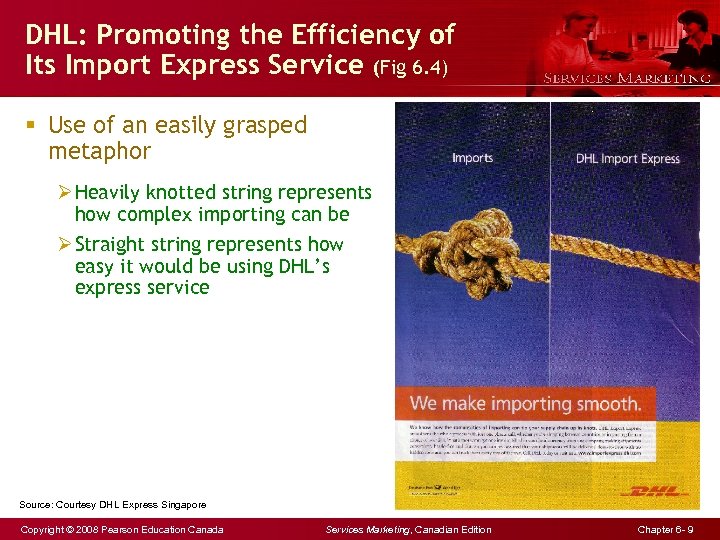 DHL: Promoting the Efficiency of Its Import Express Service (Fig 6. 4) § Use of an easily grasped metaphor Ø Heavily knotted string represents how complex importing can be Ø Straight string represents how easy it would be using DHL’s express service Source: Courtesy DHL Express Singapore Copyright © 2008 Pearson Education Canada Services Marketing, Canadian Edition Chapter 6 - 9
 Facilitate Customer Involvement in Production § When customers are actively involved in service production, they need training to perform well § Show service delivery in action § Television and videos engage viewer Ø Dentists showing patients videos of surgical procedures before surgery § Streaming videos on Web and podcasts are new channels to reach active customers § Advertising and publicity can make customers aware of changes in service features and delivery systems in b 2 b and b 2 c contexts Ø Sales promotions to help change customer behaviour ― Offer incentives to make necessary changes ― Price discounts to encourage self-service on an ongoing basis Copyright © 2008 Pearson Education Canada Services Marketing, Canadian Edition Chapter 6 - 10
 Help Customers to Evaluate Service Offerings § Customers may have difficulty distinguishing one firm from another Ø Provide tangible clues related to service performance § Some performance attributes lend themselves better to advertising than others Ø Airlines ― Boast about punctuality ― Do not talk overtly in advertising about safety, admission that things might go wrong make prospective travelers nervous ― Use indirect approach: promote pilot expertise, mechanic’s maintenance skills, newness of aircraft § Firm’s expertise is hidden in low-contact services Ø Need to illustrate equipment, procedures, employee activities that take place backstage Copyright © 2008 Pearson Education Canada Services Marketing, Canadian Edition Chapter 6 - 11
 Stimulate or Dampen Demand to Match Capacity § Live service performances are time-specific and can’t be stored for resale at a later date Ø For example, seats for Friday evening’s performance; haircut at Supercuts on Tuesdays Ø Advertising and sales promotions can change timing of customer use § Examples of demand management strategies Ø Reducing usage during peak demand periods Ø Stimulating demand during off-peak period, for example: ― Run promotions that offer extra value—room upgrades, free breakfast Copyright © 2008 Pearson Education Canada Services Marketing, Canadian Edition Chapter 6 - 12
 Promote the Contributions of Service Personnel § Frontline personnel are central to service delivery in highcontact services Ø Make the service more tangible and personalized Ø Advertise employees at work to help customers understand nature of service encounter § Show customers work performed behind the scenes to ensure good delivery Ø To enhance trust, highlight expertise and commitment of employees whom customers normally do not normally encounter Ø Advertisements must be realistic Ø Messages help set customers’ expectations Ø Service personnel should be informed about the content of new advertising campaigns or brochures before launch Copyright © 2008 Pearson Education Canada Services Marketing, Canadian Edition Chapter 6 - 13
 Setting Communication Objectives Copyright © 2008 Pearson Education Canada Services Marketing, Canadian Edition Chapter 6 - 14
 Checklist for Marketing Communications Planning: The “ 5 Ws” Model § Who is our target audience? § What do we need to communicate and achieve? § How should we communicate this? § Where should we communicate this? § When do communications need to take place? Copyright © 2008 Pearson Education Canada Services Marketing, Canadian Edition Chapter 6 - 15
 Target audience and communications objectives § Connect to target audience Ø First time users – advertising, public relations, direct marketing Ø Existing users – contact personnel and point of sale promotions Ø Employees – secondary audience in front stage roles § Specify clear communications objectives, select most appropriate messages and communications tools to achieve (Table 6. 2) § Key planning considerations Ø Know your service product, how buyers evaluate and their exposure to different media Ø Determine the content, structure, style of message and best media Ø Budget, timing and measurement system Copyright © 2008 Pearson Education Canada Services Marketing, Canadian Edition Chapter 6 - 16
 The Marketing Communications Mix Copyright © 2008 Pearson Education Canada Services Marketing, Canadian Edition Chapter 6 - 17
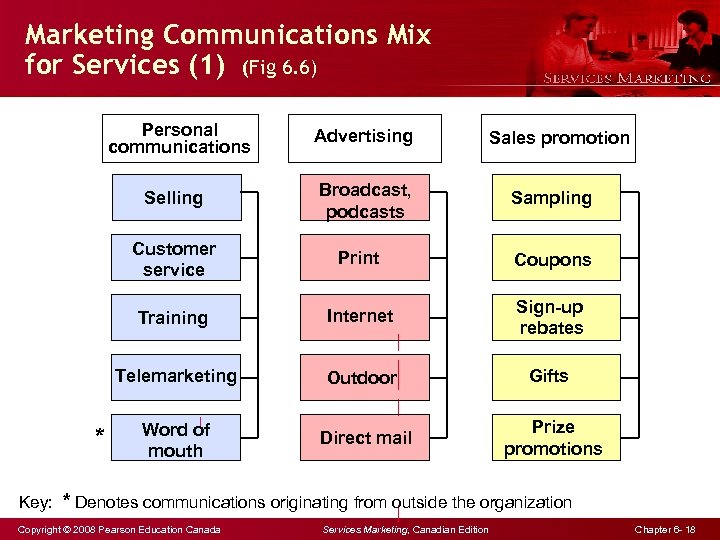 Marketing Communications Mix for Services (1) (Fig 6. 6) Personal communications Selling Advertising Broadcast, podcasts Sales promotion Sampling Customer service Coupons Training Internet Sign-up rebates Telemarketing * Print Outdoor Gifts Direct mail Prize promotions Word of (other customers) mouth Word-of-mouth Key: * Denotes communications originating from outside the organization Copyright © 2008 Pearson Education Canada Services Marketing, Canadian Edition Chapter 6 - 18
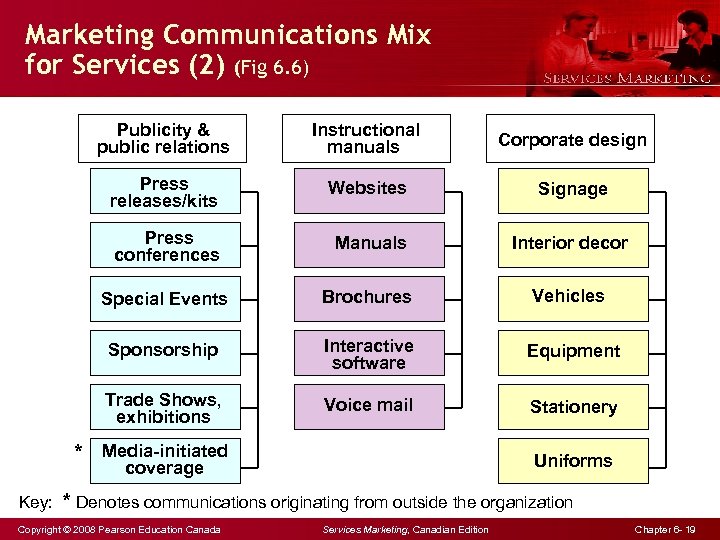 Marketing Communications Mix for Services (2) (Fig 6. 6) Publicity & public relations Corporate design Press releases/kits Websites Signage Press conferences Manuals Interior decor Special Events Brochures Vehicles Sponsorship Interactive software Equipment Trade Shows, exhibitions * Instructional manuals Voice mail Stationery Media-initiated coverage Uniforms Key: * Denotes communications originating from outside the organization Copyright © 2008 Pearson Education Canada Services Marketing, Canadian Edition Chapter 6 - 19
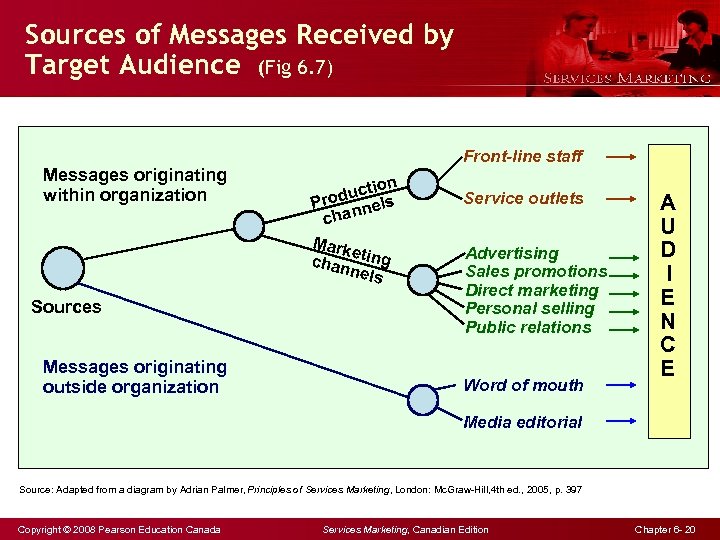 Sources of Messages Received by Target Audience (Fig 6. 7) Messages originating within organization Sources Messages originating outside organization Front-line staff ion duct ls Pro nne cha Mark e chan ting nels Service outlets Advertising Sales promotions Direct marketing Personal selling Public relations Word of mouth A U D I E N C E Media editorial Source: Adapted from a diagram by Adrian Palmer, Principles of Services Marketing, London: Mc. Graw-Hill, 4 th ed. , 2005, p. 397 Copyright © 2008 Pearson Education Canada Services Marketing, Canadian Edition Chapter 6 - 20
 Message Transmission (1) § Through Productions Channels - Developed within organization and transmitted through production channels that deliver the service itself Ø Knowledgeable, empathetic front-line staff, programs providing customer training, and imbedding messages in the service environment § Through Marketing Channels – Traditional tools of personal selling, account management programs, trade shows, advertising, direct marketing, sales promotion, public relations Copyright © 2008 Pearson Education Canada Services Marketing, Canadian Edition Chapter 6 - 21
 Message Transmission (2) § Through Messages Originating Outside the Organization – Very influential and powerful Ø Word of Mouth (WOM) - more credible than firm’s messaging. Customers rely on it when making high risk decisions Ø Blogs – On line journals where people can post their point of view, bloggers can become de factor watch dogs, links enable information sharing Ø Editorial Coverage – editorial coverage about a company initiated by broadcasters and publishers Copyright © 2008 Pearson Education Canada Services Marketing, Canadian Edition Chapter 6 - 22
 Role of Corporate Design Copyright © 2008 Pearson Education Canada Services Marketing, Canadian Edition Chapter 6 - 23
 Strategies for Corporate Design § Many service firms employ a unified and distinctive visual appearance for all tangible elements to reinforce the brand Ø For example, logos, uniforms, physical facilities § Provide a recognizable theme linking all the firm’s operations § Use of trademarked symbol as primary logo, with name secondary Ø Shell’s yellow scallop shell on a red background Ø Mac. Donald’s “Golden Arches” Copyright © 2008 Pearson Education Canada Services Marketing, Canadian Edition Chapter 6 - 24
 Marketing Communications and the Internet Copyright © 2008 Pearson Education Canada Services Marketing, Canadian Edition Chapter 6 - 25
 Internet Marketing Offers Powerful Opportunities for Interactivity § Internet used for a variety of communications tasks § Can market through firm’s own websites or advertise on other sites § Needs to be part of integrated, well-designed communications strategy § Able to establish rapport with individual customers § Contain useful, interesting information for target customers § Facilitate self-service in information gathering Copyright © 2008 Pearson Education Canada Services Marketing, Canadian Edition Chapter 6 - 26
 Website Design Considerations § Firms must set explicit communication goals for websites § Design should address attributes that affect website “stickiness” Ø Content quality Ø Ease of use Ø Speed of download Ø Frequency of update § Memorable web address helps attract visitors to a site Ø Ensure that people are aware of/can guess firm’s web address Copyright © 2008 Pearson Education Canada Services Marketing, Canadian Edition Chapter 6 - 27
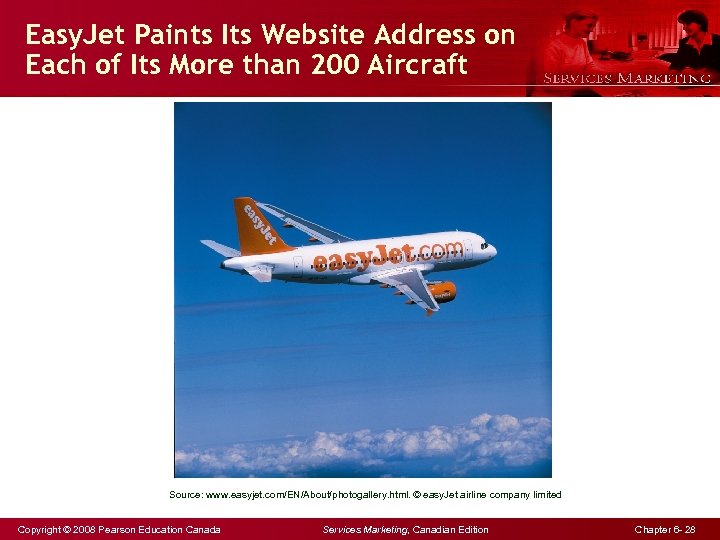 Easy. Jet Paints Its Website Address on Each of Its More than 200 Aircraft Source: www. easyjet. com/EN/About/photogallery. html. © easy. Jet airline company limited Copyright © 2008 Pearson Education Canada Services Marketing, Canadian Edition Chapter 6 - 28
 Effective Advertising on Internet: Banner Advertising (1) § Placing advertising banners and buttons on portals such as Yahoo!, Netscape and other firms’ websites § Draw online traffic to the advertiser’s own site § Websites often include advertisements of other related, but non-competing services Ø Advertisements for financial service providers on Yahoo!’s stock quotes page Ø Small messages from Amazon. com on web pages devoted to a specific topic Ø Links relevant to e-mail content on GMail Copyright © 2008 Pearson Education Canada Services Marketing, Canadian Edition Chapter 6 - 29
 Effective Advertising on Internet: Banner Advertising (2) § Easy for advertisers to measure how many visits to its own website are generated by click-throughs § Limitations Ø Obtaining many exposures (“eyeballs”) to a banner does not necessarily lead to increase in awareness, preference, or sales Ø Problem of fraudulent click-throughs designed to boost apparent effectiveness Copyright © 2008 Pearson Education Canada Services Marketing, Canadian Edition Chapter 6 - 30
 Effective Advertising on Internet: Search Engine Advertising (1) § Reverse broadcast network—search engines let advertisers know exactly what consumer wants through their keyword search § Can target relevant messages directly to desired consumers § Several advertising options Ø Pay for targeted placement of ads to relevant keyword searches Ø Sponsor a short text message with a click-through link Ø Buy top rankings in the display of search results Copyright © 2008 Pearson Education Canada Services Marketing, Canadian Edition Chapter 6 - 31
 Effective Advertising on Internet: Search Engine Advertising (2) § Google – The New Online Marketing Powerhouse Ø Google Ad. Words—allows businesses to connect with potential customers at the precise moment when they are looking at related topics; advertisers can display their ads at websites that are part of the Google content network Ø Google Ad. Sense—In return for displaying relevant Google ads on their websites, publishers receive a share of advertising revenue generated § See Service Perspectives 6. 2: Google: The Online Marketing Powerhouse Copyright © 2008 Pearson Education Canada Services Marketing, Canadian Edition Chapter 6 - 32
 Developing an Integrated Marketing Communications Strategy § Isolating online marketing activities from other marketing activities may result in conflicting message Ø Customers will not have a clear picture of a firm’s positioning and value proposition § IMC ties together and reinforces all communications to deliver a strong brand identity § Communications in different media should form part of a single, overall message about the service firm (need consistency within campaigns about specific service products targeted at specific segments) Copyright © 2008 Pearson Education Canada Services Marketing, Canadian Edition Chapter 6 - 33
 Summary – Chapter 6 § Service communication differs from goods communications as follows: Ø Service product is intangible Ø Employees have customer influence Ø Customers are involved in production Ø They have difficulties evaluating the service Ø Marketers need to balance supply and demand § There are four ways to work with the issues of intangibility in addition to using metaphors § The “ 5 W’s” model works for communications setting § The communications mix is very rich including additional areas such as instruction manuals, corporate design and Word of Mouth § The communications mix is also concerned with where the messages are being transmitted § The internet offers great opportunities for interaction and advertising § All of this needs a good integrated communications strategy Copyright © 2008 Pearson Education Canada Services Marketing, Canadian Edition Chapter 6 - 34