


 Скачать презентацию Chapter 6 Discounted Cash Flow Valuation Mc
1607c0f9ab951891764da83075128ef2.ppt
- Количество слайдов: 45
 Chapter 6 • Discounted Cash Flow Valuation Mc. Graw-Hill/Irwin Copyright © 2006 by The Mc. Graw-Hill Companies, Inc. All rights reserved.
 Chapter Outline • Future and Present Values of Multiple Cash Flows: Annuities and Perpetuities • Comparing Rates: The Effective Annual Rate • Loan Types and Loan Amortization 6 -1
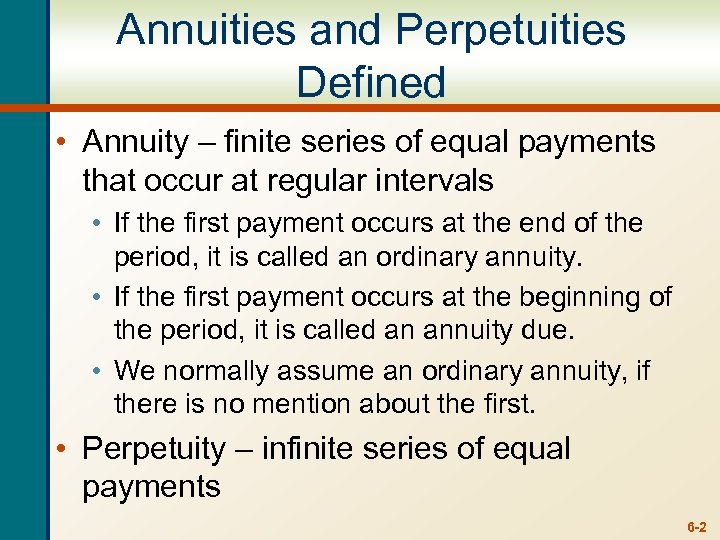 Annuities and Perpetuities Defined • Annuity – finite series of equal payments that occur at regular intervals • If the first payment occurs at the end of the period, it is called an ordinary annuity. • If the first payment occurs at the beginning of the period, it is called an annuity due. • We normally assume an ordinary annuity, if there is no mention about the first. • Perpetuity – infinite series of equal payments 6 -2
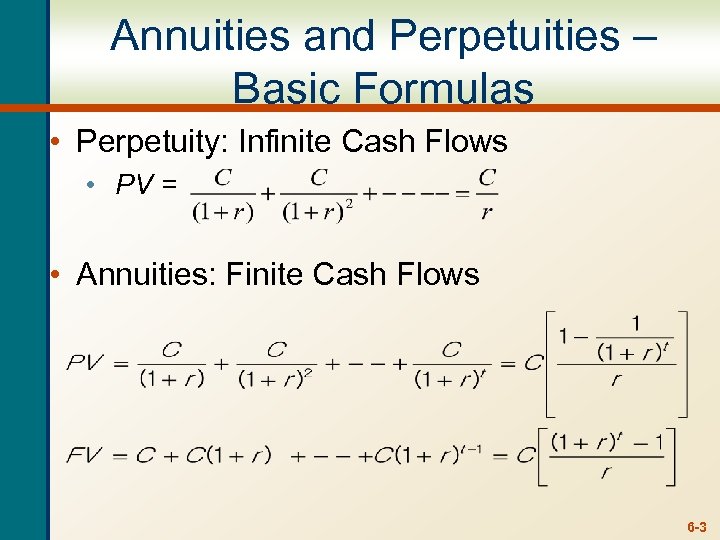 Annuities and Perpetuities – Basic Formulas • Perpetuity: Infinite Cash Flows • PV = • Annuities: Finite Cash Flows 6 -3
 Annuity – Example 6. 5 • You can afford to pay $632 per month for 48 months. The current interest rate is 1% per month. How much can you borrow from the bank given your financial ability? In other words, what is present value of your future cash flows? Assume an ordinary annuity. 6 -4
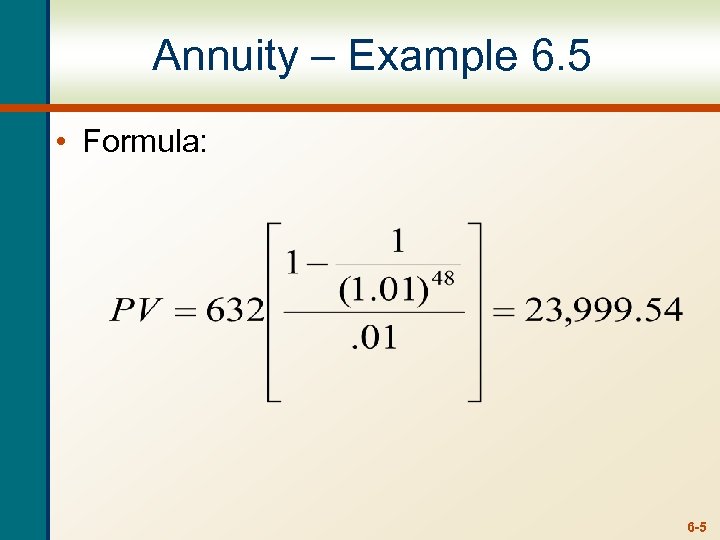 Annuity – Example 6. 5 • Formula: 6 -5
 Annuity – Sweepstakes Example • Suppose you win the Publishers Clearinghouse $10 million sweepstakes. The money is paid in equal annual installments of $333, 333. 33 over 30 years. If the appropriate discount rate is 5%, how much is the sweepstakes actually worth today? • PV = 333, 333. 33[1 – 1/1. 0530] /. 05 = 5, 124, 150. 29 6 -6
 Buying a House (Mortgage) • You are ready to buy a house and you have $20, 000 for a down payment and closing costs. Closing costs are estimated to be 4% of the loan value. You have an annual salary of $36, 000 and the bank is willing to allow your monthly mortgage payment to be equal to 28% of your monthly income. The interest rate on the loan is 6% per year with monthly compounding (. 5% per month) for a 30 -year fixed rate loan. 1. How much money will the bank loan you? Maximum loan the bank offer to you is present value of your multiple cash flows. You will monthly pay $840 to the bank for 30 years. Monthly interest rate is 0. 005. 2. How much can you offer for the house? Since closing costs are like brokerage fees, they are not included in the house price. 6 -7
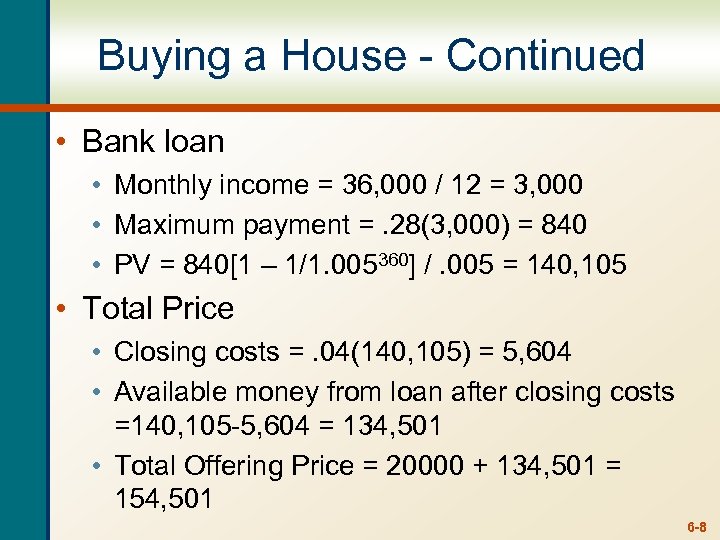 Buying a House - Continued • Bank loan • Monthly income = 36, 000 / 12 = 3, 000 • Maximum payment =. 28(3, 000) = 840 • PV = 840[1 – 1/1. 005360] /. 005 = 140, 105 • Total Price • Closing costs =. 04(140, 105) = 5, 604 • Available money from loan after closing costs =140, 105 -5, 604 = 134, 501 • Total Offering Price = 20000 + 134, 501 = 154, 501 6 -8
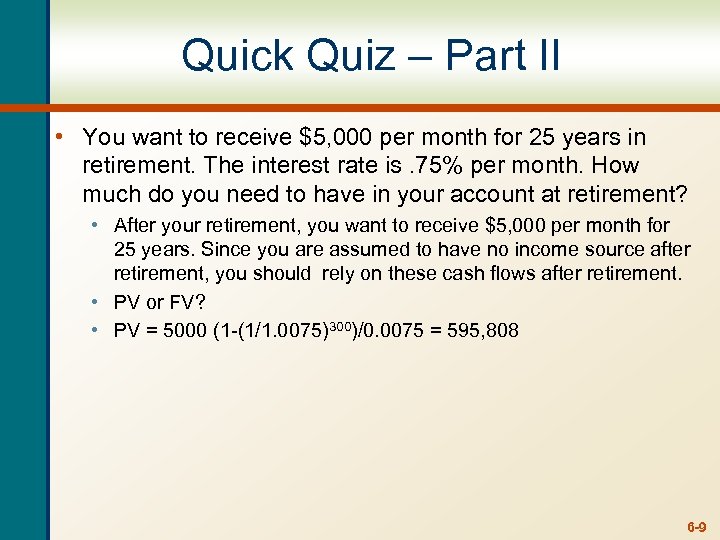 Quick Quiz – Part II • You want to receive $5, 000 per month for 25 years in retirement. The interest rate is. 75% per month. How much do you need to have in your account at retirement? • After your retirement, you want to receive $5, 000 per month for 25 years. Since you are assumed to have no income source after retirement, you should rely on these cash flows after retirement. • PV or FV? • PV = 5000 (1 -(1/1. 0075)300)/0. 0075 = 595, 808 6 -9
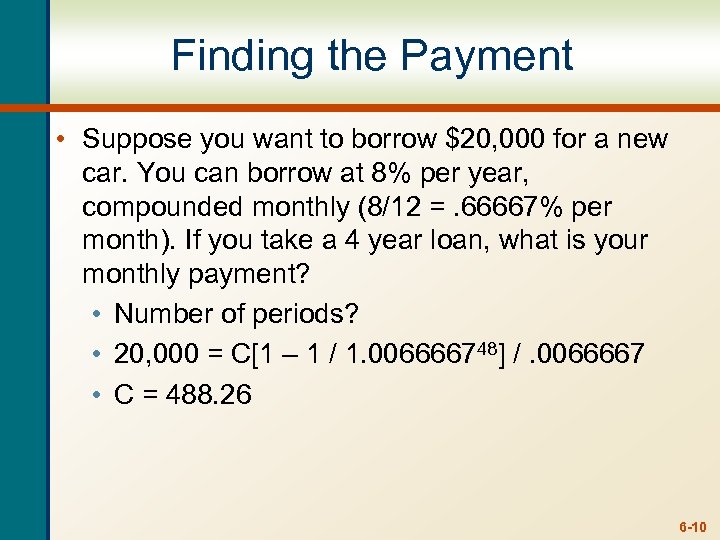 Finding the Payment • Suppose you want to borrow $20, 000 for a new car. You can borrow at 8% per year, compounded monthly (8/12 =. 66667% per month). If you take a 4 year loan, what is your monthly payment? • Number of periods? • 20, 000 = C[1 – 1 / 1. 006666748] /. 0066667 • C = 488. 26 6 -10
 Finding the Number of Payments – Example 6. 6 • You have $1, 000 loan on your credit card. You can only afford to make the minimum payment $20 per month. The interest rate on the credit card is 1. 5% per month. How long will you need to pay off the $1, 000? 6 -11
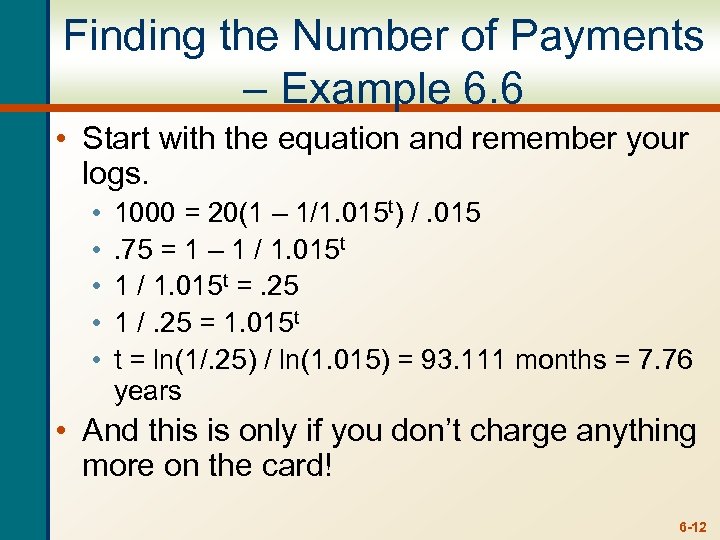 Finding the Number of Payments – Example 6. 6 • Start with the equation and remember your logs. • • • 1000 = 20(1 – 1/1. 015 t) /. 015. 75 = 1 – 1 / 1. 015 t =. 25 1 /. 25 = 1. 015 t t = ln(1/. 25) / ln(1. 015) = 93. 111 months = 7. 76 years • And this is only if you don’t charge anything more on the card! 6 -12
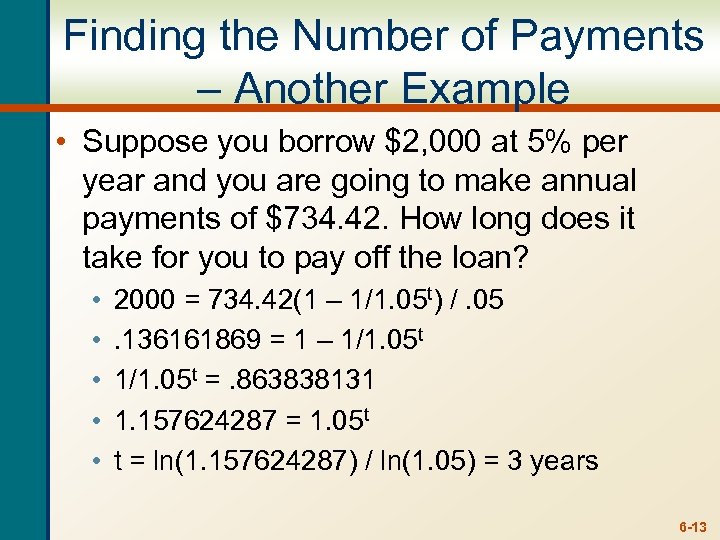 Finding the Number of Payments – Another Example • Suppose you borrow $2, 000 at 5% per year and you are going to make annual payments of $734. 42. How long does it take for you to pay off the loan? • • • 2000 = 734. 42(1 – 1/1. 05 t) /. 05. 136161869 = 1 – 1/1. 05 t =. 863838131 1. 157624287 = 1. 05 t t = ln(1. 157624287) / ln(1. 05) = 3 years 6 -13
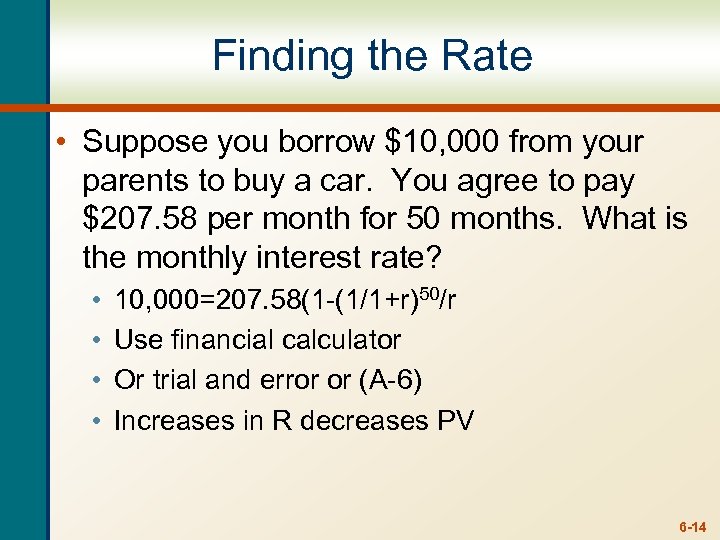 Finding the Rate • Suppose you borrow $10, 000 from your parents to buy a car. You agree to pay $207. 58 per month for 50 months. What is the monthly interest rate? • • 10, 000=207. 58(1 -(1/1+r)50/r Use financial calculator Or trial and error or (A-6) Increases in R decreases PV 6 -14
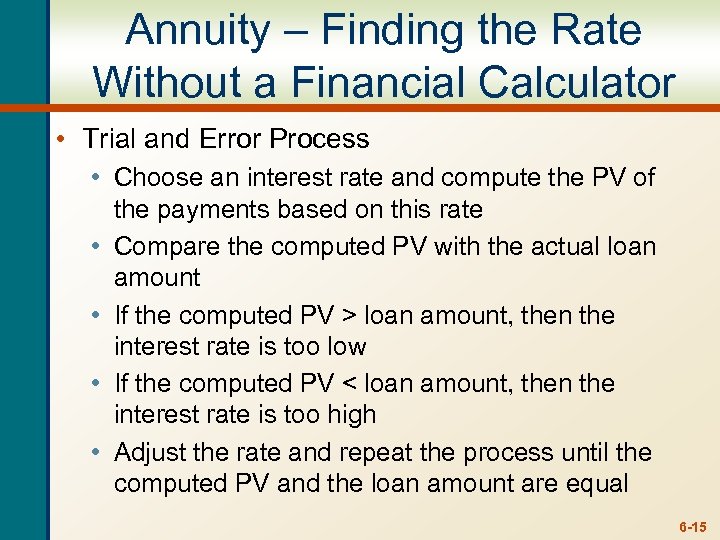 Annuity – Finding the Rate Without a Financial Calculator • Trial and Error Process • Choose an interest rate and compute the PV of the payments based on this rate • Compare the computed PV with the actual loan amount • If the computed PV > loan amount, then the interest rate is too low • If the computed PV < loan amount, then the interest rate is too high • Adjust the rate and repeat the process until the computed PV and the loan amount are equal 6 -15
 Quick Quiz – Part III • You want to receive $5, 000 per month for the next 5 years. How much would you need to deposit today if you can earn. 75% per month? • Suppose you have $200, 000 to deposit and can earn. 75% per month. • How many months could you receive the $5, 000 payment? • How much could you receive every month for 5 years? 6 -16
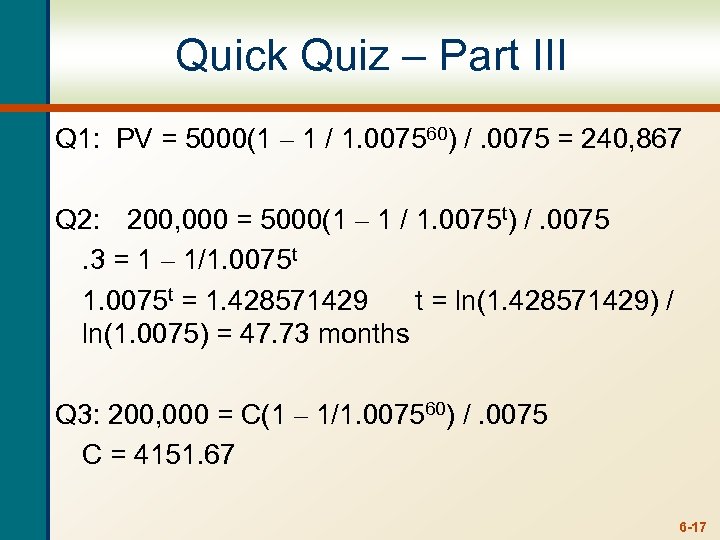 Quick Quiz – Part III Q 1: PV = 5000(1 – 1 / 1. 007560) /. 0075 = 240, 867 Q 2: 200, 000 = 5000(1 – 1 / 1. 0075 t) /. 0075. 3 = 1 – 1/1. 0075 t = 1. 428571429 t = ln(1. 428571429) / ln(1. 0075) = 47. 73 months Q 3: 200, 000 = C(1 – 1/1. 007560) /. 0075 C = 4151. 67 6 -17
 Future Values for Annuities • Suppose you begin saving for your retirement by depositing $2, 000 per year in an IRA. If the interest rate is 7. 5%, how much will you have in 40 years? • FV = 2000(1. 07540 – 1)/. 075 = 454, 513. 04 6 -18
 Annuity Due • You are saving for a new house and you put $10, 000 per year in an account paying 8%. The first payment is made today and the last payment is made at the beginning of 3 years. 1. How much will you have at the end of 3 years? • FV = 10, 000[(1. 083 – 1) /. 08](1. 08) = 35, 061. 12 2. What is PV of your total payment? 6 -19
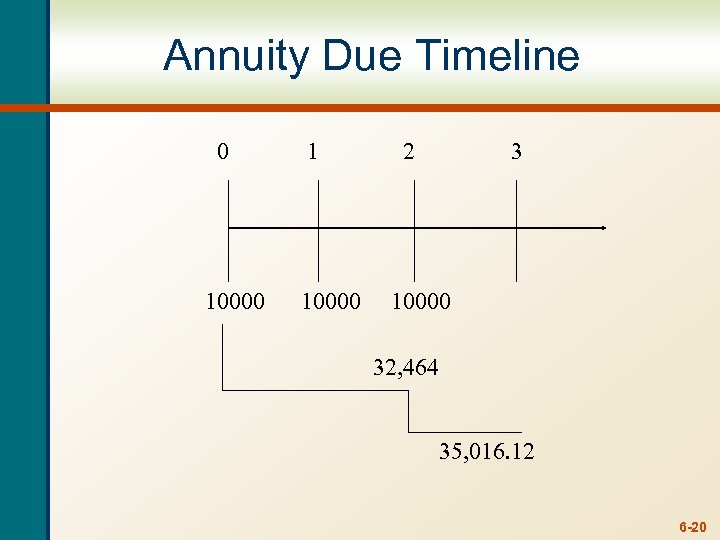 Annuity Due Timeline 0 10000 1 10000 2 3 10000 32, 464 35, 016. 12 6 -20
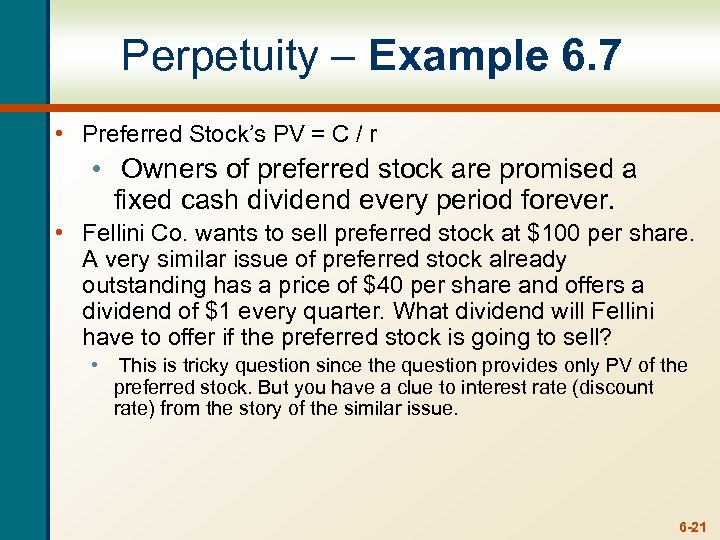 Perpetuity – Example 6. 7 • Preferred Stock’s PV = C / r • Owners of preferred stock are promised a fixed cash dividend every period forever. • Fellini Co. wants to sell preferred stock at $100 per share. A very similar issue of preferred stock already outstanding has a price of $40 per share and offers a dividend of $1 every quarter. What dividend will Fellini have to offer if the preferred stock is going to sell? • This is tricky question since the question provides only PV of the preferred stock. But you have a clue to interest rate (discount rate) from the story of the similar issue. 6 -21
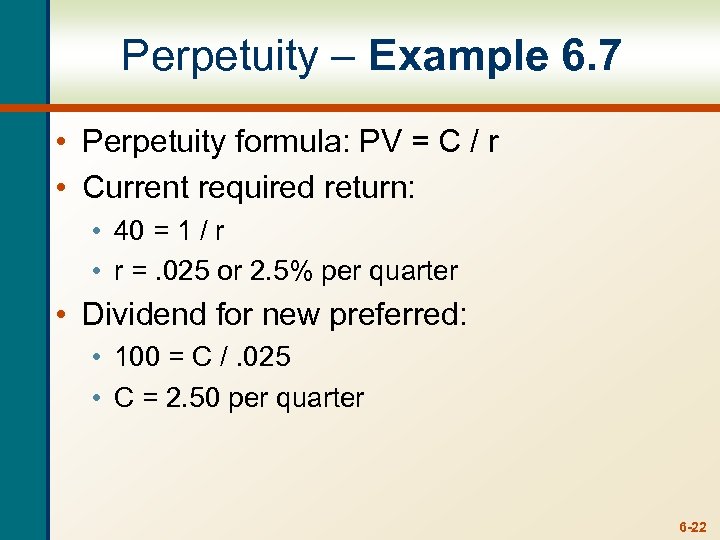 Perpetuity – Example 6. 7 • Perpetuity formula: PV = C / r • Current required return: • 40 = 1 / r • r =. 025 or 2. 5% per quarter • Dividend for new preferred: • 100 = C /. 025 • C = 2. 50 per quarter 6 -22
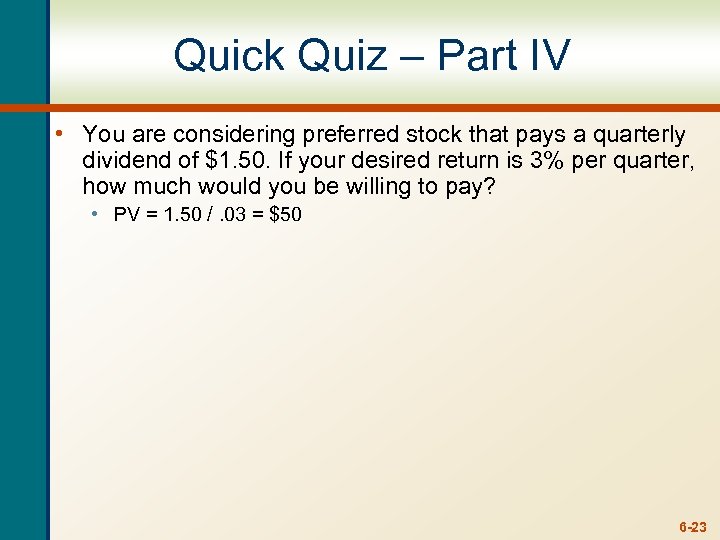 Quick Quiz – Part IV • You are considering preferred stock that pays a quarterly dividend of $1. 50. If your desired return is 3% per quarter, how much would you be willing to pay? • PV = 1. 50 /. 03 = $50 6 -23
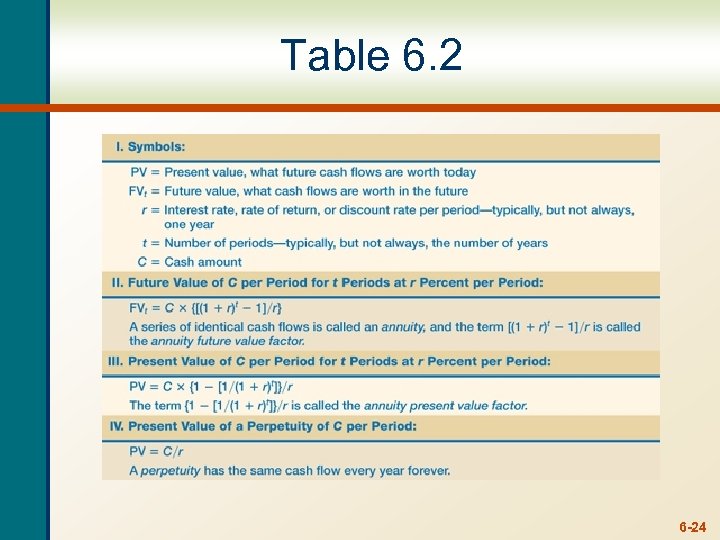 Table 6. 2 6 -24
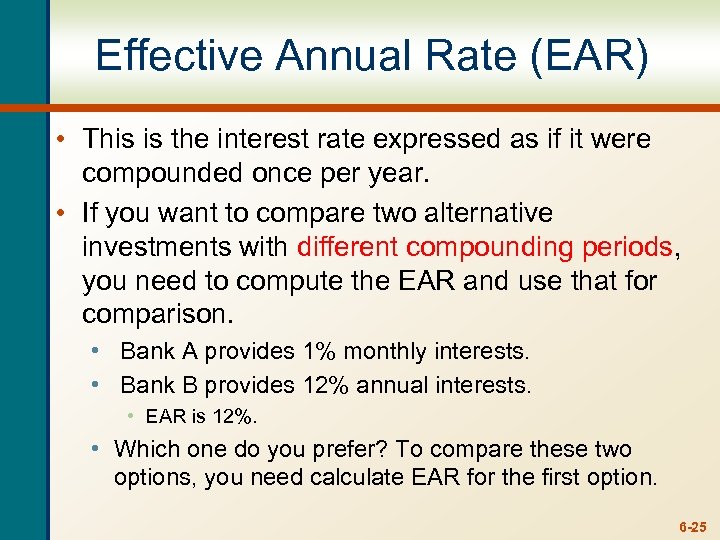 Effective Annual Rate (EAR) • This is the interest rate expressed as if it were compounded once per year. • If you want to compare two alternative investments with different compounding periods, you need to compute the EAR and use that for comparison. • Bank A provides 1% monthly interests. • Bank B provides 12% annual interests. • EAR is 12%. • Which one do you prefer? To compare these two options, you need calculate EAR for the first option. 6 -25
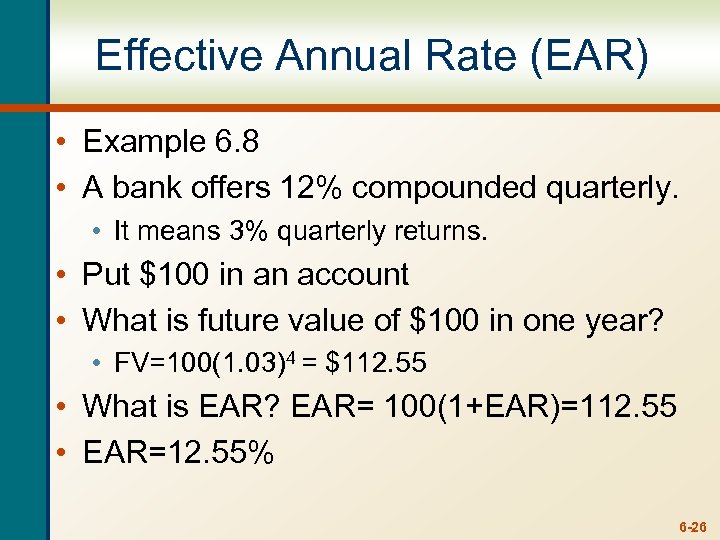 Effective Annual Rate (EAR) • Example 6. 8 • A bank offers 12% compounded quarterly. • It means 3% quarterly returns. • Put $100 in an account • What is future value of $100 in one year? • FV=100(1. 03)4 = $112. 55 • What is EAR? EAR= 100(1+EAR)=112. 55 • EAR=12. 55% 6 -26
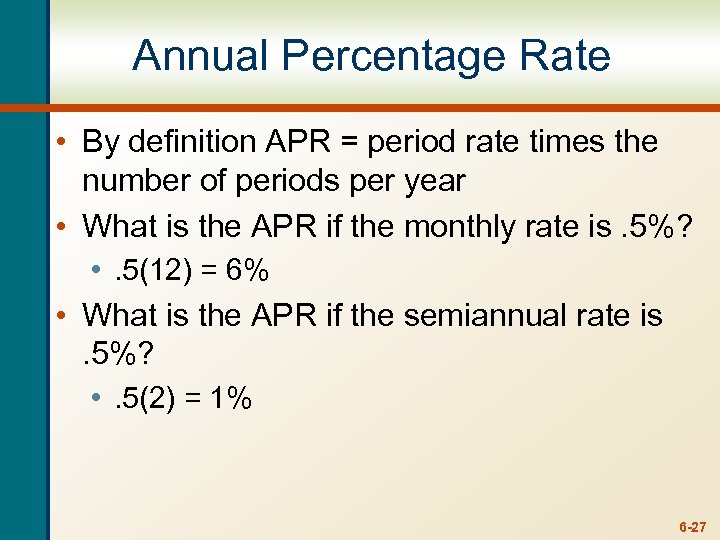 Annual Percentage Rate • By definition APR = period rate times the number of periods per year • What is the APR if the monthly rate is. 5%? • . 5(12) = 6% • What is the APR if the semiannual rate is. 5%? • . 5(2) = 1% 6 -27
 Computing APRs • Consequently, to get the period rate we rearrange the APR equation: • Period rate = APR / number of periods per year • You should NEVER divide the effective rate by the number of periods per year – it will NOT give you the period rate • What is the monthly rate if the APR is 12%? • 12 / 12 = 1% 6 -28
 EAR versus APR • • • Example 6. 10 APR=18%, Monthly payments are required. What is EAR? EAR=(1+(0. 18/12))12 – 1=0. 1956 EAR=19. 56% 6 -29
 Things to Remember • You ALWAYS need to make sure that the interest rate and the time period match. • If you are looking at annual periods, you need an annual rate. • If you are looking at monthly periods, you need a monthly rate. 6 -30
 Computing EARs - Example • Suppose you can earn 1% per month on $1 invested today. • What is the APR? 1(12) = 12% • How much are you effectively earning? • FV = 1(1. 01)12 = 1. 1268 • EAR = (1. 1268 – 1) =. 1268 = 12. 68% • Suppose if you put it in another account, you earn 3% per quarter. • What is the APR? 3(4) = 12% • How much are you effectively earning? • FV = 1(1. 03)4 = 1. 1255 • EAR = (1. 1255 – 1) =. 1255 = 12. 55% 6 -31
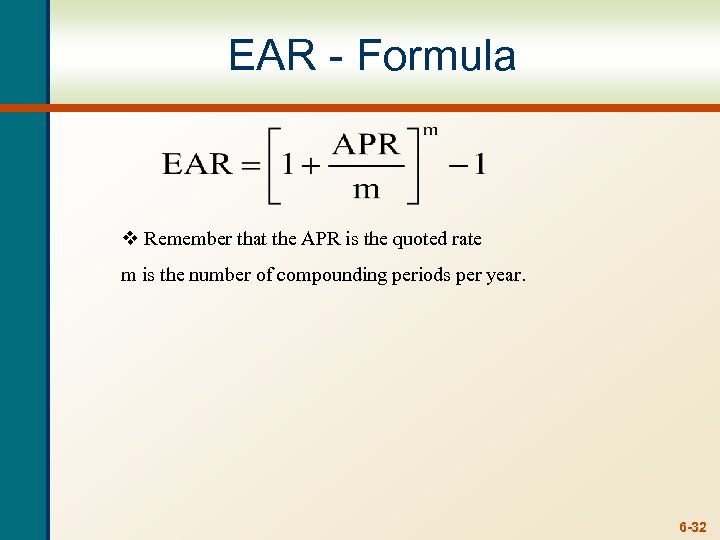 EAR - Formula v Remember that the APR is the quoted rate m is the number of compounding periods per year. 6 -32
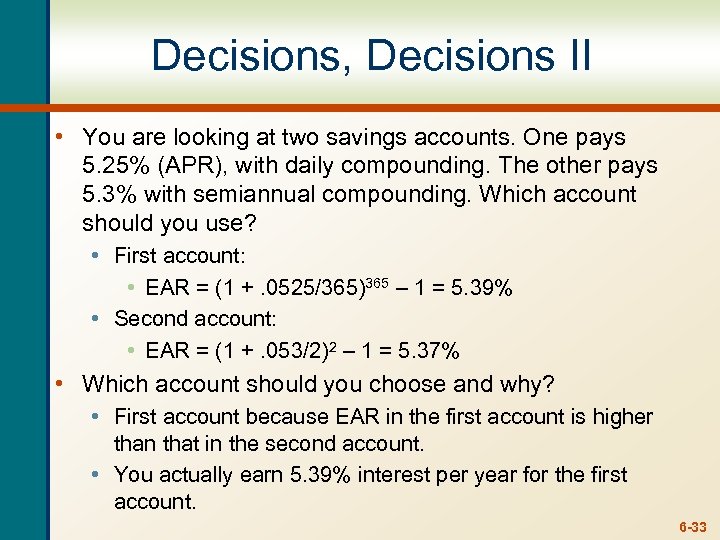 Decisions, Decisions II • You are looking at two savings accounts. One pays 5. 25% (APR), with daily compounding. The other pays 5. 3% with semiannual compounding. Which account should you use? • First account: • EAR = (1 +. 0525/365)365 – 1 = 5. 39% • Second account: • EAR = (1 +. 053/2)2 – 1 = 5. 37% • Which account should you choose and why? • First account because EAR in the first account is higher than that in the second account. • You actually earn 5. 39% interest per year for the first account. 6 -33
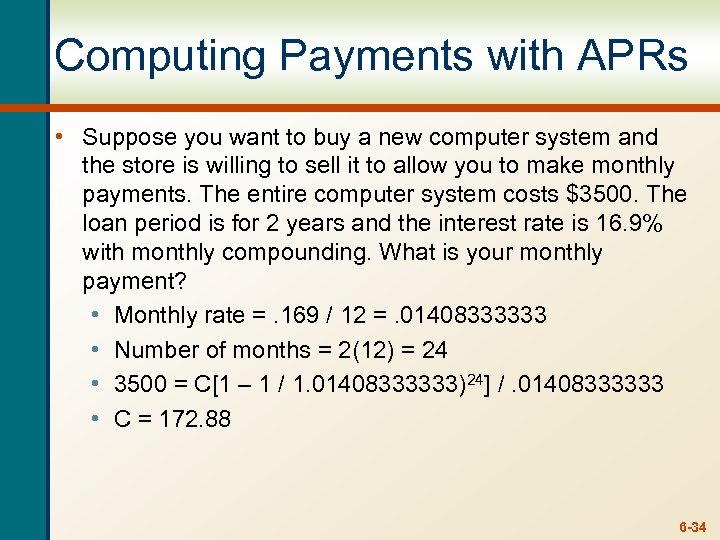 Computing Payments with APRs • Suppose you want to buy a new computer system and the store is willing to sell it to allow you to make monthly payments. The entire computer system costs $3500. The loan period is for 2 years and the interest rate is 16. 9% with monthly compounding. What is your monthly payment? • Monthly rate =. 169 / 12 =. 01408333333 • Number of months = 2(12) = 24 • 3500 = C[1 – 1 / 1. 01408333333)24] /. 01408333333 • C = 172. 88 6 -34
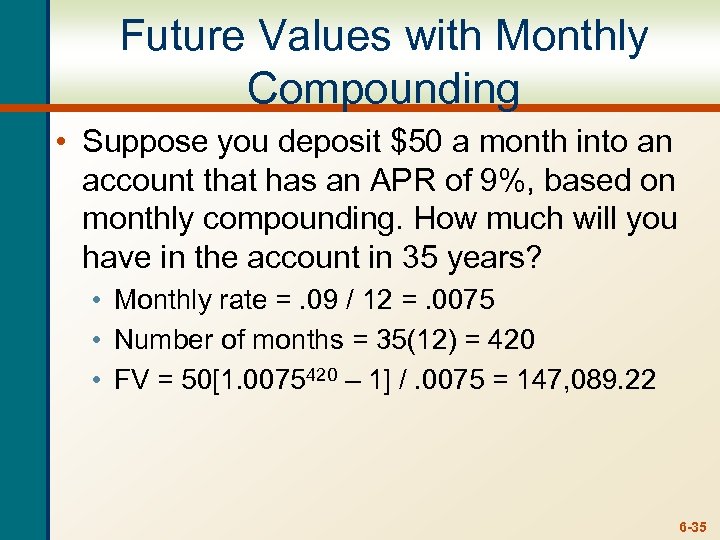 Future Values with Monthly Compounding • Suppose you deposit $50 a month into an account that has an APR of 9%, based on monthly compounding. How much will you have in the account in 35 years? • Monthly rate =. 09 / 12 =. 0075 • Number of months = 35(12) = 420 • FV = 50[1. 0075420 – 1] /. 0075 = 147, 089. 22 6 -35
 Quick Quiz – Part V • What is the definition of an APR? • What is the effective annual rate? • Which rate should you use to compare alternative investments or loans? • Which rate do you need to use to calculate the time value of money? • To get period rate, we need to use APR. • For monthly rate, period rate = APR/12 • For quarterly rate, period rate = APR/4 6 -38
 Pure Discount Loans – Example 6. 12 • Treasury bills are excellent examples of pure discount loans. The principal amount is repaid at some future date, without any periodic interest payments. • If a T-bill promises to repay $10, 000 in one year and the market interest rate is 7 percent per year, how much will the bill sell for in the market? • PV = 10, 000 / 1. 07 = 9345. 79 6 -39
 Interest-Only Loan - Example • Consider a 5 -year, interest-only loan with a 7% interest rate. The principal amount of $10, 000 will be repaid in 5 years. Interest is paid annually. • What would the stream of cash flows be? • Years 1 through 4: Interest payments of. 07(10, 000) = 700 • Year 5: Interest + principal = 10, 700 • This cash flow stream is similar to the cash flows on corporate bonds and we will talk about them in greater detail later. • What is PV of Interest Only Loan if the discount rate is 9%? • PV = 700 (1 - 1/(1. 09)5 )/0. 09+ 10, 000/(1. 09)5 6 -40
 Amortized Loans • A lender requires a borrower to repay parts of the loan amount (principal) over time • $ 5, 000 five year amortized loan • Interest rate is 9%. The loan agreement calls for borrower to pay the interest on the loan annually and to reduce the loan by $1, 000. • What is FV of the amortized loans in 5 years? 6 -41
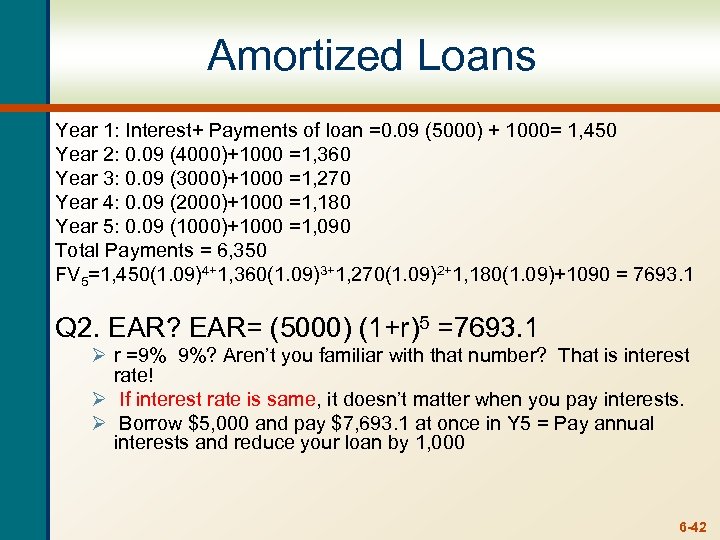 Amortized Loans Year 1: Interest+ Payments of loan =0. 09 (5000) + 1000= 1, 450 Year 2: 0. 09 (4000)+1000 =1, 360 Year 3: 0. 09 (3000)+1000 =1, 270 Year 4: 0. 09 (2000)+1000 =1, 180 Year 5: 0. 09 (1000)+1000 =1, 090 Total Payments = 6, 350 FV 5=1, 450(1. 09)4+1, 360(1. 09)3+1, 270(1. 09)2+1, 180(1. 09)+1090 = 7693. 1 Q 2. EAR? EAR= (5000) (1+r)5 =7693. 1 Ø r =9% 9%? Aren’t you familiar with that number? That is interest rate! Ø If interest rate is same, it doesn’t matter when you pay interests. Ø Borrow $5, 000 and pay $7, 693. 1 at once in Y 5 = Pay annual interests and reduce your loan by 1, 000 6 -42
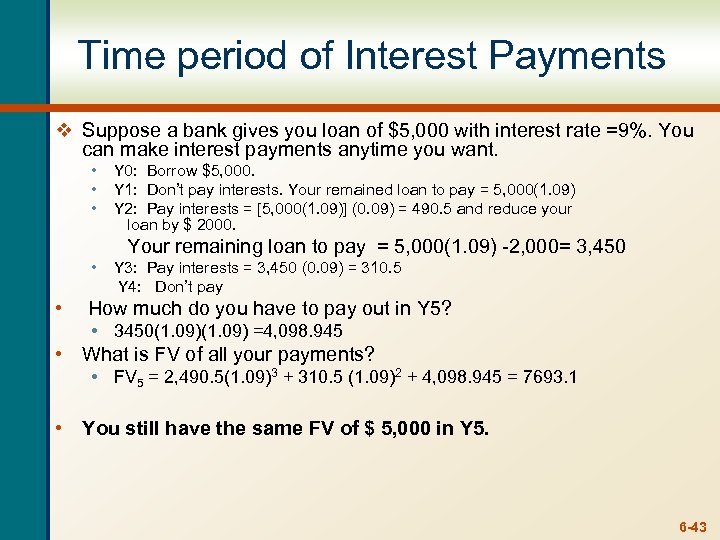 Time period of Interest Payments v Suppose a bank gives you loan of $5, 000 with interest rate =9%. You can make interest payments anytime you want. • • • Y 0: Borrow $5, 000. Y 1: Don’t pay interests. Your remained loan to pay = 5, 000(1. 09) Y 2: Pay interests = [5, 000(1. 09)] (0. 09) = 490. 5 and reduce your loan by $ 2000. Your remaining loan to pay = 5, 000(1. 09) -2, 000= 3, 450 • • Y 3: Pay interests = 3, 450 (0. 09) = 310. 5 Y 4: Don’t pay How much do you have to pay out in Y 5? • 3450(1. 09) =4, 098. 945 • What is FV of all your payments? • FV 5 = 2, 490. 5(1. 09)3 + 310. 5 (1. 09)2 + 4, 098. 945 = 7693. 1 • You still have the same FV of $ 5, 000 in Y 5. 6 -43
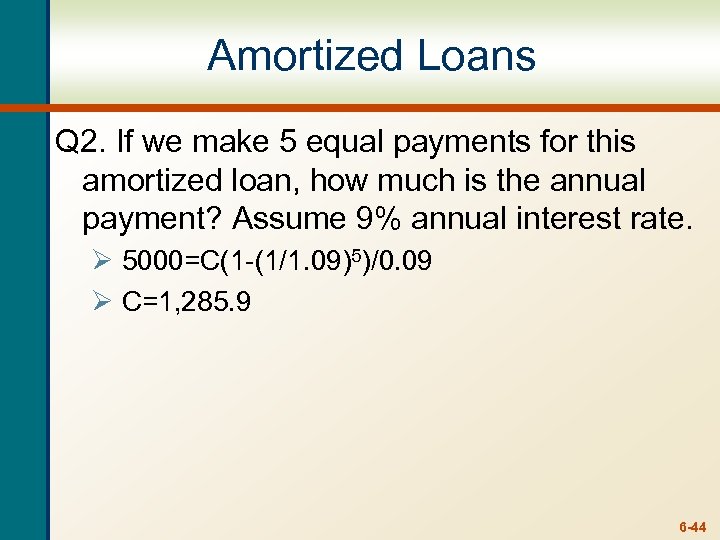 Amortized Loans Q 2. If we make 5 equal payments for this amortized loan, how much is the annual payment? Assume 9% annual interest rate. Ø 5000=C(1 -(1/1. 09)5)/0. 09 Ø C=1, 285. 9 6 -44
 Quick Quiz – Part VI • What is a pure discount loan? What is a good example of a pure discount loan? • What is an interest-only loan? What is a good example of an interest-only loan? • What is an amortized loan? What is a good example of an amortized loan? 6 -45
 Chapter 6 • End of Chapter Mc. Graw-Hill/Irwin Copyright © 2006 by The Mc. Graw-Hill Companies, Inc. All rights reserved.