


 Скачать презентацию Chapter 6 Design Patterns w w Creational Design
b22b201ee8828b6d2188eacd57e627cf.ppt
- Количество слайдов: 157
 Chapter 6 Design Patterns w w Creational Design Patterns Structural Design Patterns Behavioral Design Patterns Applying Design Patterns Object Oriented Analysis and Design 1
 Go. F Design Patterns Object Oriented Analysis and Design 2
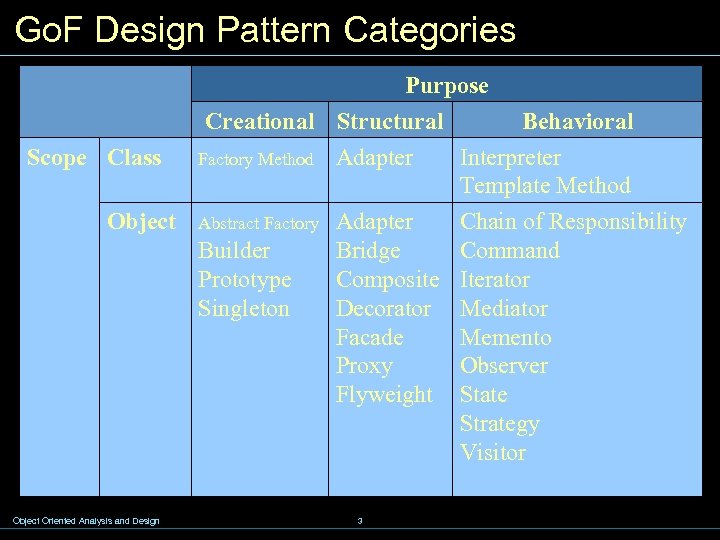 Go. F Design Pattern Categories Scope Class Object Purpose Creational Structural Behavioral Factory Method Adapter Interpreter Template Method Abstract Factory Builder Prototype Singleton Object Oriented Analysis and Design Adapter Bridge Composite Decorator Facade Proxy Flyweight 3 Chain of Responsibility Command Iterator Mediator Memento Observer State Strategy Visitor
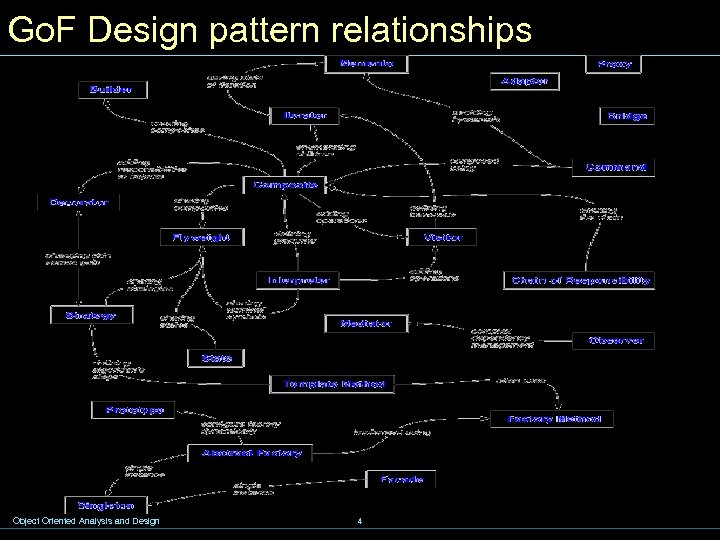 Go. F Design pattern relationships Object Oriented Analysis and Design 4
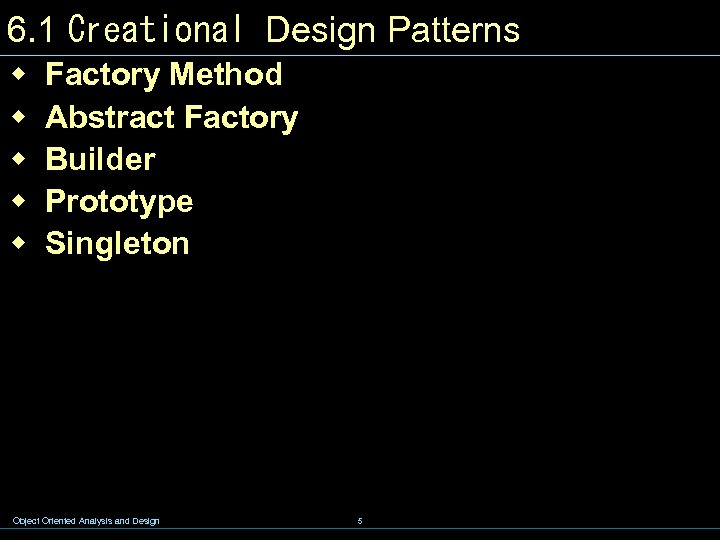 6. 1 Creational Design Patterns w w w Factory Method Abstract Factory Builder Prototype Singleton Object Oriented Analysis and Design 5
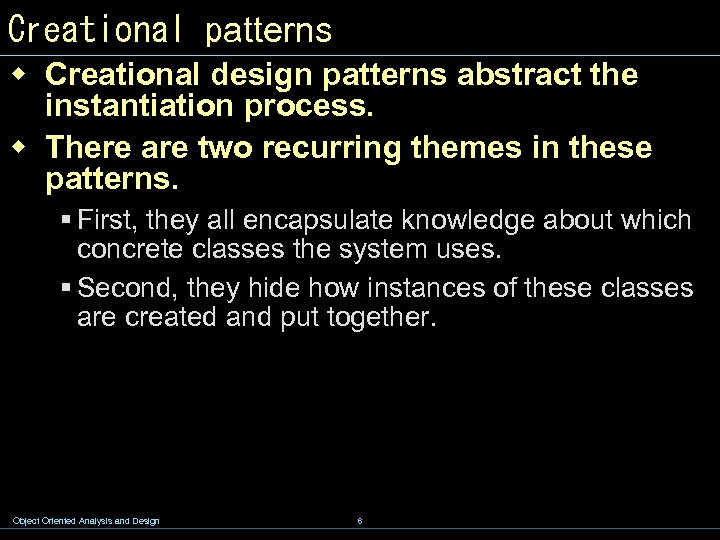 Creational patterns w Creational design patterns abstract the instantiation process. w There are two recurring themes in these patterns. § First, they all encapsulate knowledge about which concrete classes the system uses. § Second, they hide how instances of these classes are created and put together. Object Oriented Analysis and Design 6
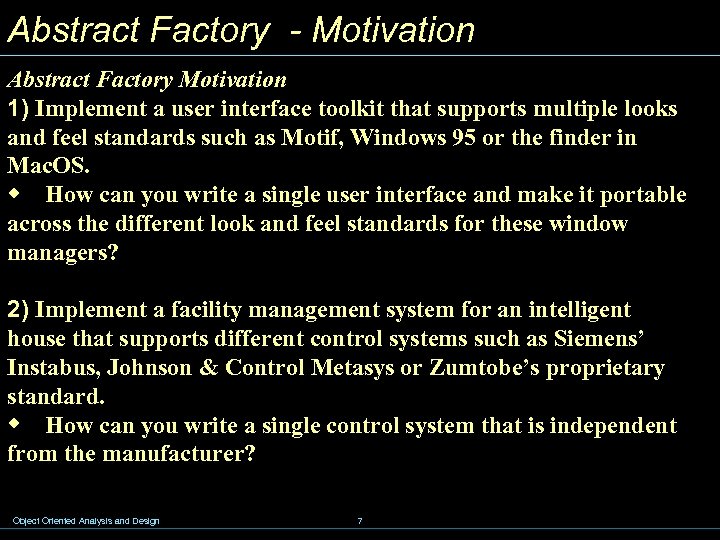 Abstract Factory - Motivation Abstract Factory Motivation 1) Implement a user interface toolkit that supports multiple looks and feel standards such as Motif, Windows 95 or the finder in Mac. OS. w How can you write a single user interface and make it portable across the different look and feel standards for these window managers? 2) Implement a facility management system for an intelligent house that supports different control systems such as Siemens’ Instabus, Johnson & Control Metasys or Zumtobe’s proprietary standard. w How can you write a single control system that is independent from the manufacturer? Object Oriented Analysis and Design 7
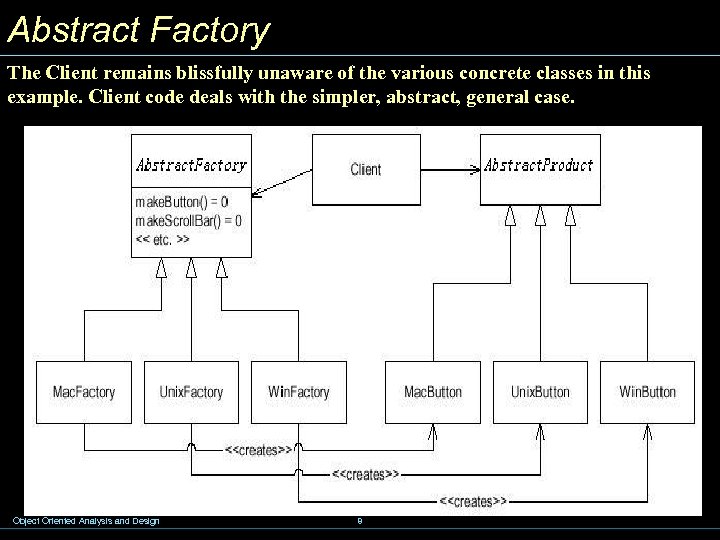 Abstract Factory The Client remains blissfully unaware of the various concrete classes in this example. Client code deals with the simpler, abstract, general case. Object Oriented Analysis and Design 8
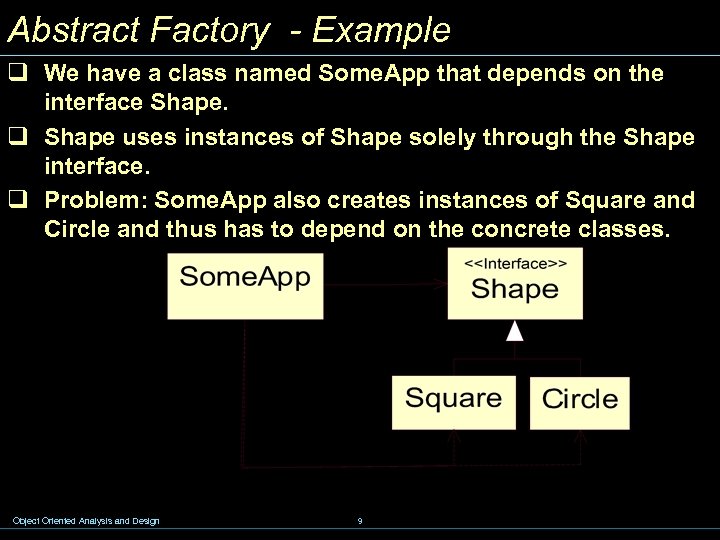 Abstract Factory - Example q We have a class named Some. App that depends on the interface Shape. q Shape uses instances of Shape solely through the Shape interface. q Problem: Some. App also creates instances of Square and Circle and thus has to depend on the concrete classes. Object Oriented Analysis and Design 9
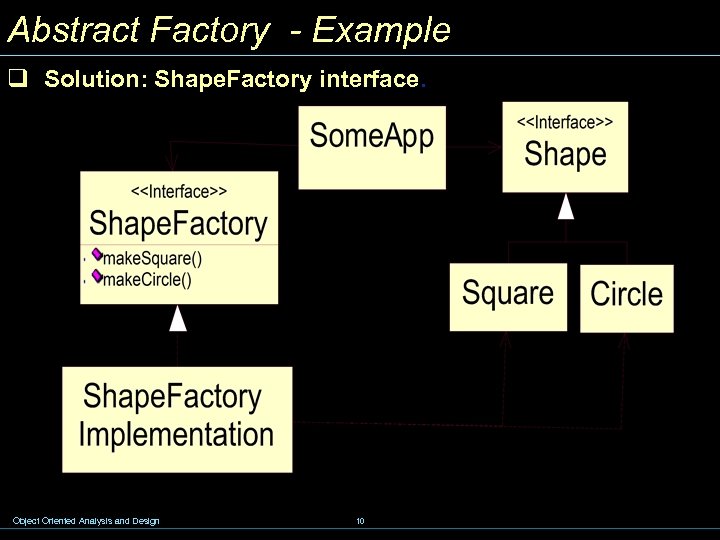 Abstract Factory - Example q Solution: Shape. Factory interface. Object Oriented Analysis and Design 10
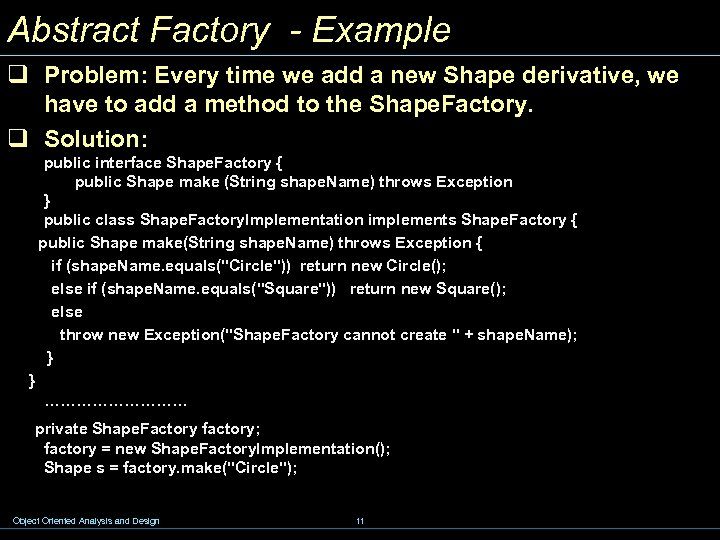 Abstract Factory - Example q Problem: Every time we add a new Shape derivative, we have to add a method to the Shape. Factory. q Solution: public interface Shape. Factory { public Shape make (String shape. Name) throws Exception } public class Shape. Factory. Implementation implements Shape. Factory { public Shape make(String shape. Name) throws Exception { if (shape. Name. equals("Circle")) return new Circle(); else if (shape. Name. equals("Square")) return new Square(); else throw new Exception("Shape. Factory cannot create " + shape. Name); } } …………… private Shape. Factory factory; factory = new Shape. Factory. Implementation(); Shape s = factory. make("Circle"); Object Oriented Analysis and Design 11
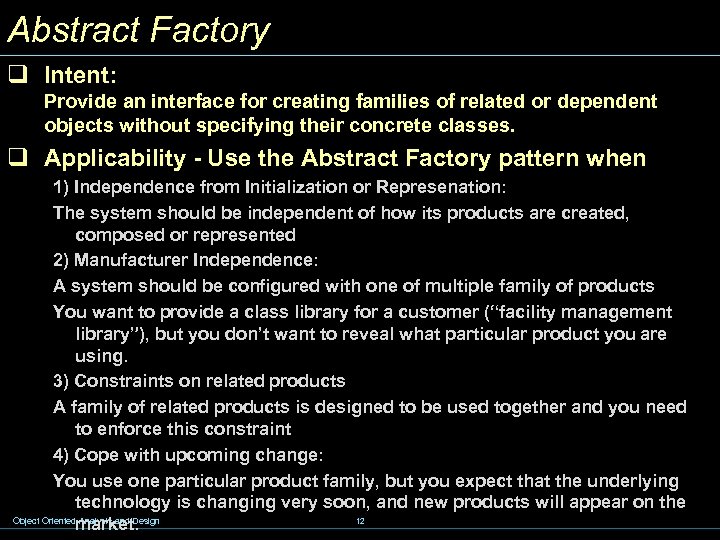 Abstract Factory q Intent: Provide an interface for creating families of related or dependent objects without specifying their concrete classes. q Applicability - Use the Abstract Factory pattern when 1) Independence from Initialization or Represenation: The system should be independent of how its products are created, composed or represented 2) Manufacturer Independence: A system should be configured with one of multiple family of products You want to provide a class library for a customer (“facility management library”), but you don’t want to reveal what particular product you are using. 3) Constraints on related products A family of related products is designed to be used together and you need to enforce this constraint 4) Cope with upcoming change: You use one particular product family, but you expect that the underlying technology is changing very soon, and new products will appear on the Object Oriented Analysis and Design 12 market.
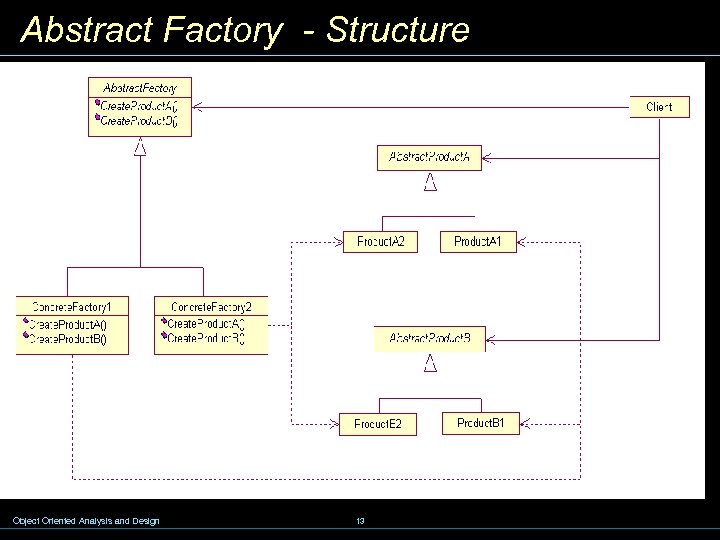 Abstract Factory - Structure Object Oriented Analysis and Design 13
 Factory Method - example w For example, a framework for a windowing application has a class Application which must create an object of class Document w But the actual applications and documents are not written yet! w Solution: Let subclasses decide which objects to instantiate w Application subclasses redefine an abstract Create. Document operation on Application to return the appropriate Document subclass. w Once an Application subclass is instantiated, it can then instantiate application-specific Documents without knowing their class. w We call Create. Document a factory method because it's responsible for "manufacturing" an object. Object Oriented Analysis and Design 14
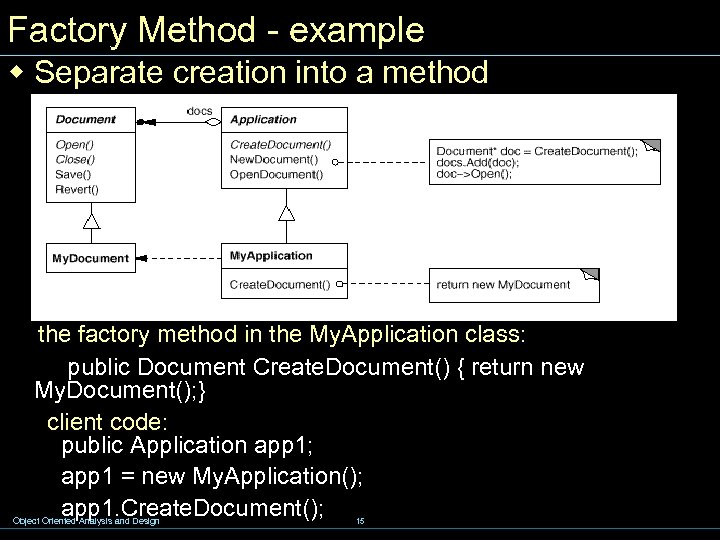 Factory Method - example w Separate creation into a method the factory method in the My. Application class: public Document Create. Document() { return new My. Document(); } client code: public Application app 1; app 1 = new My. Application(); app 1. Create. Document(); Object Oriented Analysis and Design 15
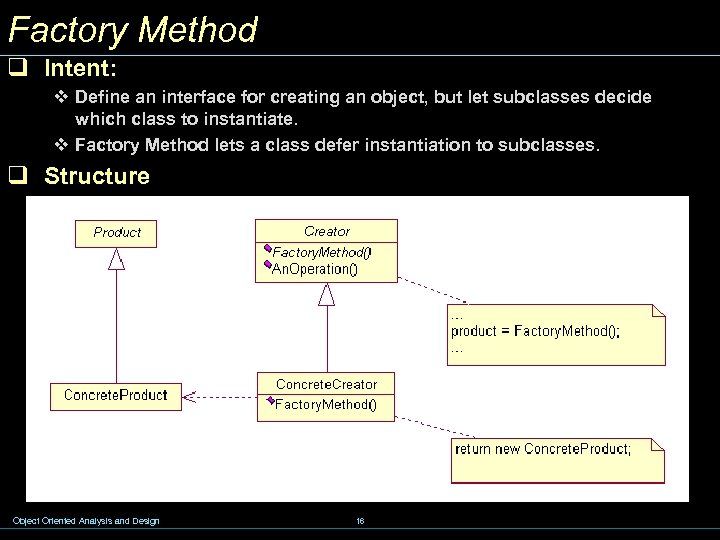 Factory Method q Intent: v Define an interface for creating an object, but let subclasses decide which class to instantiate. v Factory Method lets a class defer instantiation to subclasses. q Structure Object Oriented Analysis and Design 16
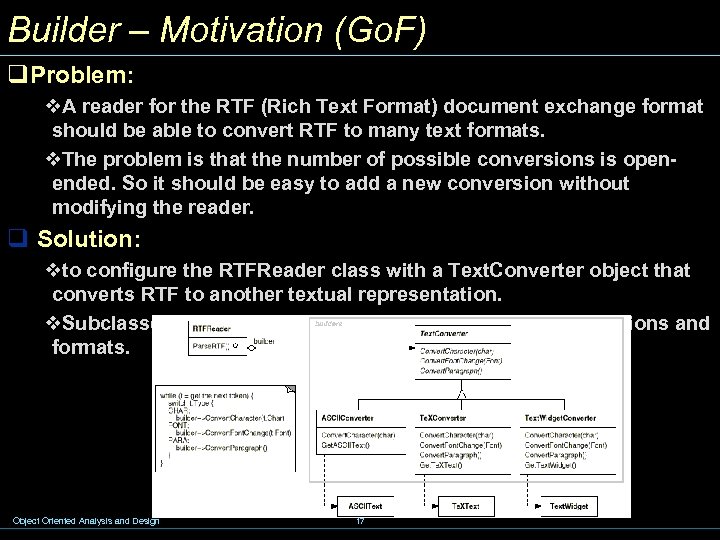 Builder – Motivation (Go. F) q Problem: v. A reader for the RTF (Rich Text Format) document exchange format should be able to convert RTF to many text formats. v. The problem is that the number of possible conversions is openended. So it should be easy to add a new conversion without modifying the reader. q Solution: vto configure the RTFReader class with a Text. Converter object that converts RTF to another textual representation. v. Subclasses of Text. Converter specialize in different conversions and formats. Object Oriented Analysis and Design 17
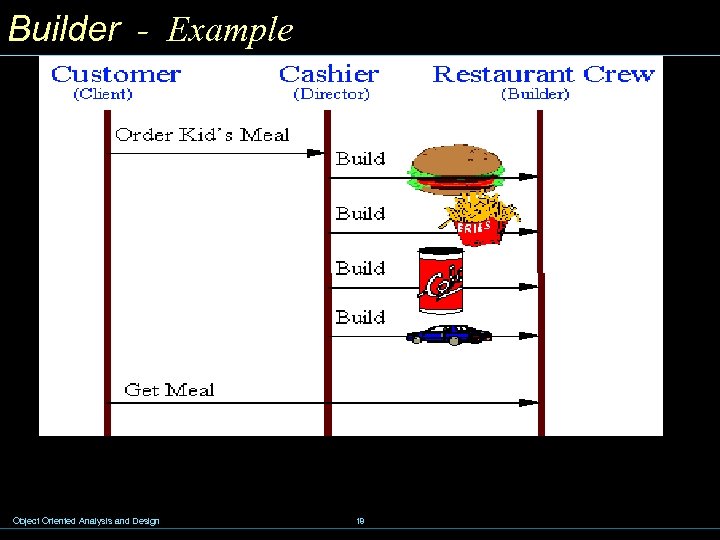 Builder - Example Object Oriented Analysis and Design 18
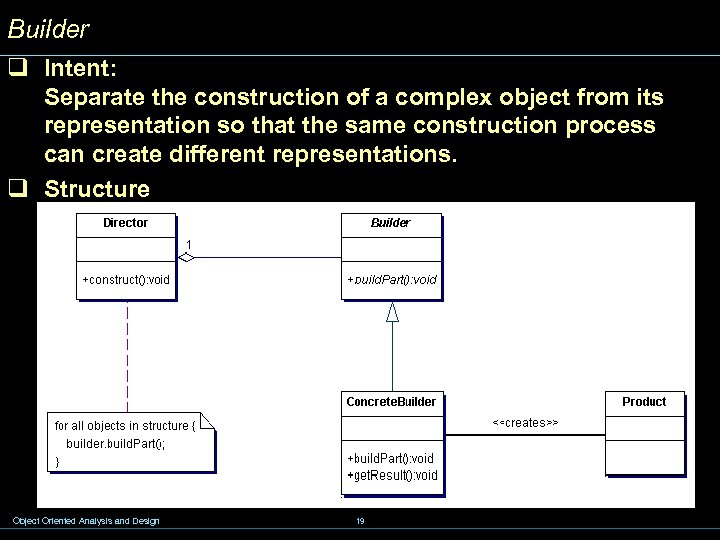 Builder q Intent: Separate the construction of a complex object from its representation so that the same construction process can create different representations. q Structure Object Oriented Analysis and Design 19
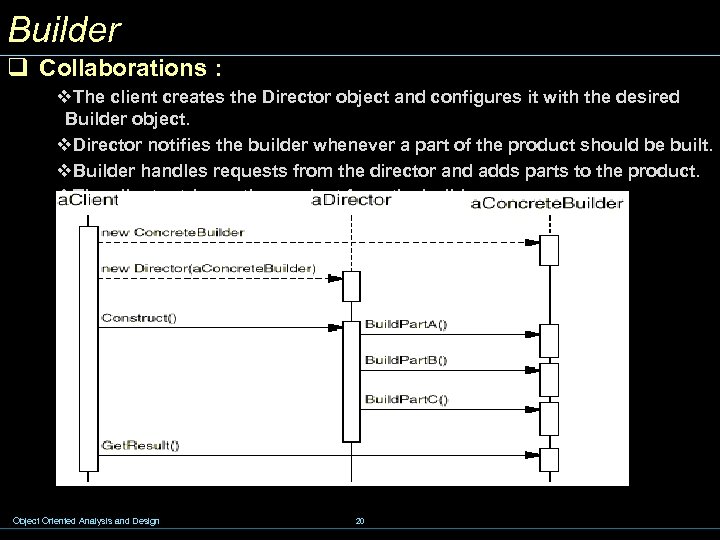 Builder q Collaborations : v. The client creates the Director object and configures it with the desired Builder object. v. Director notifies the builder whenever a part of the product should be built. v. Builder handles requests from the director and adds parts to the product. v. The client retrieves the product from the builder. Object Oriented Analysis and Design 20
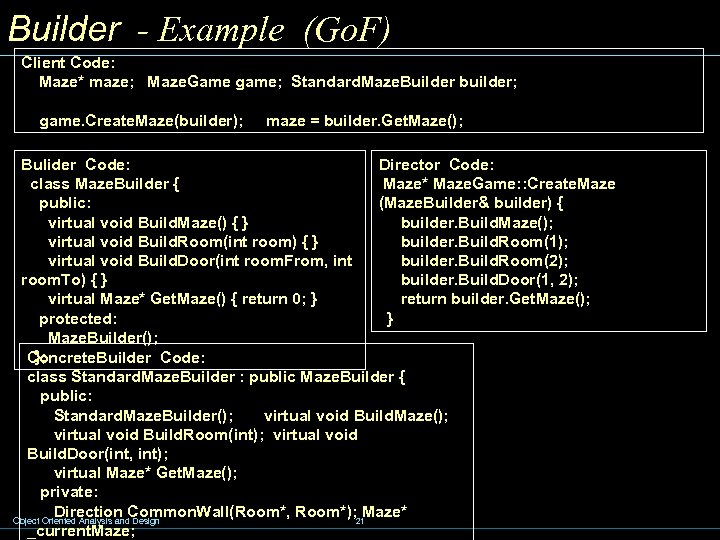 Builder - Example (Go. F) Client Code: Maze* maze; Maze. Game game; Standard. Maze. Builder builder; game. Create. Maze(builder); maze = builder. Get. Maze(); Director Code: Bulider Code: Maze* Maze. Game: : Create. Maze class Maze. Builder { (Maze. Builder& builder) { public: builder. Build. Maze(); virtual void Build. Maze() { } builder. Build. Room(1); virtual void Build. Room(int room) { } builder. Build. Room(2); virtual void Build. Door(int room. From, int builder. Build. Door(1, 2); room. To) { } return builder. Get. Maze(); virtual Maze* Get. Maze() { return 0; } } protected: Maze. Builder(); }; Concrete. Builder Code: class Standard. Maze. Builder : public Maze. Builder { public: Standard. Maze. Builder(); virtual void Build. Maze(); virtual void Build. Room(int); virtual void Build. Door(int, int); virtual Maze* Get. Maze(); private: Direction Common. Wall(Room*, Room*); 21 Maze* Object Oriented Analysis and Design _current. Maze;
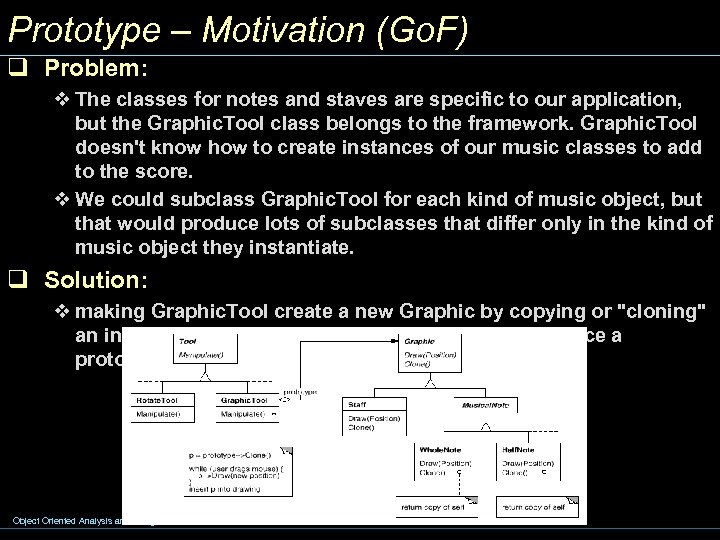 Prototype – Motivation (Go. F) q Problem: v The classes for notes and staves are specific to our application, but the Graphic. Tool class belongs to the framework. Graphic. Tool doesn't know how to create instances of our music classes to add to the score. v We could subclass Graphic. Tool for each kind of music object, but that would produce lots of subclasses that differ only in the kind of music object they instantiate. q Solution: v making Graphic. Tool create a new Graphic by copying or "cloning" an instance of a Graphic subclass. We call this instance a prototype. Object Oriented Analysis and Design 22
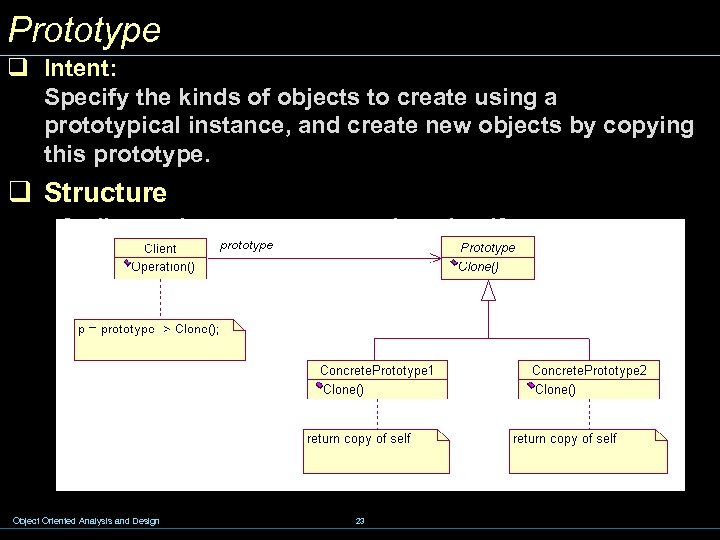 Prototype q Intent: Specify the kinds of objects to create using a prototypical instance, and create new objects by copying this prototype. q Structure A client asks a prototype to clone itself Object Oriented Analysis and Design 23
 Prototype q Discussion: v. Declare an abstract base class that specifies a pure virtual "clone" method, and, maintains a dictionary of all "cloneable" concrete derived classes. v. Any class that needs a "polymorphic constructor" capability: derives itself from the abstract base class, registers its prototypical instance, and implements the clone() operation. v. The client then, instead of writing code that invokes the "new" operator on a hard-wired class name, calls a "clone" operation on the abstract base class, supplying a string or enumerated data type that designates the particular concrete derived class desired. Object Oriented Analysis and Design 24
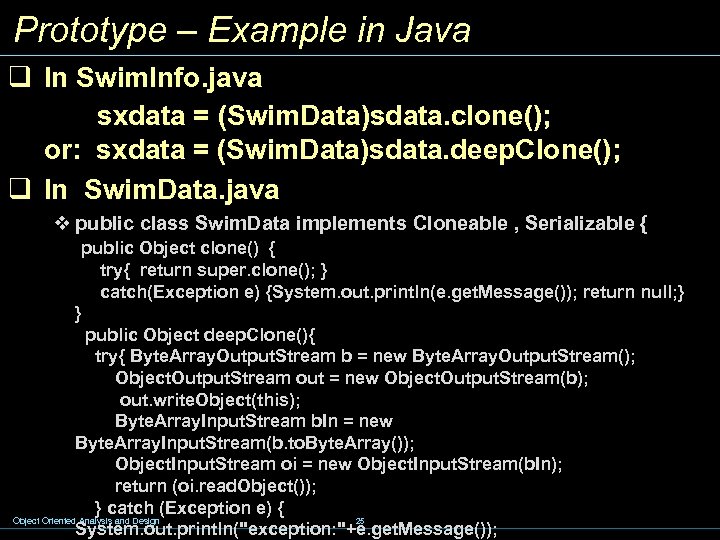 Prototype – Example in Java q In Swim. Info. java sxdata = (Swim. Data)sdata. clone(); or: sxdata = (Swim. Data)sdata. deep. Clone(); q In Swim. Data. java v public class Swim. Data implements Cloneable , Serializable { public Object clone() { try{ return super. clone(); } catch(Exception e) {System. out. println(e. get. Message()); return null; } } public Object deep. Clone(){ try{ Byte. Array. Output. Stream b = new Byte. Array. Output. Stream(); Object. Output. Stream out = new Object. Output. Stream(b); out. write. Object(this); Byte. Array. Input. Stream b. In = new Byte. Array. Input. Stream(b. to. Byte. Array()); Object. Input. Stream oi = new Object. Input. Stream(b. In); return (oi. read. Object()); } catch (Exception e) { Object Oriented Analysis and Design 25 System. out. println("exception: "+e. get. Message());
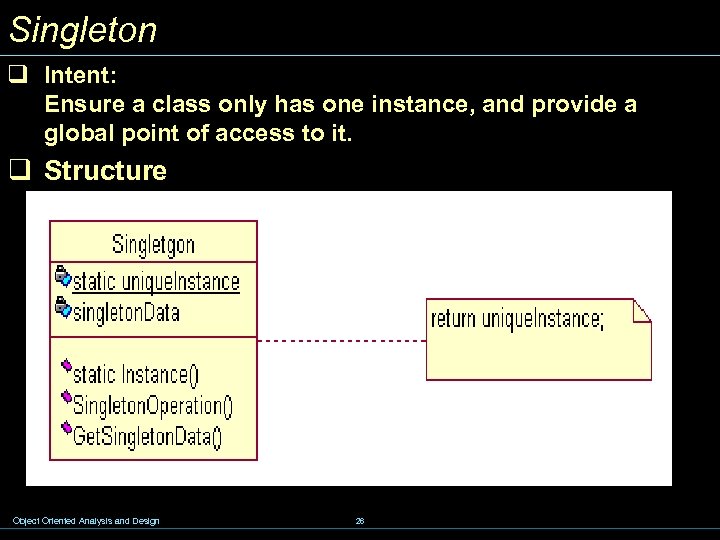 Singleton q Intent: Ensure a class only has one instance, and provide a global point of access to it. q Structure Object Oriented Analysis and Design 26
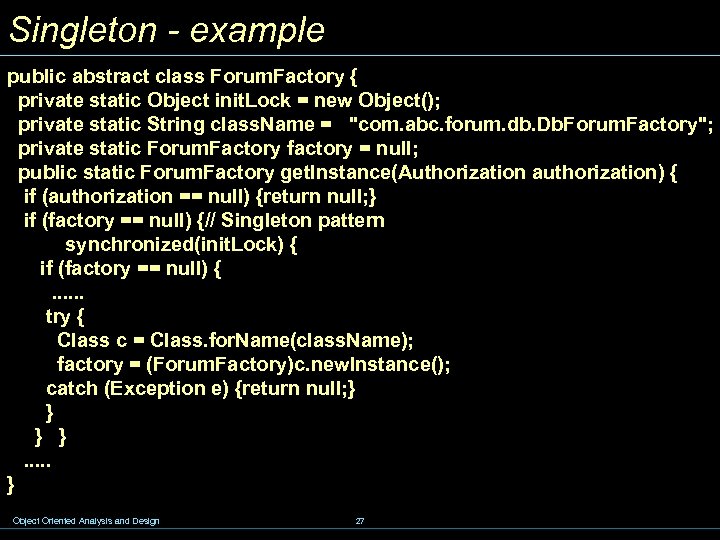 Singleton - example public abstract class Forum. Factory { private static Object init. Lock = new Object(); private static String class. Name = "com. abc. forum. db. Db. Forum. Factory"; private static Forum. Factory factory = null; public static Forum. Factory get. Instance(Authorization authorization) { if (authorization == null) {return null; } if (factory == null) {// Singleton pattern synchronized(init. Lock) { if (factory == null) {. . . try { Class c = Class. for. Name(class. Name); factory = (Forum. Factory)c. new. Instance(); catch (Exception e) {return null; } }. . . } Object Oriented Analysis and Design 27
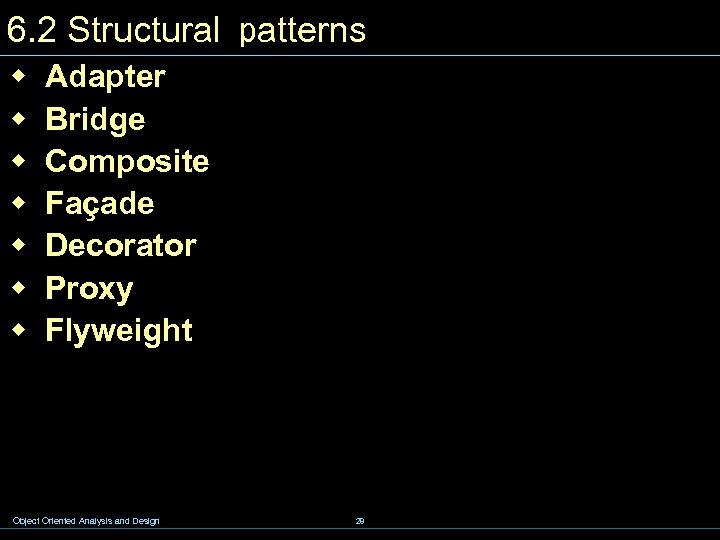 6. 2 Structural patterns w w w w Adapter Bridge Composite Façade Decorator Proxy Flyweight Object Oriented Analysis and Design 28
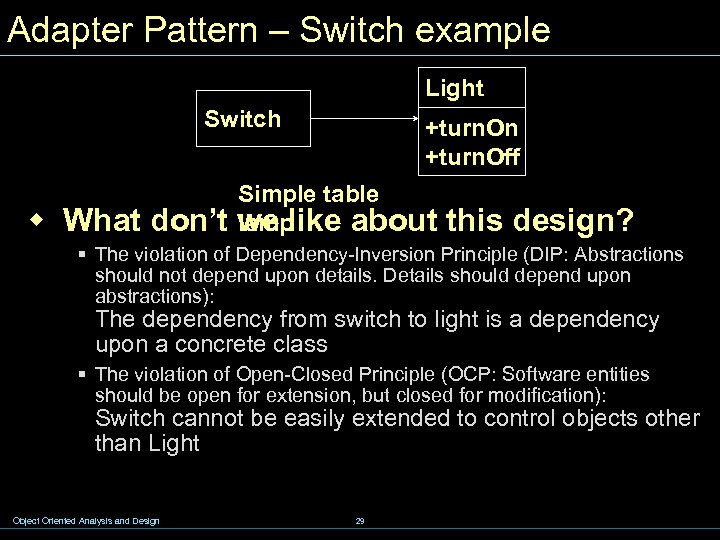 Adapter Pattern – Switch example Light Switch w What don’t +turn. On +turn. Off Simple table lamp we like about this design? § The violation of Dependency-Inversion Principle (DIP: Abstractions should not depend upon details. Details should depend upon abstractions): The dependency from switch to light is a dependency upon a concrete class § The violation of Open-Closed Principle (OCP: Software entities should be open for extension, but closed for modification): Switch cannot be easily extended to control objects other than Light Object Oriented Analysis and Design 29
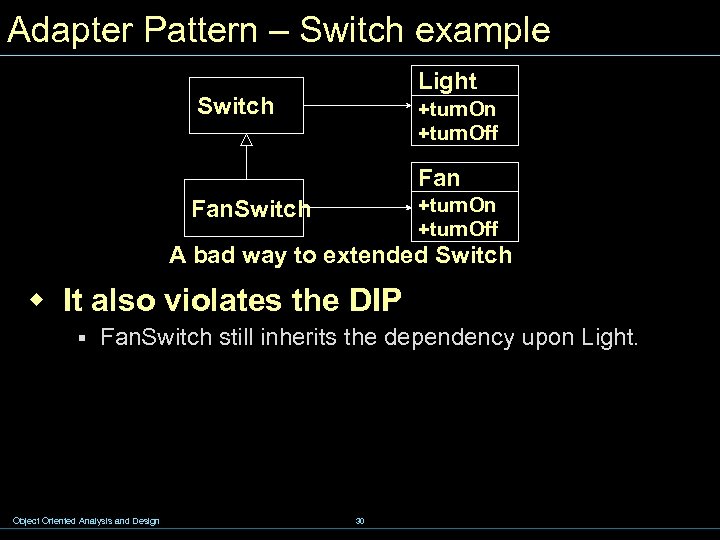 Adapter Pattern – Switch example Light Switch +turn. On +turn. Off Fan. Switch A bad way to extended Switch w It also violates the DIP § Fan. Switch still inherits the dependency upon Light. Object Oriented Analysis and Design 30
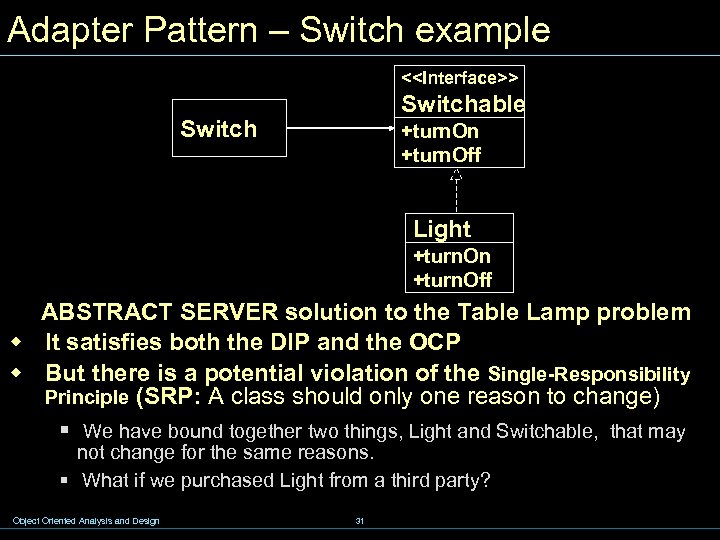 Adapter Pattern – Switch example <
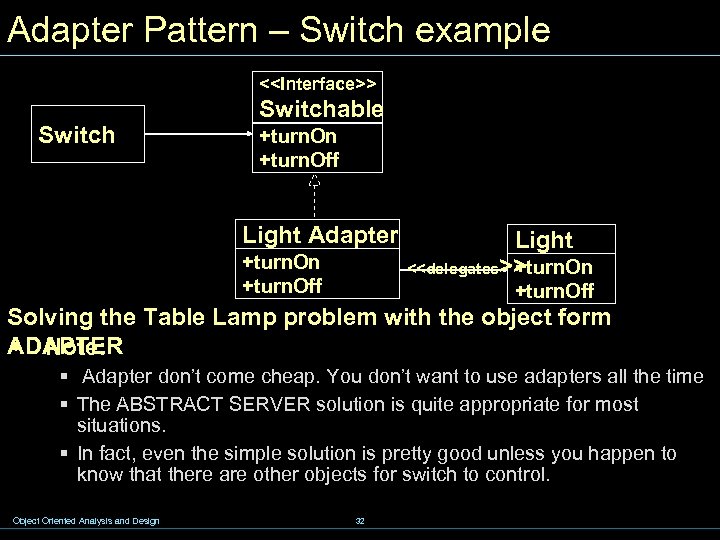 Adapter Pattern – Switch example <
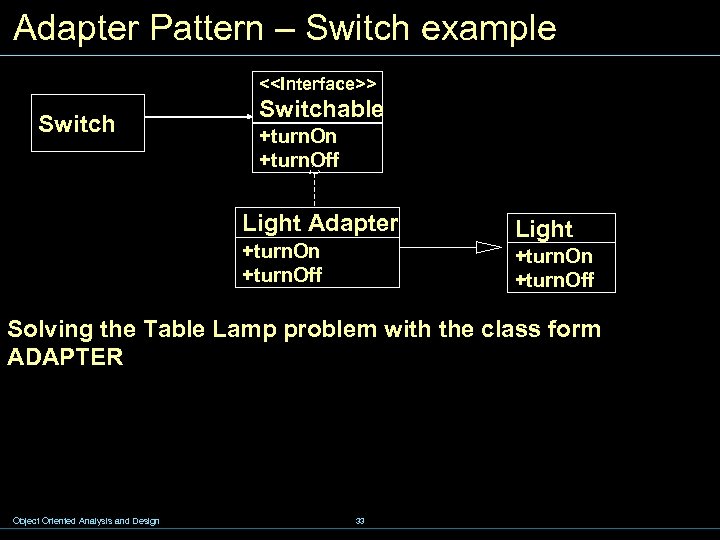 Adapter Pattern – Switch example <
 Adapter Pattern 1) “Convert the interface of a class into another interface expected by the client. Adapter lets classes work together that couldn’t otherwise because of incompatible interfaces 2) Used to provide a new interface to existing legacy components (Interface engineering, reengineering). 3) Also known as a wrapper 4) Two adapter patterns: w Class adapter: - Uses multiple inheritance to adapt one interface to another w Object adapter: - Uses single inheritance and delegation 5) We will mostly use object adapters and call them simply adapters Object Oriented Analysis and Design 34
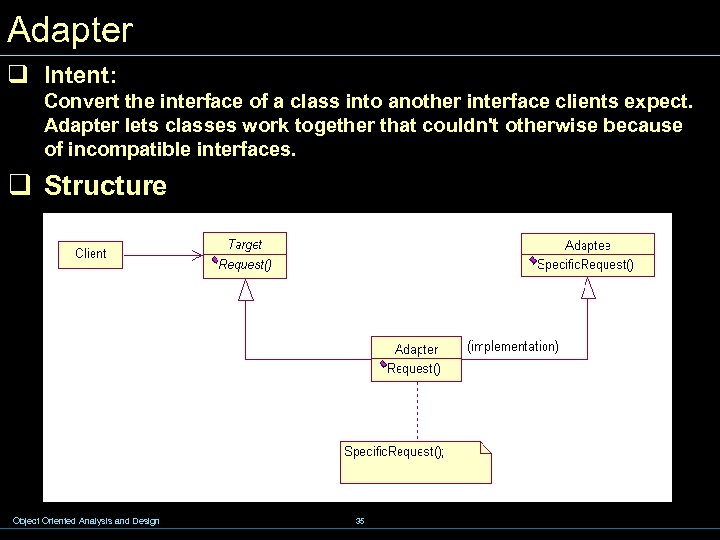 Adapter q Intent: Convert the interface of a class into another interface clients expect. Adapter lets classes work together that couldn't otherwise because of incompatible interfaces. q Structure Object Oriented Analysis and Design 35
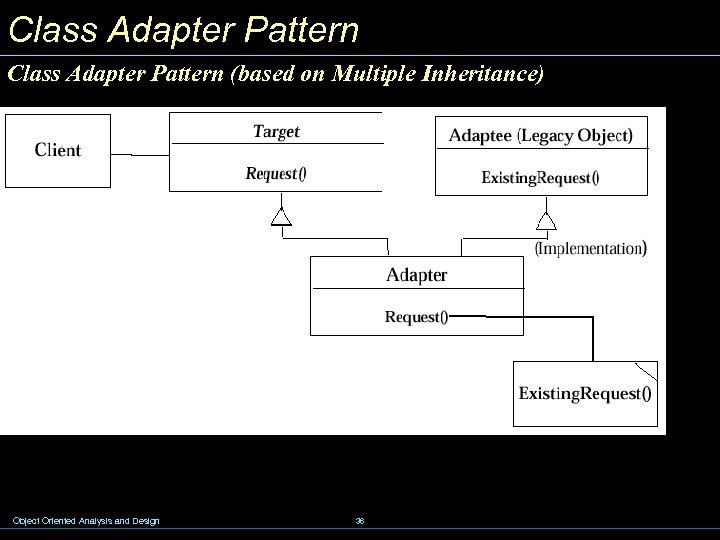 Class Adapter Pattern (based on Multiple Inheritance) Object Oriented Analysis and Design 36
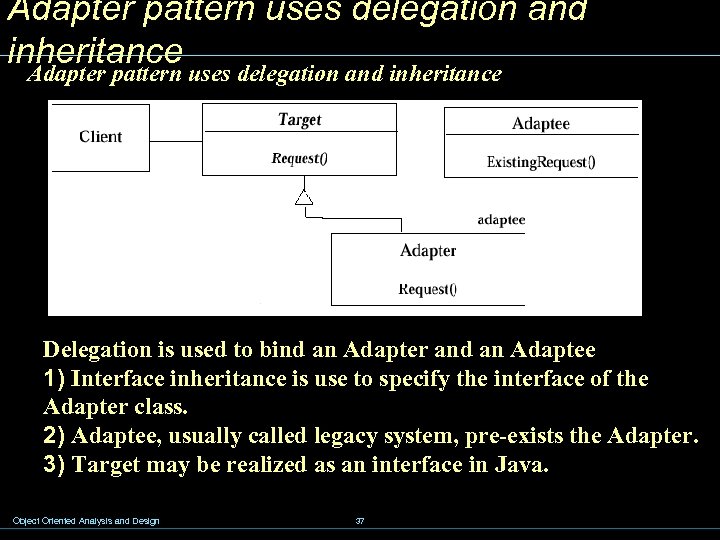 Adapter pattern uses delegation and inheritance Delegation is used to bind an Adapter and an Adaptee 1) Interface inheritance is use to specify the interface of the Adapter class. 2) Adaptee, usually called legacy system, pre-exists the Adapter. 3) Target may be realized as an interface in Java. Object Oriented Analysis and Design 37
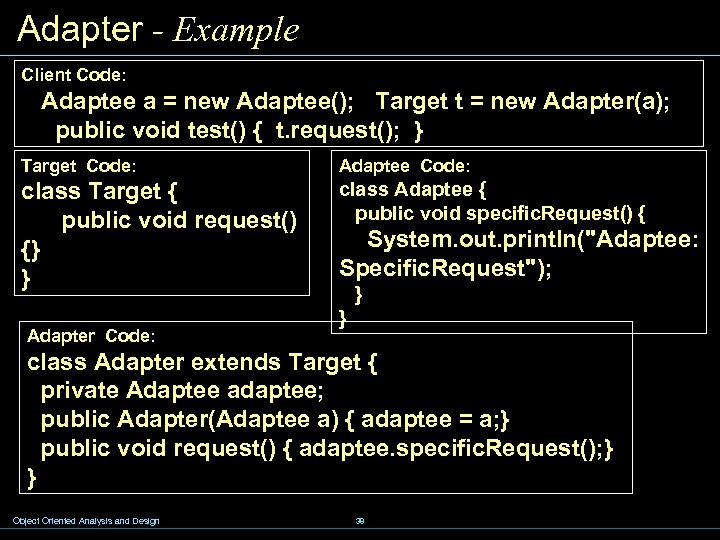 Adapter - Example Client Code: Adaptee a = new Adaptee(); Target t = new Adapter(a); public void test() { t. request(); } Target Code: Adaptee Code: class Target { public void request() {} } class Adaptee { public void specific. Request() { Adapter Code: System. out. println("Adaptee: Specific. Request"); } } class Adapter extends Target { private Adaptee adaptee; public Adapter(Adaptee a) { adaptee = a; } public void request() { adaptee. specific. Request(); } } Object Oriented Analysis and Design 38
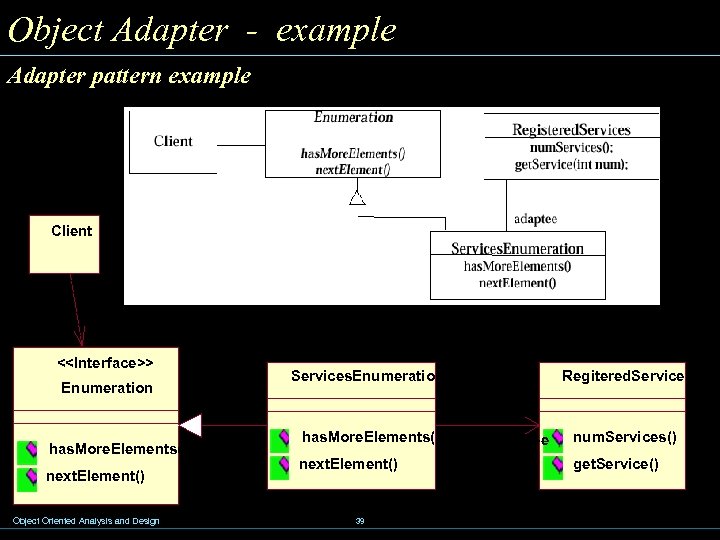 Object Adapter - example Adapter pattern example Client <
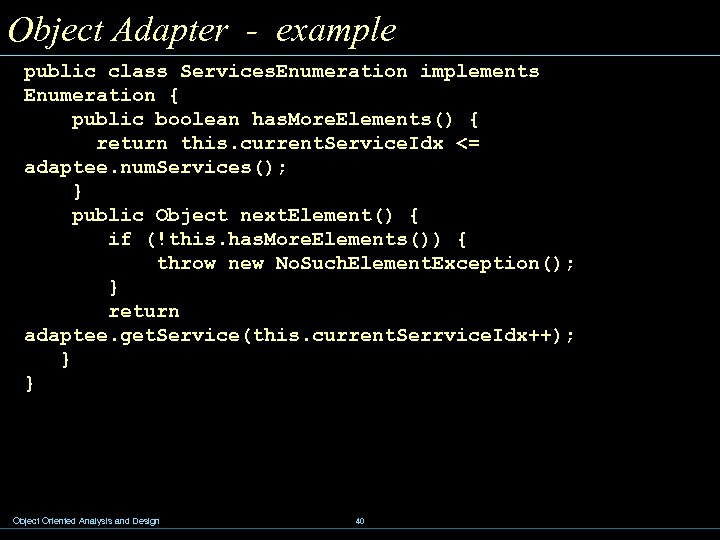 Object Adapter - example public class Services. Enumeration implements Enumeration { public boolean has. More. Elements() { return this. current. Service. Idx <= adaptee. num. Services(); } public Object next. Element() { if (!this. has. More. Elements()) { throw new No. Such. Element. Exception(); } return adaptee. get. Service(this. current. Serrvice. Idx++); } } Object Oriented Analysis and Design 40
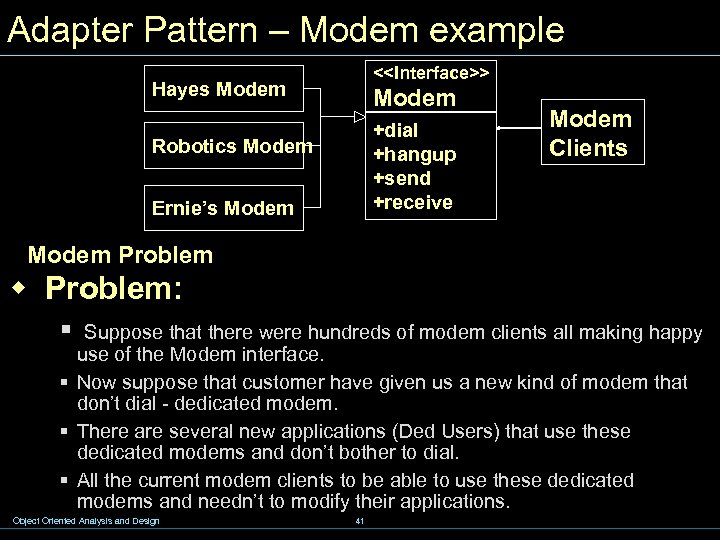 Adapter Pattern – Modem example <
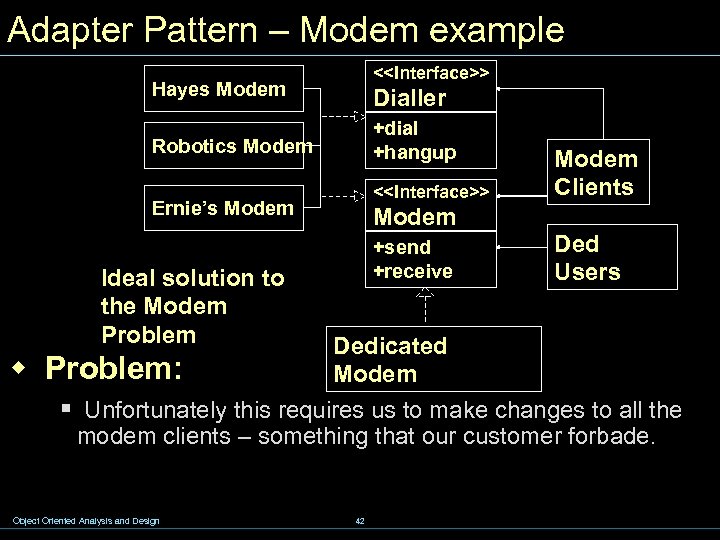 Adapter Pattern – Modem example <
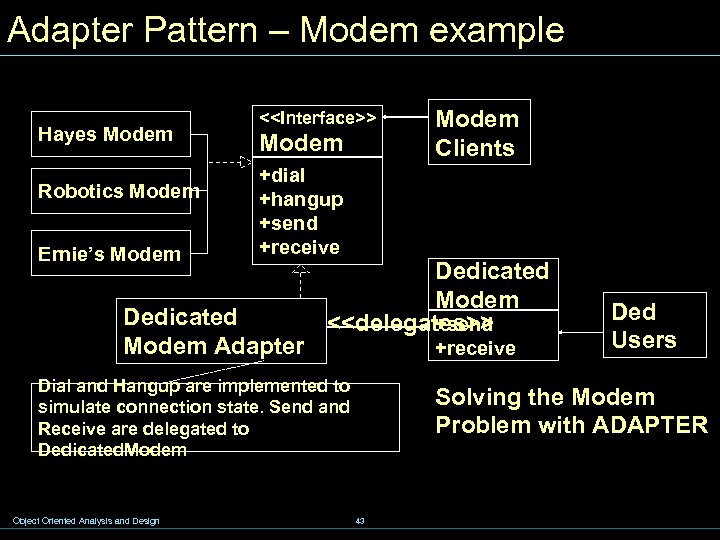 Adapter Pattern – Modem example Hayes Modem Robotics Modem Ernie’s Modem <
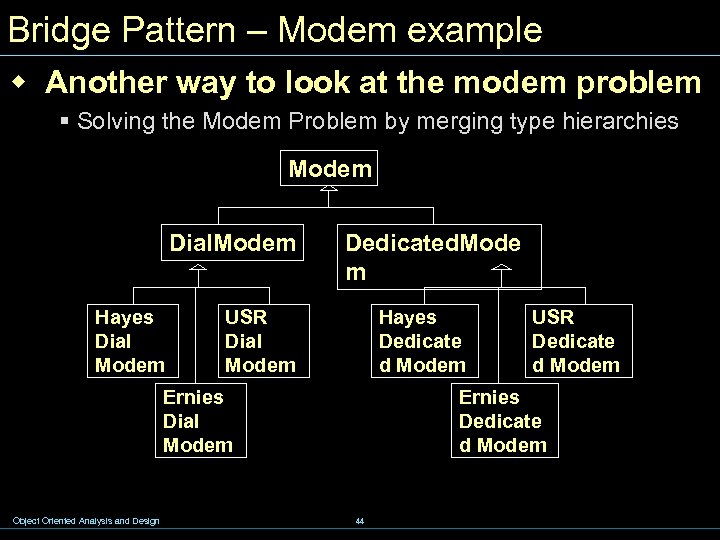 Bridge Pattern – Modem example w Another way to look at the modem problem § Solving the Modem Problem by merging type hierarchies Modem Dial. Modem Hayes Dial Modem Dedicated. Mode m USR Dial Modem Hayes Dedicate d Modem Ernies Dial Modem Object Oriented Analysis and Design USR Dedicate d Modem Ernies Dedicate d Modem 44
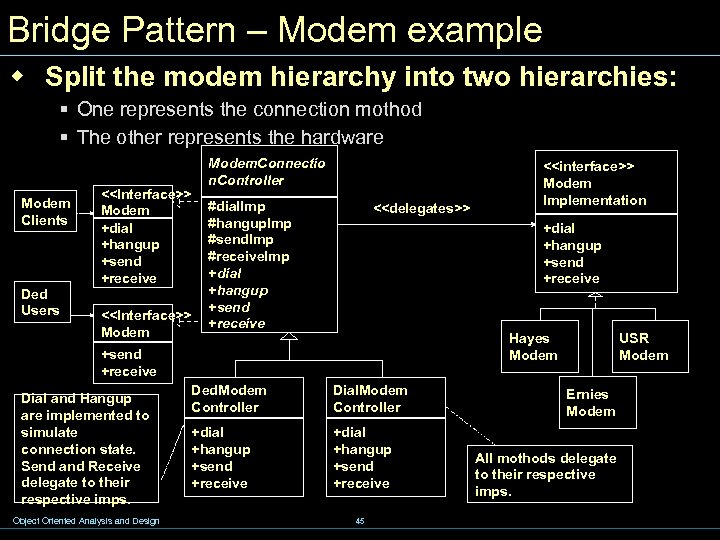 Bridge Pattern – Modem example w Split the modem hierarchy into two hierarchies: § One represents the connection mothod § The other represents the hardware Modem Clients Ded Users <
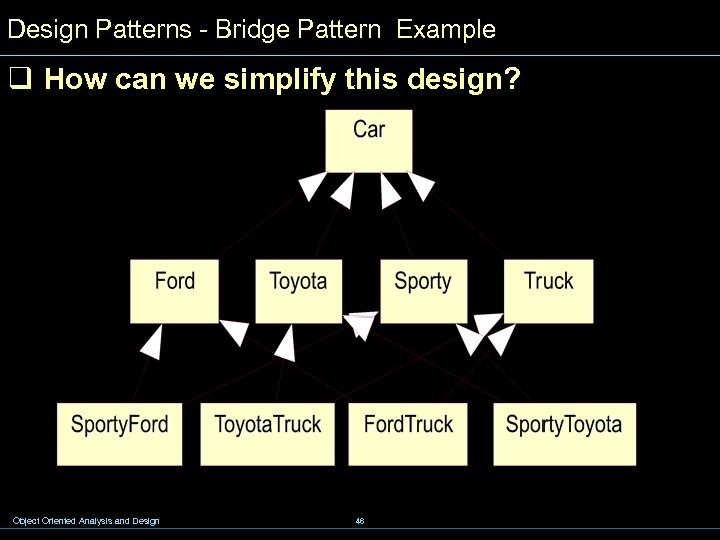 Design Patterns - Bridge Pattern Example q How can we simplify this design? Object Oriented Analysis and Design 46
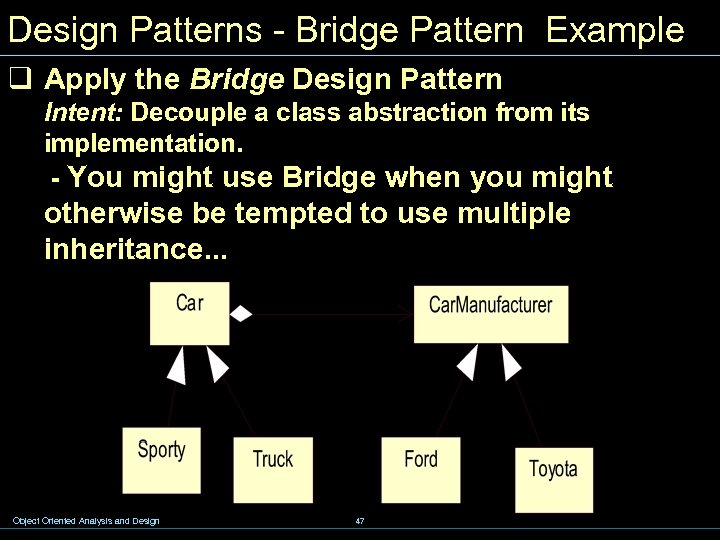 Design Patterns - Bridge Pattern Example q Apply the Bridge Design Pattern Intent: Decouple a class abstraction from its implementation. - You might use Bridge when you might otherwise be tempted to use multiple inheritance. . . Object Oriented Analysis and Design 47
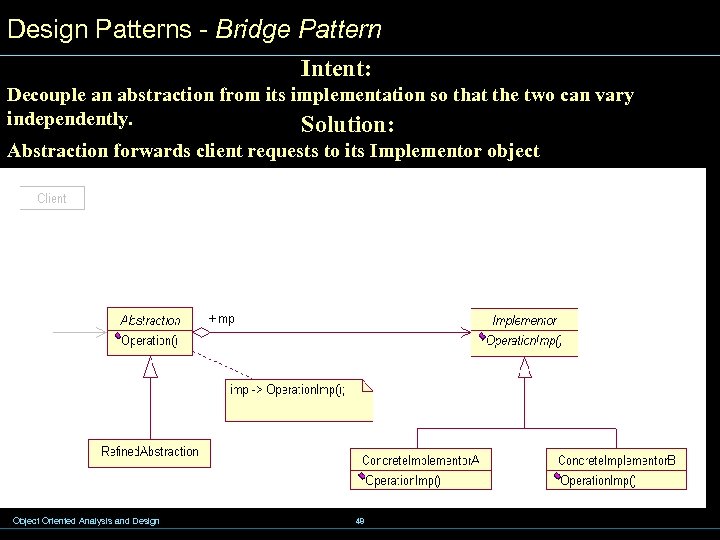 Design Patterns - Bridge Pattern Intent: Decouple an abstraction from its implementation so that the two can vary independently. Solution: Abstraction forwards client requests to its Implementor object Object Oriented Analysis and Design 48
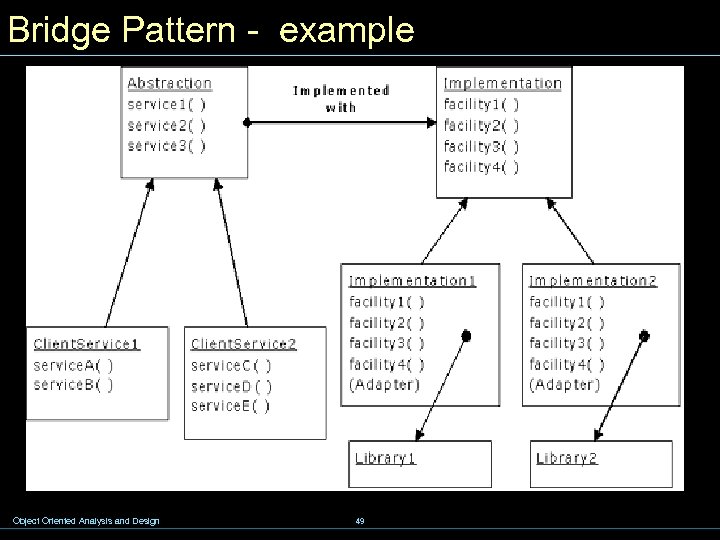 Bridge Pattern - example Object Oriented Analysis and Design 49
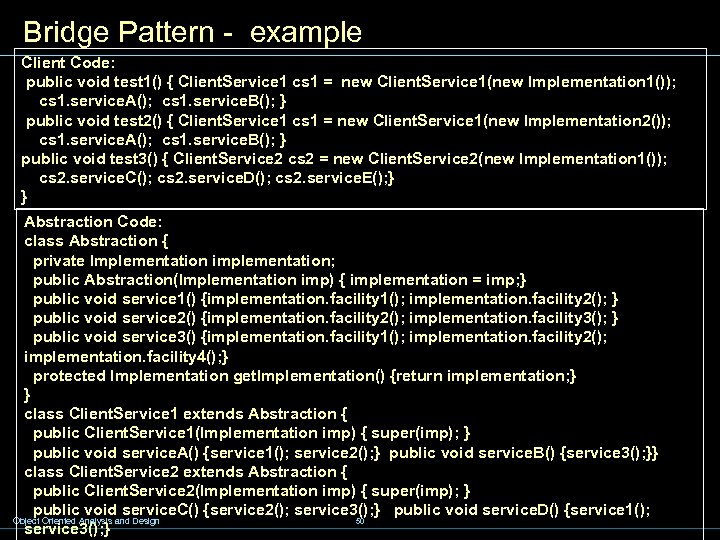 Bridge Pattern - example Client Code: public void test 1() { Client. Service 1 cs 1 = new Client. Service 1(new Implementation 1()); cs 1. service. A(); cs 1. service. B(); } public void test 2() { Client. Service 1 cs 1 = new Client. Service 1(new Implementation 2()); cs 1. service. A(); cs 1. service. B(); } public void test 3() { Client. Service 2 cs 2 = new Client. Service 2(new Implementation 1()); cs 2. service. C(); cs 2. service. D(); cs 2. service. E(); } } Abstraction Code: class Abstraction { private Implementation implementation; public Abstraction(Implementation imp) { implementation = imp; } public void service 1() {implementation. facility 1(); implementation. facility 2(); } public void service 2() {implementation. facility 2(); implementation. facility 3(); } public void service 3() {implementation. facility 1(); implementation. facility 2(); implementation. facility 4(); } protected Implementation get. Implementation() {return implementation; } } class Client. Service 1 extends Abstraction { public Client. Service 1(Implementation imp) { super(imp); } public void service. A() {service 1(); service 2(); } public void service. B() {service 3(); }} class Client. Service 2 extends Abstraction { public Client. Service 2(Implementation imp) { super(imp); } public void service. C() {service 2(); service 3(); } public void service. D() {service 1(); Object Oriented Analysis and Design 50 service 3(); }
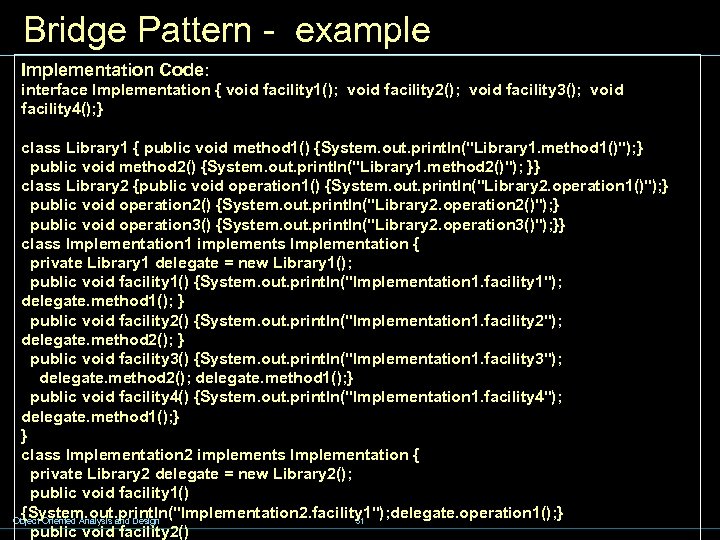 Bridge Pattern - example Implementation Code: interface Implementation { void facility 1(); void facility 2(); void facility 3(); void facility 4(); } class Library 1 { public void method 1() {System. out. println("Library 1. method 1()"); } public void method 2() {System. out. println("Library 1. method 2()"); }} class Library 2 {public void operation 1() {System. out. println("Library 2. operation 1()"); } public void operation 2() {System. out. println("Library 2. operation 2()"); } public void operation 3() {System. out. println("Library 2. operation 3()"); }} class Implementation 1 implements Implementation { private Library 1 delegate = new Library 1(); public void facility 1() {System. out. println("Implementation 1. facility 1"); delegate. method 1(); } public void facility 2() {System. out. println("Implementation 1. facility 2"); delegate. method 2(); } public void facility 3() {System. out. println("Implementation 1. facility 3"); delegate. method 2(); delegate. method 1(); } public void facility 4() {System. out. println("Implementation 1. facility 4"); delegate. method 1(); } } class Implementation 2 implements Implementation { private Library 2 delegate = new Library 2(); public void facility 1() {System. out. println("Implementation 2. facility 1"); delegate. operation 1(); } Object Oriented Analysis and Design 51 public void facility 2()
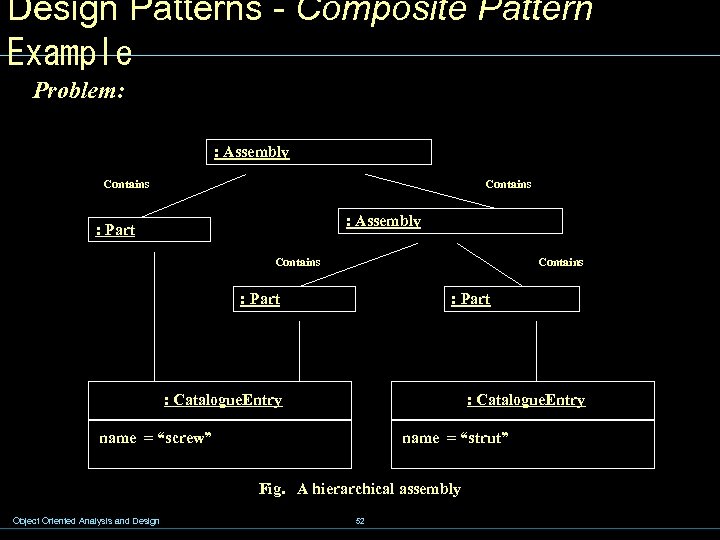 Design Patterns - Composite Pattern Example Problem: : Assembly Contains : Assembly : Part Contains : Part : Catalogue. Entry name = “screw” name = “strut” Fig. A hierarchical assembly Object Oriented Analysis and Design 52
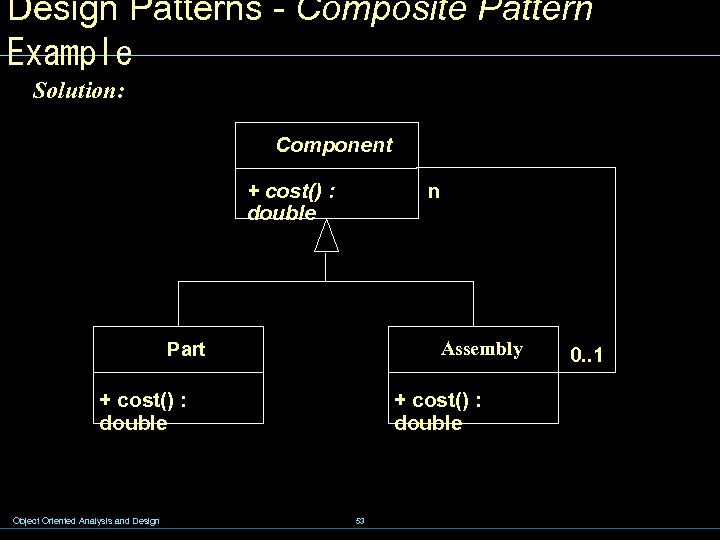 Design Patterns - Composite Pattern Example Solution: Component n + cost() : double Part Assembly + cost() : double Object Oriented Analysis and Design + cost() : double 53 0. . 1
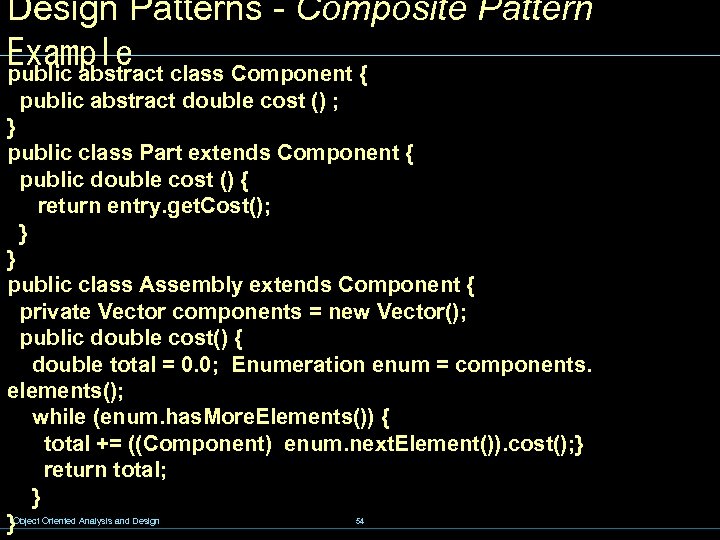 Design Patterns - Composite Pattern Example class Component { public abstract double cost () ; } public class Part extends Component { public double cost () { return entry. get. Cost(); } } public class Assembly extends Component { private Vector components = new Vector(); public double cost() { double total = 0. 0; Enumeration enum = components. elements(); while (enum. has. More. Elements()) { total += ((Component) enum. next. Element()). cost(); } return total; } }Object Oriented Analysis and Design 54
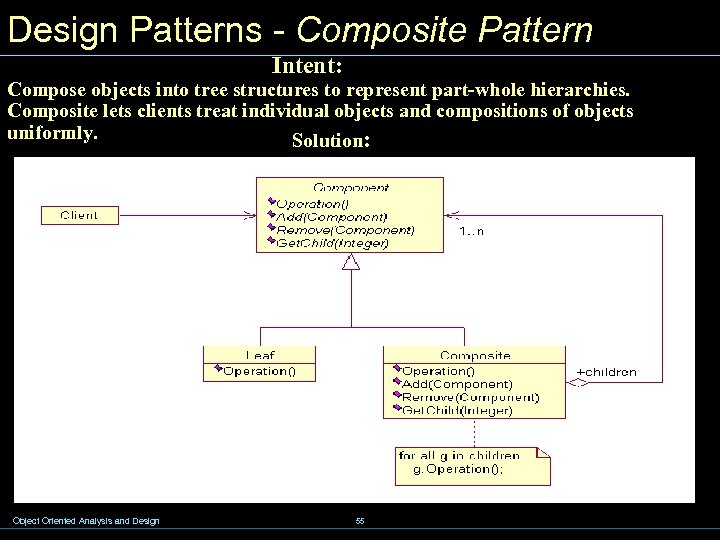 Design Patterns - Composite Pattern Intent: Compose objects into tree structures to represent part-whole hierarchies. Composite lets clients treat individual objects and compositions of objects uniformly. Solution: Object Oriented Analysis and Design 55
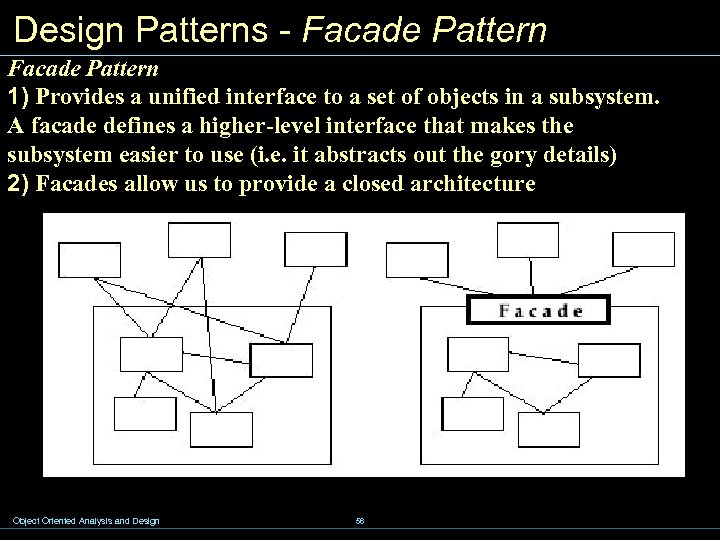 Design Patterns - Facade Pattern 1) Provides a unified interface to a set of objects in a subsystem. A facade defines a higher-level interface that makes the subsystem easier to use (i. e. it abstracts out the gory details) 2) Facades allow us to provide a closed architecture Object Oriented Analysis and Design 56
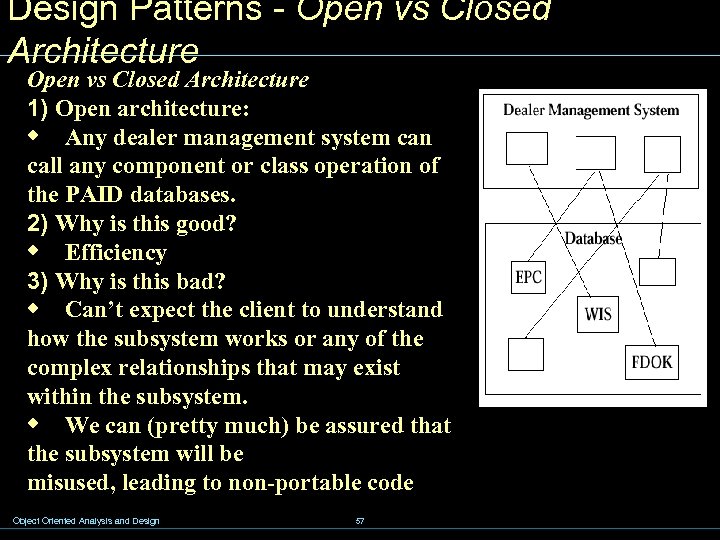 Design Patterns - Open vs Closed Architecture 1) Open architecture: w Any dealer management system can call any component or class operation of the PAID databases. 2) Why is this good? w Efficiency 3) Why is this bad? w Can’t expect the client to understand how the subsystem works or any of the complex relationships that may exist within the subsystem. w We can (pretty much) be assured that the subsystem will be misused, leading to non-portable code Object Oriented Analysis and Design 57
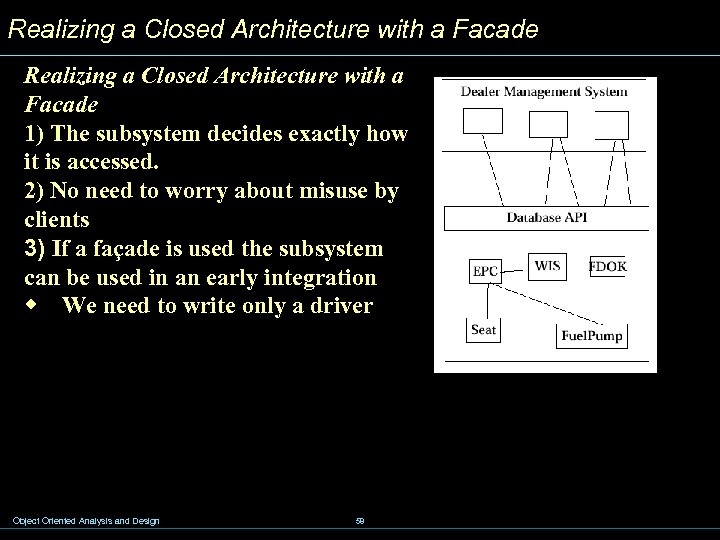 Realizing a Closed Architecture with a Facade 1) The subsystem decides exactly how it is accessed. 2) No need to worry about misuse by clients 3) If a façade is used the subsystem can be used in an early integration w We need to write only a driver Object Oriented Analysis and Design 58
 Decorator Pattern - Motivation w Widget Example § Suppose you have a user interface toolkit and you wish to make a border or scrolling feature available to clients without defining new subclasses of all existing classes. § The client "attaches" the border or scrolling responsibility to only those objects requiring these capabilities. § Widget* a. Widget = new Border. Decorator( new Scroll. Decorator(new Text. View), 1); a. Widget->draw(); w Stream Example § cascading responsibilities on to an output stream § Stream* a. Stream = new Compressing. Stream( new ASCII 7 Stream( new File. Stream( "file. Name. dat" ))); a. Stream->put. String( "Hello world" ); Object Oriented Analysis and Design 59
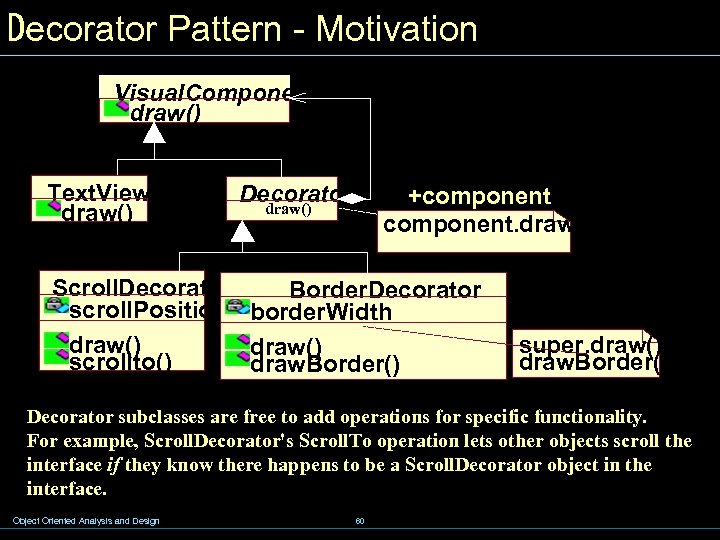 Decorator Pattern - Motivation Visual. Component draw() Text. View draw() Decorator +component. draw() Scroll. Decorator Border. Decorator scroll. Position border. Width draw() scrollto() draw. Border() super. draw() draw. Border() Decorator subclasses are free to add operations for specific functionality. For example, Scroll. Decorator's Scroll. To operation lets other objects scroll the interface if they know there happens to be a Scroll. Decorator object in the interface. Object Oriented Analysis and Design 60
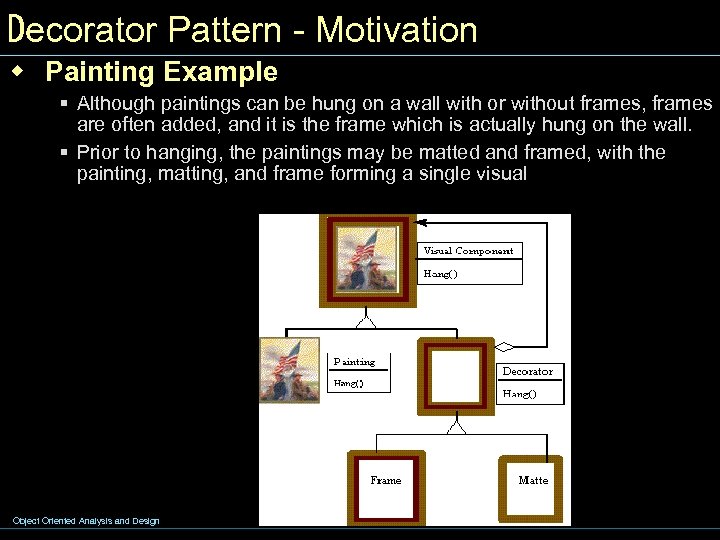 Decorator Pattern - Motivation w Painting Example § Although paintings can be hung on a wall with or without frames, frames are often added, and it is the frame which is actually hung on the wall. § Prior to hanging, the paintings may be matted and framed, with the painting, matting, and frame forming a single visual Object Oriented Analysis and Design 61
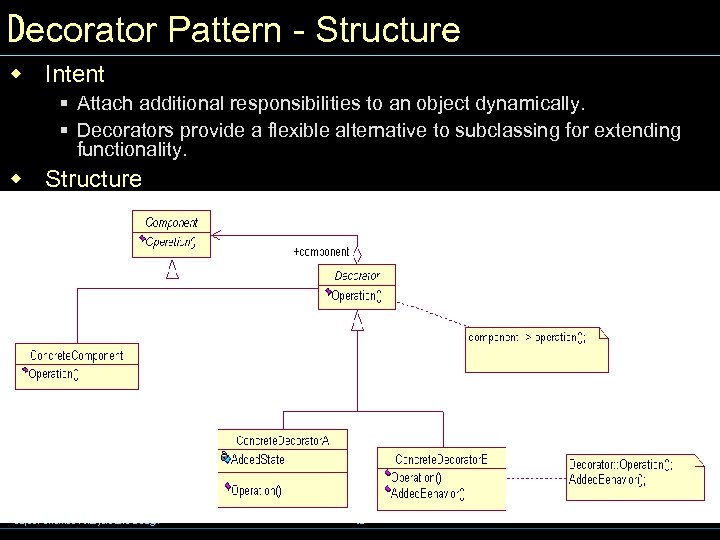 Decorator Pattern - Structure w Intent § Attach additional responsibilities to an object dynamically. § Decorators provide a flexible alternative to subclassing for extending functionality. w Structure q Structure Object Oriented Analysis and Design 62
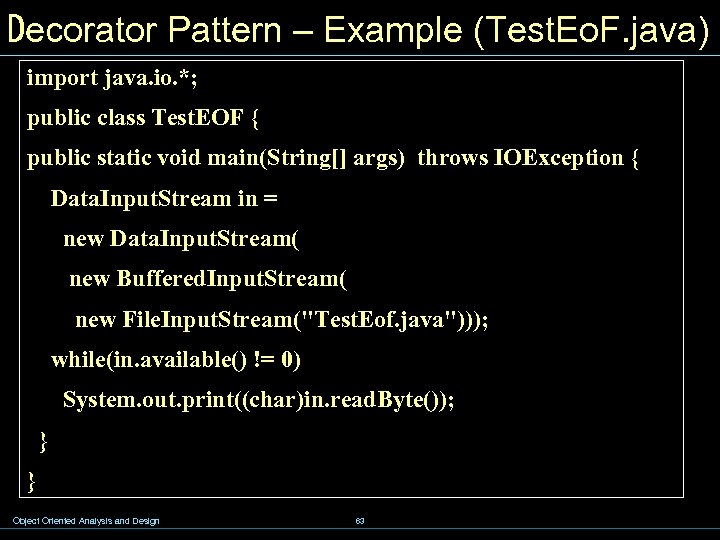 Decorator Pattern – Example (Test. Eo. F. java) import java. io. *; public class Test. EOF { public static void main(String[] args) throws IOException { Data. Input. Stream in = new Data. Input. Stream( new Buffered. Input. Stream( new File. Input. Stream("Test. Eof. java"))); while(in. available() != 0) System. out. print((char)in. read. Byte()); } } Object Oriented Analysis and Design 63
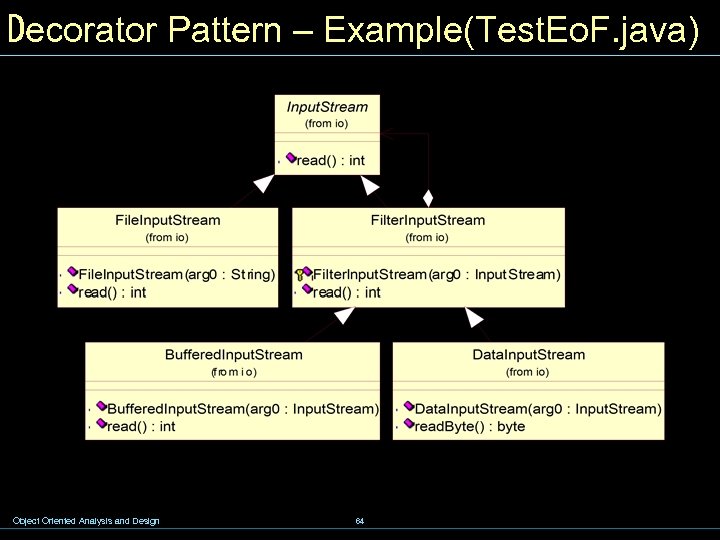 Decorator Pattern – Example(Test. Eo. F. java) Object Oriented Analysis and Design 64
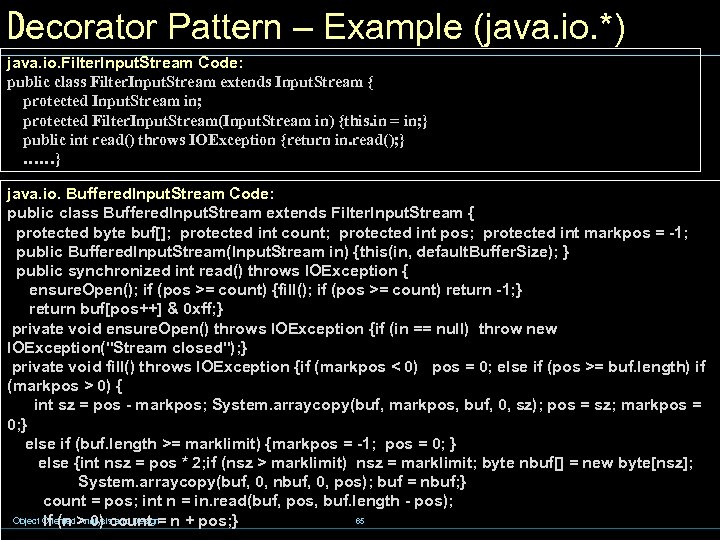 Decorator Pattern – Example (java. io. *) java. io. Filter. Input. Stream Code: public class Filter. Input. Stream extends Input. Stream { protected Input. Stream in; protected Filter. Input. Stream(Input. Stream in) {this. in = in; } public int read() throws IOException {return in. read(); } ……} java. io. Buffered. Input. Stream Code: public class Buffered. Input. Stream extends Filter. Input. Stream { protected byte buf[]; protected int count; protected int pos; protected int markpos = -1; public Buffered. Input. Stream(Input. Stream in) {this(in, default. Buffer. Size); } public synchronized int read() throws IOException { ensure. Open(); if (pos >= count) {fill(); if (pos >= count) return -1; } return buf[pos++] & 0 xff; } private void ensure. Open() throws IOException {if (in == null) throw new IOException("Stream closed"); } private void fill() throws IOException {if (markpos < 0) pos = 0; else if (pos >= buf. length) if (markpos > 0) { int sz = pos - markpos; System. arraycopy(buf, markpos, buf, 0, sz); pos = sz; markpos = 0; } else if (buf. length >= marklimit) {markpos = -1; pos = 0; } else {int nsz = pos * 2; if (nsz > marklimit) nsz = marklimit; byte nbuf[] = new byte[nsz]; System. arraycopy(buf, 0, nbuf, 0, pos); buf = nbuf; } count = pos; int n = in. read(buf, pos, buf. length - pos); Object Oriented> 0) count = n + pos; } 65 if (n Analysis and Design
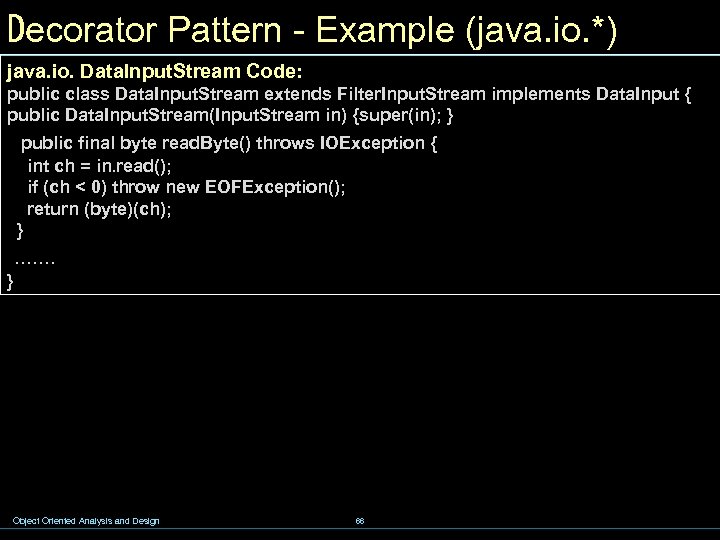 Decorator Pattern - Example (java. io. *) java. io. Data. Input. Stream Code: public class Data. Input. Stream extends Filter. Input. Stream implements Data. Input { public Data. Input. Stream(Input. Stream in) {super(in); } public final byte read. Byte() throws IOException { int ch = in. read(); if (ch < 0) throw new EOFException(); return (byte)(ch); } ……. } Object Oriented Analysis and Design 66
 Proxy Pattern - Motivation w What is expensive? § Object Creation § Object Initialization w Defer creation and initialization to the time you need the object w Reduce the cost of access to objects § Use another object (“the proxy”) that acts as a stand-in for the real object § The proxy creates the real object only if the user asks for it Object Oriented Analysis and Design 67
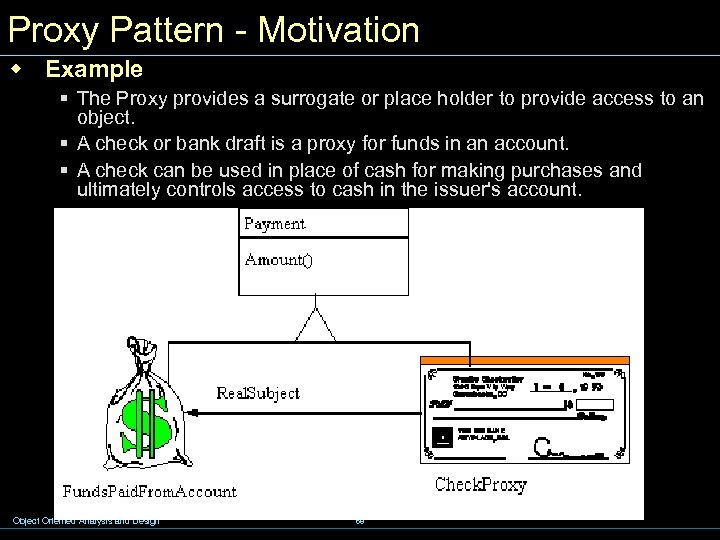 Proxy Pattern - Motivation w Example § The Proxy provides a surrogate or place holder to provide access to an object. § A check or bank draft is a proxy for funds in an account. § A check can be used in place of cash for making purchases and ultimately controls access to cash in the issuer's account. Object Oriented Analysis and Design 68
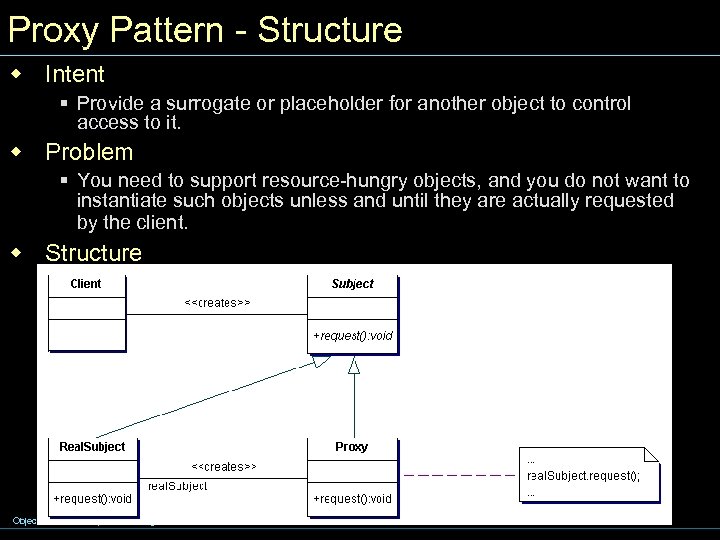 Proxy Pattern - Structure w Intent § Provide a surrogate or placeholder for another object to control access to it. w Problem § You need to support resource-hungry objects, and you do not want to instantiate such objects unless and until they are actually requested by the client. w Structure Object Oriented Analysis and Design 69
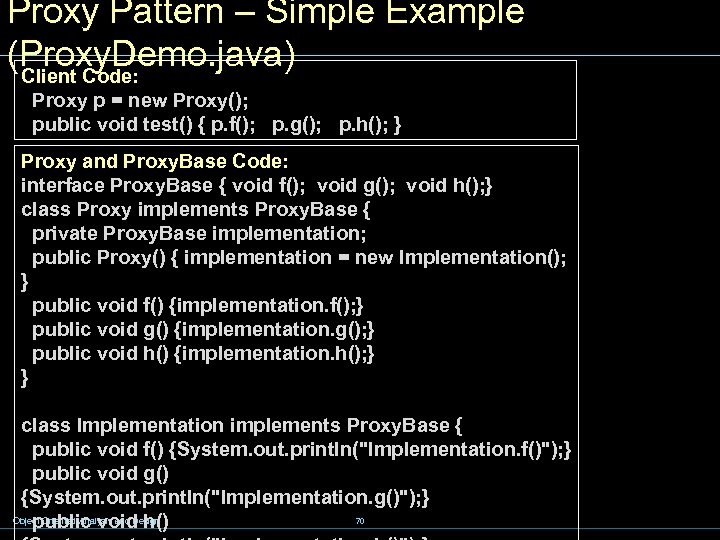 Proxy Pattern – Simple Example (Proxy. Demo. java) Client Code: Proxy p = new Proxy(); public void test() { p. f(); p. g(); p. h(); } Proxy and Proxy. Base Code: interface Proxy. Base { void f(); void g(); void h(); } class Proxy implements Proxy. Base { private Proxy. Base implementation; public Proxy() { implementation = new Implementation(); } public void f() {implementation. f(); } public void g() {implementation. g(); } public void h() {implementation. h(); } } class Implementation implements Proxy. Base { public void f() {System. out. println("Implementation. f()"); } public void g() {System. out. println("Implementation. g()"); } Object Oriented Analysis and Design public void h() 70
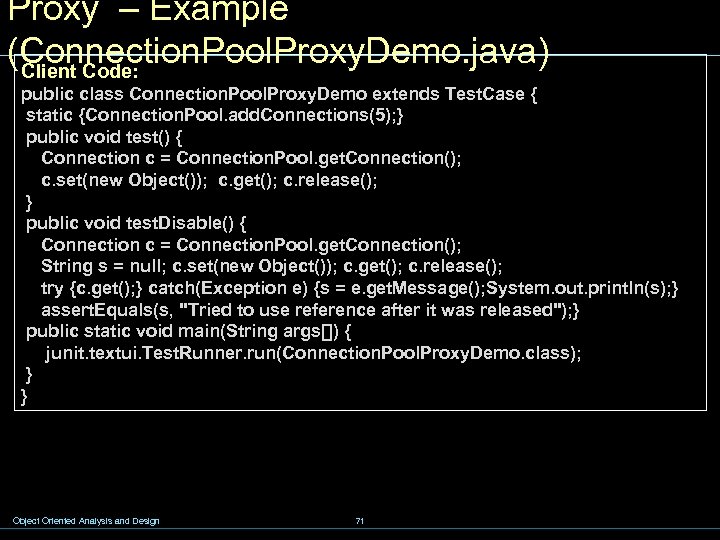 Proxy – Example (Connection. Pool. Proxy. Demo. java) Client Code: public class Connection. Pool. Proxy. Demo extends Test. Case { static {Connection. Pool. add. Connections(5); } public void test() { Connection c = Connection. Pool. get. Connection(); c. set(new Object()); c. get(); c. release(); } public void test. Disable() { Connection c = Connection. Pool. get. Connection(); String s = null; c. set(new Object()); c. get(); c. release(); try {c. get(); } catch(Exception e) {s = e. get. Message(); System. out. println(s); } assert. Equals(s, "Tried to use reference after it was released"); } public static void main(String args[]) { junit. textui. Test. Runner. run(Connection. Pool. Proxy. Demo. class); } } Object Oriented Analysis and Design 71
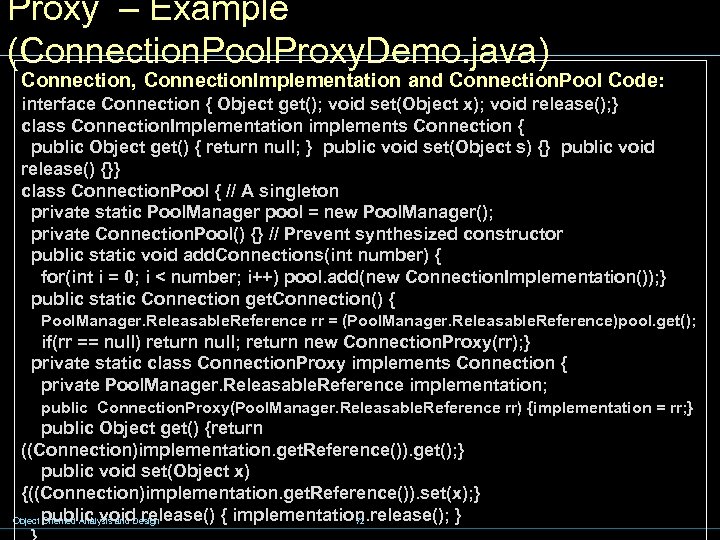 Proxy – Example (Connection. Pool. Proxy. Demo. java) Connection, Connection. Implementation and Connection. Pool Code: interface Connection { Object get(); void set(Object x); void release(); } class Connection. Implementation implements Connection { public Object get() { return null; } public void set(Object s) {} public void release() {}} class Connection. Pool { // A singleton private static Pool. Manager pool = new Pool. Manager(); private Connection. Pool() {} // Prevent synthesized constructor public static void add. Connections(int number) { for(int i = 0; i < number; i++) pool. add(new Connection. Implementation()); } public static Connection get. Connection() { Pool. Manager. Releasable. Reference rr = (Pool. Manager. Releasable. Reference)pool. get(); if(rr == null) return null; return new Connection. Proxy(rr); } private static class Connection. Proxy implements Connection { private Pool. Manager. Releasable. Reference implementation; public Connection. Proxy(Pool. Manager. Releasable. Reference rr) {implementation = rr; } public Object get() {return ((Connection)implementation. get. Reference()). get(); } public void set(Object x) {((Connection)implementation. get. Reference()). set(x); } Object public void release() { implementation. release(); } Oriented Analysis and Design 72
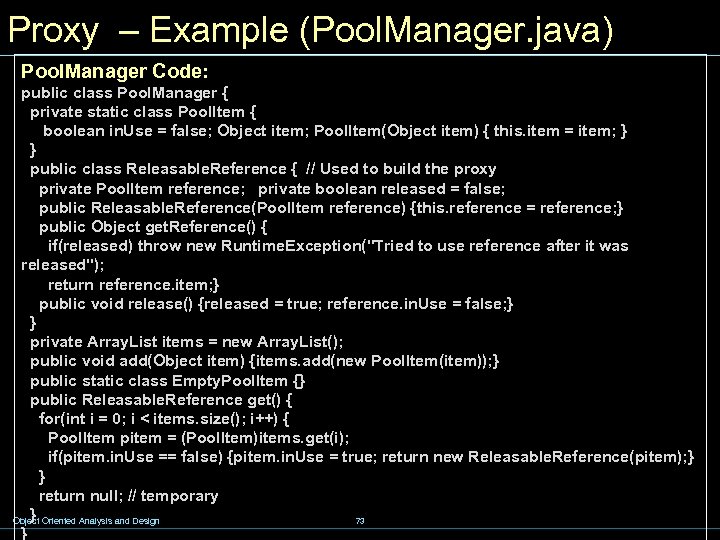 Proxy – Example (Pool. Manager. java) Pool. Manager Code: public class Pool. Manager { private static class Pool. Item { boolean in. Use = false; Object item; Pool. Item(Object item) { this. item = item; } } public class Releasable. Reference { // Used to build the proxy private Pool. Item reference; private boolean released = false; public Releasable. Reference(Pool. Item reference) {this. reference = reference; } public Object get. Reference() { if(released) throw new Runtime. Exception("Tried to use reference after it was released"); return reference. item; } public void release() {released = true; reference. in. Use = false; } } private Array. List items = new Array. List(); public void add(Object item) {items. add(new Pool. Item(item)); } public static class Empty. Pool. Item {} public Releasable. Reference get() { for(int i = 0; i < items. size(); i++) { Pool. Item pitem = (Pool. Item)items. get(i); if(pitem. in. Use == false) {pitem. in. Use = true; return new Releasable. Reference(pitem); } } return null; // temporary } Object Oriented Analysis and Design 73 }
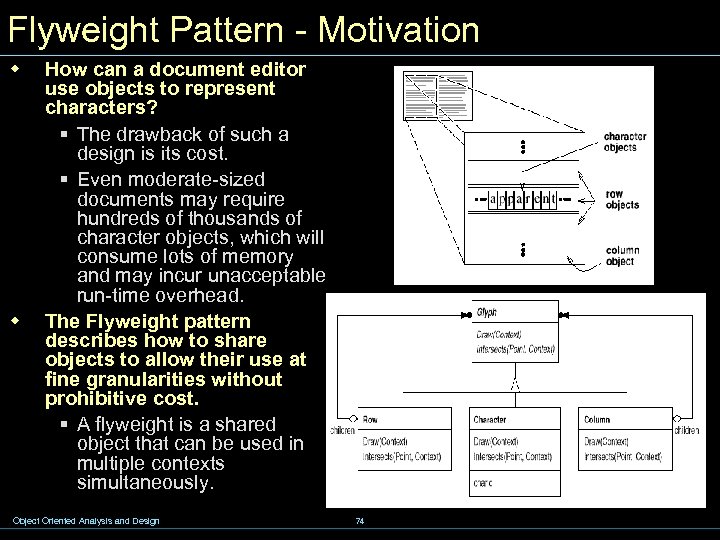 Flyweight Pattern - Motivation w w How can a document editor use objects to represent characters? § The drawback of such a design is its cost. § Even moderate-sized documents may require hundreds of thousands of character objects, which will consume lots of memory and may incur unacceptable run-time overhead. The Flyweight pattern describes how to share objects to allow their use at fine granularities without prohibitive cost. § A flyweight is a shared object that can be used in multiple contexts simultaneously. Object Oriented Analysis and Design 74
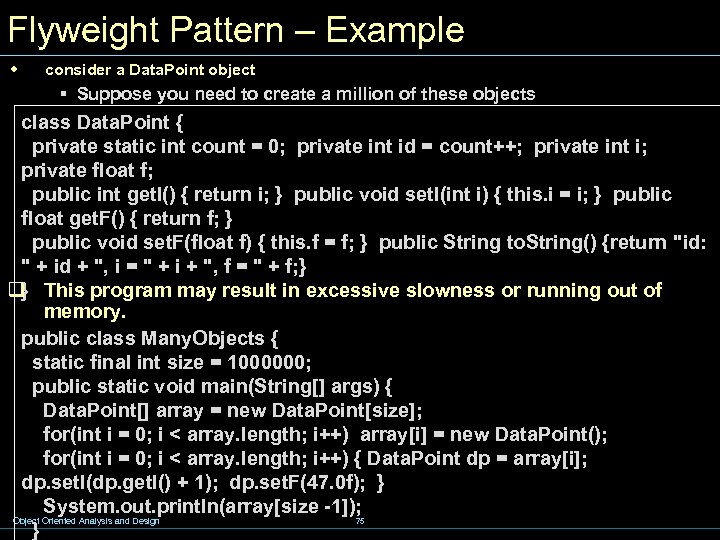 Flyweight Pattern – Example w consider a Data. Point object § Suppose you need to create a million of these objects class Data. Point { private static int count = 0; private int id = count++; private int i; private float f; public int get. I() { return i; } public void set. I(int i) { this. i = i; } public float get. F() { return f; } public void set. F(float f) { this. f = f; } public String to. String() {return "id: " + id + ", i = " + i + ", f = " + f; } } q This program may result in excessive slowness or running out of memory. public class Many. Objects { static final int size = 1000000; public static void main(String[] args) { Data. Point[] array = new Data. Point[size]; for(int i = 0; i < array. length; i++) array[i] = new Data. Point(); for(int i = 0; i < array. length; i++) { Data. Point dp = array[i]; dp. set. I(dp. get. I() + 1); dp. set. F(47. 0 f); } System. out. println(array[size -1]); Object Oriented Analysis and Design } 75
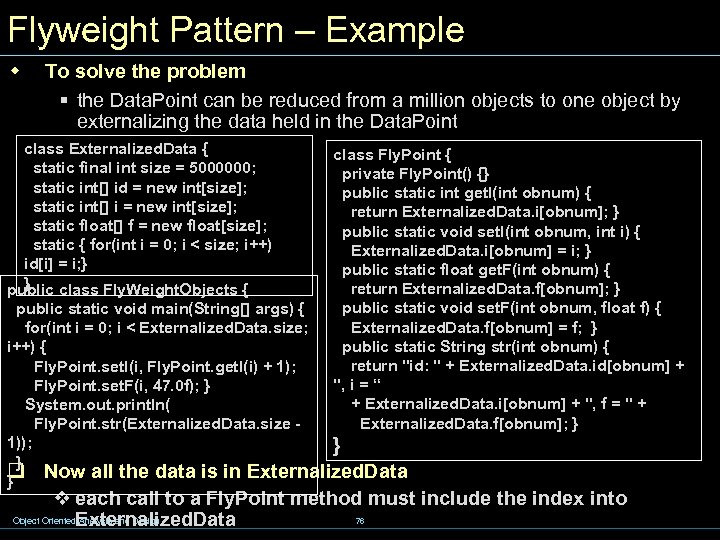 Flyweight Pattern – Example w To solve the problem § the Data. Point can be reduced from a million objects to one object by externalizing the data held in the Data. Point class Externalized. Data { static final int size = 5000000; static int[] id = new int[size]; static int[] i = new int[size]; static float[] f = new float[size]; static { for(int i = 0; i < size; i++) id[i] = i; } } public class Fly. Weight. Objects { class Fly. Point { private Fly. Point() {} public static int get. I(int obnum) { return Externalized. Data. i[obnum]; } public static void set. I(int obnum, int i) { Externalized. Data. i[obnum] = i; } public static float get. F(int obnum) { return Externalized. Data. f[obnum]; } public static void set. F(int obnum, float f) { Externalized. Data. f[obnum] = f; } public static String str(int obnum) { return "id: " + Externalized. Data. id[obnum] + ", i = “ + Externalized. Data. i[obnum] + ", f = " + Externalized. Data. f[obnum]; } public static void main(String[] args) { for(int i = 0; i < Externalized. Data. size; i++) { Fly. Point. set. I(i, Fly. Point. get. I(i) + 1); Fly. Point. set. F(i, 47. 0 f); } System. out. println( Fly. Point. str(Externalized. Data. size 1)); } } q Now all the data is in Externalized. Data } v each call to a Fly. Point method must include the index into Object Oriented. Externalized. Data Analysis and Design 76
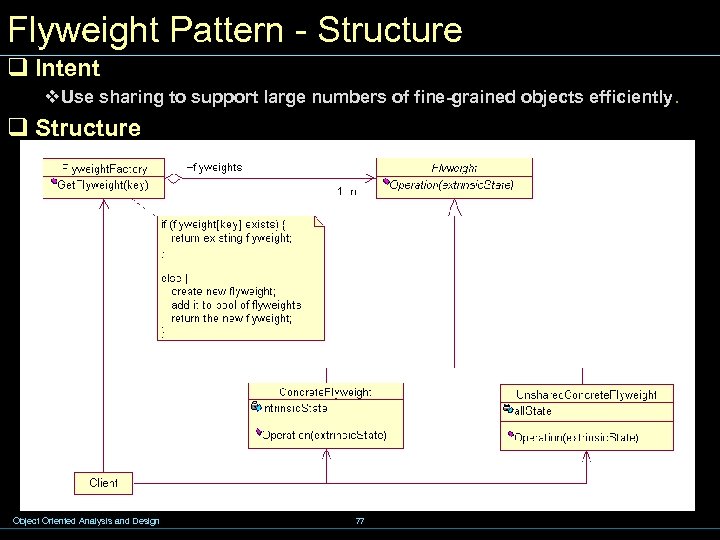 Flyweight Pattern - Structure q Intent v Use sharing to support large numbers of fine-grained objects efficiently. q Structure Object Oriented Analysis and Design 77
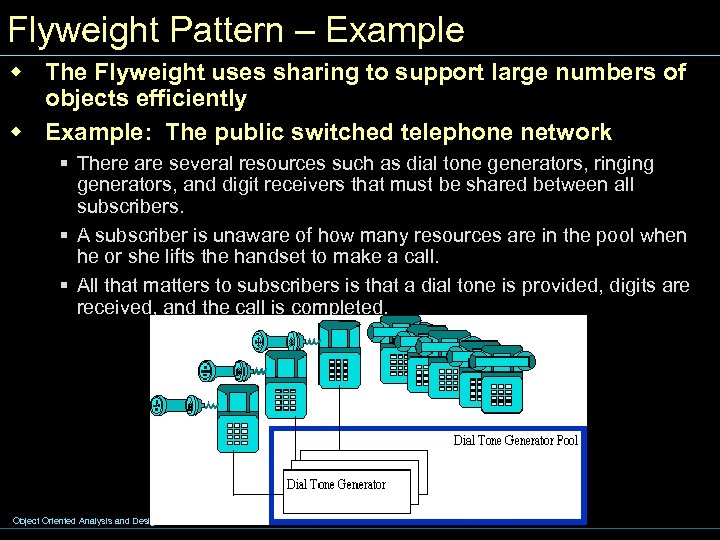 Flyweight Pattern – Example w The Flyweight uses sharing to support large numbers of objects efficiently w Example: The public switched telephone network § There are several resources such as dial tone generators, ringing generators, and digit receivers that must be shared between all subscribers. § A subscriber is unaware of how many resources are in the pool when he or she lifts the handset to make a call. § All that matters to subscribers is that a dial tone is provided, digits are received, and the call is completed. Object Oriented Analysis and Design 78
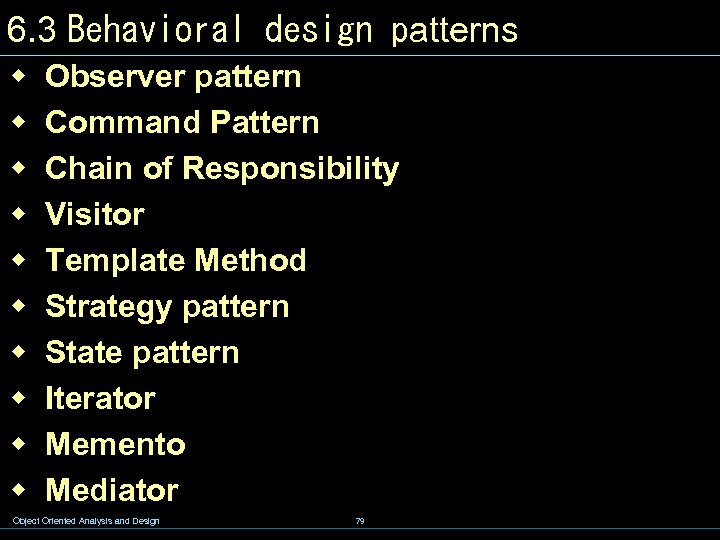 6. 3 Behavioral design patterns w w w w w Observer pattern Command Pattern Chain of Responsibility Visitor Template Method Strategy pattern State pattern Iterator Memento Mediator Object Oriented Analysis and Design 79
 Observer pattern Also known as: “Publish / Subscribe, ” “Model / View, ” and “Source / Listener. ” Motivation: Two File Managers are both observing the same Directory; the user deletes a subdirectory using File Manager A; we want File Manager B to immediately and automatically get updated, reflecting the change. . . Applicability: – When there are multiple views of a model (subject) that need to stay in sync. No view should know about any other. – When an object needs to communicate to other objects of unknown type (but known Observer interface) it can notify them. Pros: – Promotes loose coupling between objects. – Excellent communication protocol. – Avoids polling Cons: – None. Knowledge of this pattern is essential. Object Oriented Analysis and Design 80
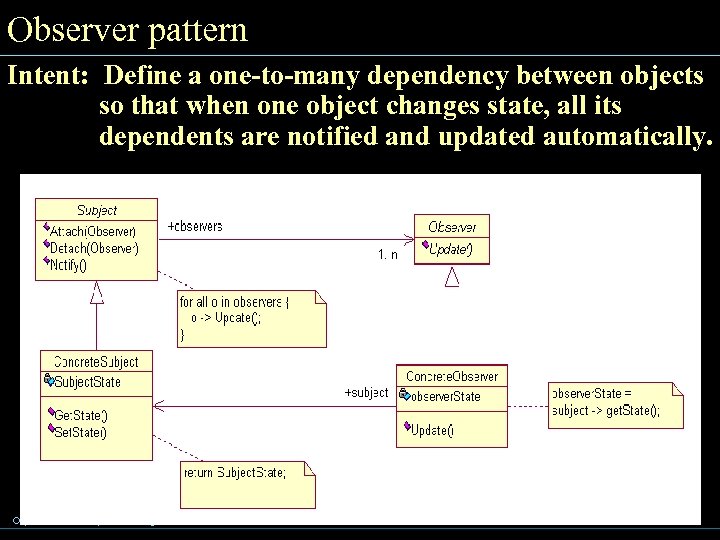 Observer pattern Intent: Define a one-to-many dependency between objects so that when one object changes state, all its dependents are notified and updated automatically. Object Oriented Analysis and Design 81
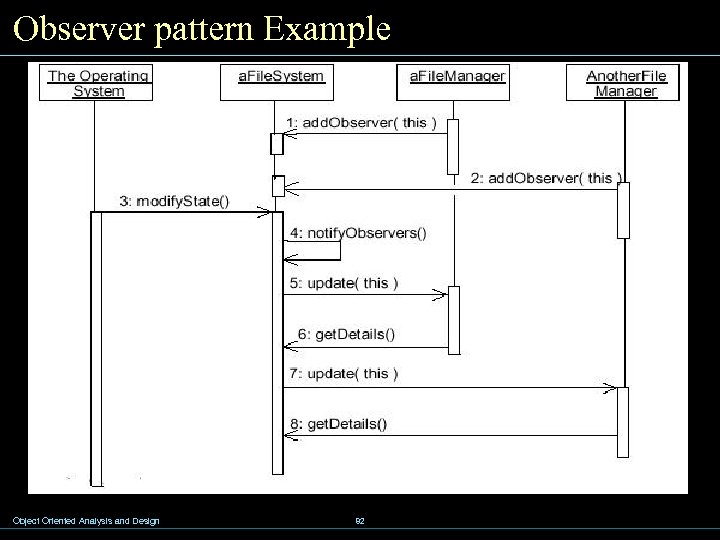 Observer pattern Example Object Oriented Analysis and Design 82
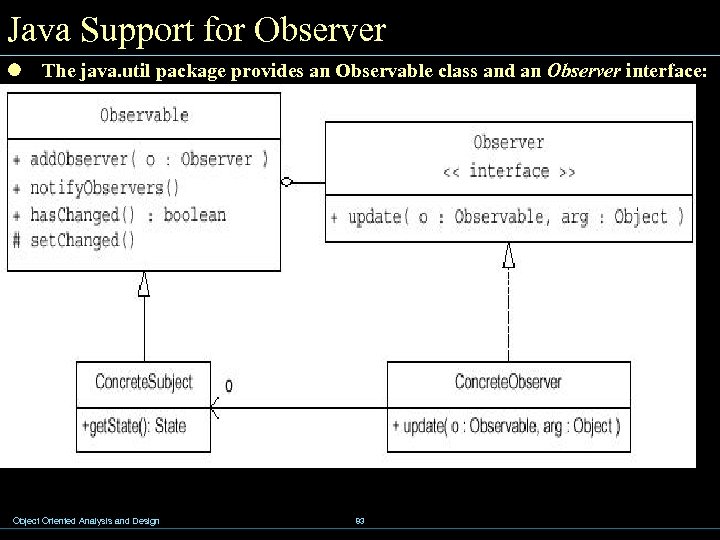 Java Support for Observer l The java. util package provides an Observable class and an Observer interface: Object Oriented Analysis and Design 83
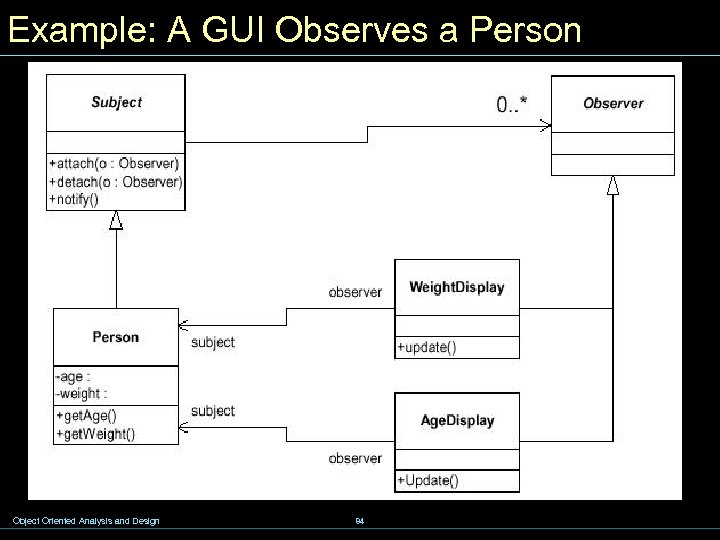 Example: A GUI Observes a Person Object Oriented Analysis and Design 84
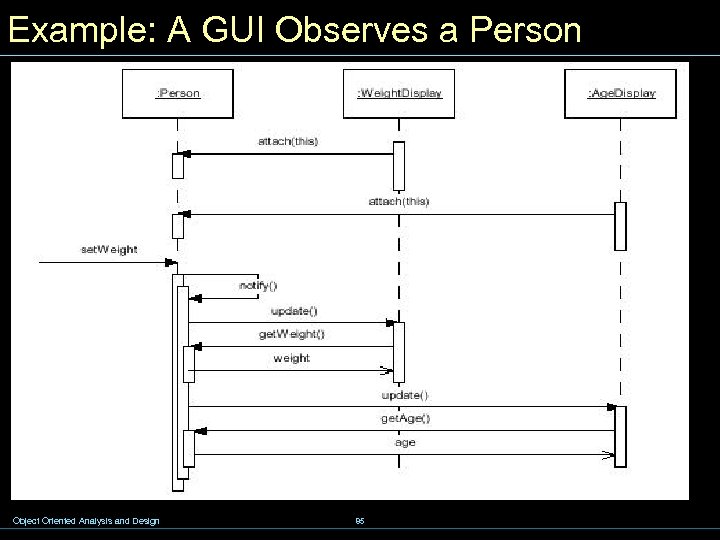 Example: A GUI Observes a Person Object Oriented Analysis and Design 85
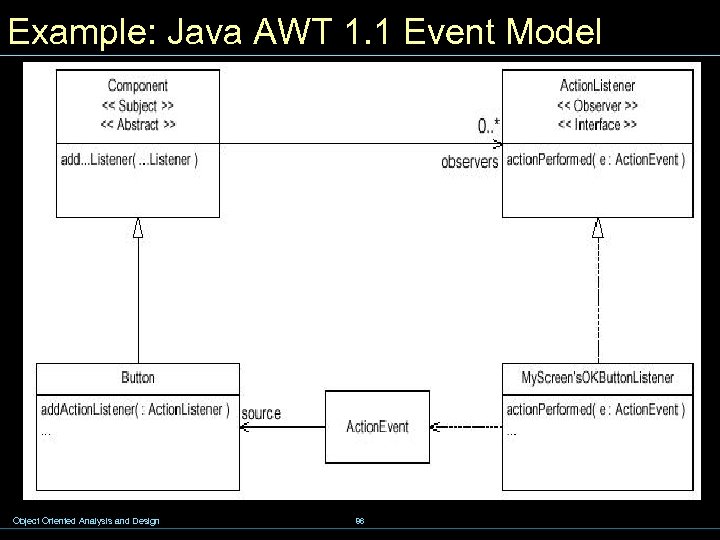 Example: Java AWT 1. 1 Event Model Object Oriented Analysis and Design 86
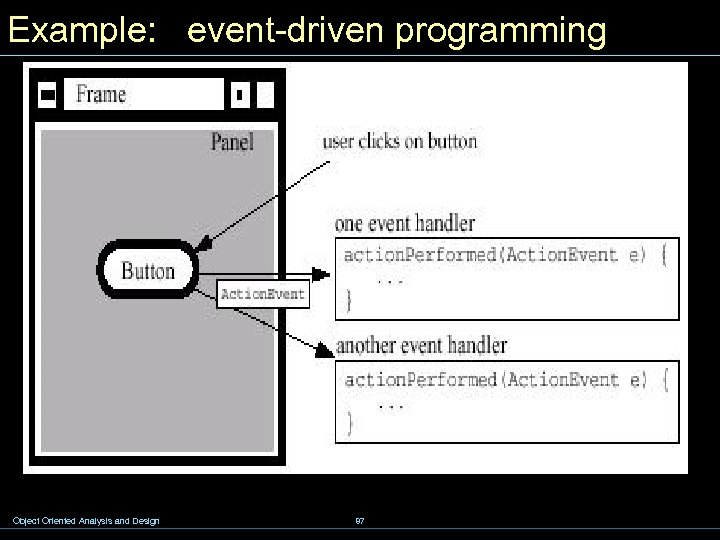 Example: event-driven programming Object Oriented Analysis and Design 87
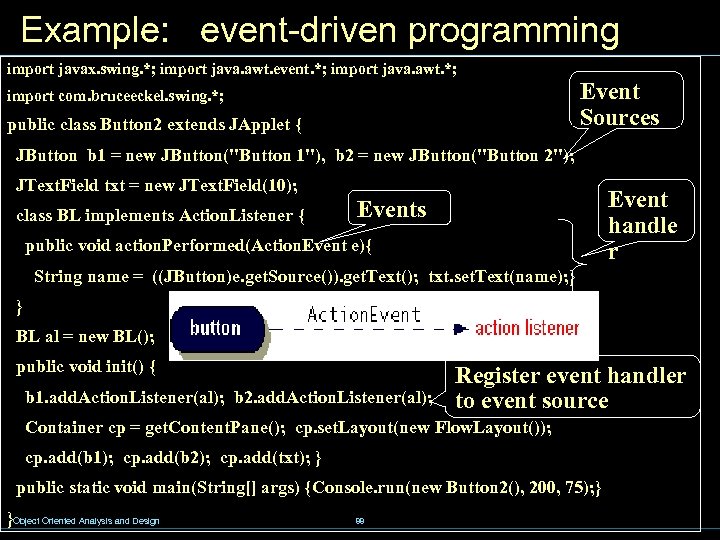 Example: event-driven programming import javax. swing. *; import java. awt. event. *; import java. awt. *; Event Sources import com. bruceeckel. swing. *; public class Button 2 extends JApplet { JButton b 1 = new JButton("Button 1"), b 2 = new JButton("Button 2"); JText. Field txt = new JText. Field(10); class BL implements Action. Listener { Event handle r Events public void action. Performed(Action. Event e){ String name = ((JButton)e. get. Source()). get. Text(); txt. set. Text(name); } } BL al = new BL(); public void init() { b 1. add. Action. Listener(al); b 2. add. Action. Listener(al); Register event handler to event source Container cp = get. Content. Pane(); cp. set. Layout(new Flow. Layout()); cp. add(b 1); cp. add(b 2); cp. add(txt); } public static void main(String[] args) {Console. run(new Button 2(), 200, 75); } Object } Oriented Analysis and Design 88
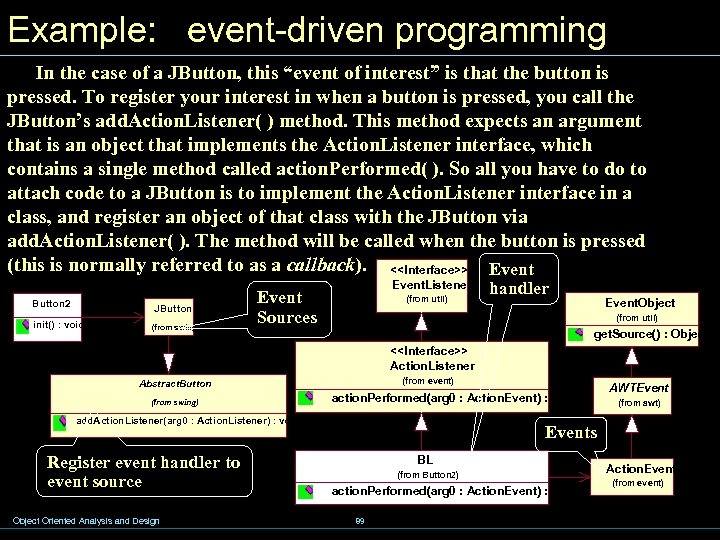 Example: event-driven programming In the case of a JButton, this “event of interest” is that the button is pressed. To register your interest in when a button is pressed, you call the JButton’s add. Action. Listener( ) method. This method expects an argument that is an object that implements the Action. Listener interface, which contains a single method called action. Performed( ). So all you have to do to attach code to a JButton is to implement the Action. Listener interface in a class, and register an object of that class with the JButton via add. Action. Listener( ). The method will be called when the button is pressed (this is normally referred to as a callback). <
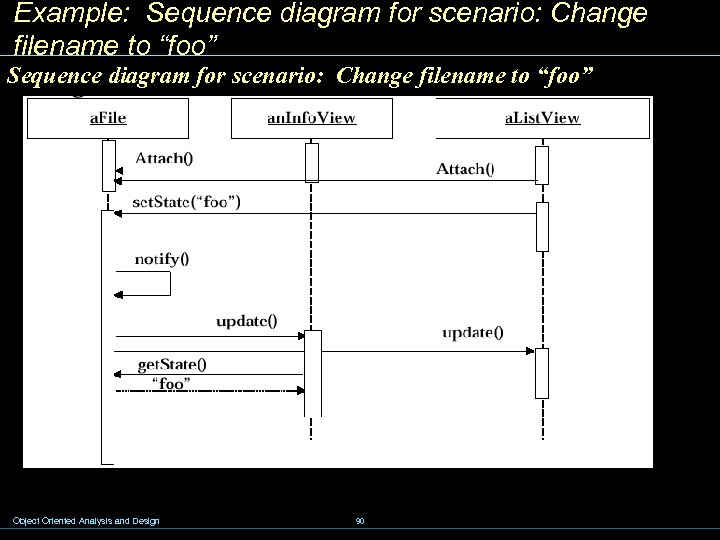 Example: Sequence diagram for scenario: Change filename to “foo” Object Oriented Analysis and Design 90
 Command Pattern - Motivation w You want to make the user interface reusable across many applications § You cannot hardcode the meanings of the menus for the various applications § The applications only know what has to be done when a menu is selected. w You want to support Undo and Redo Object Oriented Analysis and Design 91
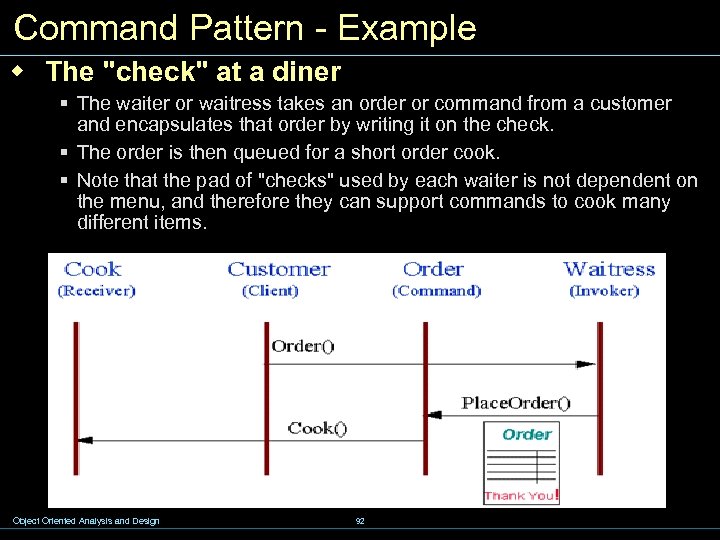 Command Pattern - Example w The "check" at a diner § The waiter or waitress takes an order or command from a customer and encapsulates that order by writing it on the check. § The order is then queued for a short order cook. § Note that the pad of "checks" used by each waiter is not dependent on the menu, and therefore they can support commands to cook many different items. Object Oriented Analysis and Design 92
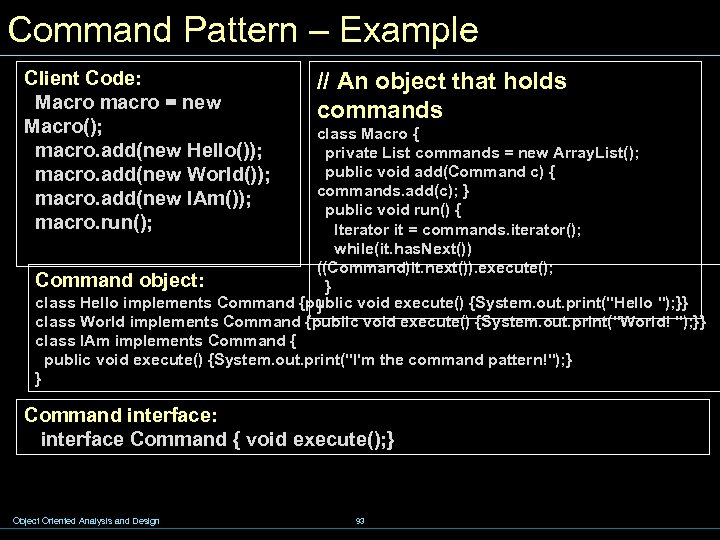 Command Pattern – Example Client Code: Macro macro = new Macro(); macro. add(new Hello()); macro. add(new World()); macro. add(new IAm()); macro. run(); // An object that holds commands class Macro { private List commands = new Array. List(); public void add(Command c) { commands. add(c); } public void run() { Iterator it = commands. iterator(); while(it. has. Next()) ((Command)it. next()). execute(); Command object: } class Hello implements Command {public void execute() {System. out. print("Hello "); }} } class World implements Command {public void execute() {System. out. print("World! "); }} class IAm implements Command { public void execute() {System. out. print("I'm the command pattern!"); } } Command interface: interface Command { void execute(); } Object Oriented Analysis and Design 93
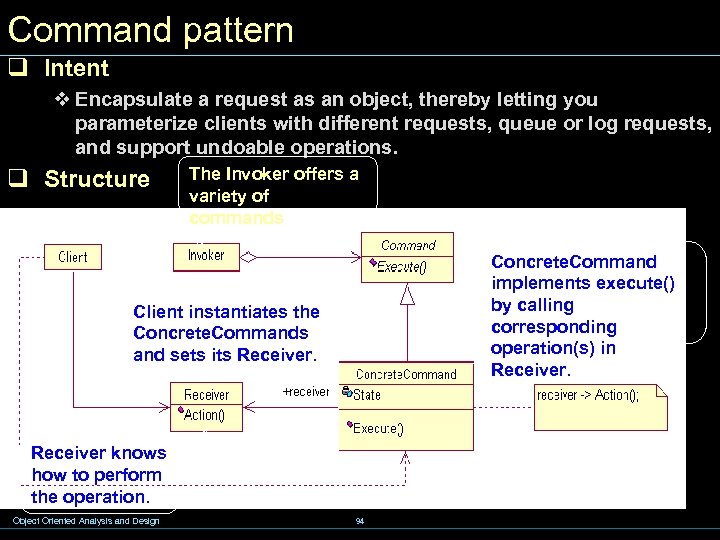 Command pattern q Intent v Encapsulate a request as an object, thereby letting you parameterize clients with different requests, queue or log requests, and support undoable operations. q Structure The Invoker offers a variety of commands Concrete. Command implements execute() by calling corresponding operation(s) in Receiver. Client instantiates the Concrete. Commands and sets its Receiver knows how to perform the operation. Object Oriented Analysis and Design 94
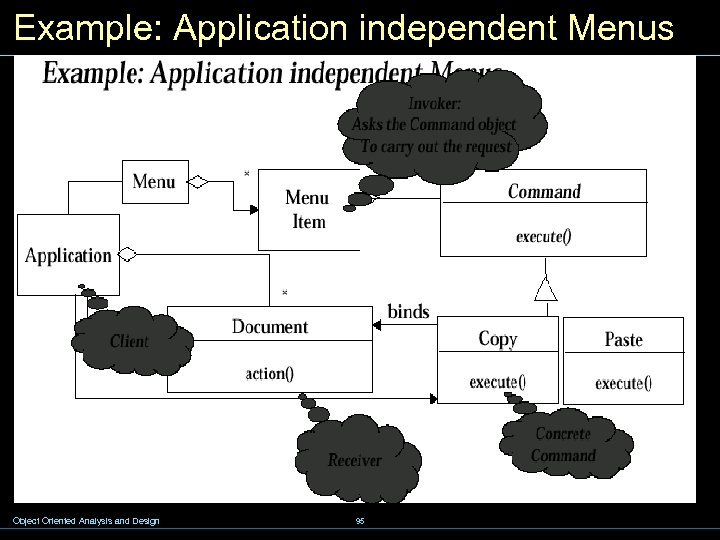 Example: Application independent Menus Object Oriented Analysis and Design 95
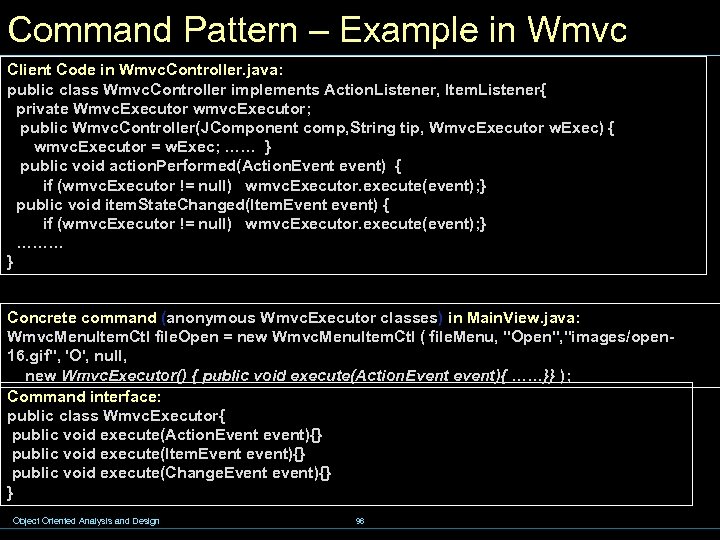 Command Pattern – Example in Wmvc Client Code in Wmvc. Controller. java: public class Wmvc. Controller implements Action. Listener, Item. Listener{ private Wmvc. Executor wmvc. Executor; public Wmvc. Controller(JComponent comp, String tip, Wmvc. Executor w. Exec) { wmvc. Executor = w. Exec; …… } public void action. Performed(Action. Event event) { if (wmvc. Executor != null) wmvc. Executor. execute(event); } public void item. State. Changed(Item. Event event) { if (wmvc. Executor != null) wmvc. Executor. execute(event); } ……… } Concrete command (anonymous Wmvc. Executor classes) in Main. View. java: Wmvc. Menu. Item. Ctl file. Open = new Wmvc. Menu. Item. Ctl ( file. Menu, "Open", "images/open 16. gif", 'O', null, new Wmvc. Executor() { public void execute(Action. Event event){ ……}} ); Command interface: public class Wmvc. Executor{ public void execute(Action. Event event){} public void execute(Item. Event event){} public void execute(Change. Event event){} } Object Oriented Analysis and Design 96
 Chain of Resposibility Pattern - Motivation w Consider a context-sensitive help facility for a GUI § The user can obtain help information on any part of the interface just by clicking on it. § The help that's provided depends on the part of the interface that's selected and its context. w Problem § How to decouple the button that initiates the help request from the objects that might provide help information? w Solution § to decouple senders and receivers by giving multiple objects a chance to handle a request. The request gets passed along a chain of objects until one of them handles it. § The first object in the chain receives the request and either handles it or forwards it to the next candidate on the chain, which does likewise. § The object that made the request has no explicit knowledge of who will handle it Object Oriented Analysis and Design 97
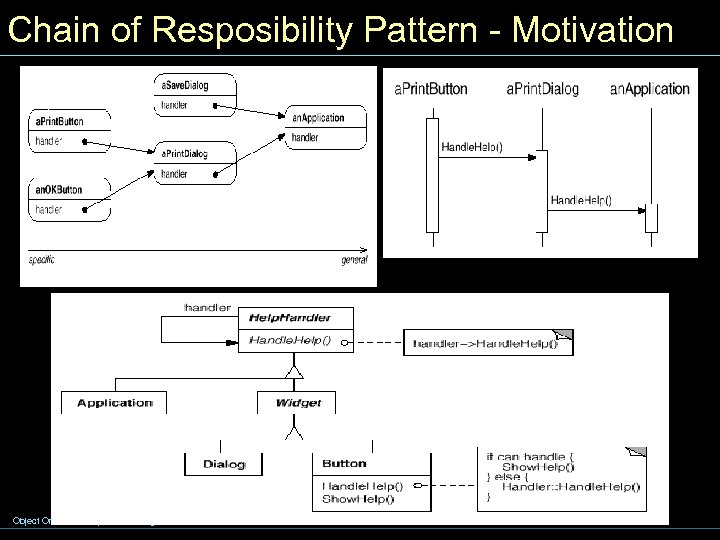 Chain of Resposibility Pattern - Motivation Object Oriented Analysis and Design 98
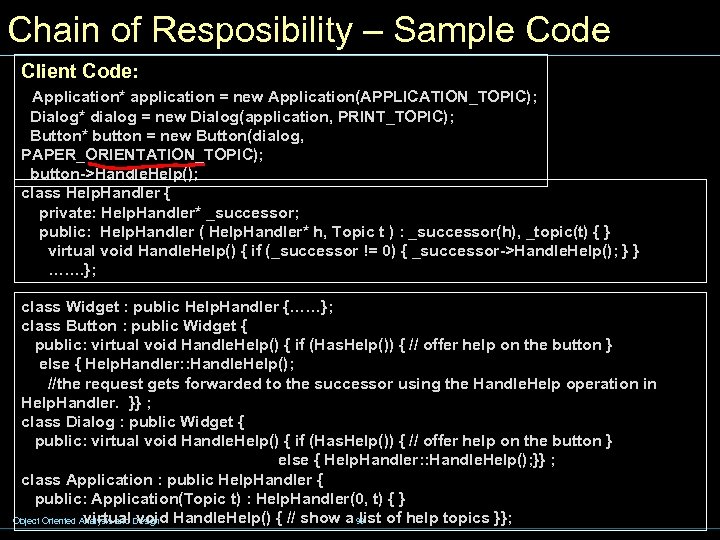 Chain of Resposibility – Sample Code Client Code: Application* application = new Application(APPLICATION_TOPIC); Dialog* dialog = new Dialog(application, PRINT_TOPIC); Button* button = new Button(dialog, PAPER_ORIENTATION_TOPIC); button->Handle. Help(); class Help. Handler { private: Help. Handler* _successor; public: Help. Handler ( Help. Handler* h, Topic t ) : _successor(h), _topic(t) { } virtual void Handle. Help() { if (_successor != 0) { _successor->Handle. Help(); } } ……. }; class Widget : public Help. Handler {……}; class Button : public Widget { public: virtual void Handle. Help() { if (Has. Help()) { // offer help on the button } else { Help. Handler: : Handle. Help(); //the request gets forwarded to the successor using the Handle. Help operation in Help. Handler. }} ; class Dialog : public Widget { public: virtual void Handle. Help() { if (Has. Help()) { // offer help on the button } else { Help. Handler: : Handle. Help(); }} ; class Application : public Help. Handler { public: Application(Topic t) : Help. Handler(0, t) { } virtual void list of help topics }}; Object Oriented Analysis and Design Handle. Help() { // show a 99
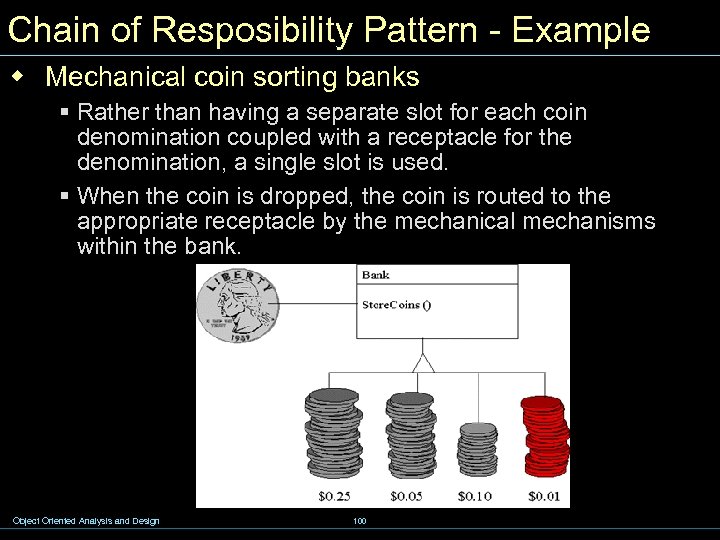 Chain of Resposibility Pattern - Example w Mechanical coin sorting banks § Rather than having a separate slot for each coin denomination coupled with a receptacle for the denomination, a single slot is used. § When the coin is dropped, the coin is routed to the appropriate receptacle by the mechanical mechanisms within the bank. Object Oriented Analysis and Design 100
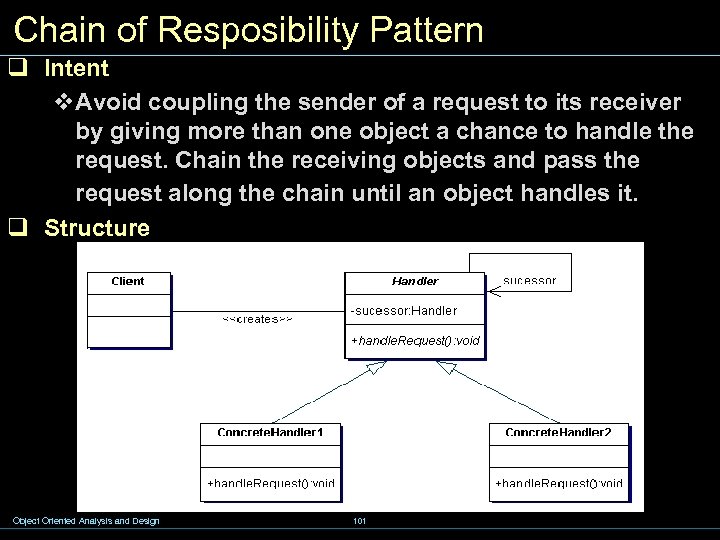 Chain of Resposibility Pattern q Intent v. Avoid coupling the sender of a request to its receiver by giving more than one object a chance to handle the request. Chain the receiving objects and pass the request along the chain until an object handles it. q Structure Object Oriented Analysis and Design 101
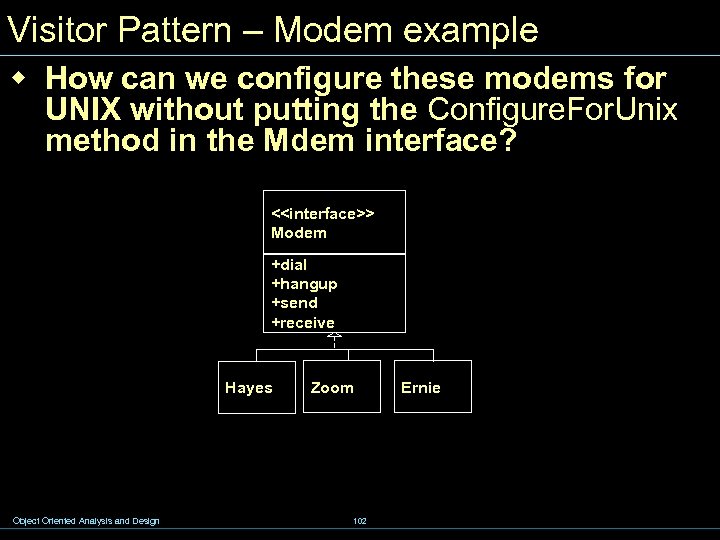 Visitor Pattern – Modem example w How can we configure these modems for UNIX without putting the Configure. For. Unix method in the Mdem interface? <
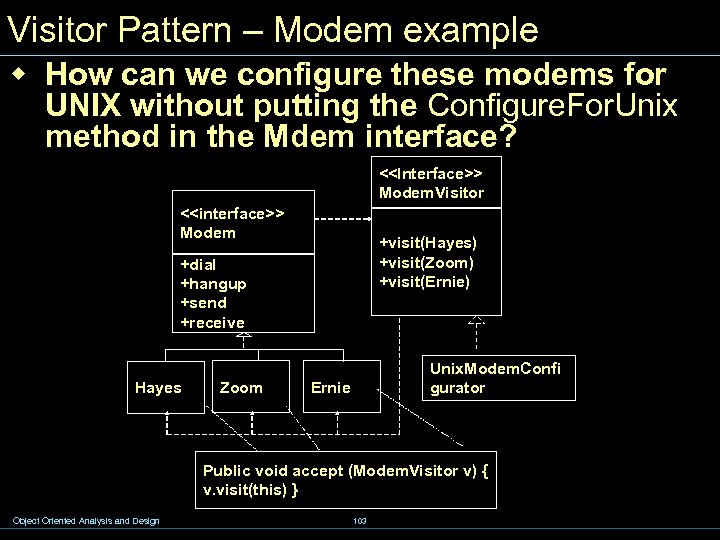 Visitor Pattern – Modem example w How can we configure these modems for UNIX without putting the Configure. For. Unix method in the Mdem interface? <
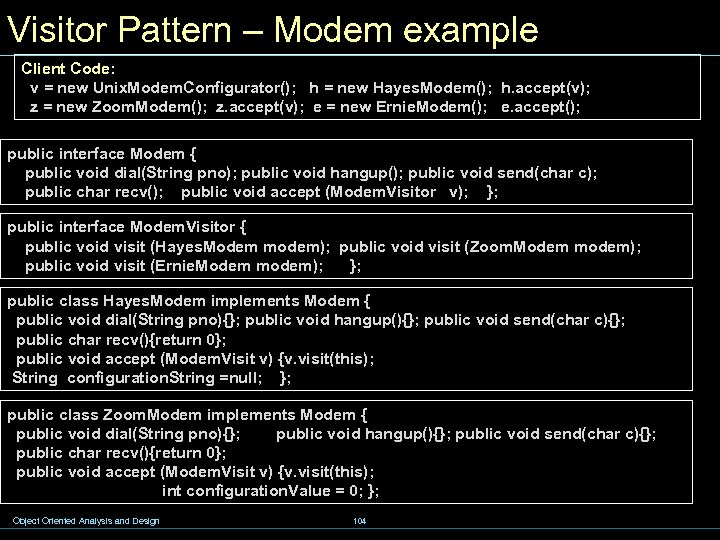 Visitor Pattern – Modem example Client Code: v = new Unix. Modem. Configurator(); h = new Hayes. Modem(); h. accept(v); z = new Zoom. Modem(); z. accept(v); e = new Ernie. Modem(); e. accept(); public interface Modem { public void dial(String pno); public void hangup(); public void send(char c); public char recv(); public void accept (Modem. Visitor v); }; public interface Modem. Visitor { public void visit (Hayes. Modem modem); public void visit (Zoom. Modem modem); public void visit (Ernie. Modem modem); }; public class Hayes. Modem implements Modem { public void dial(String pno){}; public void hangup(){}; public void send(char c){}; public char recv(){return 0}; public void accept (Modem. Visit v) {v. visit(this); String configuration. String =null; }; public class Zoom. Modem implements Modem { public void dial(String pno){}; public void hangup(){}; public void send(char c){}; public char recv(){return 0}; public void accept (Modem. Visit v) {v. visit(this); int configuration. Value = 0; }; Object Oriented Analysis and Design 104
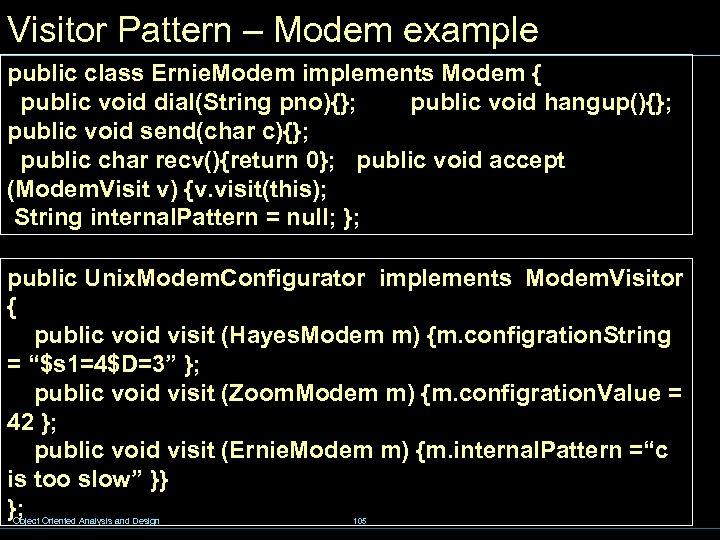 Visitor Pattern – Modem example public class Ernie. Modem implements Modem { public void dial(String pno){}; public void hangup(){}; public void send(char c){}; public char recv(){return 0}; public void accept (Modem. Visit v) {v. visit(this); String internal. Pattern = null; }; public Unix. Modem. Configurator implements Modem. Visitor { public void visit (Hayes. Modem m) {m. configration. String = “$s 1=4$D=3” }; public void visit (Zoom. Modem m) {m. configration. Value = 42 }; public void visit (Ernie. Modem m) {m. internal. Pattern =“c is too slow” }} }; Object Oriented Analysis and Design 105
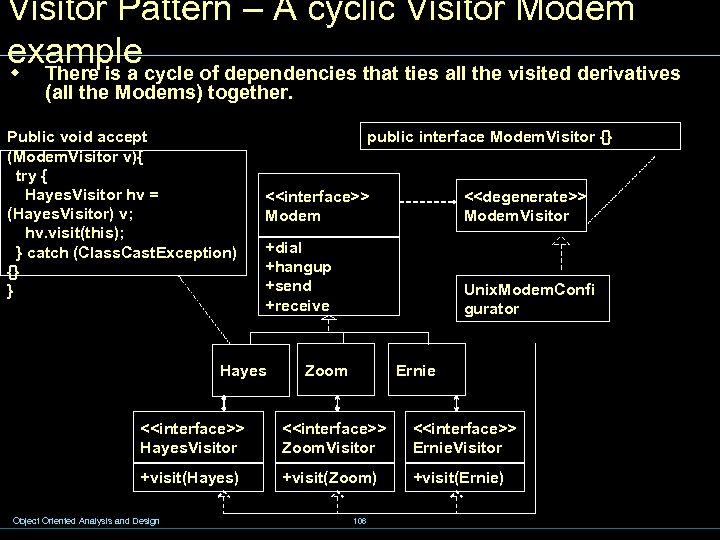 Visitor Pattern – A cyclic Visitor Modem examplecycle of dependencies that ties all the visited derivatives w There is a (all the Modems) together. Public void accept (Modem. Visitor v){ try { Hayes. Visitor hv = (Hayes. Visitor) v; hv. visit(this); } catch (Class. Cast. Exception) {} } public interface Modem. Visitor {} <
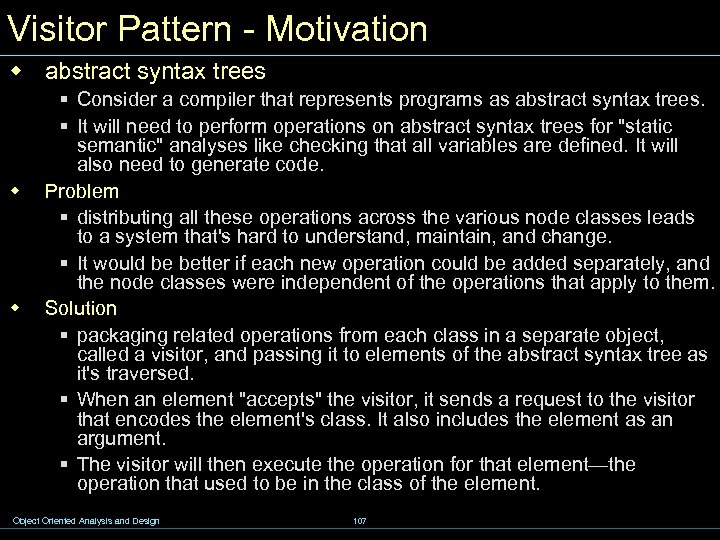 Visitor Pattern - Motivation w abstract syntax trees w w § Consider a compiler that represents programs as abstract syntax trees. § It will need to perform operations on abstract syntax trees for "static semantic" analyses like checking that all variables are defined. It will also need to generate code. Problem § distributing all these operations across the various node classes leads to a system that's hard to understand, maintain, and change. § It would be better if each new operation could be added separately, and the node classes were independent of the operations that apply to them. Solution § packaging related operations from each class in a separate object, called a visitor, and passing it to elements of the abstract syntax tree as it's traversed. § When an element "accepts" the visitor, it sends a request to the visitor that encodes the element's class. It also includes the element as an argument. § The visitor will then execute the operation for that element—the operation that used to be in the class of the element. Object Oriented Analysis and Design 107
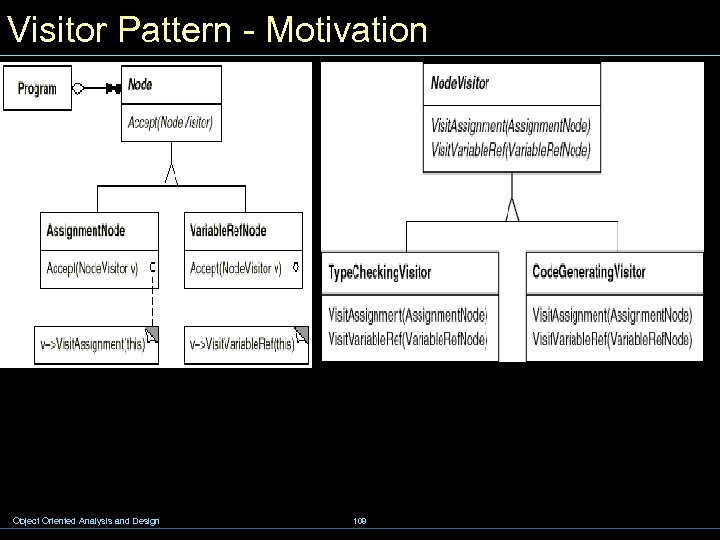 Visitor Pattern - Motivation Object Oriented Analysis and Design 108
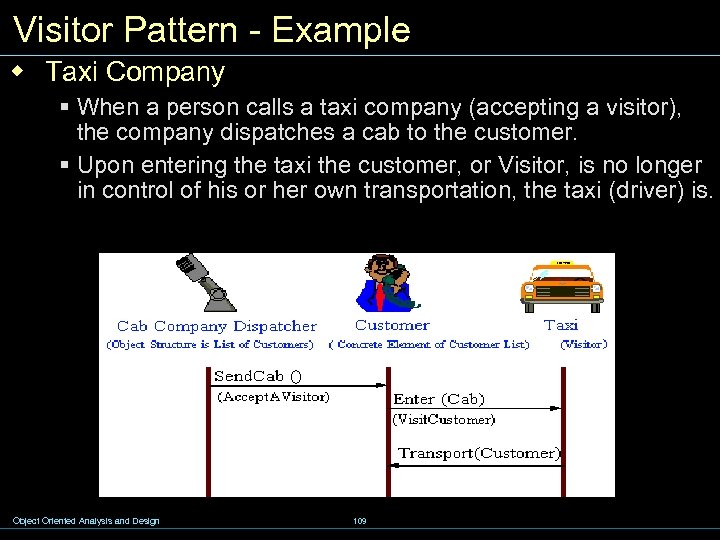 Visitor Pattern - Example w Taxi Company § When a person calls a taxi company (accepting a visitor), the company dispatches a cab to the customer. § Upon entering the taxi the customer, or Visitor, is no longer in control of his or her own transportation, the taxi (driver) is. Object Oriented Analysis and Design 109
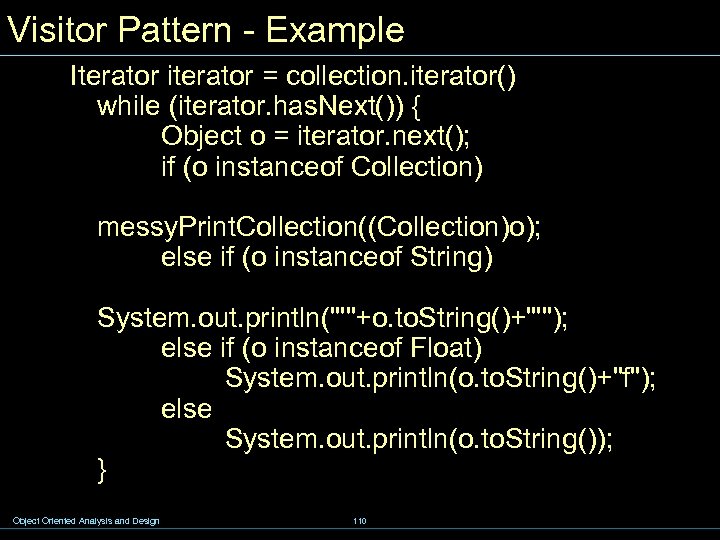 Visitor Pattern - Example Iterator iterator = collection. iterator() while (iterator. has. Next()) { Object o = iterator. next(); if (o instanceof Collection) messy. Print. Collection((Collection)o); else if (o instanceof String) System. out. println("'"+o. to. String()+"'"); else if (o instanceof Float) System. out. println(o. to. String()+"f"); else System. out. println(o. to. String()); } Object Oriented Analysis and Design 110
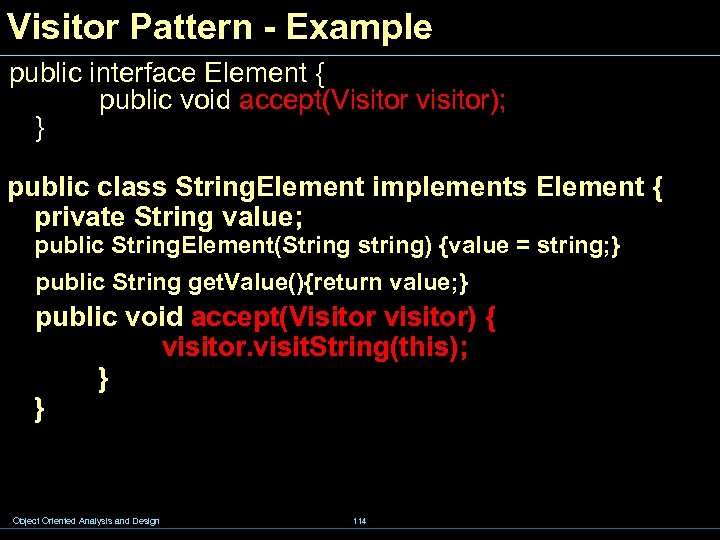
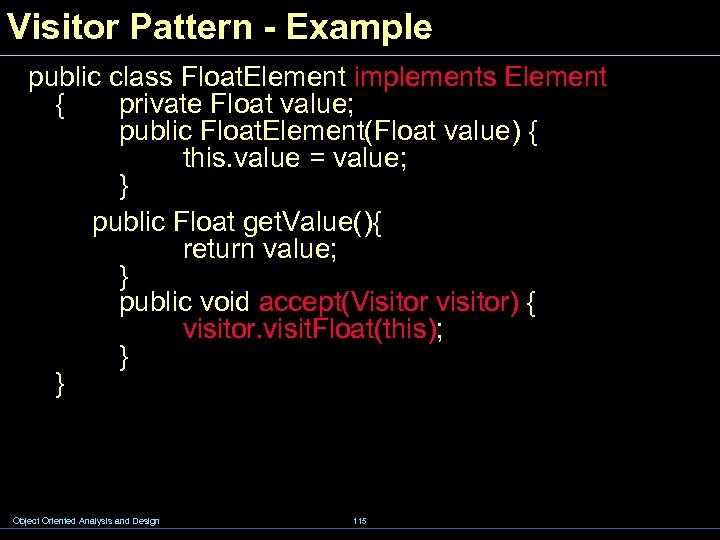
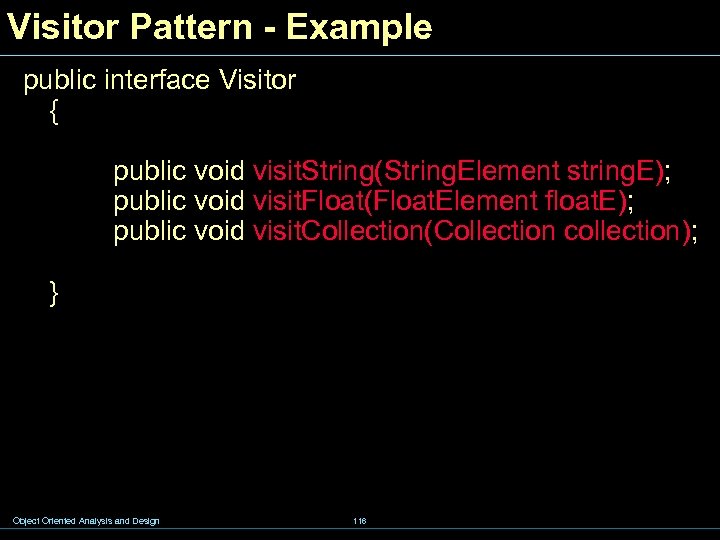
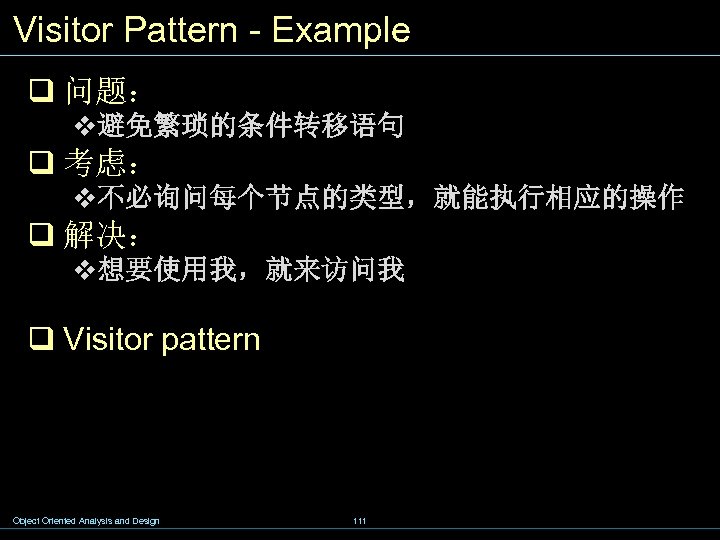 Visitor Pattern - Example q 问题: v避免繁琐的条件转移语句 q 考虑: v不必询问每个节点的类型,就能执行相应的操作 q 解决: v想要使用我,就来访问我 q Visitor pattern Object Oriented Analysis and Design 111
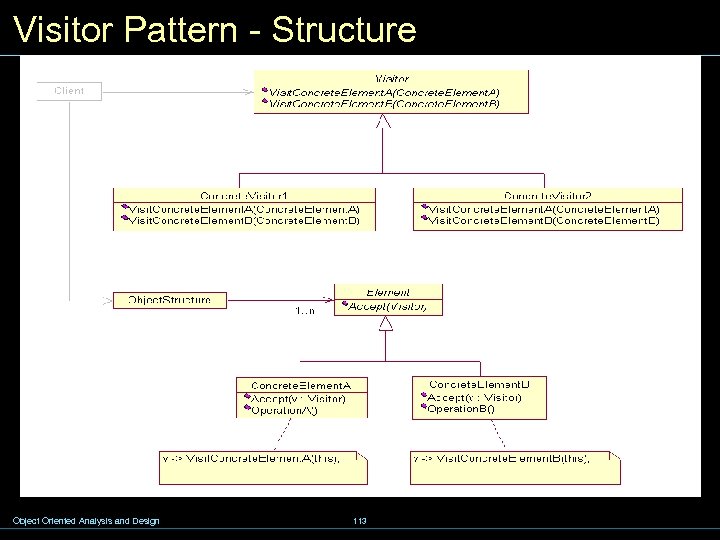
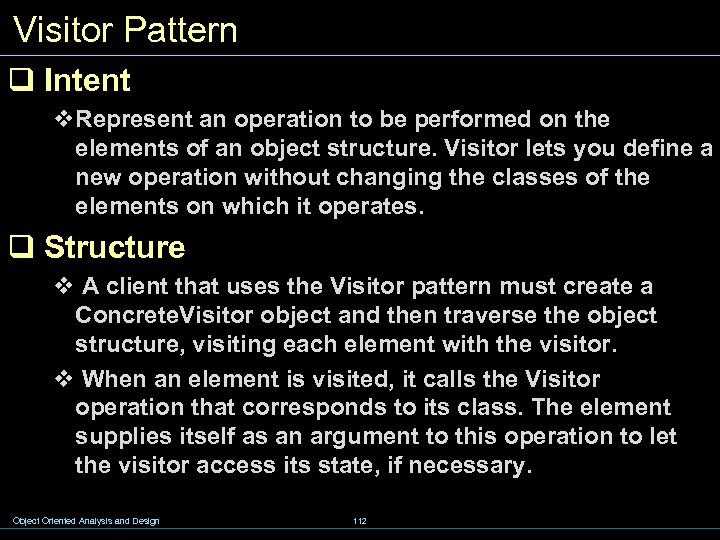 Visitor Pattern q Intent v. Represent an operation to be performed on the elements of an object structure. Visitor lets you define a new operation without changing the classes of the elements on which it operates. q Structure v A client that uses the Visitor pattern must create a Concrete. Visitor object and then traverse the object structure, visiting each element with the visitor. v When an element is visited, it calls the Visitor operation that corresponds to its class. The element supplies itself as an argument to this operation to let the visitor access its state, if necessary. Object Oriented Analysis and Design 112
 Visitor Pattern - Structure Object Oriented Analysis and Design 113
 Visitor Pattern - Example public interface Element { public void accept(Visitor visitor); } public class String. Element implements Element { private String value; public String. Element(String string) {value = string; } public String get. Value(){return value; } public void accept(Visitor visitor) { visitor. visit. String(this); } } Object Oriented Analysis and Design 114
 Visitor Pattern - Example public class Float. Element implements Element { private Float value; public Float. Element(Float value) { this. value = value; } public Float get. Value(){ return value; } public void accept(Visitor visitor) { visitor. visit. Float(this); } } Object Oriented Analysis and Design 115
 Visitor Pattern - Example public interface Visitor { public void visit. String(String. Element string. E); public void visit. Float(Float. Element float. E); public void visit. Collection(Collection collection); } Object Oriented Analysis and Design 116
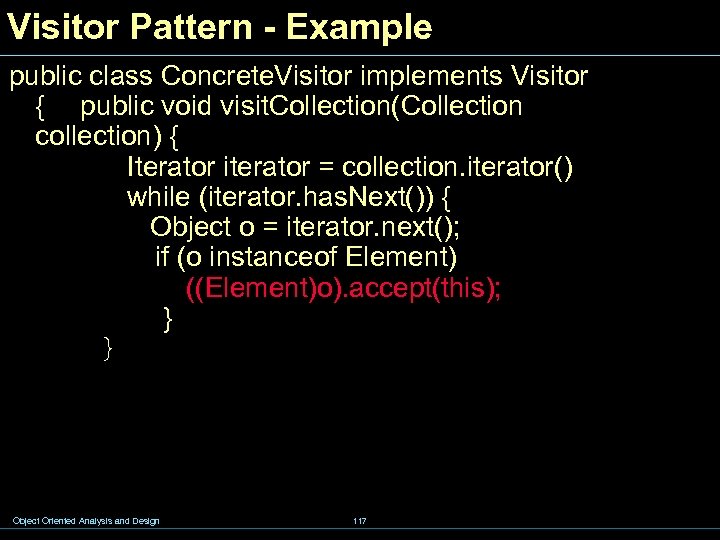 Visitor Pattern - Example public class Concrete. Visitor implements Visitor { public void visit. Collection(Collection collection) { Iterator iterator = collection. iterator() while (iterator. has. Next()) { Object o = iterator. next(); if (o instanceof Element) ((Element)o). accept(this); } } Object Oriented Analysis and Design 117
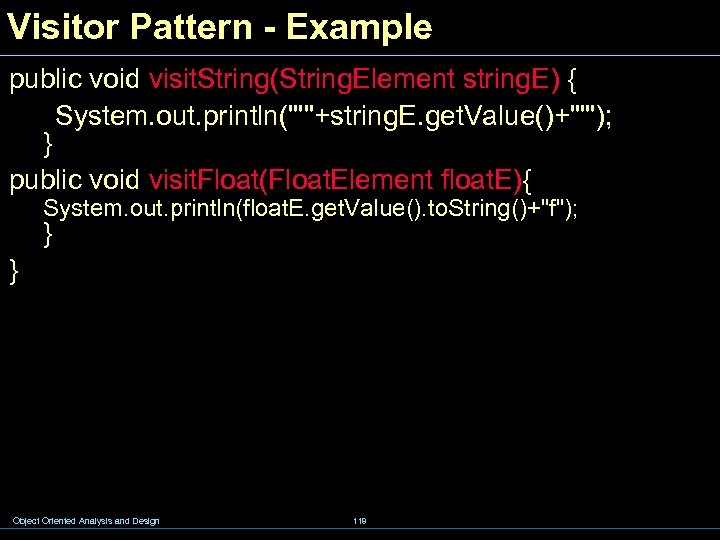 Visitor Pattern - Example public void visit. String(String. Element string. E) { System. out. println("'"+string. E. get. Value()+"'"); } public void visit. Float(Float. Element float. E){ System. out. println(float. E. get. Value(). to. String()+"f"); } } Object Oriented Analysis and Design 118
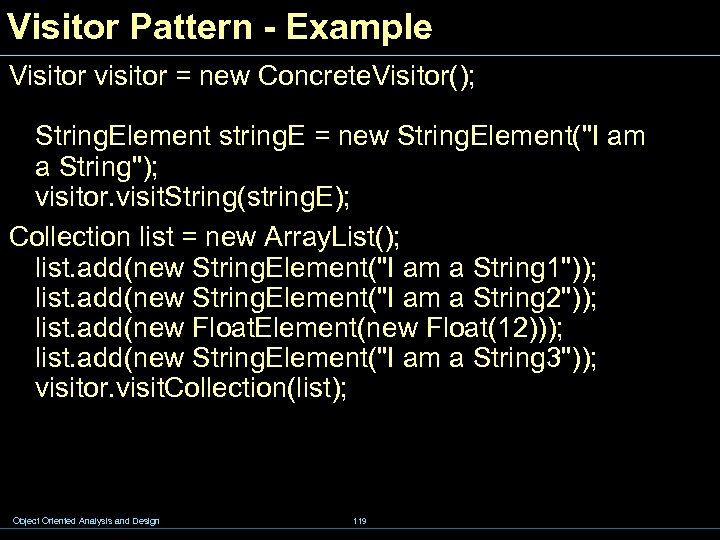 Visitor Pattern - Example Visitor visitor = new Concrete. Visitor(); String. Element string. E = new String. Element("I am a String"); visitor. visit. String(string. E); Collection list = new Array. List(); list. add(new String. Element("I am a String 1")); list. add(new String. Element("I am a String 2")); list. add(new Float. Element(new Float(12))); list. add(new String. Element("I am a String 3")); visitor. visit. Collection(list); Object Oriented Analysis and Design 119
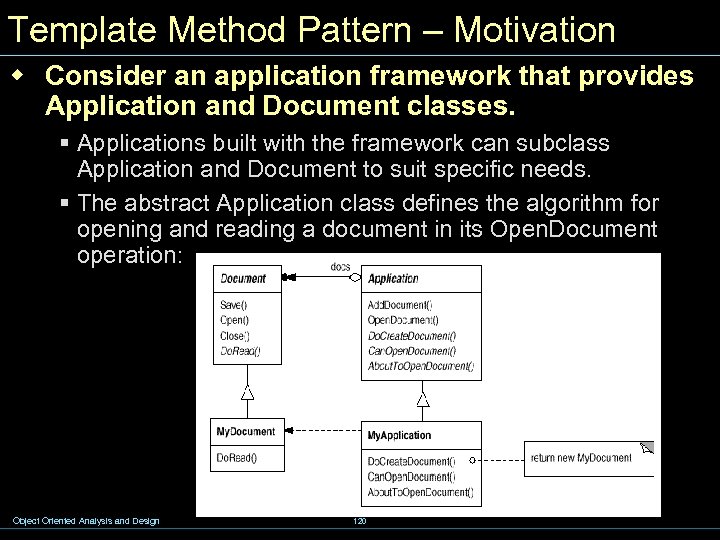 Template Method Pattern – Motivation w Consider an application framework that provides Application and Document classes. § Applications built with the framework can subclass Application and Document to suit specific needs. § The abstract Application class defines the algorithm for opening and reading a document in its Open. Document operation: Object Oriented Analysis and Design 120
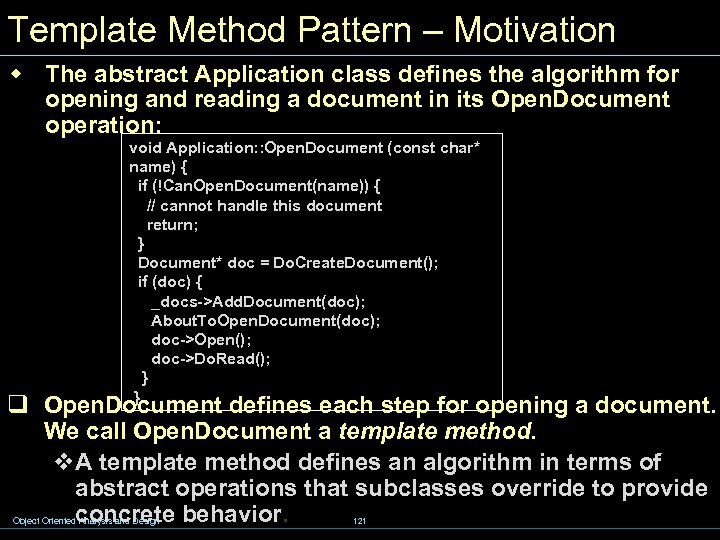 Template Method Pattern – Motivation w The abstract Application class defines the algorithm for opening and reading a document in its Open. Document operation: void Application: : Open. Document (const char* name) { if (!Can. Open. Document(name)) { // cannot handle this document return; } Document* doc = Do. Create. Document(); if (doc) { _docs->Add. Document(doc); About. To. Open. Document(doc); doc->Open(); doc->Do. Read(); } } q Open. Document defines each step for opening a document. We call Open. Document a template method. v. A template method defines an algorithm in terms of abstract operations that subclasses override to provide concrete behavior. Object Oriented Analysis and Design 121
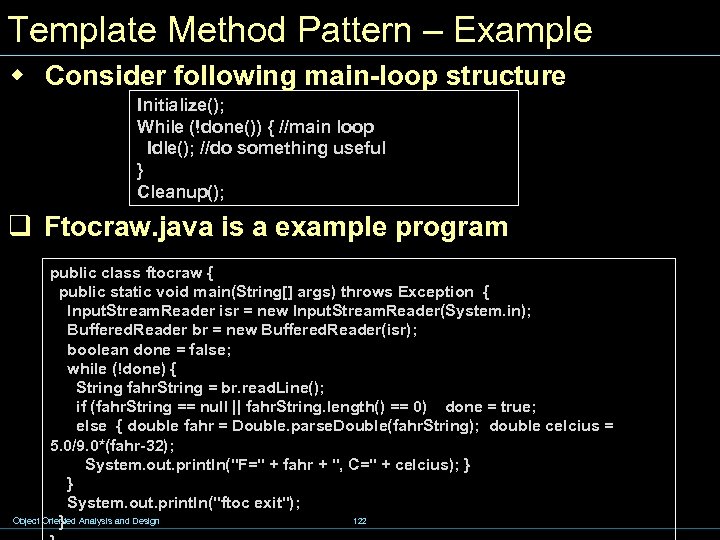 Template Method Pattern – Example w Consider following main-loop structure Initialize(); While (!done()) { //main loop Idle(); //do something useful } Cleanup(); q Ftocraw. java is a example program public class ftocraw { public static void main(String[] args) throws Exception { Input. Stream. Reader isr = new Input. Stream. Reader(System. in); Buffered. Reader br = new Buffered. Reader(isr); boolean done = false; while (!done) { String fahr. String = br. read. Line(); if (fahr. String == null || fahr. String. length() == 0) done = true; else { double fahr = Double. parse. Double(fahr. String); double celcius = 5. 0/9. 0*(fahr-32); System. out. println("F=" + fahr + ", C=" + celcius); } } System. out. println("ftoc exit"); Object Oriented Analysis and Design 122 }
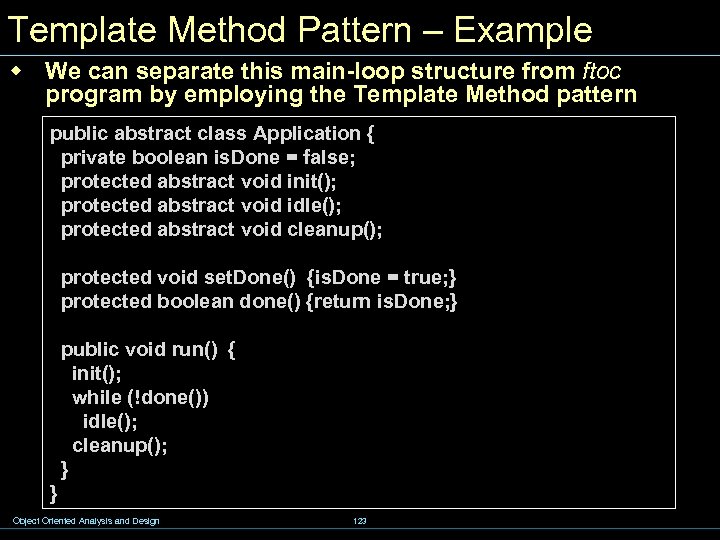 Template Method Pattern – Example w We can separate this main-loop structure from ftoc program by employing the Template Method pattern public abstract class Application { private boolean is. Done = false; protected abstract void init(); protected abstract void idle(); protected abstract void cleanup(); protected void set. Done() {is. Done = true; } protected boolean done() {return is. Done; } public void run() { init(); while (!done()) idle(); cleanup(); } } Object Oriented Analysis and Design 123
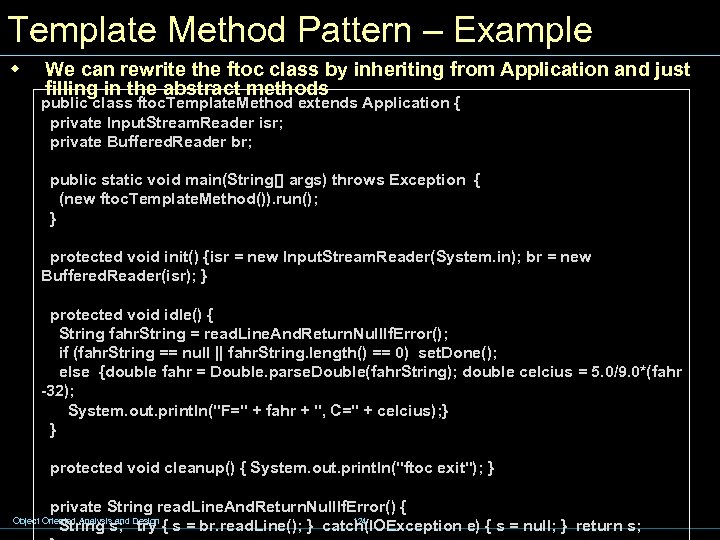 Template Method Pattern – Example w We can rewrite the ftoc class by inheriting from Application and just filling in the abstract methods public class ftoc. Template. Method extends Application { private Input. Stream. Reader isr; private Buffered. Reader br; public static void main(String[] args) throws Exception { (new ftoc. Template. Method()). run(); } protected void init() {isr = new Input. Stream. Reader(System. in); br = new Buffered. Reader(isr); } protected void idle() { String fahr. String = read. Line. And. Return. Null. If. Error(); if (fahr. String == null || fahr. String. length() == 0) set. Done(); else {double fahr = Double. parse. Double(fahr. String); double celcius = 5. 0/9. 0*(fahr -32); System. out. println("F=" + fahr + ", C=" + celcius); } } protected void cleanup() { System. out. println("ftoc exit"); } private String read. Line. And. Return. Null. If. Error() { 124 String s; try { s = br. read. Line(); } catch(IOException e) { s = null; } return s; Object Oriented Analysis and Design
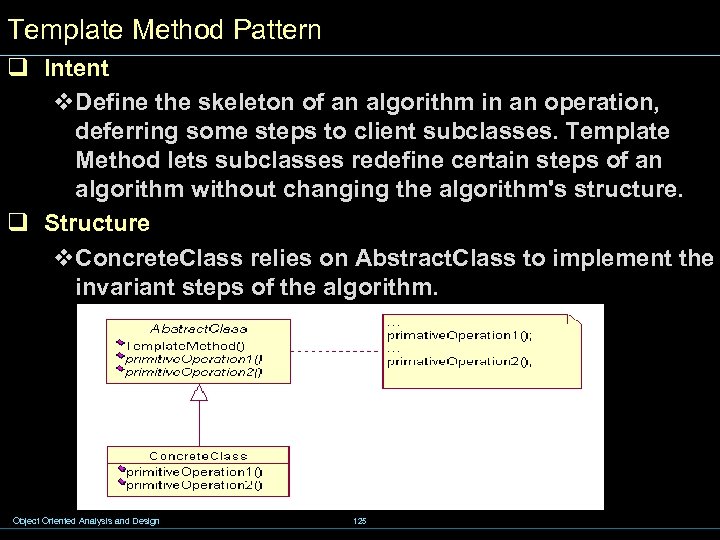 Template Method Pattern q Intent v. Define the skeleton of an algorithm in an operation, deferring some steps to client subclasses. Template Method lets subclasses redefine certain steps of an algorithm without changing the algorithm's structure. q Structure v. Concrete. Class relies on Abstract. Class to implement the invariant steps of the algorithm. Object Oriented Analysis and Design 125
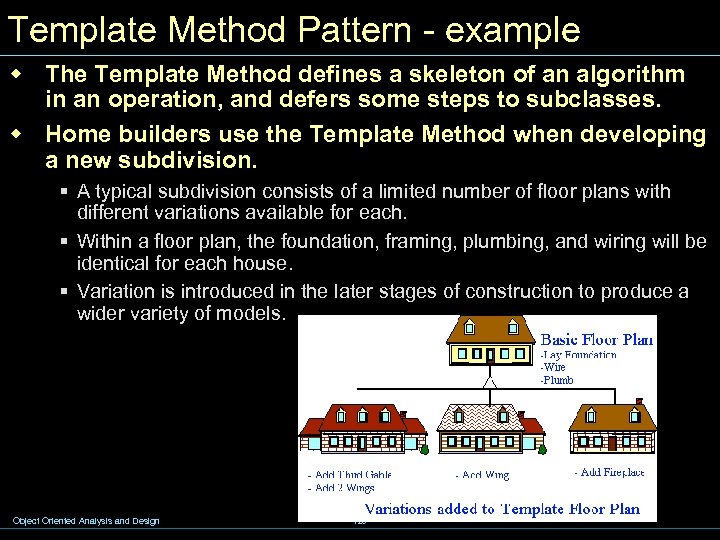 Template Method Pattern - example w The Template Method defines a skeleton of an algorithm in an operation, and defers some steps to subclasses. w Home builders use the Template Method when developing a new subdivision. § A typical subdivision consists of a limited number of floor plans with different variations available for each. § Within a floor plan, the foundation, framing, plumbing, and wiring will be identical for each house. § Variation is introduced in the later stages of construction to produce a wider variety of models. Object Oriented Analysis and Design 126
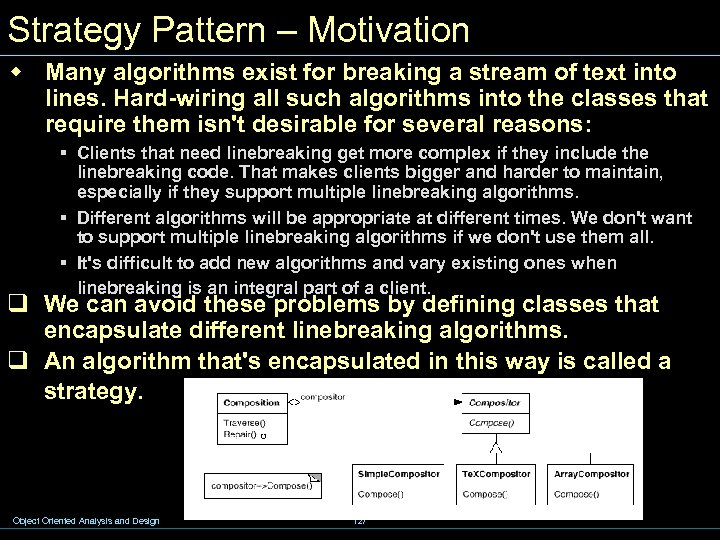 Strategy Pattern – Motivation w Many algorithms exist for breaking a stream of text into lines. Hard-wiring all such algorithms into the classes that require them isn't desirable for several reasons: § Clients that need linebreaking get more complex if they include the linebreaking code. That makes clients bigger and harder to maintain, especially if they support multiple linebreaking algorithms. § Different algorithms will be appropriate at different times. We don't want to support multiple linebreaking algorithms if we don't use them all. § It's difficult to add new algorithms and vary existing ones when linebreaking is an integral part of a client. q We can avoid these problems by defining classes that encapsulate different linebreaking algorithms. q An algorithm that's encapsulated in this way is called a strategy. Object Oriented Analysis and Design 127
 Strategy Pattern – Example w Consider following main-loop structure Initialize(); While (!done()) { //main loop Idle(); //do something useful } Cleanup(); q Ftocraw. java is a example program public class ftocraw { public static void main(String[] args) throws Exception { Input. Stream. Reader isr = new Input. Stream. Reader(System. in); Buffered. Reader br = new Buffered. Reader(isr); boolean done = false; while (!done) { String fahr. String = br. read. Line(); if (fahr. String == null || fahr. String. length() == 0) done = true; else { double fahr = Double. parse. Double(fahr. String); double celcius = 5. 0/9. 0*(fahr-32); System. out. println("F=" + fahr + ", C=" + celcius); } } System. out. println("ftoc exit"); } Object Oriented Analysis and Design 128 }
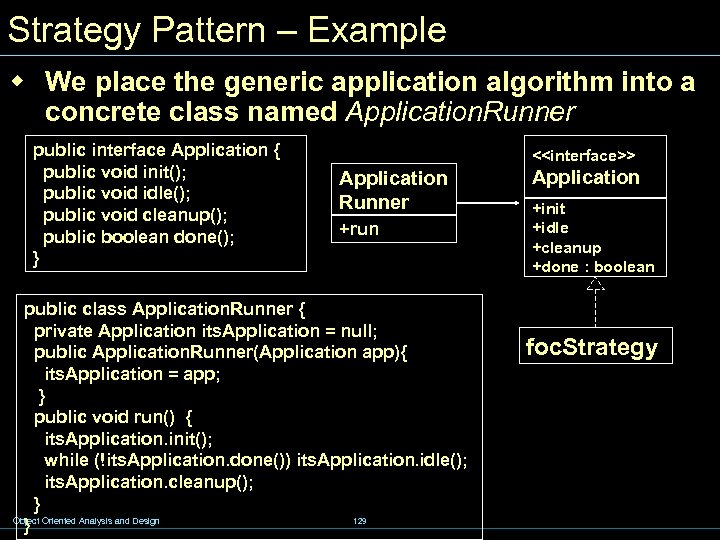 Strategy Pattern – Example w We place the generic application algorithm into a concrete class named Application. Runner public interface Application { public void init(); public void idle(); public void cleanup(); public boolean done(); } <
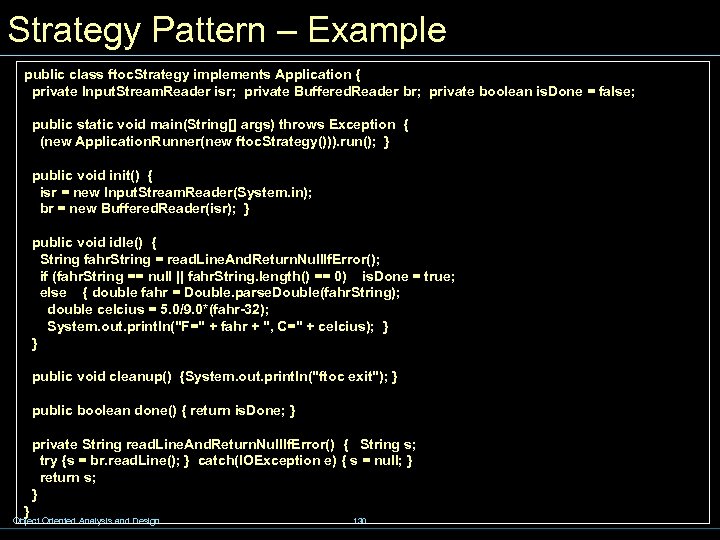 Strategy Pattern – Example public class ftoc. Strategy implements Application { private Input. Stream. Reader isr; private Buffered. Reader br; private boolean is. Done = false; public static void main(String[] args) throws Exception { (new Application. Runner(new ftoc. Strategy())). run(); } public void init() { isr = new Input. Stream. Reader(System. in); br = new Buffered. Reader(isr); } public void idle() { String fahr. String = read. Line. And. Return. Null. If. Error(); if (fahr. String == null || fahr. String. length() == 0) is. Done = true; else { double fahr = Double. parse. Double(fahr. String); double celcius = 5. 0/9. 0*(fahr-32); System. out. println("F=" + fahr + ", C=" + celcius); } } public void cleanup() {System. out. println("ftoc exit"); } public boolean done() { return is. Done; } private String read. Line. And. Return. Null. If. Error() { String s; try {s = br. read. Line(); } catch(IOException e) { s = null; } return s; } } Object Oriented Analysis and Design 130
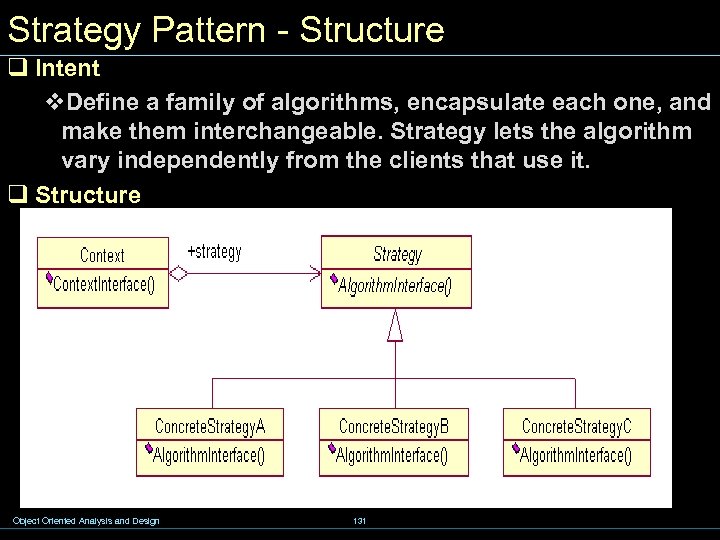 Strategy Pattern - Structure q Intent v. Define a family of algorithms, encapsulate each one, and make them interchangeable. Strategy lets the algorithm vary independently from the clients that use it. q Structure Object Oriented Analysis and Design 131
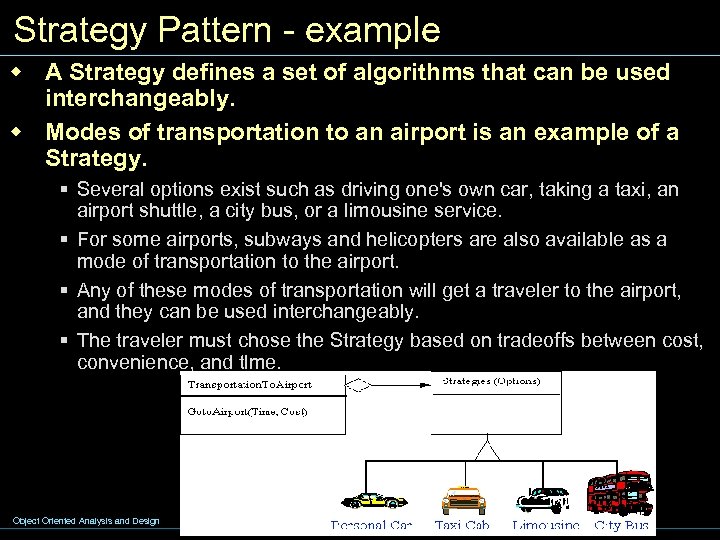 Strategy Pattern - example w A Strategy defines a set of algorithms that can be used interchangeably. w Modes of transportation to an airport is an example of a Strategy. § Several options exist such as driving one's own car, taking a taxi, an airport shuttle, a city bus, or a limousine service. § For some airports, subways and helicopters are also available as a mode of transportation to the airport. § Any of these modes of transportation will get a traveler to the airport, and they can be used interchangeably. § The traveler must chose the Strategy based on tradeoffs between cost, convenience, and tlme. Object Oriented Analysis and Design 132
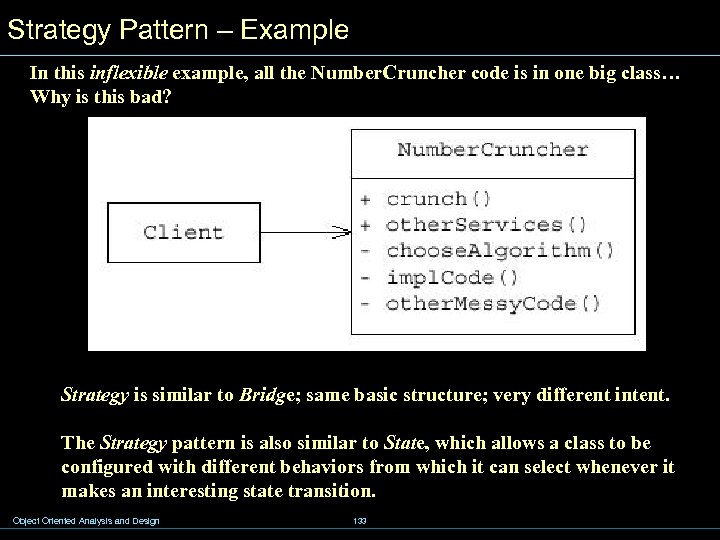 Strategy Pattern – Example In this inflexible example, all the Number. Cruncher code is in one big class… Why is this bad? Strategy is similar to Bridge; same basic structure; very different intent. The Strategy pattern is also similar to State, which allows a class to be configured with different behaviors from which it can select whenever it makes an interesting state transition. Object Oriented Analysis and Design 133
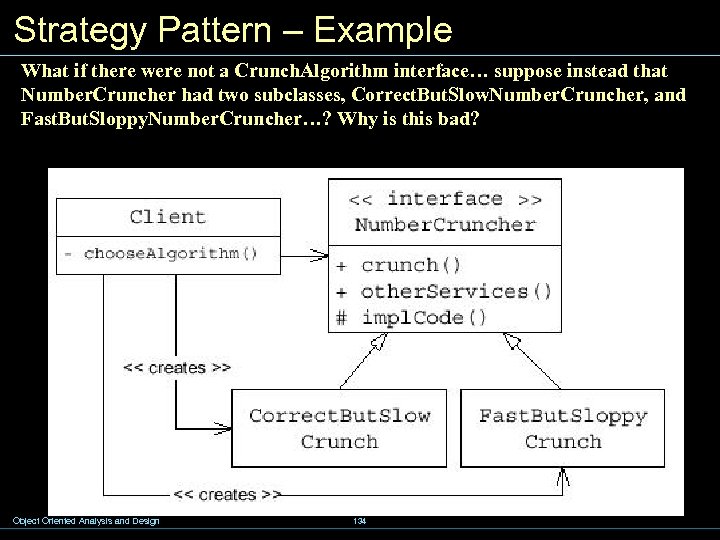 Strategy Pattern – Example What if there were not a Crunch. Algorithm interface… suppose instead that Number. Cruncher had two subclasses, Correct. But. Slow. Number. Cruncher, and Fast. But. Sloppy. Number. Cruncher…? Why is this bad? Object Oriented Analysis and Design 134
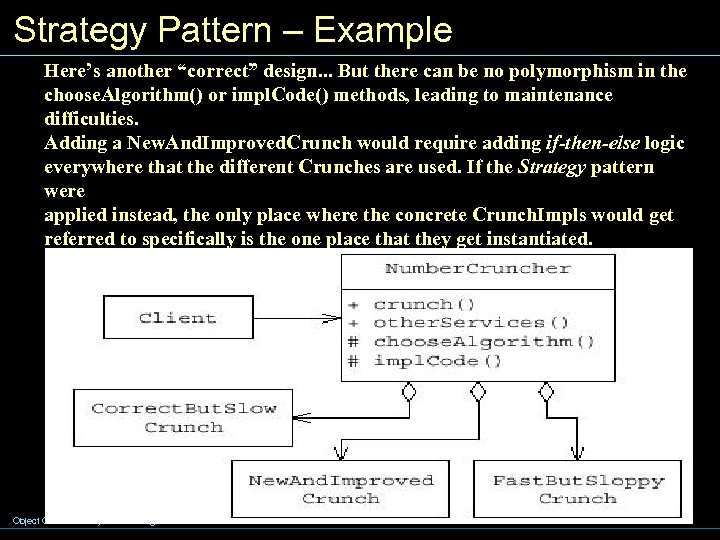 Strategy Pattern – Example Here’s another “correct” design. . . But there can be no polymorphism in the choose. Algorithm() or impl. Code() methods, leading to maintenance difficulties. Adding a New. And. Improved. Crunch would require adding if-then-else logic everywhere that the different Crunches are used. If the Strategy pattern were applied instead, the only place where the concrete Crunch. Impls would get referred to specifically is the one place that they get instantiated. Object Oriented Analysis and Design 135
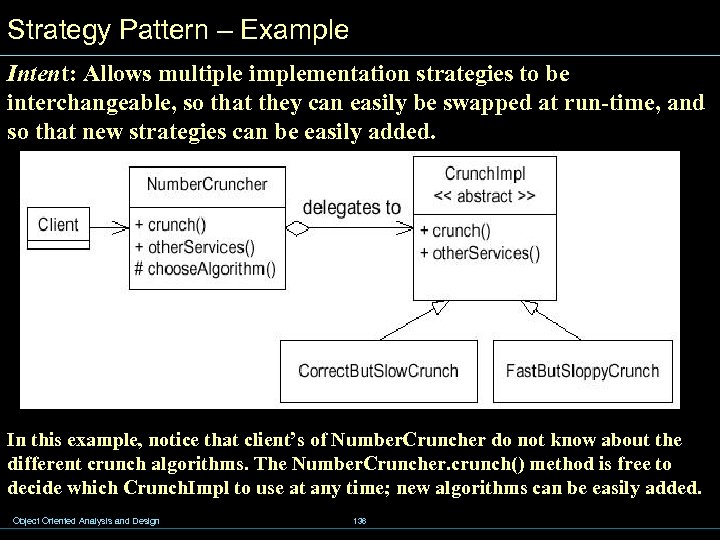 Strategy Pattern – Example Intent: Allows multiple implementation strategies to be interchangeable, so that they can easily be swapped at run-time, and so that new strategies can be easily added. In this example, notice that client’s of Number. Cruncher do not know about the different crunch algorithms. The Number. Cruncher. crunch() method is free to decide which Crunch. Impl to use at any time; new algorithms can be easily added. Object Oriented Analysis and Design 136
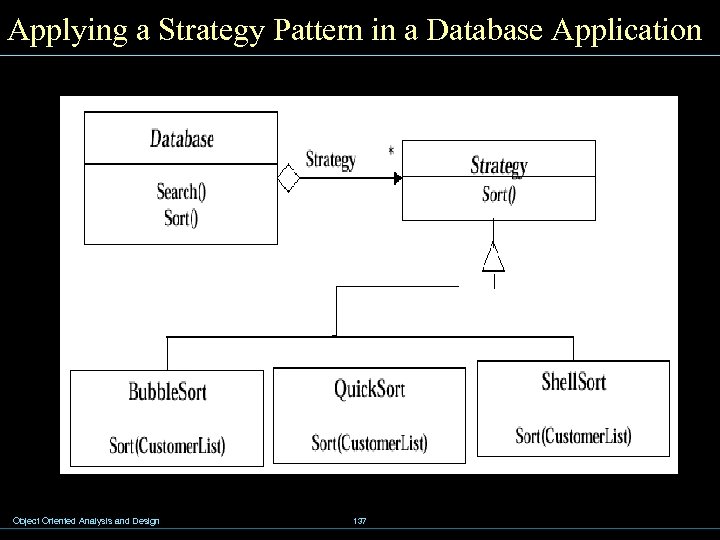 Applying a Strategy Pattern in a Database Application Object Oriented Analysis and Design 137
 Applicability of Strategy Pattern 1) Many related classes differ only in their behavior. Strategy allows to configure a single class with one of many behaviors 2) Different variants of an algorithm are needed that trade-off space against time. All these variants can be implemented as a class hierarchy of algorithms Object Oriented Analysis and Design 138
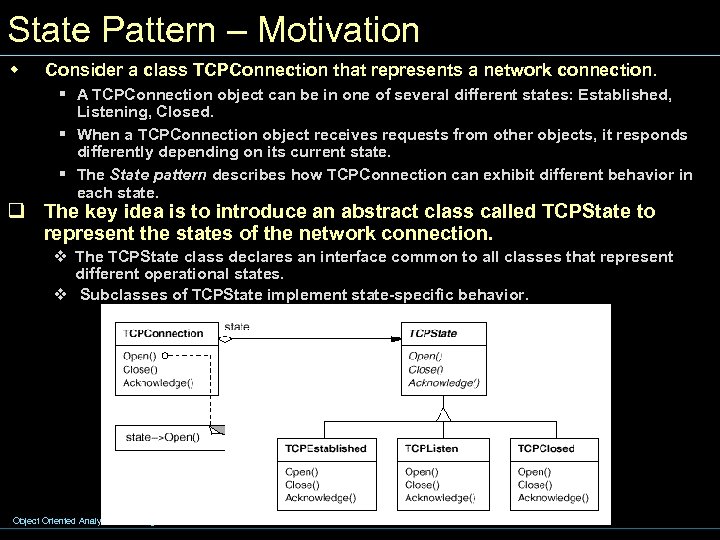 State Pattern – Motivation w Consider a class TCPConnection that represents a network connection. § A TCPConnection object can be in one of several different states: Established, Listening, Closed. § When a TCPConnection object receives requests from other objects, it responds differently depending on its current state. § The State pattern describes how TCPConnection can exhibit different behavior in each state. q The key idea is to introduce an abstract class called TCPState to represent the states of the network connection. v The TCPState class declares an interface common to all classes that represent different operational states. v Subclasses of TCPState implement state-specific behavior. Object Oriented Analysis and Design 139
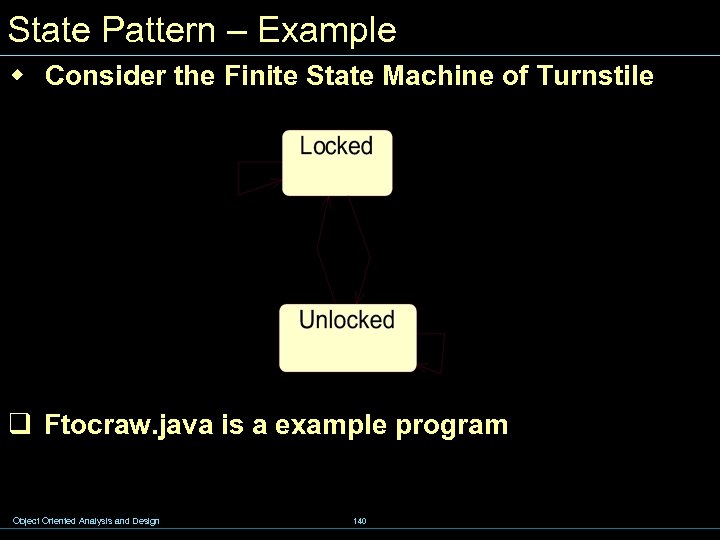 State Pattern – Example w Consider the Finite State Machine of Turnstile q Ftocraw. java is a example program Object Oriented Analysis and Design 140
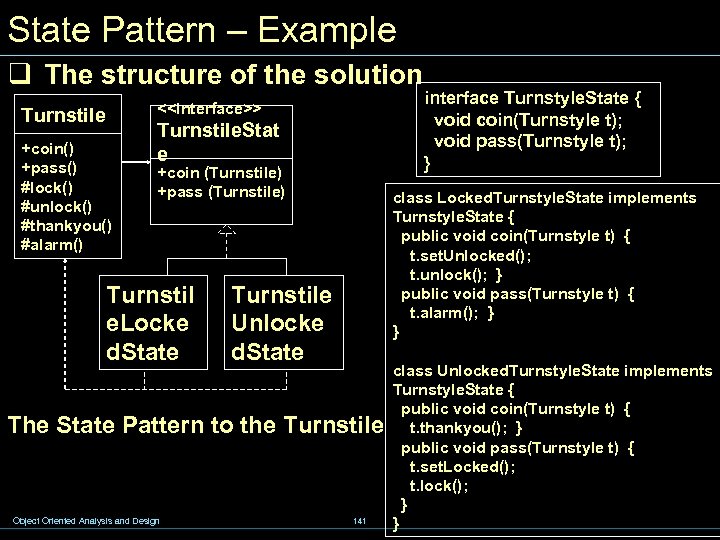 State Pattern – Example q The structure of the solution <
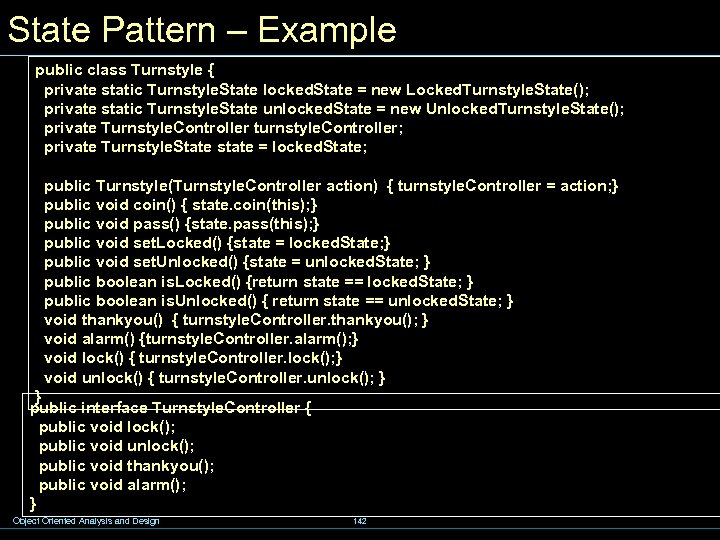 State Pattern – Example public class Turnstyle { private static Turnstyle. State locked. State = new Locked. Turnstyle. State(); private static Turnstyle. State unlocked. State = new Unlocked. Turnstyle. State(); private Turnstyle. Controller turnstyle. Controller; private Turnstyle. State state = locked. State; public Turnstyle(Turnstyle. Controller action) { turnstyle. Controller = action; } public void coin() { state. coin(this); } public void pass() {state. pass(this); } public void set. Locked() {state = locked. State; } public void set. Unlocked() {state = unlocked. State; } public boolean is. Locked() {return state == locked. State; } public boolean is. Unlocked() { return state == unlocked. State; } void thankyou() { turnstyle. Controller. thankyou(); } void alarm() {turnstyle. Controller. alarm(); } void lock() { turnstyle. Controller. lock(); } void unlock() { turnstyle. Controller. unlock(); } } public interface Turnstyle. Controller { public void lock(); public void unlock(); public void thankyou(); public void alarm(); } Object Oriented Analysis and Design 142
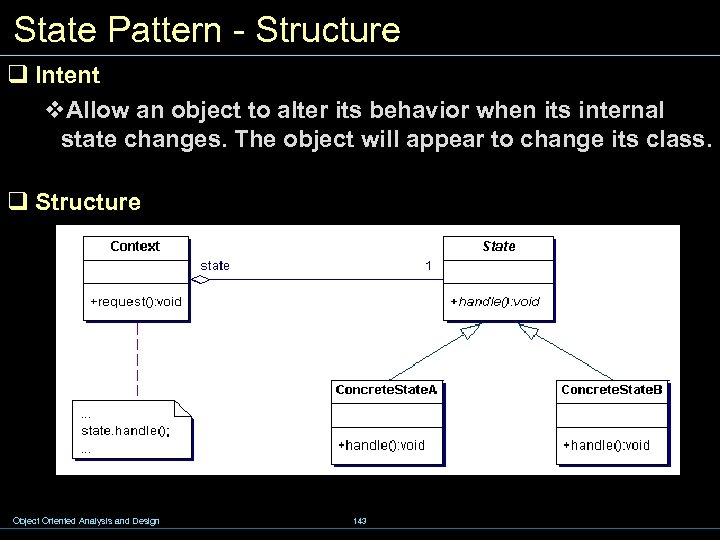 State Pattern - Structure q Intent v. Allow an object to alter its behavior when its internal state changes. The object will appear to change its class. q Structure Object Oriented Analysis and Design 143
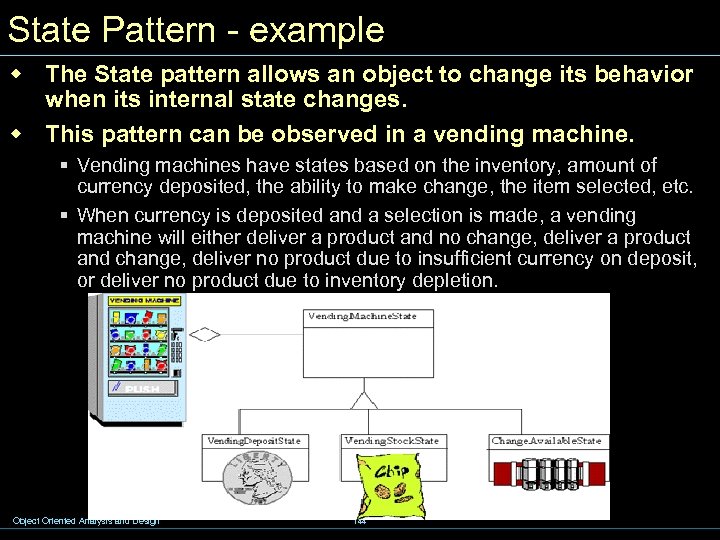 State Pattern - example w The State pattern allows an object to change its behavior when its internal state changes. w This pattern can be observed in a vending machine. § Vending machines have states based on the inventory, amount of currency deposited, the ability to make change, the item selected, etc. § When currency is deposited and a selection is made, a vending machine will either deliver a product and no change, deliver a product and change, deliver no product due to insufficient currency on deposit, or deliver no product due to inventory depletion. Object Oriented Analysis and Design 144
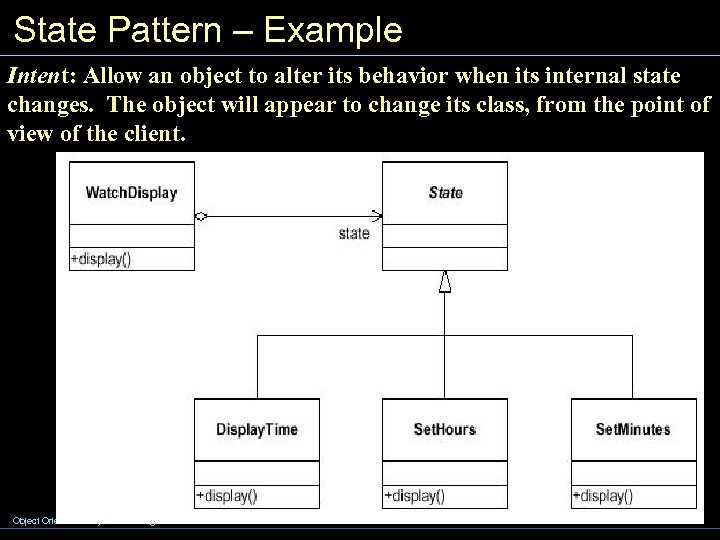 State Pattern – Example Intent: Allow an object to alter its behavior when its internal state changes. The object will appear to change its class, from the point of view of the client. Object Oriented Analysis and Design 145
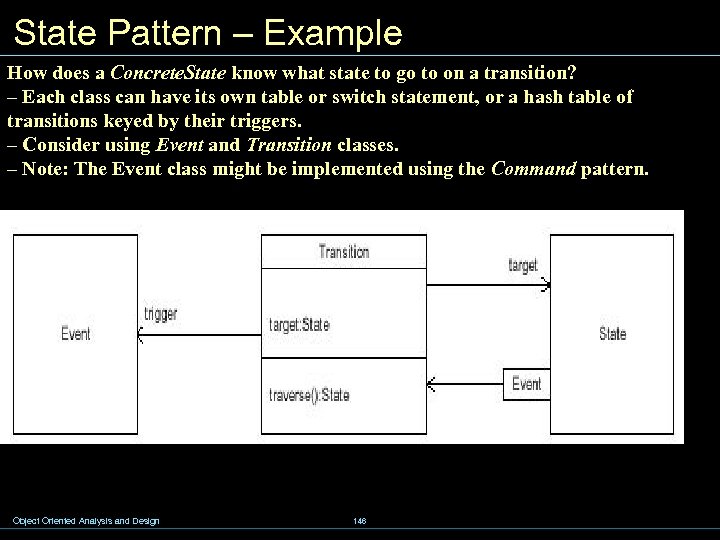 State Pattern – Example How does a Concrete. State know what state to go to on a transition? – Each class can have its own table or switch statement, or a hash table of transitions keyed by their triggers. – Consider using Event and Transition classes. – Note: The Event class might be implemented using the Command pattern. Object Oriented Analysis and Design 146
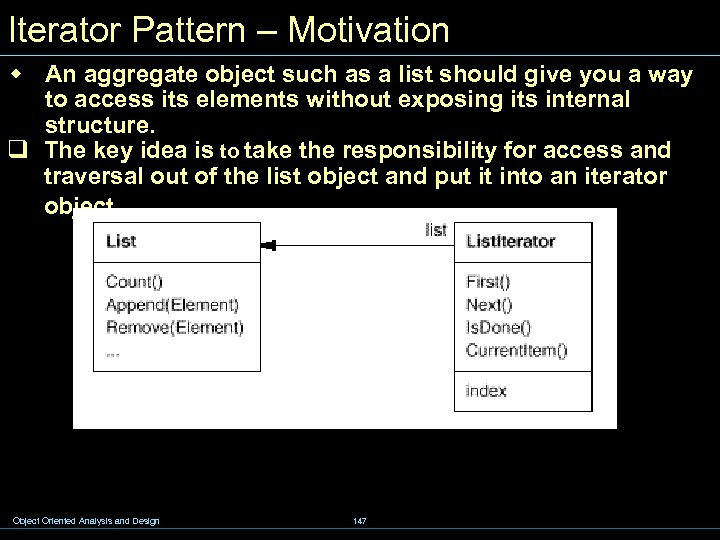 Iterator Pattern – Motivation w An aggregate object such as a list should give you a way to access its elements without exposing its internal structure. q The key idea is to take the responsibility for access and traversal out of the list object and put it into an iterator object. Object Oriented Analysis and Design 147
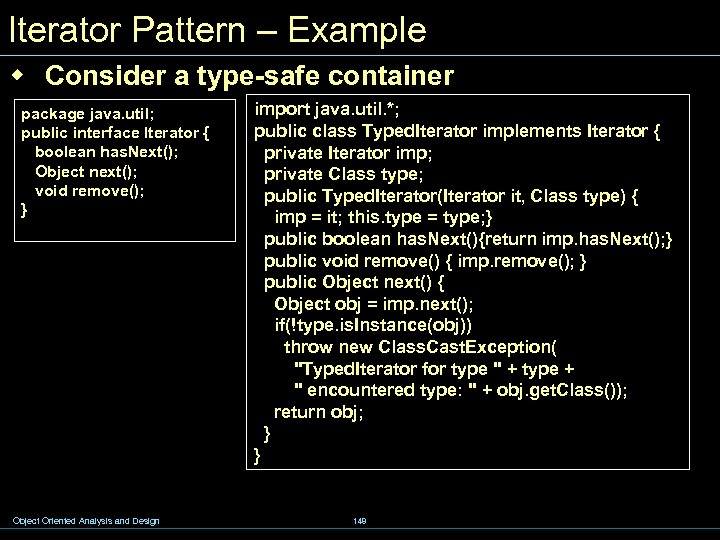 Iterator Pattern – Example w Consider a type-safe container package java. util; public interface Iterator { boolean has. Next(); Object next(); void remove(); } Object Oriented Analysis and Design import java. util. *; public class Typed. Iterator implements Iterator { private Iterator imp; private Class type; public Typed. Iterator(Iterator it, Class type) { imp = it; this. type = type; } public boolean has. Next(){return imp. has. Next(); } public void remove() { imp. remove(); } public Object next() { Object obj = imp. next(); if(!type. is. Instance(obj)) throw new Class. Cast. Exception( "Typed. Iterator for type " + type + " encountered type: " + obj. get. Class()); return obj; } } 148
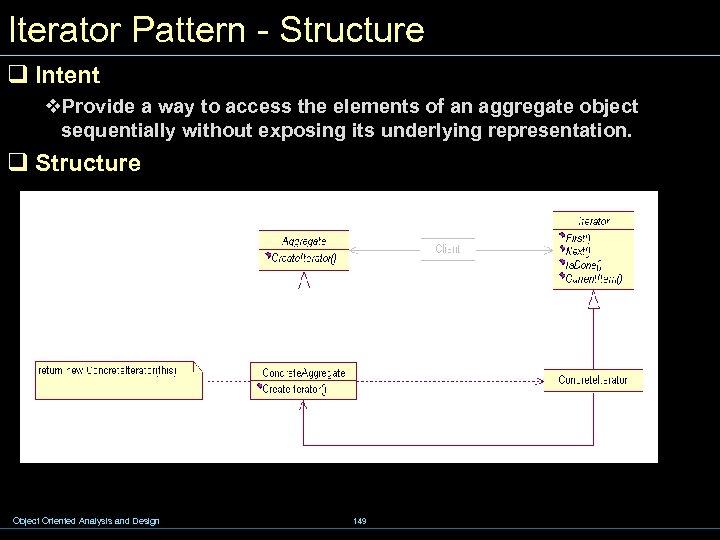 Iterator Pattern - Structure q Intent v. Provide a way to access the elements of an aggregate object sequentially without exposing its underlying representation. q Structure Object Oriented Analysis and Design 149
 Memento Pattern – Motivation w Sometimes it's necessary to record the internal state of an object. § This is required when implementing checkpoints and undo mechanisms § Exposing this state would violate encapsulation q A memento is an object that stores a snapshot of the internal state of another object—the memento's originator. v The undo mechanism will request a memento from the originator when it needs to checkpoint the originator's state. v The originator initializes the memento with information that characterizes its current state. v Only the originator can store and retrieve information from the memento—the memento is "opaque" to other objects. Object Oriented Analysis and Design 150
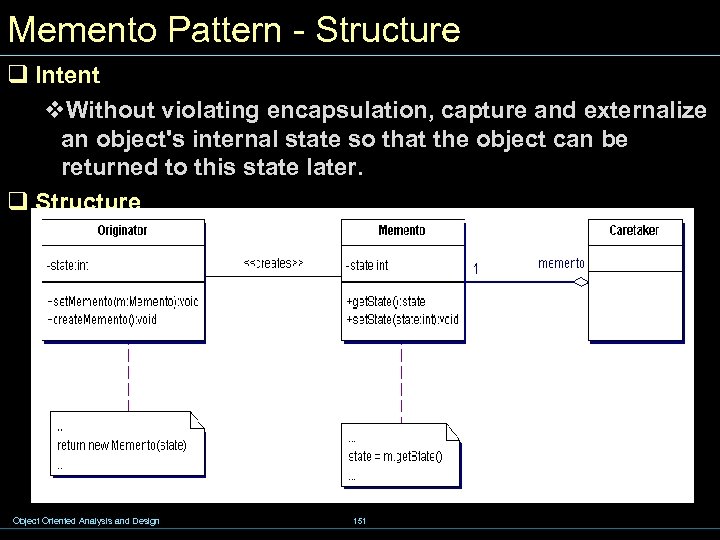 Memento Pattern - Structure q Intent v. Without violating encapsulation, capture and externalize an object's internal state so that the object can be returned to this state later. q Structure Object Oriented Analysis and Design 151
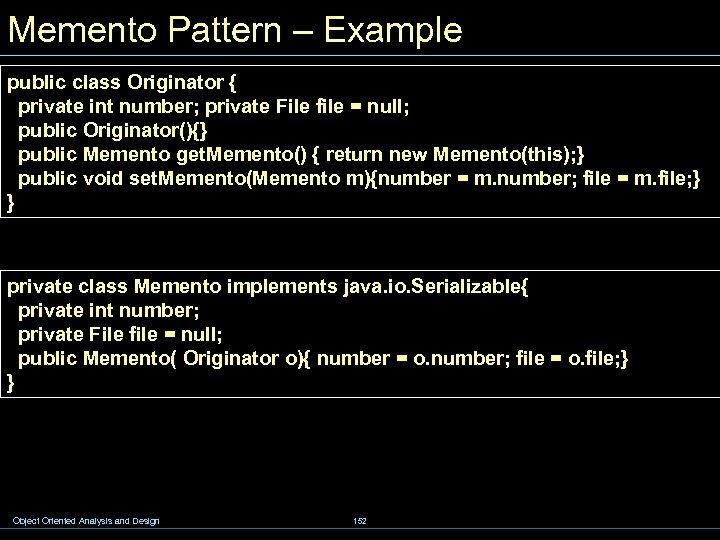 Memento Pattern – Example public class Originator { private int number; private File file = null; public Originator(){} public Memento get. Memento() { return new Memento(this); } public void set. Memento(Memento m){number = m. number; file = m. file; } } private class Memento implements java. io. Serializable{ private int number; private File file = null; public Memento( Originator o){ number = o. number; file = o. file; } } Object Oriented Analysis and Design 152
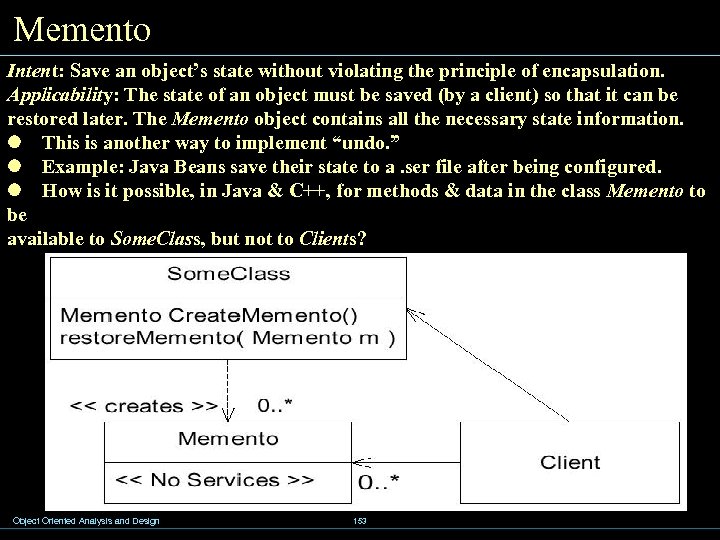 Memento Intent: Save an object’s state without violating the principle of encapsulation. Applicability: The state of an object must be saved (by a client) so that it can be restored later. The Memento object contains all the necessary state information. l This is another way to implement “undo. ” l Example: Java Beans save their state to a. ser file after being configured. l How is it possible, in Java & C++, for methods & data in the class Memento to be available to Some. Class, but not to Clients? Object Oriented Analysis and Design 153
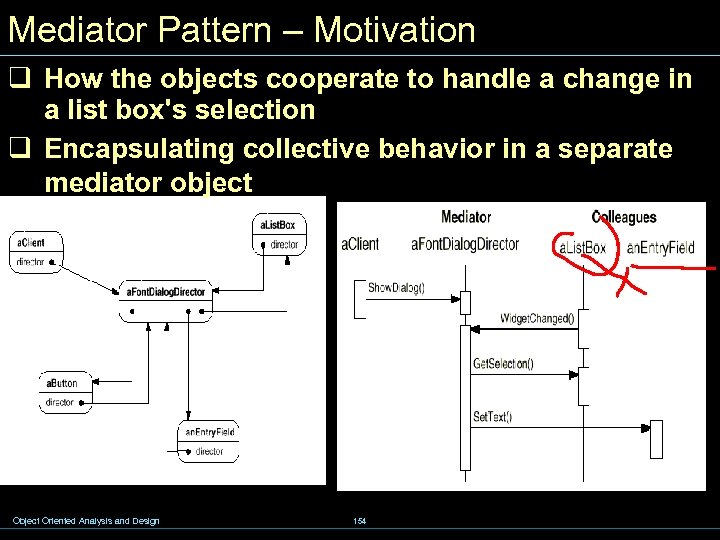 Mediator Pattern – Motivation q How the objects cooperate to handle a change in a list box's selection q Encapsulating collective behavior in a separate mediator object Oriented Analysis and Design 154
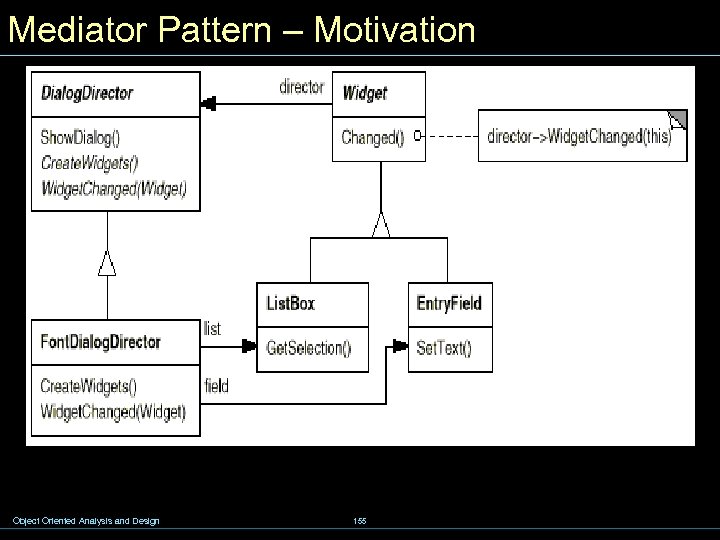 Mediator Pattern – Motivation Object Oriented Analysis and Design 155
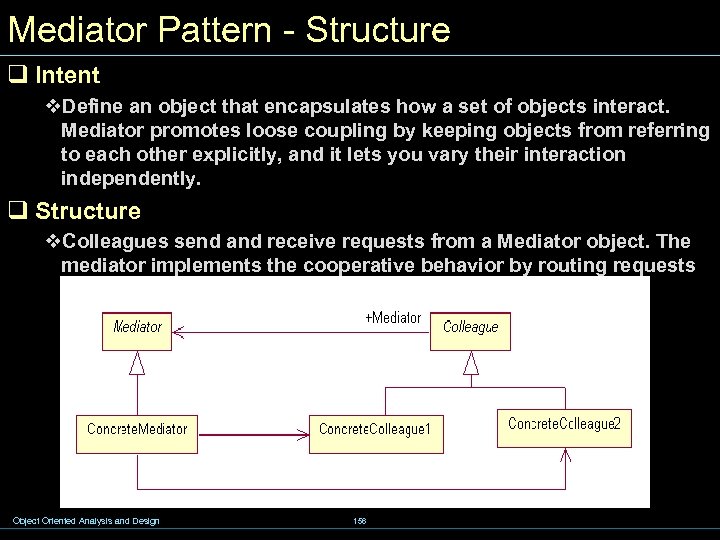 Mediator Pattern - Structure q Intent v. Define an object that encapsulates how a set of objects interact. Mediator promotes loose coupling by keeping objects from referring to each other explicitly, and it lets you vary their interaction independently. q Structure v. Colleagues send and receive requests from a Mediator object. The mediator implements the cooperative behavior by routing requests between the appropriate colleague(s). Object Oriented Analysis and Design 156
 6. 4 Applying Design Patterns w w MVC pattern Wmvc Framework Movie. Cat Application using Wmvc Thermometer Application using Wmvc Object Oriented Analysis and Design 157