


 Скачать презентацию Chapter 6 Data Integrity and Security Copyright
ee249deeb072dcccee75af91220f7468.ppt
- Количество слайдов: 49
 Chapter 6 Data Integrity and Security Copyright © 2007 Ramez Elmasri and Shamkant B. Navathe
 Chapter Outline n n Relational Model Constraints and Relational Database Schemas Update Operations and Dealing with Constraint Violations 1 Database Security and Authorization n 1. 1 Introduction to Database Security Issues n 1. 3 Database Security and DBA n 1. 4 Access Protection, User Accounts, and Database Audits 2 Discretionary Access Control Based on Granting Revoking Privileges n 2. 1 Types of Discretionary Privileges n 2. 2 Specifying Privileges Using Views n 2. 3 Revoking Privileges n 2. 4 Propagation of Privileges Using the GRANT OPTION n 2. 5 Specifying Limits on Propagation of Privileges Copyright © 2007 Ramez Elmasri and Shamkant B. Navathe 2
 Relational Integrity Constraints n n Constraints are conditions that must hold on all valid relation states. There are three main types of constraints in the relational model: n n Key constraints Entity integrity constraints Referential integrity constraints Another implicit constraint is the domain constraint n Every value in a tuple must be from the domain of its attribute (or it could be null, if allowed for that attribute) Copyright © 2007 Ramez Elmasri and Shamkant B. Navathe 3
 Key Constraints n Superkey of R: n Is a set of attributes SK of R with the following condition: n n No two tuples in any valid relation state r(R) will have the same value for SK That is, for any distinct tuples t 1 and t 2 in r(R), t 1[SK] t 2[SK] This condition must hold in any valid state r(R) Key of R: n n A "minimal" superkey That is, a key is a superkey K such that removal of any attribute from K results in a set of attributes that is not a superkey (does not possess the superkey uniqueness property) Copyright © 2007 Ramez Elmasri and Shamkant B. Navathe 4
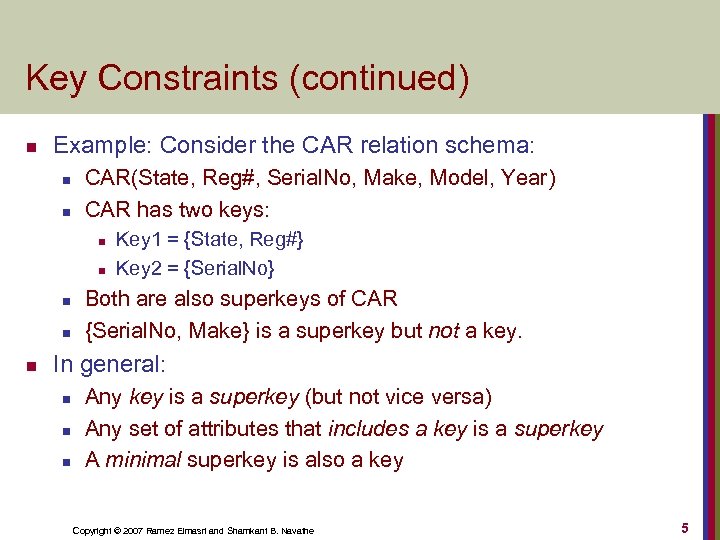 Key Constraints (continued) n Example: Consider the CAR relation schema: n n CAR(State, Reg#, Serial. No, Make, Model, Year) CAR has two keys: n n n Key 1 = {State, Reg#} Key 2 = {Serial. No} Both are also superkeys of CAR {Serial. No, Make} is a superkey but not a key. In general: n n n Any key is a superkey (but not vice versa) Any set of attributes that includes a key is a superkey A minimal superkey is also a key Copyright © 2007 Ramez Elmasri and Shamkant B. Navathe 5
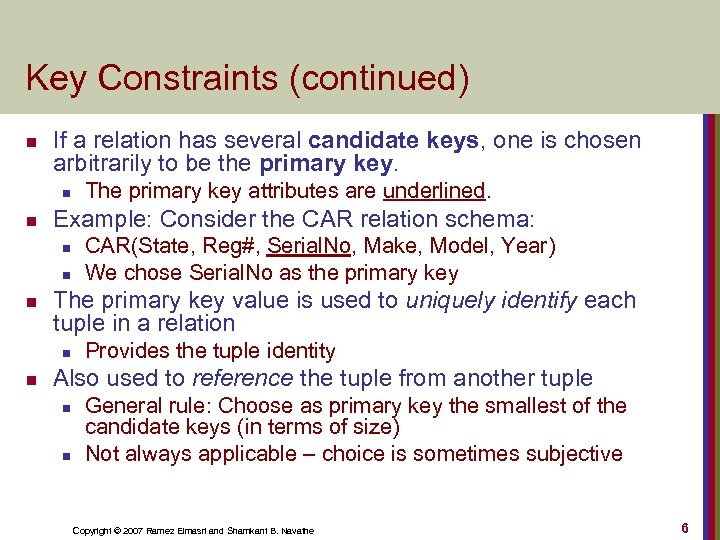 Key Constraints (continued) n If a relation has several candidate keys, one is chosen arbitrarily to be the primary key. n n Example: Consider the CAR relation schema: n n n CAR(State, Reg#, Serial. No, Make, Model, Year) We chose Serial. No as the primary key The primary key value is used to uniquely identify each tuple in a relation n n The primary key attributes are underlined. Provides the tuple identity Also used to reference the tuple from another tuple n n General rule: Choose as primary key the smallest of the candidate keys (in terms of size) Not always applicable – choice is sometimes subjective Copyright © 2007 Ramez Elmasri and Shamkant B. Navathe 6
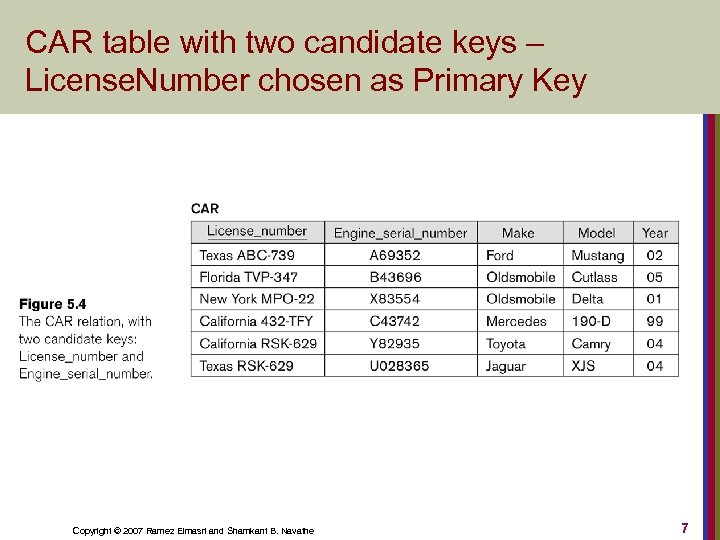 CAR table with two candidate keys – License. Number chosen as Primary Key Copyright © 2007 Ramez Elmasri and Shamkant B. Navathe 7
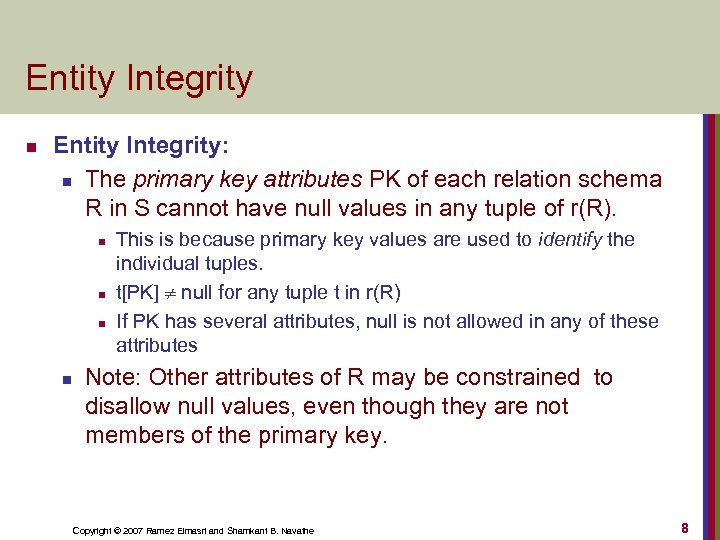 Entity Integrity n Entity Integrity: n The primary key attributes PK of each relation schema R in S cannot have null values in any tuple of r(R). n n This is because primary key values are used to identify the individual tuples. t[PK] null for any tuple t in r(R) If PK has several attributes, null is not allowed in any of these attributes Note: Other attributes of R may be constrained to disallow null values, even though they are not members of the primary key. Copyright © 2007 Ramez Elmasri and Shamkant B. Navathe 8
 Referential Integrity n A constraint involving two relations n n The previous constraints involve a single relation. Used to specify a relationship among tuples in two relations: n The referencing relation and the referenced relation. Copyright © 2007 Ramez Elmasri and Shamkant B. Navathe 9
 Referential Integrity n Tuples in the referencing relation R 1 have attributes FK (called foreign key attributes) that reference the primary key attributes PK of the referenced relation R 2. n n A tuple t 1 in R 1 is said to reference a tuple t 2 in R 2 if t 1[FK] = t 2[PK]. A referential integrity constraint can be displayed in a relational database schema as a directed arc from R 1. FK to R 2. Copyright © 2007 Ramez Elmasri and Shamkant B. Navathe 10
 Referential Integrity (or foreign key) Constraint n Statement of the constraint n The value in the foreign key column (or columns) FK of the referencing relation R 1 can be either: n n n (1) a value of an existing primary key value of a corresponding primary key PK in the referenced relation R 2, or (2) a null. In case (2), the FK in R 1 should not be a part of its own primary key. Copyright © 2007 Ramez Elmasri and Shamkant B. Navathe 11
 Displaying a relational database schema and its constraints n n Each relation schema can be displayed as a row of attribute names The name of the relation is written above the attribute names The primary key attribute (or attributes) will be underlined A foreign key (referential integrity) constraints is displayed as a directed arc (arrow) from the foreign key attributes to the referenced table n n Can also point the primary key of the referenced relation for clarity Next slide shows the COMPANY relational schema diagram Copyright © 2007 Ramez Elmasri and Shamkant B. Navathe 12
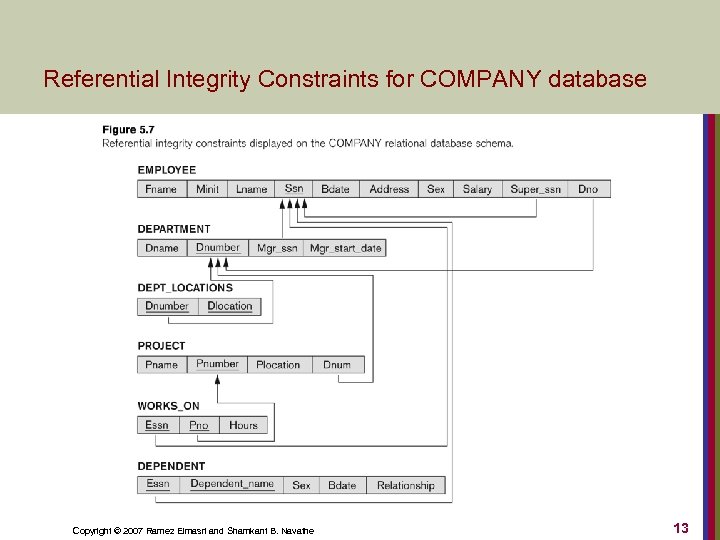 Referential Integrity Constraints for COMPANY database Copyright © 2007 Ramez Elmasri and Shamkant B. Navathe 13
 Other Types of Constraints n Semantic Integrity Constraints: n n based on application semantics and cannot be expressed by the model per se Example: “the max. no. of hours per employee for all projects he or she works on is 56 hrs per week” A constraint specification language may have to be used to express these SQL-99 allows triggers and ASSERTIONS to express for some of these Copyright © 2007 Ramez Elmasri and Shamkant B. Navathe 14
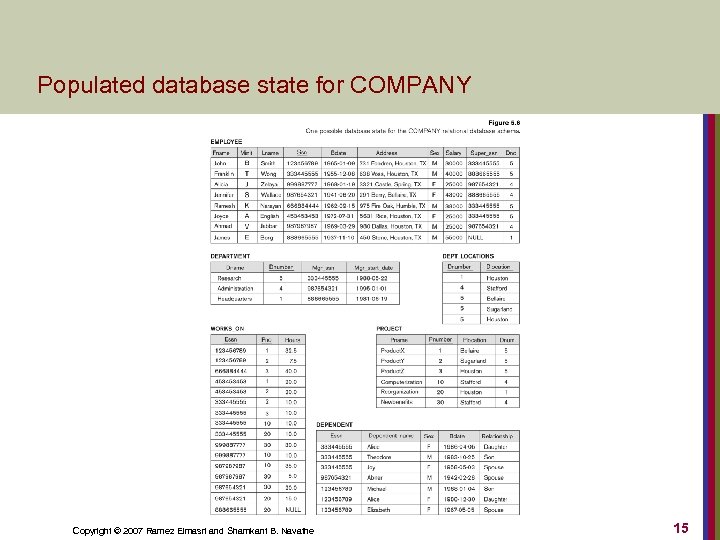 Populated database state for COMPANY Copyright © 2007 Ramez Elmasri and Shamkant B. Navathe 15
 Update Operations on Relations n n n INSERT a tuple. DELETE a tuple. MODIFY a tuple. Integrity constraints should not be violated by the update operations. Several update operations may have to be grouped together. Updates may propagate to cause other updates automatically. This may be necessary to maintain integrity constraints. Copyright © 2007 Ramez Elmasri and Shamkant B. Navathe 16
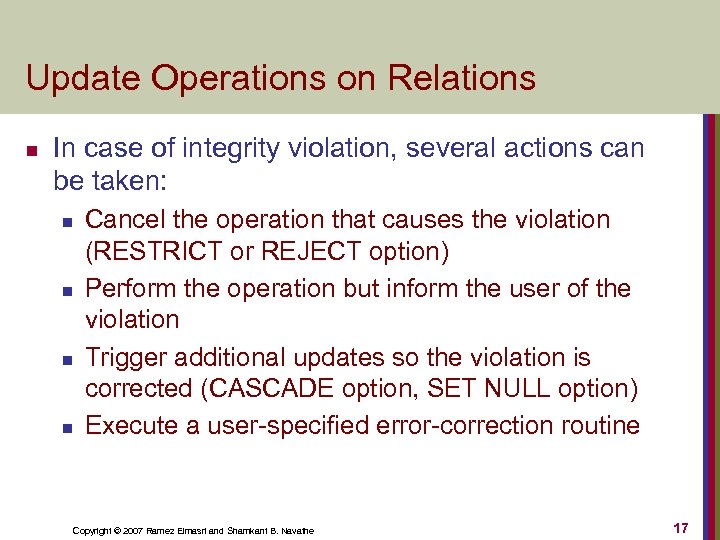 Update Operations on Relations n In case of integrity violation, several actions can be taken: n n Cancel the operation that causes the violation (RESTRICT or REJECT option) Perform the operation but inform the user of the violation Trigger additional updates so the violation is corrected (CASCADE option, SET NULL option) Execute a user-specified error-correction routine Copyright © 2007 Ramez Elmasri and Shamkant B. Navathe 17
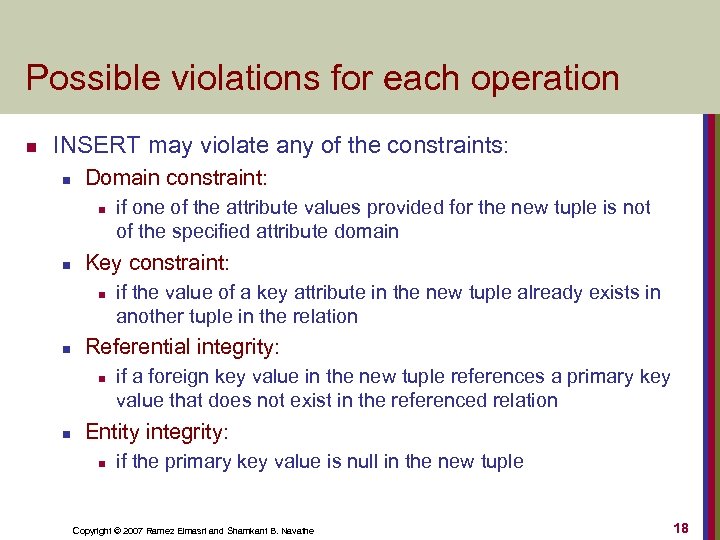 Possible violations for each operation n INSERT may violate any of the constraints: n Domain constraint: n n Key constraint: n n if the value of a key attribute in the new tuple already exists in another tuple in the relation Referential integrity: n n if one of the attribute values provided for the new tuple is not of the specified attribute domain if a foreign key value in the new tuple references a primary key value that does not exist in the referenced relation Entity integrity: n if the primary key value is null in the new tuple Copyright © 2007 Ramez Elmasri and Shamkant B. Navathe 18
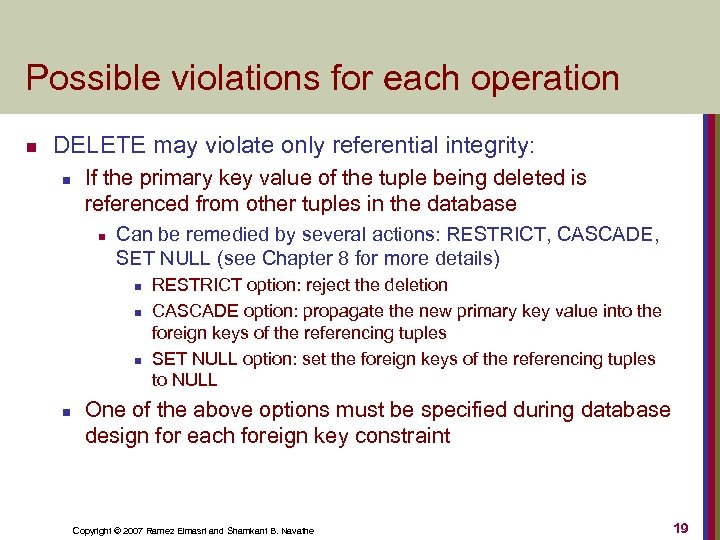 Possible violations for each operation n DELETE may violate only referential integrity: n If the primary key value of the tuple being deleted is referenced from other tuples in the database n Can be remedied by several actions: RESTRICT, CASCADE, SET NULL (see Chapter 8 for more details) n n RESTRICT option: reject the deletion CASCADE option: propagate the new primary key value into the foreign keys of the referencing tuples SET NULL option: set the foreign keys of the referencing tuples to NULL One of the above options must be specified during database design for each foreign key constraint Copyright © 2007 Ramez Elmasri and Shamkant B. Navathe 19
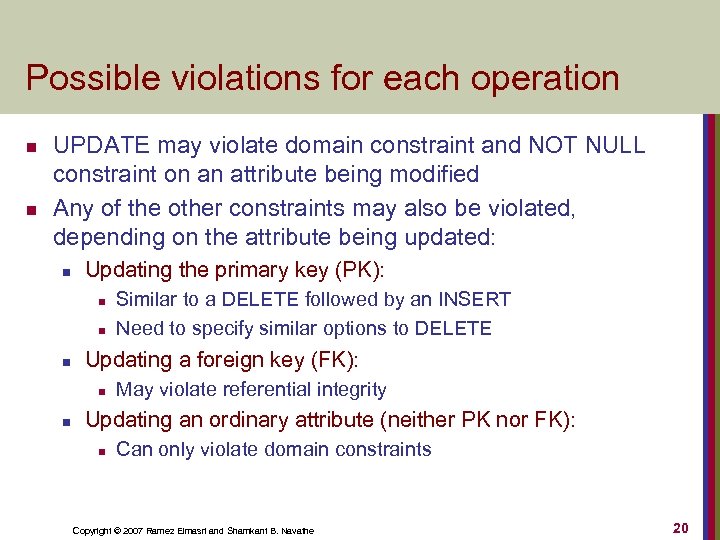 Possible violations for each operation n n UPDATE may violate domain constraint and NOT NULL constraint on an attribute being modified Any of the other constraints may also be violated, depending on the attribute being updated: n Updating the primary key (PK): n n n Updating a foreign key (FK): n n Similar to a DELETE followed by an INSERT Need to specify similar options to DELETE May violate referential integrity Updating an ordinary attribute (neither PK nor FK): n Can only violate domain constraints Copyright © 2007 Ramez Elmasri and Shamkant B. Navathe 20
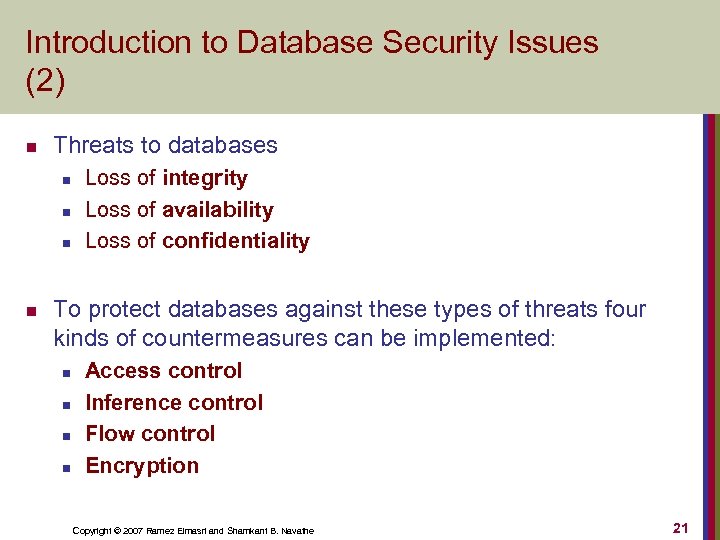 Introduction to Database Security Issues (2) n Threats to databases n n Loss of integrity Loss of availability Loss of confidentiality To protect databases against these types of threats four kinds of countermeasures can be implemented: n n Access control Inference control Flow control Encryption Copyright © 2007 Ramez Elmasri and Shamkant B. Navathe 21
 Introduction to Database Security Issues (3) n n A DBMS typically includes a database security and authorization subsystem that is responsible for ensuring the security portions of a database against unauthorized access. Two types of database security mechanisms: n n Discretionary security mechanisms Mandatory security mechanisms Copyright © 2007 Ramez Elmasri and Shamkant B. Navathe 22
 Introduction to Database Security Issues (4) n The security mechanism of a DBMS must include provisions for restricting access to the database as a whole n This function is called access control and is handled by creating user accounts and passwords to control login process by the DBMS. Copyright © 2007 Ramez Elmasri and Shamkant B. Navathe 23
 Introduction to Database Security Issues (5) n The security problem associated with databases is that of controlling the access to a statistical database, which is used to provide statistical information or summaries of values based on various criteria. n The countermeasures to statistical database security problem is called inference control measures. Copyright © 2007 Ramez Elmasri and Shamkant B. Navathe 24
 Introduction to Database Security Issues (6) n n Another security is that of flow control, which prevents information from flowing in such a way that it reaches unauthorized users. Channels that are pathways for information to flow implicitly in ways that violate the security policy of an organization are called covert channels. Copyright © 2007 Ramez Elmasri and Shamkant B. Navathe 25
 Introduction to Database Security Issues (7) n n A final security issue is data encryption, which is used to protect sensitive data (such as credit card numbers) that is being transmitted via some type communication network. The data is encoded using some encoding algorithm. n An unauthorized user who access encoded data will have difficulty deciphering it, but authorized users are given decoding or decrypting algorithms (or keys) to decipher data. Copyright © 2007 Ramez Elmasri and Shamkant B. Navathe 26
 1. 2 Database Security and the DBA n The database administrator (DBA) is the central authority for managing a database system. n The DBA’s responsibilities include n n n granting privileges to users who need to use the system classifying users and data in accordance with the policy of the organization The DBA is responsible for the overall security of the database system. Copyright © 2007 Ramez Elmasri and Shamkant B. Navathe 27
 1. 2 Database Security and the DBA (2) n The DBA has a DBA account in the DBMS n n Sometimes these are called a system or superuser account These accounts provide powerful capabilities such as: n n n 1. Account creation 2. Privilege granting 3. Privilege revocation 4. Security level assignment Action 1 is access control, whereas 2 and 3 are discretionarym and 4 is used to control mandatory authorization Copyright © 2007 Ramez Elmasri and Shamkant B. Navathe 28
 1. 3 Access Protection, User Accounts, and Database Audits n Whenever a person or group of person s need to access a database system, the individual or group must first apply for a user account. n n The DBA will then create a new account id and password for the user if he/she deems there is a legitimate need to access the database The user must log in to the DBMS by entering account id and password whenever database access is needed. Copyright © 2007 Ramez Elmasri and Shamkant B. Navathe 29
 1. 3 Access Protection, User Accounts, and Database Audits(2) n The database system must also keep track of all operations on the database that are applied by a certain user throughout each login session. n To keep a record of all updates applied to the database and of the particular user who applied each update, we can modify system log, which includes an entry for each operation applied to the database that may be required for recovery from a transaction failure or system crash. Copyright © 2007 Ramez Elmasri and Shamkant B. Navathe 30
 1. 3 Access Protection, User Accounts, and Database Audits(3) n If any tampering with the database is suspected, a database audit is performed n n A database audit consists of reviewing the log to examine all accesses and operations applied to the database during a certain time period. A database log that is used mainly for security purposes is sometimes called an audit trail. Copyright © 2007 Ramez Elmasri and Shamkant B. Navathe 31
 Discretionary Access Control Based on Granting and Revoking Privileges n The typical method of enforcing discretionary access control in a database system is based on the granting and revoking privileges. Copyright © 2007 Ramez Elmasri and Shamkant B. Navathe 32
 2. 1 Types of Discretionary Privileges n The account level: n n At this level, the DBA specifies the particular privileges that each account holds independently of the relations in the database. The relation level (or table level): n At this level, the DBA can control the privilege to access each individual relation or view in the database. Copyright © 2007 Ramez Elmasri and Shamkant B. Navathe 33
 2. 1 Types of Discretionary Privileges(2) n The privileges at the account level apply to the capabilities provided to the account itself and can include n n n the CREATE SCHEMA or CREATE TABLE privilege, to create a schema or base relation; the CREATE VIEW privilege; the ALTER privilege, to apply schema changes such adding or removing attributes from relations; the DROP privilege, to delete relations or views; the MODIFY privilege, to insert, delete, or update tuples; and the SELECT privilege, to retrieve information from the database by using a SELECT query. Copyright © 2007 Ramez Elmasri and Shamkant B. Navathe 34
 2. 1 Types of Discretionary Privileges(3) n The second level of privileges applies to the relation level n n This includes base relations and virtual (view) relations. The granting and revoking of privileges generally follow an authorization model for discretionary privileges known as the access matrix model where n n n The rows of a matrix M represents subjects (users, accounts, programs) The columns represent objects (relations, records, columns, views, operations). Each position M(i, j) in the matrix represents the types of privileges (read, write, update) that subject i holds on object j. Copyright © 2007 Ramez Elmasri and Shamkant B. Navathe 35
 2. 1 Types of Discretionary Privileges(4) n To control the granting and revoking of relation privileges, each relation R in a database is assigned and owner account, which is typically the account that was used when the relation was created in the first place. n n n The owner of a relation is given all privileges on that relation. In SQL 2, the DBA can assign and owner to a whole schema by creating the schema and associating the appropriate authorization identifier with that schema, using the CREATE SCHEMA command. The owner account holder can pass privileges on any of the owned relation to other users by granting privileges to their accounts. Copyright © 2007 Ramez Elmasri and Shamkant B. Navathe 36
 2. 1 Types of Discretionary Privileges(5) n In SQL the following types of privileges can be granted on each individual relation R: n SELECT (retrieval or read) privilege on R: n n n Gives the account retrieval privilege. In SQL this gives the account the privilege to use the SELECT statement to retrieve tuples from R. MODIFY privileges on R: n n n This gives the account the capability to modify tuples of R. In SQL this privilege is further divided into UPDATE, DELETE, and INSERT privileges to apply the corresponding SQL command to R. In addition, both the INSERT and UPDATE privileges can specify that only certain attributes can be updated by the account. Copyright © 2007 Ramez Elmasri and Shamkant B. Navathe 37
 2. 1 Types of Discretionary Privileges(6) n In SQL the following types of privileges can be granted on each individual relation R (contd. ): n REFERENCES privilege on R: n n n This gives the account the capability to reference relation R when specifying integrity constraints. The privilege can also be restricted to specific attributes of R. Notice that to create a view, the account must have SELECT privilege on all relations involved in the view definition. Copyright © 2007 Ramez Elmasri and Shamkant B. Navathe 38
 2. 2 Specifying Privileges Using Views n The mechanism of views is an important discretionary authorization mechanism in its own right. For example, n n If the owner A of a relation R wants another account B to be able to retrieve only some fields of R, then A can create a view V of R that includes only those attributes and then grant SELECT on V to B. The same applies to limiting B to retrieving only certain tuples of R; a view V’ can be created by defining the view by means of a query that selects only those tuples from R that A wants to allow B to access. Copyright © 2007 Ramez Elmasri and Shamkant B. Navathe 39
 2. 3 Revoking Privileges n In some cases it is desirable to grant a privilege to a user temporarily. For example, n n The owner of a relation may want to grant the SELECT privilege to a user for a specific task and then revoke that privilege once the task is completed. Hence, a mechanism for revoking privileges is needed. In SQL, a REVOKE command is included for the purpose of canceling privileges. Copyright © 2007 Ramez Elmasri and Shamkant B. Navathe 40
 2. 4 Propagation of Privileges using the GRANT OPTION n n Whenever the owner A of a relation R grants a privilege on R to another account B, privilege can be given to B with or without the GRANT OPTION. If the GRANT OPTION is given, this means that B can also grant that privilege on R to other accounts. n n Suppose that B is given the GRANT OPTION by A and that B then grants the privilege on R to a third account C, also with GRANT OPTION. In this way, privileges on R can propagate to other accounts without the knowledge of the owner of R. If the owner account A now revokes the privilege granted to B, all the privileges that B propagated based on that privilege should automatically be revoked by the system. Copyright © 2007 Ramez Elmasri and Shamkant B. Navathe 41
 2. 5 An Example n Suppose that the DBA creates four accounts n n A 1, A 2, A 3, A 4 and wants only A 1 to be able to create base relations. Then the DBA must issue the following GRANT command in SQL GRANT CREATETAB TO A 1; n In SQL 2 the same effect can be accomplished by having the DBA issue a CREATE SCHEMA command as follows: CREATE SCHAMA EXAMPLE AUTHORIZATION A 1; Copyright © 2007 Ramez Elmasri and Shamkant B. Navathe 42
 2. 5 An Example(2) n n User account A 1 can create tables under the schema called EXAMPLE. Suppose that A 1 creates the two base relations EMPLOYEE and DEPARTMENT n n A 1 is then owner of these two relations and hence all the relation privileges on each of them. Suppose that A 1 wants to grant A 2 the privilege to insert and delete tuples in both of these relations, but A 1 does not want A 2 to be able to propagate these privileges to additional accounts: GRANT INSERT, DELETE ON EMPLOYEE, DEPARTMENT TO A 2; Copyright © 2007 Ramez Elmasri and Shamkant B. Navathe 43
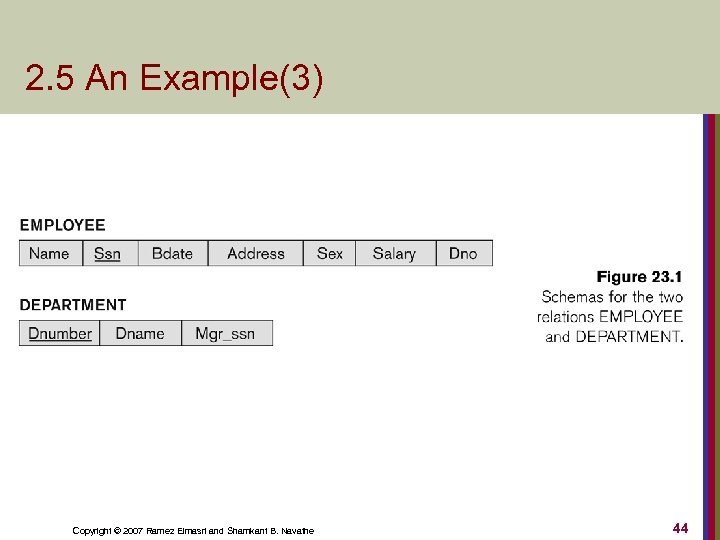 2. 5 An Example(3) Copyright © 2007 Ramez Elmasri and Shamkant B. Navathe 44
 2. 5 An Example(4) n n Suppose that A 1 wants to allow A 3 to retrieve information from either of the two tables and also to be able to propagate the SELECT privilege to other accounts. A 1 can issue the command: GRANT SELECT ON EMPLOYEE, DEPARTMENT TO A 3 WITH GRANT OPTION; n A 3 can grant the SELECT privilege on the EMPLOYEE relation to A 4 by issuing: GRANT SELECT ON EMPLOYEE TO A 4; n Notice that A 4 can’t propagate the SELECT privilege because GRANT OPTION was not given to A 4 Copyright © 2007 Ramez Elmasri and Shamkant B. Navathe 45
 2. 5 An Example(5) n Suppose that A 1 decides to revoke the SELECT privilege on the EMPLOYEE relation from A 3; A 1 can issue: REVOKE SELECT ON EMPLOYEE FROM A 3; n The DBMS must now automatically revoke the SELECT privilege on EMPLOYEE from A 4, too, because A 3 granted that privilege to A 4 and A 3 does not have the privilege any more. Copyright © 2007 Ramez Elmasri and Shamkant B. Navathe 46
 2. 5 An Example(6) n n Suppose that A 1 wants to give back to A 3 a limited capability to SELECT from the EMPLOYEE relation and wants to allow A 3 to be able to propagate the privilege. n The limitation is to retrieve only the NAME, BDATE, and ADDRESS attributes and only for the tuples with DNO=5. A 1 then create the view: CREATE VIEW A 3 EMPLOYEE AS SELECT NAME, BDATE, ADDRESS FROM EMPLOYEE WHERE DNO = 5; n After the view is created, A 1 can grant SELECT on the view A 3 EMPLOYEE to A 3 as follows: GRANT SELECT ON A 3 EMPLOYEE TO A 3 WITH GRANT OPTION; Copyright © 2007 Ramez Elmasri and Shamkant B. Navathe 47
 2. 5 An Example(7) n n Finally, suppose that A 1 wants to allow A 4 to update only the SALARY attribute of EMPLOYEE; A 1 can issue: GRANT UPDATE ON EMPLOYEE (SALARY) TO A 4; n n The UPDATE or INSERT privilege can specify particular attributes that may be updated or inserted in a relation. Other privileges (SELECT, DELETE) are not attribute specific. Copyright © 2007 Ramez Elmasri and Shamkant B. Navathe 48
 2. 6 Specifying Limits on Propagation of Privileges n Techniques to limit the propagation of privileges have been developed, although they have not yet been implemented in most DBMSs and are not a part of SQL. n n Limiting horizontal propagation to an integer number i means that an account B given the GRANT OPTION can grant the privilege to at most i other accounts. Vertical propagation is more complicated; it limits the depth of the granting of privileges. Copyright © 2007 Ramez Elmasri and Shamkant B. Navathe 49