 Скачать презентацию Chapter 6 Corporate Strategy Leveraging Resources by Robert
2ab63614670a12a662600ff15472f022.ppt
- Количество слайдов: 27



Chapter 6 Corporate Strategy: Leveraging Resources by Robert Pitts & David Lei Slides prepared by John P. Orr Webster University Copyright © 2006 by South-Western, a division of Thomson Learning. All rights reserved. 1
What you will learn… Slide 1 of 3 • The concept of corporate strategy • The notion of a “resource-based view” of corporate strategy • How effective corporate strategy can be used to extend and leverage a firm’s distinctive competence • The broad types of corporate strategy – Vertical Integration – Related Diversification – Unrelated Diversification Copyright © 2006 by South-Western, a division of Thomson Learning. All rights reserved. 2
What you will learn… Slide 2 of 3 • Economic forces that motivate the pursuit of different corporate strategies • How to balance the benefits and costs of diversification • Benefits of sharing and leveraging resources among businesses or activities • Costs accompanying diversification and the limitations of sharing Copyright © 2006 by South-Western, a division of Thomson Learning. All rights reserved. 3
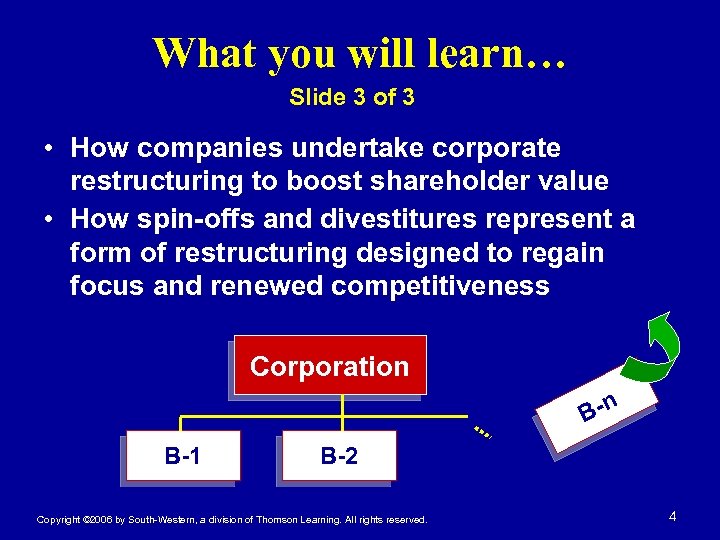
What you will learn… Slide 3 of 3 • How companies undertake corporate restructuring to boost shareholder value • How spin-offs and divestitures represent a form of restructuring designed to regain focus and renewed competitiveness Corporation B-1 B-2 Copyright © 2006 by South-Western, a division of Thomson Learning. All rights reserved. 4
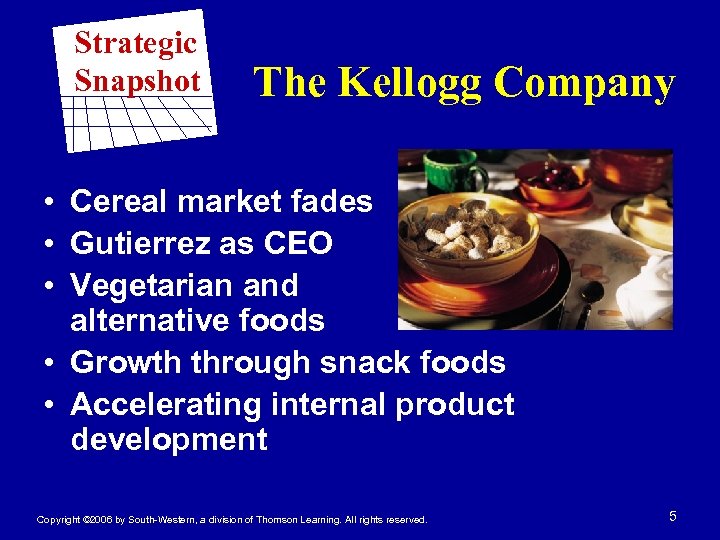
Strategic Snapshot The Kellogg Company • Cereal market fades • Gutierrez as CEO • Vegetarian and alternative foods • Growth through snack foods • Accelerating internal product development Copyright © 2006 by South-Western, a division of Thomson Learning. All rights reserved. 5
Resources and Strategy Resource-Based View of the Firm An evolving set of strategic management ideas that place considerable emphasis on the firm’s ability to distinguish itself from rivals by means of investing in hard-toimitate and specific resources, such as: • • • Technologies Skills Capabilities Assets Management approaches Copyright © 2006 by South-Western, a division of Thomson Learning. All rights reserved. 6
Resource-Based View: Key Concepts • Ideally, distinctive resources are hard for competitors to duplicate • A firm’s resources should be highly specialized and durable • Firms need to monitor the environment so that their corporate resources do not suffer from easy substitution by rivals Copyright © 2006 by South-Western, a division of Thomson Learning. All rights reserved. 7
Exhibit 6 -1 Enlarging the Firm’s Scope of Operations Entrance into… • New stages of activity (i. e. , vertical integration) • New businesses/ industries (i. e. , industry-based diversification) Copyright © 2006 by South-Western, a division of Thomson Learning. All rights reserved. 8
Strategic Competency in action A New Corporate Vision: Transforming Du. Pont • • • Enter CEO Chad Holliday Biotechnology + chemistry Heritage of Nylon and Lycra Agribusiness and ‘bio-refinery’ Exiting the pharmaceutical and petroleum industries Copyright © 2006 by South-Western, a division of Thomson Learning. All rights reserved. 9
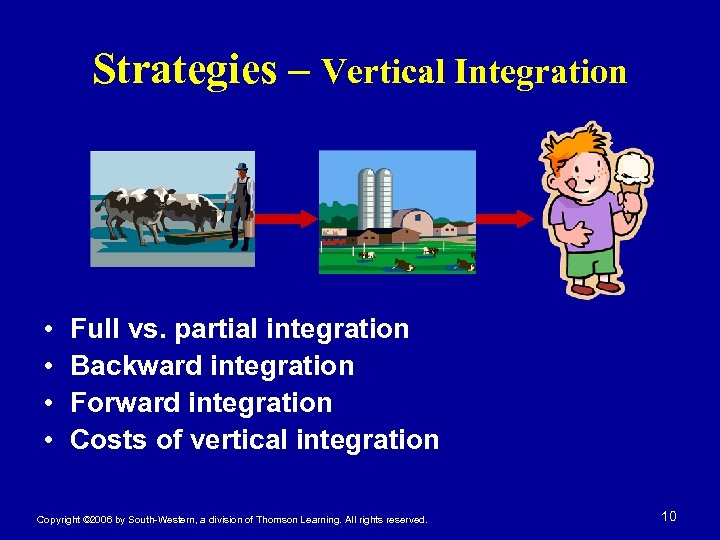
Strategies – Vertical Integration • • Full vs. partial integration Backward integration Forward integration Costs of vertical integration Copyright © 2006 by South-Western, a division of Thomson Learning. All rights reserved. 10
Strategies – Related Diversification • Focus on internal development • Mutually reinforcing businesses • Making competence hard to imitate • Ensuring managerial fit Copyright © 2006 by South-Western, a division of Thomson Learning. All rights reserved. 11
Strategies – Unrelated Diversification • Acquisitions vs. internal development • Attempting to beat the market • Conglomerate discount? • Limited unrelated diversification Copyright © 2006 by South-Western, a division of Thomson Learning. All rights reserved. 12
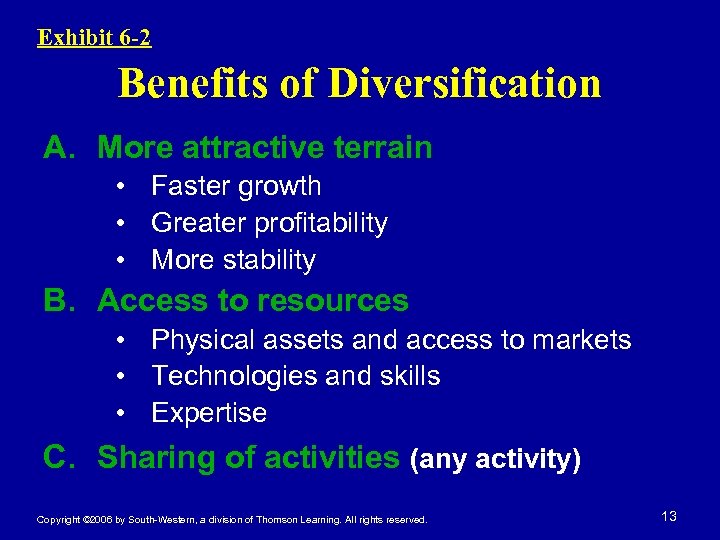
Exhibit 6 -2 Benefits of Diversification A. More attractive terrain • Faster growth • Greater profitability • More stability B. Access to resources • Physical assets and access to markets • Technologies and skills • Expertise C. Sharing of activities (any activity) Copyright © 2006 by South-Western, a division of Thomson Learning. All rights reserved. 13
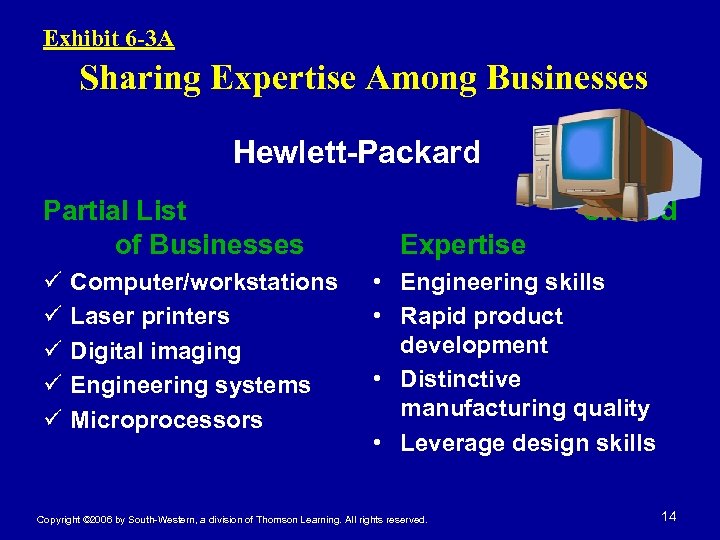
Exhibit 6 -3 A Sharing Expertise Among Businesses Hewlett-Packard Partial List of Businesses ü ü ü Computer/workstations Laser printers Digital imaging Engineering systems Microprocessors Shared Expertise • Engineering skills • Rapid product development • Distinctive manufacturing quality • Leverage design skills Copyright © 2006 by South-Western, a division of Thomson Learning. All rights reserved. 14
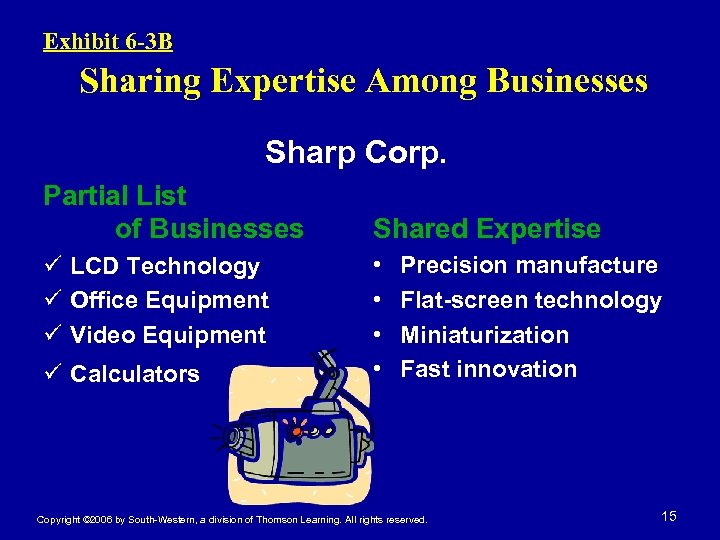
Exhibit 6 -3 B Sharing Expertise Among Businesses Sharp Corp. Partial List of Businesses ü LCD Technology ü Office Equipment ü Video Equipment ü Calculators Shared Expertise • • Precision manufacture Flat-screen technology Miniaturization Fast innovation Copyright © 2006 by South-Western, a division of Thomson Learning. All rights reserved. 15
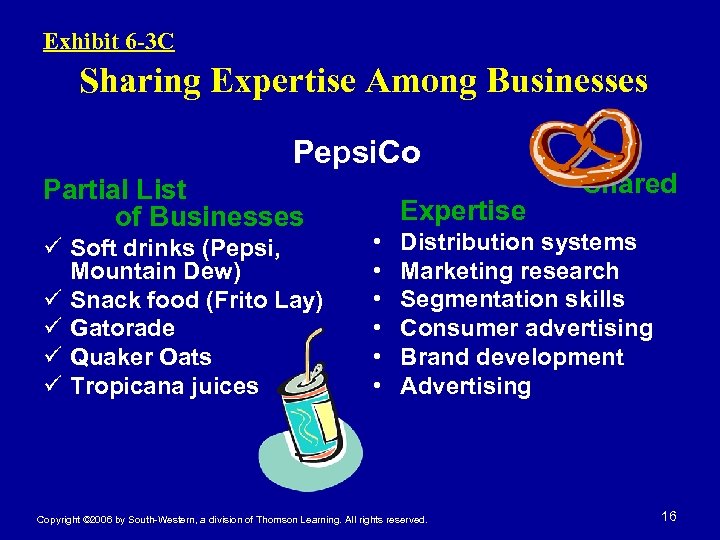
Exhibit 6 -3 C Sharing Expertise Among Businesses Pepsi. Co Partial List of Businesses ü Soft drinks (Pepsi, Mountain Dew) ü Snack food (Frito Lay) ü Gatorade ü Quaker Oats ü Tropicana juices Expertise • • • Shared Distribution systems Marketing research Segmentation skills Consumer advertising Brand development Advertising Copyright © 2006 by South-Western, a division of Thomson Learning. All rights reserved. 16
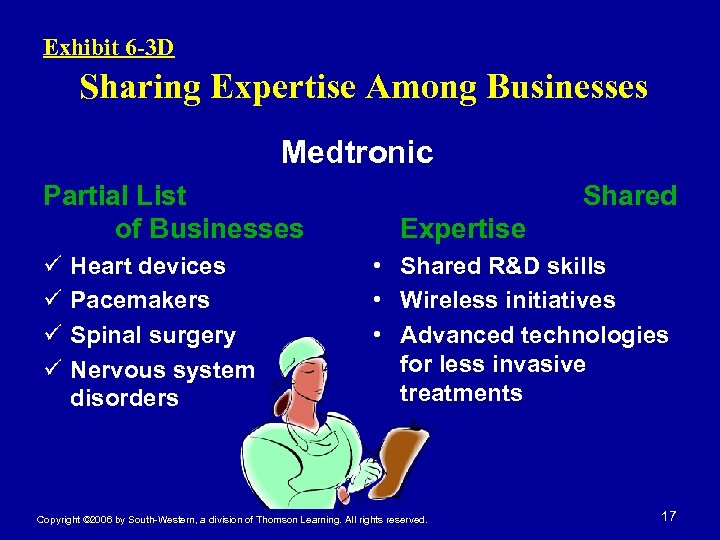
Exhibit 6 -3 D Sharing Expertise Among Businesses Medtronic Partial List of Businesses ü ü Heart devices Pacemakers Spinal surgery Nervous system disorders Shared Expertise • Shared R&D skills • Wireless initiatives • Advanced technologies for less invasive treatments Copyright © 2006 by South-Western, a division of Thomson Learning. All rights reserved. 17
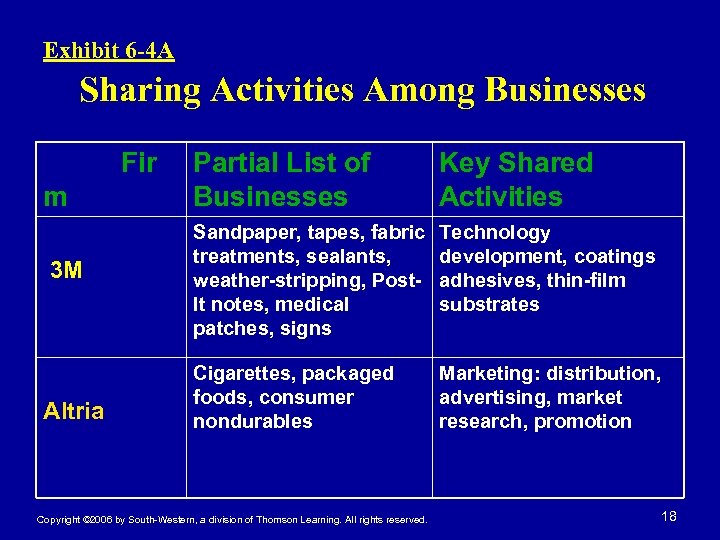
Exhibit 6 -4 A Sharing Activities Among Businesses Fir m 3 M Altria Partial List of Businesses Key Shared Activities Sandpaper, tapes, fabric treatments, sealants, weather-stripping, Post. It notes, medical patches, signs Technology development, coatings adhesives, thin-film substrates Cigarettes, packaged foods, consumer nondurables Marketing: distribution, advertising, market research, promotion Copyright © 2006 by South-Western, a division of Thomson Learning. All rights reserved. 18
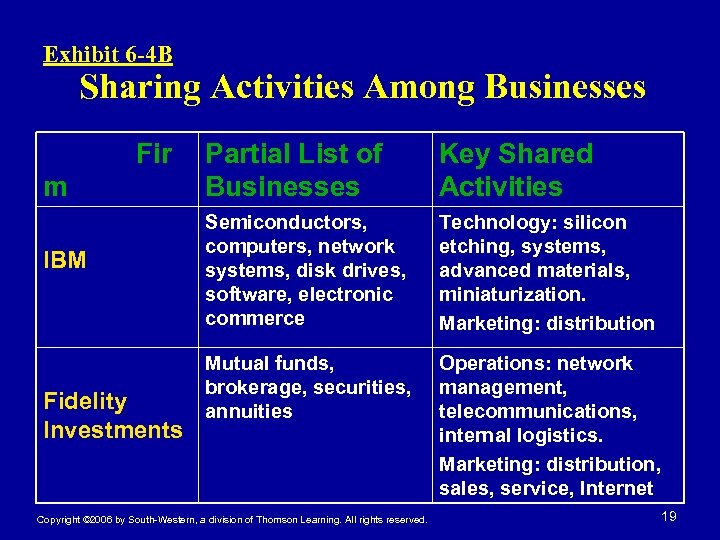
Exhibit 6 -4 B Sharing Activities Among Businesses Fir m IBM Fidelity Investments Partial List of Businesses Key Shared Activities Semiconductors, computers, network systems, disk drives, software, electronic commerce Technology: silicon etching, systems, advanced materials, miniaturization. Marketing: distribution Mutual funds, brokerage, securities, annuities Operations: network management, telecommunications, internal logistics. Marketing: distribution, sales, service, Internet Copyright © 2006 by South-Western, a division of Thomson Learning. All rights reserved. 19
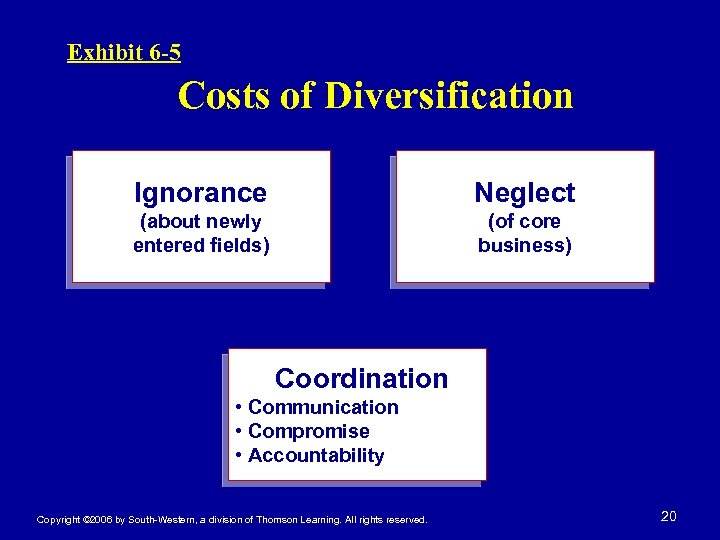
Exhibit 6 -5 Costs of Diversification Ignorance Neglect (about newly entered fields) (of core business) Coordination • Communication • Compromise • Accountability Copyright © 2006 by South-Western, a division of Thomson Learning. All rights reserved. 20
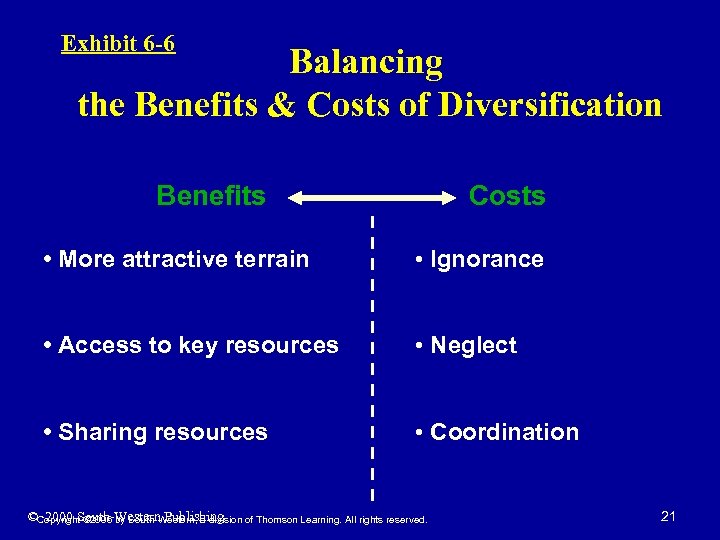
Exhibit 6 -6 Balancing the Benefits & Costs of Diversification Benefits Costs • More attractive terrain • Ignorance • Access to key resources • Neglect • Sharing resources • Coordination ©Copyright © 2006 by South-Western, a division of Thomson Learning. All rights reserved. 2000 South-Western Publishing 21
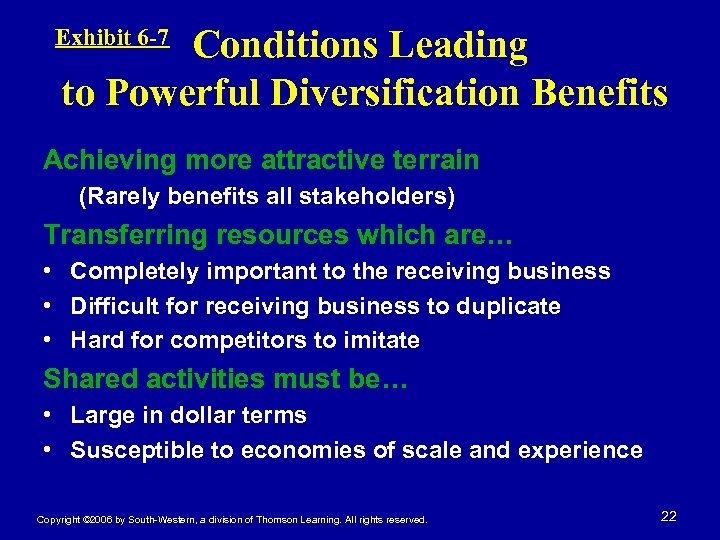
Conditions Leading to Powerful Diversification Benefits Exhibit 6 -7 Achieving more attractive terrain (Rarely benefits all stakeholders) Transferring resources which are… • Completely important to the receiving business • Difficult for receiving business to duplicate • Hard for competitors to imitate Shared activities must be… • Large in dollar terms • Susceptible to economies of scale and experience Copyright © 2006 by South-Western, a division of Thomson Learning. All rights reserved. 22
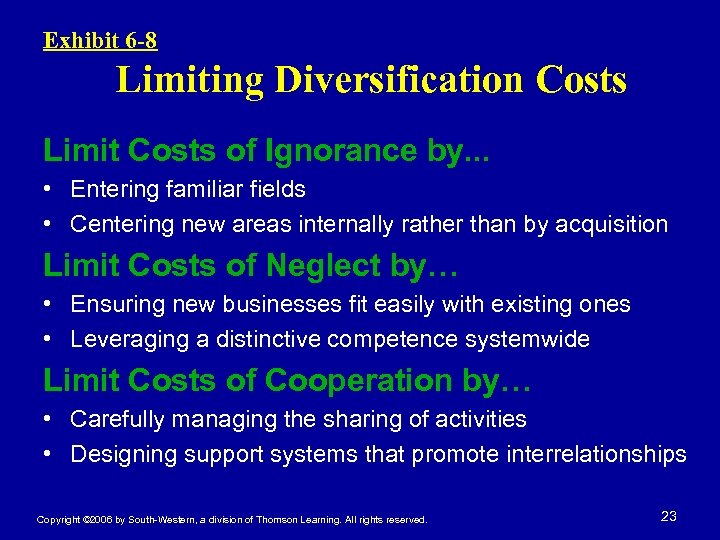
Exhibit 6 -8 Limiting Diversification Costs Limit Costs of Ignorance by. . . • Entering familiar fields • Centering new areas internally rather than by acquisition Limit Costs of Neglect by… • Ensuring new businesses fit easily with existing ones • Leveraging a distinctive competence systemwide Limit Costs of Cooperation by… • Carefully managing the sharing of activities • Designing support systems that promote interrelationships Copyright © 2006 by South-Western, a division of Thomson Learning. All rights reserved. 23
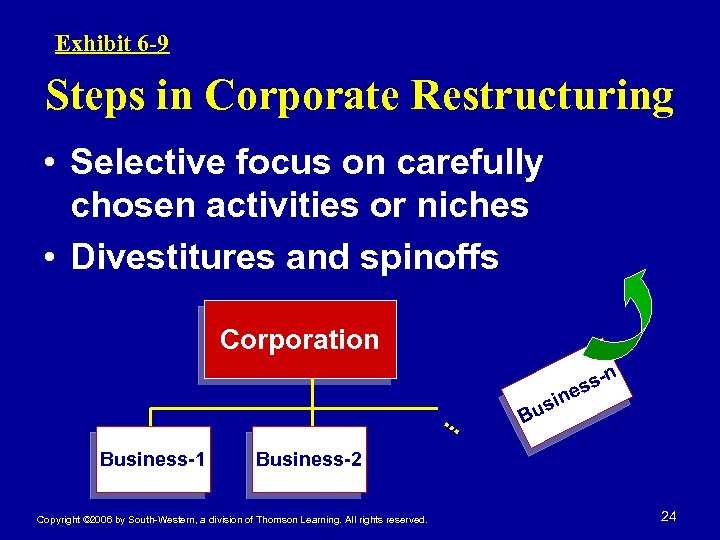
Exhibit 6 -9 Steps in Corporate Restructuring • Selective focus on carefully chosen activities or niches • Divestitures and spinoffs Corporation s Bu Business-1 -n in s es Business-2 Copyright © 2006 by South-Western, a division of Thomson Learning. All rights reserved. 24
Strategic Competency in action Creating Distinctive Value The 3 M Company • • • Legends in innovation Mc. Knight builds in-house labs Scientists share across projects Post-Its glue failed at first Boosting health care and electronics Copyright © 2006 by South-Western, a division of Thomson Learning. All rights reserved. 25
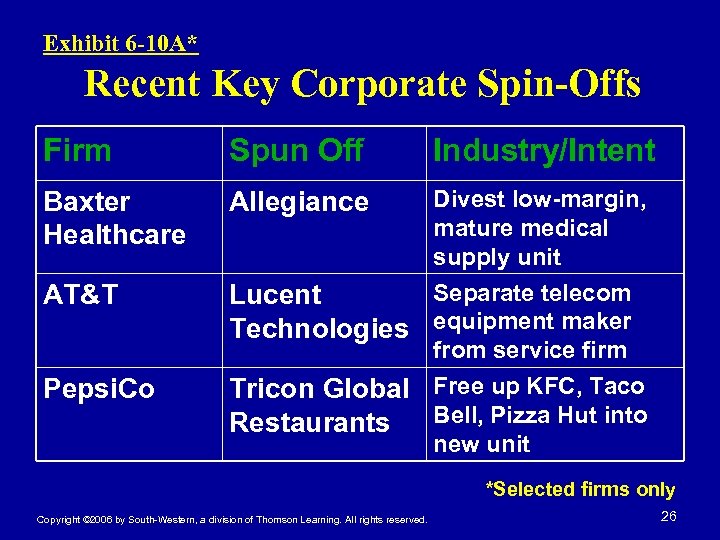
Exhibit 6 -10 A* Recent Key Corporate Spin-Offs Firm Spun Off Baxter Healthcare Allegiance AT&T Pepsi. Co Industry/Intent Divest low-margin, mature medical supply unit Separate telecom Lucent Technologies equipment maker from service firm Tricon Global Free up KFC, Taco Bell, Pizza Hut into Restaurants new unit *Selected firms only Copyright © 2006 by South-Western, a division of Thomson Learning. All rights reserved. 26
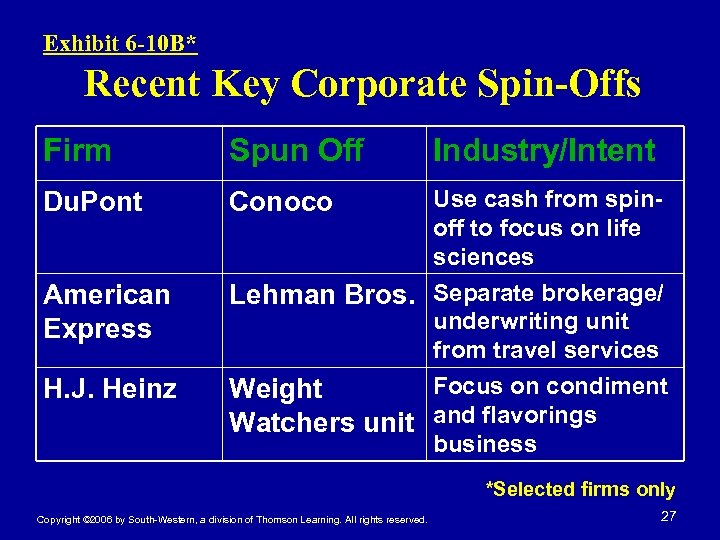
Exhibit 6 -10 B* Recent Key Corporate Spin-Offs Firm Spun Off Du. Pont Conoco American Express H. J. Heinz Industry/Intent Use cash from spinoff to focus on life sciences Lehman Bros. Separate brokerage/ underwriting unit from travel services Focus on condiment Weight Watchers unit and flavorings business *Selected firms only Copyright © 2006 by South-Western, a division of Thomson Learning. All rights reserved. 27
Скачать презентацию Chapter 6 Corporate Strategy Leveraging Resources by Robert
2ab63614670a12a662600ff15472f022.ppt