 Скачать презентацию Chapter 6 Company-Centric B 2 B Prentice Hall
c7d1f9aea59122f900378a042f0704a6.ppt
- Количество слайдов: 80



Chapter 6 Company-Centric B 2 B Prentice Hall, 2002 1
Learning Objectives Describe the B 2 B field Describe the major types of B 2 B models Describe the characteristics of the sell-side marketplace Describe the sell-side intermediaries models Describe the characteristics of the buyside marketplace and e-procurement Prentice Hall, 2002 2
Learning Objectives (cont. ) Explain how forward and backward auctions work in B 2 B Describe B 2 B aggregation and group purchasing models Describe collaborative e-commerce Understand issues concerning the implementation of company-centric B 2 B Distinguish Internet-based EDI from traditional EDI Prentice Hall, 2002 3
General Motors’ B 2 B Initiatives EC initiatives—build-to-order project to be in place by 2005 reducing inventory of finished cars Selling capital assets Trade. Xchange online auctions of items like used machines for manufacturing Significantly decreases time for sales Increases dollar amount of the sales Prentice Hall, 2002 4
General Motors’ B 2 B Initiatives EC initiatives at Trade. Xchange Buying commodity products--$1 billion annual expenditure for direct and indirect products Traditional process Length of time measured in weeks Cost prohibited the number of bids Reverse auction—automated process Internet “open bid”—many suppliers take part Job is awarded quickly Price to GM significantly lower Prentice Hall, 2002 5
Concepts and Characteristics of B 2 B EC defined Transaction conducted electronically between business over the networks Internet Extranets Intranets Private networks (e. g. , EDI) Automated trading improves the process Prentice Hall, 2002 6
Concepts and Characteristics of B 2 B EC (cont. ) Market size and content Expected to grow from $1. 1 trillion in 2003 to $10 trillion by 2005 Percentage of Internet-based B 2 B from 2. 1% in 2000 to 10% in 2005 Private and public e-marketplace Private—one-to-many mode Public—many-to-many mode Prentice Hall, 2002 7
Concepts and Characteristics of B 2 B EC (cont. ) How is B 2 B conducted? Directly between buyer and seller Via an online intermediary Along the supply chain With or without intermediaries Types of transactions Spot buying—determined by dynamic supply and demand Strategic sourcing—long term contracts Prentice Hall, 2002 8
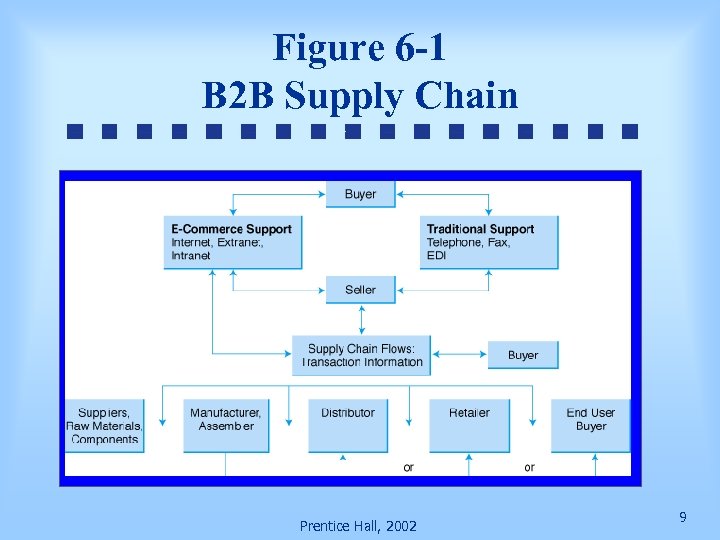
Figure 6 -1 B 2 B Supply Chain Prentice Hall, 2002 9
Concepts and Characteristics of B 2 B EC (cont. ) Supply chain relationships Interrelated subprocesses and roles Acquisition of materials Processing products and services Moving to distributors Purchase by consumer Traditional process managed through paper transactions B 2 B applications offer competitive advantages for supply chain management (SCM) Prentice Hall, 2002 10
Concepts and Characteristics of B 2 B EC (cont. ) Entities of B 2 B EC Selling company—marketing management perspective Buying company—procurement management perspective Electronic intermediaries—optional third party directory service provider (scope of service may be extended to order fulfillment) Trading platforms—pricing and negotiation protocol (auctions, reverse auctions) Prentice Hall, 2002 11
Concepts and Characteristics of B 2 B EC (cont. ) Entities of B 2 B EC (cont. ) Payment services—mechanism for transferring money to sellers Logistics providers—logistics to complete transaction (packaging, storage, delivery) Network platforms—Internet, VAN, intranet, extranet Protocols of communication—EDI or XML Back-end integration—connecting to ERP systems, databases, functional applications Prentice Hall, 2002 12
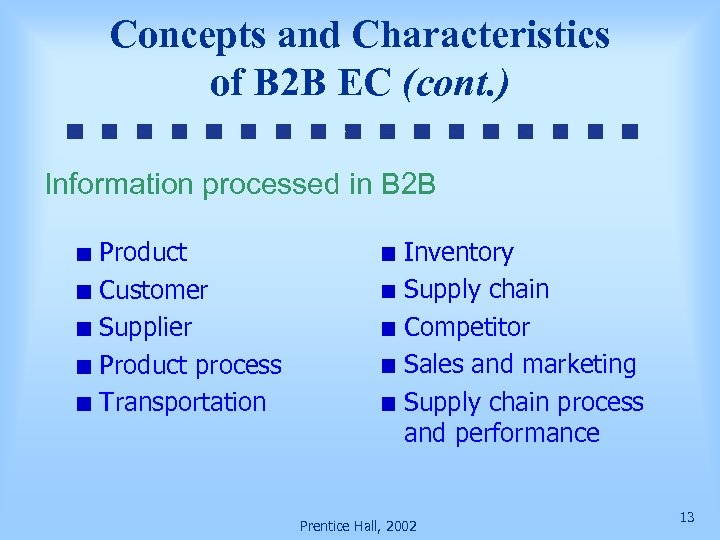
Concepts and Characteristics of B 2 B EC (cont. ) Information processed in B 2 B Product Customer Supplier Product process Transportation Inventory Supply chain Competitor Sales and marketing Supply chain process and performance Prentice Hall, 2002 13
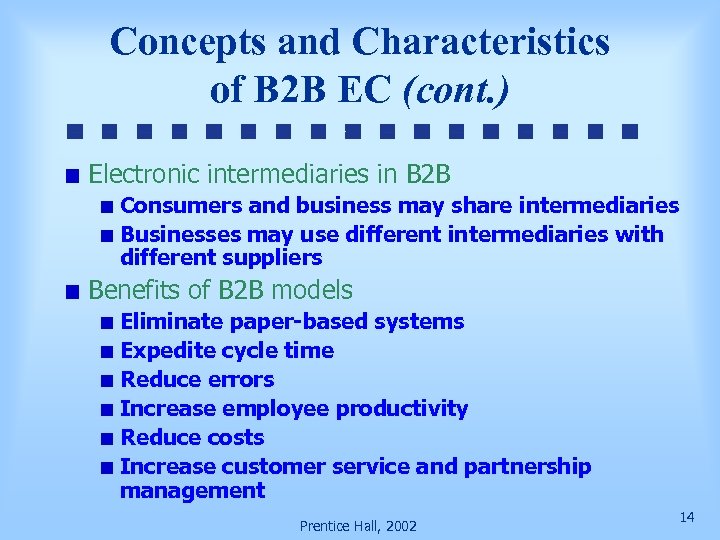
Concepts and Characteristics of B 2 B EC (cont. ) Electronic intermediaries in B 2 B Consumers and business may share intermediaries Businesses may use different intermediaries with different suppliers Benefits of B 2 B models Eliminate paper-based systems Expedite cycle time Reduce errors Increase employee productivity Reduce costs Increase customer service and partnership management Prentice Hall, 2002 14
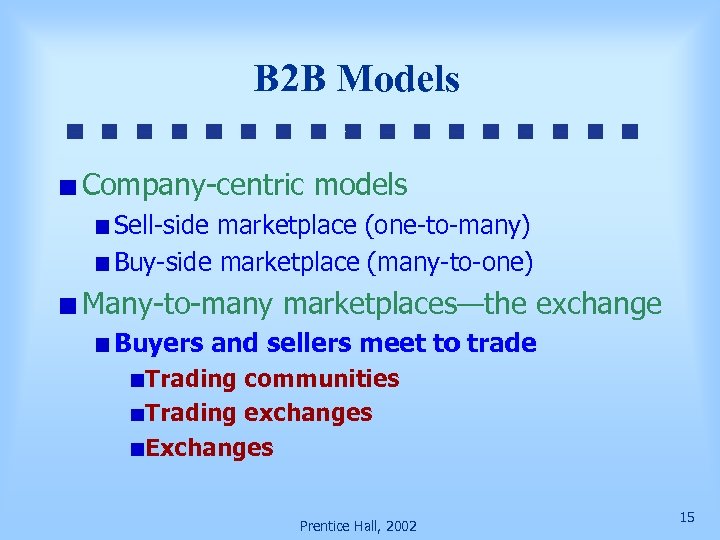
B 2 B Models Company-centric models Sell-side marketplace (one-to-many) Buy-side marketplace (many-to-one) Many-to-many marketplaces—the exchange Buyers and sellers meet to trade Trading communities Trading exchanges Exchanges Prentice Hall, 2002 15
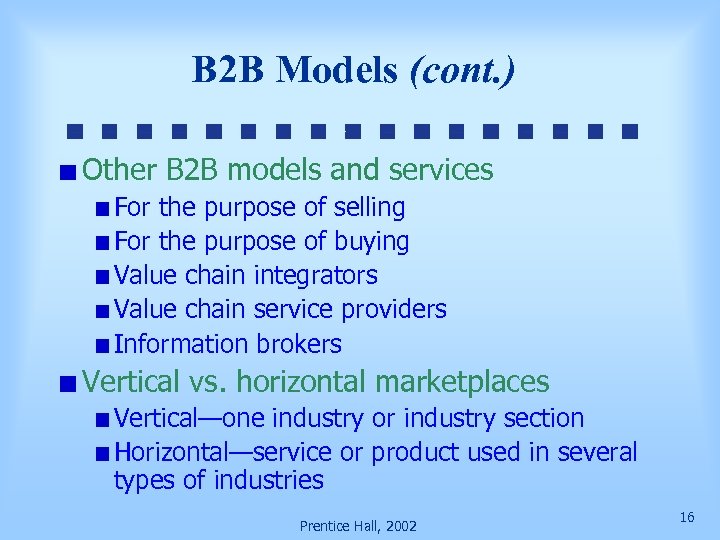
B 2 B Models (cont. ) Other B 2 B models and services For the purpose of selling For the purpose of buying Value chain integrators Value chain service providers Information brokers Vertical vs. horizontal marketplaces Vertical—one industry or industry section Horizontal—service or product used in several types of industries Prentice Hall, 2002 16
B 2 B Models (cont. ) Virtual service industries in B 2 B Travel and tourism services Real estate Electronic payments Online stock trading Online financing Other online services Prentice Hall, 2002 17
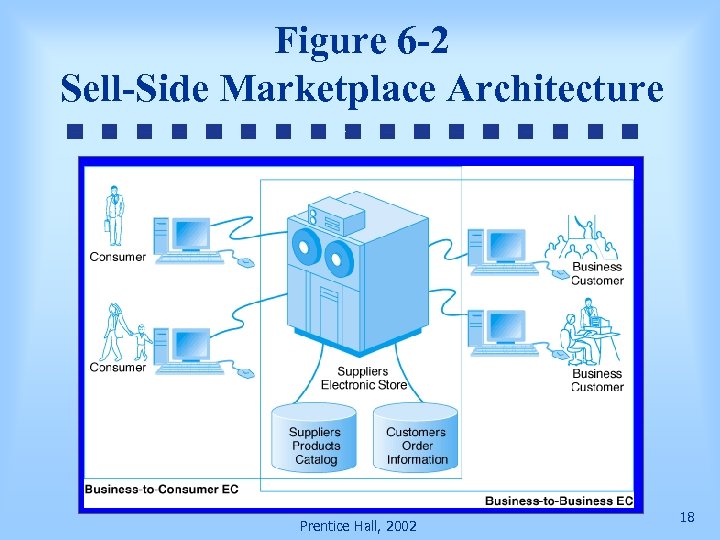
Figure 6 -2 Sell-Side Marketplace Architecture Prentice Hall, 2002 18
Sell-Side Marketplaces: One-to-Many Virtual sellers—Bigboxx. com. hk of Hong Kong B 2 B office supply retailer services Large corporate clients Medium corporate clients Small offices Goal—sell products in various SE Asian countries Offers more than 10, 000 items Uses more than 300 suppliers Prentice Hall, 2002 19
Sell-Side Marketplaces: One-to-Many (cont. ) Virtual sellers—Bigboxx. com. hk of Hong Kong (cont. ) Company portal attractive, easy to use Browse online catalogs Use search engines Payments Cash or check upon delivery Automatic payments Credit card Purchasing card Prentice Hall, 2002 20
Sell-Side Marketplaces: One-to-Many (cont. ) Virtual sellers—Bigboxx. com. hk of Hong Kong (cont. ) Delivery Owns trucks and warehouses Delivery scheduled online Same day (within an hour) Specifically scheduled time Ordering system integrated with SAP-based back-office system Prentice Hall, 2002 21
Sell-Side Marketplaces: One-to-Many (cont. ) Virtual sellers—Bigboxx. com. hk of Hong Kong (cont. ) Value-added services Track status of order Check stock availability Promotions Customized prices Group accounts and central approval—for businesses with multiple branches Standing orders automatically activated Large number of reports and data available Prentice Hall, 2002 22
Sell-Side Marketplaces: One-to-Many (cont. ) Customer service General Electric 20 million calls/year about appliances Reduced cost of each call from $5 to $0. 20 Milacron, Inc. Site contains 55, 000 products Easy to use Securely handles selection, purchase, application Technical service—expanded to provide a higher level of service than previously available at the site 23 Prentice Hall, 2002
Sell-Side Marketplaces: One-to-Many (cont. ) Direct sales from catalogs Configuration and customization Efficient customization for direct sales Business customers Customize products Receive price quote Submit order Successful cases Dell Intel IBM Cisco Prentice Hall, 2002 24
Sell-Side Marketplaces: One-to-Many (cont. ) Direct sales from catalogs Benefits Reduces costs (to buyers and sellers) and errors during the process Speeds up order cycle Ability to customize products Offer different prices to different customers Prentice Hall, 2002 25
Sell-Side Marketplaces: One-to-Many (cont. ) Direct sales from catalogs (cont. ) Limitations Channel conflicts with distribution systems High cost when traditional EDI used Large number of business partners is needed to justify system Prentice Hall, 2002 26
Selling Side: Auctions and Other Models Forward auctions—quick disposal of items Revenue generation Increased page views Member acquisition and retention—bidding transactions result in additional registered members Selling from own site when: Large companies that conduct auctions frequently don’t benefit from using intermediaries E-marketplace already in use, cost of adding auction not too high Prentice Hall, 2002 27
Selling Side: Auctions and Other Models (cont. ) Using intermediaries when: No resources required Own and control auction information Fast time to market Searching and reporting Search and report all auction activities Standard reports available Additional analysis of complex information Prentice Hall, 2002 28
Selling Side: Auctions and Other Models (cont. ) Billing and collection Automatic calculation of shipping weights and charges Payment—encrypted credit card data Billing information—easily downloaded into existing systems Successful if: Sufficient number of loyal customers Products well known Price not major purchasing criteria Prentice Hall, 2002 29
Sell-Side Case: CISCO Connection Online (CCO) Benefits—saves the company $363 million per year in: Technical support Human resources Software distribution Marketing material Prentice Hall, 2002 30
Cisco Connection Online (CCO) (cont. ) Customer service—Cisco Connection online Online ordering—Internet Product Center builds virtually all products to order Order status—customer tools for finding answers to order status inquiries Prentice Hall, 2002 31
Cisco Connection Online (CCO) (cont. ) Benefits to Cisco Reduced operating costs for order taking Enhanced technical support and customer service Reduced technical support staff cost Reduced software distribution costs Lead times reduced fro 4 -10 days to 2 -3 days Prentice Hall, 2002 32
Cisco Connection Online (CCO) (cont. ) Benefits to customers Quick order configuration Immediate cost determination Collaboration with Cisco staff Prentice Hall, 2002 33
Sell-Side Intermediaries Marshall Industries—(a subsidiary of Avnet. Marshall) multinational distributor of electronic components known for its innovative uses of IT and the Web Products and services Marshall. Net Marshall on the Internet (portal) Strategic European Internet Electronic Design Center Partner. Net. Seminar Education and News Portal Prentice Hall, 2002 34
Sell-Side Intermediaries (cont. ) Marshall Industries—a subsidiary or Avnet. Marshall (cont. ) Survival strategy Continuous improvement programs and innovations Team-based organization, flat hierarchy, decentralized decision making Profit sharing compensation for salespeople Prentice Hall, 2002 35
Sell-Side Intermediaries (cont. ) Marshall Industries—a subsidiary of Avnet. Marshall (cont. ) Survival strategy CRM highly promoted Web-based services create value between suppliers and customers EC initiatives supported by: Changing internal organization Changing internal procedures Prentice Hall, 2002 36
Sell-Side Intermediaries (cont. ) Boeing’s PART Acts as an intermediary between the airlines and parts’ suppliers Provides a single point of online access through which airlines and parts’ providers can access the data needed Goal: provide its customers with one-stop shopping for online parts and maintenance information and ordering capability Prentice Hall, 2002 37
Sell-Side Intermediaries (cont. ) Boeing’s PART Spare parts business using traditional EDI Mechanic tells purchasing department parts are needed, purchase is approved, purchase is made Large airlines connect to Boeing's VAN Boeing finds part and delivers Debut of PART on the Internet Encourages customers to order parts electronically— cheap, easy, fast 50% of customers using Internet within first year Prentice Hall, 2002 38
Sell-Side Intermediaries (cont. ) Boeing’s PART Benefits of PART online Improved customer service Significant operating savings New sales opportunities Customer service online reduced Phone calls (purchasing, order status etc. ) Data entry Prentice Hall, 2002 39
Sell-Side Intermediaries (cont. ) Boeing’s PART Portable access to technical drawings/support Boeing On Line Data (BOLD) provides availability to: Engineering drawings Manuals Catalogs Other technical information Portable Maintenance Aid (PMA)—solves maintenance problems Prentice Hall, 2002 40
Sell-Side Intermediaries (cont. ) Boeing’s PART Benefits to Boeing’s customers Increased productivity—less time searching for information Reduced costs—delays at gate reduced because all information is available Increased revenues—faster service provides time savings Prentice Hall, 2002 41
Buy Side: One-from-Many, E-Procurement Purchasing agents (buyers) Direct purchasing Use of material is scheduled Not a shelf item Indirect purchasing MROs Nonproduction materials Inefficiencies in procurement management of indirect materials Prentice Hall, 2002 42
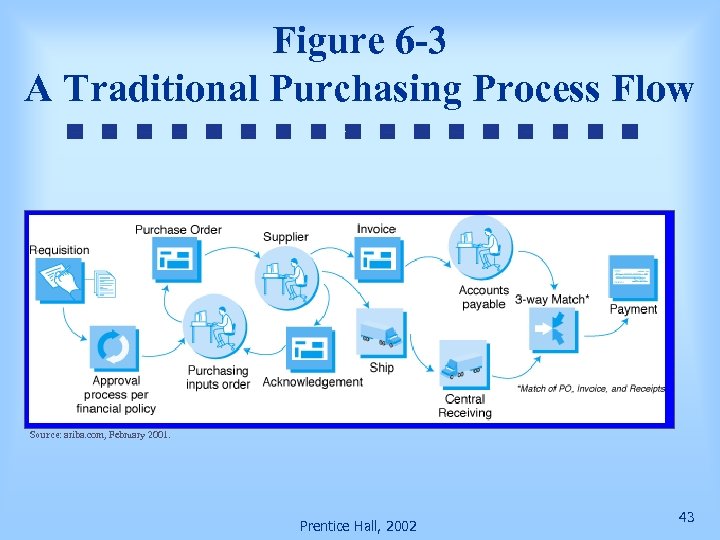
Figure 6 -3 A Traditional Purchasing Process Flow Source: ariba. com, February 2001. Prentice Hall, 2002 43
Buy Side: One-from-Many, E-Procurement (cont. ) Innovative procurement management Innovative purchasing as strategic approach to increase profit margins Web facilitation includes: Electronic tendering Volume purchasing Aggregating supplier catalogs at buyer’s site Group purchasing Others Prentice Hall, 2002 44
Buy Side: One-from-Many, E-Procurement (cont. ) Goals of procurement reengineering Increase purchasing agent productivity Lower purchasing prices of items Improve information flow and management Minimize maverick (unplanned) buying Improve payment process Streamline purchasing process to make it: Simple Fast Prentice Hall, 2002 45
Buy Side: One-from-Many, E-Procurement (cont. ) Goals of procurement reengineering (cont. ) Reduce administrative processing cost per order Find new suppliers and vendors to provide faster/cheaper goods and services Integrate procurement process with budgetary control in an efficient and effective way Minimize human errors in buying or shipping process Prentice Hall, 2002 46
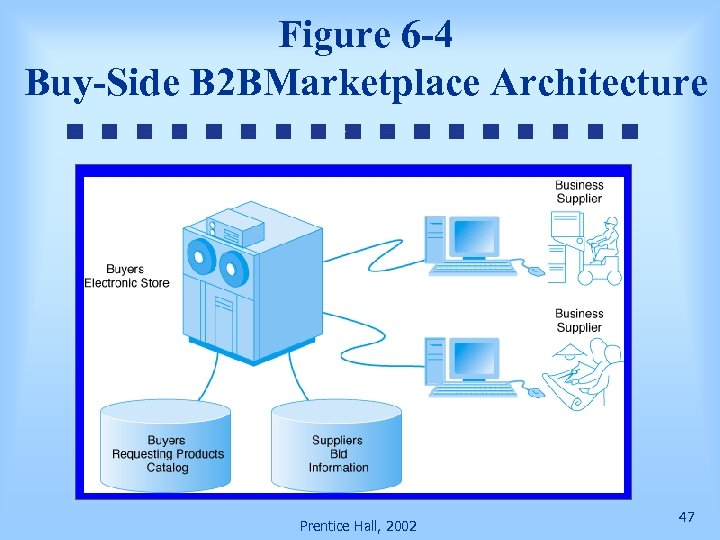
Figure 6 -4 Buy-Side B 2 BMarketplace Architecture Prentice Hall, 2002 47
Buy Side: One-from-Many, E-Procurement (cont. ) Direct vs. indirect sourcing Tools to automate purchasing goods Direct or mission critical 80% of manufacturer’s expenditure Long-term relationship with vendor of known quality goods Tight integration with suppliers along supply chain Indirect—use of public exchanges for indirect sourcing Prentice Hall, 2002 48
Buy Side: Reverse Auctions Pre-Internet Reverse auction process Prepare description of product to be produced Announce project via ads, mail, telephone Send detailed information to interested vendors Vendors prepare proposals Bidders submit document proposals Proposals evaluated Problems: Laws Expensive Errors Prentice Hall, 2002 49
Buy Side: Reverse Auctions (cont. ) Web-based reverse auction process Buyers prepare bidding project information Buyers post project on portal Identify potential suppliers Invite suppliers to bid Suppliers download project information Suppliers submit electronic bid Reverse auction in real-time, or it can take a few days Buyers evaluate and award contract Prentice Hall, 2002 50
Buy Side: Reverse Auctions (cont. ) Web-based reverse auction process Benefits: Electronic process is faster Administratively much less expensive Enables location of cheapest possible products Prentice Hall, 2002 51
Procurement Revolution at GE TPN at GE Lighting Division Purchasing was inefficient—too many administrative transactions Process for each requisition took 7 days Complex and time-consuming Could only send out bids for 2 or 3 suppliers Trading Process Network (TPN)—electronic bids Entire process takes 7 days (for suppliers to bid) 2 hours to send information to suppliers Evaluate and award bids same day Prentice Hall, 2002 52
Procurement Revolution at GE (cont. ) Benefits to GE Involvement in procurement process Labor declined 30% Material costs declined 5%-20%--wider base of suppliers online Redeployment 60% of the staff Sourcing department concentrates on strategic activities instead of paperwork, etc. Prentice Hall, 2002 53
Procurement Revolution at GE (cont. ) Benefits to GE Time to identify suppliers, prepare a request for bid, negotiate a price, and award the contract Was 18 -23 days Now 9 -11 days Invoices automatically reconciled reflecting modifications GE procurement departments share information about their best suppliers across the world Prentice Hall, 2002 54
Procurement Revolution at GE (cont. ) Benefits to buyers Worldwide supplier partnerships Current business partners Strengthen relationships Streamline sourcing process Rapid distribution of information Transmit electronic drawings to multiple suppliers Decrease sourcing cycle time Quick receipt and comparison of pricing bids Prentice Hall, 2002 55
Procurement Revolution at GE (cont. ) Benefits to suppliers Increased sales volume Expanded market reach, finding new buyers Lowered administration costs for sales and marketing activities Shortened requisition cycle time Improved sales staff productivity Streamlined bidding process Prentice Hall, 2002 56
Procurement Revolution at GE (cont. ) Deployment strategies Start EC in one division and slowly go to all divisions Use the site as public bidding marketplace to generate commission income to GE Prentice Hall, 2002 57
Aggregating Catalogs Aggregating suppliers’ catalogs: an internal marketplace Maverick buying to save time leads to high prices Aggregating all approved suppliers’ catalogs in one place Reduced number of suppliers Buyers at multiple corporate locations Fewer and remote suppliers Larger quantity/lower costs Prentice Hall, 2002 58
Group Purchasing Group purchasing—orders from several buyers are aggregated Internal aggregation Economy of scale Reduced transaction processing cost External aggregation Aggregating demand online Putting together orders from multiple buyers to make large volumes/lower costs Prentice Hall, 2002 59
Electronic Bartering Electronic bartering Exchange of goods or services without the use of money Exchange a surplus for other need Bartering exchange Submit surplus to exchange for points Points used to buy what company needs Benefits: Faster than manually Easier to match Prentice Hall, 2002 60
Collaborative Commerce (C-Commerce) Web-based systems used between and among suppliers for: Communication Design Planning Information sharing Information discovery Prentice Hall, 2002 61
Collaborative Commerce (C-Commerce) (cont. ) Webcore construction goes online with its partners Prentice Hall, 2002 62
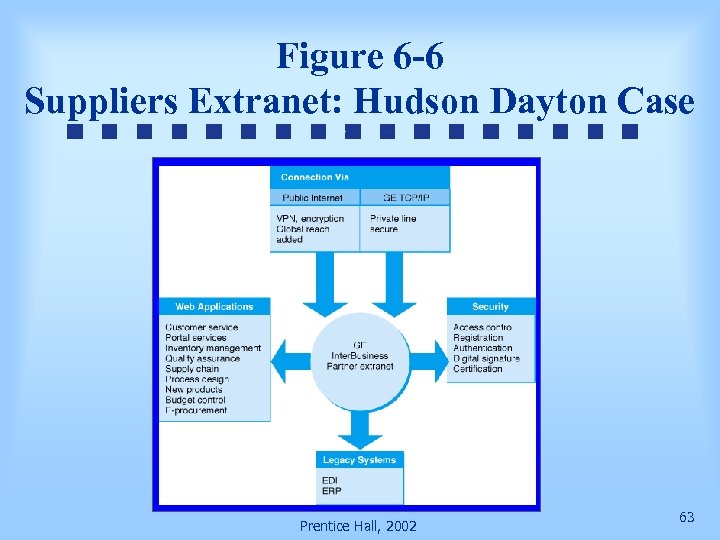
Figure 6 -6 Suppliers Extranet: Hudson Dayton Case Prentice Hall, 2002 63
Collaborative Commerce (C-Commerce) (cont. ) Reduce design cycle time by connecting suppliers: Adaptec, Inc. Microchip manufacturer supplying electronic equipment makers Outsources manufacturing tasks Delivery times exceeded their competitors Solution to the problem Extranet and enterprise-level supply chain integrated software Significantly reduced order-to-product delivery time Prentice Hall, 2002 64
Collaborative Commerce (C-Commerce) (cont. ) Reduce product development time by connecting suppliers: Caterpillar, Inc. Heavy machinery manufacturer uses extranet Request for customized component directly to designers and suppliers ship to buyers Connect engineering and manufacturing division with worldwide Suppliers Distributors Overseas Factories Customers Prentice Hall, 2002 65
Collaborative Commerce (C-Commerce) (cont. ) Other examples of c-commerce Tricon Restaurant International—global brand marketing management RE/MAX—real estate franchiser improved communication and collaboration between independent owners Marriott International—links corporations, franchising partners, suppliers, customers Nygard of Canada—interorganizational collaboration Prentice Hall, 2002 66
B 2 B Infrastructure Server to host database and applications Software for executing sell-side (catalogs) Software for conducting auctions and reverse auctions Software for e-procurement (buy-side) Prentice Hall, 2002 67
B 2 B Infrastructure (cont. ) Software for CRM Security hardware and software Software for building a storefront Telecommunications networks and protocols Prentice Hall, 2002 68
Extranet and EDI Secure interorganizational networks Traditional EDI limits accessibility of small companies Internet-based EDI offers wide accessibility to companies around the world Prentice Hall, 2002 69
Integration ERP software Customer, supplier, and other databases Legacy systems Catalog (product) information Inventory systems Sales statistics Decision support systems (DSS) and SCM applications Prentice Hall, 2002 70
Integration (cont. ) Integration with existing information systems Issues in integrating with back-end information systems: Intranet-based work flow Database management systems (DMBS) Application packages ERP Back-end sell-side integration works for sellers but not buyers and vice versa Prentice Hall, 2002 71
Integration (cont. ) Integration with business partners Easy integration with one company-centric side Not easy to integrate for many buyers or sellers Need buyer owned shopping cart that can interface with back-end information systems Prentice Hall, 2002 72
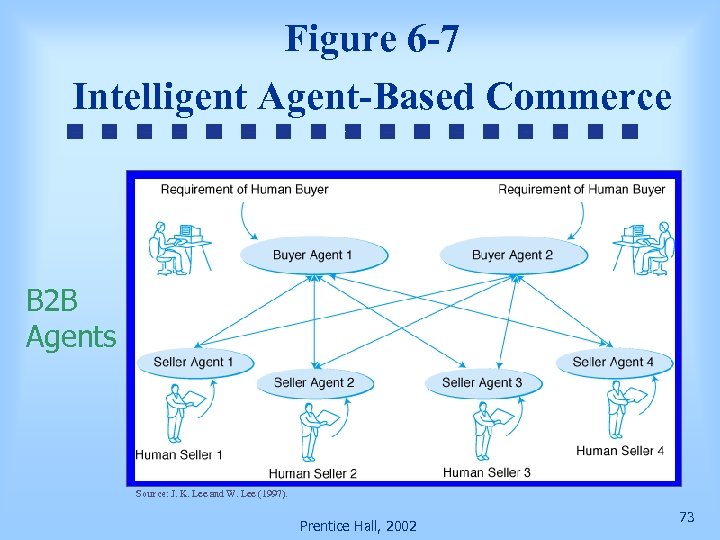
Figure 6 -7 Intelligent Agent-Based Commerce B 2 B Agents Source: J. K. Lee and W. Lee (1997). Prentice Hall, 2002 73
Implementation Issues Justification and prioritization Must conduct cost benefit analysis of proposed projects Include organizational impacts Possible channel conflicts Dealing with resistance to change due to processes reengineering Cost-benefit analysis related to: Finding B 2 B opportunities Prioritizing potential initiatives Prentice Hall, 2002 74
Implementation Issues (cont. ) Vendor selection Primary vendor uses its software and procedures, adds partners as needed Integrator mixes and matches existing products and vendors to create “best of the breed” Affiliate programs Referral program Useful for B 2 B intermediaries Prentice Hall, 2002 75
Implementation Issues (cont. ) Implementing e-procurement Fit e-procurement into EC strategy Review and change procurement process itself If ERP or SCM is in place—integrate e-procurement, If not in place—BPR before implementation Coordinate buyer’s information system with seller’s Prentice Hall, 2002 76
Managerial Issues B 2 B marketing—sell-side marketplaces require advertisement and incentives Which models to use and when—need for implementation strategies and prioritization Purchase process reengineering (BPR) Establish buy-side marketplace on its server if volume is big enough to attract major vendors Join third-party intermediary-oriented marketplace if volume is small Prentice Hall, 2002 77
Managerial Issues (cont. ) Integration—trading in e-marketplaces is interrelated with logistics Particularly true in many-to-many exchanges Company-centric marketplaces must integrate: Logistics Other support services Prentice Hall, 2002 78
Managerial Issues (cont. ) Business ethics Accessing unauthorized areas in the tracing system should not be allowed Privacy of partners should be protected technically and legally Auctions—both forward and reverse Benefits are substantial Implementation is relatively simple Considerable flexibility in implementation Prentice Hall, 2002 79
Managerial Issues (cont. ) E-procurement—critical success factors Need to cut down number of routine tasks Reduce overall procurement cycle using appropriate information technologies Workflow Groupware ERP software B 2 B models Prentice Hall, 2002 80
Скачать презентацию Chapter 6 Company-Centric B 2 B Prentice Hall
c7d1f9aea59122f900378a042f0704a6.ppt