 Скачать презентацию Chapter 6 Company-Centric B 2 B and E-Procurement
1fcb0183ebd6831b7c6c44ab19f15f43.ppt
- Количество слайдов: 97



Chapter 6 Company-Centric B 2 B and E-Procurement
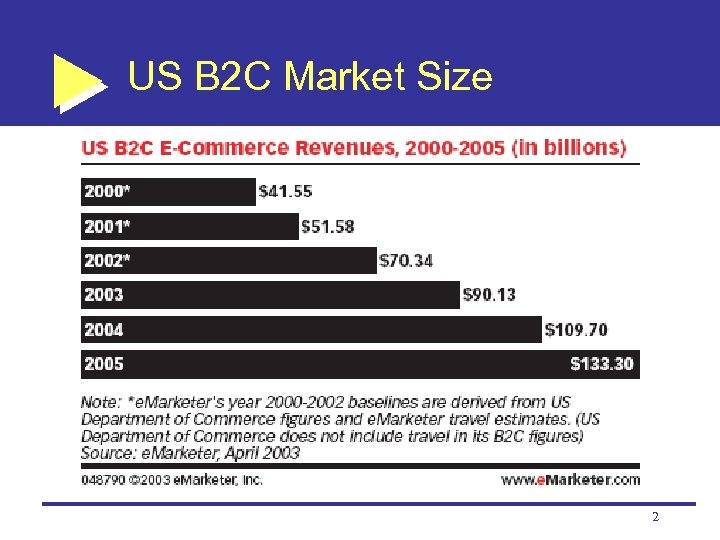
US B 2 C Market Size 2
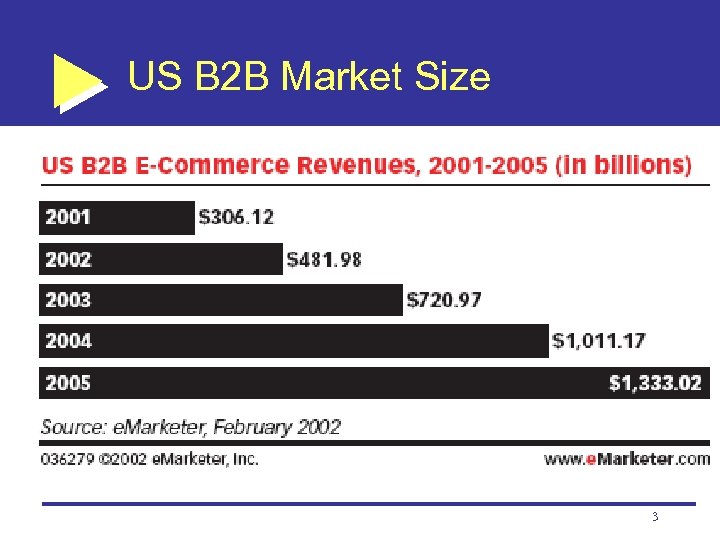
US B 2 B Market Size 3
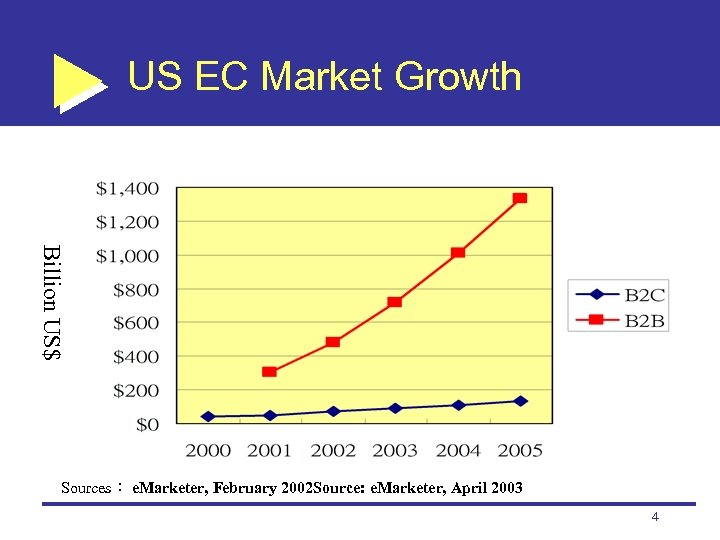
US EC Market Growth Billion US$ Sources: e. Marketer, February 2002 Source: e. Marketer, April 2003 4
General Motors’ B 2 B Initiatives The Problem Because the automotive industry is very competitive, GM is always looking for ways to improve its effectiveness GM expects to custom-build the majority of its cars by 2005 The company hopes to use the system to save billions of dollars by reducing its inventory of finished cars (why inventory? ? ) 5
General Motors’ B 2 B Initiatives (cont. ) GM sells custom-designed cars online through its dealers’ sites avoiding channel conflict (think about Dell vs. HP) This collaboration requires sharing information with dealers and suppliers Operational problems disposing of manufacturing machines that are no longer sufficiently productive procurement of commodity products 6
General Motors’ B 2 B Initiatives (cont. ) The Solution GM established an extranet infrastructure called ANX (Automotive Network e. Xchange) ANX has evolved into the consortium exchange covisint. com supported by other automakers 7
General Motors’ B 2 B Initiatives (cont. ) Capital assets problem GM implemented its own electronic market from which forward auctions are conducted Resource procurement problem GM automated the bidding process using reverse auctions on its e-procurement site 8
General Motors’ B 2 B Initiatives (cont. ) The Results Within just 89 minutes after the first forward auction opened, eight stamping presses were sold for $1. 8 million Off-line method, a similar item would have sold for less than half of its online price, and the process would have taken 4 to 6 weeks 9
General Motors’ B 2 B Initiatives (cont. ) Online reverse auction prices are significantly lower than the prices the company had been paying for the same items previously negotiated by manual tendering Administrative costs per order have been reduced by 40% Most GM dealers and thousands of GM’s suppliers are connected on a common extranet platform 10
General Motors’ B 2 B Initiatives (cont. ) What can we learn… Involvement of a large company in three EC activities: 1. connecting with dealers and suppliers through an extranet 2. electronically auctioning used equipment to customers 3. conducting purchasing via electronic bidding 11
General Motors’ B 2 B Initiatives (cont. ) B 2 B transactions Company can be a seller, offering goods or services to many corporate buyers Company can be a buyer, seeking goods or services from many corporate sellers (suppliers) A company can employ auctions use electronic catalogs use other market mechanisms 12
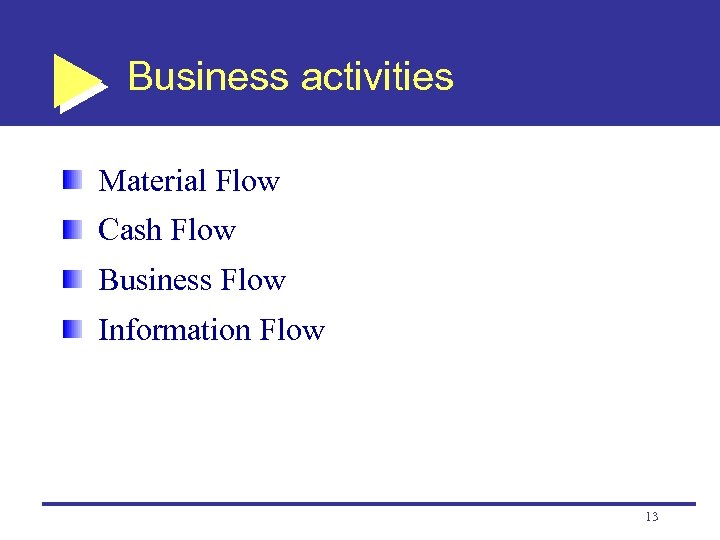
Business activities Material Flow Cash Flow Business Flow Information Flow 13
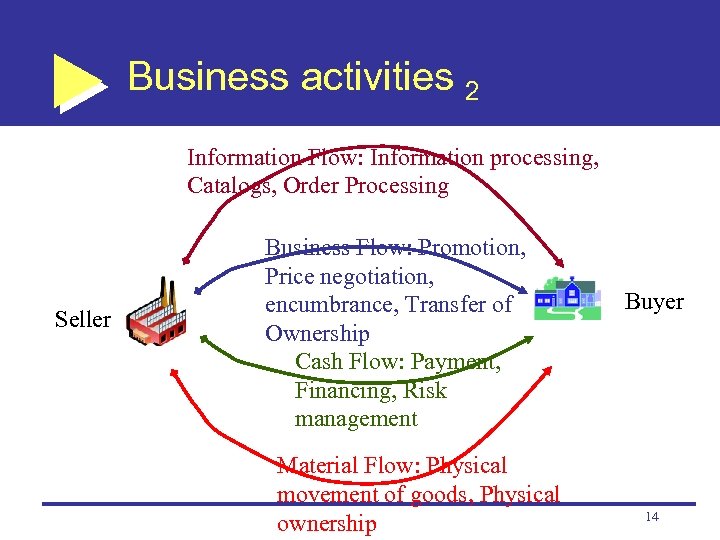
Business activities 2 Information Flow: Information processing, Catalogs, Order Processing Seller Business Flow: Promotion, Price negotiation, encumbrance, Transfer of Ownership Cash Flow: Payment, Financing, Risk management Material Flow: Physical movement of goods, Physical ownership Buyer 14
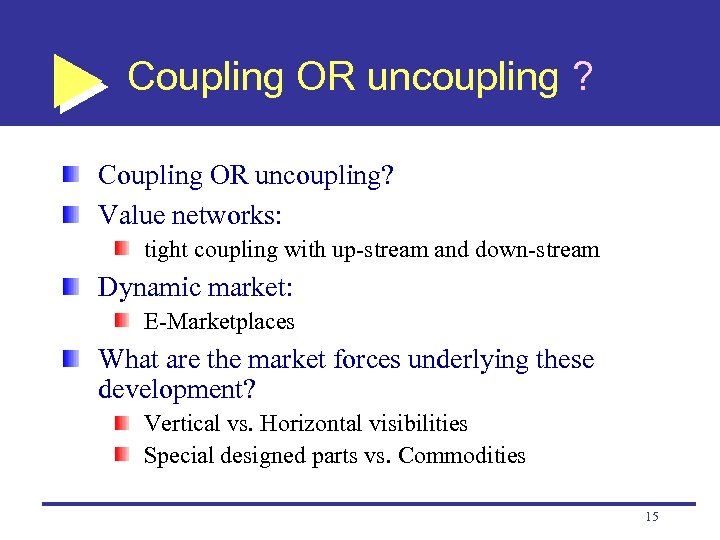
Coupling OR uncoupling ? Coupling OR uncoupling? Value networks: tight coupling with up-stream and down-stream Dynamic market: E-Marketplaces What are the market forces underlying these development? Vertical vs. Horizontal visibilities Special designed parts vs. Commodities 15
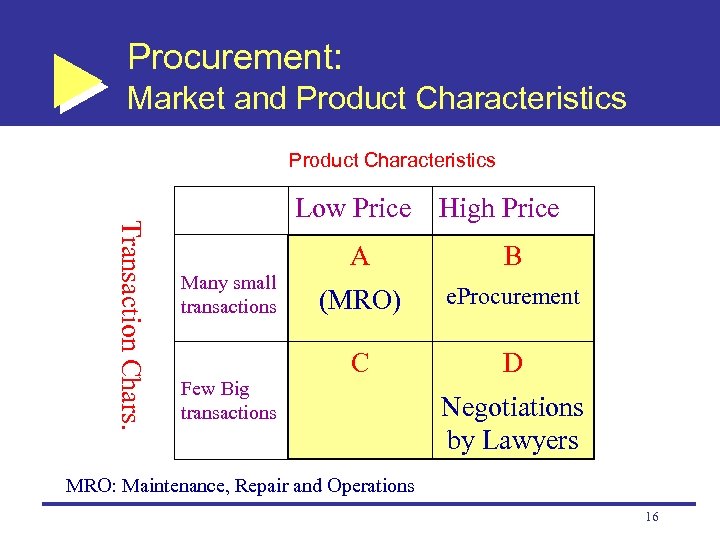
Procurement: Market and Product Characteristics Transaction Chars. Low Price Many small transactions Few Big transactions High Price A B (MRO) e. Procurement C D Negotiations by Lawyers MRO: Maintenance, Repair and Operations 16
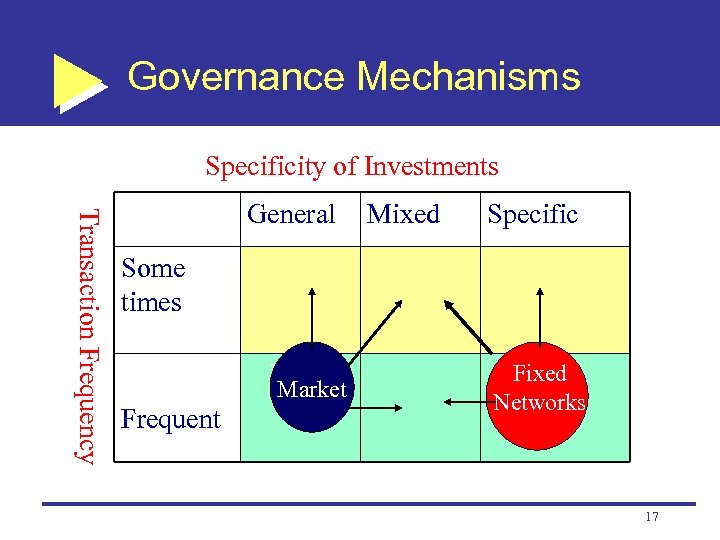
Governance Mechanisms Specificity of Investments Transaction Frequency General Mixed Specific Some times 市場 Market Frequent Fixed Networks 17
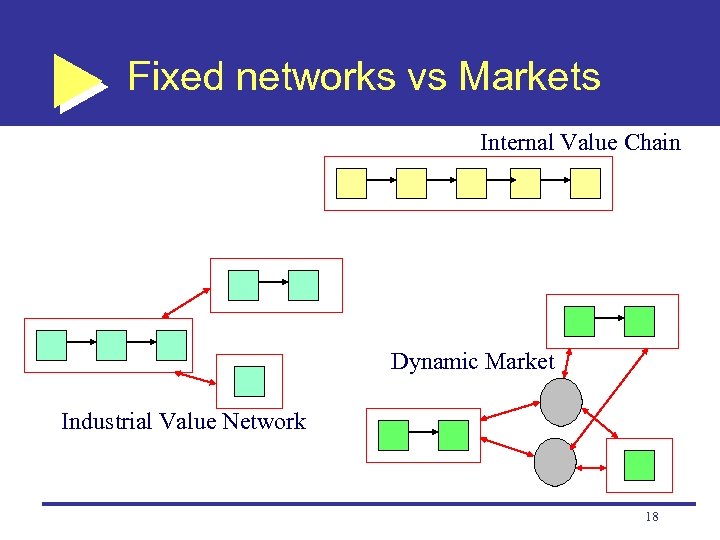
Fixed networks vs Markets Internal Value Chain Dynamic Market Industrial Value Network 18
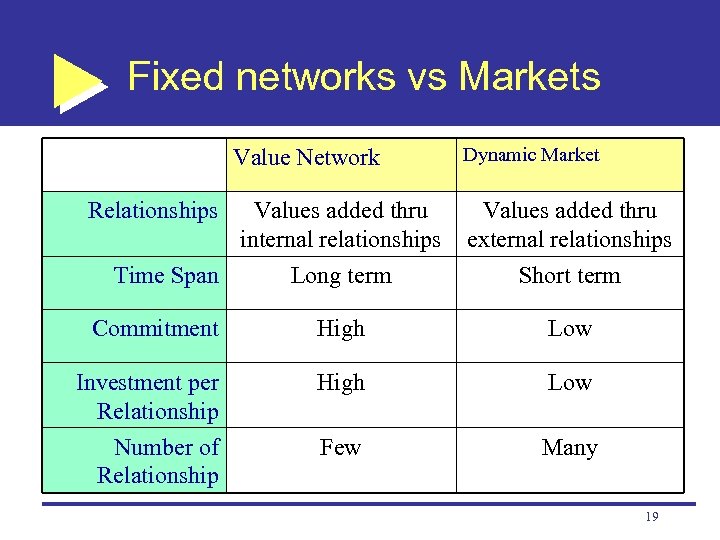
Fixed networks vs Markets Value Network Relationships Values added thru internal relationships Time Span Long term Dynamic Market Values added thru external relationships Short term Commitment High Low Investment per Relationship Number of Relationship High Low Few Many 19
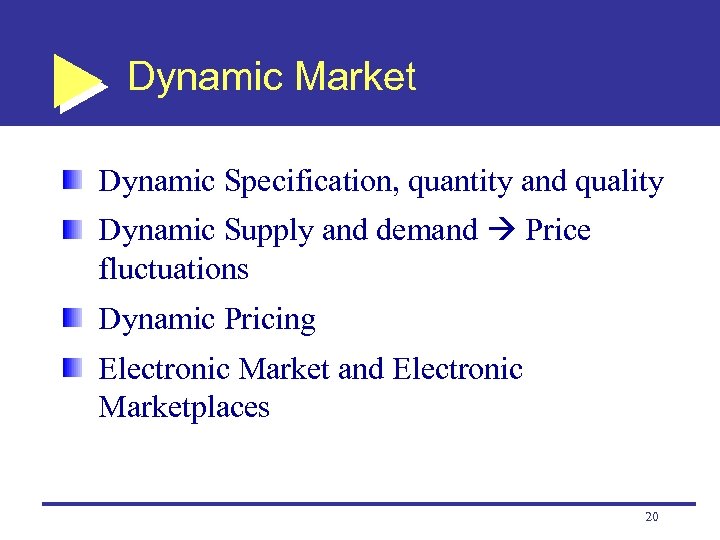
Dynamic Market Dynamic Specification, quantity and quality Dynamic Supply and demand Price fluctuations Dynamic Pricing Electronic Market and Electronic Marketplaces 20
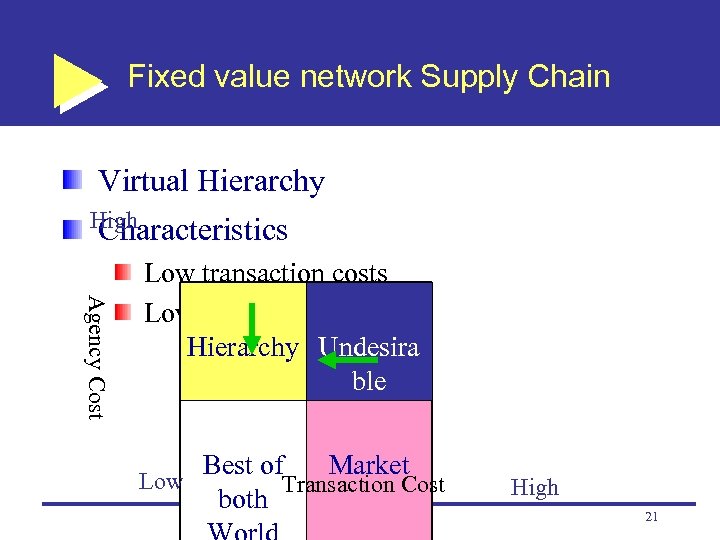
Fixed value network Supply Chain Virtual Hierarchy High Characteristics Agency Cost Low transaction costs Low agency costs Hierarchy Undesira ble Best of Market Low Transaction Cost both High 21
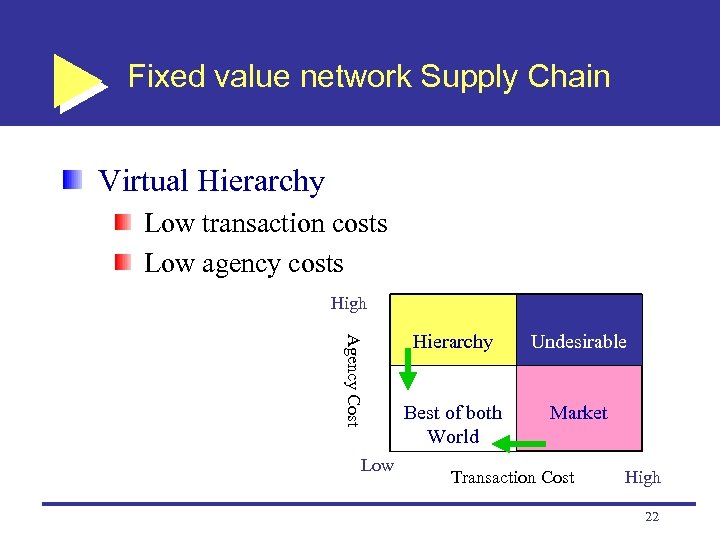
Fixed value network Supply Chain Virtual Hierarchy Low transaction costs Low agency costs High Agency Cost Low Hierarchy Undesirable Best of both World Market Transaction Cost High 22
This book treats B 2 B EC as e. Market. Places 23
Concepts, Characteristics, and Models of B 2 B EC Basic B 2 B concepts Business-to-business e-commerce (B 2 B EC): Transactions between businesses conducted electronically over the Internet, extranets, intranets, or private networks; also known as e. B 2 B (electronic B 2 B) or just B 2 B 24
Concepts, Characteristics, and Models of B 2 B EC (cont. ) B 2 B characteristics Parties to the transaction Online intermediary: An online third party that brokers a transaction online between a buyer and a seller; can be virtual or click-and-mortar 25
Concepts, Characteristics, and Models of B 2 B EC (cont. ) Types of transactions Spot buying: The purchase of goods and services as they are needed, usually at prevailing market prices Strategic sourcing: Purchases involving longterm contracts that are usually based on private negotiations between sellers and buyers 26
B 2 B Characteristics (cont. ) Types of materials Direct materials: Materials used in the production of a product (e. g. , steel in a car or paper in a book) Indirect materials: Materials used to support production (e. g. , office supplies or light bulbs) MROs (maintenance, repairs, and operations): Indirect materials used in activities that support production 27
Concepts, Characteristics, and Models of B 2 B EC (cont. ) Direction of trade Vertical marketplaces: Markets that deal with one industry or industry segment (e. g. , steel, chemicals) Horizontal marketplaces: Markets that concentrate on a service, material, or a product that is used in all types of industries (e. g. , office supplies, PCs) 28
Concepts, Characteristics, and Models of B 2 B EC (cont. ) Basic B 2 B transaction types Sell-side One seller to many buyers Buy-side One buyer from many sellers Exchanges Many sellers to many buyers Collaborative commerce Communication and sharing of information, design, and planning among business partners 29
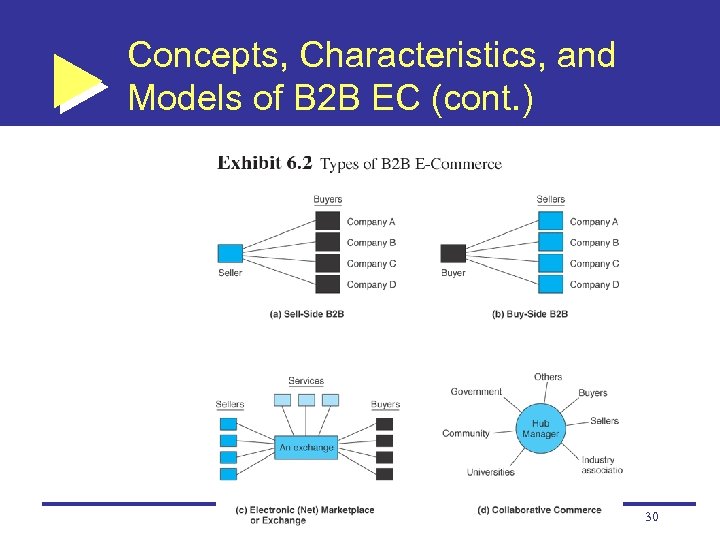
Concepts, Characteristics, and Models of B 2 B EC (cont. ) 30
Concepts, Characteristics, and Models of B 2 B EC (cont. ) One-to-many and many-to-one: company-centric transactions Company-centric EC: E-commerce that focuses on a single company’s buying needs (many-to-one, or buyside) or selling needs (one-to-many, or sell-side) Private e-marketplaces: Markets in which the individual sell-side or buy side company has complete control over participation in the selling or buying transaction 31
Concepts, Characteristics, and Models of B 2 B EC (cont. ) Many-to-many: exchanges Exchanges (trading communities or trading exchanges): Many-to-many e-marketplaces, usually owned and run by a third party or a consortium, in which many buyers and many sellers meet electronically to trade with each other; also called trading communities or trading exchanges Public e-marketplaces: Third-party exchanges that are open to all interested parties (sellers and buyers) 32
Concepts, Characteristics, and Models of B 2 B EC (cont. ) Collaborative commerce Communication, design, planning, and information sharing among business partners 33
Concepts, Characteristics, and Models of B 2 B EC (cont. ) Supply chain relationships in B 2 B Supply chain process consists of a number of interrelated subprocesses and roles acquisition of materials from suppliers processing of a product or service packaging it and moving it to distributors and retailers purchase of a product by the end consumer 34
Concepts, Characteristics, and Models of B 2 B EC (cont. ) B 2 B private e-marketplace provides a company with high supply chain power and high capabilities for online interactions Joining a public e-marketplace provides a business with high buying and selling capabilities, but will result in low supply chain power Companies that choose an intermediary to do their buying and selling will be low on both supply chain power and buying/selling capabilities 35
Concepts, Characteristics, and Models of B 2 B EC (cont. ) Virtual services industries in B 2 B Travel services Real estate Financial services Online stock trading Online financing Other online services 36
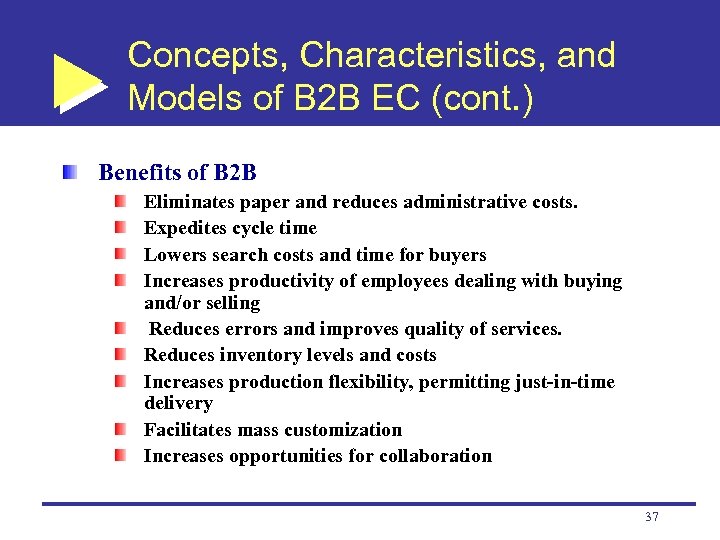
Concepts, Characteristics, and Models of B 2 B EC (cont. ) Benefits of B 2 B Eliminates paper and reduces administrative costs. Expedites cycle time Lowers search costs and time for buyers Increases productivity of employees dealing with buying and/or selling Reduces errors and improves quality of services. Reduces inventory levels and costs Increases production flexibility, permitting just-in-time delivery Facilitates mass customization Increases opportunities for collaboration 37
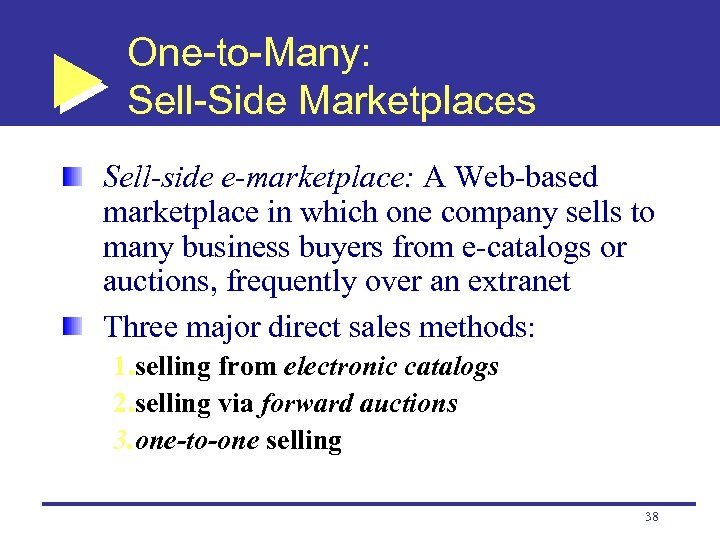
One-to-Many: Sell-Side Marketplaces Sell-side e-marketplace: A Web-based marketplace in which one company sells to many business buyers from e-catalogs or auctions, frequently over an extranet Three major direct sales methods: 1. selling from electronic catalogs 2. selling via forward auctions 3. one-to-one selling 38
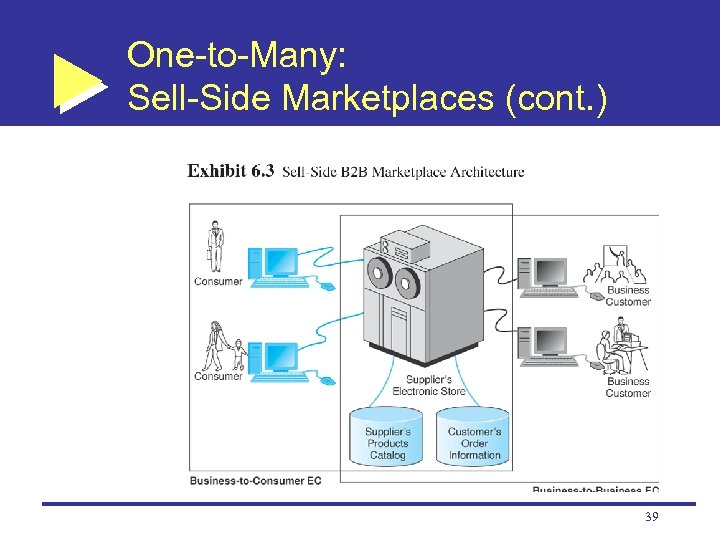
One-to-Many: Sell-Side Marketplaces (cont. ) 39
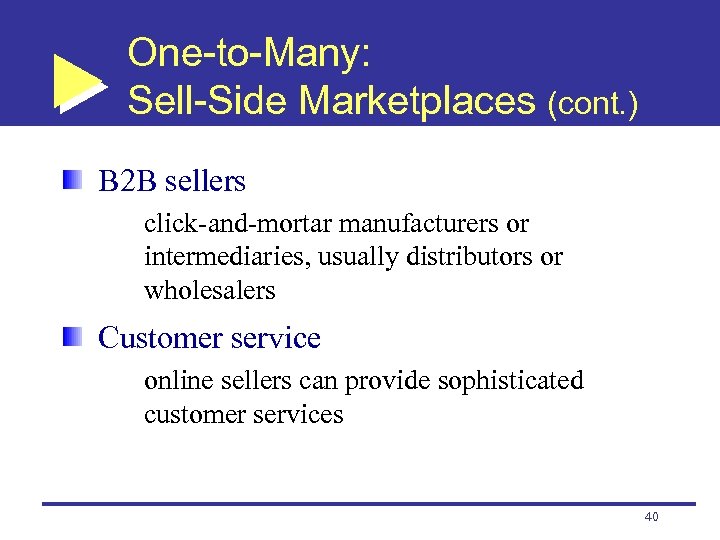
One-to-Many: Sell-Side Marketplaces (cont. ) B 2 B sellers click-and-mortar manufacturers or intermediaries, usually distributors or wholesalers Customer service online sellers can provide sophisticated customer services 40
One-to-Many: Sell-Side Marketplaces (cont. ) Configuration and customization customize products get price quotes submit orders 41
One-to-Many: Sell-Side Marketplaces (cont. ) Major benefits of direct sales are: Lower order-processing costs and less paperwork A faster ordering cycle Fewer errors in ordering and product configuration Lower search costs of products for buyers Lower search costs of finding buyers for sellers Sellers can advertise and communicate online Lower logistics costs Ability to offer different catalogs and prices to different customers 42
Selling via Auctions Using auctions on the sell side Revenue generation Cost savings Increased page views Member acquisition and retention 43
Selling via Auctions (cont. ) Selling from the company’s own site The company will have to pay for infrastructure and operate and maintain the auction site If then company already has an electronic marketplace for selling from e-catalogs, the additional cost may not be too high 44
Selling via Auctions (cont. ) Using intermediaries An intermediary may conduct private auctions for a seller, either from the intermediary’s or the seller’s site A company may choose to conduct auctions in a public marketplace, using a third-party hosting company 45
Using Intermediaries in Auctions (cont. ) Benefits of using intermediaries no additional resources are required auction set up to show the branding (company name) of the merchant rather than the intermediary’s name intermediary does the work of: q controlling data on Web traffic, page views, and member registration q setting all the auction parameters (transaction fee structure, user interface, and reports) q integrating the information flow and logistics 46
Sell-Side Cases Direct sales: Cisco Systems World’s leading producer of routers, switches, and network interconnection services Cisco’s portal began with technical support for customers and developed into one of the world’s largest direct sales EC sites 47
Sell-Side Cases (cont. ) Customer service Applications offered: q software downloads q defect tracking q technical advice 85% of customer service inquiries and 95% of software updates are delivered online Online ordering by customers Provides online pricing and configuration tools to customers 98% are now placed through Cisco Connection Online (CCO) Order status 48
Sell-Side Cases (cont. ) Benefits Reduced operating costs for order taking Enhanced technical support and customer service Reduced technical support staff cost Reduced software distribution costs Faster service 49
Sell-Side Cases (cont. ) Sales through an intermediary: Marshall Industries (now Avnet. com) large distributor of electronics components known for its innovative use of information technologies and the Web 50
Sell-Side Cases (cont. ) Marshall Industries EC initiatives Marshall. Net intranet that supports salespeople in the field via wireless devices and portable PCs Marshall on the Internet (portal) B 2 B portal for customers that offers information, ordering, and tracking capabilities Strategic European Internet strategic partner in Europe that offers Marshall. Net in 17 languages 51
Sell-Side Cases (cont. ) Marshal Industries Electronic Design Center online configuration tool; provides technical specifications; offers simulation capabilities for making virtual components Partner. Net customized Web pages for major customers and suppliers Net. Seminar Education and News Portal online training tool; brings suppliers and customers together for live interactions 52
Sell-Side Cases (cont. ) B 2 B intermediary: Boeing’s parts marketplace World’s largest maker of airplanes for commercial and military customers Major goal of Boeing’s intermediary parts market, called PART is supporting customers’ maintenance needs as a customer service 53
Sell-Side Cases (cont. ) Online strategy is to provide a single point of online access through which airlines (buyers) and the maintenance and parts providers (suppliers) can access data about the parts they need Began using traditional EDI 54
Sell-Side Cases (cont. ) 1996, Boeing introduced its PART page on the Internet Customers around the world could check parts availability and pricing order parts track order status Less than a year later, about 50 percent of Boeing’s customers used PART for parts orders and customer service inquiries 55
Sell-Side Cases (cont. ) Boeing On. Line Data (BOLD) enables mechanics and technicians at the airport to access the technical manuals they need for repairs These manuals are now available in digital form, and mechanics and technicians can access them via wireline or wireless devices 56
One-from-Many: Buy-Side Marketplaces and E-Procurement Buy-side e-marketplace: A corporate-based acquisition site that uses reverse auctions, negotiations, group purchasing, or any other e-procurement method 57
One-from-Many: Buy-Side Marketplaces and E-Procurement (cont. ) Procurement methods Buy from manufacturers, wholesalers, or retailers from their catalogs, and possibly by negotiation Buy from the catalog of an intermediary that aggregates sellers’ catalogs or buy at industrial malls Buy from an internal buyer’s catalog in which company-approved vendors’ catalogs, including agreed upon prices, are aggregated 58
One-from-Many: Buy-Side Marketplaces and E-Procurement (cont. ) Conduct bidding or tendering (a reverse auction) in a system where suppliers compete against each other Buy at private or public auction sites in which the organization participates as one of the buyers Join a group-purchasing system that aggregates participants’ demand, creating a large volume Collaborate with suppliers to share information about sales and inventory, so as to reduce inventory and stock-outs and enhance just-in-time delivery 59
One-from-Many: Buy-Side Marketplaces and E-Procurement (cont. ) Inefficiencies in traditional procurement management Procurement management: The coordination of all the activities relating to purchasing goods and services needed to accomplish the mission of an organization Maverick buying: Unplanned purchases of items needed quickly, often at non-prenegotiated, higher prices 60
One-from-Many: Buy-Side Marketplaces and E-Procurement (cont. ) e-procurement: The electronic acquisition of goods and services for organizations 61
Benefits of E-Procurement Benefits of e-procurement Increasing the productivity of purchasing agents Lowering purchase prices through product standardization and consolidation of purchases Improving information flow and management 62
Benefits of E-Procurement (cont. ) Minimizing the purchases made from noncontract vendors. Improving the payment process Establishing efficient, collaborative supplier relations Ensuring delivery on time, every time Reducing the skill requirements and training needs of purchasing agents Reducing the number of suppliers Streamlining the purchasing process, making it simple and fast 63
Benefits of E-Procurement (cont. ) Reducing the administrative processing cost per order Improved sourcing Integrating the procurement process with budgetary control in an efficient and effective way Minimizing human errors in the buying or shipping process Monitoring and regulating buying behavior 64
Implementing E-Procurement Implementing e-procurement—major eprocurement implementation issues Fitting e-procurement into the company EC strategy Reviewing and changing the procurement process itself Providing interfaces between e-procurement with integrated enterprisewide information systems such as ERP or supply chain management (SCM) 65
Implementing E-Procurement (cont. ) Coordinating the buyer’s information system with that of the sellers; sellers have many potential buyers Consolidating the number of regular suppliers to a minimum and assuring integration with their information systems, and if possible with their business processes 66
Buy-Side E-Marketplaces: Reverse Auctions One of the major methods of eprocurement is through reverse auctions (tendering or bidding model) request for quote (RFQ): The “invitation” to participate in a tendering (bidding) system The reverse auction method is the most common model for large MRO purchases as it provides considerable savings 67
Reverse Auctions (cont. ) Conducting reverse auctions Thousands of companies use the reverse auction model They may be administered from a company’s Web site or from an intermediary’s site The bidding process may last a day or more Bidders may bid only once, but bidders can usually view the lowest bid and rebid several times 68
Reverse Auctions A Pioneer: General Electric’s TPN Procurement revolution at GE—Trading Process Network (TPN) Post With this online system, the sourcing department received the requisitions electronically from its internal customers and sent off a bid package to suppliers around the world via the Internet The system automatically pulled the correct drawings and attached them to the electronic requisition forms 69
Reverse Auctions A Pioneer: General Electric’s TPN (cont. ) Benefits of TPN labor involved in the procurement process declined by 30% cut by 50% staff involved in the procurement process and redeployed those workers into other jobs reduced the number of days to complete a contract by half invoices were automatically reconciled with purchase orders procurement departments around the world were able to share information about their best suppliers 70
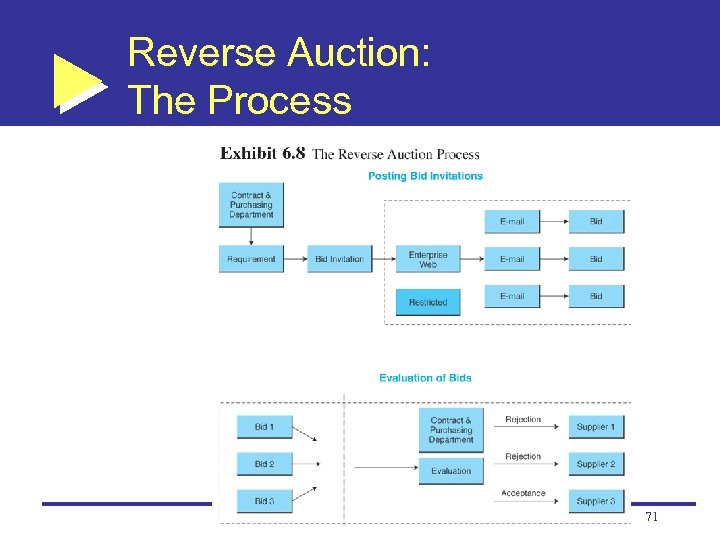
Reverse Auction: The Process 71
Reverse Auctions A Pioneer: General Electric’s TPN (cont. ) GXS Express Marketplaces is an expanded system that makes it a public posting place for other buyers Suppliers gain instant access to global buyers Dramatically improve the productivity of their bidding and sales activities Increased sales volume Expanded market reach and ability to find new buyers Lower administration costs Shorter requisition cycle time Improved sales staff productivity Streamlined bidding process 72
Other E-Procurement Methods Internal marketplace: The aggregated catalogs of all approved suppliers combined into a single internal electronic catalog 73
Internal Marketplace (cont. ) Benefits of internal marketplaces corporate buyers quickly find what they want, check availability and delivery times, and complete an electronic requisition form reduce number of regular suppliers easy financial controls 74
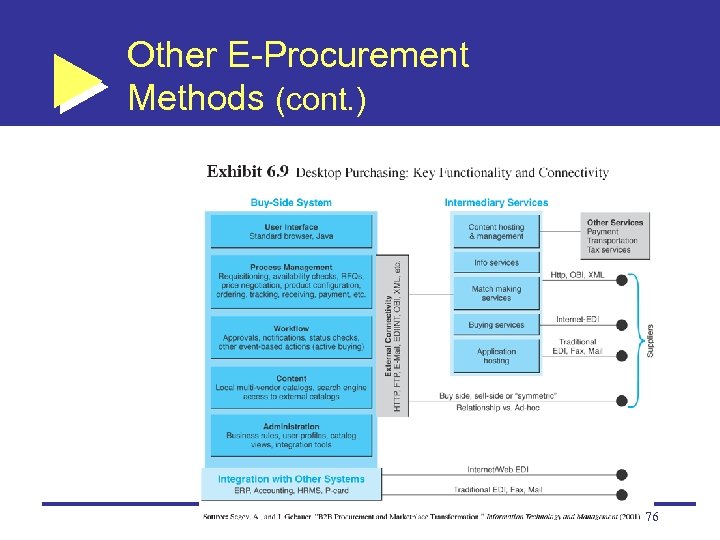
Internal Marketplace: Desktop Purchasing Desktop purchasing: Direct purchasing from internal marketplaces without the approval of supervisors and without intervention of a procurement department Desktop purchasing systems: Software that automates and supports purchasing operations for nonpurchasing professionals and casual end users 75
Other E-Procurement Methods (cont. ) 76
Other E-Procurement Methods (cont. ) Industrial malls Distributors that aggregate products from hundreds or thousands of suppliers in one place Horizontal—carrying MRO (nonproduction) materials for use in a variety of industries Vertical—carrying products used by one industry but at various segments of the supply chain 77
Other E-Procurement Methods (cont. ) E-auctions sellers are increasingly motivated to sell surpluses and even regular products via auctions e-auctions provide an opportunity to buyers to find inexpensive or unique items fairly quickly 78
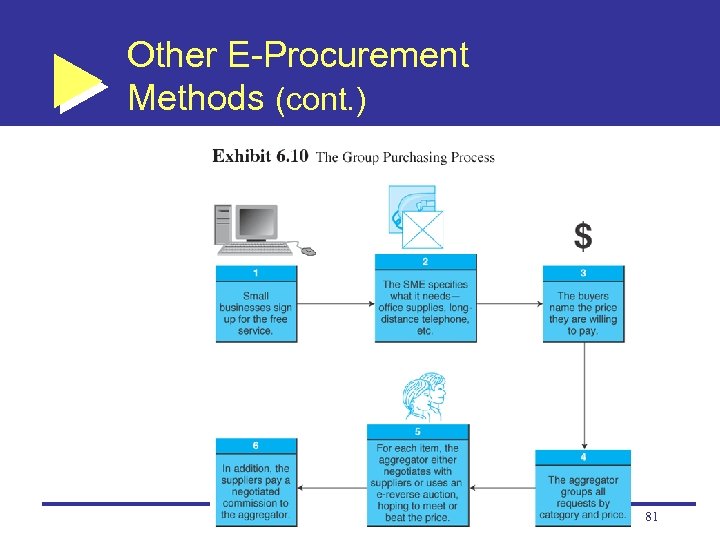
Other E-Procurement Methods (cont. ) Group purchasing: The aggregation of orders from several buyers into volume purchases so that better prices can be negotiated 79
Other E-Procurement Methods (cont. ) Internal aggregation—companywide orders are aggregated using the Web and replenished automatically External aggregation—provide SMEs with better prices, selection, and services by aggregating demand online and then either negotiating with suppliers or conducting reverse auctions 80
Other E-Procurement Methods (cont. ) 81
Other E-Procurement Methods (cont. ) Purchasing direct goods E-purchasing direct goods allows buyers to: get them faster reduce the unit cost reduce inventories avoid shortages of materials expedite their own production processes 82
Other E-Procurement Methods (cont. ) Electronic bartering Bartering exchange: An intermediary that links parties in a barter; a company submits surplus to the exchange and receives points of credit, which can be used to buy the items that the company needs from other exchange participants 83
Infrastructure for B 2 B Major infrastructures needed for B 2 B marketplaces Telecommunications networks and protocols Server(s) for hosting the databases and the applications Software for various activities for executing the sell-side activities, buy-side activities, PRM, and building a storefront Security for hardware and software 84
Other E-Procurement Methods (cont. ) Electronic data interchange (EDI): The electronic transfer of specially formatted standard business documents, such as bills, orders, and confirmations sent between business partners 85
Other E-Procurement Methods (cont. ) Value-added networks (VANs): Private, third-party managed networks that add communications services and security to existing common carriers; used to implement traditional EDI systems 86
Other E-Procurement Methods (cont. ) Internet-based (Web) EDI: EDI that runs on the Internet and is widely accessible to most companies, including SMEs 87
Other E-Procurement Methods (cont. ) Integration with existing internal infrastructure and applications EC applications of any kind need to be connected to the existing internal information systems Integration with business partners EC can be integrated more easily with internal systems than with external ones 88
Other E-Procurement Methods (cont. ) The role of standards and XML in B 2 B integration XML (e. Xtensible Markup Language): Standard (and its variants) used to improve compatibility between the disparate systems of business partners by defining the meaning of data in business documents 89
Other E-Procurement Methods (cont. ) XML can overcome EDI barriers for three reasons: 1. XML is a flexible language, therefore it expands the rigid ranges of EDI 2. Message content can be easily read and understood by people using standard browsers 3. XML-based technologies require lessspecialized skills 90
Other E-Procurement Methods (cont. ) Web services: An architecture enabling assembly of distributed applications from software services and tying them together 91
Managerial Issues 1. Can we justify the cost of B 2 B applications? 2. Which vendor(s) should we select? 3. Which B 2 B model(s) should we use? 4. Should we restructure our procurement system? 92
Managerial Issues (cont. ) 5. What restructuring will be required for the shift to e-procurement? 6. What integration would be useful? 7. What are the ethical issues in B 2 B? 8. Will there be massive disintermediation? 93
Summary 1. The B 2 B field: EC activities between businesses 2. The major B 2 B models: sell-side; buyside; trade exchanges; collaborative commerce 3. The characteristics of sell-side marketplaces: online direct sale by one seller to many buyers 94
Summary (cont. ) 4. Sell-side intermediaries: provide valueadded services to manufacturers and business customers 5. The characteristics of buy-side marketplaces and e-procurement: expedite purchasing, save on item and administrative costs, and gain better control over the purchasing process. 95
Summary (cont. ) 6. B 2 B reverse auctions: tendering system used by buyers to collect bids electronically from suppliers 7. B 2 B aggregation and group purchasing: increasing the exposure and the bargaining power of companies can be done by aggregating either the buyers or the sellers. 96
Summary (cont. ) 8. Infrastructure and standards in B 2 B: networks and protocols, multiple servers, application software, and security. 9. Web-based EDI, XML, and Web services: connectivity of B 2 B is facilitated by Web services. 97
Скачать презентацию Chapter 6 Company-Centric B 2 B and E-Procurement
1fcb0183ebd6831b7c6c44ab19f15f43.ppt