 Скачать презентацию Chapter 6 Business-to-Business Electronic Commerce Prentice Hall
107558a24d2fd3930ba93a53aa2e1d1b.ppt
- Количество слайдов: 43



Chapter 6 Business-to-Business Electronic Commerce © Prentice Hall, 2000 1
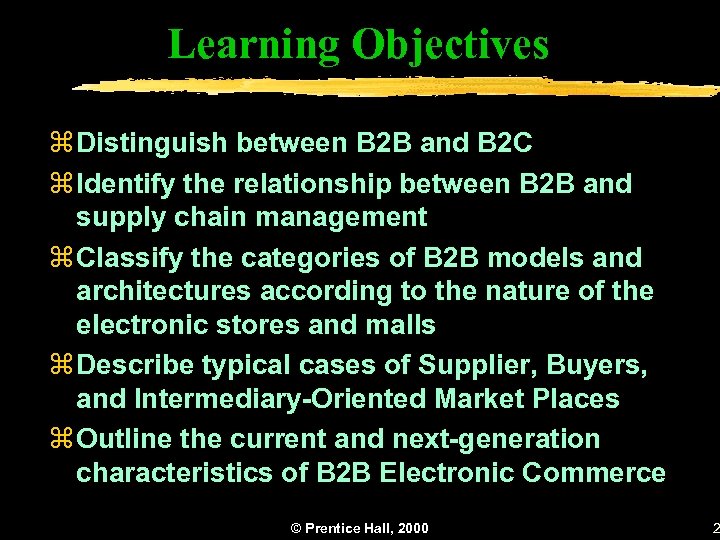
Learning Objectives z Distinguish between B 2 B and B 2 C z Identify the relationship between B 2 B and supply chain management z Classify the categories of B 2 B models and architectures according to the nature of the electronic stores and malls z Describe typical cases of Supplier, Buyers, and Intermediary-Oriented Market Places z Outline the current and next-generation characteristics of B 2 B Electronic Commerce © Prentice Hall, 2000 2
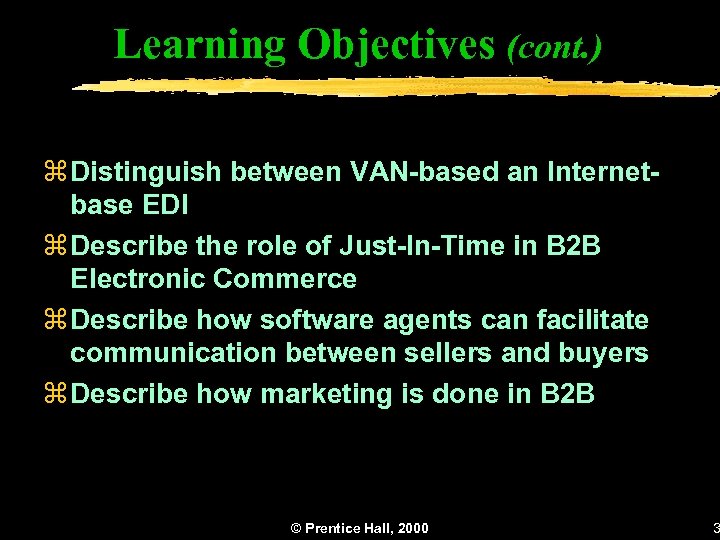
Learning Objectives (cont. ) z Distinguish between VAN-based an Internetbase EDI z Describe the role of Just-In-Time in B 2 B Electronic Commerce z Describe how software agents can facilitate communication between sellers and buyers z Describe how marketing is done in B 2 B © Prentice Hall, 2000 3
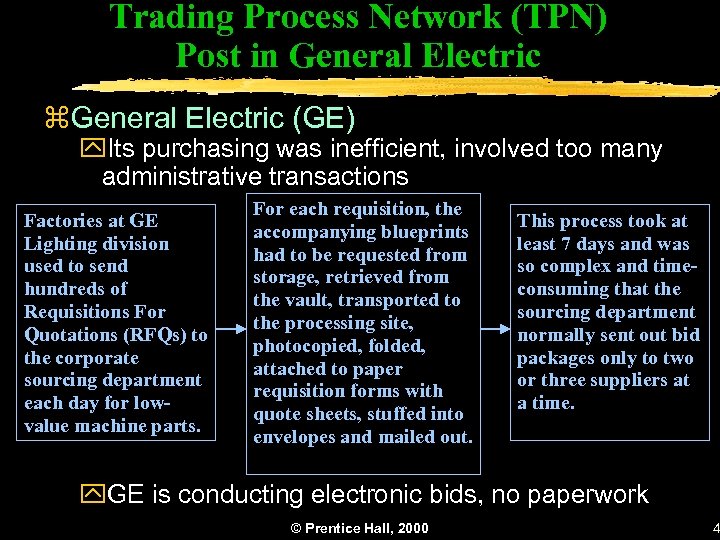
Trading Process Network (TPN) Post in General Electric z. General Electric (GE) y. Its purchasing was inefficient, involved too many administrative transactions Factories at GE Lighting division used to send hundreds of Requisitions For Quotations (RFQs) to the corporate sourcing department each day for lowvalue machine parts. For each requisition, the accompanying blueprints had to be requested from storage, retrieved from the vault, transported to the processing site, photocopied, folded, attached to paper requisition forms with quote sheets, stuffed into envelopes and mailed out. This process took at least 7 days and was so complex and timeconsuming that the sourcing department normally sent out bid packages only to two or three suppliers at a time. y. GE is conducting electronic bids, no paperwork © Prentice Hall, 2000 4
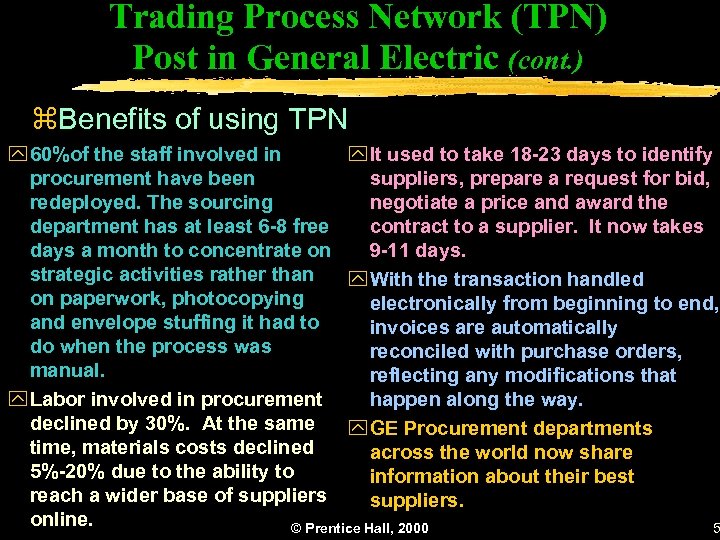
Trading Process Network (TPN) Post in General Electric (cont. ) z. Benefits of using TPN y 60%of the staff involved in y It used to take 18 -23 days to identify procurement have been suppliers, prepare a request for bid, redeployed. The sourcing negotiate a price and award the department has at least 6 -8 free contract to a supplier. It now takes days a month to concentrate on 9 -11 days. strategic activities rather than y With the transaction handled on paperwork, photocopying electronically from beginning to end, and envelope stuffing it had to invoices are automatically do when the process was reconciled with purchase orders, manual. reflecting any modifications that y Labor involved in procurement happen along the way. declined by 30%. At the same y GE Procurement departments time, materials costs declined across the world now share 5%-20% due to the ability to information about their best reach a wider base of suppliers. online. © Prentice Hall, 2000 5
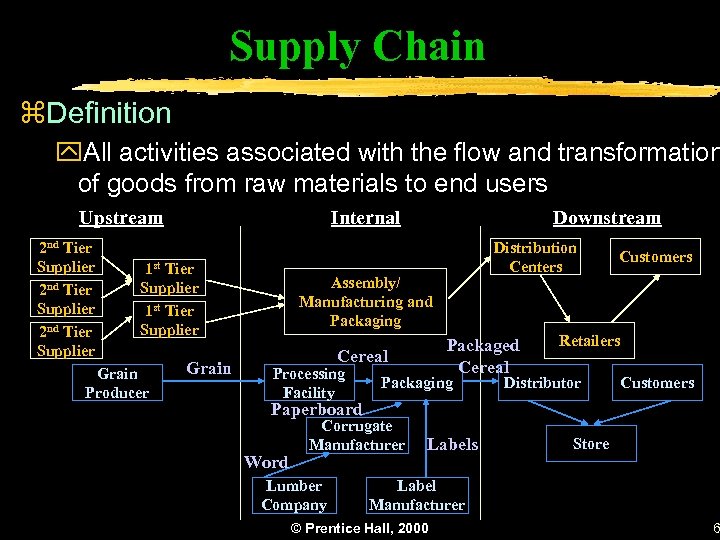
Supply Chain z. Definition y. All activities associated with the flow and transformation of goods from raw materials to end users Upstream 2 nd Tier Supplier Internal 1 st Tier Supplier Grain Producer Grain Downstream Distribution Centers Assembly/ Manufacturing and Packaging Packaged Cereal Processing Facility Packaging Customers Retailers Distributor Customers Paperboard Word Corrugate Manufacturer Lumber Company Labels Store Label Manufacturer © Prentice Hall, 2000 6
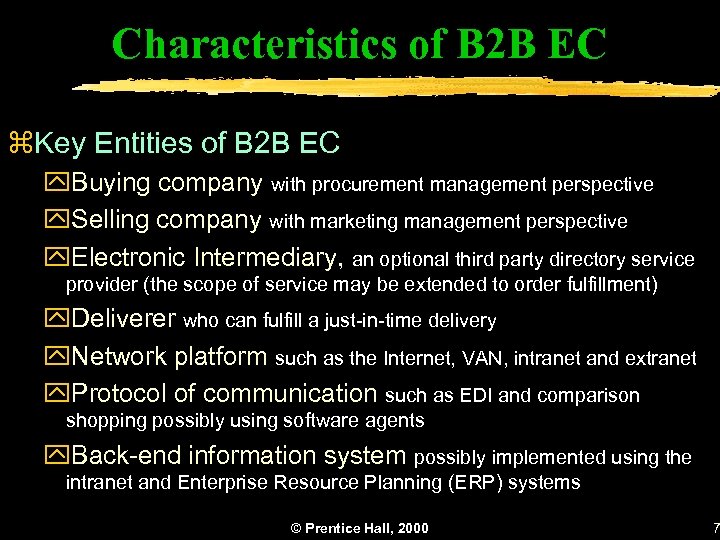
Characteristics of B 2 B EC z. Key Entities of B 2 B EC y. Buying company with procurement management perspective y. Selling company with marketing management perspective y. Electronic Intermediary, an optional third party directory service provider (the scope of service may be extended to order fulfillment) y. Deliverer who can fulfill a just-in-time delivery y. Network platform such as the Internet, VAN, intranet and extranet y. Protocol of communication such as EDI and comparison shopping possibly using software agents y. Back-end information system possibly implemented using the intranet and Enterprise Resource Planning (ERP) systems © Prentice Hall, 2000 7
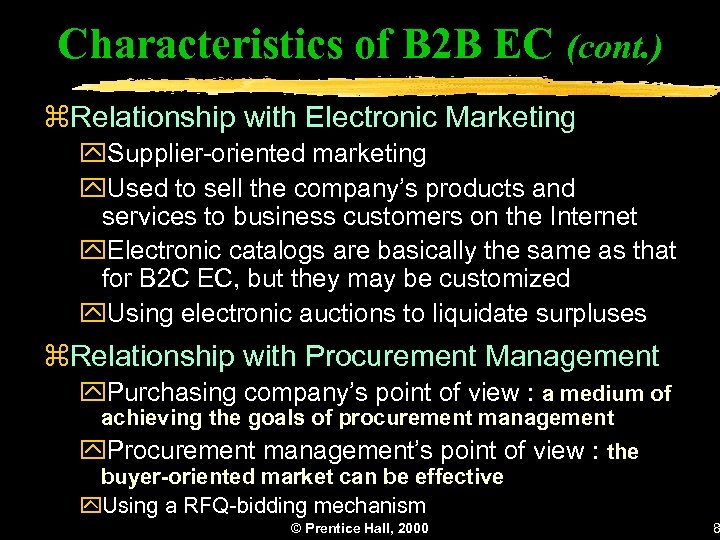
Characteristics of B 2 B EC (cont. ) z. Relationship with Electronic Marketing y. Supplier-oriented marketing y. Used to sell the company’s products and services to business customers on the Internet y. Electronic catalogs are basically the same as that for B 2 C EC, but they may be customized y. Using electronic auctions to liquidate surpluses z. Relationship with Procurement Management y. Purchasing company’s point of view : a medium of achieving the goals of procurement management y. Procurement management’s point of view : the buyer-oriented market can be effective y. Using a RFQ-bidding mechanism © Prentice Hall, 2000 8
Characteristics of B 2 B EC (cont. ) z. Relationship with Electronic Intermediaries y. Similar to the B 2 B electronic intermediaries, but the customers are businesses y. Also, special intermediaries for matching buyers and sellers, bartering etc. z. Relationship with intranet are very important z. Relationship with extranets y. A dedicated network between business partners or a secured public network like the Internet y. Implementing a virtually private network (VPN) to improve internet security © Prentice Hall, 2000 9
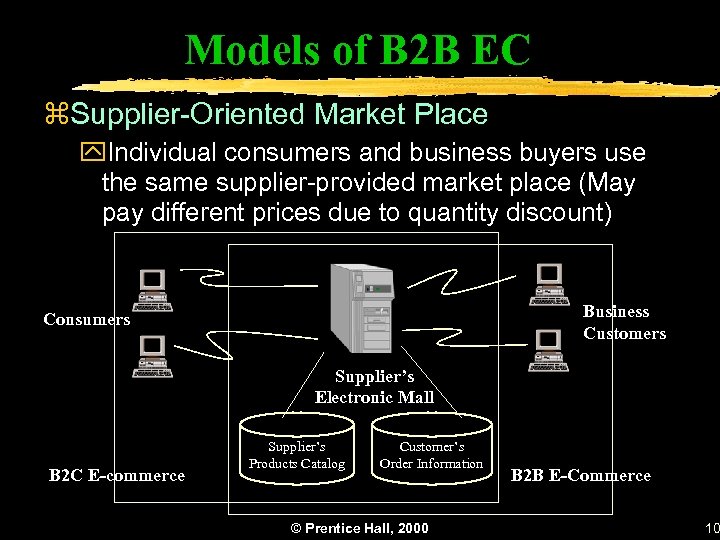
Models of B 2 B EC z. Supplier-Oriented Market Place y. Individual consumers and business buyers use the same supplier-provided market place (May pay different prices due to quantity discount) Business Customers Consumers Supplier’s Electronic Mall B 2 C E-commerce Supplier’s Products Catalog Customer’s Order Information © Prentice Hall, 2000 B 2 B E-Commerce 10
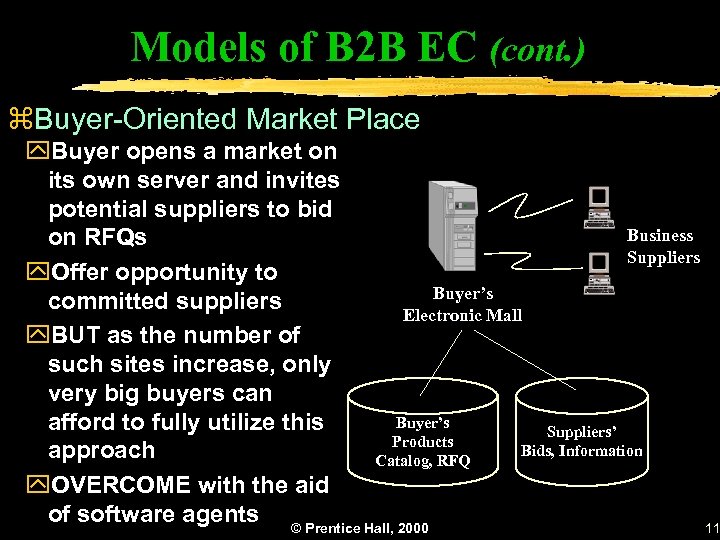
Models of B 2 B EC (cont. ) z. Buyer-Oriented Market Place y. Buyer opens a market on its own server and invites potential suppliers to bid Business on RFQs Suppliers y. Offer opportunity to Buyer’s committed suppliers Electronic Mall y. BUT as the number of such sites increase, only very big buyers can Buyer’s afford to fully utilize this Suppliers’ Products Bids, Information approach Catalog, RFQ y. OVERCOME with the aid of software agents © Prentice Hall, 2000 11
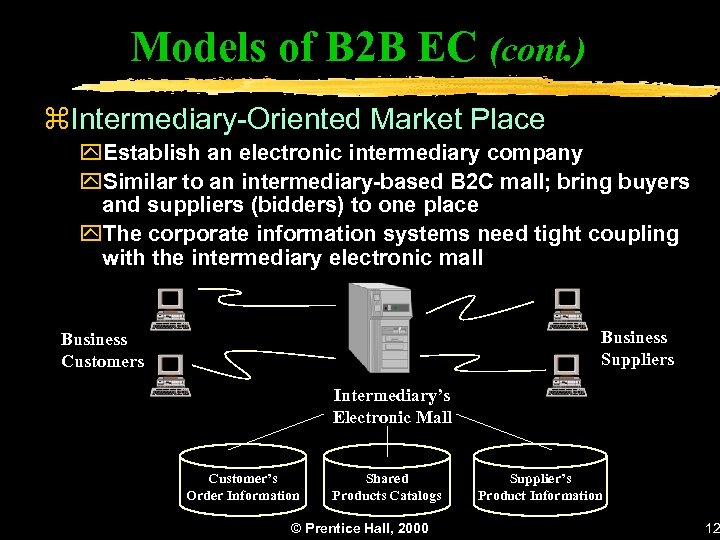
Models of B 2 B EC (cont. ) z. Intermediary-Oriented Market Place y. Establish an electronic intermediary company y. Similar to an intermediary-based B 2 C mall; bring buyers and suppliers (bidders) to one place y. The corporate information systems need tight coupling with the intermediary electronic mall Business Suppliers Business Customers Intermediary’s Electronic Mall Customer’s Order Information Shared Products Catalogs © Prentice Hall, 2000 Supplier’s Product Information 12
Procurement Management Using B 2 B EC Platform z Purchasing is now a strategic function, to increase profit margins z By automating and streamlining the laborious routine of the purchasing function, purchasing professionals can focus on more strategic purchases, achieving the following goals: y. Reducing purchasing cycle time and cost y. Enhancing budgetary control y. Eliminating administrative errors y. Increasing buyers’ productivity y. Lowering prices through product standardization and consolidation of purchases y. Better information management; e. g. supplier’s information and pricing information y. Improving the payment process © Prentice Hall, 2000 13
Case Study of Supplier-Oriented Market Place: CISCO Connection Online z. Customer Service— Cisco Connection online z. Online Ordering— Internet Product Center builds virtually all its products to order z. Finding Order Status— gives the customers tools to find answers to order status inquiries by themselves z. Benefits— save the company $363 million per year from technical support, human resources, software distribution and marketing material z. The Future— expect online sales to grow more than 60% of total volume in 1999 © Prentice Hall, 2000 14
Case Study of Customer-Oriented Market Place: GE’s TPN Post z Provides a chance for sellers to participate in the bidding process of GE using the following procedure: y. Buyers prepare bidding project information y. Buyers post the bidding projects on the Internet y. Buyers identify potential suppliers y. Buyers invite suppliers to bid on projects y. Suppliers download the project information from the Internet y. Suppliers electronically submit bids for projects y. Buyers evaluate the suppliers’ bids and negotiate online to achieve the ‘best deal’ y. Buyers accept the bid that best meets their requirements © Prentice Hall, 2000 15
Case Study of Customer-Oriented Market Place: GE’s TPN Post (cont. ) z. The benefits of joining GE TPN Post y. As buyers y. As Sellers x. Identify and build partnerships with new suppliers worldwide x. Strengthen relationships and streamline sourcing processes with current business partners x. Rapidly distribute information and specifications to business partners x. Transmit electronic drawings to multiple suppliers simultaneously x. Cut sourcing cycle times and reduce costs for sourced goods x. Quickly receive and compare bids from large number of suppliers to negotiate better prices © Prentice Hall, 2000 x. Boost Sales x. Expand market reach x. Cut costs for sales and marketing activities x. Shorten the selling cycle x. Improve sales productivity x. Streamline the bidding process 16
Case Study of Intermediary-Oriented Market Place: Boeing’s PART z. Boeing’s PART Case y. Acts as an intermediary between the airlines and parts’ suppliers y. Provides a single point of online access through which airlines and parts providers can access the data needed y. Goal: provide its customers with one-stop shopping with online parts and maintenance information and ordering capability © Prentice Hall, 2000 17
Case Study of Intermediary-Oriented Market Place: Boeing’s PART (cont. ) z. Boeing On Line Data (BOLD) y. Incorporating not only engineering drawings but manuals, catalogs and other technical information that used to be available only in paper or in microfiche format z. Portable Maintenance Aid (PMA) y. Solves maintenance problems © Prentice Hall, 2000 18
Case Study of Intermediary-Oriented Market Place: Boeing’s PART (cont. ) z. Benefits to Boeing’s Customers y. Increased productivity xspending less time searching for information; frees up engineers and maintenance technicians to focus on more productive activities y. Reduced costs xwith information available online at the airports’ gates, through PMA, rather than back in the office, delays at the gate due to missing information are reduced y. Increased revenue opportunity xthrough BOLD and PMA, a European airline estimates it will save 1 -2 days/year of down time for each aircraft z. Should Boeing keep the inventory of parts in stock, or relay on the manufacturers? © Prentice Hall, 2000 19
Just-In-Time Delivery: Fed Express Inter. Net. Ship z. Fed. Ex y. Internet and private networks improve efficiency and customer satisfaction y. Fed. Ex Power. Ship and Fed. Ex Ship were the two software rolled out in the mid 1980 s and 1995 respectively y. Now moving to the Internet : Inter. Net. Ship © Prentice Hall, 2000 20
Just-In-Time Delivery: Fed Express Inter. Net. Ship (cont. ) z. Fed. Ex Inter. Net. Ship y. Extends online capabilities to the Internet y. Customers can request a parcel pickup or find the nearest drop-off point, print packing labels, compute fees, request invoice adjustments and track the status of their deliveries without leaving the Web site y. Fed. Ex COSMOS (own proprietary network) handles 54 million transactions a day (1998) y. Hundreds of thousands of tracking requests per month come from links from over 5, 000 Web sites to fedex. com © Prentice Hall, 2000 21
Just-In-Time Delivery: Fed Express Inter. Net. Ship (cont. ) z. Benefits to Fed. Ex y. Avoided Costs x. If not for Fed. Ex Power. Ship, Fed. Ex would have had to hire an additional 20, 000 employees to answer phone calls at the call centers and key in air bills y. Lower Operating Costs x. Without the system, approximately half of the calls would have gone to Fed. Ex’s toll-free number resulting in high telephone and labor expenses y. Better Customer Service x. Customers still have a choice for how they interact with the company, whether by e-mail, phone, fax or other means © Prentice Hall, 2000 22
Business-to-Business Auctions z. Benefits y. New sales channel y. New venue for disposing excess, obsolete products y. Increase page views; viewers like to watch auctions y. Acquire and retain members z. Types y. Independent auctions: using 3 rd party auction site y. Community auctions: many sellers and buyers simultaneously (Electricity, Flowers) y. Private auctions: large distributor (Ingrain Micro) © Prentice Hall, 2000 23
Business-to-Business Auctions (cont. ) z. What Auction Intermediary Provides? y. All necessary infrastructure y. Company controls all auction information (software provided) y. All procedures for auctions y. Fast deployment time y. Search engine y. Trust mechanism (escrow, insurance) y. Activity report generation y. Billing and collection © Prentice Hall, 2000 24
EDI - The Infrastructure for B 2 B z. A network for transmitting standard transactions z. A paperless TPS environment z. Routine documents; purchase order, billings, shipping manifests z. Documents translated into standard business language z. In use since the 1970 s on private VANs. Save time, reduce errors in data entry, save money, consistent information flow z. Provide strategic advantages © Prentice Hall, 2000 25
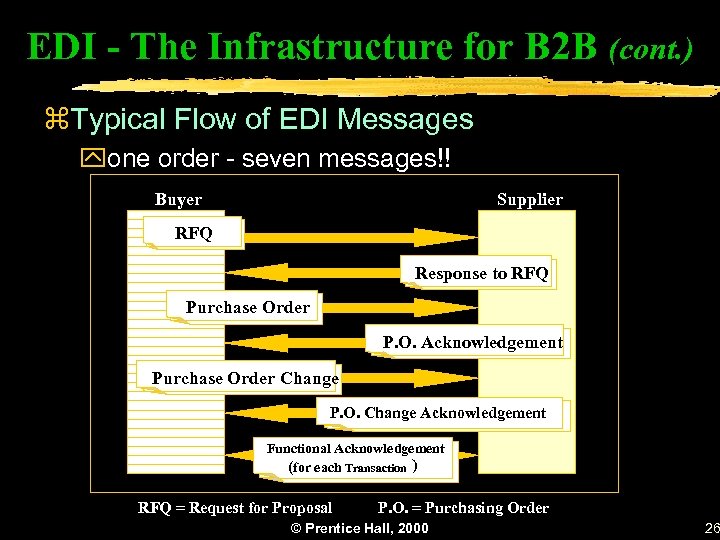
EDI - The Infrastructure for B 2 B (cont. ) z. Typical Flow of EDI Messages yone order - seven messages!! Buyer Supplier RFQ Response to RFQ Purchase Order P. O. Acknowledgement Purchase Order Change P. O. Change Acknowledgement Functional Acknowledgement (for each Transaction ) RFQ = Request for Proposal P. O. = Purchasing Order © Prentice Hall, 2000 26
From Traditional to Internet-based EDI z. Factors limiting businesses to benefit from the traditional EDI y. Significant initial investment is needed y. Restructuring business processes is necessary to fit the EDI requirements and standards y. Long start-up time is needed y. Use of Private VANs is necessary y. High EDI operating cost is needed y. There are several EDI standards y. The EDI system is complex to use © Prentice Hall, 2000 27
From Traditional to Internet-based EDI (cont. ) z. Traditional EDI does not meet following requirements: y. Enable more firms to use EDI y. Encourage full integration of EDI into trading partner business processes y. Simplify EDI implementation y. Expand the capabilities of online information exchange © Prentice Hall, 2000 28
From Traditional to Internet-based EDI (cont. ) z. Reasons for firms to create the ability to change transactions over the Internet y. The Internet is a publicly accessible network with few geographical constraints. Its largest attribute, large-scale connectivity (without the need to have special company networking architecture) is a seedbed for growth of a vast range of business applications. y. The Internet global inter-network connections offers the potential to reach the widest possible number of trading partners of any viable alternative currently available. © Prentice Hall, 2000 29
From Traditional to Internet-based EDI (cont. ) z. Reasons y. Using the Internet can cut communication cost by over 50%. y. Using the Internet to exchange EDI transactions is consistent with the growing interest of business in delivering an ever-increasing variety of products and services electronically, particularly through the Web. y. Internet-based EDI can compliment or replace current EDI systems. y. Internet tools such as browsers and search engines are very user friendly and most users today know how to use them. © Prentice Hall, 2000 30
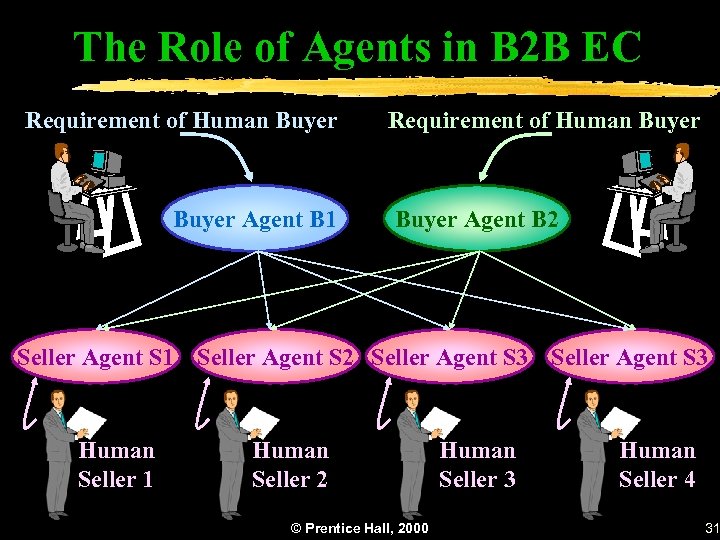
The Role of Agents in B 2 B EC Requirement of Human Buyer Agent B 1 Requirement of Human Buyer Agent B 2 Seller Agent S 1 Seller Agent S 2 Seller Agent S 3 Human Seller 1 Human Seller 2 © Prentice Hall, 2000 Human Seller 3 Human Seller 4 31
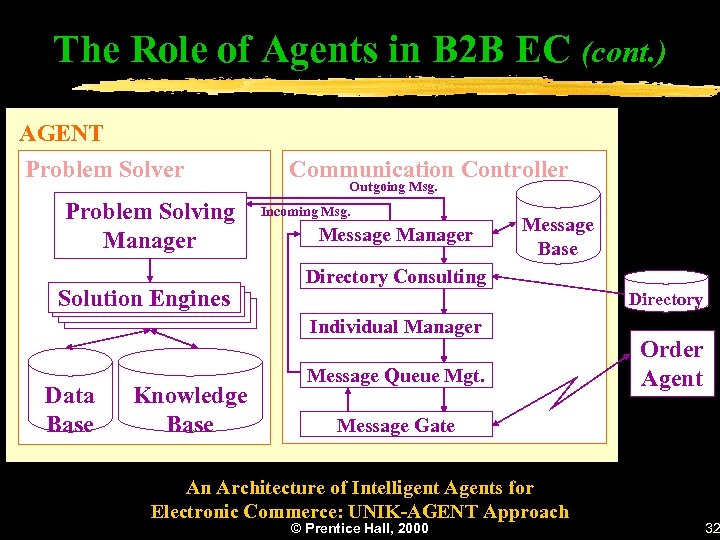
The Role of Agents in B 2 B EC (cont. ) AGENT Problem Solver Problem Solving Manager Solution Engines Communication Controller Outgoing Msg. Incoming Msg. Message Manager Message Base Directory Consulting Directory Individual Manager Data Base Knowledge Base Message Queue Mgt. Order Agent Message Gate An Architecture of Intelligent Agents for Electronic Commerce: UNIK-AGENT Approach © Prentice Hall, 2000 32
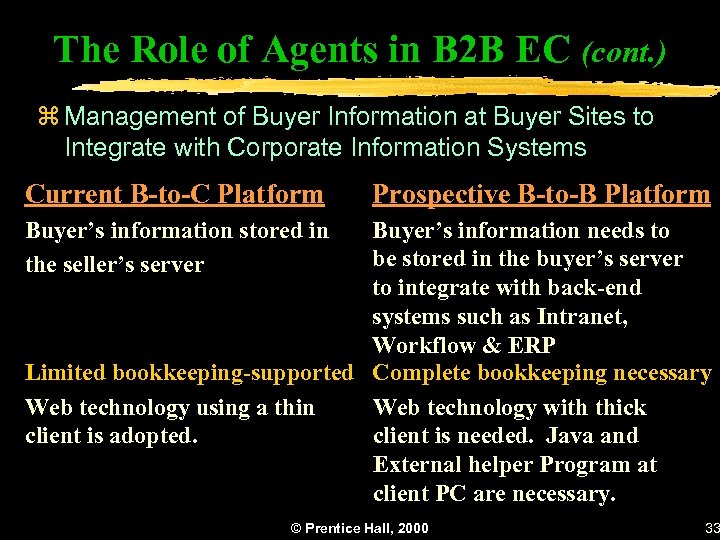
The Role of Agents in B 2 B EC (cont. ) z Management of Buyer Information at Buyer Sites to Integrate with Corporate Information Systems Current B-to-C Platform Prospective B-to-B Platform Buyer’s information stored in the seller’s server Buyer’s information needs to be stored in the buyer’s server to integrate with back-end systems such as Intranet, Workflow & ERP Limited bookkeeping-supported Complete bookkeeping necessary Web technology using a thin Web technology with thick client is adopted. client is needed. Java and External helper Program at client PC are necessary. © Prentice Hall, 2000 33
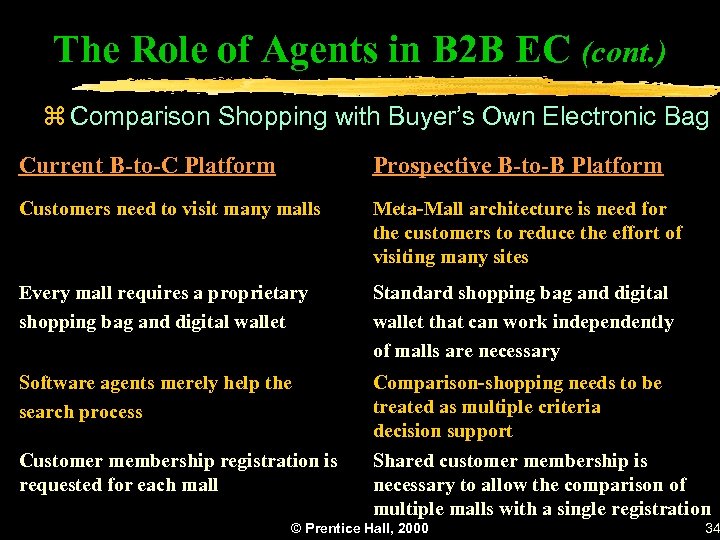
The Role of Agents in B 2 B EC (cont. ) z Comparison Shopping with Buyer’s Own Electronic Bag Current B-to-C Platform Prospective B-to-B Platform Customers need to visit many malls Meta-Mall architecture is need for the customers to reduce the effort of visiting many sites Every mall requires a proprietary shopping bag and digital wallet Standard shopping bag and digital wallet that can work independently of malls are necessary Software agents merely help the search process Comparison-shopping needs to be treated as multiple criteria decision support Customer membership registration is requested for each mall Shared customer membership is necessary to allow the comparison of multiple malls with a single registration © Prentice Hall, 2000 34
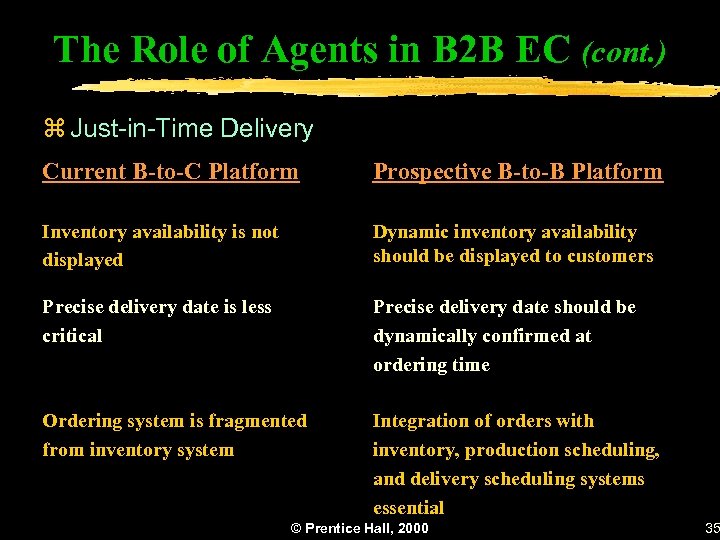
The Role of Agents in B 2 B EC (cont. ) z Just-in-Time Delivery Current B-to-C Platform Prospective B-to-B Platform Inventory availability is not displayed Dynamic inventory availability should be displayed to customers Precise delivery date is less critical Precise delivery date should be dynamically confirmed at ordering time Ordering system is fragmented from inventory system Integration of orders with inventory, production scheduling, and delivery scheduling systems essential © Prentice Hall, 2000 35
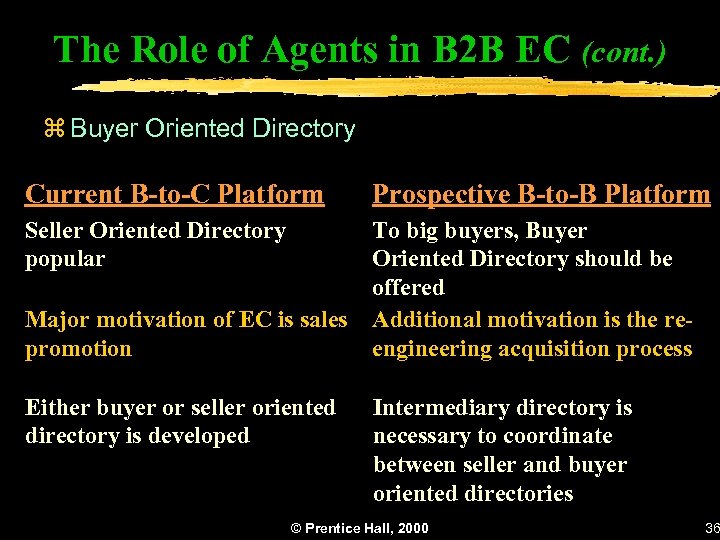
The Role of Agents in B 2 B EC (cont. ) z Buyer Oriented Directory Current B-to-C Platform Prospective B-to-B Platform Seller Oriented Directory popular To big buyers, Buyer Oriented Directory should be offered Additional motivation is the reengineering acquisition process Major motivation of EC is sales promotion Either buyer or seller oriented directory is developed Intermediary directory is necessary to coordinate between seller and buyer oriented directories © Prentice Hall, 2000 36
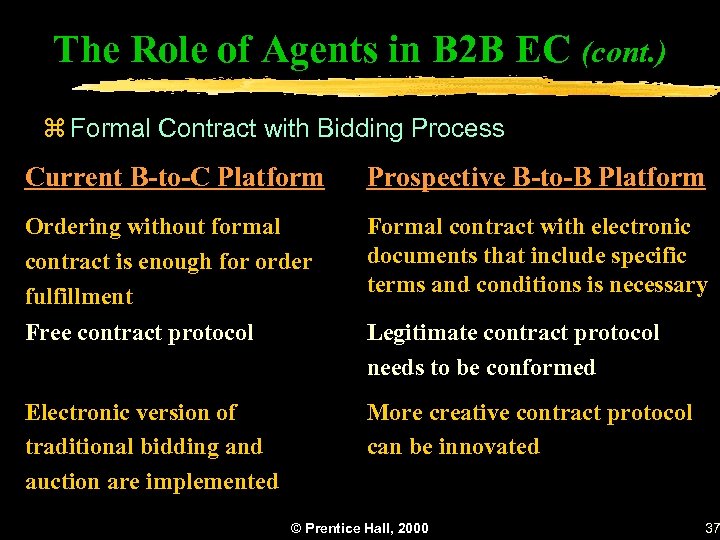
The Role of Agents in B 2 B EC (cont. ) z Formal Contract with Bidding Process Current B-to-C Platform Prospective B-to-B Platform Ordering without formal contract is enough for order fulfillment Formal contract with electronic documents that include specific terms and conditions is necessary Free contract protocol Legitimate contract protocol needs to be conformed Electronic version of traditional bidding and auction are implemented More creative contract protocol can be innovated © Prentice Hall, 2000 37
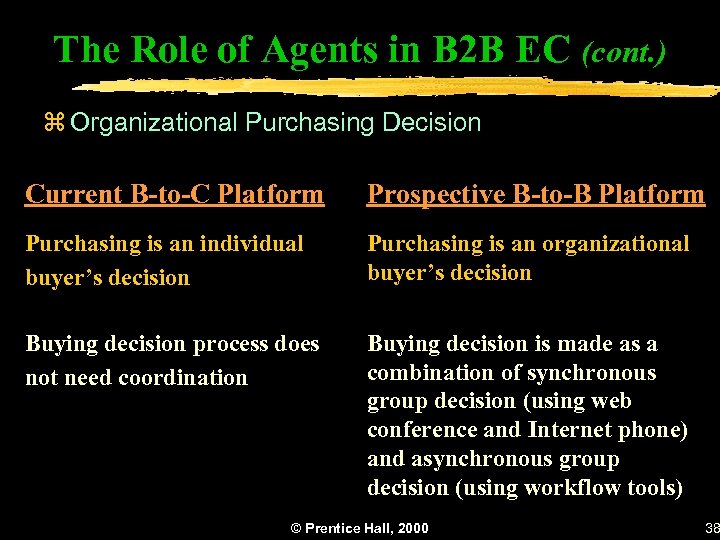
The Role of Agents in B 2 B EC (cont. ) z Organizational Purchasing Decision Current B-to-C Platform Prospective B-to-B Platform Purchasing is an individual buyer’s decision Purchasing is an organizational buyer’s decision Buying decision process does not need coordination Buying decision is made as a combination of synchronous group decision (using web conference and Internet phone) and asynchronous group decision (using workflow tools) © Prentice Hall, 2000 38
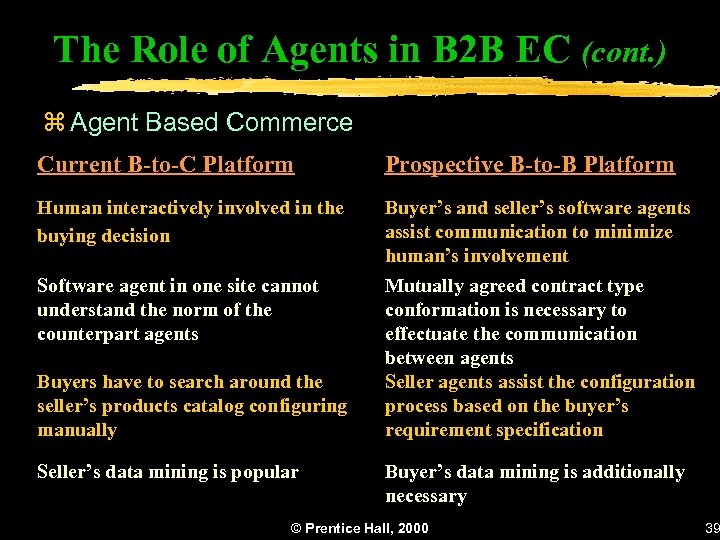
The Role of Agents in B 2 B EC (cont. ) z Agent Based Commerce Current B-to-C Platform Prospective B-to-B Platform Human interactively involved in the buying decision Buyer’s and seller’s software agents assist communication to minimize human’s involvement Software agent in one site cannot understand the norm of the counterpart agents Mutually agreed contract type conformation is necessary to effectuate the communication between agents Seller agents assist the configuration process based on the buyer’s requirement specification Buyers have to search around the seller’s products catalog configuring manually Seller’s data mining is popular Buyer’s data mining is additionally necessary © Prentice Hall, 2000 39
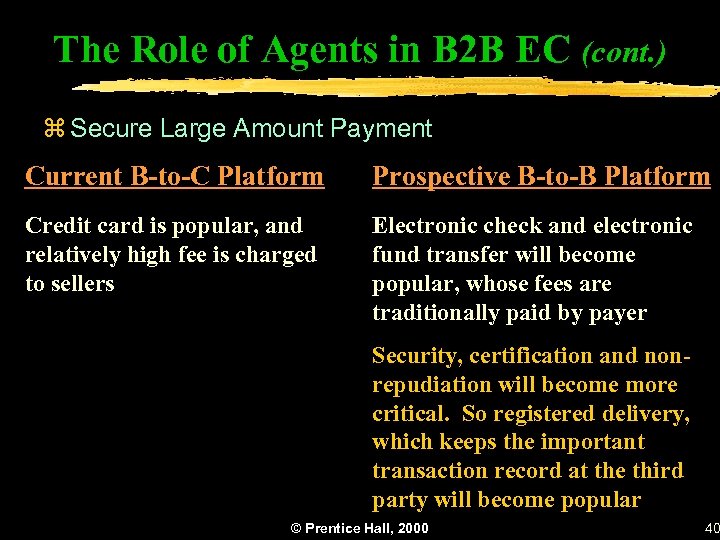
The Role of Agents in B 2 B EC (cont. ) z Secure Large Amount Payment Current B-to-C Platform Prospective B-to-B Platform Credit card is popular, and relatively high fee is charged to sellers Electronic check and electronic fund transfer will become popular, whose fees are traditionally paid by payer Security, certification and nonrepudiation will become more critical. So registered delivery, which keeps the important transaction record at the third party will become popular © Prentice Hall, 2000 40
Issues in B 2 B Advertisement and Marketing z. Finding and retaining business customers z. Making them buy z. Reaching organizational buyers (functional, corporate) z. Building relationship marketing in B 2 B z. Advertisement, mailing lists, strategies z. Mailing lists: house, response, compiled z. The role of the CD-ROM z. Marketing databases and e-mail lists © Prentice Hall, 2000 41
Internet Marketing Strategies z. Generating and qualifying leads with the Internet z. Using Internet events to promote products and services z. Executing instant fulfillment on the Internet z. Generating orders through the Internet z. Enhancing customer relationships with the Internet © Prentice Hall, 2000 42
Managerial Issues z If sales promotion is a major concern, adopt the Supplier-Oriented Marketing approach possibly joining popular Intermediary-Oriented Market Places as well z If purchase process re-engineering is a major concern, consider establishing Customer-Oriented Market Place (if sales volume is big enough) to attract the attention of major vendors z Otherwise, join a third party Intermediary-Oriented Market Place to implement the plan from either or both aspects, because every company needs effective and efficient sales and purchases © Prentice Hall, 2000 43
Скачать презентацию Chapter 6 Business-to-Business Electronic Commerce Prentice Hall
107558a24d2fd3930ba93a53aa2e1d1b.ppt