 Скачать презентацию Chapter 6 Broadband Solutions Connecting Networks Presentation_ID
CN_instructorPPT_Chapter6_final.pptx
- Количество слайдов: 30



Chapter 6: Broadband Solutions Connecting Networks Presentation_ID © 2008 Cisco Systems, Inc. All rights reserved. Cisco Confidential 1
Chapter 6 6. 0 Introduction 6. 1 Teleworking 6. 2 Comparing Broadband Solutions 6. 3 Configuring x. DSL 6. 4 Summary Presentation_ID © 2008 Cisco Systems, Inc. All rights reserved. Cisco Confidential 2
Chapter 6: Objectives § Determine how to select broadband solutions to support remote connectivity in a small-to-medium-sized business network. § Explain the benefits of teleworking solutions. § Describe the business requirements of teleworking. § Describe a cable system and cable broadband access. § Describe a DSL system and DSL broadband access. § Describe broadband wireless options. § Compare broadband solutions. § Configure and verify a basic Point-to-Point Protocol (PPP) over Ethernet connection on a client router. Presentation_ID © 2008 Cisco Systems, Inc. All rights reserved. Cisco Confidential 3
6. 1 Teleworking Presentation_ID © 2008 Cisco Systems, Inc. All rights reserved. Cisco Confidential 4
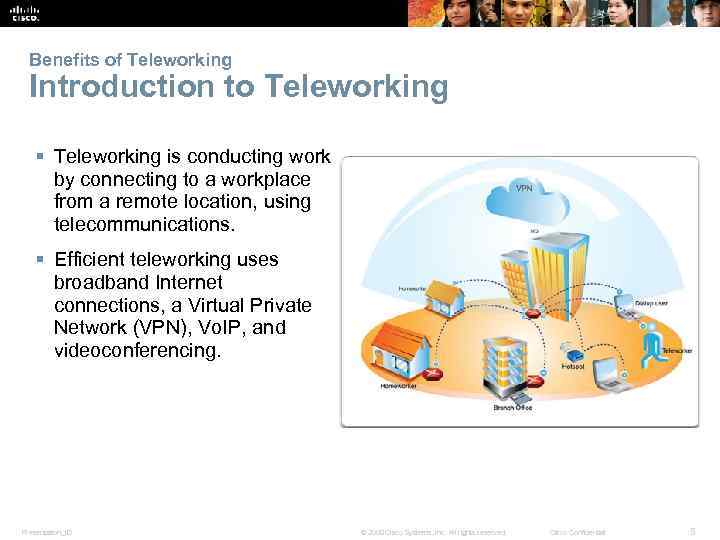
Benefits of Teleworking Introduction to Teleworking § Teleworking is conducting work by connecting to a workplace from a remote location, using telecommunications. § Efficient teleworking uses broadband Internet connections, a Virtual Private Network (VPN), Vo. IP, and videoconferencing. Presentation_ID © 2008 Cisco Systems, Inc. All rights reserved. Cisco Confidential 5
Benefits of Teleworking Employer Benefits of Teleworking § Improved employee productivity – Teleworking staff is between 8 and 40% more productive than office working staff. § Reduced costs and expenses – Savings in real estate cost equaling anywhere from 10 to 80%. § Easier recruitment and retention – Being able to offer flexibility can reduce staff turnover by up to 20%. § Reduced absenteeism § Improved morale § Improved corporate citizenship § Improved customer service Presentation_ID © 2008 Cisco Systems, Inc. All rights reserved. Cisco Confidential 6
Benefits of Teleworking Government Benefits of Teleworking § Helps build a sustainable economy § Helps reduce contemporary problems, such as traffic § Increases productivity § Alleviates symptoms of the digital divide § Reduces costs and expenses § Improves flexibility § Attracts growth and development Presentation_ID © 2008 Cisco Systems, Inc. All rights reserved. Cisco Confidential 7
Benefits of Teleworking Individual Benefits of Teleworking § Productivity – Over 70% of teleworkers claim they are significantly more productive. § Time savings – Less time commuting. § Cost savings – Saving money on lunch, clothing, commuting. § Better health – Less exposure to ‘sick' buildings, traffic accidents, stress. § Home and family – Able to spend more time with the family. § Taking control – The teleworker can take control over when and where work is performed, and also over the myriad of other details of modern life. § Flexibility – Telework can make it easier to have a more flexible schedule. Presentation_ID © 2008 Cisco Systems, Inc. All rights reserved. Cisco Confidential 8
Benefits of Teleworking Community Benefits of Teleworking § Helps build a sustainable economy – Telework is a critical component to building a truly sustainable local economy. § Increases value of real estate – Less traffic, less smog, and lower demands for urban office space means existing green spaces and heritage buildings can be preserved. § Helps reduce contemporary problems, such as traffic, infrastructure needs, urban drift. § Increases productivity. § Alleviates symptoms of the digital divide. § Reduces costs and expenses. § Attracts growth and development. Presentation_ID © 2008 Cisco Systems, Inc. All rights reserved. Cisco Confidential 9
Benefits of Teleworking Detriments to Telework For the organization: § More difficult to track employee progress § Necessary to implement a new management style For the individual: § Feeling of isolation § Slower connections § Distractions Presentation_ID © 2008 Cisco Systems, Inc. All rights reserved. Cisco Confidential 10
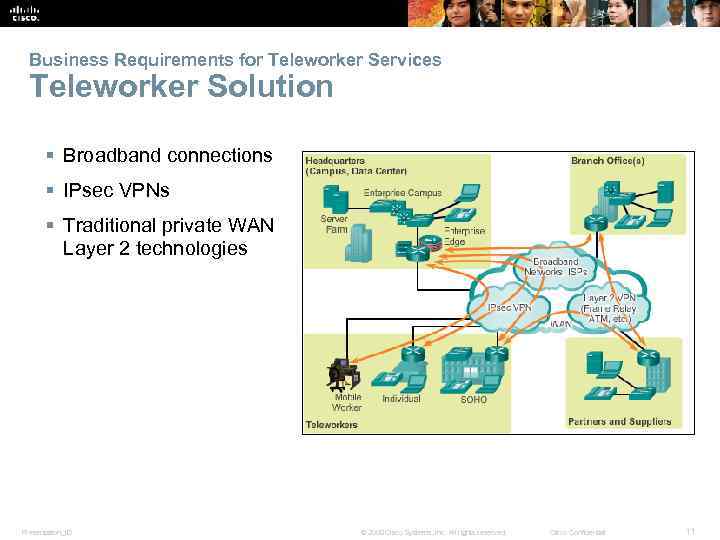
Business Requirements for Teleworker Services Teleworker Solution § Broadband connections § IPsec VPNs § Traditional private WAN Layer 2 technologies Presentation_ID © 2008 Cisco Systems, Inc. All rights reserved. Cisco Confidential 11
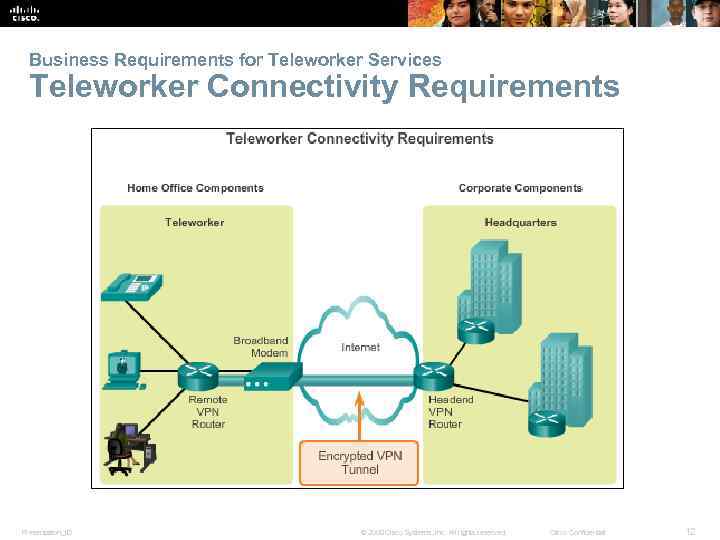
Business Requirements for Teleworker Services Teleworker Connectivity Requirements Presentation_ID © 2008 Cisco Systems, Inc. All rights reserved. Cisco Confidential 12
6. 2 Comparing Broadband Solutions Presentation_ID © 2008 Cisco Systems, Inc. All rights reserved. Cisco Confidential 13
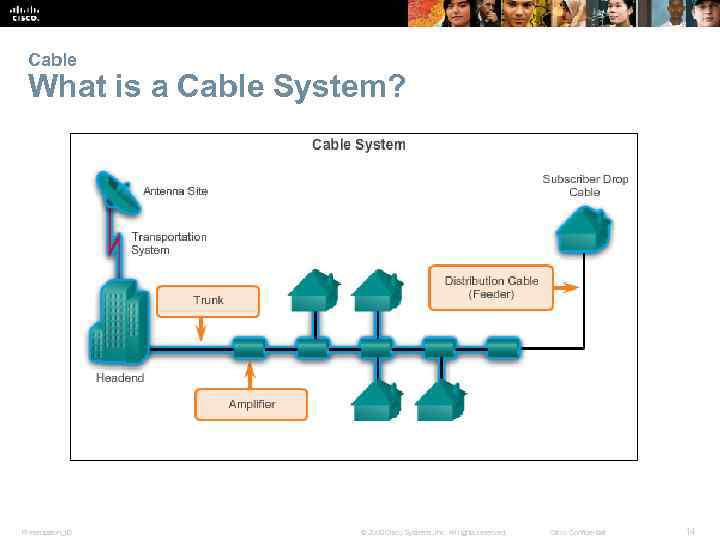
Cable What is a Cable System? Presentation_ID © 2008 Cisco Systems, Inc. All rights reserved. Cisco Confidential 14
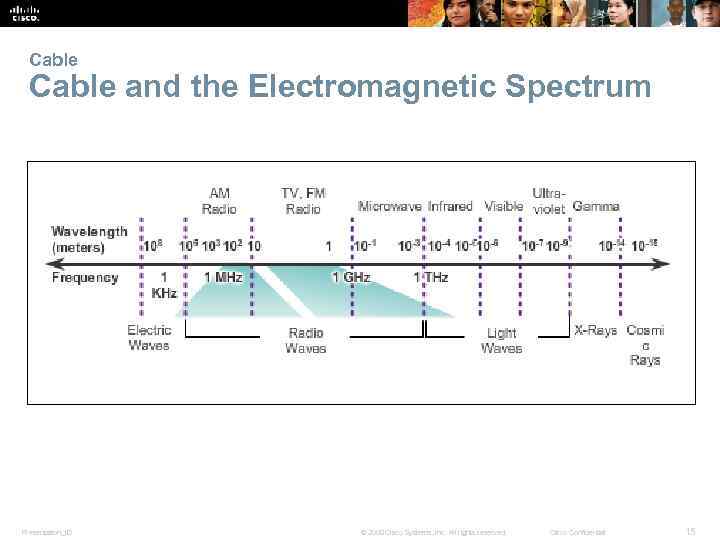
Cable and the Electromagnetic Spectrum Presentation_ID © 2008 Cisco Systems, Inc. All rights reserved. Cisco Confidential 15
Cable DOCSIS § Data-over-Cable Service Interface Specification (DOCSIS) is an international standard developed by Cable. Labs. § Tests and certifies cable equipment vendor devices. § Defines the communications and operation support interface requirements for a data-over-cable system. § Specifies the OSI Layer 1 and Layer 2 requirements. Presentation_ID © 2008 Cisco Systems, Inc. All rights reserved. Cisco Confidential 16
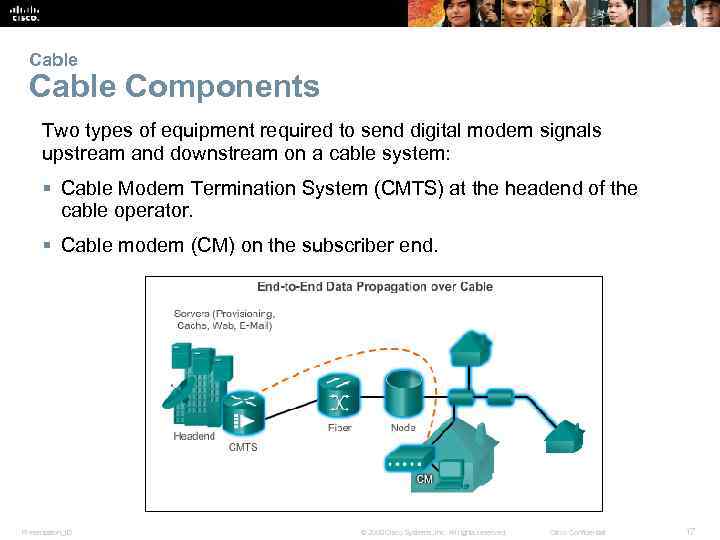
Cable Components Two types of equipment required to send digital modem signals upstream and downstream on a cable system: § Cable Modem Termination System (CMTS) at the headend of the cable operator. § Cable modem (CM) on the subscriber end. Presentation_ID © 2008 Cisco Systems, Inc. All rights reserved. Cisco Confidential 17
DSL § DSL provides high-speed connections over installed copper wire system. § Two basic types of DSL technologies are asymmetric (ADSL) and symmetric (SDSL). § ADSL uses a frequency range from approximately 20 k. Hz to 1 MHz. § ADSL provides higher downstream bandwidth to the user than upload bandwidth. § SDSL provides the same capacity in both directions. § Local loop must be less than approximately 3. 39 mi. (5. 46 km) for ADSL. Presentation_ID © 2008 Cisco Systems, Inc. All rights reserved. Cisco Confidential 18
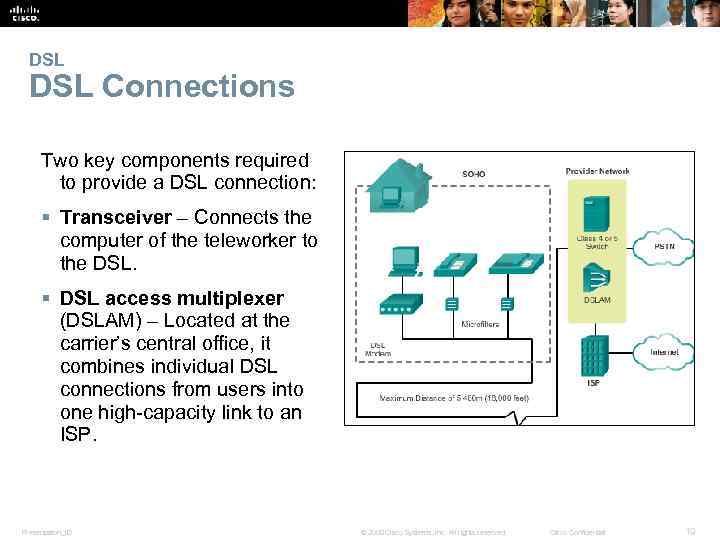
DSL Connections Two key components required to provide a DSL connection: § Transceiver – Connects the computer of the teleworker to the DSL. § DSL access multiplexer (DSLAM) – Located at the carrier’s central office, it combines individual DSL connections from users into one high-capacity link to an ISP. Presentation_ID © 2008 Cisco Systems, Inc. All rights reserved. Cisco Confidential 19
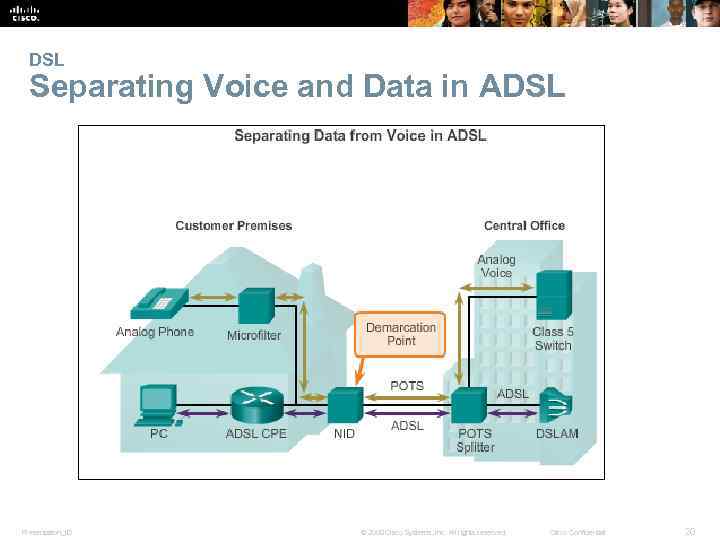
DSL Separating Voice and Data in ADSL Presentation_ID © 2008 Cisco Systems, Inc. All rights reserved. Cisco Confidential 20
Broadband Wireless Technology Types § Municipal Wi-Fi (Mesh) § Worldwide Interoperability for Microwave Access (Wi. MAX) • A single Wi. MAX tower can provide coverage to an area as large as 3, 000 square miles. • A Wi. MAX receiver similar in size and shape to a PCMCIA card, or built into a laptop or other wireless device. Presentation_ID © 2008 Cisco Systems, Inc. All rights reserved. Cisco Confidential 21
Broadband Wireless Technology Types § Cellular/mobile implementations wireless Internet: • 3 G/4 G Wireless: Third generation and fourth generation wireless. • Long-Term Evolution (LTE): A newer and faster technology considered to be part of the 4 G technology. § Satellite Implementations • one-way multicast • one-way terrestrial return • two-way satellite Internet Presentation_ID © 2008 Cisco Systems, Inc. All rights reserved. Cisco Confidential 22
Selecting Broadband Solutions Comparing Broadband Solutions § Cable – Bandwidth is shared by many users. § DSL – Limited bandwidth that is distance-sensitive. § Fiber-to-the-Home – Requires fiber-access network overlay. § Cellular/Mobile – Coverage is often an issue, bandwidth relatively limited. § Wi-Fi Mesh – Many municipalities do not have a mesh network deployed. § Wi. MAX – Bit rate is limited to 2 Mb/s per subscriber; cell size is 1. 25 miles (1 to 2 km. ) § Satellite – Expensive; limited capacity per subscriber. Presentation_ID © 2008 Cisco Systems, Inc. All rights reserved. Cisco Confidential 23
6. 3 Configuring x. DSL Presentation_ID © 2008 Cisco Systems, Inc. All rights reserved. Cisco Confidential 24
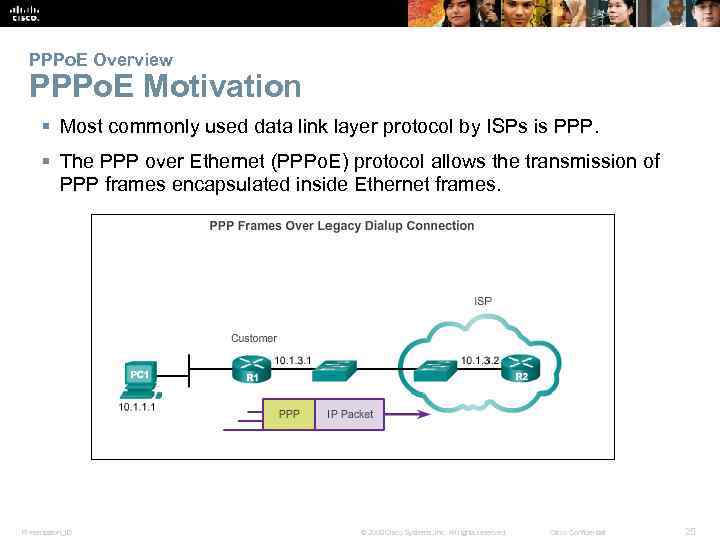
PPPo. E Overview PPPo. E Motivation § Most commonly used data link layer protocol by ISPs is PPP. § The PPP over Ethernet (PPPo. E) protocol allows the transmission of PPP frames encapsulated inside Ethernet frames. Presentation_ID © 2008 Cisco Systems, Inc. All rights reserved. Cisco Confidential 25
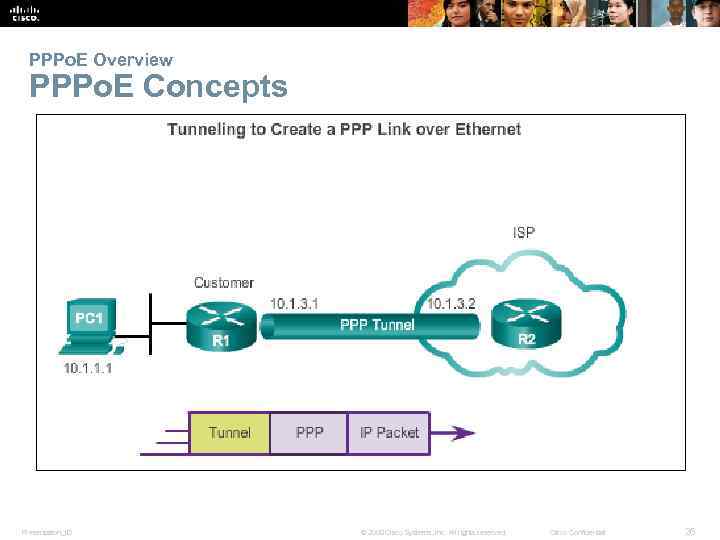
PPPo. E Overview PPPo. E Concepts. Presentation_ID © 2008 Cisco Systems, Inc. All rights reserved. Cisco Confidential 26
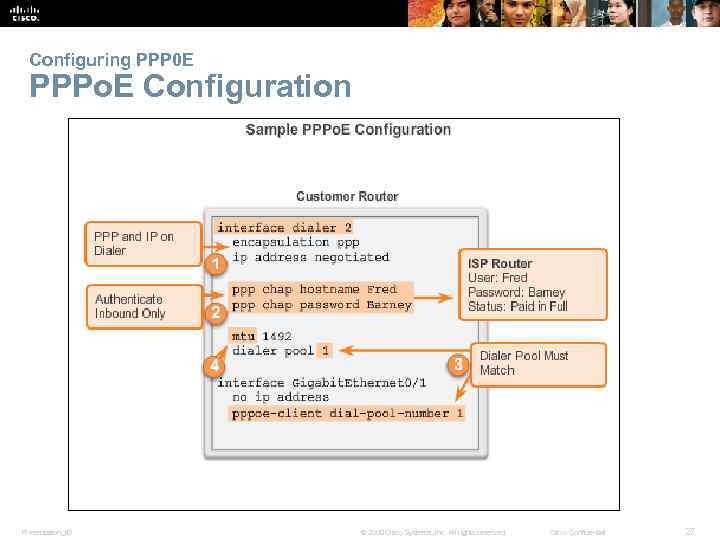
Configuring PPP 0 E PPPo. E Configuration Presentation_ID © 2008 Cisco Systems, Inc. All rights reserved. Cisco Confidential 27
6. 4 Summary Presentation_ID © 2008 Cisco Systems, Inc. All rights reserved. Cisco Confidential 28
Chapter 6: Summary This chapter: § Explored the various broadband solutions used by telecommuters and branch office workers. § Outlined the features and basic infrastructure behind each broadband technology, which enables a network manager to make an informed selection. § Identified DSL, cable, and broadband wireless options as the various broadband solutions. § Described basic DSL configuration. Presentation_ID © 2008 Cisco Systems, Inc. All rights reserved. Cisco Confidential 29
Presentation_ID © 2008 Cisco Systems, Inc. All rights reserved. Cisco Confidential 30
Скачать презентацию Chapter 6 Broadband Solutions Connecting Networks Presentation_ID
CN_instructorPPT_Chapter6_final.pptx